
G 2 F Mission and Outlook Natalia de
- Slides: 12
G 2 F Mission and Outlook Natalia de Leon University of Wisconsin, Madison Tucson, AZ February 6 th, 2019 www. Genomes 2 Fields. org
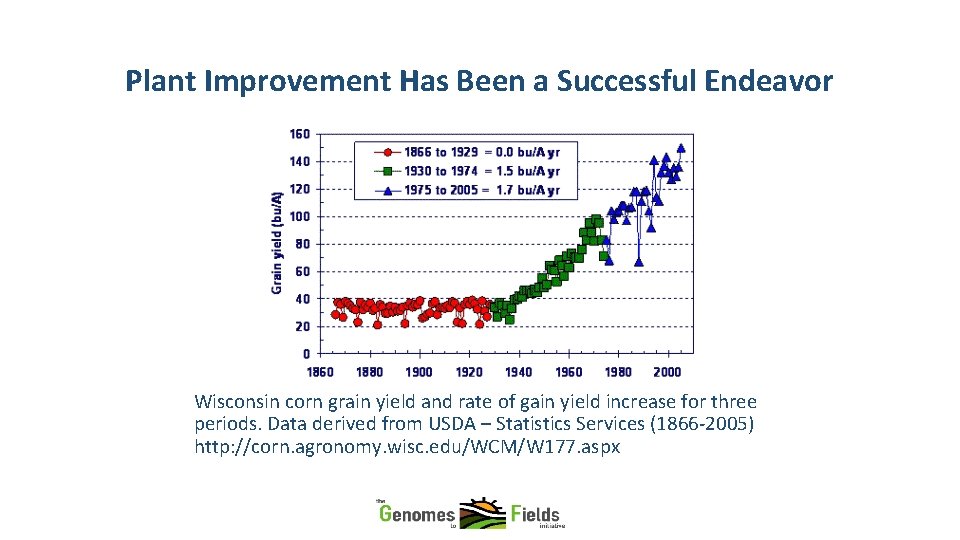
Plant Improvement Has Been a Successful Endeavor Wisconsin corn grain yield and rate of gain yield increase for three periods. Data derived from USDA – Statistics Services (1866 -2005) http: //corn. agronomy. wisc. edu/WCM/W 177. aspx
NCGA National Corn Yield Contest: http: //www. ncga. com/for-farmers/national-corn-yield-contest : ❖ 2017 (USDA) average corn yield nationally: 176. 6 bushels/acre ❖ NGCA Corn Contest had 5 entries above 400 bushels/acre in 2017 (1 in 2018) ❖ 2017 no till/strip till, irrigated winner harvest 542 bushels/acre in 2017 (Charles City, VA) ❖ Recommendations: ❖ “Be best friend with your crop”, “walk your field”, ”farmers are great observers” ❖ plant when conditions are appropriate and use appropriate seed spacing ❖ plants need to germinate between 4 to 12 hours from its neighbor plant ❖ constant plant and soil sampling to monitor status ❖ winner corn was harvested at 19% moisture with ear leaf still green ❖ What resources, tools, processes can help increase efficiency of breeding outcome for specific conditions/situations?
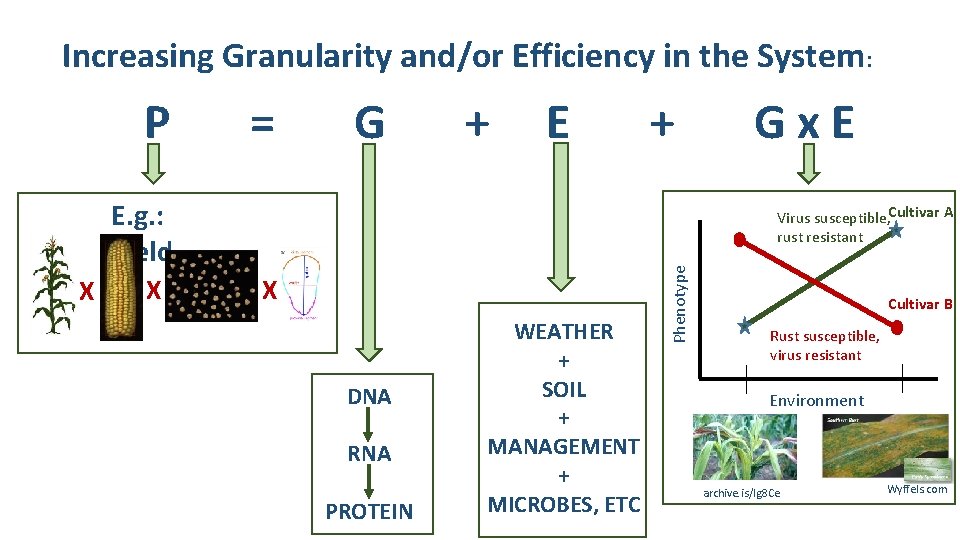
Increasing Granularity and/or Efficiency in the System: = G + E E. g. : Yield X X + Gx. E Virus susceptible, Cultivar A rust resistant X DNA RNA PROTEIN WEATHER + SOIL + MANAGEMENT + MICROBES, ETC Phenotype P Cultivar B Rust susceptible, virus resistant Environment archive. is/lg 8 Ce Wyffels. com
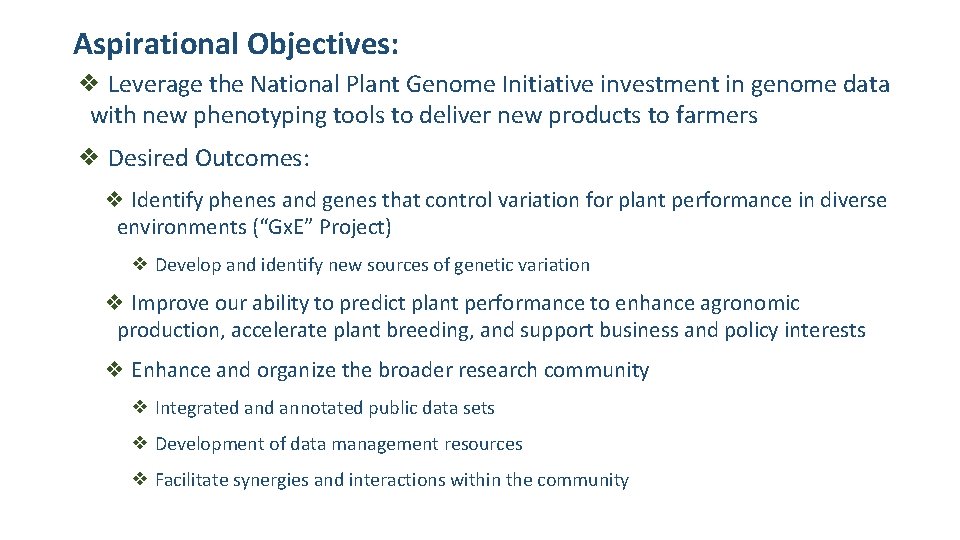
Aspirational Objectives: ❖ Leverage the National Plant Genome Initiative investment in genome data with new phenotyping tools to deliver new products to farmers ❖ Desired Outcomes: ❖ Identify phenes and genes that control variation for plant performance in diverse environments (“Gx. E” Project) ❖ Develop and identify new sources of genetic variation ❖ Improve our ability to predict plant performance to enhance agronomic production, accelerate plant breeding, and support business and policy interests ❖ Enhance and organize the broader research community ❖ Integrated annotated public data sets ❖ Development of data management resources ❖ Facilitate synergies and interactions within the community
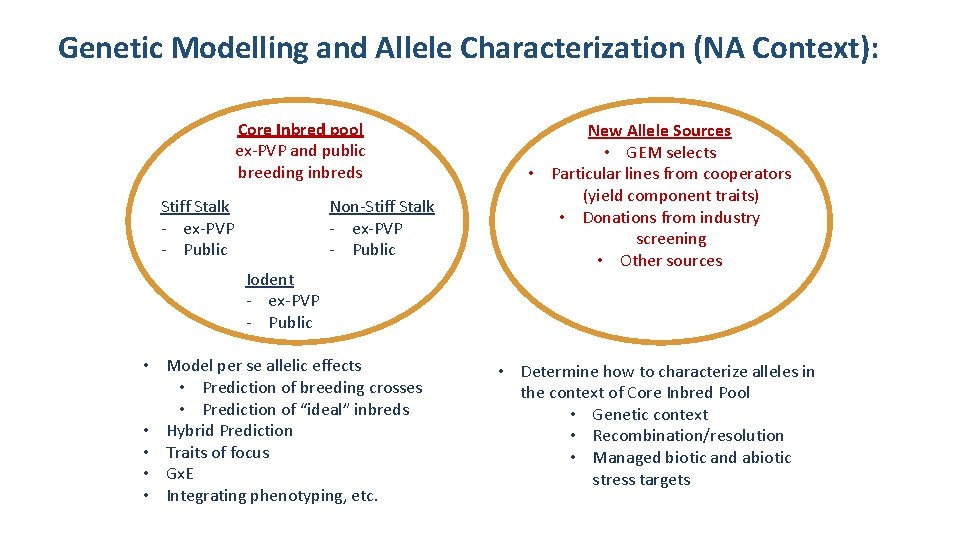
Genetic Modelling and Allele Characterization (NA Context): Core Inbred pool ex-PVP and public breeding inbreds Stiff Stalk - ex-PVP - Public Non-Stiff Stalk - ex-PVP - Public Iodent - ex-PVP - Public • Model per se allelic effects • Prediction of breeding crosses • Prediction of “ideal” inbreds • Hybrid Prediction • Traits of focus • Gx. E • Integrating phenotyping, etc. New Allele Sources • GEM selects • Particular lines from cooperators (yield component traits) • Donations from industry screening • Other sources • Determine how to characterize alleles in the context of Core Inbred Pool • Genetic context • Recombination/resolution • Managed biotic and abiotic stress targets
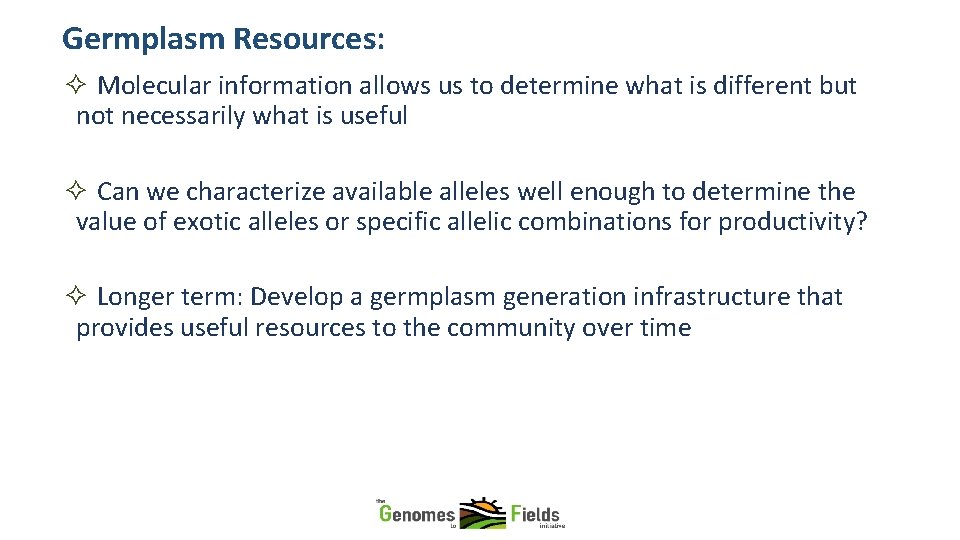
Germplasm Resources: ✧ Molecular information allows us to determine what is different but not necessarily what is useful ✧ Can we characterize available alleles well enough to determine the value of exotic alleles or specific allelic combinations for productivity? ✧ Longer term: Develop a germplasm generation infrastructure that provides useful resources to the community over time
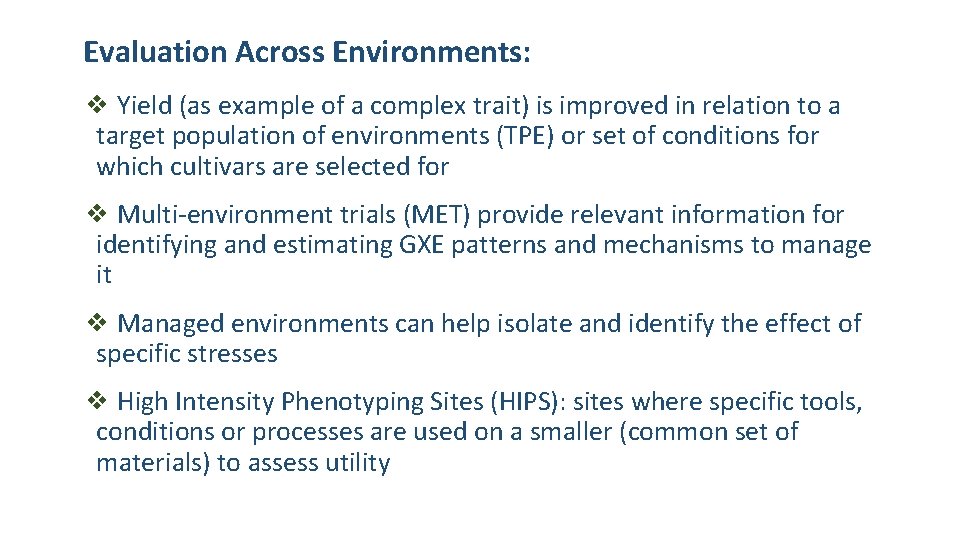
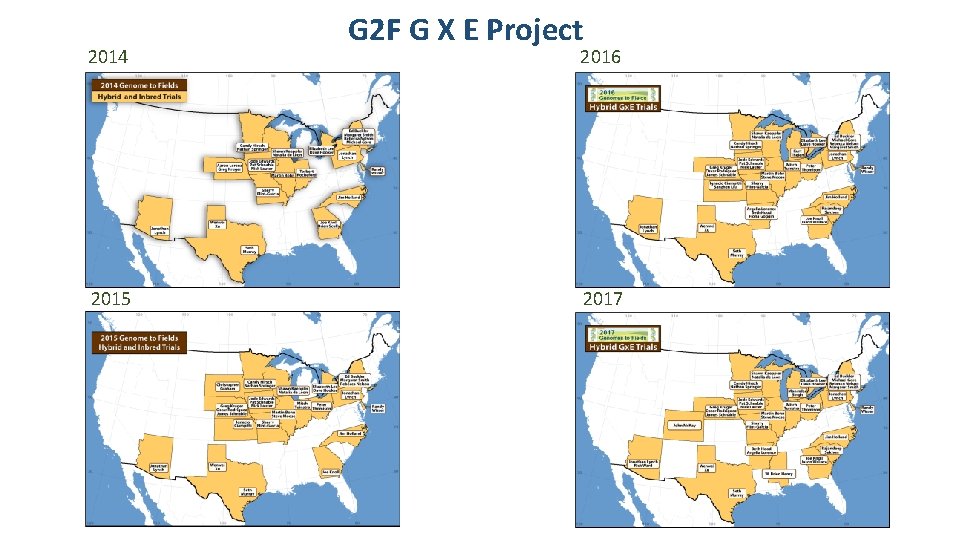
Evaluation Across Environments: ❖ Yield (as example of a complex trait) is improved in relation to a target population of environments (TPE) or set of conditions for which cultivars are selected for ❖ Multi-environment trials (MET) provide relevant information for identifying and estimating GXE patterns and mechanisms to manage it ❖ Managed environments can help isolate and identify the effect of specific stresses ❖ High Intensity Phenotyping Sites (HIPS): sites where specific tools, conditions or processes are used on a smaller (common set of materials) to assess utility
2014 2015 G 2 F G X E Project 2016 2017
Predicting Genotypes vs Predicting Environments: Unknown Genotypes in Known Environments Known Genotypes in Unknown Environments CV 0
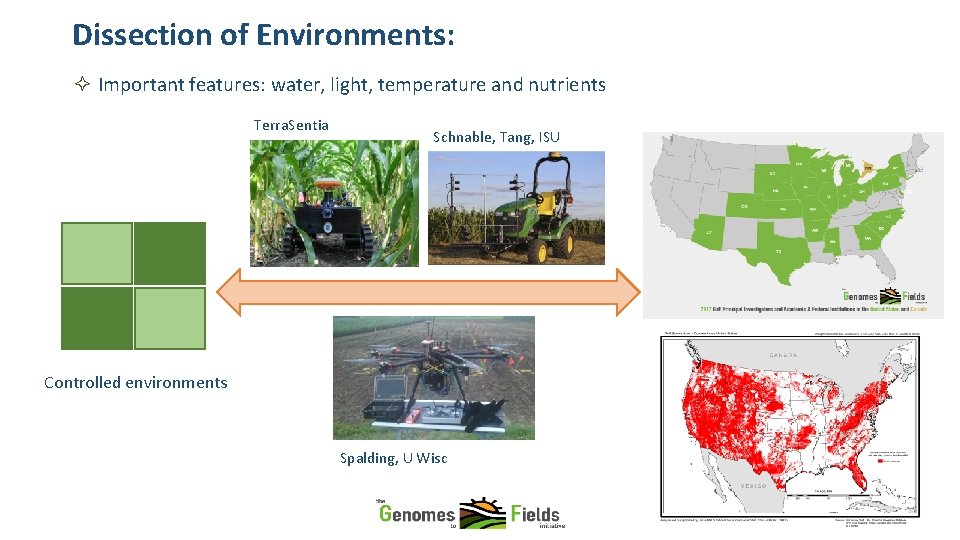
Dissection of Environments: ✧ Important features: water, light, temperature and nutrients Terra. Sentia Schnable, Tang, ISU Controlled environments Spalding, U Wisc
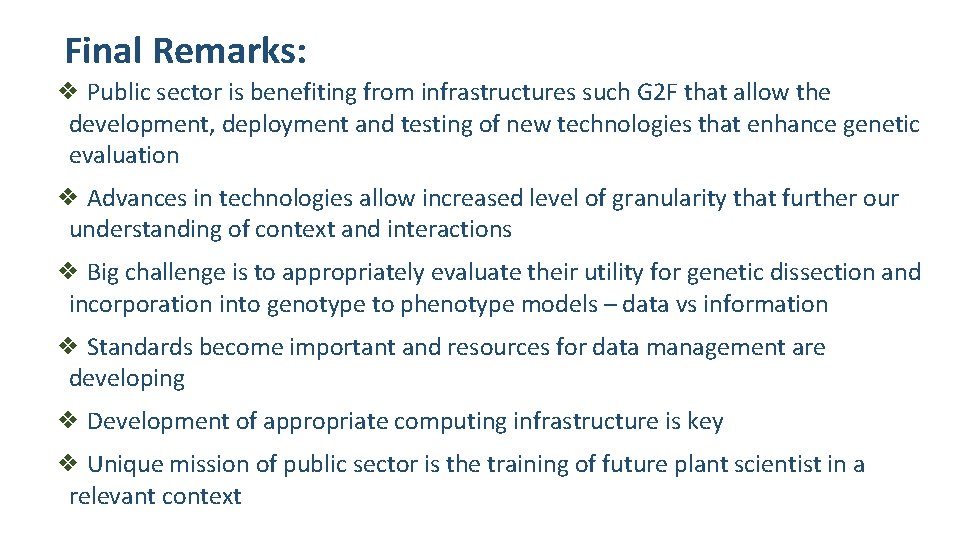
Final Remarks: ❖ Public sector is benefiting from infrastructures such G 2 F that allow the development, deployment and testing of new technologies that enhance genetic evaluation ❖ Advances in technologies allow increased level of granularity that further our understanding of context and interactions ❖ Big challenge is to appropriately evaluate their utility for genetic dissection and incorporation into genotype to phenotype models – data vs information ❖ Standards become important and resources for data management are developing ❖ Development of appropriate computing infrastructure is key ❖ Unique mission of public sector is the training of future plant scientist in a relevant context