
G 16 4427 Practical MRI 1 Radiofrequency Pulse



- Slides: 29
G 16. 4427 Practical MRI 1 Radiofrequency Pulse Shapes and Functions G 16. 4427 Practical MRI 1 – 12 th February 2015
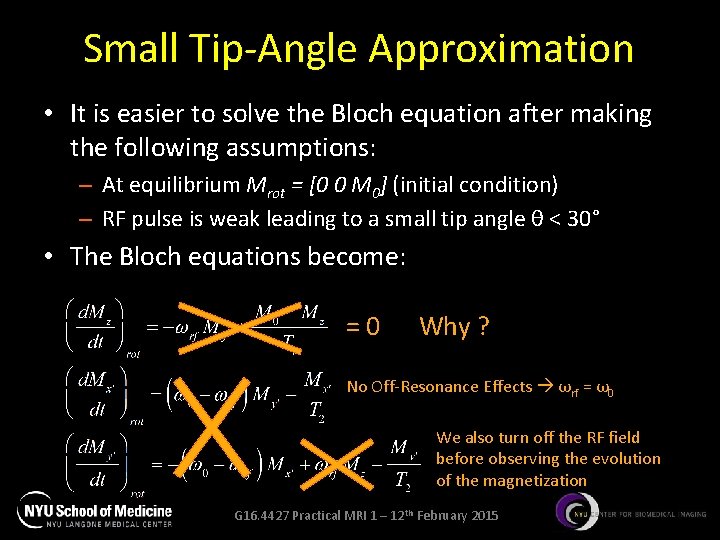
Small Tip-Angle Approximation • It is easier to solve the Bloch equation after making the following assumptions: – At equilibrium Mrot = [0 0 M 0] (initial condition) – RF pulse is weak leading to a small tip angle θ < 30° • The Bloch equations become: =0 Why ? No Off-Resonance Effects ωrf = ω0 We also turn off the RF field before observing the evolution of the magnetization G 16. 4427 Practical MRI 1 – 12 th February 2015
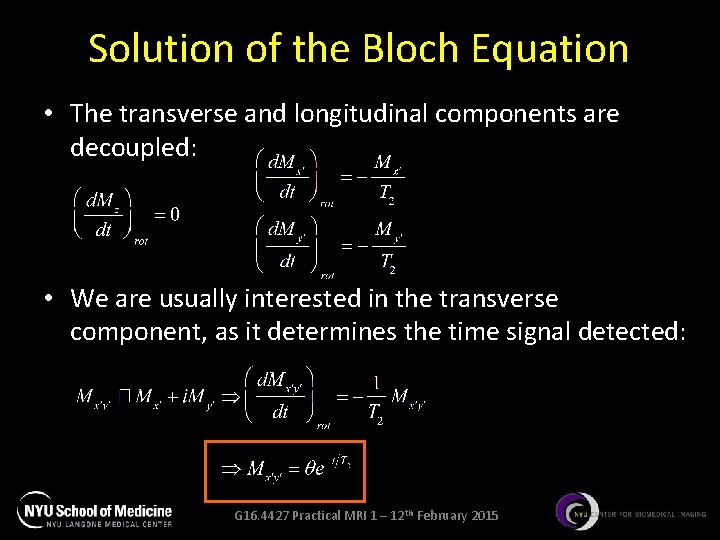
Solution of the Bloch Equation • The transverse and longitudinal components are decoupled: • We are usually interested in the transverse component, as it determines the time signal detected: G 16. 4427 Practical MRI 1 – 12 th February 2015
A k-Space Analysis of Small-Tip-Angle Excitation G 16. 4427 Practical MRI 1 – 12 th February 2015
Useful Quantities to Describe RF Pulses • Pulse width (T) – Indicates the duration of the RF pulse – Typically measured in seconds or milliseconds • RF bandwidth (∆f) – A measure of the frequency content of the pulse – FWHM of the frequency profile – Specified in hertz or kilohertz • Flip angle (θ) – Describes the nutation angle produced by the pulse – Measured in radians or degrees – Calculated by finding the area underneath the envelope of the RF pulse G 16. 4427 Practical MRI 1 – 12 th February 2015
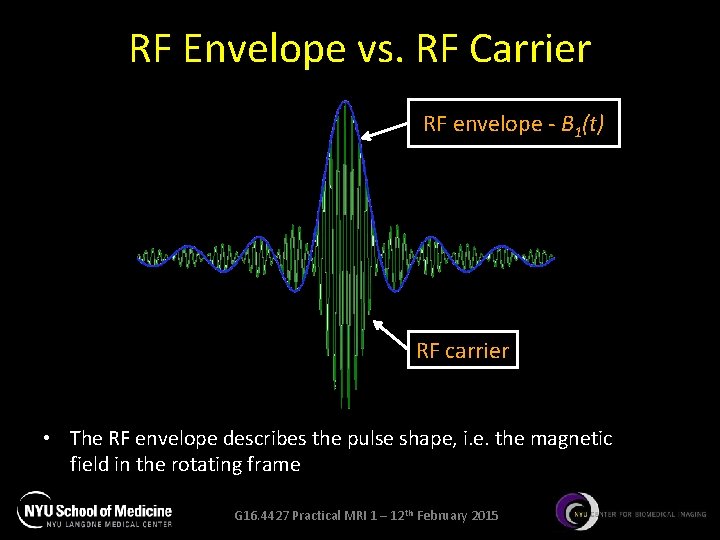
RF Envelope • Denoted with B 1(t) and measured in microteslas • Relatively slowly varying function of time, with at most a few zero-crossings per millisecond • The RF pulse played at the transmit coil is a sinusoidal carrier waveform that is modulated (i. e. multiplied) by the RF envelope • The frequency of the RF carrier is typically set equal to the Larmor frequency ± the frequency offset required for the desired slice location G 16. 4427 Practical MRI 1 – 12 th February 2015
RF Envelope vs. RF Carrier RF envelope - B 1(t) RF carrier • The RF envelope describes the pulse shape, i. e. the magnetic field in the rotating frame G 16. 4427 Practical MRI 1 – 12 th February 2015
SLR Pulses • For small flip-angles, the shape of an RF pulse can be determined by inverse Fourier transformation of the desired slice profile • The Shinnar-Le Roux (SLR) algorithm allows the inverse problem to be solved directly and efficiently without iterations – Allows the pulse designer to optimize the pulse before it’s generated – Uses the SU(2) representation for rotations and the hard pulse approximation to describe the effect of a soft pulse on the magnetization with 2 polynomials of complex coefficients – Given 2 complex polynomials corresponding to the desired magnetization, the inverse SLR transform yields the RF pulse G 16. 4427 Practical MRI 1 – 12 th February 2015
Practical Considerations For SLR Pulses • Pulses designed with SLR account for the nonlinearity of Bloch equations only at a single flip angle – If played at a different flip angle there will be deviations from the desired profile • If this is an important consideration: – A set of pulses designed for different flip angles could be stored on the MR scanner – The SLR design could be done in real time when the operator selects the flip angle G 16. 4427 Practical MRI 1 – 12 th February 2015
Variable-Rate (VR) Pulses • A one-dimensional spatially selective RF pulse that is played concurrently with a time-varying gradient is called a variable-rate (VR) pulse – Also known as VRG or VERSE pulses • The main application is to reduce SAR – Decrease RF amplitude near the peak of the pulse G 16. 4427 Practical MRI 1 – 12 th February 2015
Variable-Rate (VR) Pulses • A one-dimensional spatially selective RF pulse that is played concurrently with a time-varying gradient is called a variable-rate (VR) pulse – Also known as VRG or VERSE pulses • The main application is to reduce SAR – Decrease RF amplitude near the peak of the pulse • Another application is to play the RF excitation concurrently with the gradient ramps – Efficient use of the entire time allotted for the sliceselection gradient lobe, which improves slice profile G 16. 4427 Practical MRI 1 – 12 th February 2015
VR-Modified SINC Pulse • To maintain the nominal flip angle when RF amplitude is reduced, the VR pulse is proportionately stretched (time delayed). Why? Answer: flip angle is the area under the RF envelope G 16. 4427 Practical MRI 1 – 12 th February 2015
VR-Modified SINC Pulse • To maintain the nominal flip angle when RF amplitude is reduced, the VR pulse is proportionately stretched (time delayed). – What happens as a result? G 16. 4427 Practical MRI 1 – 12 th February 2015
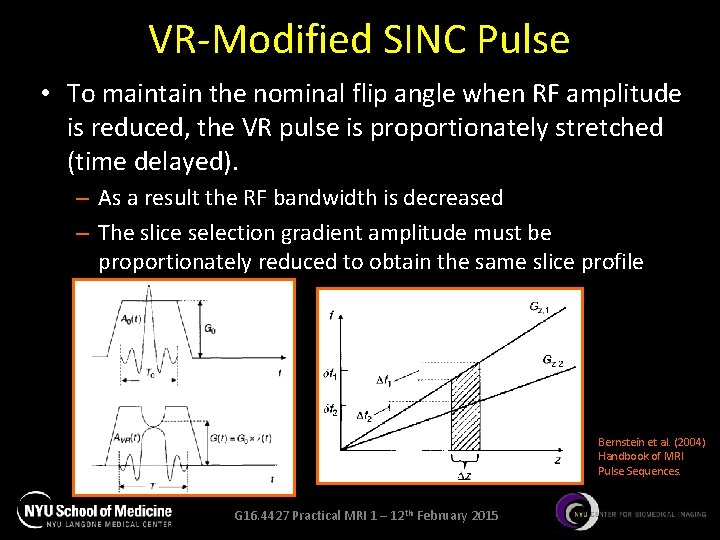
VR-Modified SINC Pulse • To maintain the nominal flip angle when RF amplitude is reduced, the VR pulse is proportionately stretched (time delayed). – As a result the RF bandwidth is decreased – The slice selection gradient amplitude must be proportionately reduced to obtain the same slice profile Bernstein et al. (2004) Handbook of MRI Pulse Sequences. G 16. 4427 Practical MRI 1 – 12 th February 2015
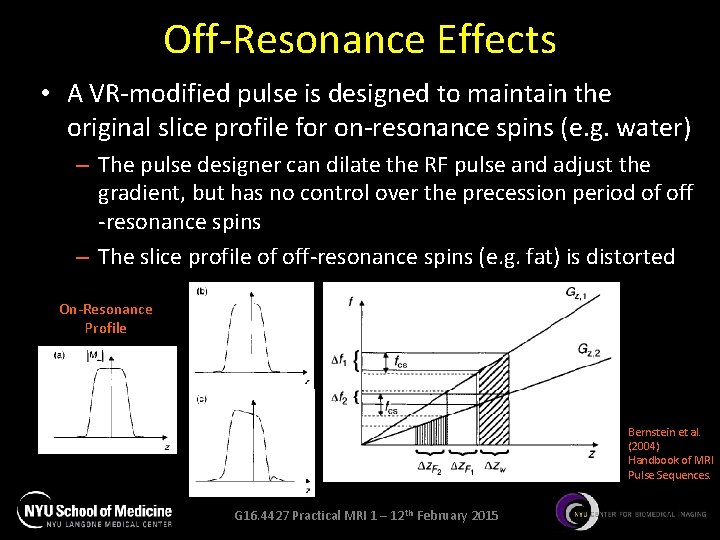
Off-Resonance Effects • A VR-modified pulse is designed to maintain the original slice profile for on-resonance spins (e. g. water) – The pulse designer can dilate the RF pulse and adjust the gradient, but has no control over the precession period of off -resonance spins – The slice profile of off-resonance spins (e. g. fat) is distorted On-Resonance Profile Off-Resonance Profile (Original Pulse) Off-Resonance Profile (VR Pulse) G 16. 4427 Practical MRI 1 – 12 th February 2015 Bernstein et al. (2004) Handbook of MRI Pulse Sequences.
Any questions? G 16. 4427 Practical MRI 1 – 12 th February 2015
Basic Radiofrequency (RF) Functions G 16. 4427 Practical MRI 1 – 12 th February 2015
Excitation Pulses • Excitation pulses tip the magnetization vector away from the direction of B 0 – They are implemented by switching on B 1(t) for a short time (200 μs to 5 ms) – T 1 and T 2 relaxation during the pulse can be neglected • They are characterized by the flip angle (θ), which is the angle between the direction of B 0 and the magnetization vector after turning off RF – For non-adiabatic excitation pulses, θ is calculated as the area under the envelope of B 1(t) – Typically θ = 90° for spin echo and θ = 5 -70° for gradient echo G 16. 4427 Practical MRI 1 – 12 th February 2015
Slice Profile And Flip Angle • The distribution of the flip angle across the selected slice is called the slice profile – What is the ideal slice profile? G 16. 4427 Practical MRI 1 – 12 th February 2015
Slice Profile And Flip Angle • The distribution of the flip angle across the selected slice is called the slice profile – The ideal slice profile consists of a uniform flip angle within the desired slice and θ = 0° outside – Why it cannot be achieved in practice? G 16. 4427 Practical MRI 1 – 12 th February 2015
Slice Profile And Flip Angle • The distribution of the flip angle across the selected slice is called the slice profile – The ideal slice profile consists of a uniform flip angle within the desired slice and θ = 0 outside – It would require a pulse of infinite duration, so several approximations are used in practice • Problem – A hard RF pulse has a rectangular-shaped envelope. Its pulse width is 100 μs and its flip angle (onresonance) is 90°. What is its amplitude? G 16. 4427 Practical MRI 1 – 12 th February 2015
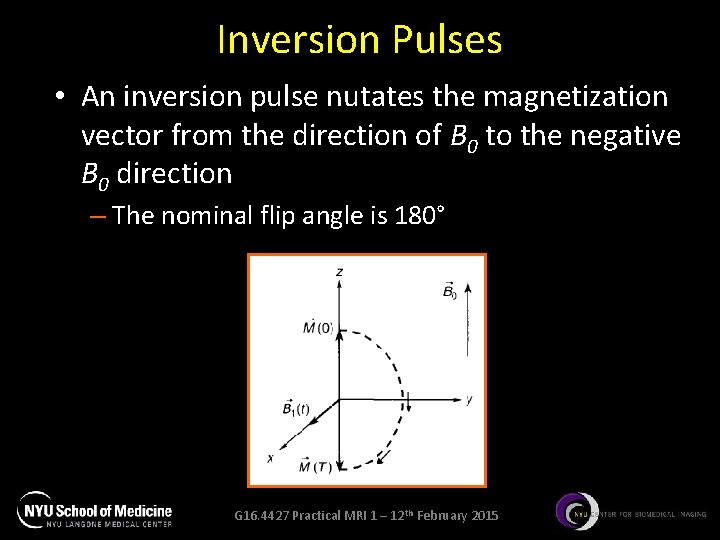
Inversion Pulses • An inversion pulse nutates the magnetization vector from the direction of B 0 to the negative B 0 direction – The nominal flip angle is 180° G 16. 4427 Practical MRI 1 – 12 th February 2015
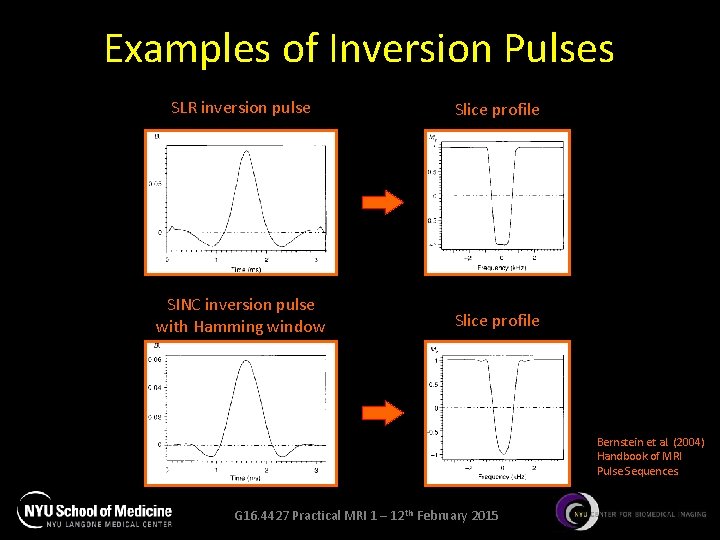
Examples of Inversion Pulses SLR inversion pulse Slice profile SINC inversion pulse with Hamming window Slice profile Bernstein et al. (2004) Handbook of MRI Pulse Sequences. G 16. 4427 Practical MRI 1 – 12 th February 2015
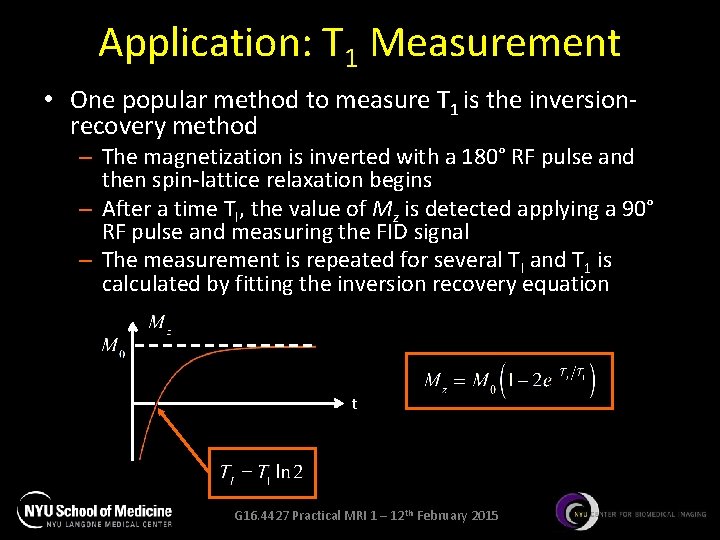
Application: T 1 Measurement • One popular method to measure T 1 is the inversionrecovery method – The magnetization is inverted with a 180° RF pulse and then spin-lattice relaxation begins – After a time TI, the value of Mz is detected applying a 90° RF pulse and measuring the FID signal – The measurement is repeated for several TI and T 1 is calculated by fitting the inversion recovery equation t G 16. 4427 Practical MRI 1 – 12 th February 2015
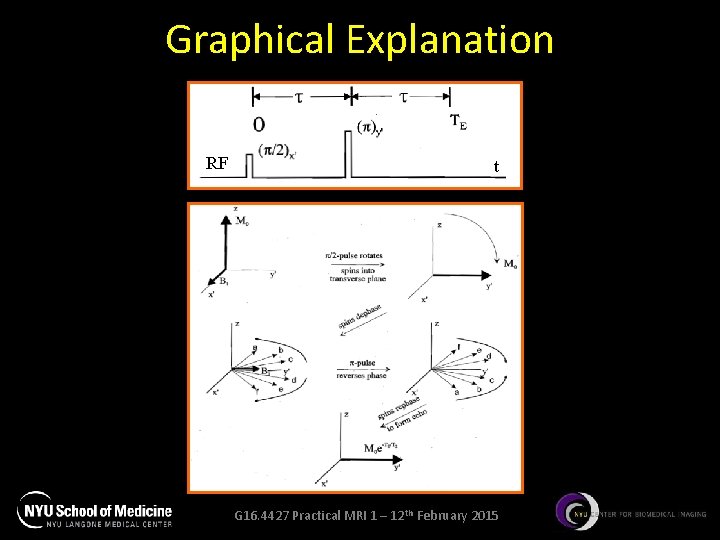
Refocusing Pulses • Due to the gradients, local magnetic field inhomogeneities, magnetic susceptibility variation, or chemical shift, the spins contributing to the transverse magnetization have a range of precessing frequencies – As a result there is a phase dispersion (fanning out) • A refocusing RF pulse (typically 180°) rotates the dispersing spins about an axis in the transverse plane so the magnetization vector will rephase (or refocus) at a later time – The refocused magnetization is known as spin echo G 16. 4427 Practical MRI 1 – 12 th February 2015
Graphical Explanation RF t G 16. 4427 Practical MRI 1 – 12 th February 2015
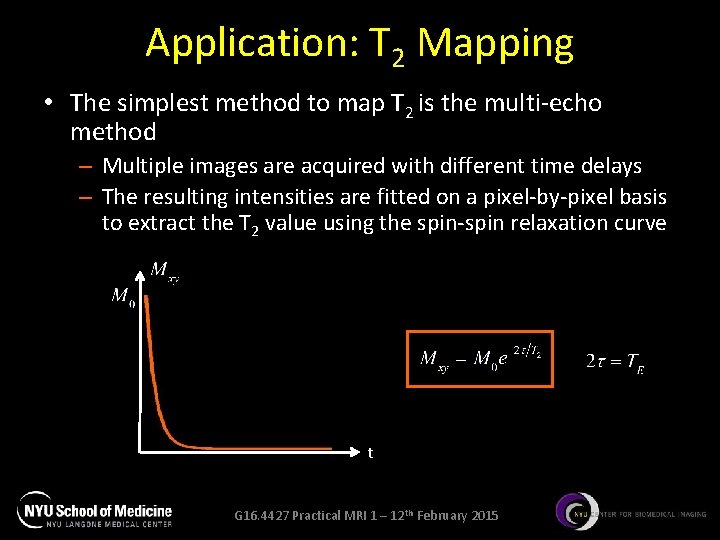
Application: T 2 Mapping • The simplest method to map T 2 is the multi-echo method – Multiple images are acquired with different time delays – The resulting intensities are fitted on a pixel-by-pixel basis to extract the T 2 value using the spin-spin relaxation curve t G 16. 4427 Practical MRI 1 – 12 th February 2015
Any questions? G 16. 4427 Practical MRI 1 – 12 th February 2015
See you next Thursday! G 16. 4427 Practical MRI 1 – 12 th February 2015