
FYEX 101 TIME MANAGEMENT STUDY SKILLS TIME MANAGEMENT
- Slides: 16
FYEX 101 TIME MANAGEMENT & STUDY SKILLS
TIME MANAGEMENT Time Is Your Most Valuable Resource Maximize Study and Review Time Organize your Environment Avoid Pitfalls Remember… You control how you use your time so find a system that works for you. This will help you stay organized and avoid falling behind throughout the semester.
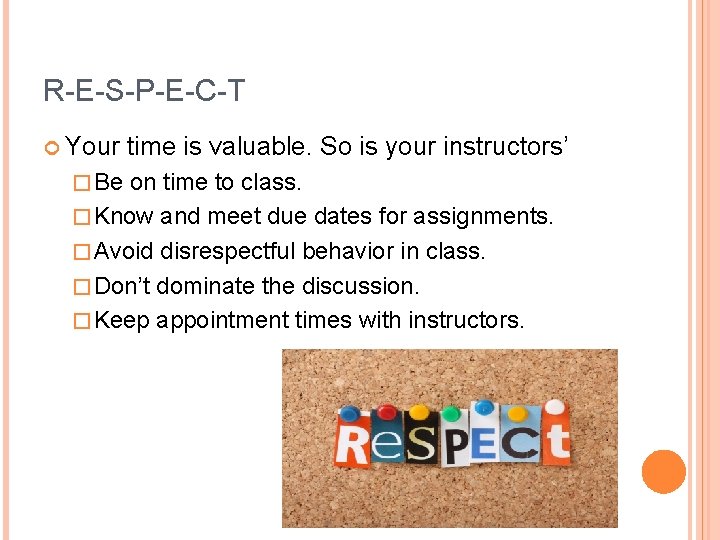
R-E-S-P-E-C-T Your time is valuable. So is your instructors’ � Be on time to class. � Know and meet due dates for assignments. � Avoid disrespectful behavior in class. � Don’t dominate the discussion. � Keep appointment times with instructors.
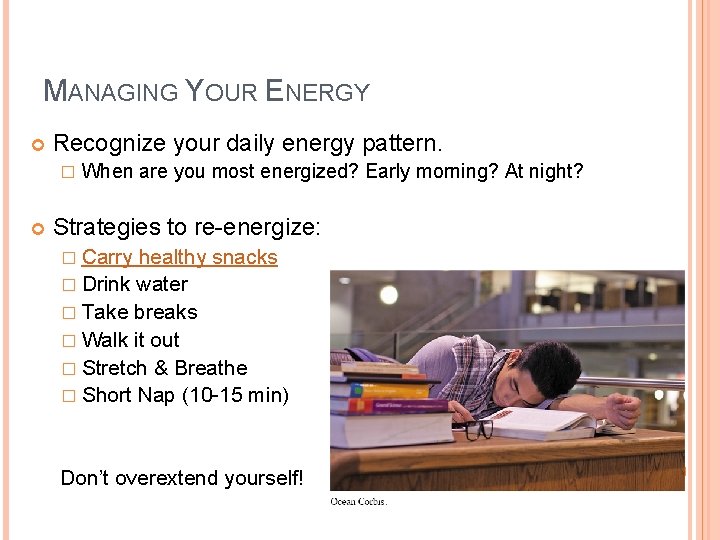
MANAGING YOUR ENERGY Recognize your daily energy pattern. � When are you most energized? Early morning? At night? Strategies to re-energize: � Carry healthy snacks � Drink water � Take breaks � Walk it out � Stretch & Breathe � Short Nap (10 -15 min) Don’t overextend yourself!
PITFALLS: PROCRASTINATION AND DISTRACTIONS Procrastination: putting off necessary tasks Reasons for procrastination: � Fear of failure or success � Perfectionism � Easily distracted � Find task irrelevant Distractions: � Find places to study where you can concentrate � Turn off your phone and other distractions � Organize your space � Don’t overcommit!
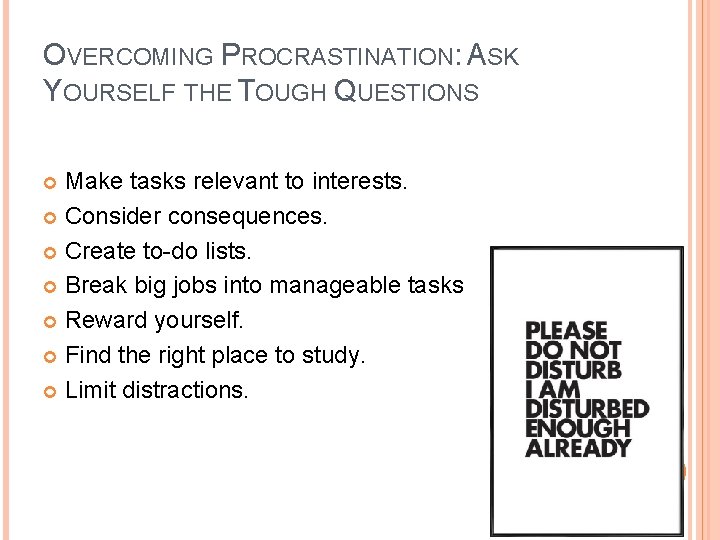
OVERCOMING PROCRASTINATION: ASK YOURSELF THE TOUGH QUESTIONS Make tasks relevant to interests. Consider consequences. Create to-do lists. Break big jobs into manageable tasks Reward yourself. Find the right place to study. Limit distractions.
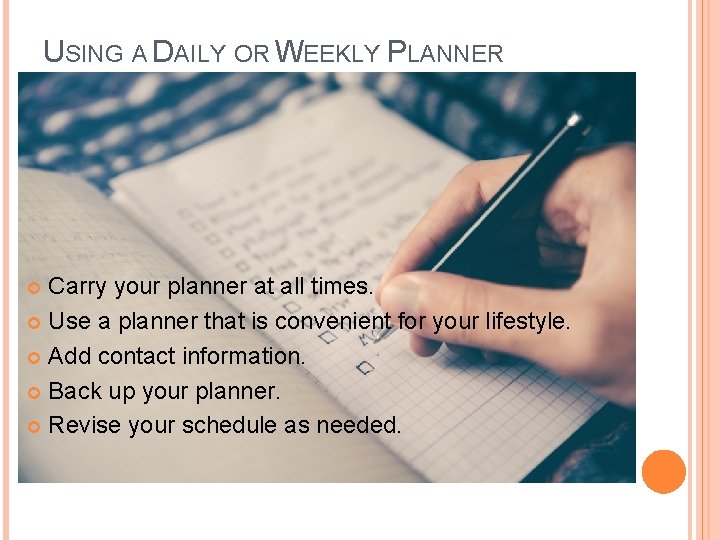
USING A DAILY OR WEEKLY PLANNER Carry your planner at all times. Use a planner that is convenient for your lifestyle. Add contact information. Back up your planner. Revise your schedule as needed.
SCHEDULING YOUR TIME WEEK BY WEEK Enter commitments into a planner. Review syllabus for each class constantly Reserve adequate study time. � Follow the 2 -for-1 rule. Consider your body clock. Estimate time needed for assignments. � Don’t forget to add research & editing/revision time Schedule exercise & time for workouts. College often requires more self discipline to ensure due dates are met. Get help early on
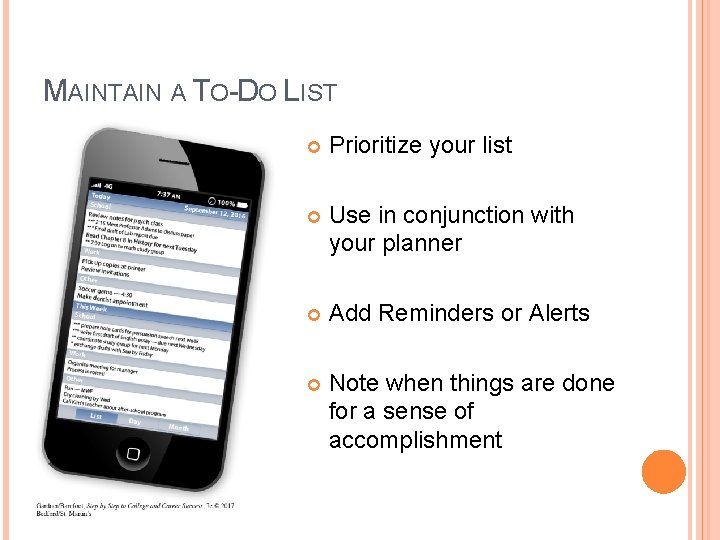
MAINTAIN A TO-DO LIST Prioritize your list Use in conjunction with your planner Add Reminders or Alerts Note when things are done for a sense of accomplishment
MAXIMIZING STUDY AND REVIEW TIME Find your space. Stick to a routine. Break down large tasks. Set realistic goals. Review when the material is fresh. Study difficult or boring subjects first. Divide study time into 50 -minute blocks. Avoid multitasking. Overcome distractions. Let others help. Be flexible. Reward yourself. Use travel time wisely.
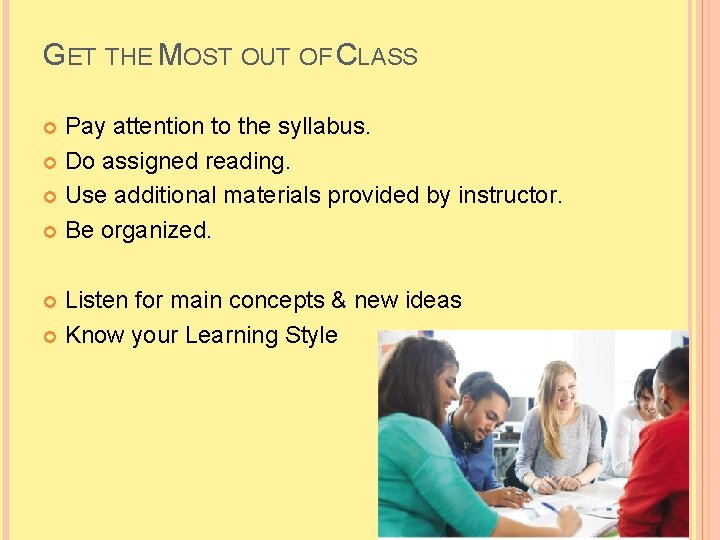
GET THE MOST OUT OF CLASS Pay attention to the syllabus. Do assigned reading. Use additional materials provided by instructor. Be organized. Listen for main concepts & new ideas Know your Learning Style
BE AN ACTIVE PARTICIPANT Sit close to front. Keep eyes on teacher. Focus on the lecture. Raise your hand when you don’t understand. Speak up in class. Never feel your questions are “stupid. ” When called on to speak, don’t bluff. Listen carefully to other students. Bring in relevant outside materials.
TAKE NOTES IN CLASS Identify main ideas. Don’t try to write down everything. Prepare to use your notes as a study tool. Make adjustments for different classes. Summarize in your own words Highlight, use color coding, or visual breaks
USE SPECIFIC STRATEGIES Create separate binders for each course. Download materials before class. Use only the front of each page. Listen carefully to questions and answers. Use asterisks and other symbols. Consider using pencil. Write down diagrams, equations, graphs, etc. Write down worked problems step by step. Refer to the textbook after class.
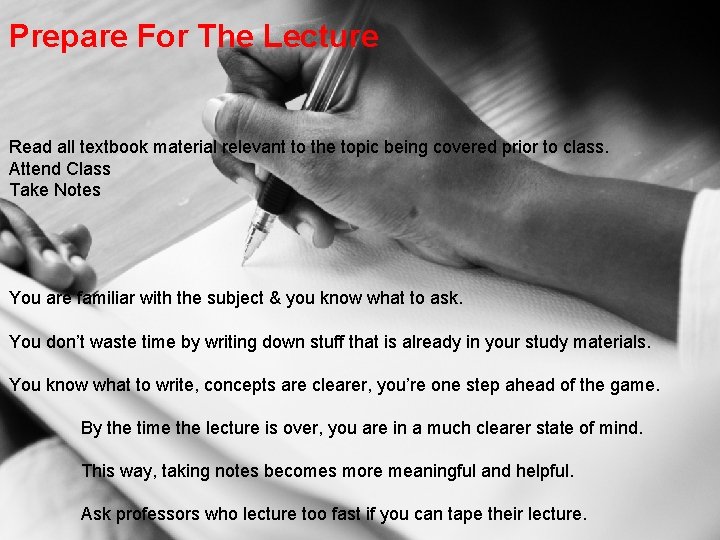
Prepare For The Lecture Read all textbook material relevant to the topic being covered prior to class. Attend Class Take Notes You are familiar with the subject & you know what to ask. You don’t waste time by writing down stuff that is already in your study materials. You know what to write, concepts are clearer, you’re one step ahead of the game. By the time the lecture is over, you are in a much clearer state of mind. This way, taking notes becomes more meaningful and helpful. Ask professors who lecture too fast if you can tape their lecture.
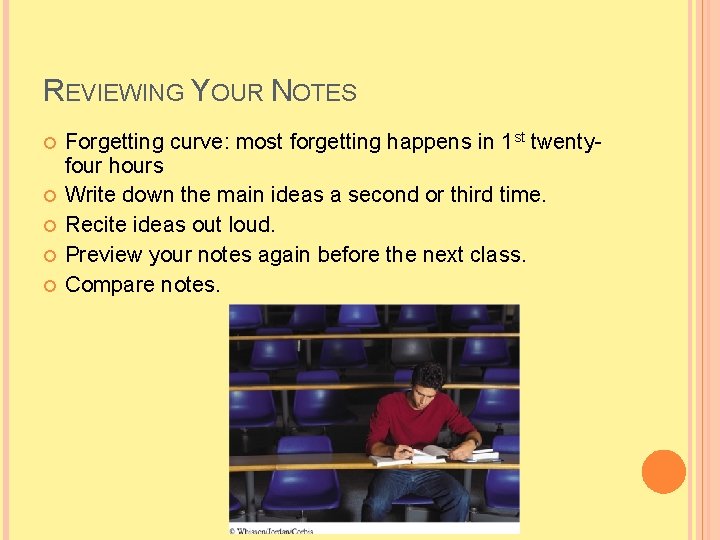
REVIEWING YOUR NOTES Forgetting curve: most forgetting happens in 1 st twentyfour hours Write down the main ideas a second or third time. Recite ideas out loud. Preview your notes again before the next class. Compare notes.