
FY 1 Teaching Programme AnneMarie Walker Clinical Skills
- Slides: 11
FY 1 Teaching Programme Anne-Marie Walker Clinical Skills Facilitator RGN, Hon Clinical Tutor Liverpool University (Foundation Programme and Rolling Programme Lead)
Teaching days • 20 Thematic days mapped to the curriculum • Includes simulation • Evaluation expected • Registers am & pm • Venue • Ideas/requests: Anne-marie. walker@nhs. net
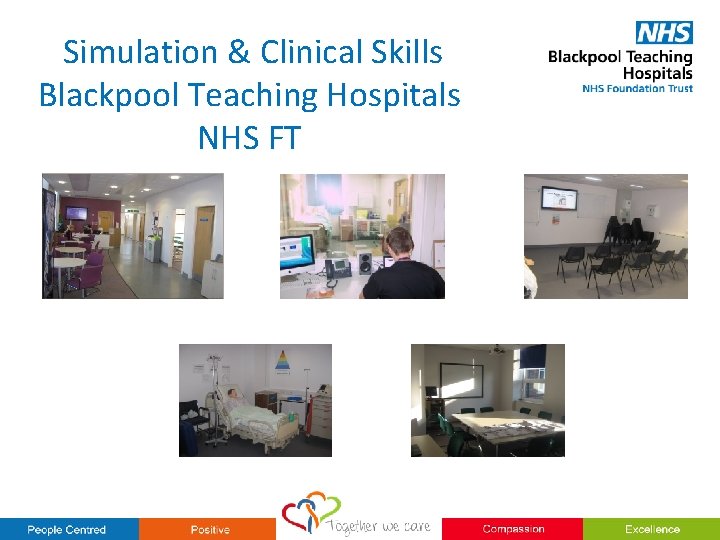
Simulation & Clinical Skills Blackpool Teaching Hospitals NHS FT
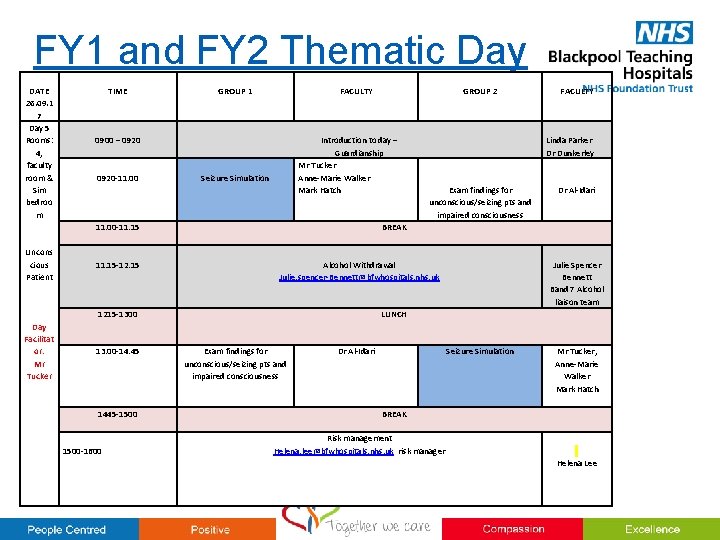
FY 1 and FY 2 Thematic Day DATE TIME 26. 09. 1 7 Day 5 Rooms: 0900 – 0920 4, faculty room & 0920 -11. 00 Sim bedroo m 11. 00 -11. 15 Uncons 11. 15 -12. 15 cious Patient 1215 -1300 Day Facilitat 13. 00 -14. 45 or: Mr Tucker 1445 -1500 1500 -1600 GROUP 1 FACULTY GROUP 2 Introduction to day – Guardianship Mr Tucker Anne-Marie Walker Mark Hatch Seizure Simulation Exam findings for unconscious/seizing pts and impaired consciousness FACULTY Linda Parker Dr Dunkerley Dr Al-Idari BREAK Alcohol Withdrawal Julie. spencer-Bennett@bfwhospitals. nhs. uk Julie Spencer Bennett Band 7 Alcohol liaison team LUNCH Exam findings for unconscious/seizing pts and impaired consciousness Dr Al-Idari Seizure Simulation Mr Tucker, Anne-Marie Walker Mark Hatch BREAK Risk management Helena. lee@bfwhospitals. nhs. uk risk manager Helena Lee
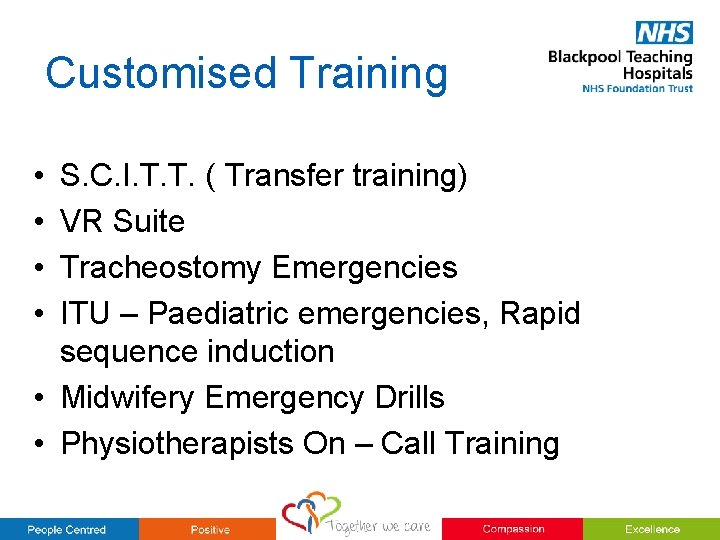
Customised Training • • S. C. I. T. T. ( Transfer training) VR Suite Tracheostomy Emergencies ITU – Paediatric emergencies, Rapid sequence induction • Midwifery Emergency Drills • Physiotherapists On – Call Training
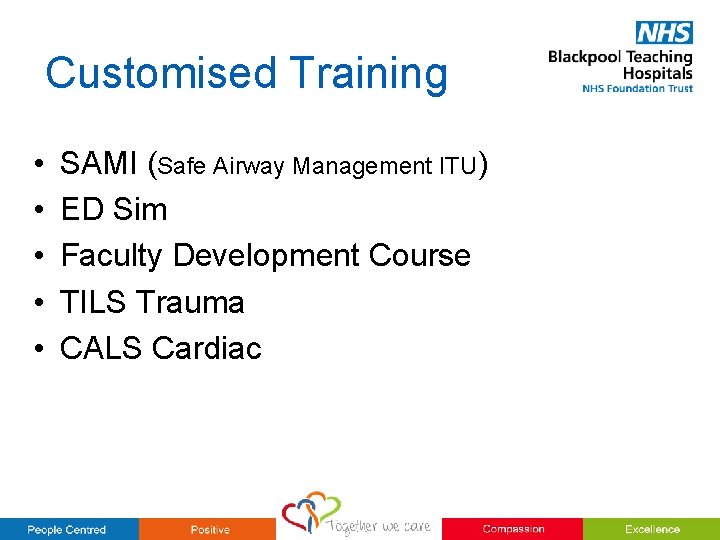
Customised Training • • • SAMI (Safe Airway Management ITU) ED Sim Faculty Development Course TILS Trauma CALS Cardiac
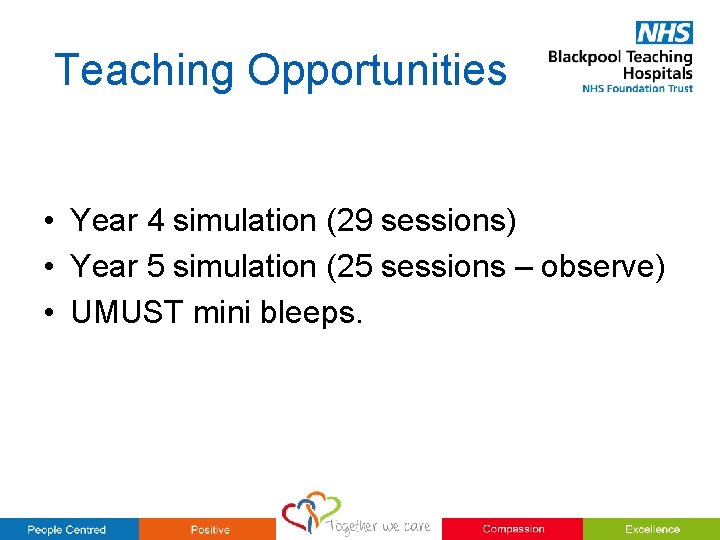
Teaching Opportunities • Year 4 simulation (29 sessions) • Year 5 simulation (25 sessions – observe) • UMUST mini bleeps.
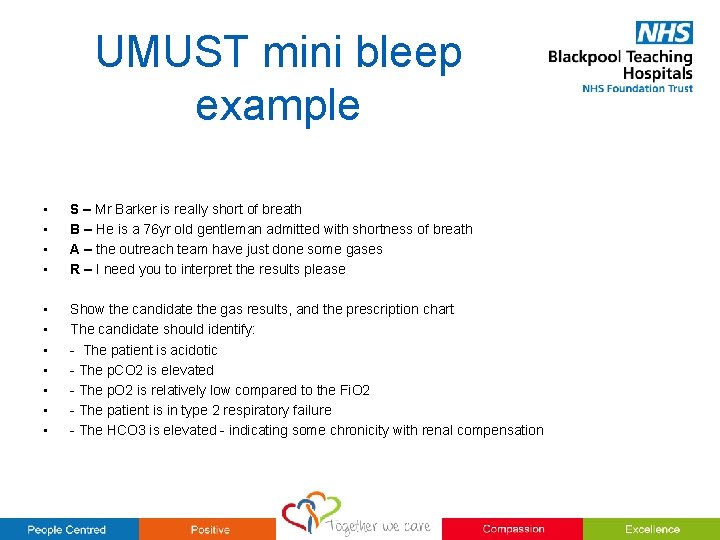
UMUST mini bleep example • • • • S – Mr Barker is really short of breath B – He is a 76 yr old gentleman admitted with shortness of breath A – the outreach team have just done some gases R – I need you to interpret the results please Show the candidate the gas results, and the prescription chart The candidate should identify: - The patient is acidotic - The p. CO 2 is elevated - The p. O 2 is relatively low compared to the Fi. O 2 - The patient is in type 2 respiratory failure - The HCO 3 is elevated - indicating some chronicity with renal compensation
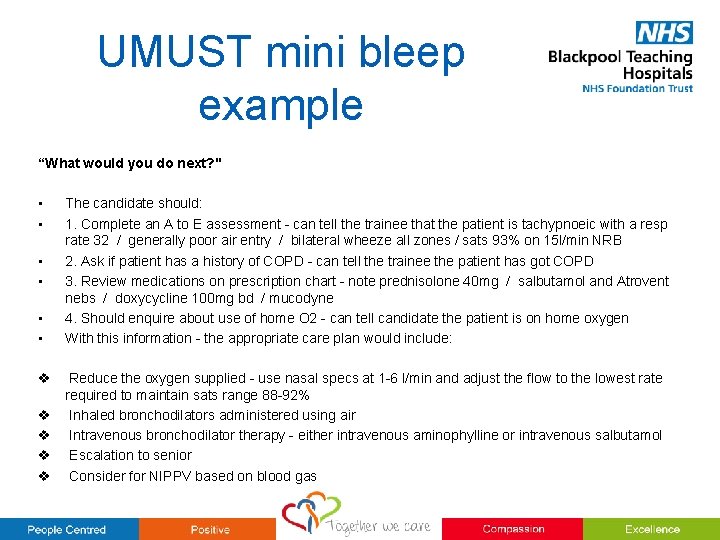
UMUST mini bleep example “What would you do next? " • • The candidate should: 1. Complete an A to E assessment - can tell the trainee that the patient is tachypnoeic with a resp rate 32 / generally poor air entry / bilateral wheeze all zones / sats 93% on 15 l/min NRB 2. Ask if patient has a history of COPD - can tell the trainee the patient has got COPD 3. Review medications on prescription chart - note prednisolone 40 mg / salbutamol and Atrovent nebs / doxycycline 100 mg bd / mucodyne 4. Should enquire about use of home O 2 - can tell candidate the patient is on home oxygen With this information - the appropriate care plan would include: • • v Reduce the oxygen supplied - use nasal specs at 1 -6 l/min and adjust the flow to the lowest rate required to maintain sats range 88 -92% v Inhaled bronchodilators administered using air v Intravenous bronchodilator therapy - either intravenous aminophylline or intravenous salbutamol v Escalation to senior v Consider for NIPPV based on blood gas
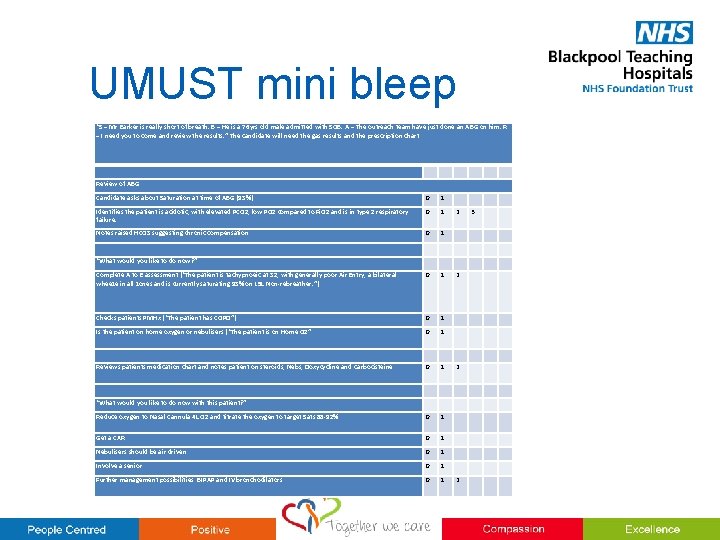
UMUST mini bleep “S – Mr Barker is really short of breath. B – He is a 76 yrs old male admitted with SOB. A – The outreach team have just done an ABG on him. R – I need you to come and review the results. ” The candidate will need the gas results and the prescription chart Candidate asks about Saturation at time of ABG (93%) 0 1 Identifies the patient is acidotic, with elevated PCO 2, low PO 2 compared to Fi. O 2 and is in type 2 respiratory failure. 0 1 2 3 Notes raised HCO 3 suggesting chronic compensation 0 1 “What would you like to do now? ” Complete A to E assessment (“The patient is tachypnoeic at 32, with generally poor Air Entry, a bilateral wheeze in all zones and is currently saturating 93% on 15 L Non-rebreather. ”) 0 1 2 Checks patients PMHx (“The patient has COPD”) 0 1 Is the patient on home oxygen or nebulisers (“The patient is on Home O 2” 0 1 Reviews patients medication chart and notes patient on steroids, Nebs, Doxycycline and Carbocisteine 0 1 2 “What would you like to do now with this patient? ” Reduce oxygen to Nasal Cannula 4 L O 2 and titrate the oxygen to target Sats 88 -92% 0 1 Get a CXR 0 1 Nebulisers should be air driven 0 1 Involve a senior 0 1 Further management possibilities: BIPAP and IV bronchodilators 0 1 2 Review of ABG
Teaching programme Contacts Mr Blackmore - Foundation Programme YR 1 Director Alexander. Blackmore@nhs. net Dr Sari-kouzel - Foundation Programme YR 2 Director dr. sari-kouzel@nhs. net Anne-Marie Walker - Foundation Programme Lead Anne-marie. walker@nhs. net Trish Broadhead - Foundation Programme Administration bfwh. foundation. education@nhs. net