
FW 364 Ecological Problem Solving Class 7 Population
FW 364 Ecological Problem Solving Class 7: Population Growth September 23, 2013
Outline for Today Last Two Classes: Derived a simple model of discrete population growth between consecutive time periods Nt+1 = Nt λ Derived an equation to forecast population growth (still discrete growth) N t = N 0 λt Objectives for Today: Derive continuous population growth equations Include immigration and emigration into equations Text (optional reading): Chapter 1

Continuous Growth Equation Nt+1 = Nt λ N t = N 0 λt Continuo us 1918 1926 1934 1942 1950 1958 1966 1974 1982 1990 1998 2006 Population Size Discrete 1918 1926 1934 1942 1950 1958 1966 1974 1982 1990 1998 2006 Population Size Recall that continuous growth is more appropriate for some organisms: Toda y: Continuous Analogs Application to humans in text… …discussed as discrete growth, but continuous is
Continuous Growth Equation Start with general equation for closed population: Nt+1 = Nt + B - D Rearrange to: Nt+1 - Nt = B - D And substitute ΔN for Nt+1 - Nt ΔN = B - D This is a model of rate of change in N Still a discrete equation
Continuous Growth Equation ΔN = B - D To make continuous, change time step to “infinitely small time intervals” (~instantaneous time step) d. N/dt = B - D In other words, to get from discrete to continuous time, we make the time step smaller and smaller (until infinitely small) Important Note: When changing from discrete to continuous time, we added time units N: number B and D: number/time
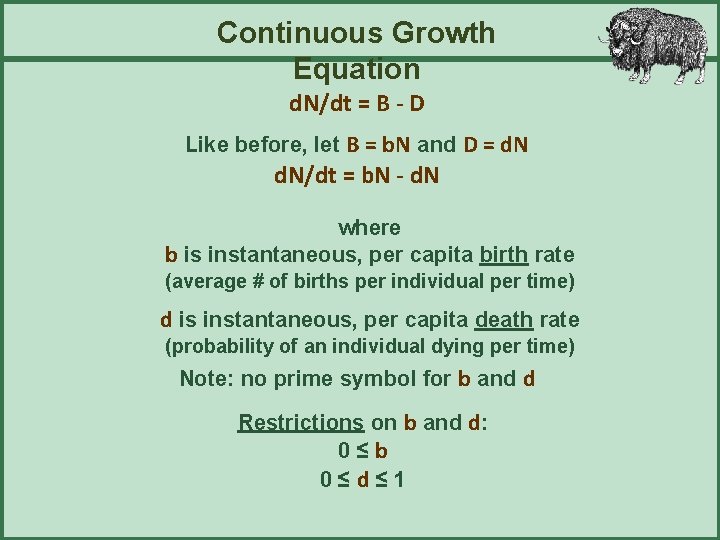
Continuous Growth Equation d. N/dt = B - D Like before, let B = b. N and D = d. N/dt = b. N - d. N where b is instantaneous, per capita birth rate (average # of births per individual per time) d is instantaneous, per capita death rate (probability of an individual dying per time) Note: no prime symbol for b and d Restrictions on b and d: 0≤b 0≤d≤ 1
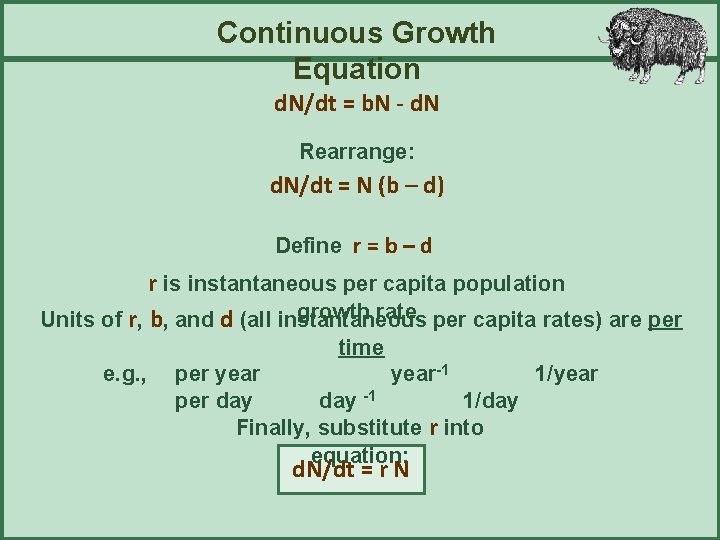
Continuous Growth Equation d. N/dt = b. N - d. N Rearrange: d. N/dt = N (b – d) Define r = b – d r is instantaneous per capita population growth rate per capita rates) are per Units of r, b, and d (all instantaneous time e. g. , per year-1 1/year per day -1 1/day Finally, substitute r into equation: d. N/dt = r N
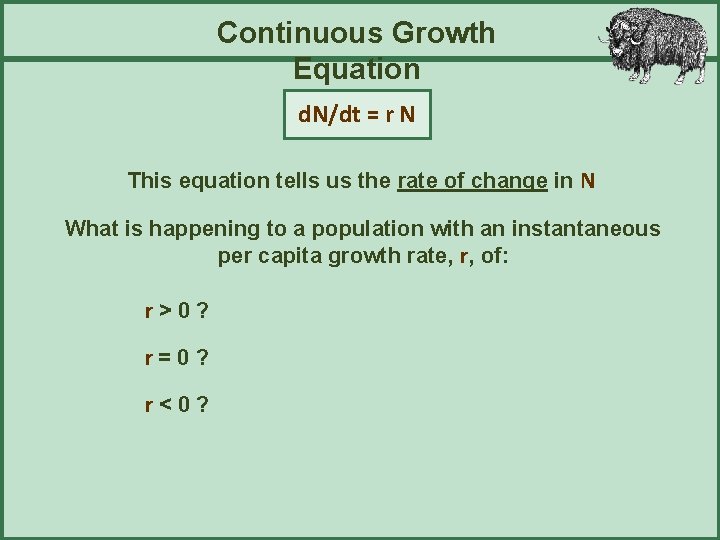
Continuous Growth Equation d. N/dt = r N This equation tells us the rate of change in N What is happening to a population with an instantaneous per capita growth rate, r, of: r>0? r= 0 ? r<0?
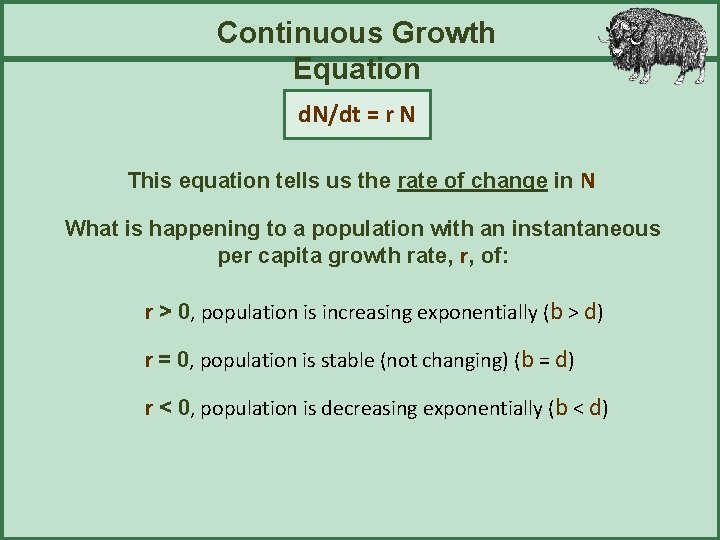
Continuous Growth Equation d. N/dt = r N This equation tells us the rate of change in N What is happening to a population with an instantaneous per capita growth rate, r, of: r > 0, population is increasing exponentially (b > d) r = 0, population is stable (not changing) (b = d) r < 0, population is decreasing exponentially (b < d)
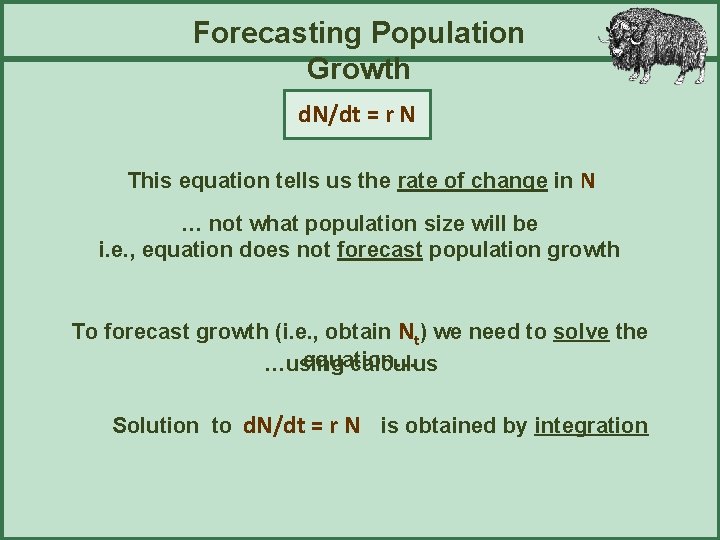
Forecasting Population Growth d. N/dt = r N This equation tells us the rate of change in N … not what population size will be i. e. , equation does not forecast population growth To forecast growth (i. e. , obtain Nt) we need to solve the equation… …using calculus Solution to d. N/dt = r N is obtained by integration
Forecasting Population Growth If you can’t remember your calculus, it’s OK (you will not be doing calculus on the exam)
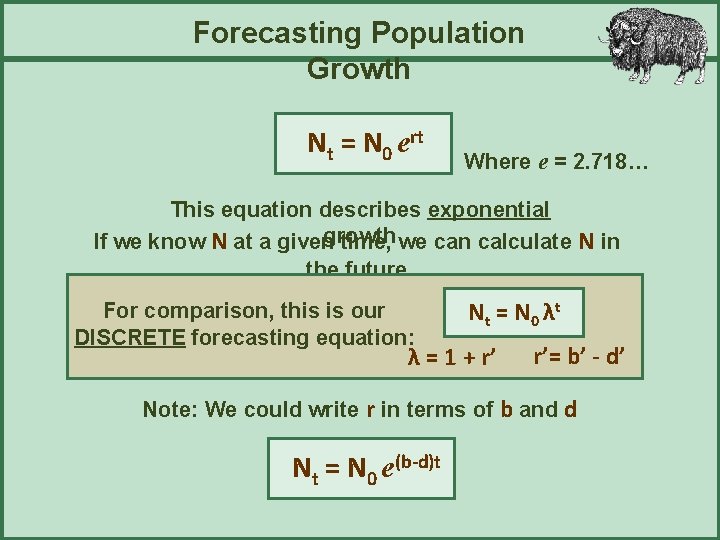
Forecasting Population Growth Nt = N 0 ert Where e = 2. 718… This equation describes exponential growth If we know N at a given time, we can calculate N in the future For comparison, this is our DISCRETE forecasting equation: N t = N 0 λt λ = 1 + r’ r’= b’ - d’ Note: We could write r in terms of b and d Nt = N 0 e(b-d)t
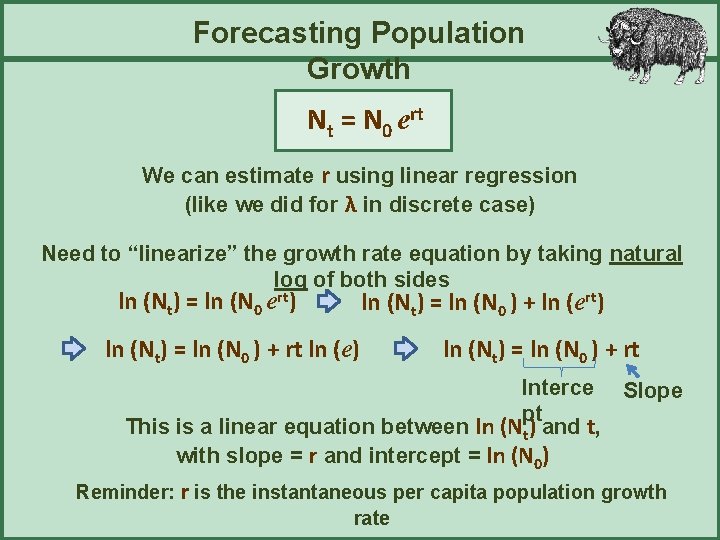
Forecasting Population Growth Nt = N 0 ert We can estimate r using linear regression (like we did for λ in discrete case) Need to “linearize” the growth rate equation by taking natural log of both sides ln (Nt) = ln (N 0 ert) ln (Nt) = ln (N 0 ) + rt ln (e) ln (Nt) = ln (N 0 ) + ln (ert) ln (Nt) = ln (N 0 ) + rt Interce Slope pt This is a linear equation between ln (Nt) and t, with slope = r and intercept = ln (N 0) Reminder: r is the instantaneous per capita population growth rate
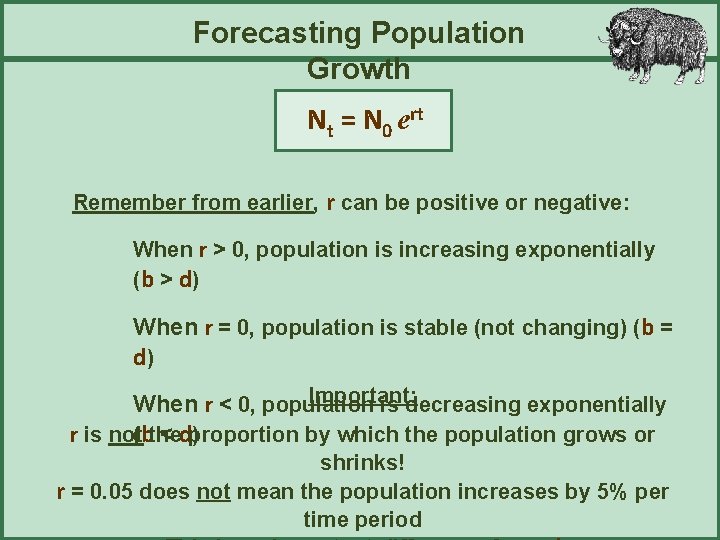
Forecasting Population Growth Nt = N 0 ert Remember from earlier, r can be positive or negative: When r > 0, population is increasing exponentially (b > d ) When r = 0, population is stable (not changing) (b = d) Important: When r < 0, population is decreasing exponentially < dproportion ) r is not(bthe by which the population grows or shrinks! r = 0. 05 does not mean the population increases by 5% per time period
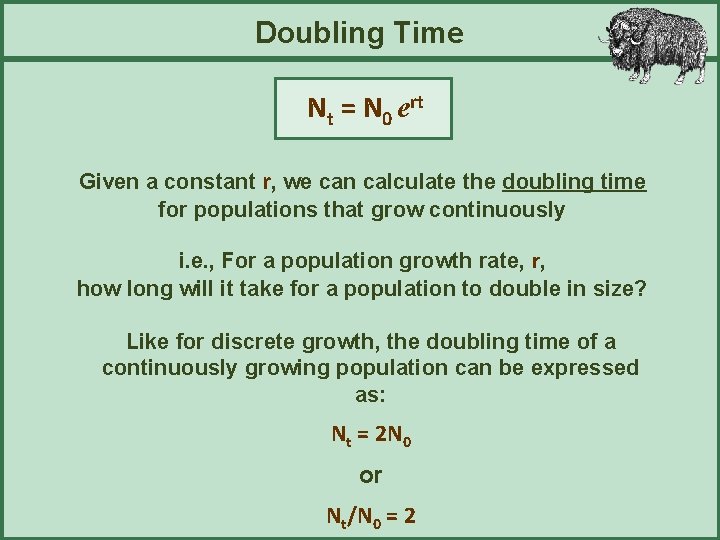
Doubling Time Nt = N 0 ert Given a constant r, we can calculate the doubling time for populations that grow continuously i. e. , For a population growth rate, r, how long will it take for a population to double in size? Like for discrete growth, the doubling time of a continuously growing population can be expressed as: Nt = 2 N 0 or Nt/N 0 = 2
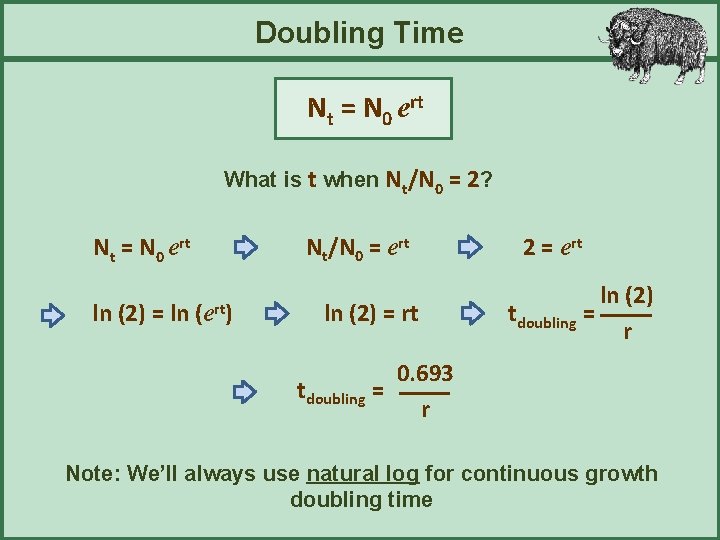
Doubling Time Nt = N 0 ert What is t when Nt/N 0 = 2? Nt/N 0 = ert Nt = N 0 ert ln (2) = ln (ert) ln (2) = rt 2 = ert ln (2) tdoubling = r 0. 693 tdoubling = r Note: We’ll always use natural log for continuous growth doubling time
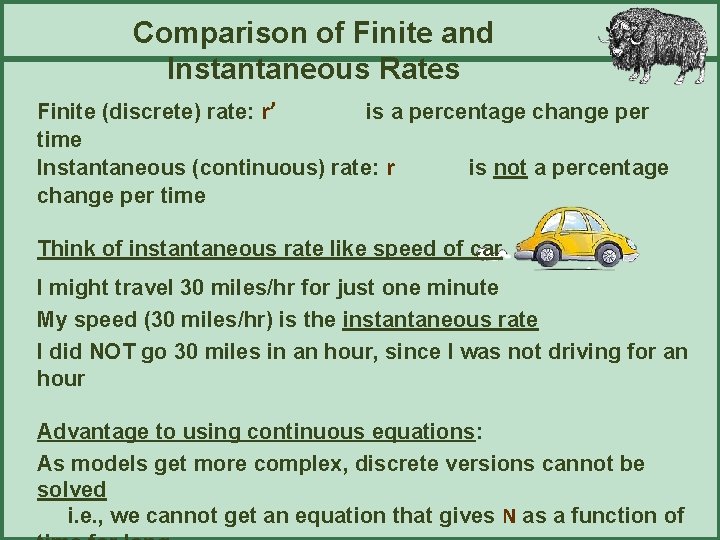
Comparison of Finite and Instantaneous Rates Finite (discrete) rate: r’ is a percentage change per time Instantaneous (continuous) rate: r is not a percentage change per time Think of instantaneous rate like speed of car I might travel 30 miles/hr for just one minute My speed (30 miles/hr) is the instantaneous rate I did NOT go 30 miles in an hour, since I was not driving for an hour Advantage to using continuous equations: As models get more complex, discrete versions cannot be solved i. e. , we cannot get an equation that gives N as a function of

Immigration & Emigration for discrete & continuous
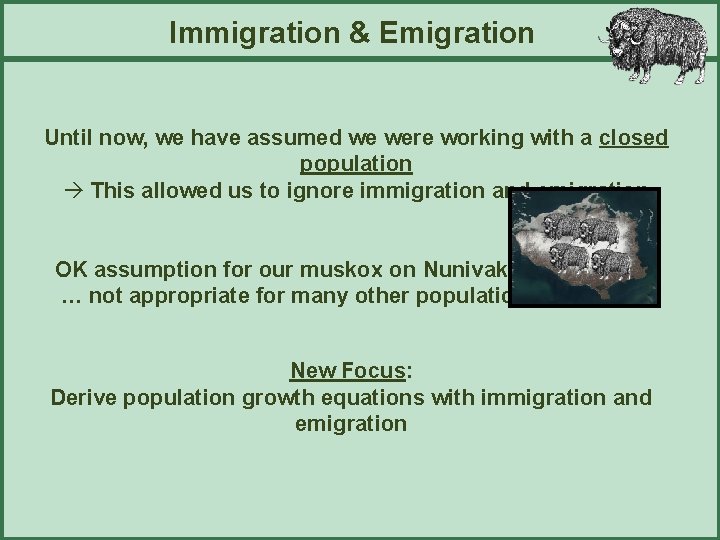
Immigration & Emigration Until now, we have assumed we were working with a closed population à This allowed us to ignore immigration and emigration OK assumption for our muskox on Nunivak Island … … not appropriate for many other populations New Focus: Derive population growth equations with immigration and emigration
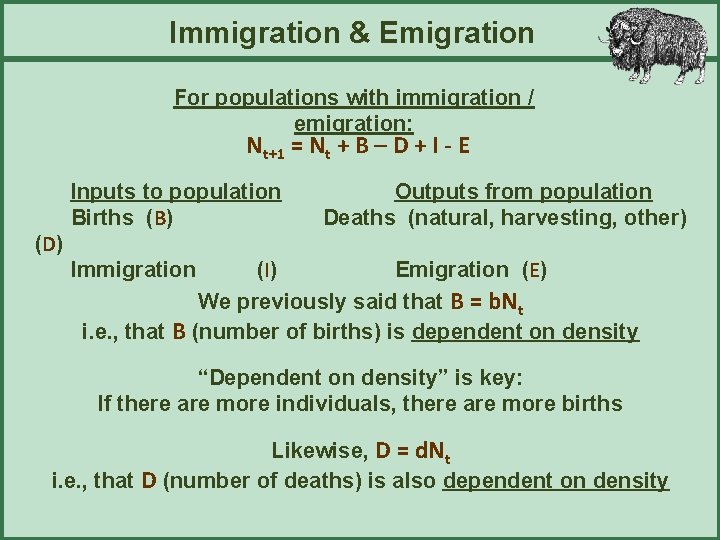
Immigration & Emigration For populations with immigration / emigration: Nt+1 = Nt + B – D + I - E Inputs to population Births (B) Outputs from population Deaths (natural, harvesting, other) (D) Immigration (I) Emigration (E) We previously said that B = b. Nt i. e. , that B (number of births) is dependent on density “Dependent on density” is key: If there are more individuals, there are more births Likewise, D = d. Nt i. e. , that D (number of deaths) is also dependent on density
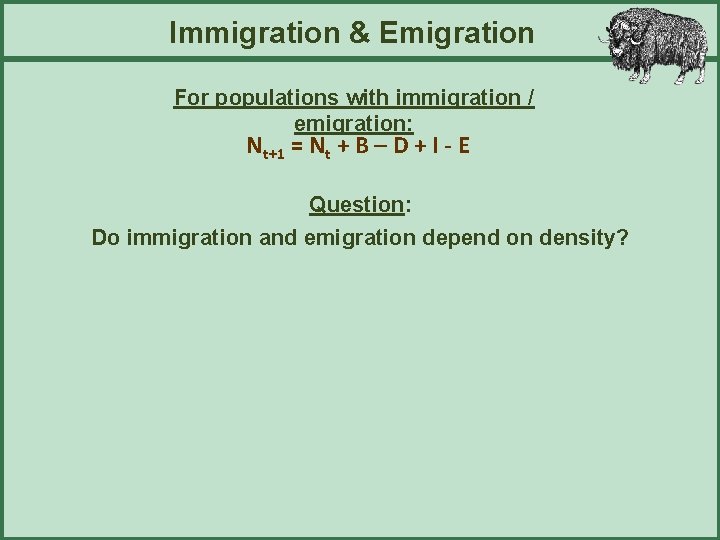
Immigration & Emigration For populations with immigration / emigration: Nt+1 = Nt + B – D + I - E Question: Do immigration and emigration depend on density?
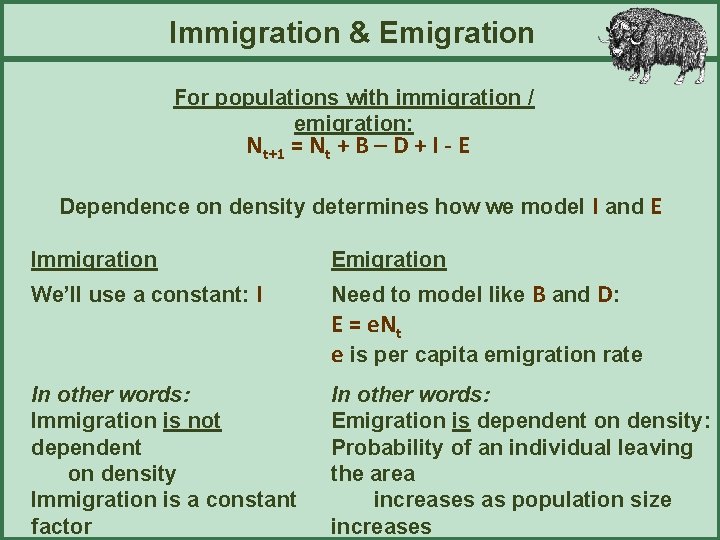
Immigration & Emigration For populations with immigration / emigration: Nt+1 = Nt + B – D + I - E Dependence on density determines how we model I and E Immigration Emigration We’ll use a constant: I Need to model like B and D: In other words: Immigration is not dependent on density Immigration is a constant factor In other words: Emigration is dependent on density: Probability of an individual leaving the area increases as population size increases E = e. Nt e is per capita emigration rate
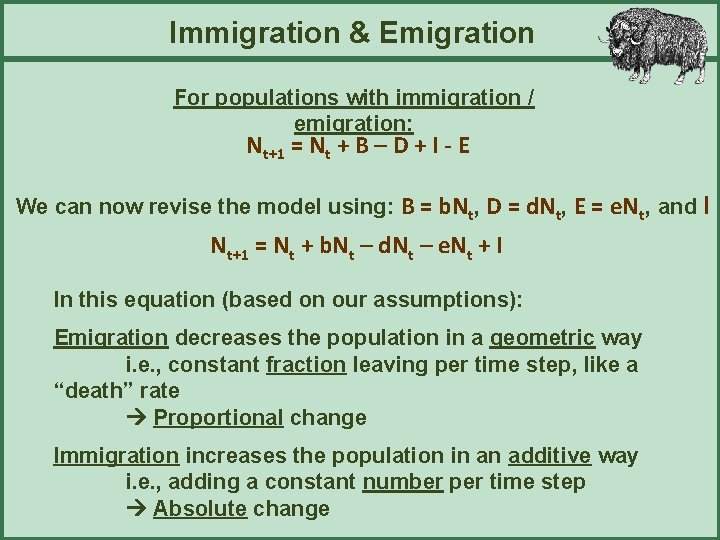
Immigration & Emigration For populations with immigration / emigration: Nt+1 = Nt + B – D + I - E We can now revise the model using: B = b. Nt, D = d. Nt, E = e. Nt, and I Nt+1 = Nt + b. Nt – d. Nt – e. Nt + I In this equation (based on our assumptions): Emigration decreases the population in a geometric way i. e. , constant fraction leaving per time step, like a “death” rate Proportional change Immigration increases the population in an additive way i. e. , adding a constant number per time step Absolute change
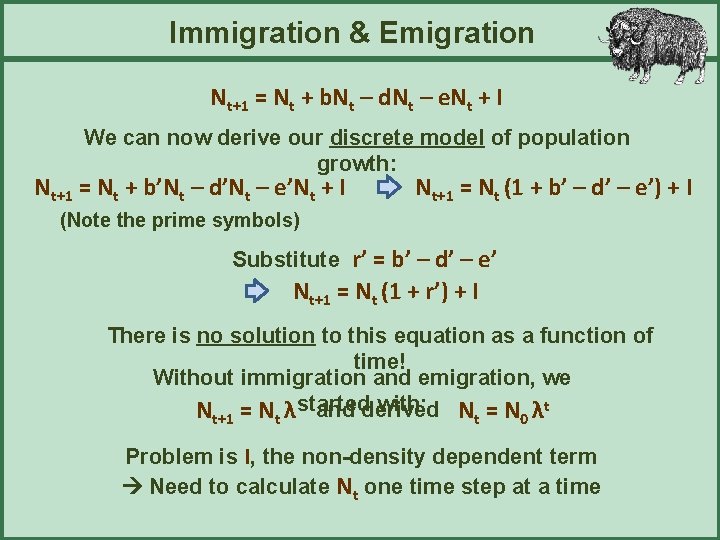
Immigration & Emigration Nt+1 = Nt + b. Nt – d. Nt – e. Nt + I We can now derive our discrete model of population growth: Nt+1 = Nt + b’Nt – d’Nt – e’Nt + I Nt+1 = Nt (1 + b’ – d’ – e’) + I (Note the prime symbols) Substitute r’ = b’ – d’ – e’ Nt+1 = Nt (1 + r’) + I There is no solution to this equation as a function of time! Without immigration and emigration, we with: N = N λt and derived Nt+1 = Nt λ started t 0 Problem is I, the non-density dependent term Need to calculate Nt one time step at a time
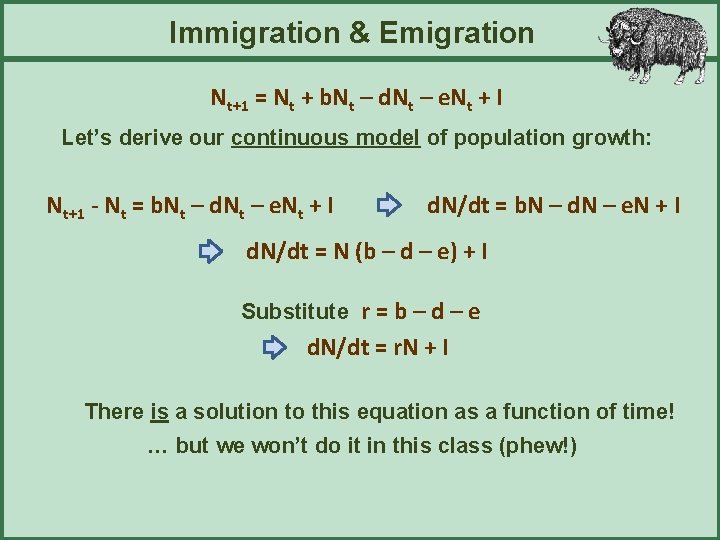
Immigration & Emigration Nt+1 = Nt + b. Nt – d. Nt – e. Nt + I Let’s derive our continuous model of population growth: Nt+1 - Nt = b. Nt – d. Nt – e. Nt + I d. N/dt = b. N – d. N – e. N + I d. N/dt = N (b – d – e) + I Substitute r = b – d – e d. N/dt = r. N + I There is a solution to this equation as a function of time! … but we won’t do it in this class (phew!)
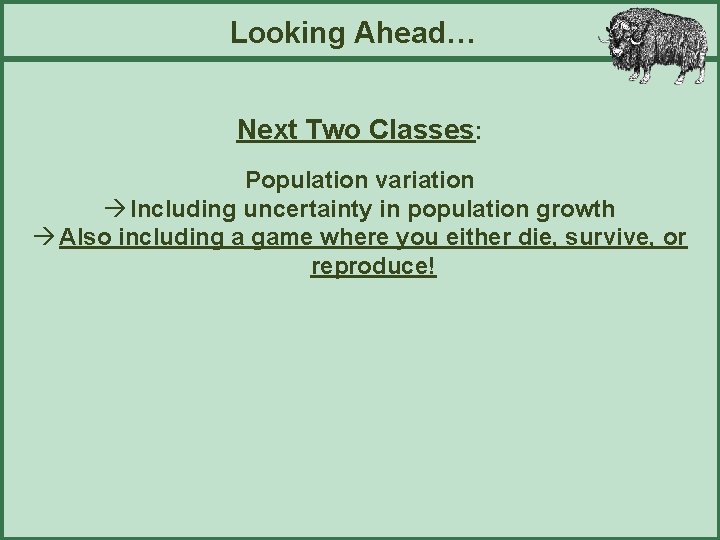
Looking Ahead… Next Two Classes: Population variation à Including uncertainty in population growth à Also including a game where you either die, survive, or reproduce!
- Slides: 26