
FW 364 Ecological Problem Solving Class 6 Population
FW 364 Ecological Problem Solving Class 6: Population Growth September 18, 2013
Outline for Today Goal for Today: Continuing introduction to population growth – Discrete Growth Last Class: Derived a simple model of discrete population growth between consecutive time periods (Nt and Nt+1) Objective for Today’s Class: Derive an equation to forecast population growth (still discrete growth) Objective for Next Class: Derive continuous population growth equation Text (optional reading): Chapter 1
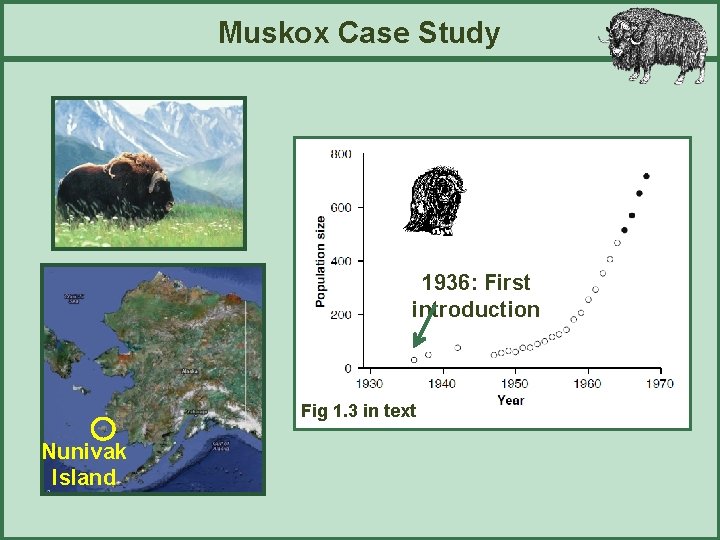
Muskox Case Study 1936: First introduction Fig 1. 3 in text Nunivak Island
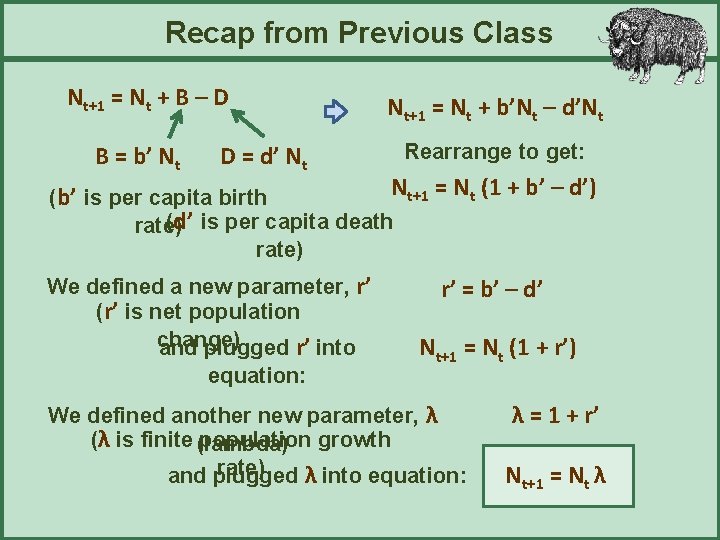
Recap from Previous Class Nt+1 = Nt + B – D B = b’ Nt D = d’ Nt Nt+1 = Nt + b’Nt – d’Nt Rearrange to get: Nt+1 = Nt (1 + b’ – d’) (b’ is per capita birth (d’ is per capita death rate) We defined a new parameter, r’ (r’ is net population change) and plugged r’ into equation: r’ = b’ – d’ Nt+1 = Nt (1 + r’) We defined another new parameter, λ (λ is finite (lambda) population growth rate) and plugged λ into equation: λ = 1 + r’ Nt+1 = Nt λ
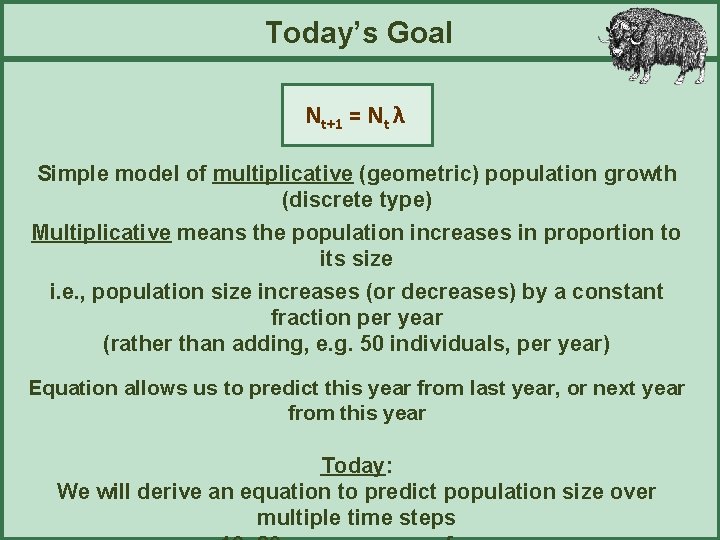
Today’s Goal Nt+1 = Nt λ Simple model of multiplicative (geometric) population growth (discrete type) Multiplicative means the population increases in proportion to its size i. e. , population size increases (or decreases) by a constant fraction per year (rather than adding, e. g. 50 individuals, per year) Equation allows us to predict this year from last year, or next year from this year Today: We will derive an equation to predict population size over multiple time steps

Deriving Equation to Forecast Growth Nt+1 = Nt λ Assume λ is constant across time (i. e. , population grows at a constant rate each year) Let’s plug specific time steps into the equation: N 1 = N 0 λ N is in both equations… 1 … we can substitute N 1= N 0 λ N 2 = N 1 λ in second equation Similarly, N 3 = N 2 λ N 2 = (N 0 λ) λ N 3 = (N 0 λ 2) λ Pattern continues; eventually we arrive at: N 2 = N 0 λ 2 N 3 = N 0 λ 3 N t = N 0 λt
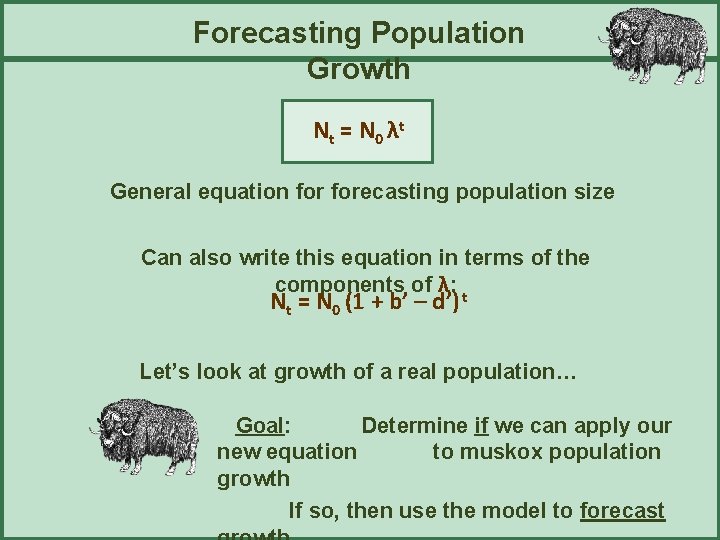
Forecasting Population Growth N t = N 0 λt General equation forecasting population size Can also write this equation in terms of the components of λ: t Nt = N 0 (1 + b’ – d’) Let’s look at growth of a real population… Goal: Determine if we can apply our new equation to muskox population growth If so, then use the model to forecast
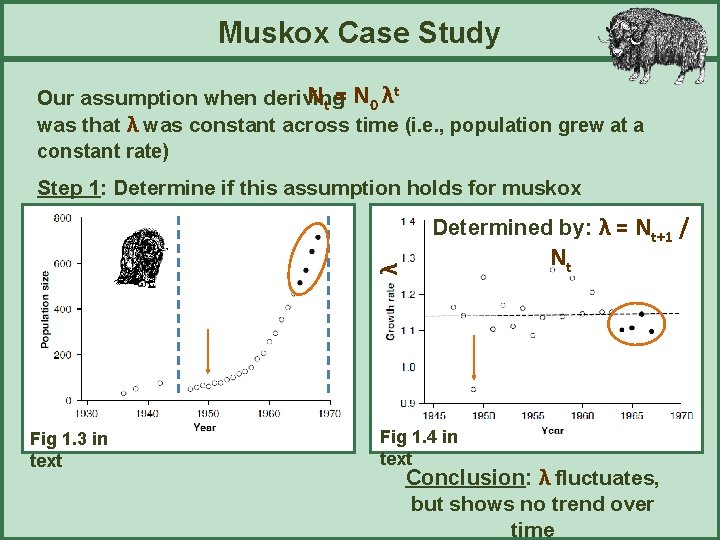
Muskox Case Study N t = N 0 λt Our assumption when deriving was that λ was constant across time (i. e. , population grew at a constant rate) Step 1: Determine if this assumption holds for muskox Determined by: λ = Nt+1 / λ Nt Fig 1. 3 in text Fig 1. 4 in text Conclusion: λ fluctuates, but shows no trend over time
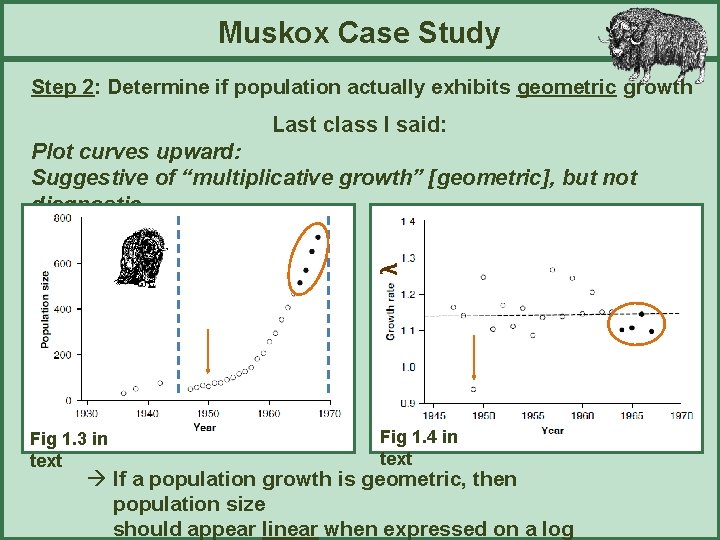
Muskox Case Study Step 2: Determine if population actually exhibits geometric growth Last class I said: λ Plot curves upward: Suggestive of “multiplicative growth” [geometric], but not diagnostic Fig 1. 3 in text Fig 1. 4 in text à If a population growth is geometric, then population size should appear linear when expressed on a log
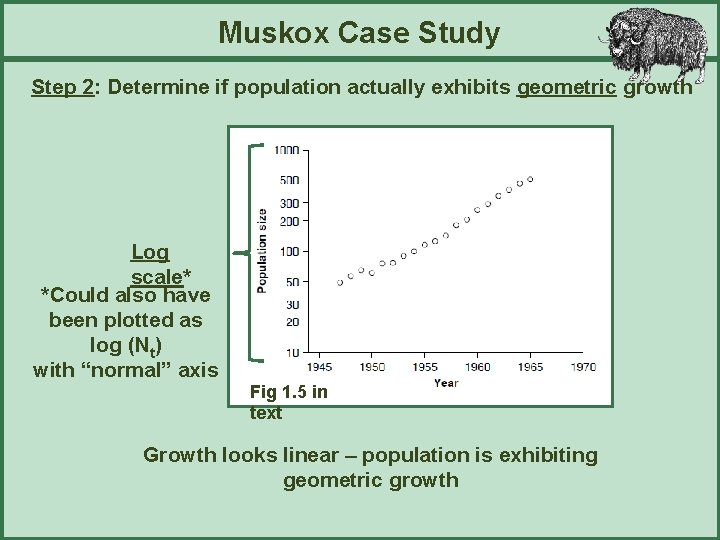
Muskox Case Study Step 2: Determine if population actually exhibits geometric growth Log scale* *Could also have been plotted as log (Nt) with “normal” axis Fig 1. 5 in text Growth looks linear – population is exhibiting geometric growth
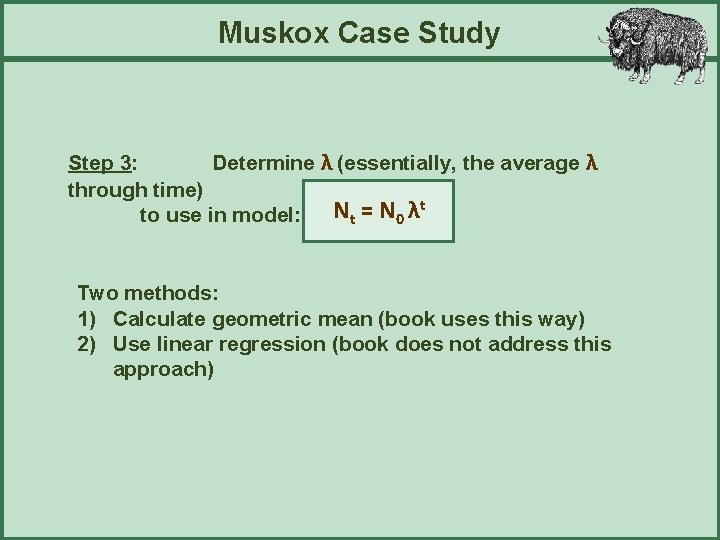
Muskox Case Study Step 3: Determine λ (essentially, the average λ through time) N t = N 0 λt to use in model: Two methods: 1) Calculate geometric mean (book uses this way) 2) Use linear regression (book does not address this approach)
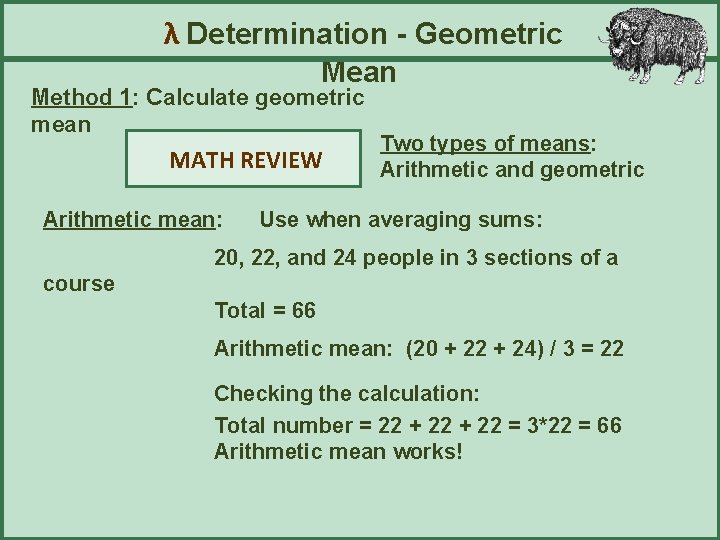
λ Determination - Geometric Mean Method 1: Calculate geometric mean MATH REVIEW Arithmetic mean: Two types of means: Arithmetic and geometric Use when averaging sums: 20, 22, and 24 people in 3 sections of a course Total = 66 Arithmetic mean: (20 + 22 + 24) / 3 = 22 Checking the calculation: Total number = 22 + 22 = 3*22 = 66 Arithmetic mean works!
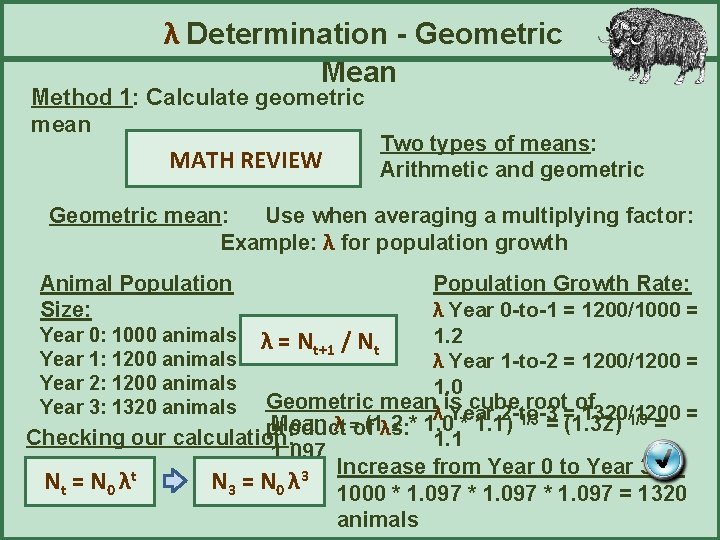
λ Determination - Geometric Mean Method 1: Calculate geometric mean MATH REVIEW Two types of means: Arithmetic and geometric Geometric mean: Use when averaging a multiplying factor: Example: λ for population growth Animal Population Size: Population Growth Rate: λ Year 0 -to-1 = 1200/1000 = Year 0: 1000 animals λ = N / N 1. 2 t+1 t Year 1: 1200 animals λ Year 1 -to-2 = 1200/1200 = Year 2: 1200 animals 1. 0 cube root=of Year 3: 1320 animals Geometric meanλis Year 2 -to-3 1320/1200 1/3 = (1. 32) 1/3 = = Mean λ = (1. 2 * 1. 0 * 1. 1) product of λs: Checking our calculation: 1. 1 1. 097 Increase from Year 0 to Year 3 is: t 3 Nt = N 0 λ N 3 = N 0 λ 1000 * 1. 097 = 1320 animals
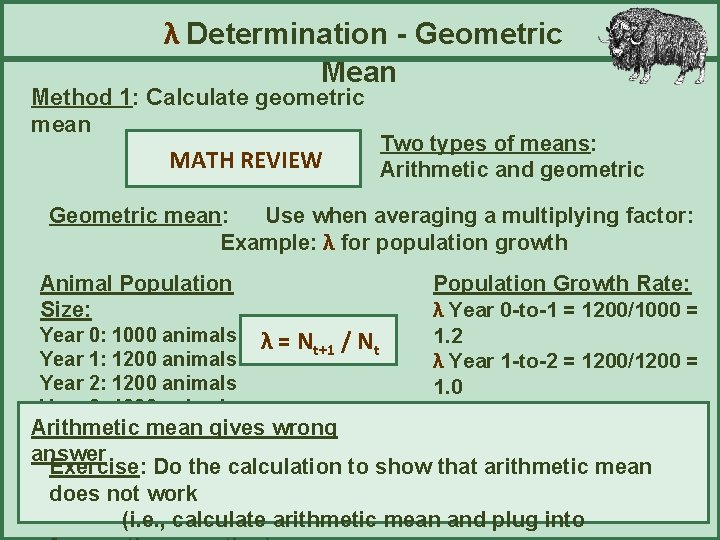
λ Determination - Geometric Mean Method 1: Calculate geometric mean MATH REVIEW Two types of means: Arithmetic and geometric Geometric mean: Use when averaging a multiplying factor: Example: λ for population growth Animal Population Size: Population Growth Rate: λ Year 0 -to-1 = 1200/1000 = Year 0: 1000 animals λ = N / N 1. 2 t+1 t Year 1: 1200 animals λ Year 1 -to-2 = 1200/1200 = Year 2: 1200 animals 1. 0 Year 3: 1320 animals λ Year 2 -to-3 = 1320/1200 = Arithmetic mean gives wrong 1. 1 answer Exercise: Do the calculation to show that arithmetic mean does not work (i. e. , calculate arithmetic mean and plug into
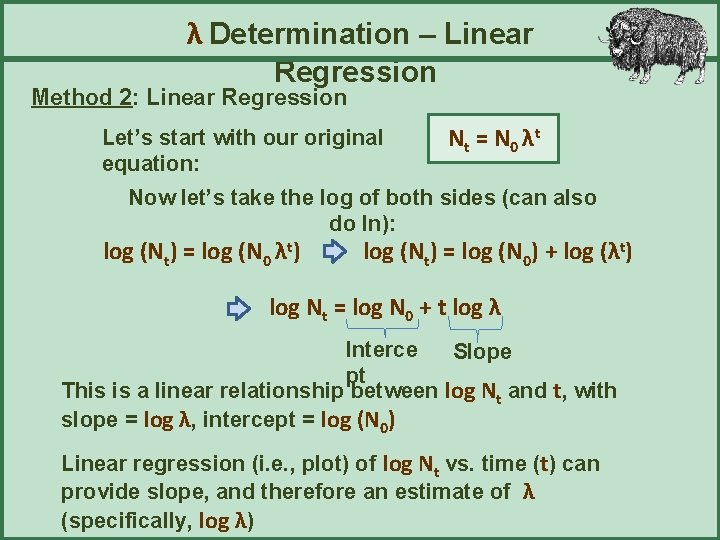
λ Determination – Linear Regression Method 2: Linear Regression Let’s start with our original equation: N t = N 0 λt Now let’s take the log of both sides (can also do ln): log (Nt) = log (N 0 λt) log (Nt) = log (N 0) + log (λt) log Nt = log N 0 + t log λ Interce Slope pt This is a linear relationship between log Nt and t, with slope = log λ, intercept = log (N 0) Linear regression (i. e. , plot) of log Nt vs. time (t) can provide slope, and therefore an estimate of λ (specifically, log λ)
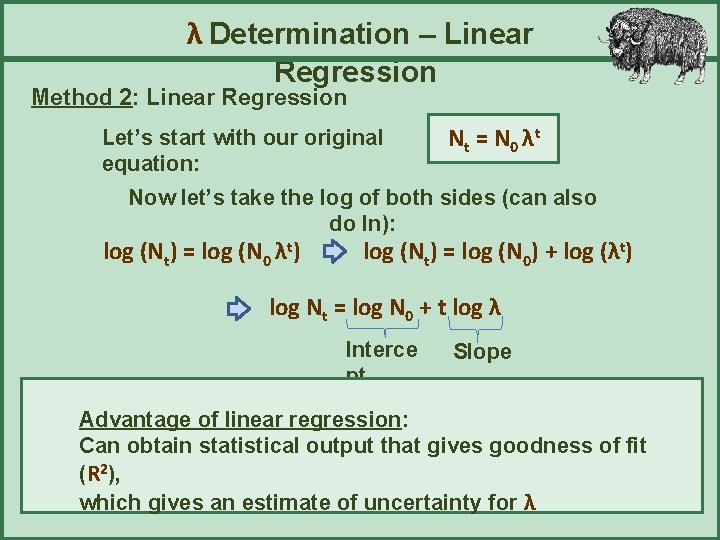
λ Determination – Linear Regression Method 2: Linear Regression Let’s start with our original equation: N t = N 0 λt Now let’s take the log of both sides (can also do ln): log (Nt) = log (N 0 λt) log (Nt) = log (N 0) + log (λt) log Nt = log N 0 + t log λ Interce pt Slope Advantage of linear regression: Can obtain statistical output that gives goodness of fit (R 2), which gives an estimate of uncertainty for λ
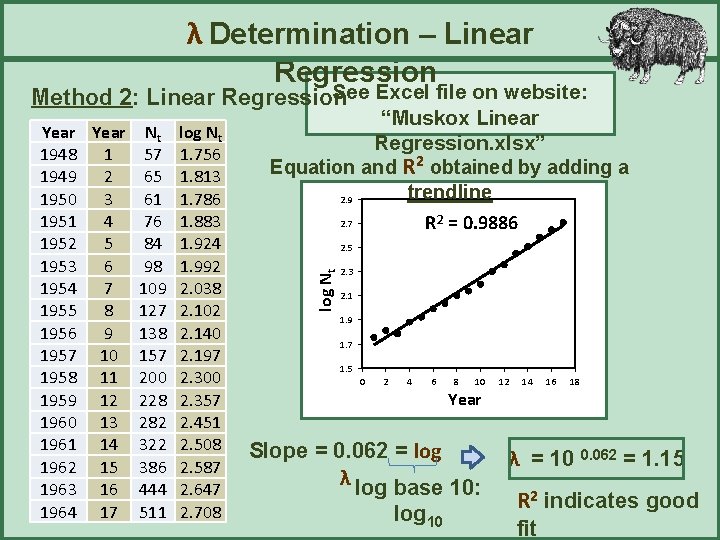
λ Determination – Linear Regression See Excel file on website: Method 2: Linear Regression “Muskox Linear Regression. xlsx” Equation and R 2 obtained by adding a trendline 2. 9 2. 7 R 2 = 0. 9886 2. 5 log Nt Year Nt log Nt 1948 1 57 1. 756 1949 2 65 1. 813 1950 3 61 1. 786 1951 4 76 1. 883 1952 5 84 1. 924 1953 6 98 1. 992 1954 7 109 2. 038 1955 8 127 2. 102 1956 9 138 2. 140 1957 10 157 2. 197 1958 11 200 2. 300 1959 12 228 2. 357 1960 13 282 2. 451 1961 14 322 2. 508 1962 15 386 2. 587 1963 16 444 2. 647 1964 17 511 2. 708 2. 3 2. 1 1. 9 1. 7 1. 5 0 2 4 6 8 10 12 14 16 18 Year Slope = 0. 062 = log λ log base 10: log 10 λ = 10 0. 062 = 1. 15 R 2 indicates good fit
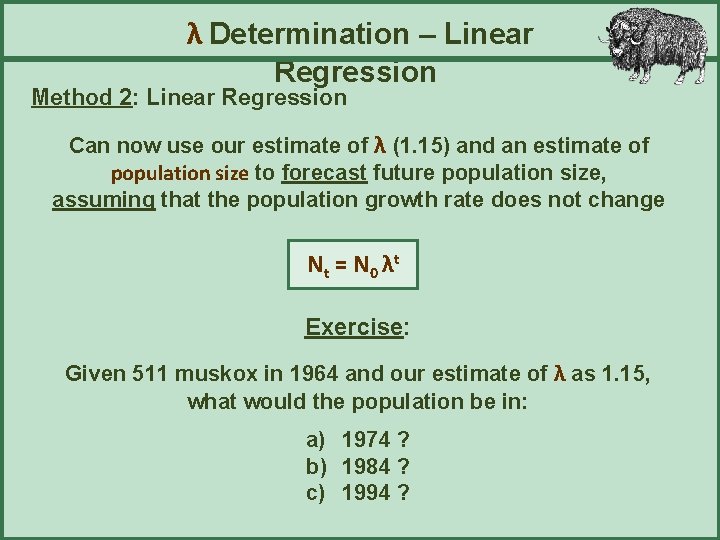
λ Determination – Linear Regression Method 2: Linear Regression Can now use our estimate of λ (1. 15) and an estimate of population size to forecast future population size, assuming that the population growth rate does not change N t = N 0 λt Exercise: Given 511 muskox in 1964 and our estimate of λ as 1. 15, what would the population be in: a) 1974 ? b) 1984 ? c) 1994 ?
Doubling Time How long will it take for a population to double in size given its growth rate? A common question in population analysis Key to answering this question is to recognize that the doubling of a population can be expressed as: Nt = 2 N 0 or Nt/N 0 = 2
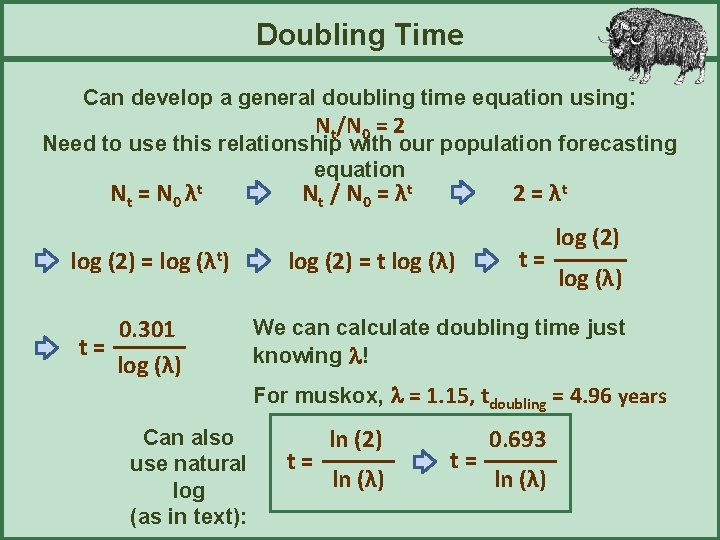
Doubling Time Can develop a general doubling time equation using: Nt/N 0 = 2 Need to use this relationship with our population forecasting equation N t = N 0 λt log (2) = log (λt) 0. 301 t= log (λ) Can also use natural log (as in text): N t / N 0 = λt 2 = λt log (2) = t log (λ) t= log (2) log (λ) We can calculate doubling time just knowing ! For muskox, = 1. 15, tdoubling = 4. 96 years t= ln (2) ln (λ) t= 0. 693 ln (λ)
Looking Ahead Next Class: Derive continuous population growth equation …and more!
- Slides: 21