
Fuzzy Numbers Definition Fuzzy Number n n Convex

Fuzzy Numbers
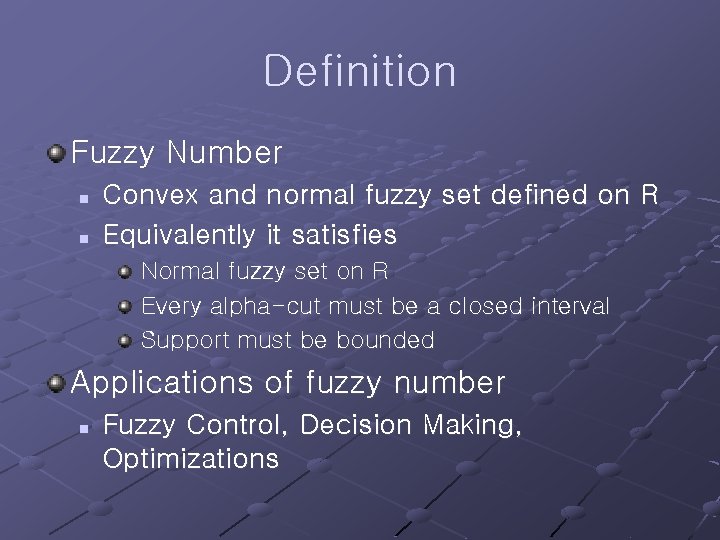
Definition Fuzzy Number n n Convex and normal fuzzy set defined on R Equivalently it satisfies Normal fuzzy set on R Every alpha-cut must be a closed interval Support must be bounded Applications of fuzzy number n Fuzzy Control, Decision Making, Optimizations
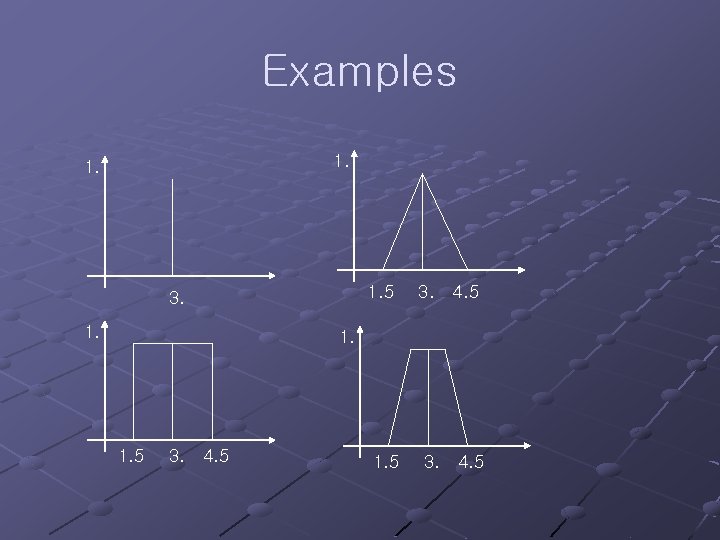
Examples 1. 1. 5 3. 1. 3. 4. 5 1. 5 3. 4. 5
![Arithmetic Operations Interval Operations A = [ a 1 , a 3 ] ,](http://slidetodoc.com/presentation_image_h/876b998e6866efad1d0a174a7e428345/image-4.jpg "Arithmetic Operations Interval Operations A = [ a 1 , a 3 ] ,")
Arithmetic Operations Interval Operations A = [ a 1 , a 3 ] , B = [ b 1 , b 3 ]
![Examples Addition [2, 5]+[1, 3]=[3, 8] [0, 1]+[-6, 5]=[-6, 6] Subtraction [2, 5]-[1, 3]=[-1,](http://slidetodoc.com/presentation_image_h/876b998e6866efad1d0a174a7e428345/image-5.jpg "Examples Addition [2, 5]+[1, 3]=[3, 8] [0, 1]+[-6, 5]=[-6, 6] Subtraction [2, 5]-[1, 3]=[-1,")
Examples Addition [2, 5]+[1, 3]=[3, 8] [0, 1]+[-6, 5]=[-6, 6] Subtraction [2, 5]-[1, 3]=[-1, 4] [0, 1]-[-6, 5]=[-5, 7] Multiplication [-1, 1]*[-2, -0. 5]=[-2, 2] [3, 4]*[2, 2]=[6, 8] Division [-1, 1]/[-2, -0. 5]=[-2, 2] [4, 10]*[1, 2]=[2, 10]
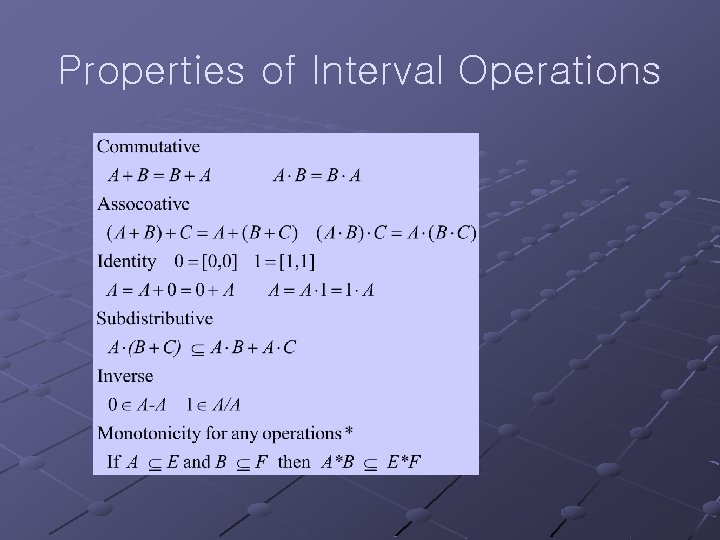
Properties of Interval Operations
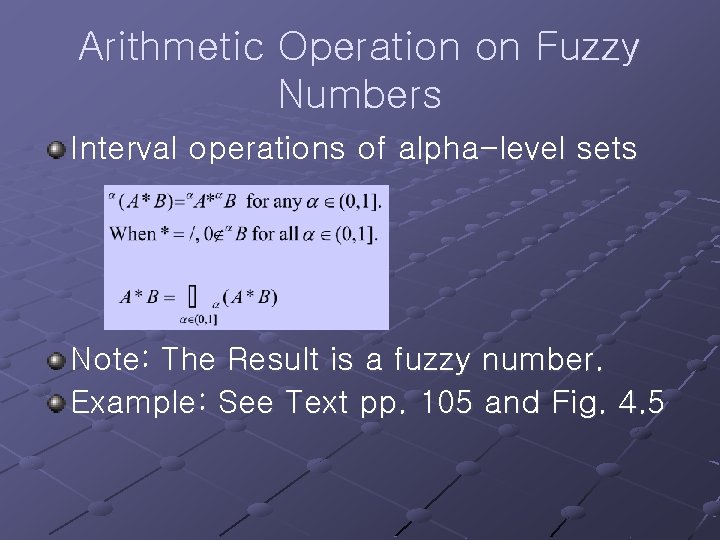
Arithmetic Operation on Fuzzy Numbers Interval operations of alpha-level sets Note: The Result is a fuzzy number. Example: See Text pp. 105 and Fig. 4. 5
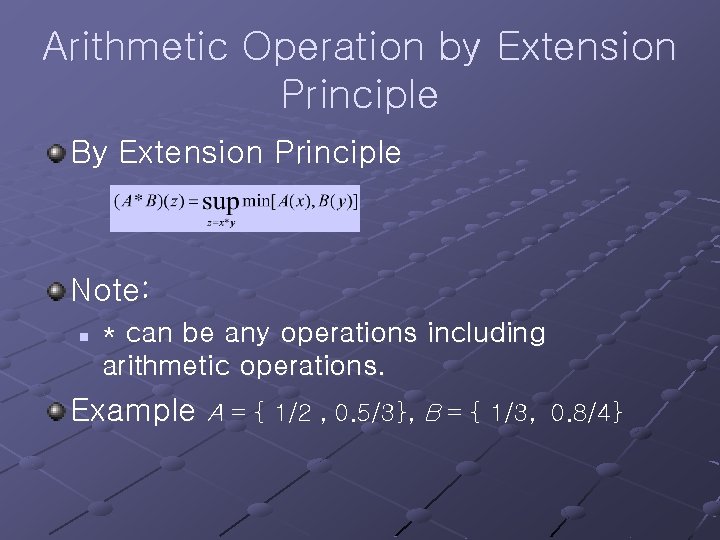
Arithmetic Operation by Extension Principle By Extension Principle Note: n * can be any operations including arithmetic operations. Example A = { 1/2 , 0. 5/3}, B = { 1/3, 0. 8/4}
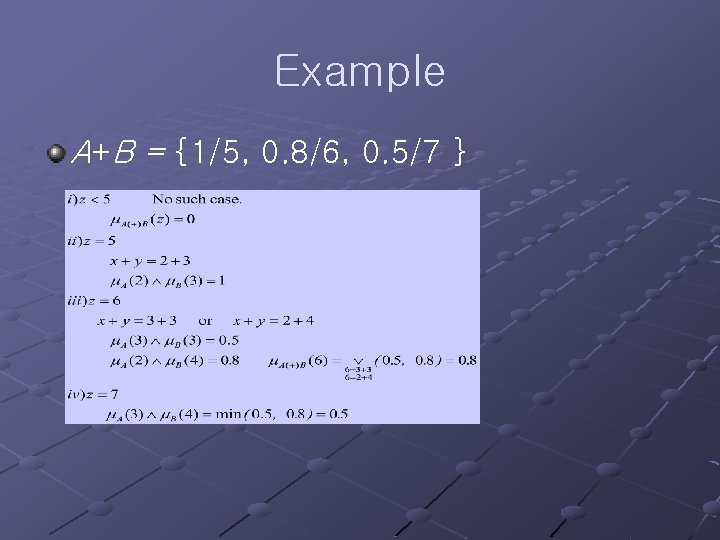
Example A+B = {1/5, 0. 8/6, 0. 5/7 }
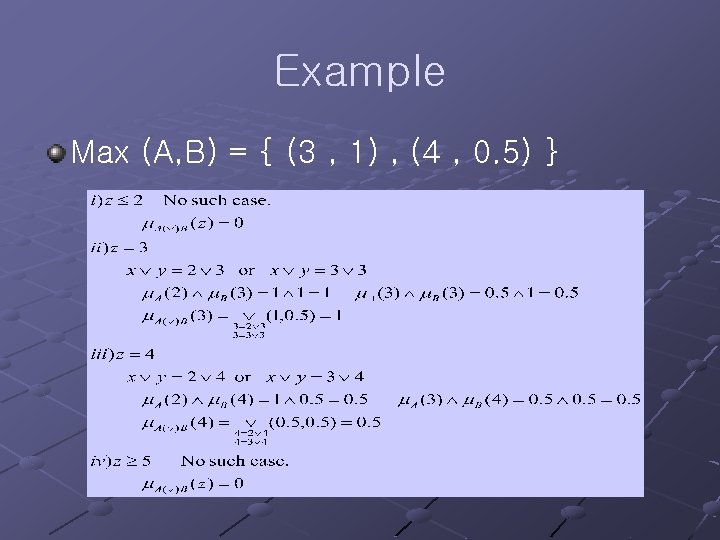
Example Max (A, B) = { (3 , 1) , (4 , 0. 5) }
Typical Fuzzy Numbers Triangular Fuzzy Number n Fig. 4. 5 Trapezoidal Fuzzy Numbers: Fig. 4. 4 Linguistic variable: ”Performance” Linguistic values (terms): “very small” … “very large” Semantic Rules: Terms maps on trapezoidal fuzzy numbers Syntactic rules (grammar): Rules for other terms such as “not small”

An Application of Optimal Decision Making n Which alternative are you going to choose? weighted average. How to make use of resulted fuzzy set Similarity comparisons with model fuzzy sets Criterion 1 Criterion 2 Criterion 3 Alternative 1 Low High Alternative 2 High Low Alternative 3 Low High Medium Weight of Attribute high medium Low
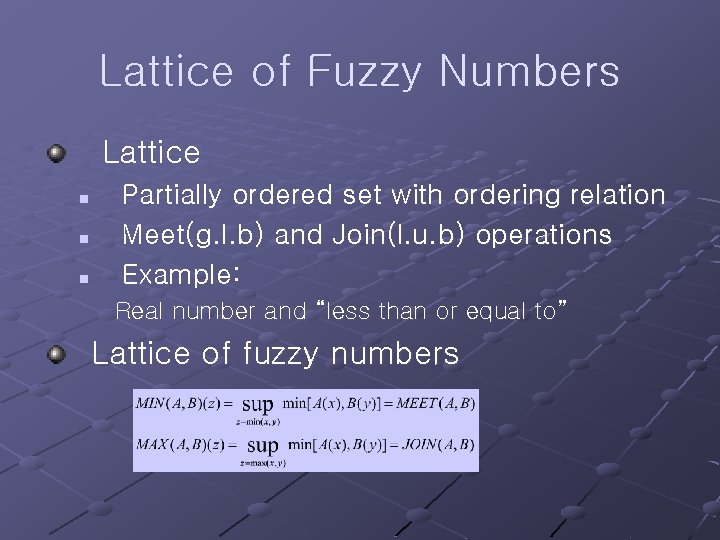
Lattice of Fuzzy Numbers Lattice n n n Partially ordered set with ordering relation Meet(g. l. b) and Join(l. u. b) operations Example: Real number and “less than or equal to” Lattice of fuzzy numbers
![Lattice of Fuzzy Numbers Distributive lattice n n MIN[A, MAX(B, C)]=MAX[MIN[A, B], MIN[A, C]]](http://slidetodoc.com/presentation_image_h/876b998e6866efad1d0a174a7e428345/image-14.jpg "Lattice of Fuzzy Numbers Distributive lattice n n MIN[A, MAX(B, C)]=MAX[MIN[A, B], MIN[A, C]]")
Lattice of Fuzzy Numbers Distributive lattice n n MIN[A, MAX(B, C)]=MAX[MIN[A, B], MIN[A, C]] MAX[A, MIN(B, C)]=MIN[MAX[A, B], MAX[A, C]] Example: See Fig. 4. 6 Example: “very small” <= “small” <= … <= “very large”
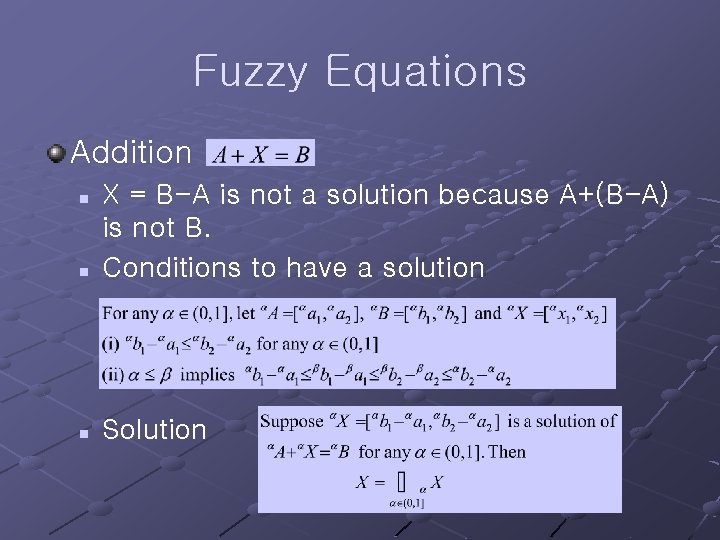
Fuzzy Equations Addition n X = B-A is not a solution because A+(B-A) is not B. Conditions to have a solution n Solution n
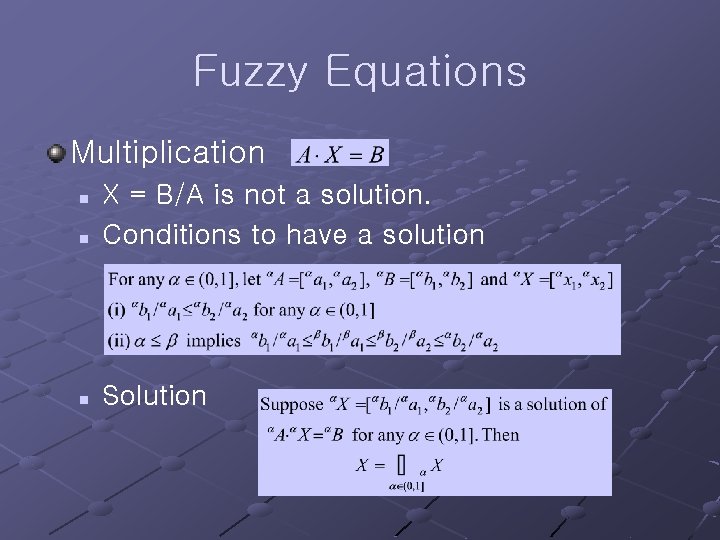
Fuzzy Equations Multiplication n X = B/A is not a solution. Conditions to have a solution n Solution n
- Slides: 16