
FUTURE TENSES will be going to present continuous
FUTURE TENSES will be going to present continuous present simple
NÁZEV ŠKOLY: Gymnázium Lovosice, Sady pionýrů 600/6 ČÍSLO PROJEKTU: CZ. 1. 07/1. 5. 00/34. 1073 NÁZEV MATERIÁLU: VY_32_INOVACE_4 B_07_Future. tenses TÉMA SADY: Gramatická cvičení z angličtiny ROČNÍK: tercie DATUM VZNIKU: září 2013 AUTOR: Mgr. Lucie Kučerová
Anotace • tento výukový materiál slouží k procvičení gramatických struktur sloužících k vyjádření budoucnosti v angličtině a je určen pro interaktivní tabule • snímky číslo pět až osm objasňují užití těchto struktur v praxi; teoretické vysvětlení se objeví až po kliknutí, což nabízí prostor pro interakci studentů • snímek číslo devět je prvním cvičením; studenti mají za úkol vyplnit si diář danými úkoly a poté ve skupinách domluvit termín pro společnou akci • druhé cvičení se nachází na snímku číslo deset; úkolem je použít správný tvar budoucího času za použití slov v závorkách; řešení se objeví při kliknutí na žluté obdélníky
FUTURE TENSES • in English there is actually no future tense • we use other structures to express future • these structures include modal verb will, preset continuous, present simple, the phrase of „be going to“ and others • there also exist more difficult structures of future perfect (will have done) and future continuous (will be doing)
WILL • decision at the moment of speaking, typically offers, requests, promises, refusals • The phone is ringing. I will answer it. • Martin cannot understand the homework. Will you help him? • unplanned, uncertain future events • We will probably come a bit later. • Maybe, I will not be able to go shopping tomorrow. • personal predictions, usually along with verbs expressing thoughts or belives, e. g. hope, believe, be sure, think etc. • I hope she will like the book • Tom is sure he will manage to finish the work in time.
BE BOING TO • long-term plans, which we have already decided to do • We are going to visit my parents on Saturday. • I am not going to travel during the summer. • predictions we cannot control, but are obvious; e. g. we can see them • The building is going to fall down. (We can see it is badly demaged. ) • It is going to rain. (There are heavy clouds in the sky. )
PRESENT CONTINUOUS • arranged, fully planned future events diary based plans • we usually know all the details (time, place, etc. ) • My parents are vising us at the weekend. • I am seeing my dentist on Wednesday.
PRESENT SIMPLE • timetable events, regular schedule • What does the train leave? • The shop opens at 7. 30. • x The shop is opening at 7. 30. (One time arranged occasion vs regular one) • to express the future in time/conditional clauses; after if, when as soon as, until etc. • We will text you as soon as we arrive. • When the match starts, we will be there!
Excercise n° 1 Make a few notes into your diary (Monday to Sunday). Include the following: • 2 arranged events • 3 plans • 3 activities you hope to join Now try to arrange a meeting with two or more friends. Discuss you diary notes and find the best time for it.
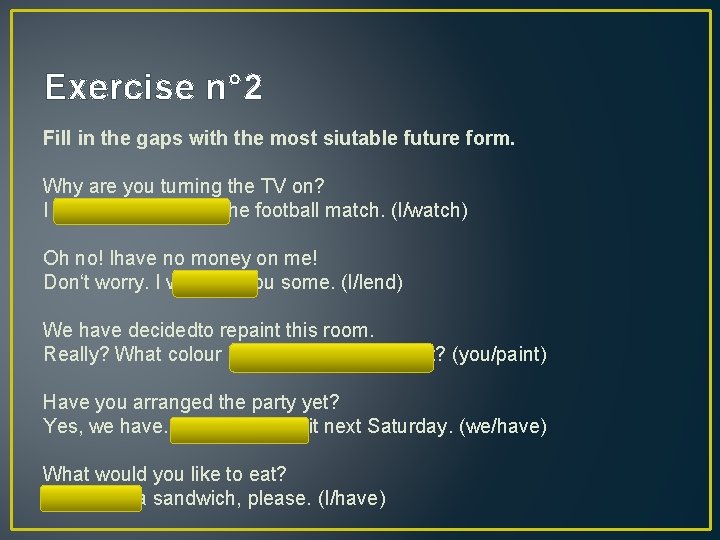
Exercise n° 2 Fill in the gaps with the most siutable future form. Why are you turning the TV on? I am going to watch the football match. (I/watch) Oh no! Ihave no money on me! Don‘t worry. I will lend you some. (I/lend) We have decidedto repaint this room. Really? What colour are you going to paint it? (you/paint) Have you arranged the party yet? Yes, we have. We are having it next Saturday. (we/have) What would you like to eat? I will have a sandwich, please. (I/have)

Zdroje obrázků V prezentaci byly použity obrázky z galerie Microsoft office, včetně webu Office. com.
- Slides: 11