
future tenses in English There are several ways
- Slides: 20
future tenses in English
There are several ways to express the future. Let’s see two of those ways. • 1. With the modal WILL. (Future Simple) • 2. With BE GOING TO
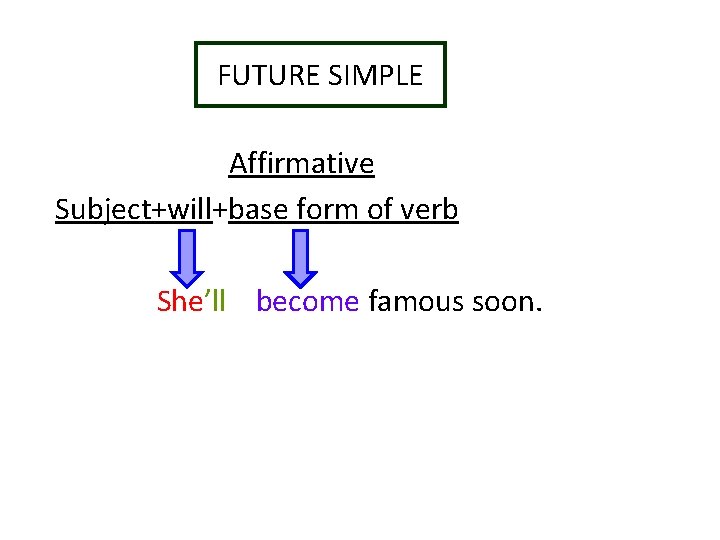
FUTURE SIMPLE Affirmative Subject+will+base form of verb She’ll become famous soon.
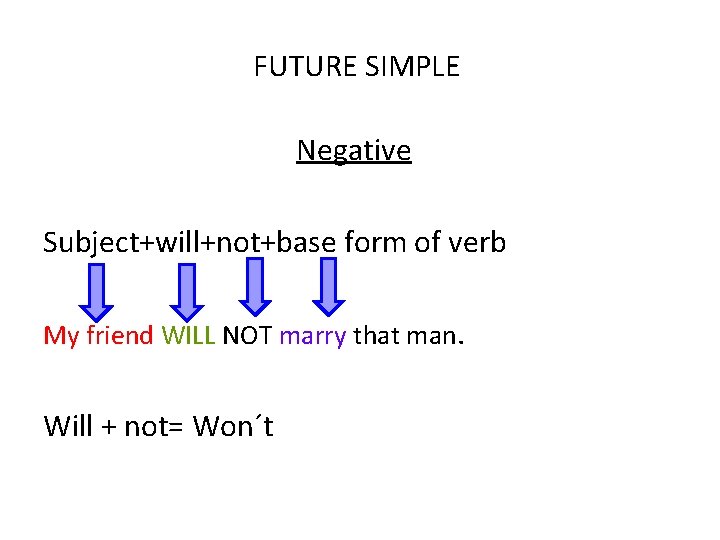
FUTURE SIMPLE Negative Subject+will+not+base form of verb My friend WILL NOT marry that man. Will + not= Won´t
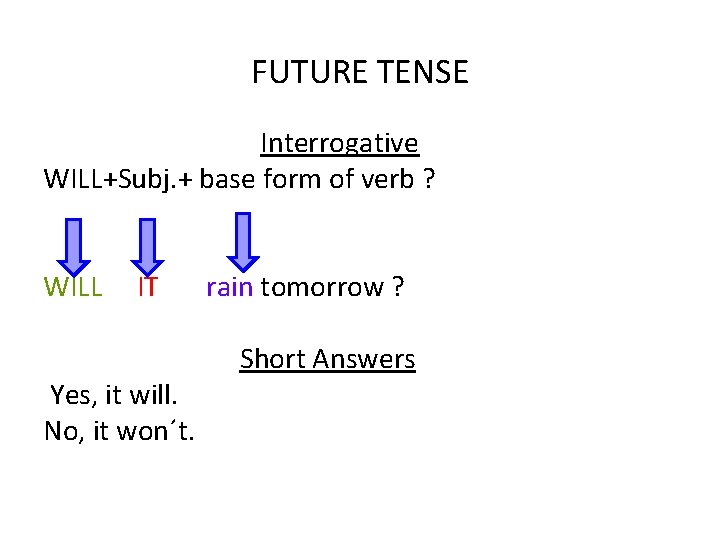
FUTURE TENSE Interrogative WILL+Subj. + base form of verb ? WILL IT Yes, it will. No, it won´t. rain tomorrow ? Short Answers
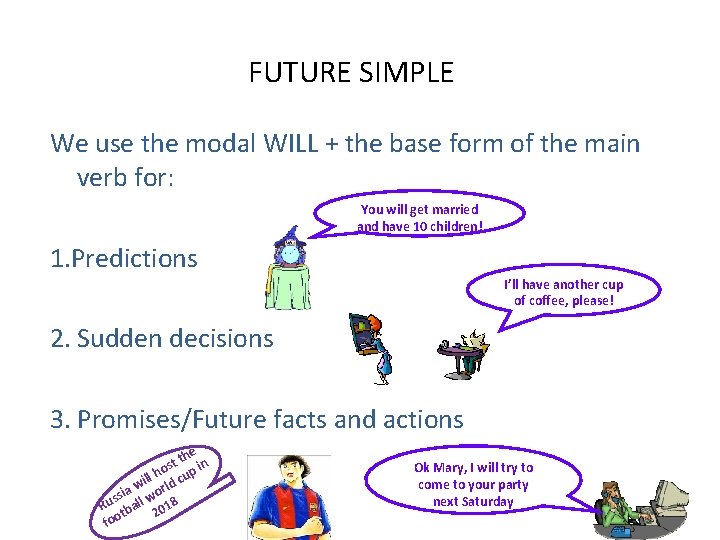
FUTURE SIMPLE We use the modal WILL + the base form of the main verb for: You will get married and have 10 children! 1. Predictions I’ll have another cup of coffee, please! 2. Sudden decisions 3. Promises/Future facts and actions the n t s i o li l h d cup ia w worl s s Ru tball 018 2 foo Ok Mary, I will try to come to your party next Saturday
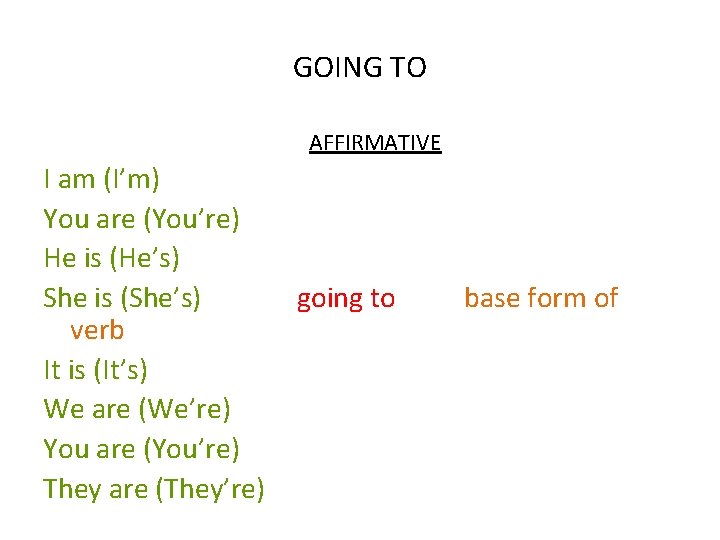
GOING TO AFFIRMATIVE I am (I’m) You are (You’re) He is (He’s) She is (She’s) verb It is (It’s) We are (We’re) You are (You’re) They are (They’re) going to base form of
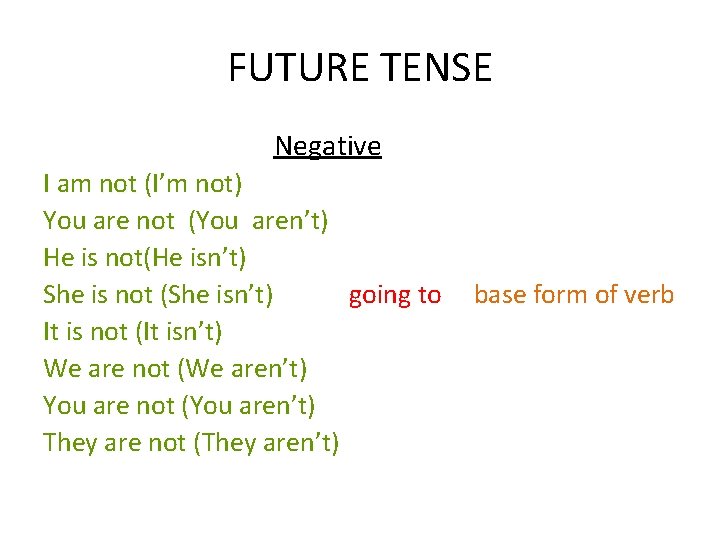
FUTURE TENSE Negative I am not (I’m not) You are not (You aren’t) He is not(He isn’t) not She is not (She isn’t) going to It is not (It isn’t) We are not (We aren’t) You are not (You aren’t) They are not (They aren’t) base form of verb
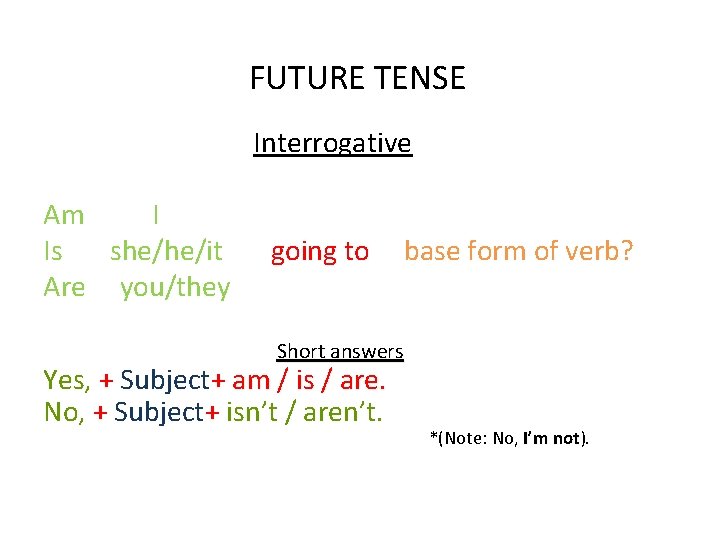
FUTURE TENSE Interrogative Am I Is she/he/it Are you/they going to base form of verb? Short answers Yes, + Subject+ am / is / are. No, + Subject+ isn’t / aren’t. *(Note: No, I’m not). not
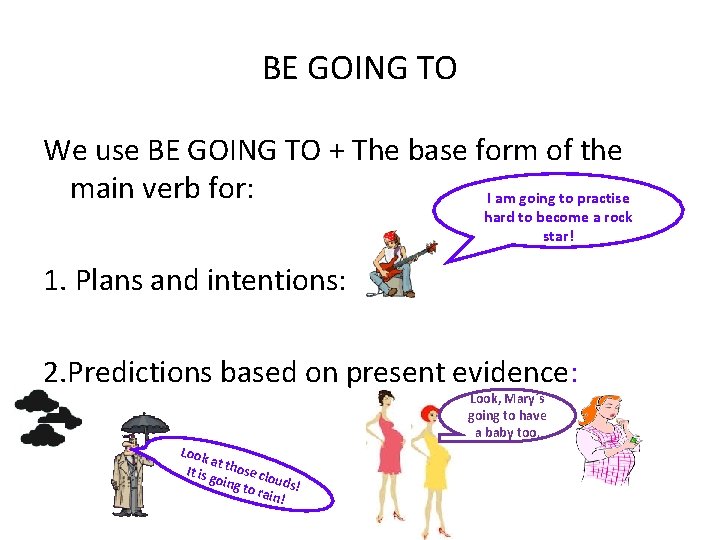
BE GOING TO We use BE GOING TO + The base form of the main verb for: I am going to practise hard to become a rock star! 1. Plans and intentions: 2. Predictions based on present evidence: Look, Mary´s going to have a baby too. Look at It is g those cl ou oing to ra ds! in!
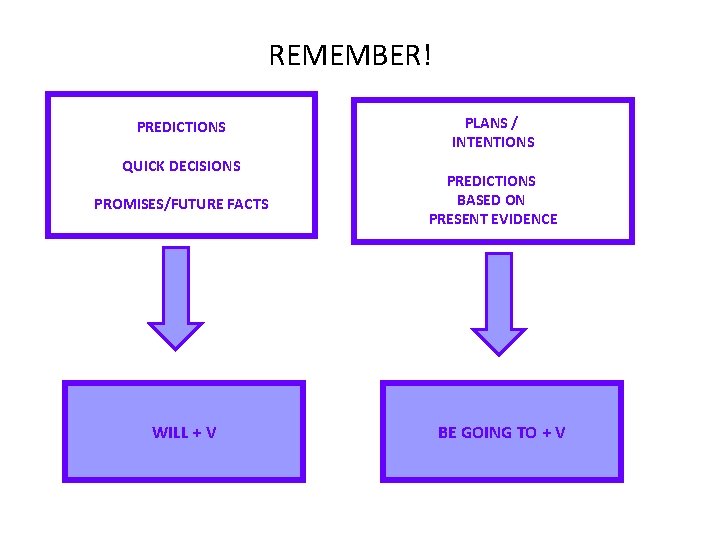
REMEMBER! PREDICTIONS QUICK DECISIONS PROMISES/FUTURE FACTS WILL + V PLANS / INTENTIONS PREDICTIONS BASED ON PRESENT EVIDENCE BE GOING TO + V
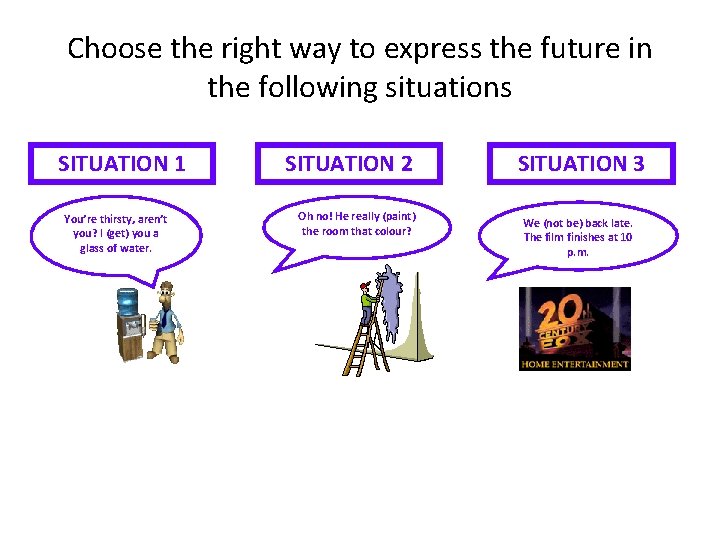
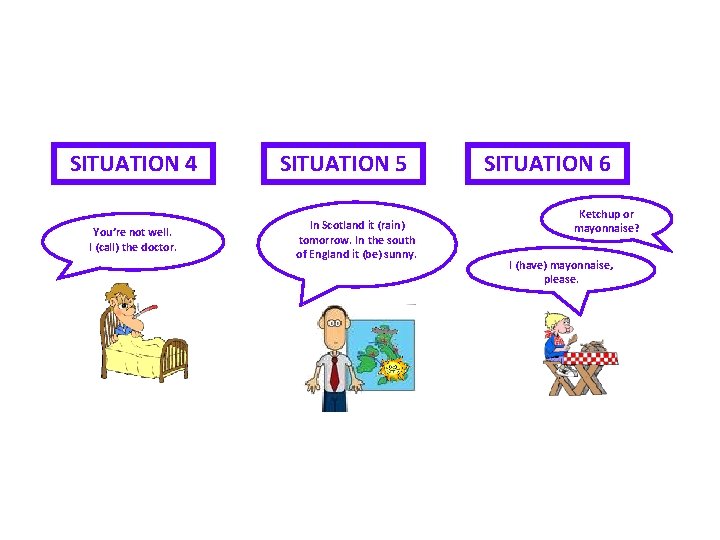
Choose the right way to express the future in the following situations SITUATION 1 You’re thirsty, aren’t you? I (get) you a glass of water. SITUATION 2 Oh no! He really (paint) the room that colour? SITUATION 3 We (not be) back late. The film finishes at 10 p. m.
SITUATION 4 You’re not well. I (call) the doctor. SITUATION 5 In Scotland it (rain) tomorrow. In the south of England it (be) sunny. SITUATION 6 Ketchup or mayonnaise? I (have) mayonnaise, please.
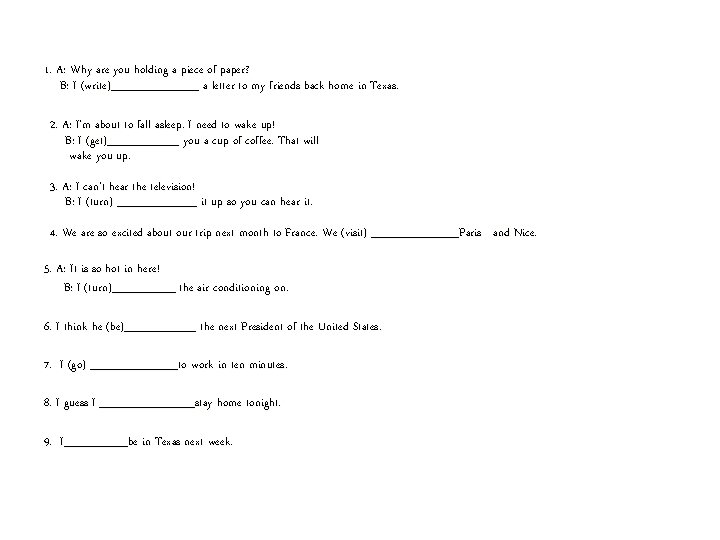
1. A: Why are you holding a piece of paper? B: I (write)______ a letter to my friends back home in Texas. 2. A: I'm about to fall asleep. I need to wake up! B: I (get)_____ you a cup of coffee. That will wake you up. 3. A: I can't hear the television! B: I (turn) _____ it up so you can hear it. 4. We are so excited about our trip next month to France. We (visit) ______Paris and Nice. 5. A: It is so hot in here! B: I (turn)____ the air conditioning on. 6. I think he (be)_____ the next President of the United States. 7. I (go) ______to work in ten minutes. 8. I guess I ______stay home tonight. 9. I____be in Texas next week.
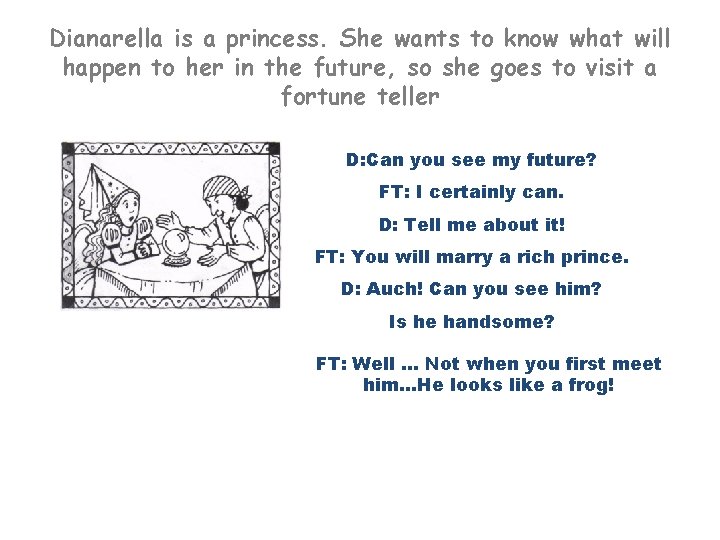
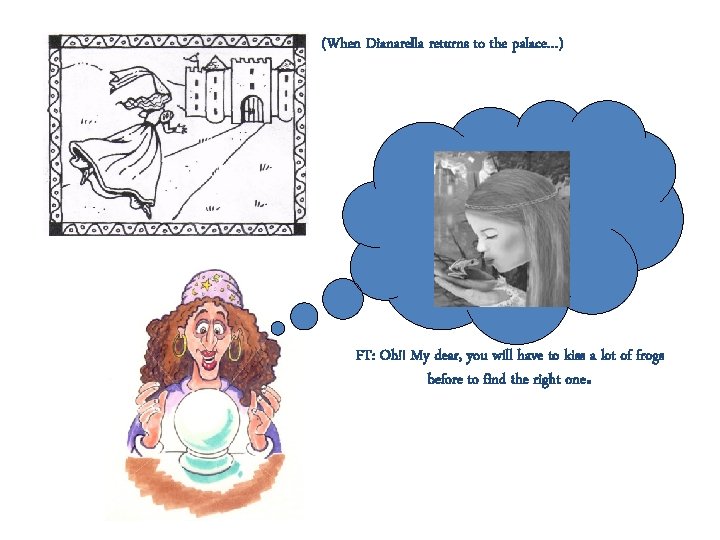
Dianarella is a princess. She wants to know what will happen to her in the future, so she goes to visit a fortune teller D: Can you see my future? FT: I certainly can. D: Tell me about it! FT: You will marry a rich prince. D: Auch! Can you see him? Is he handsome? FT: Well … Not when you first meet him…He looks like a frog!
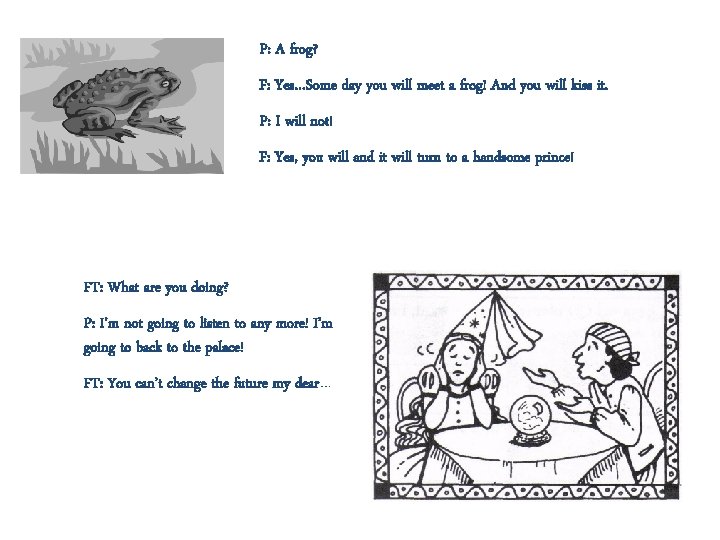
P: A frog? F: Yes…Some day you will meet a frog! And you will kiss it. P: I will not! F: Yes, you will and it will turn to a handsome prince! FT: What are you doing? P: I’m not going to listen to any more! I’m going to back to the palace! FT: You can’t change the future my dear…
(When Dianarella returns to the palace…) FT: Oh!! My dear, you will have to kiss a lot of frogs before to find the right one.
OTHER WAYS OF EXPRESSING THE FUTURE The simple present and present progressive are also used to express future time. These are often used in connection with schedules. -The train leaves at 6: 00 a. m. tomorrow. -She is meeting a new client at six o’clock in the evening and she is travelling by byke through the forest.
• • • 1. The present continuous for future plans: fixed plans with definite time and/or place. Examples: I'm doing my homework this evening. I'm starting university in September. Sally is meeting John at seven o'clock this evening in a restaurant downtown. 2. To be + going to + verb: A. We use 'going to' to express the future when we intend to do something or have decided to do something but did not arrange it. It is just an intention. Example: A: The windows are dirty. B: Yes I know. I'm going to clean them later. B. We also use 'going to' to make predictions. Watch out! you are going to break the glass. It's so cloudy! I think it's going to rain.
present continuous and be going to with future meaning • Complete the text with the correct form of the verb. Use short forms if possible. Type the verb into the box. I (1)…………………. . (go) on holiday with my best friend next week and I've just finished making the travel arrangements! I (2)……………. . (meet) Jack at the station at five o'clock and we (3)…………. (leave) on the 5. 30 train. We (4)…………… (catch) the ferry at Dover at 7 p. m. We haven't booked anywhere to stay yet, so we (5)…………………. . (find) a hotel when we arrive. We haven't got a lot of money, so we (6)…………. . (look for) somewhere cheap. I can't wait! I'm sure we (7)…………. (have) a fantastic time!