
FUTURE REGULATION OF THE UK GAS GRID Annex

- Slides: 13
FUTURE REGULATION OF THE UK GAS GRID Annex 1: Current stakeholder landscape 22 April 2016 Confidential
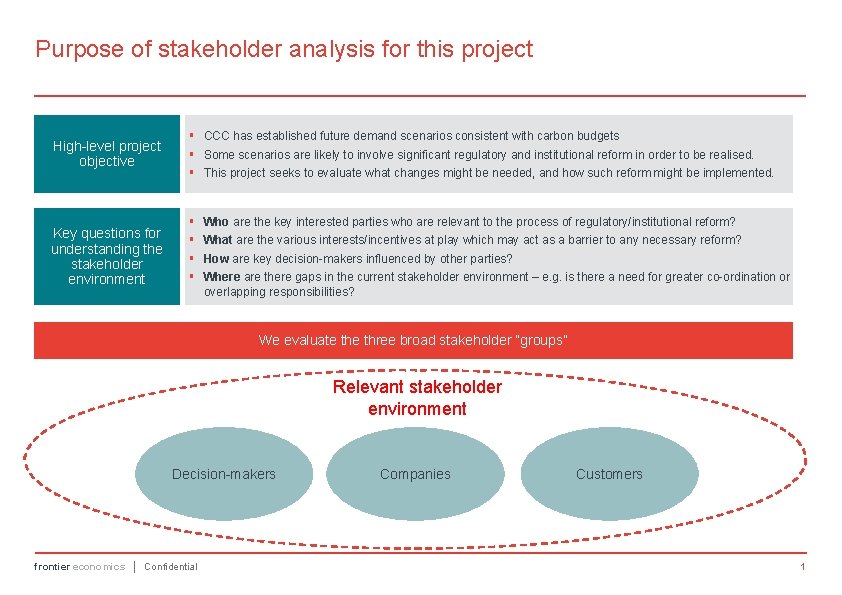
Purpose of stakeholder analysis for this project High-level project objective Key questions for understanding the stakeholder environment § CCC has established future demand scenarios consistent with carbon budgets § Some scenarios are likely to involve significant regulatory and institutional reform in order to be realised. § This project seeks to evaluate what changes might be needed, and how such reform might be implemented. § § Who are the key interested parties who are relevant to the process of regulatory/institutional reform? What are the various interests/incentives at play which may act as a barrier to any necessary reform? How are key decision-makers influenced by other parties? Where are there gaps in the current stakeholder environment – e. g. is there a need for greater co-ordination or overlapping responsibilities? We evaluate three broad stakeholder “groups” Relevant stakeholder environment Decision-makers frontier economics │ Confidential Companies Customers 1
Contents 1 Description of stakeholder groups 2 Discussion of stakeholder incentives/issues and drivers of behaviour frontier economics │ Confidential 2
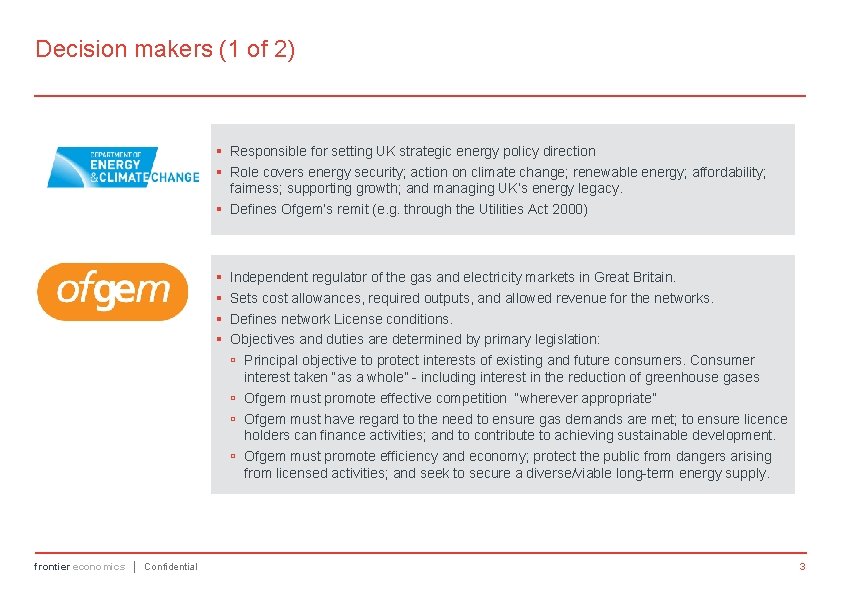
Decision makers (1 of 2) § Responsible for setting UK strategic energy policy direction § Role covers energy security; action on climate change; renewable energy; affordability; fairness; supporting growth; and managing UK’s energy legacy. § Defines Ofgem’s remit (e. g. through the Utilities Act 2000) § § frontier economics │ Confidential Independent regulator of the gas and electricity markets in Great Britain. Sets cost allowances, required outputs, and allowed revenue for the networks. Defines network License conditions. Objectives and duties are determined by primary legislation: Principal objective to protect interests of existing and future consumers. Consumer interest taken “as a whole” - including interest in the reduction of greenhouse gases Ofgem must promote effective competition “wherever appropriate” Ofgem must have regard to the need to ensure gas demands are met; to ensure licence holders can finance activities; and to contribute to achieving sustainable development. Ofgem must promote efficiency and economy; protect the public from dangers arising from licensed activities; and seek to secure a diverse/viable long-term energy supply. 3
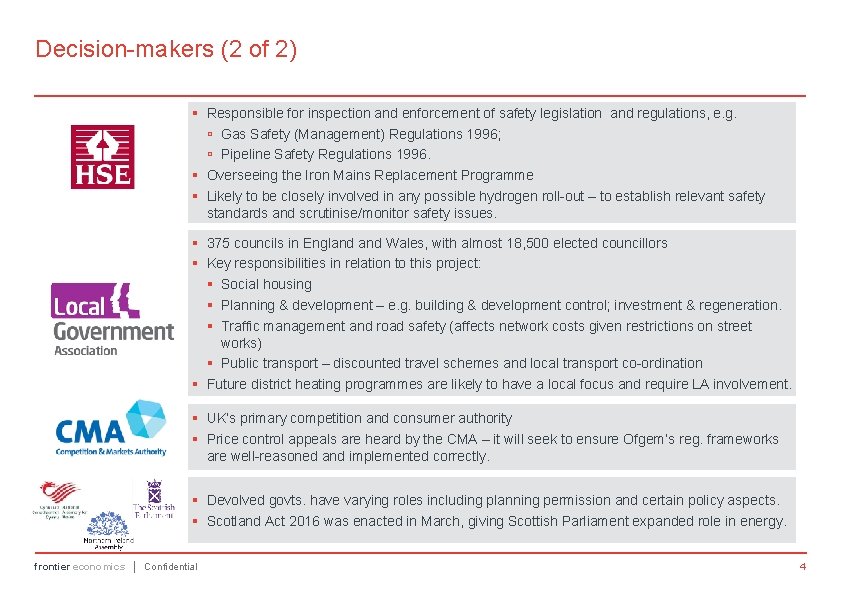
Decision-makers (2 of 2) § Responsible for inspection and enforcement of safety legislation and regulations, e. g. Gas Safety (Management) Regulations 1996; Pipeline Safety Regulations 1996. § Overseeing the Iron Mains Replacement Programme § Likely to be closely involved in any possible hydrogen roll-out – to establish relevant safety standards and scrutinise/monitor safety issues. § 375 councils in England Wales, with almost 18, 500 elected councillors § Key responsibilities in relation to this project: § Social housing § Planning & development – e. g. building & development control; investment & regeneration. § Traffic management and road safety (affects network costs given restrictions on street works) § Public transport – discounted travel schemes and local transport co-ordination § Future district heating programmes are likely to have a local focus and require LA involvement. § UK’s primary competition and consumer authority § Price control appeals are heard by the CMA – it will seek to ensure Ofgem’s reg. frameworks are well-reasoned and implemented correctly. § Devolved govts. have varying roles including planning permission and certain policy aspects. § Scotland Act 2016 was enacted in March, giving Scottish Parliament expanded role in energy. frontier economics │ Confidential 4
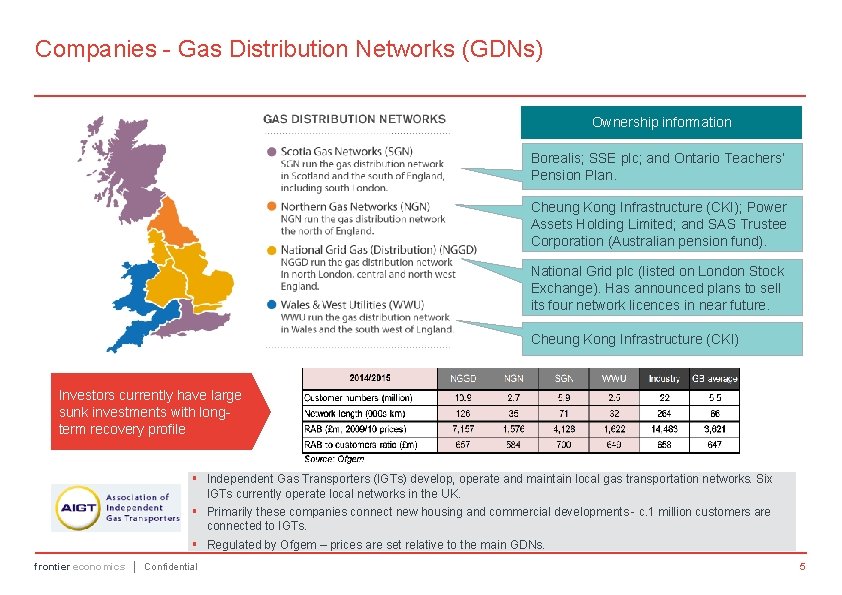
Companies - Gas Distribution Networks (GDNs) Ownership information Borealis; SSE plc; and Ontario Teachers’ Pension Plan. Cheung Kong Infrastructure (CKI); Power Assets Holding Limited; and SAS Trustee Corporation (Australian pension fund). National Grid plc (listed on London Stock Exchange). Has announced plans to sell its four network licences in near future. Cheung Kong Infrastructure (CKI) Investors currently have large sunk investments with longterm recovery profile § Independent Gas Transporters (IGTs) develop, operate and maintain local gas transportation networks. Six IGTs currently operate local networks in the UK. § Primarily these companies connect new housing and commercial developments - c. 1 million customers are connected to IGTs. § Regulated by Ofgem – prices are set relative to the main GDNs. frontier economics │ Confidential 5
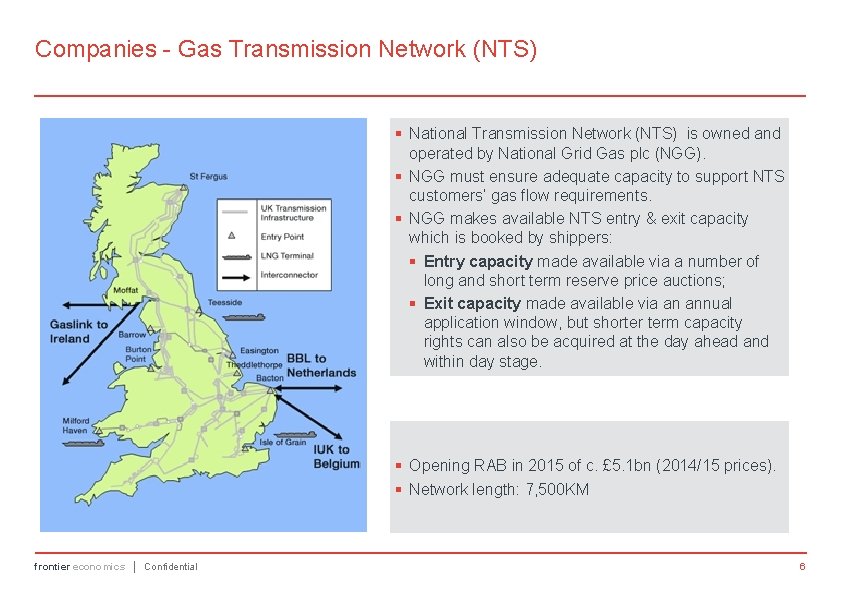
Companies - Gas Transmission Network (NTS) § National Transmission Network (NTS) is owned and operated by National Grid Gas plc (NGG). § NGG must ensure adequate capacity to support NTS customers’ gas flow requirements. § NGG makes available NTS entry & exit capacity which is booked by shippers: § Entry capacity made available via a number of long and short term reserve price auctions; § Exit capacity made available via an annual application window, but shorter term capacity rights can also be acquired at the day ahead and within day stage. § Opening RAB in 2015 of c. £ 5. 1 bn (2014/15 prices). § Network length: 7, 500 KM frontier economics │ Confidential 6
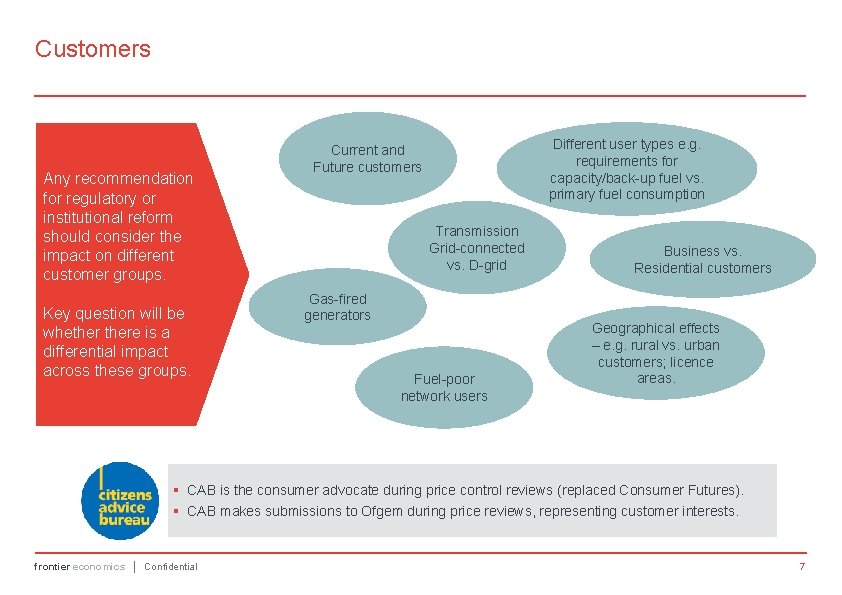
Customers Any recommendation for regulatory or institutional reform should consider the impact on different customer groups. Key question will be whethere is a differential impact across these groups. Different user types e. g. requirements for capacity/back-up fuel vs. primary fuel consumption Current and Future customers Transmission Grid-connected vs. D-grid Gas-fired generators Fuel-poor network users Business vs. Residential customers Geographical effects – e. g. rural vs. urban customers; licence areas. § CAB is the consumer advocate during price control reviews (replaced Consumer Futures). § CAB makes submissions to Ofgem during price reviews, representing customer interests. frontier economics │ Confidential 7
Contents 1 Description of stakeholder group 2 Discussion of stakeholder incentives/issues and drivers of behaviour frontier economics │ Confidential 8
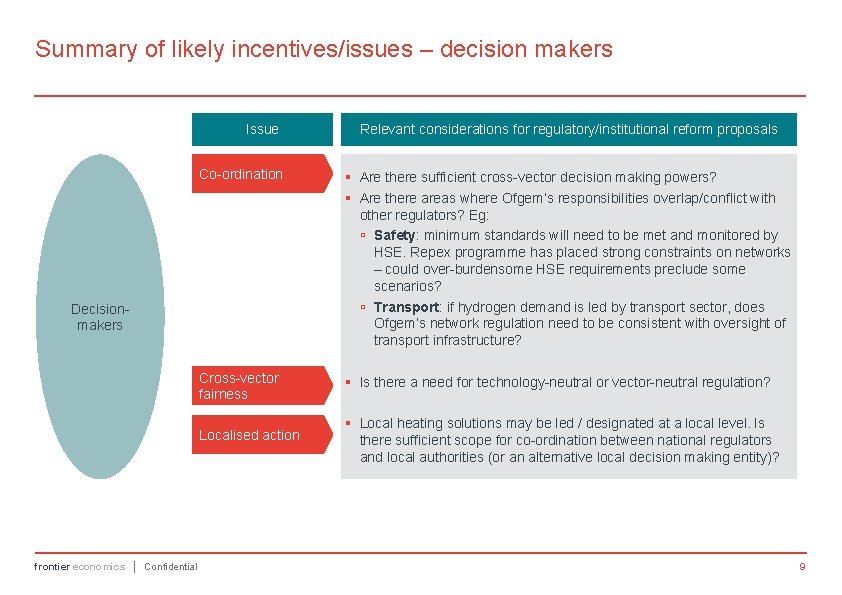
Summary of likely incentives/issues – decision makers Issue Co-ordination § Are there sufficient cross-vector decision making powers? § Are there areas where Ofgem’s responsibilities overlap/conflict with other regulators? Eg: Safety: minimum standards will need to be met and monitored by HSE. Repex programme has placed strong constraints on networks – could over-burdensome HSE requirements preclude some scenarios? Transport: if hydrogen demand is led by transport sector, does Ofgem’s network regulation need to be consistent with oversight of transport infrastructure? Cross-vector fairness § Is there a need for technology-neutral or vector-neutral regulation? Localised action § Local heating solutions may be led / designated at a local level. Is there sufficient scope for co-ordination between national regulators and local authorities (or an alternative local decision making entity)? Decisionmakers frontier economics │ Confidential Relevant considerations for regulatory/institutional reform proposals 9
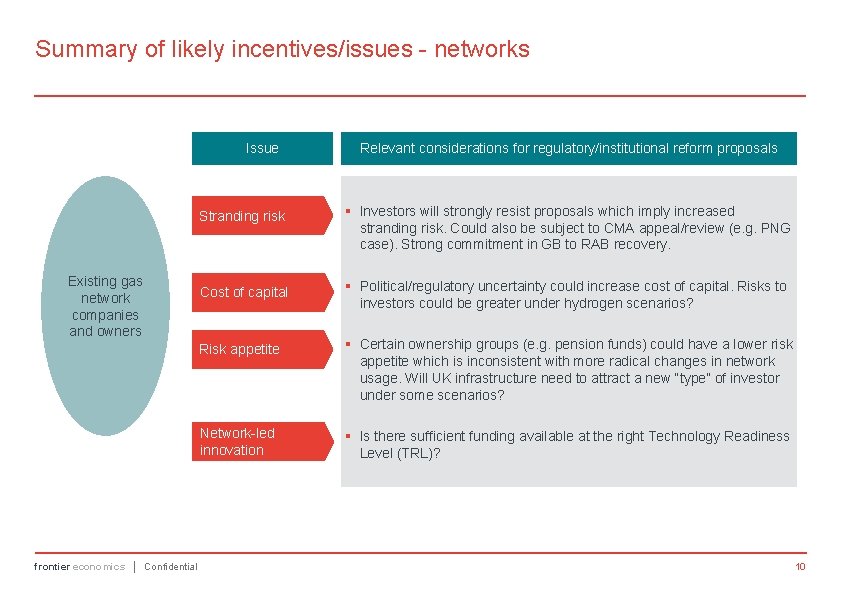
Summary of likely incentives/issues - networks Issue Existing gas network companies and owners frontier economics │ Confidential Relevant considerations for regulatory/institutional reform proposals Stranding risk § Investors will strongly resist proposals which imply increased stranding risk. Could also be subject to CMA appeal/review (e. g. PNG case). Strong commitment in GB to RAB recovery. Cost of capital § Political/regulatory uncertainty could increase cost of capital. Risks to investors could be greater under hydrogen scenarios? Risk appetite § Certain ownership groups (e. g. pension funds) could have a lower risk appetite which is inconsistent with more radical changes in network usage. Will UK infrastructure need to attract a new “type” of investor under some scenarios? Network-led innovation § Is there sufficient funding available at the right Technology Readiness Level (TRL)? 10
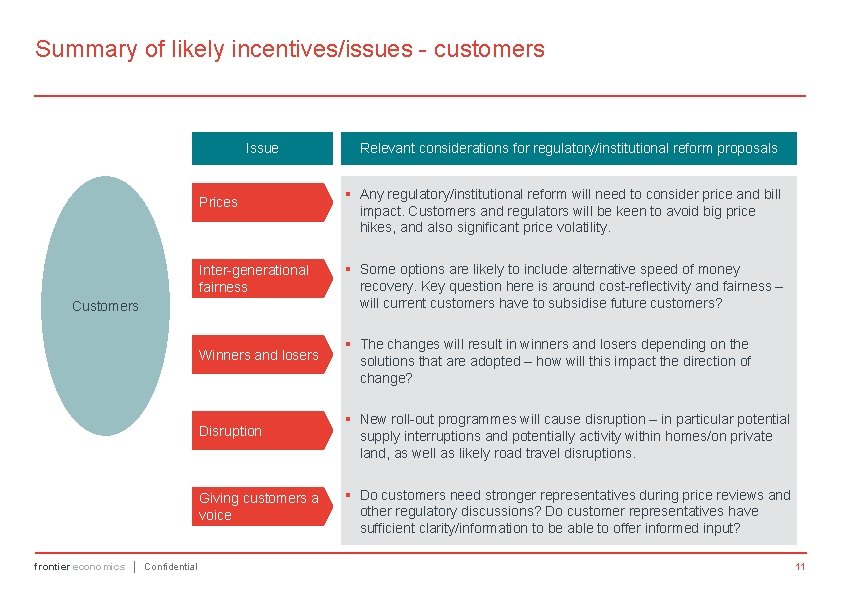
Summary of likely incentives/issues - customers Issue Prices Inter-generational fairness Customers frontier economics │ Confidential Relevant considerations for regulatory/institutional reform proposals § Any regulatory/institutional reform will need to consider price and bill impact. Customers and regulators will be keen to avoid big price hikes, and also significant price volatility. § Some options are likely to include alternative speed of money recovery. Key question here is around cost-reflectivity and fairness – will current customers have to subsidise future customers? Winners and losers § The changes will result in winners and losers depending on the solutions that are adopted – how will this impact the direction of change? Disruption § New roll-out programmes will cause disruption – in particular potential supply interruptions and potentially activity within homes/on private land, as well as likely road travel disruptions. Giving customers a voice § Do customers need stronger representatives during price reviews and other regulatory discussions? Do customer representatives have sufficient clarity/information to be able to offer informed input? 11
Frontier Economics Ltd is a member of the Frontier Economics network, which consists of two separate companies based in Europe (Frontier Economics Ltd, with offices in Brussels, Cologne, Dublin, London & Madrid) and Australia (Frontier Economics Pty Ltd, with offices in Melbourne & Sydney). Both companies are independently owned, and legal commitments entered into by one company do not impose any obligations on the other company in the network. All views expressed in this document are the views of Frontier Economics Ltd.