
Future of Qualitative Research in Human Nutrition Summary

- Slides: 12
Future of Qualitative Research in Human Nutrition Summary Notes
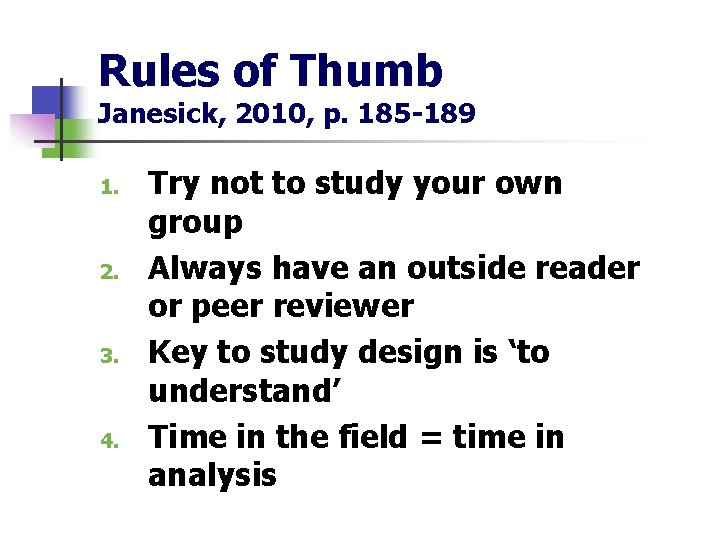
Rules of Thumb Janesick, 2010, p. 185 -189 1. 2. 3. 4. Try not to study your own group Always have an outside reader or peer reviewer Key to study design is ‘to understand’ Time in the field = time in analysis
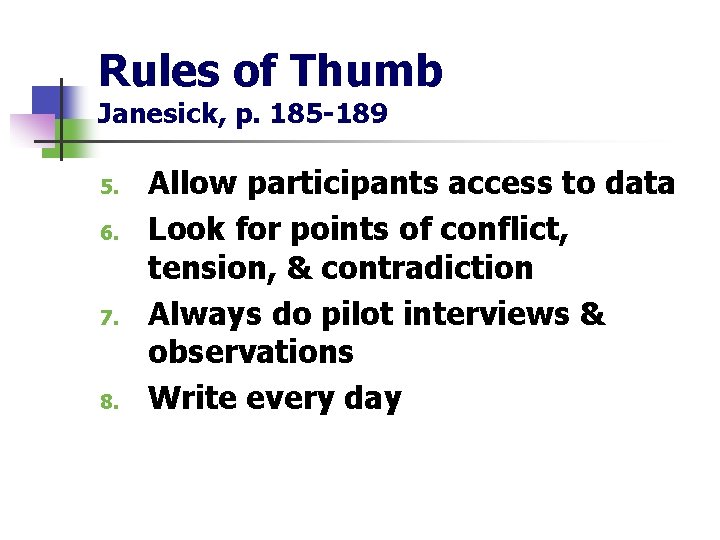
Rules of Thumb Janesick, p. 185 -189 5. 6. 7. 8. Allow participants access to data Look for points of conflict, tension, & contradiction Always do pilot interviews & observations Write every day
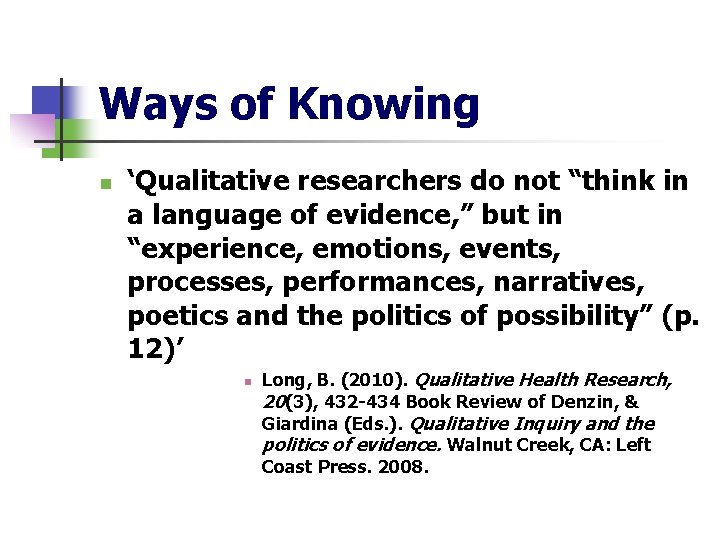
Ways of Knowing n ‘Qualitative researchers do not “think in a language of evidence, ” but in “experience, emotions, events, processes, performances, narratives, poetics and the politics of possibility” (p. 12)’ n Long, B. (2010). Qualitative Health Research, 20(3), 432 -434 Book Review of Denzin, & Giardina (Eds. ). Qualitative Inquiry and the politics of evidence. Walnut Creek, CA: Left Coast Press. 2008.
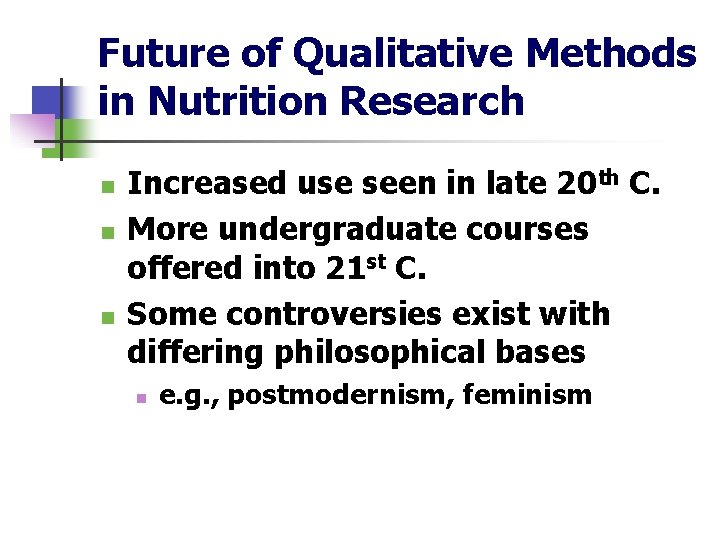
Future of Qualitative Methods in Nutrition Research n n n Increased use seen in late 20 th C. More undergraduate courses offered into 21 st C. Some controversies exist with differing philosophical bases n e. g. , postmodernism, feminism
Interdisciplinary Directions n n n Practice becoming more collaborative Research following same path Journals provide publication for interdisciplinary research n Aging, education, communication, cultural studies
Applied Qualitative Research n n n Often team-based Study social problems with goal to change situation Aging, education, program evaluation, health inequities
Debates n n “. . . Early adopters of qualitative approaches in the health research arena were confronted with a rather hostile environment within which to try to defend their research approaches and findings. ” “. . . Creating a serious barrier for scholars seeking to make inroads into competitive funding or find venues within which to publish their research. ” n Thorne, S. (2011). Toward methodological emancipation in applied health research. Qual Health Res, 21(4), 443 -453.
Debates n Thorne (2011) suggests n n Need to diverge from social science and from health research Develop qualitative health research n “. . . an entirely distinct subset of the qualitative research genre (Morse, 2010). ”
Debates n Interdisciplinary debates will continue n n May lead to richer approaches with combined viewpoints over time Need to stay “experience-near” and ground knowledge in “what the fieldworker has seen, heard & experienced” to address debates n Warren, & Karner, 2005, p. 270
Debates n INTRA-disciplinary debates n n n Norlyk, & Harder (2010). What makes a phenomenological study phenomenological? An analysis of peer-reviewed empirical nursing studies. Qualitative Health Research, 20(3), 420 -431. 18 different forms of phenomenology identified 3 main themes to debate in nursing from this review n n 1. arguments over philosophical interpretation 2. discussion of phenomenology vs. other qualitative approaches n n -- descriptive vs. interpretive approaches – focus on similarities and differences 3. discussion of rigor within phenomenology in nursing
Debates n ‘“It is far less important to be indentifying enemies and threats to qualitative inquiry than to be developing and pursuing activist qualitative inquiry agendas” (p. 122)’ n Denzin, & Giardina (2008). Cited in Long, 2010)