
Future of Internet Governance Arrangements Internet Governance Capacity
- Slides: 23
Future of Internet Governance Arrangements Internet Governance Capacity Building Programme Presentation by Research Group IGF in Hyderabad December 3 -6, 2008
Research topic Main goals: Identifying the main global models of Internet Governance policy-making, the actors involved and the dynamics of decision-making Identifyinh the best practices in regional/national approaches of policy and strategy drafting and implementation Making recommendations based on best practices that could be replicated
Relevance of theme Governance is one of the most important among Internetrelated issues, since all other policy areas must be debated within an established framework. These arrangements may show different levels of institutionalisation and formality, but they will determine the way in which different actors will interact, as well as the nature of the outcomes of the decision-making processes. To analyse the decision-making processes of different organisations and to identify best practices that could be replicated is a precondition to the improvement of decision-making regarding IG-related themes.
Research Summary – Part One was dedicated to an overall view and evaluation of the global landscape, identifying the main decisionmaking models and debating the following topics: Competences Main actors involved Efficiency, efficacy and real decision-making power of different stakeholders Three organisations were under analysis: IETF – private organisation ITU – intergovernmental organisation ICANN – sui generis organisation
Internet Engineering Task Force (IETF) The main actors involved in decision-making Membership is open to all interested parties. Decisions are a result of a wide consultative process that integrates multistakeholder contributions. To achieve this, all contributions are managed through mailing lists. Each issue-area is managed by an Area Director (ADs). ADs are members of the Internet Engineers Steering Group (IESG). Along with this is the Internet Architecture Board (IAB) which provides architectural oversight. The IAB adjudicates in the case of complaints that the IESG has failed. Individual contribution ---> via working group ---> Area Director ---> Internet Engineers Steering Group ---> Internet Architecture Board ---> Decision
IETF decision-making assessment IETF’s decision-making process is well-defined with roles and responsibilities of specialised working groups clearly stated. Participation is open to anyone who may give his/her contribution online via a mailing list or orally during open sessions. The consolidated contributions are then taken up by the Area Directors to the Internet Engineers Steering Group for approval into standards. The decision-making process may not always be efficient in the case of handling urgent IG issues that require prompt policy response. IETF is composed by voluntary workforce, except for the senior management; it is not possible to commit resources that take up urgent or spontaneous issues. There is the need to have more permanent staff who are committed to supporting the decision-making process.
International Telecommunications Union (ITU) The ITU is the intergovernmental organisation which has the greatest responsibility, dealing with IT issues in a global scale. The organisation is concerned with the transmission, emission, and reception of information. ITU encompasses national telecommunication ministries and foreign ministries, and also private sector representatives. All of them are chosen by their constituencies.
ITU decision-making assessment Member states have a vote in the decisions of the ITU irrespective of size or economic power. Many smaller developing countries lack the expertise to deal with some IG issues and their representatives are forced to multitask. Capacity building programmes go a long way in assisting developing countries to be more prepared to represent their interest and understand the issues affecting the future of Internet governance. Sector members participate in the activities of their sector only and do not have the same rights as member states. They represent specific interests whereas member states take their peoples’ interest into consideration. Decisions taken by ITU are seen by many as having the greatest legitimacy from an international point of view.
Internet Corporation for Assigned Names and Numbers (ICANN) ICANN is responsible for the management of IP addressing and Domain Name System designation. According to ICANN bye-laws, its mission is to: 1. Co-ordinate the allocation and assignment of the three sets of unique identifiers for the Internet, which are a. Domain names (forming a system referred to as "DNS"); b. Internet Protocol (IP) addresses and autonomous system (AS) numbers, and c. Protocol port and parameter numbers. 2. Co-ordinate the operation and evolution of the DNS root name server system. 3. Co-ordinate policy development reasonably and appropriately related to these technical functions.
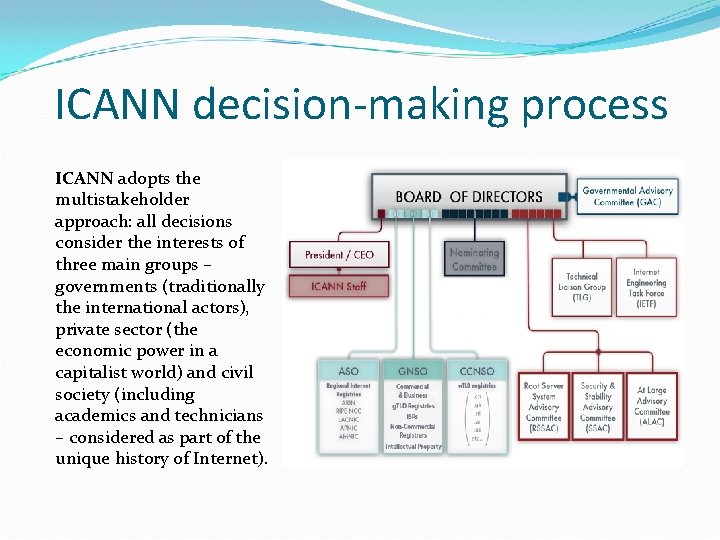
ICANN decision-making process ICANN adopts the multistakeholder approach: all decisions consider the interests of three main groups – governments (traditionally the international actors), private sector (the economic power in a capitalist world) and civil society (including academics and technicians – considered as part of the unique history of Internet).
A comparision among global models The ITU has a long history of setting standards in global telecommunications. Since member states (governments) have the greatest input with respect to their right to vote in the ITU, it stands to reason that the decisions taken would be seen as having the greatest legitimacy from an international point of view. ICANN cannot claim such type of participation and such type of legitimacy. This is not to say that an ITU model would contribute better to the stability of managing the root of the Internet because other models may offer different input from other sectors of society as well. Other issues beyond the root management that affect the proper functioning of the Internet, such as cybersecurity and spam, have to be tackled at a global level with a wider participation from all stakeholders. It is important to come to an agreement as to which are the issues debated within the realm of Internet governance and who the main stakeholders in this debate are.
Possible modifications envisioned There is a role for ICANN, ITU and the IETF in future IG arrangements and the augments should not be fashioned around an “either/or” scenario but on more clearly defined roles and a greater spirit of co-operation. It is possible to envision the scenario where ITU, for example, replaces the GAC on the board of ICANN since the ITU already has the legitimacy of governments, the legitimacy of a UN specialised agency and a long trackrecord in the telecommunications industry. ICANN can also be seen as having a special role within the ITU particularly with respect to its technical input. This would encompass the IETF as well. The ITU may consider a change in its structure to add a director with a specific Internet Governance portfolio. The establishment of an international umbrella agency under the UN whose role would be to manage the broader Internet policy issues is also suggested.
Research summary – Part Two was dedicated to the study of IG policy arrangements from a regional/national perspective. A delimitation of the topic should be made: a) Geographical delimitation b) Delimitation of policy-area Participants should highlight best practices that could be replicated in other environments. The following examples were analysed as case studies: LACNIC Afri. NIC Caricom Africa: e-commerce policies
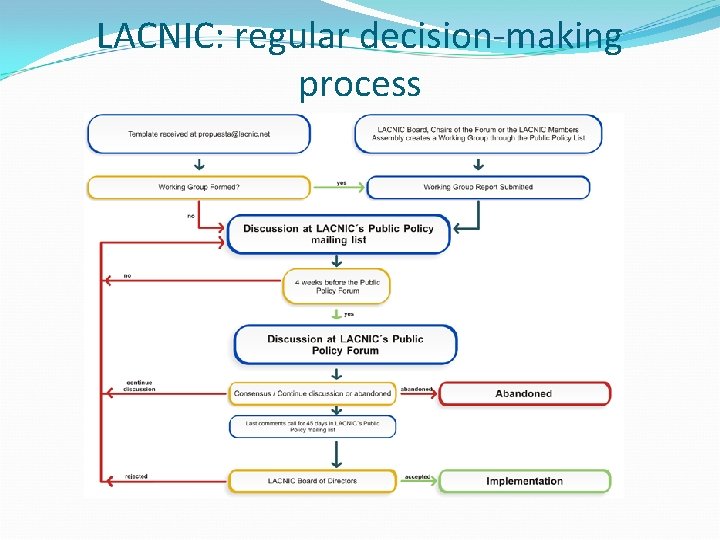
LACNIC (Latin American and Caribbean Internet Addresses Registry) is the regional RIR (Regional Internet Registry) for the LAC region. Its basic function is, roughly, to manage the assignment of the IPs (IPv 4 and IPv 6) plus ASN among the region. The organisation aims to be a leader in the construction and articulation of collaborative efforts for Internet development and stability in Latin America and the Caribbean. The membership is open and automatic for organisations that receive IP addresses directly from this organisation. The "Policy Forum", has a public instance and a mailing list, and is the main reference in the Policy Development Process. It is an open forum, with more than 700 members from all over the region and means a horizontal space, and consensus as the most important concept. The Policy Forum is open and to all kind of members. It iss also possible to join the mailing list.
LACNIC: regular decision-making process
Afri. NIC is a non-governmental and not-for-profit membership-based organisation. Its main role is to serve the African region as RIR. Afri. NICs structure and organisation is based on a bottom-up process with broad participation. It ensures an open and participative environment through: a) a public and open policy mailing list; b) a public policy meeting where members and community discuss proposed policies and agreement is based on consensus. Policy is proposed by anyone and posted in the mailing list for 30 days for discussion time after which it is brought to the open (face-to-face) meeting for community and members’ endorsement through consensus. In the absence of consensus, this step is re-posted in the mailing list for another 30 days of discussion. Otherwise, a 15 -day period is given to accommodate final changes and amendments. The board then ratifies and adopts the policy for use.
Afri. NIC: decision-making assessment The decision-making process is very inclusive and therefore captures diverse positions in deriving Internet-based policy. In the case where there is lack of consensus on certain policy propositions, the 30 -day repeat process may prove very lengthy where urgent decisions have to be made. Majority ruling can be adopted to pass urgent policy decisions where consensus fails.
CARICOM established a regional ICT steering committee and made the Georgetown Declaration in 2003 which sought to encourage new business applications including e-commerce. CARICOM was assisted by the UNDP in regional capacity-building programmes. CARICOM also encouraged the formulation of national ICT policies in each member state, the creation of the appropriate legal and regulatory framework, e-readiness assessments and the progressive liberalisation of telecommunication markets. The process has effectively been very slow and different member states have had different experiences with respect to the adoption of ICTs. Additionally, the region is still not fully involved in the “international” Internet Governance process.
Africa: multilevel e-commerce policies Many countries in the continent have or are developing their national ICT strategies which should certainly boost e-commerce. There are regional meetings on e-commerce that provide and opportunity to share best practices. The decision-making process: Africa is divided into five economic blocks/regions: ECOWAS, AMU, SADEC, CEMAC and COMESA. The countries within a specific area have strong economic ties between them through the agreements which bind them. The regulation of commercial activities in the African continent is shaped initially on the level of the five areas referred to above. For that purpose, actors at regional level, namely, governments, civil society, and international institutions, intervene at the time of discussions and negotiations. Decisions taken at the end of discussions are carried by governments to the international level. Common discussions are organised at the continental level by integrating governments, civil society, and international institutions of all countries.
Key recommendations on future arrangementss A consultative approach that involves all stakeholders. A fast and efficient policy formulation mechanism that can address the spontaneous and dynamic issues related to the Internet. A stronger focus on capacity building and integration of developing country interests, challenges and opportunities. Access to information for all as a key pillar and motive for IG. A more independent ICANN that is autonomous and accountable to all member governments.
Research methodology An online collaborative method that combined individual contributions to a pre-defined wiki framework was used. Weekly online sessions and daily workflow notifications (via e-mail) to exchange ideas, updates and challenges were used to refine the researchers’ thoughts into clear analogies. Under Diplo. Foundation’s auspices, the research was highly consultative on a broad range of existing literature and institutions that are active in the area of IG. The research refined its focus on institutions and areas that provided an ideal platform for inferring the future of IG arrangements.
Authors Adrián Carballo - Argentina Andres Piazza - Argentina Gabriel Piñeiro - Argentina John Ngahu – Kenya – UNDP Mozambique Pascal Bekono - Cameroon Raquel Gatto - Brazil Rodney Taylor - Barbados Tracy Hackshaw – Trinidad and Tobago Marilia Maciel (tutor) - Brazil