
Future of Hadron Physics Experiments at JPARC K




- Slides: 58
Future of Hadron Physics Experiments at J-PARC K. Ozawa (KEK) Contents: J-PARC & Hadron Facility Some topics at J-PARC and related Facility (Future plan of J-PARC & Hadron Facility) Summary
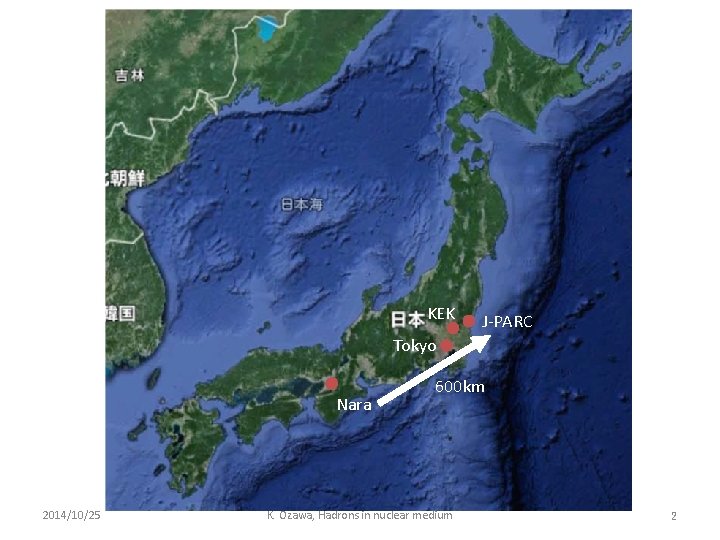
KEK J-PARC Tokyo Nara 2014/10/25 600 km K. Ozawa, Hadrons in nuclear medium 2
J-PARC Tokai, Japan (Japan Proton Accelerator Research Complex) Material and Life Science Facility 400 Me. V Linac RCS 3 Ge. V Synchrotron MR 30 Ge. V Synchrotron Hadron Experimental Facility. Hall Hadron 60 m x 56 m Neutrino Experimental Facility 2014/10/25 K. Ozawa, Hadrons in nuclear medium 3
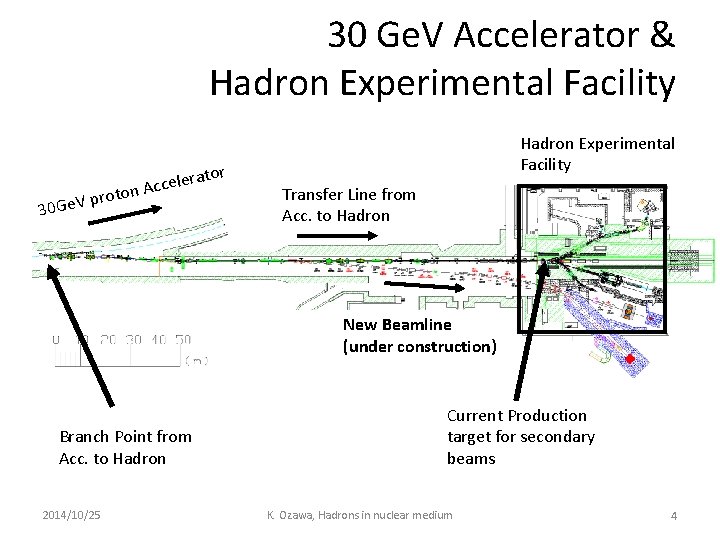
30 Ge. V Accelerator & Hadron Experimental Facility ator ler e c c A ton e. V pro 3 0 G Hadron Experimental Facility Transfer Line from Acc. to Hadron New Beamline (under construction) Branch Point from Acc. to Hadron 2014/10/25 Current Production target for secondary beams K. Ozawa, Hadrons in nuclear medium 4
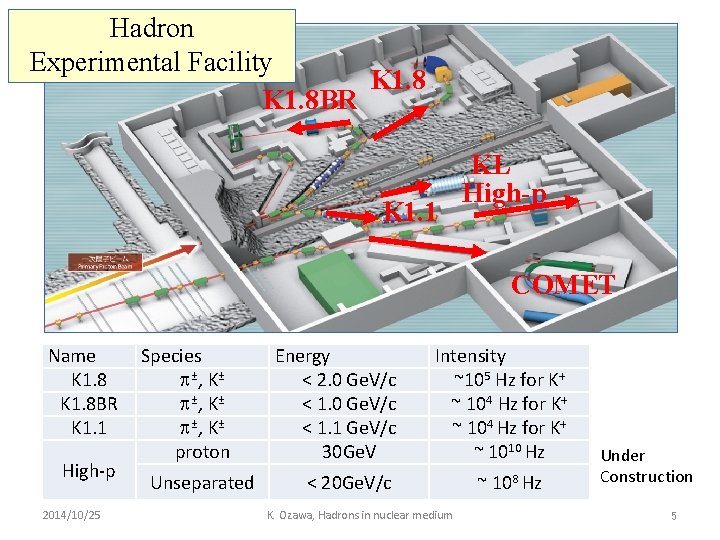
Hadron Experimental Facility K 1. 8 BR K 1. 1 KL High-p COMET Name K 1. 8 BR K 1. 1 High-p 2014/10/25 Species p± , K ± p ± , K± proton Unseparated Energy < 2. 0 Ge. V/c < 1. 1 Ge. V/c 30 Ge. V Intensity ~105 Hz for K+ ~ 104 Hz for K+ ~ 1010 Hz < 20 Ge. V/c K. Ozawa, Hadrons in nuclear medium ~ 108 Hz Under Construction 5
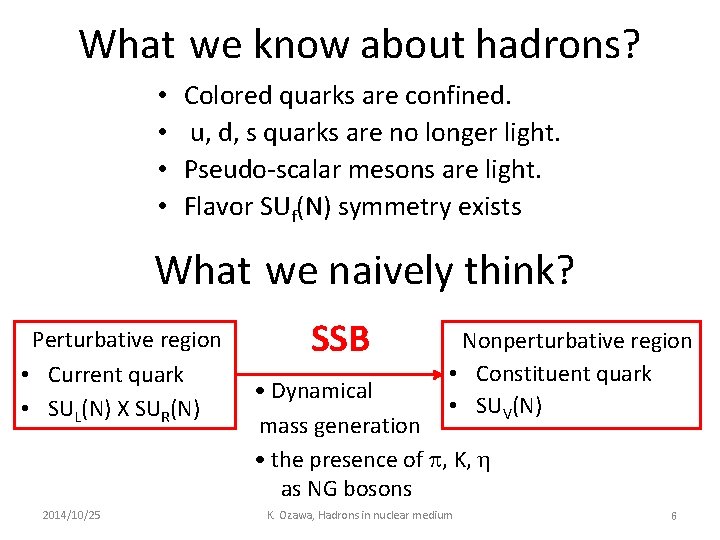
What we know about hadrons? • • Colored quarks are confined. u, d, s quarks are no longer light. Pseudo-scalar mesons are light. Flavor SUf(N) symmetry exists What we naively think? Perturbative region • Current quark • SUL(N) X SUR(N) 2014/10/25 SSB Nonperturbative region • Constituent quark • SUV(N) • Dynamical mass generation • the presence of p, K, h as NG bosons K. Ozawa, Hadrons in nuclear medium 6
Puzzles in hadron physics • Missing resonances. • States cannot be easily explained by a quark model. (e. g. Roper, L(1405), …) • Unexpected states. (e. g. narrow resonances at Belle) What we want to know? • What are inside structures of hadron? Ø Constituent quark? , Di-quark? Ø Hadron as a constituent of hadron? • How can hadrons interact with other hadrons ? • How mass is dynamically generated? 2014/10/25 K. Ozawa, Hadrons in nuclear medium 7
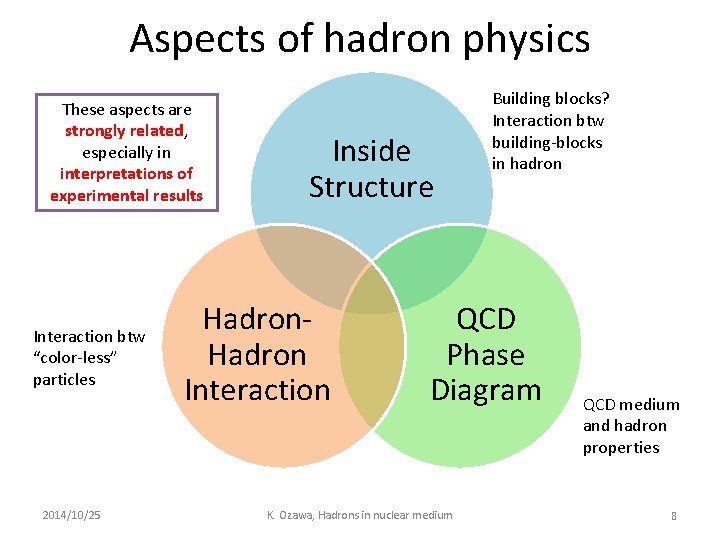
Aspects of hadron physics These aspects are strongly related, especially in interpretations of experimental results Interaction btw “color-less” particles 2014/10/25 Inside Structure Hadron Interaction Building blocks? Interaction btw building-blocks in hadron QCD Phase Diagram K. Ozawa, Hadrons in nuclear medium QCD medium and hadron properties 8
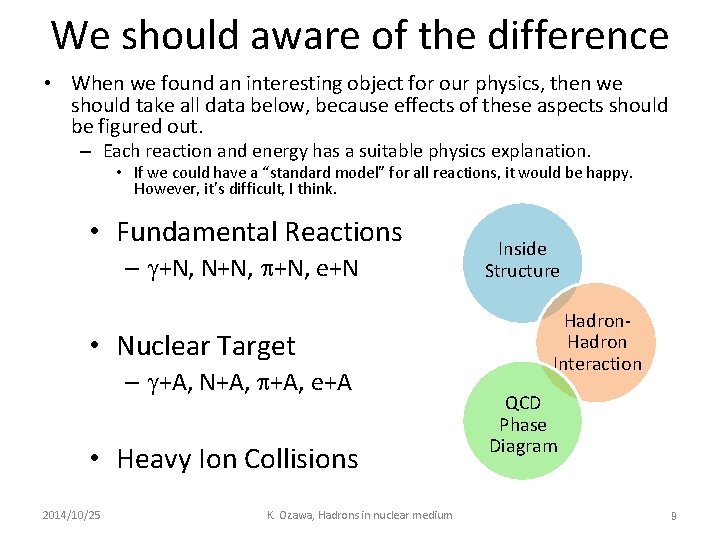
We should aware of the difference • When we found an interesting object for our physics, then we should take all data below, because effects of these aspects should be figured out. – Each reaction and energy has a suitable physics explanation. • If we could have a “standard model” for all reactions, it would be happy. However, it’s difficult, I think. • Fundamental Reactions – g+N, N+N, p+N, e+N • Nuclear Target – g+A, N+A, p+A, e+A • Heavy Ion Collisions 2014/10/25 K. Ozawa, Hadrons in nuclear medium Inside Structure Hadron Interaction QCD Phase Diagram 9
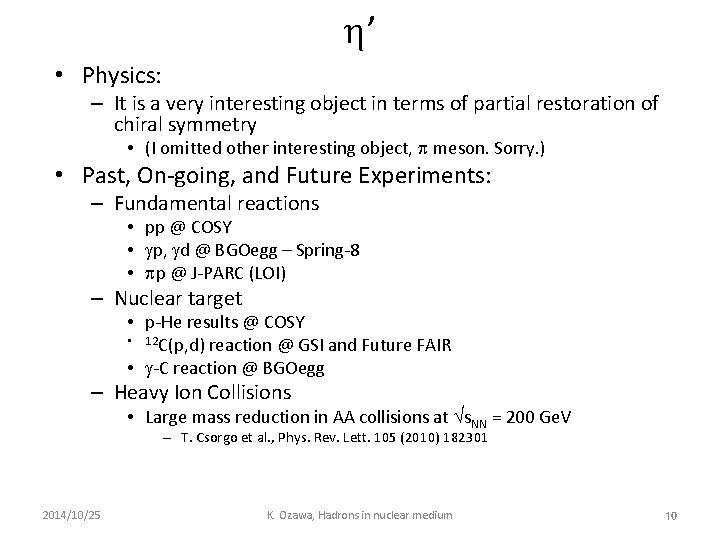
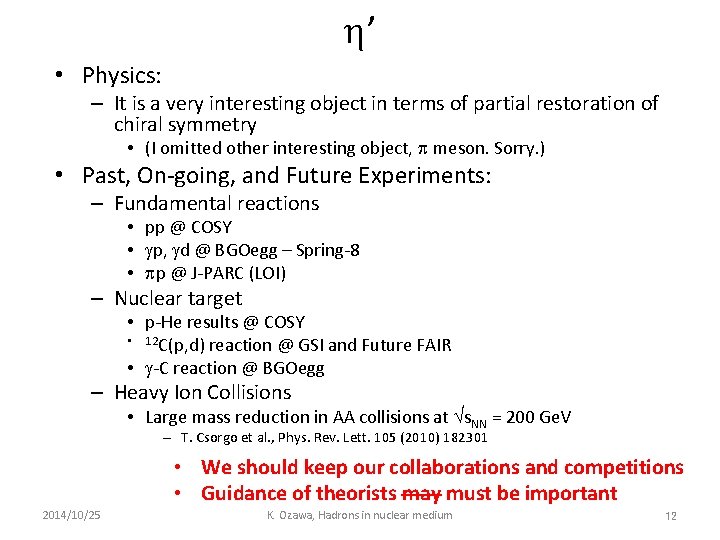
h’ • Physics: – It is a very interesting object in terms of partial restoration of chiral symmetry • (I omitted other interesting object, p meson. Sorry. ) • Past, On-going, and Future Experiments: – Fundamental reactions • pp @ COSY • gp, gd @ BGOegg – Spring-8 • pp @ J-PARC (LOI) – Nuclear target • p-He results @ COSY • 12 C(p, d) reaction @ GSI and Future FAIR • g-C reaction @ BGOegg – Heavy Ion Collisions • Large mass reduction in AA collisions at s. NN = 200 Ge. V – T. Csorgo et al. , Phys. Rev. Lett. 105 (2010) 182301 2014/10/25 K. Ozawa, Hadrons in nuclear medium 10
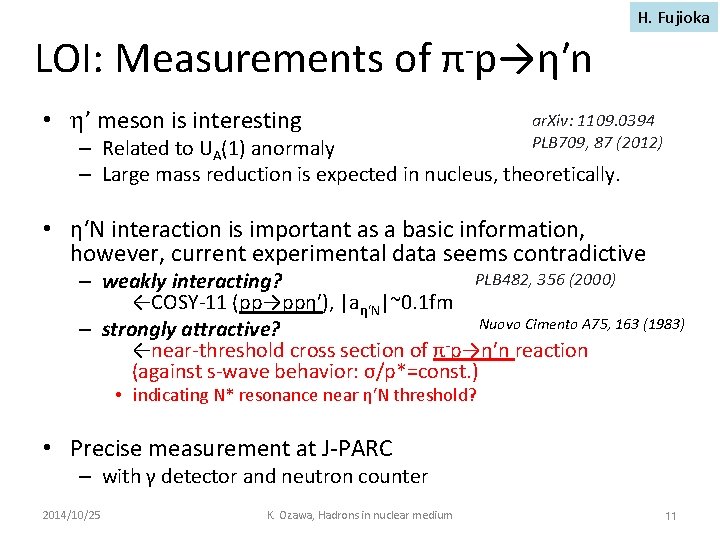
H. Fujioka LOI: Measurements of π p→η′n • h’ meson is interesting ar. Xiv: 1109. 0394 PLB 709, 87 (2012) – Related to UA(1) anormaly – Large mass reduction is expected in nucleus, theoretically. • η′N interaction is important as a basic information, however, current experimental data seems contradictive PLB 482, 356 (2000) – weakly interacting? ←COSY-11 (pp→ppη′), |aη′N|~0. 1 fm Nuovo Cimento A 75, 163 (1983) – strongly attractive? ←near-threshold cross section of π-p→η′n reaction (against s-wave behavior: σ/p*=const. ) • indicating N* resonance near η′N threshold? • Precise measurement at J-PARC – with γ detector and neutron counter 2014/10/25 K. Ozawa, Hadrons in nuclear medium 11
h’ • Physics: – It is a very interesting object in terms of partial restoration of chiral symmetry • (I omitted other interesting object, p meson. Sorry. ) • Past, On-going, and Future Experiments: – Fundamental reactions • pp @ COSY • gp, gd @ BGOegg – Spring-8 • pp @ J-PARC (LOI) – Nuclear target • p-He results @ COSY • 12 C(p, d) reaction @ GSI and Future FAIR • g-C reaction @ BGOegg – Heavy Ion Collisions • Large mass reduction in AA collisions at s. NN = 200 Ge. V – T. Csorgo et al. , Phys. Rev. Lett. 105 (2010) 182301 • We should keep our collaborations and competitions • Guidance of theorists may must be important 2014/10/25 K. Ozawa, Hadrons in nuclear medium 12
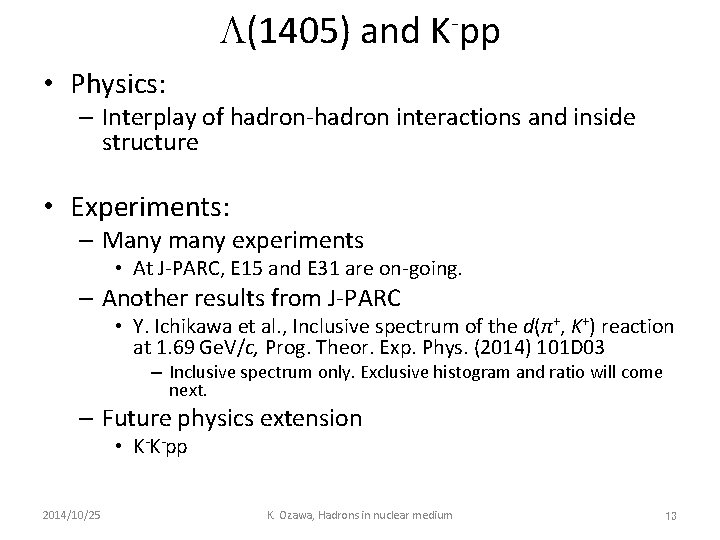
L(1405) and K-pp • Physics: – Interplay of hadron-hadron interactions and inside structure • Experiments: – Many many experiments • At J-PARC, E 15 and E 31 are on-going. – Another results from J-PARC • Y. Ichikawa et al. , Inclusive spectrum of the d(π+, K+) reaction at 1. 69 Ge. V/c, Prog. Theor. Exp. Phys. (2014) 101 D 03 – Inclusive spectrum only. Exclusive histogram and ratio will come next. – Future physics extension • K-K-pp 2014/10/25 K. Ozawa, Hadrons in nuclear medium 13
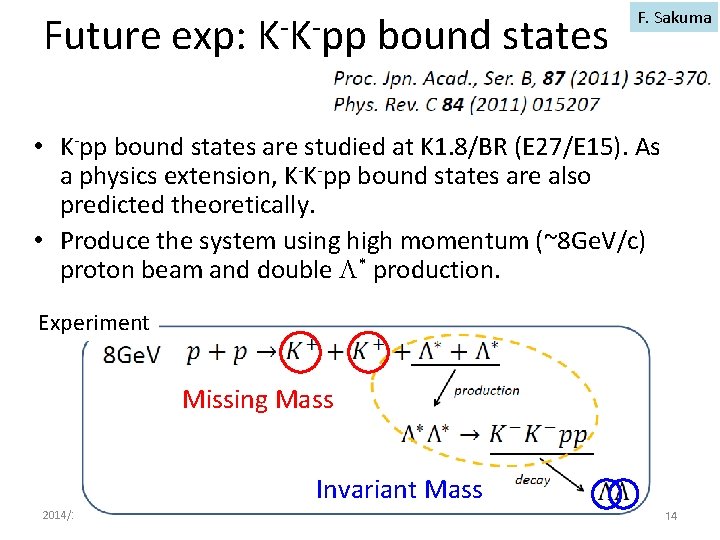
Future exp: K-K-pp bound states F. Sakuma • K-pp bound states are studied at K 1. 8/BR (E 27/E 15). As a physics extension, K-K-pp bound states are also predicted theoretically. • Produce the system using high momentum (~8 Ge. V/c) proton beam and double L* production. Experiment Missing Mass Invariant Mass 2014/10/25 K. Ozawa, Hadrons in nuclear medium 14
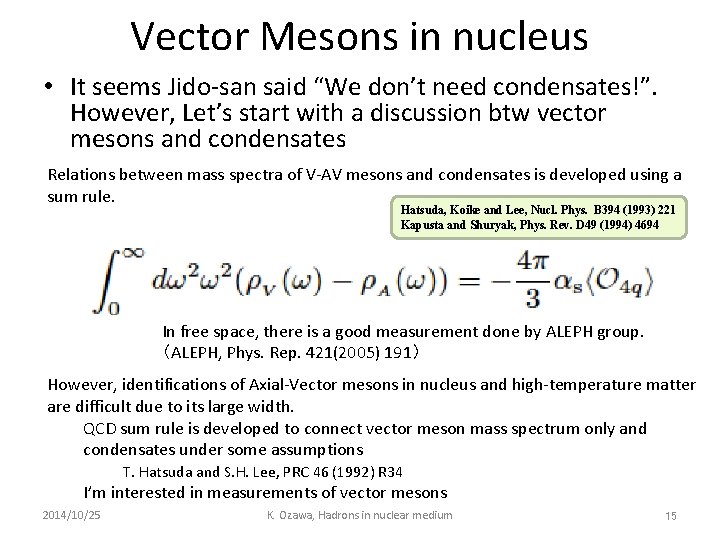
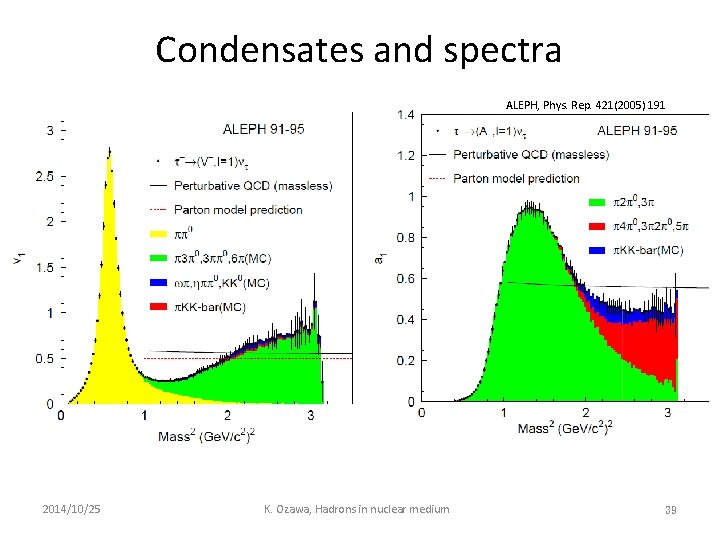
Vector Mesons in nucleus • It seems Jido-san said “We don’t need condensates!”. However, Let’s start with a discussion btw vector mesons and condensates Relations between mass spectra of V-AV mesons and condensates is developed using a sum rule. Hatsuda, Koike and Lee, Nucl. Phys. B 394 (1993) 221 Kapusta and Shuryak, Phys. Rev. D 49 (1994) 4694 In free space, there is a good measurement done by ALEPH group. (ALEPH, Phys. Rep. 421(2005) 191) However, identifications of Axial-Vector mesons in nucleus and high-temperature matter are difficult due to its large width. QCD sum rule is developed to connect vector meson mass spectrum only and condensates under some assumptions T. Hatsuda and S. H. Lee, PRC 46 (1992) R 34 I’m interested in measurements of vector mesons 2014/10/25 K. Ozawa, Hadrons in nuclear medium 15
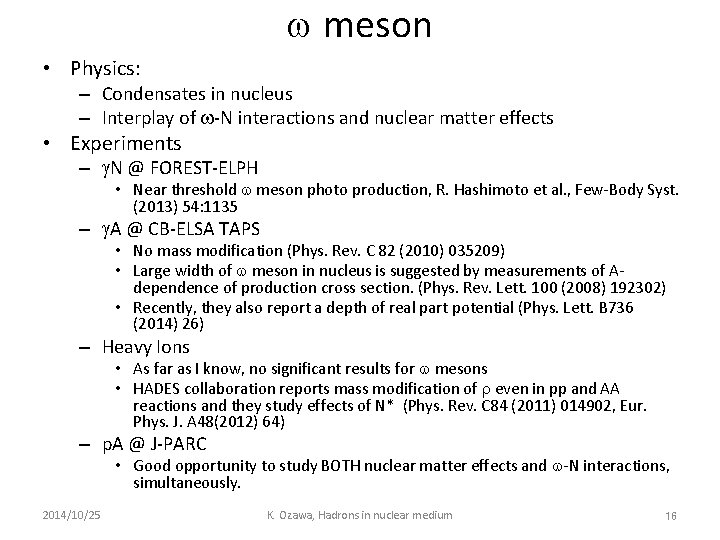
w meson • Physics: – Condensates in nucleus – Interplay of w-N interactions and nuclear matter effects • Experiments – g. N @ FOREST-ELPH • Near threshold w meson photo production, R. Hashimoto et al. , Few-Body Syst. (2013) 54: 1135 – g. A @ CB-ELSA TAPS • No mass modification (Phys. Rev. C 82 (2010) 035209) • Large width of w meson in nucleus is suggested by measurements of Adependence of production cross section. (Phys. Rev. Lett. 100 (2008) 192302) • Recently, they also report a depth of real part potential (Phys. Lett. B 736 (2014) 26) – Heavy Ions • As far as I know, no significant results for w mesons • HADES collaboration reports mass modification of r even in pp and AA reactions and they study effects of N* (Phys. Rev. C 84 (2011) 014902, Eur. Phys. J. A 48(2012) 64) – p. A @ J-PARC • Good opportunity to study BOTH nuclear matter effects and w-N interactions, simultaneously. 2014/10/25 K. Ozawa, Hadrons in nuclear medium 16
w in nucleus and w-N Interaction(E 26) p n p 0 • p-A + n+X – Focus on low momentum w meson and clear mass spectrum in nucleus – Missing mass spectroscopy and detection of an exclusive production process using the forward p 0 Measurements of w meson in nucleus using p 0 g decays using an exclusive reaction • Beam Momentum is 2. 0 Ge. V/c. – To generate w meson at rest – K 1. 8 or High-p • Detectors – High precision g detector around the target Neutron counter at the forward direction 2014/10/25 • DE/E = ~ 1% @ Eg = 1 Ge. V – Neutron counter • DTOF ~ 80 ps K. Ozawa, Hadrons in nuclear medium 17
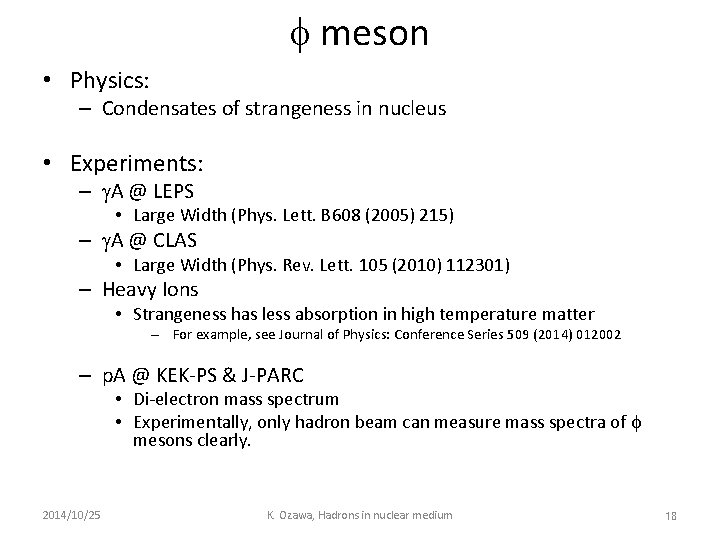
f meson • Physics: – Condensates of strangeness in nucleus • Experiments: – g. A @ LEPS • Large Width (Phys. Lett. B 608 (2005) 215) – g. A @ CLAS • Large Width (Phys. Rev. Lett. 105 (2010) 112301) – Heavy Ions • Strangeness has less absorption in high temperature matter – For example, see Journal of Physics: Conference Series 509 (2014) 012002 – p. A @ KEK-PS & J-PARC • Di-electron mass spectrum • Experimentally, only hadron beam can measure mass spectra of f mesons clearly. 2014/10/25 K. Ozawa, Hadrons in nuclear medium 18
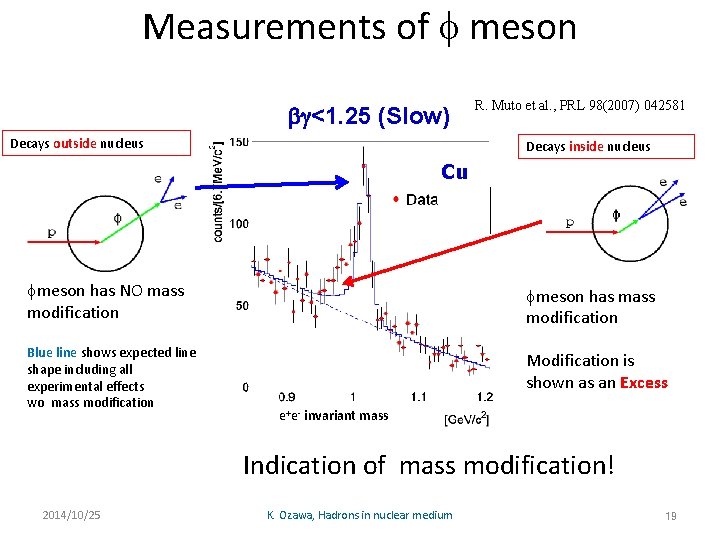
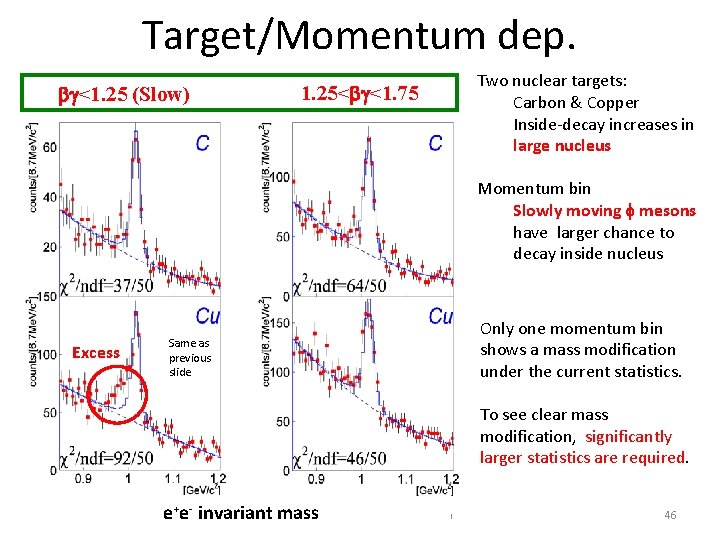
Measurements of f meson b <1. 25 (Slow) Decays outside nucleus R. Muto et al. , PRL 98(2007) 042581 Decays inside nucleus Cu fmeson has NO mass modification fmeson has mass modification Blue line shows expected line shape including all experimental effects wo mass modification Modification is shown as an Excess e+e- invariant mass Indication of mass modification! 2014/10/25 K. Ozawa, Hadrons in nuclear medium 19
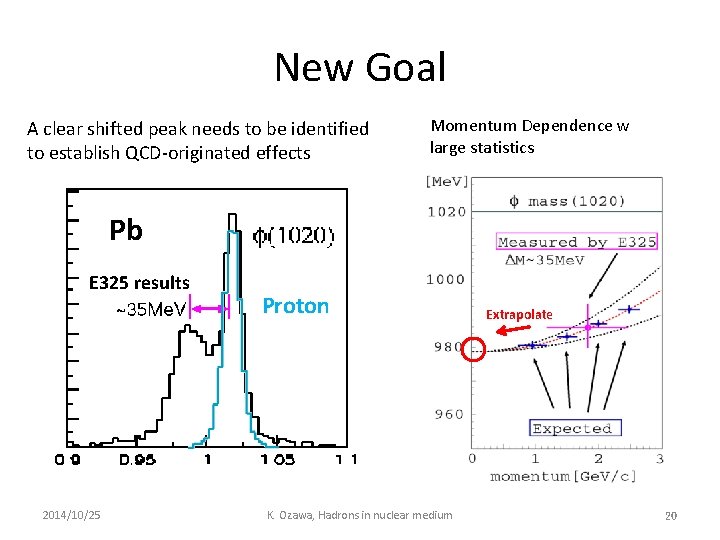
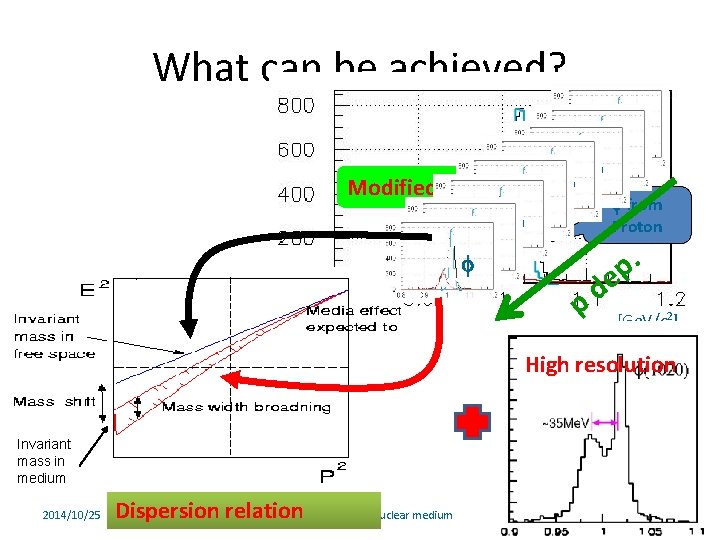
New Goal A clear shifted peak needs to be identified to establish QCD-originated effects Momentum Dependence w large statistics Pb E 325 results 2014/10/25 Proton K. Ozawa, Hadrons in nuclear medium Extrapolate 20
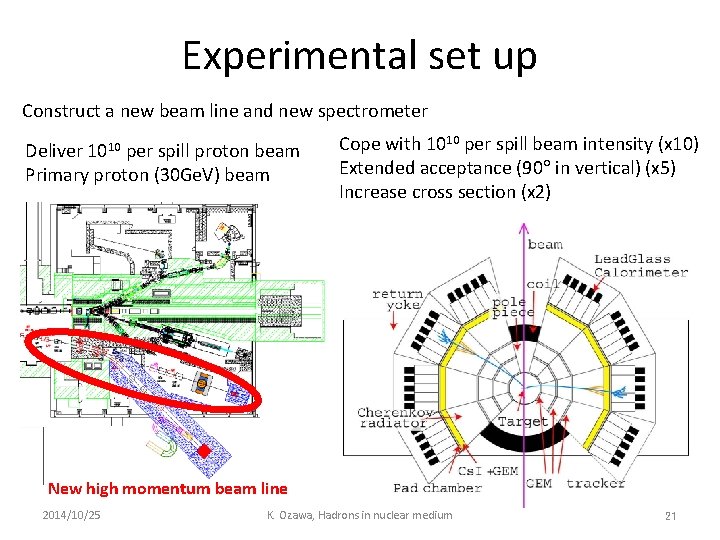
Experimental set up Construct a new beam line and new spectrometer 1010 Deliver per spill proton beam Primary proton (30 Ge. V) beam Cope with 1010 per spill beam intensity (x 10) Extended acceptance (90 in vertical) (x 5) Increase cross section (x 2) New high momentum beam line 2014/10/25 K. Ozawa, Hadrons in nuclear medium 21
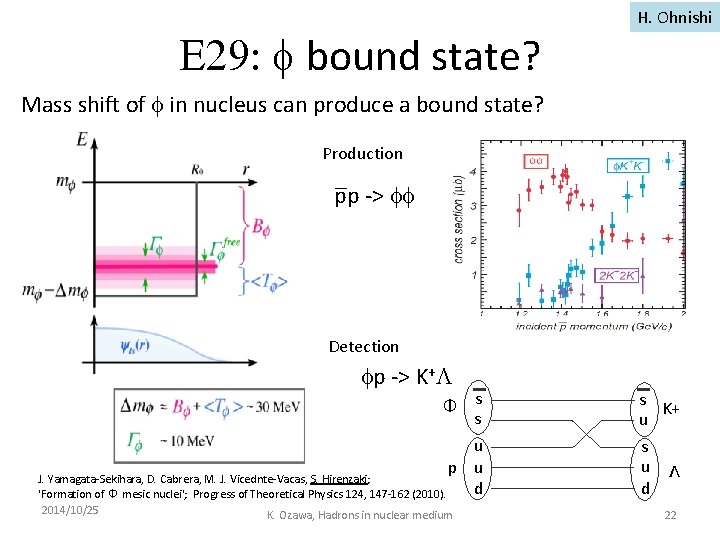
E 29: f bound state? H. Ohnishi Mass shift of f in nucleus can produce a bound state? Production pp -> ff Detection fp -> K+L s s u p u J. Yamagata-Sekihara, D. Cabrera, M. J. Vicednte-Vacas, S. Hirenzaki; d 'Formation of Φ mesic nuclei'; Progress of Theoretical Physics 124, 147 -162 (2010). Φ 2014/10/25 K. Ozawa, Hadrons in nuclear medium s K+ u s u d Λ 22
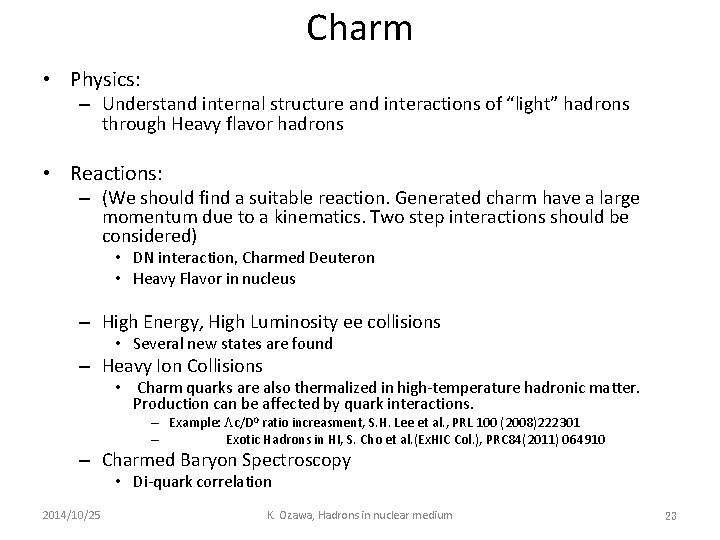
Charm • Physics: – Understand internal structure and interactions of “light” hadrons through Heavy flavor hadrons • Reactions: – (We should find a suitable reaction. Generated charm have a large momentum due to a kinematics. Two step interactions should be considered) • DN interaction, Charmed Deuteron • Heavy Flavor in nucleus – High Energy, High Luminosity ee collisions • Several new states are found – Heavy Ion Collisions • Charm quarks are also thermalized in high-temperature hadronic matter. Production can be affected by quark interactions. – Example: Lc/D 0 ratio increasment, S. H. Lee et al. , PRL 100 (2008)222301 – Exotic Hadrons in HI, S. Cho et al. (Ex. HIC Col. ), PRC 84(2011) 064910 – Charmed Baryon Spectroscopy • Di-quark correlation 2014/10/25 K. Ozawa, Hadrons in nuclear medium 23
Di-quark correlation • One of possible strong effects is a quark-quark (Di-quark) correlation Color-Magnetic Interaction of two quarks VCMI~[as/(mimj)]*(li, lj)(si, sj) “Good Diquark”: Strong Attraction VCMI(1 S 0, 3 c) = 1/2*VCMI(1 S 0, 1 c) [qq] [ qq] • Diquarks are emerged due to the color magnetic interaction between two quarks. • The so-called “good diquark” has a color anti-symmetric 3 bar and spin singlet configuration. It’s strong enough. • One expects that a “good diquark” may be formed in a baryon. 2014/10/25 K. Ozawa, Hadrons in nuclear medium 24
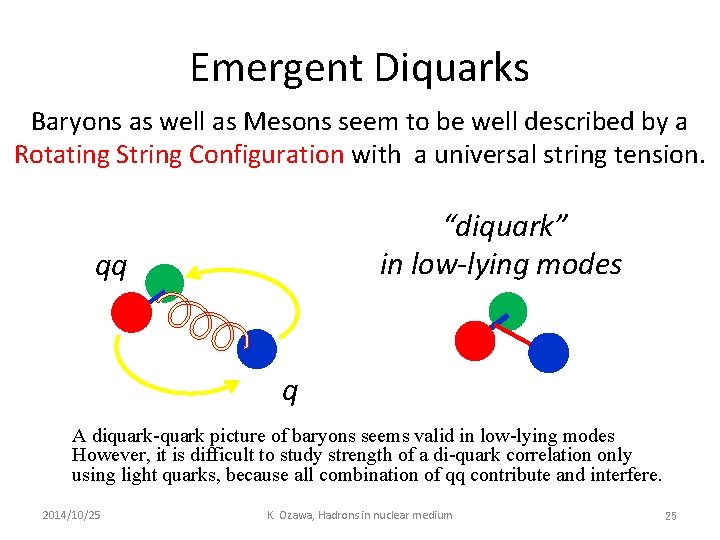
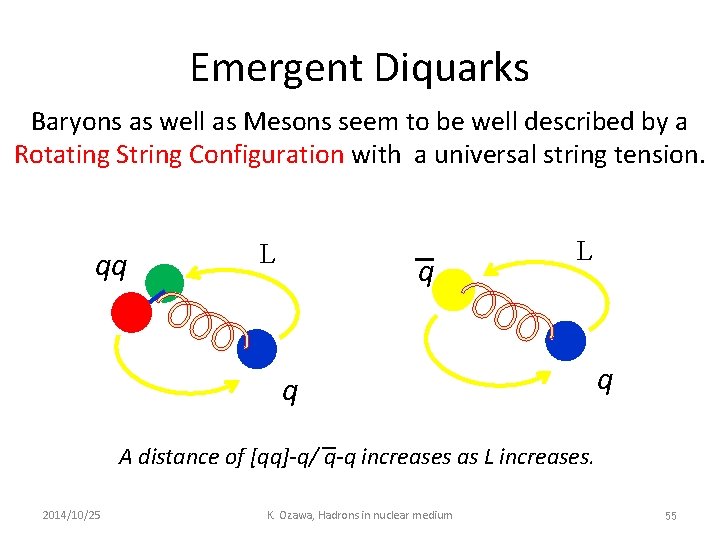
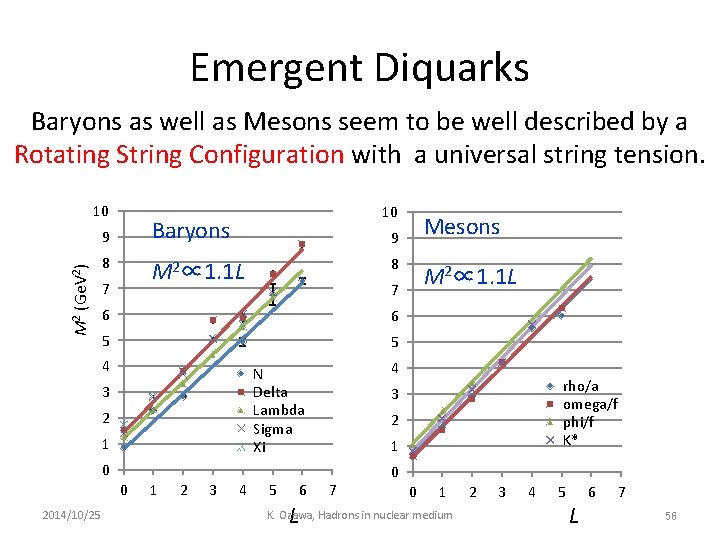
Emergent Diquarks Baryons as well as Mesons seem to be well described by a Rotating String Configuration with a universal string tension. “diquark” in low-lying modes qq q A diquark-quark picture of baryons seems valid in low-lying modes However, it is difficult to study strength of a di-quark correlation only using light quarks, because all combination of qq contribute and interfere. 2014/10/25 K. Ozawa, Hadrons in nuclear medium 25
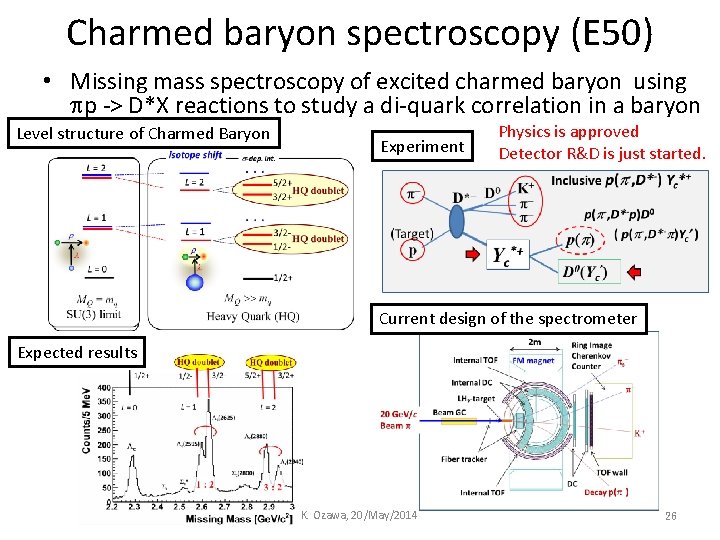
Charmed baryon spectroscopy (E 50) • Missing mass spectroscopy of excited charmed baryon using pp -> D*X reactions to study a di-quark correlation in a baryon Level structure of Charmed Baryon Experiment Physics is approved Detector R&D is just started. Current design of the spectrometer Expected results K. Ozawa, 20/May/2014 26
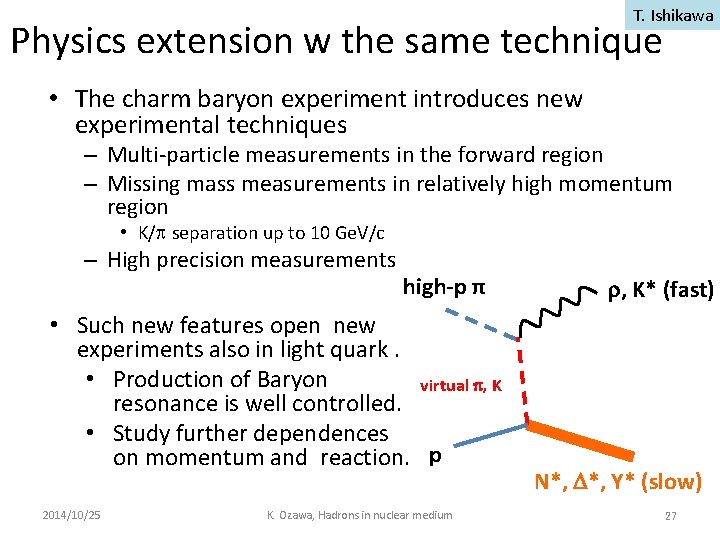
T. Ishikawa Physics extension w the same technique • The charm baryon experiment introduces new experimental techniques – Multi-particle measurements in the forward region – Missing mass measurements in relatively high momentum region • K/p separation up to 10 Ge. V/c – High precision measurements high-p π • Such new features open new experiments also in light quark. • Production of Baryon virtual p, K resonance is well controlled. • Study further dependences on momentum and reaction. p 2014/10/25 K. Ozawa, Hadrons in nuclear medium r, K* (fast) N*, D*, Y* (slow) 27
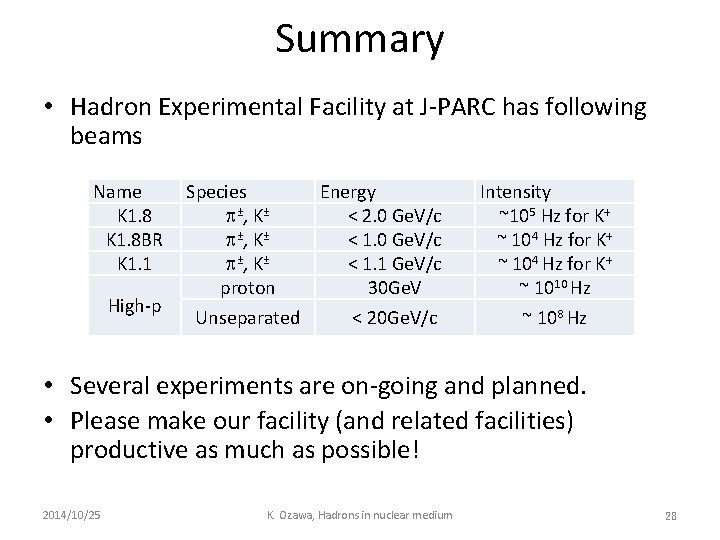
Summary • Hadron Experimental Facility at J-PARC has following beams Name K 1. 8 BR K 1. 1 High-p Species p± , K ± p ± , K± proton Unseparated Energy < 2. 0 Ge. V/c < 1. 1 Ge. V/c 30 Ge. V < 20 Ge. V/c Intensity ~105 Hz for K+ ~ 104 Hz for K+ ~ 1010 Hz ~ 108 Hz • Several experiments are on-going and planned. • Please make our facility (and related facilities) productive as much as possible! 2014/10/25 K. Ozawa, Hadrons in nuclear medium 28
FUTURE UPGRADE OF THE FACILITY 2014/10/25 K. Ozawa, Hadrons in nuclear medium 29
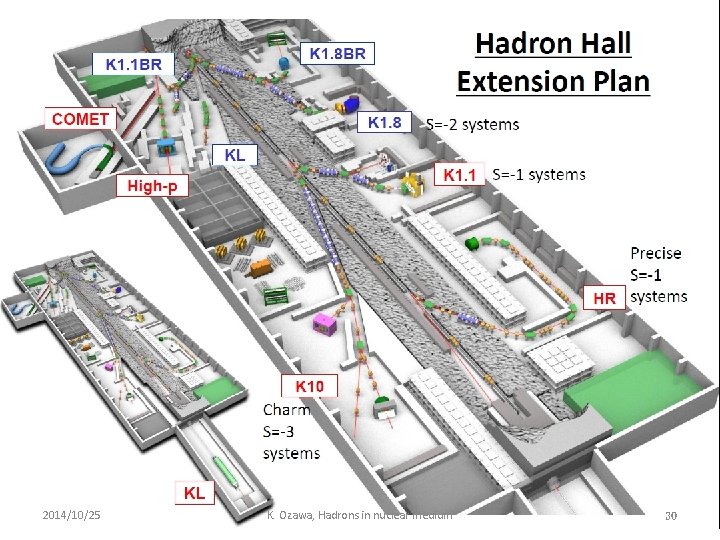
2014/10/25 K. Ozawa, Hadrons in nuclear medium 30
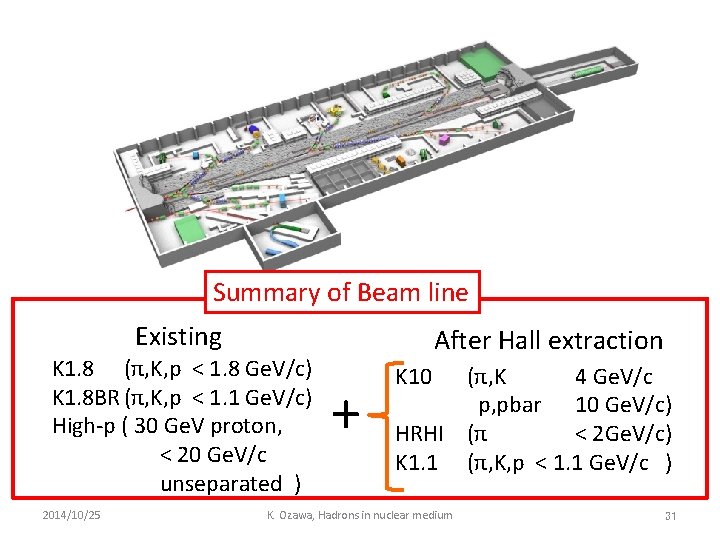
Summary of Beam line Existing K 1. 8 (π, K, p < 1. 8 Ge. V/c) K 1. 8 BR (π, K, p < 1. 1 Ge. V/c) High-p ( 30 Ge. V proton, < 20 Ge. V/c unseparated ) 2014/10/25 After Hall extraction + K 10 (π, K 4 Ge. V/c p, pbar 10 Ge. V/c) HRHI (π < 2 Ge. V/c) K 1. 1 (π, K, p < 1. 1 Ge. V/c ) K. Ozawa, Hadrons in nuclear medium 31
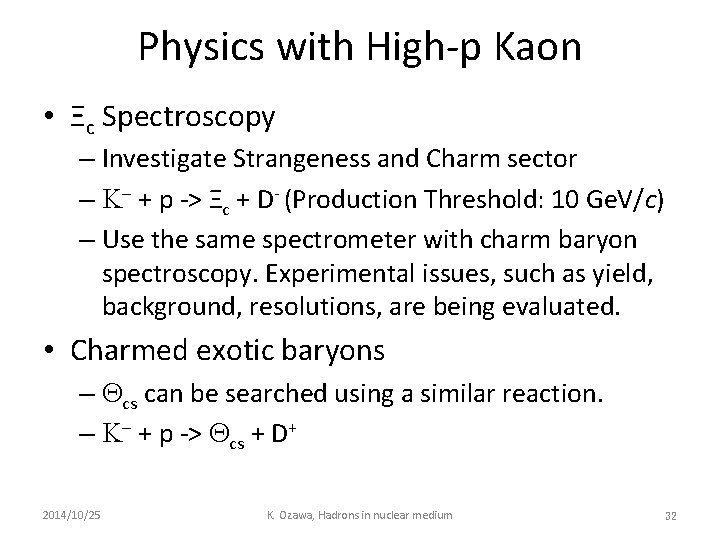
Physics with High-p Kaon • Ξc Spectroscopy – Investigate Strangeness and Charm sector – K- + p -> Ξc + D- (Production Threshold: 10 Ge. V/c) – Use the same spectrometer with charm baryon spectroscopy. Experimental issues, such as yield, background, resolutions, are being evaluated. • Charmed exotic baryons – Qcs can be searched using a similar reaction. – K- + p -> Qcs + D+ 2014/10/25 K. Ozawa, Hadrons in nuclear medium 32
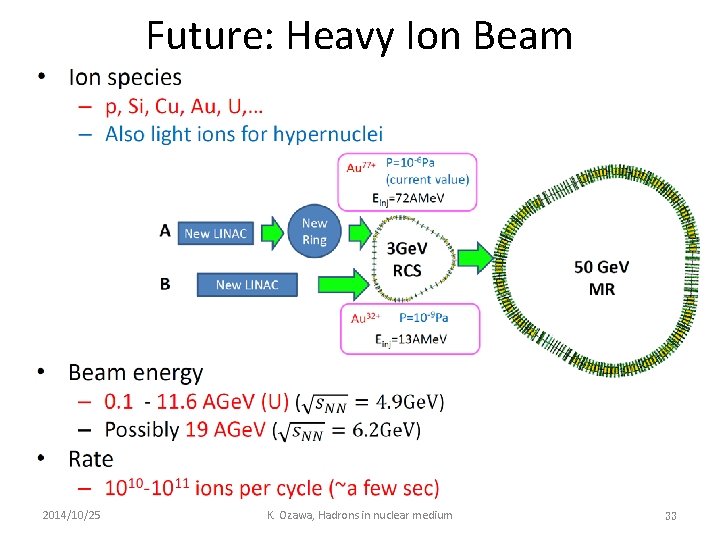
Future: Heavy Ion Beam 2014/10/25 K. Ozawa, Hadrons in nuclear medium 33
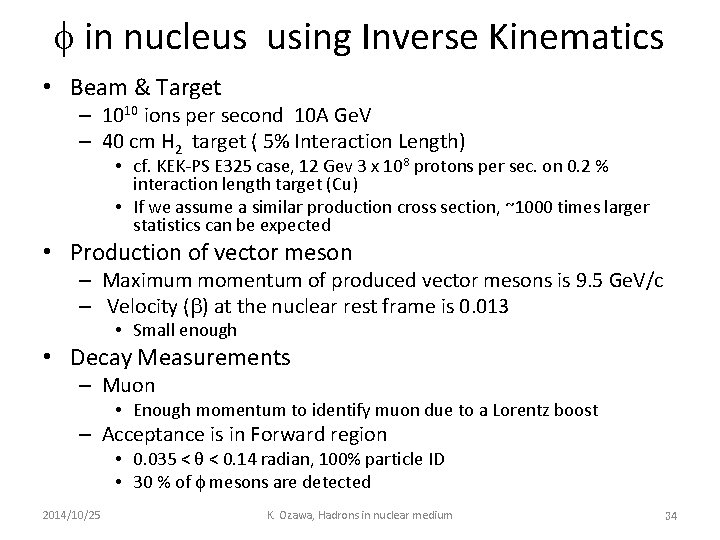
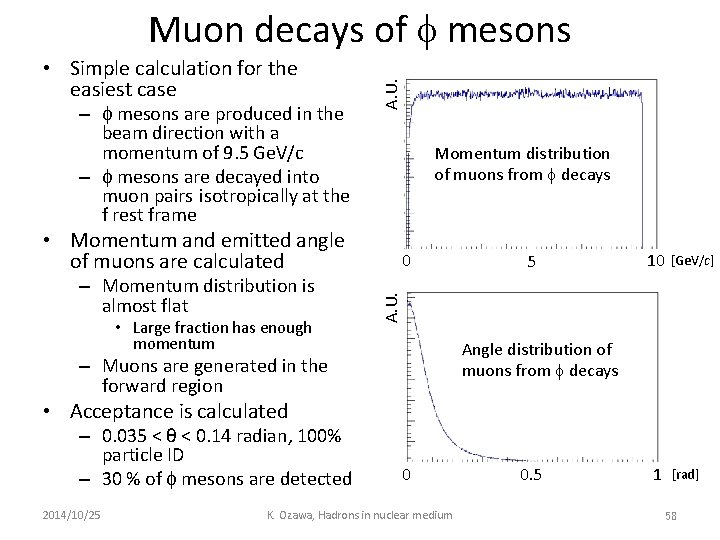
f in nucleus using Inverse Kinematics • Beam & Target – 1010 ions per second 10 A Ge. V – 40 cm H 2 target ( 5% Interaction Length) • cf. KEK-PS E 325 case, 12 Gev 3 x 10⁸ protons per sec. on 0. 2 % interaction length target (Cu) • If we assume a similar production cross section, ~1000 times larger statistics can be expected • Production of vector meson – Maximum momentum of produced vector mesons is 9. 5 Ge. V/c – Velocity (b) at the nuclear rest frame is 0. 013 • Small enough • Decay Measurements – Muon • Enough momentum to identify muon due to a Lorentz boost – Acceptance is in Forward region • 0. 035 < θ < 0. 14 radian, 100% particle ID • 30 % of f mesons are detected 2014/10/25 K. Ozawa, Hadrons in nuclear medium 34
BACK UP 2014/10/25 K. Ozawa, Hadrons in nuclear medium 35
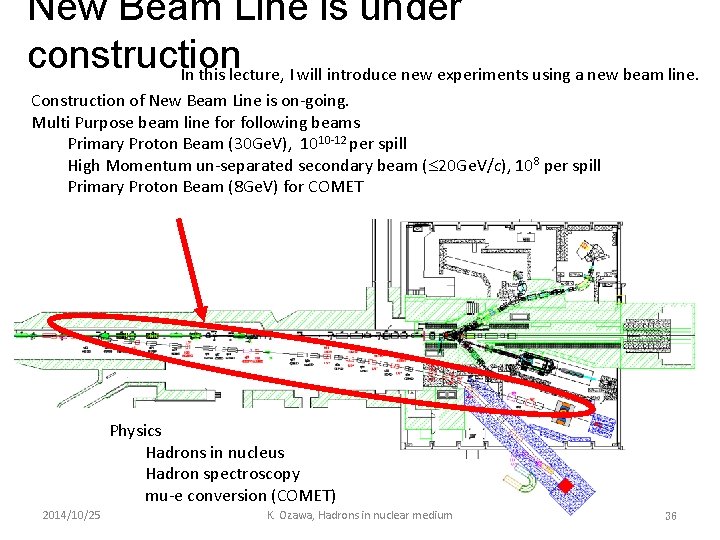
New Beam Line is under construction In this lecture, I will introduce new experiments using a new beam line. Construction of New Beam Line is on-going. Multi Purpose beam line for following beams Primary Proton Beam (30 Ge. V), 1010 -12 per spill High Momentum un-separated secondary beam ( 20 Ge. V/c), 108 per spill Primary Proton Beam (8 Ge. V) for COMET Physics Hadrons in nucleus Hadron spectroscopy mu-e conversion (COMET) 2014/10/25 K. Ozawa, Hadrons in nuclear medium 36
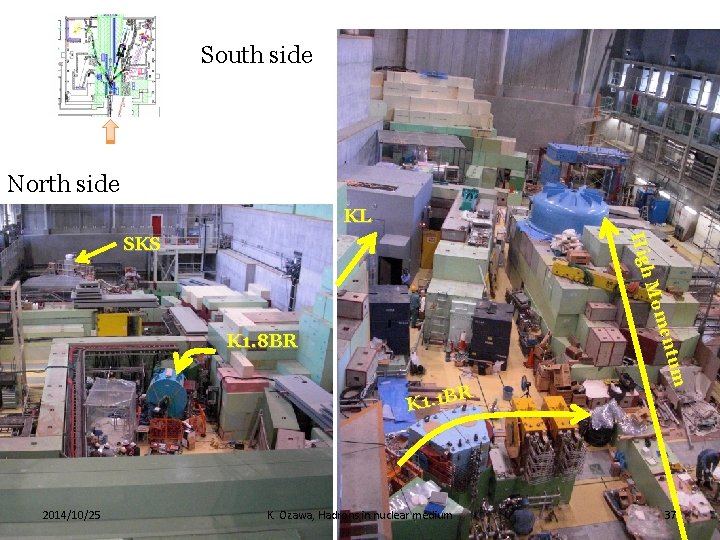
South side North side KL K 1. 8 BR R K 1. 1 B 2014/10/25 K. Ozawa, Hadrons in nuclear medium m entu Mom Hig h SKS 37
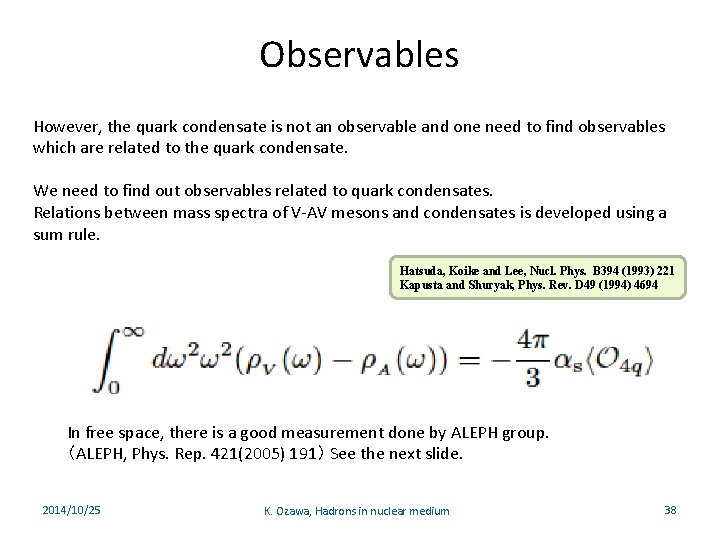
Observables However, the quark condensate is not an observable and one need to find observables which are related to the quark condensate. We need to find out observables related to quark condensates. Relations between mass spectra of V-AV mesons and condensates is developed using a sum rule. Hatsuda, Koike and Lee, Nucl. Phys. B 394 (1993) 221 Kapusta and Shuryak, Phys. Rev. D 49 (1994) 4694 In free space, there is a good measurement done by ALEPH group. (ALEPH, Phys. Rep. 421(2005) 191) See the next slide. 2014/10/25 K. Ozawa, Hadrons in nuclear medium 38
Condensates and spectra ALEPH, Phys. Rep. 421(2005) 191 2014/10/25 K. Ozawa, Hadrons in nuclear medium 39
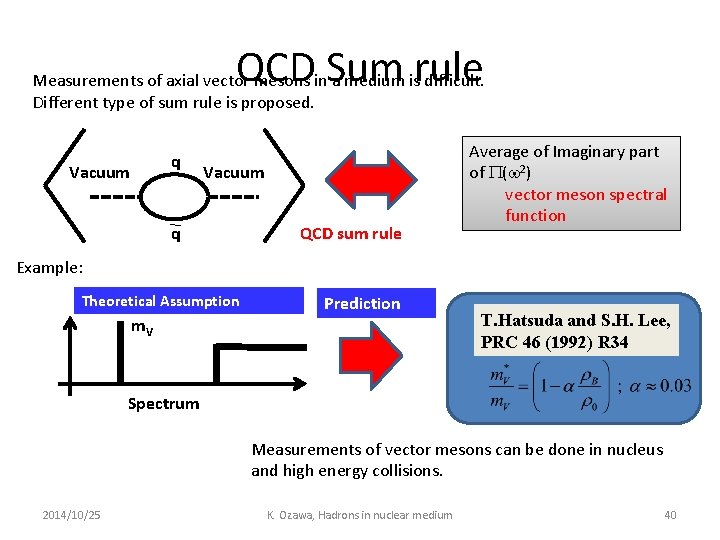
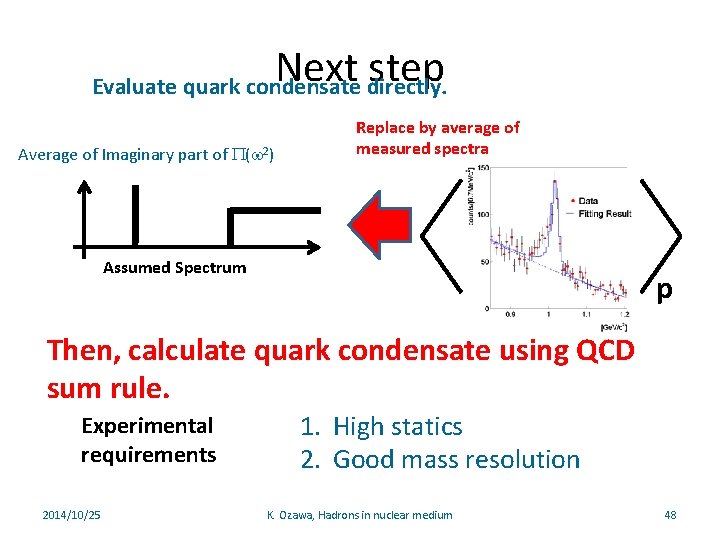
QCD Sum rule Measurements of axial vector mesons in a medium is difficult. Different type of sum rule is proposed. q Vacuum q QCD sum rule Average of Imaginary part of P(w 2) vector meson spectral function Example: Theoretical Assumption Prediction m. V T. Hatsuda and S. H. Lee, PRC 46 (1992) R 34 Spectrum Measurements of vector mesons can be done in nucleus and high energy collisions. 2014/10/25 K. Ozawa, Hadrons in nuclear medium 40
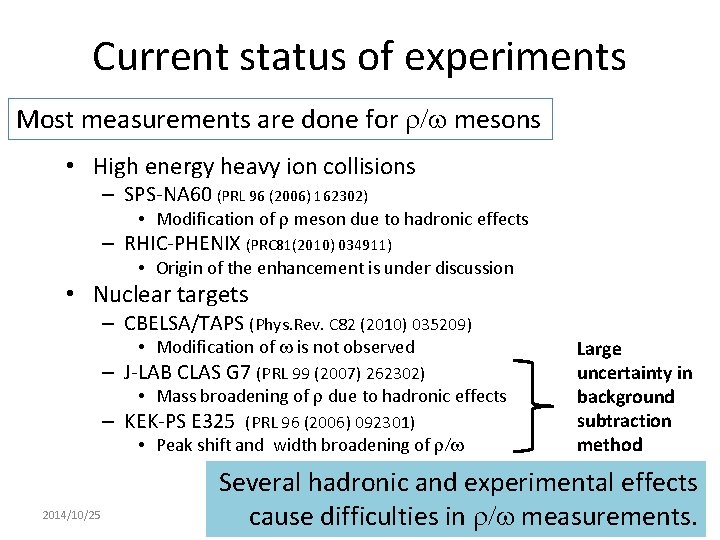
Current status of experiments Most measurements are done for r/w mesons • High energy heavy ion collisions – SPS-NA 60 (PRL 96 (2006) 162302) • Modification of r meson due to hadronic effects – RHIC-PHENIX (PRC 81(2010) 034911) • Origin of the enhancement is under discussion • Nuclear targets – CBELSA/TAPS (Phys. Rev. C 82 (2010) 035209) • Modification of w is not observed – J-LAB CLAS G 7 (PRL 99 (2007) 262302) • Mass broadening of r due to hadronic effects – KEK-PS E 325 (PRL 96 (2006) 092301) • Peak shift and width broadening of r/w 2014/10/25 Large uncertainty in background subtraction method Several hadronic and experimental effects K. Ozawa, Hadrons in nuclear medium 41 cause difficulties in r/w measurements.
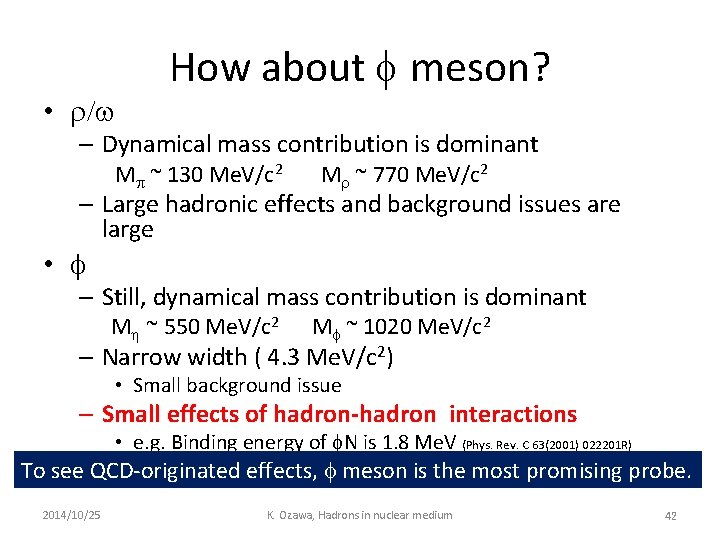
• r/w How about f meson? – Dynamical mass contribution is dominant Mp ~ 130 Me. V/c 2 Mr ~ 770 Me. V/c 2 – Large hadronic effects and background issues are large • f – Still, dynamical mass contribution is dominant Mh ~ 550 Me. V/c 2 Mf ~ 1020 Me. V/c 2 – Narrow width ( 4. 3 Me. V/c 2) • Small background issue – Small effects of hadron-hadron interactions • e. g. Binding energy of f. N is 1. 8 Me. V (Phys. Rev. C 63(2001) 022201 R) To see QCD-originated effects, f meson is the most promising probe. 2014/10/25 K. Ozawa, Hadrons in nuclear medium 42
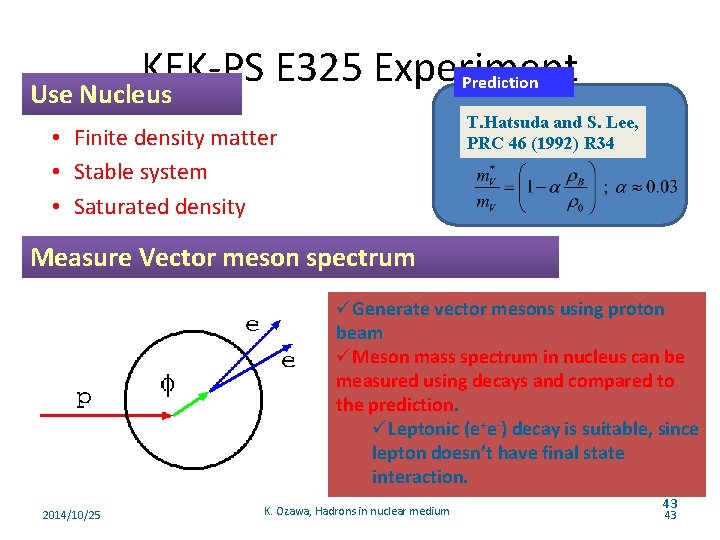
KEK-PS E 325 Experiment Prediction Use Nucleus T. Hatsuda and S. Lee, PRC 46 (1992) R 34 • Finite density matter • Stable system • Saturated density Measure Vector meson spectrum üGenerate vector mesons using proton beam üMeson mass spectrum in nucleus can be measured using decays and compared to the prediction. üLeptonic (e+e-) decay is suitable, since lepton doesn’t have final state interaction. 2014/10/25 K. Ozawa, Hadrons in nuclear medium 43 43
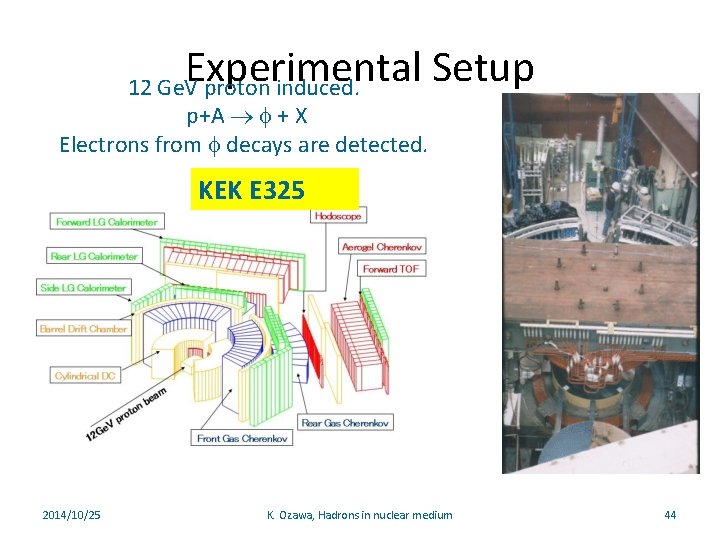
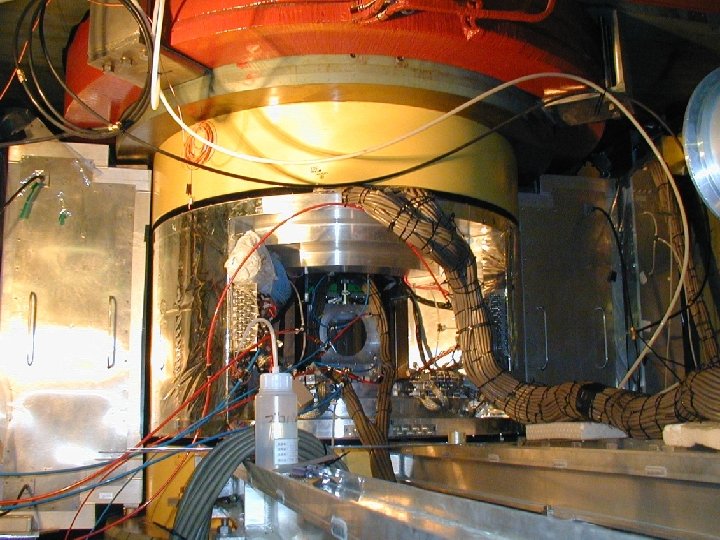
Experimental Setup 12 Ge. V proton induced. p+A f + X Electrons from f decays are detected. KEK E 325 2014/10/25 K. Ozawa, Hadrons in nuclear medium 44
E 325 Spectrometer 2014/10/25 K. Ozawa, Hadrons in nuclear medium 45
Target/Momentum dep. b <1. 25 (Slow) 1. 25<b <1. 75 Two nuclear targets: Carbon & Copper Inside-decay increases in large nucleus Momentum bin Slowly moving f mesons have larger chance to decay inside nucleus Excess Same as previous slide Only one momentum bin shows a mass modification under the current statistics. To see clear mass modification, significantly larger statistics are required. 2014/10/25 Ozawa, Hadrons in nuclear medium e+e- invariant. K. mass 46
What can be achieved? Modified f f f f Pb f from Proton . p e d p [Ge. V/c 2] High resolution Invariant mass in medium 2014/10/25 Dispersion relation K. Ozawa, Hadrons in nuclear medium 47
Next step Evaluate quark condensate directly. Average of Imaginary part of P(w 2) Replace by average of measured spectra Assumed Spectrum p Then, calculate quark condensate using QCD sum rule. Experimental requirements 2014/10/25 1. High statics 2. Good mass resolution K. Ozawa, Hadrons in nuclear medium 48
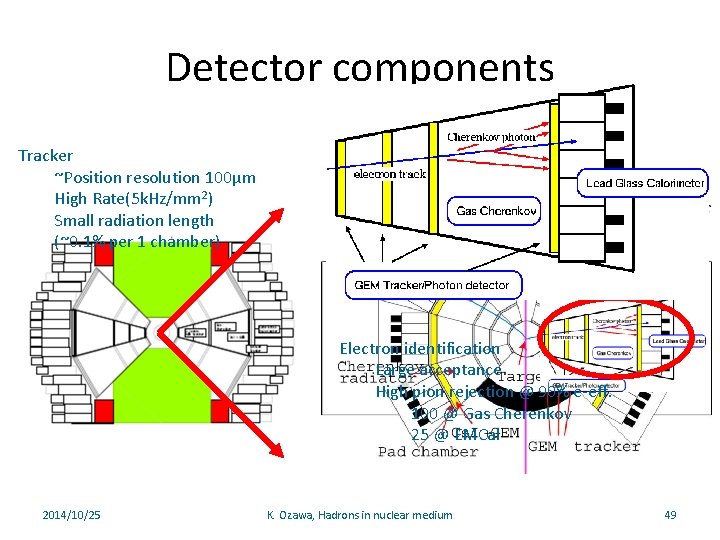
Detector components Tracker ~Position resolution 100μm High Rate(5 k. Hz/mm 2) Small radiation length (~0. 1% per 1 chamber) Electron identification Large acceptance High pion rejection @ 90% e-eff. 100 @ Gas Cherenkov 25 @ EMCal 2014/10/25 K. Ozawa, Hadrons in nuclear medium 49
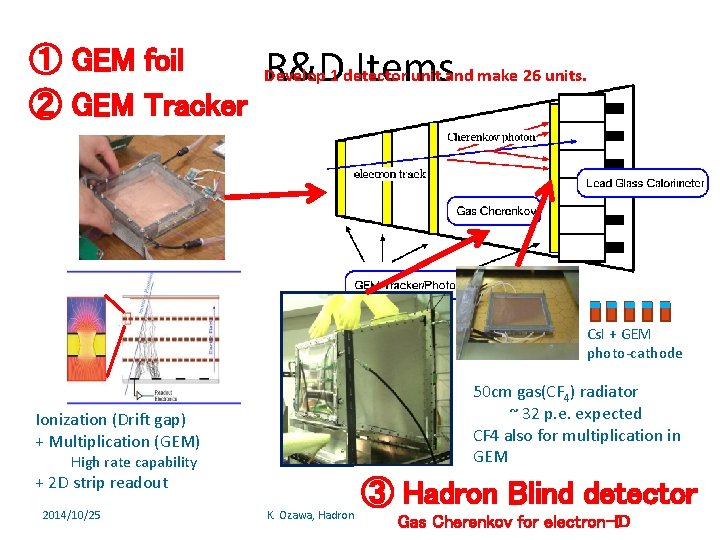
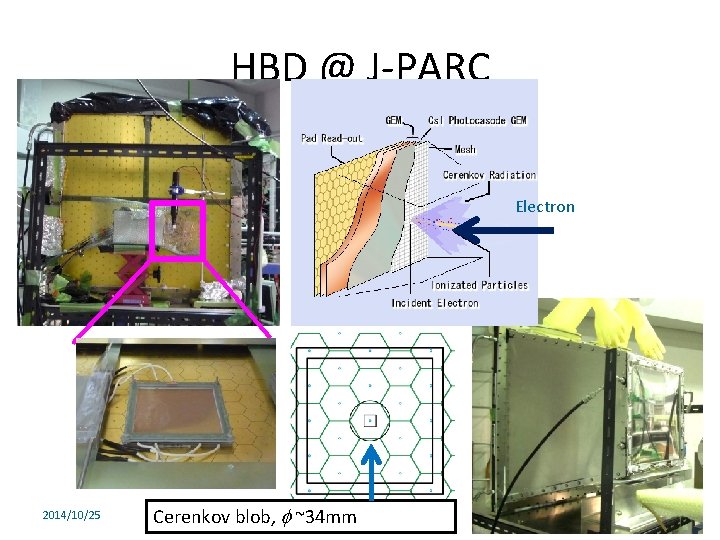
① GEM foil ② GEM Tracker R&D Items Develop 1 detector unit and make 26 units. Cs. I + GEM photo-cathode 50 cm gas(CF 4) radiator ~ 32 p. e. expected CF 4 also for multiplication in GEM Ionization (Drift gap) + Multiplication (GEM) High rate capability + 2 D strip readout 2014/10/25 ③ Hadron Blind detector K. Ozawa, Hadrons in nuclear medium Gas Cherenkov for electron-ID 50
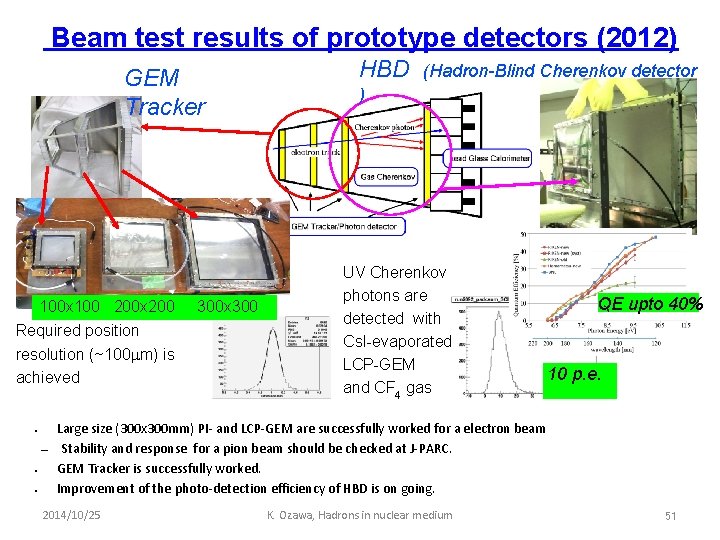
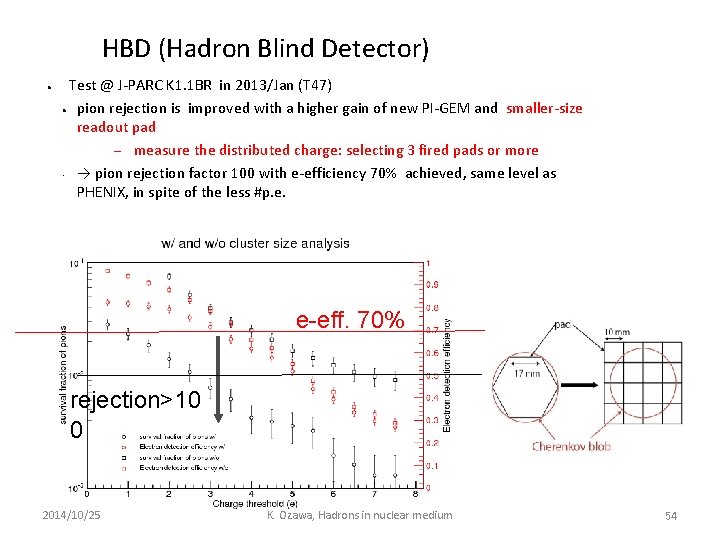
Beam test results of prototype detectors (2012) GEM Tracker 100 x 100 200 x 200 Required position resolution (~100 m) is achieved ● – ● ● 300 x 300 HBD (Hadron-Blind Cherenkov detector ) UV Cherenkov photons are detected with Cs. I-evaporated LCP-GEM and CF 4 gas QE upto 40% 10 p. e. Large size (300 x 300 mm) PI- and LCP-GEM are successfully worked for a electron beam Stability and response for a pion beam should be checked at J-PARC. GEM Tracker is successfully worked. Improvement of the photo-detection efficiency of HBD is on going. 2014/10/25 K. Ozawa, Hadrons in nuclear medium 51
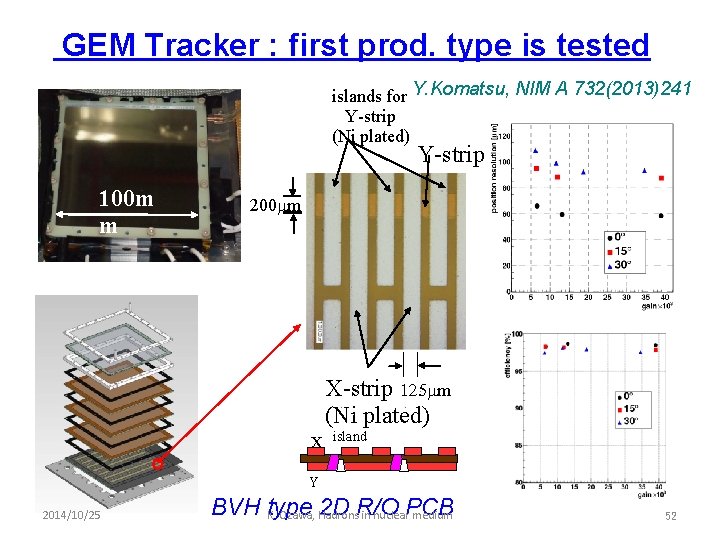
GEM Tracker : first prod. type is tested islands for Y. Komatsu, NIM A 732(2013)241 Y-strip (Ni plated) Y-strip 100 m m 200 m x X-strip 125 m (Ni plated) island Y 2014/10/25 BVH type 2 D R/O K. Ozawa, Hadrons in nuclear. PCB medium 52
HBD @ J-PARC Electron 2014/10/25 Hadrons in nuclear medium Cerenkov blob, K. Ozawa, f ~34 mm 53
HBD (Hadron Blind Detector) ● Test @ J-PARC K 1. 1 BR in 2013/Jan (T 47) ● pion rejection is improved with a higher gain of new PI-GEM and smaller-size readout pad – measure the distributed charge: selecting 3 fired pads or more • → pion rejection factor 100 with e-efficiency 70% achieved, same level as PHENIX, in spite of the less #p. e. e-eff. 70% rejection>10 0 2014/10/25 K. Ozawa, Hadrons in nuclear medium 54
Emergent Diquarks Baryons as well as Mesons seem to be well described by a Rotating String Configuration with a universal string tension. qq L q q 2~W*L M A distance of [qq]-q/ q-q increases as L increases. 2014/10/25 K. Ozawa, Hadrons in nuclear medium 55
Emergent Diquarks Baryons as well as Mesons seem to be well described by a Rotating String Configuration with a universal string tension. 10 Baryons 9 M 2 (Ge. V 2) 10 8 8 M 2∝ 1. 1 L 7 6 5 5 4 4 N Delta Lambda Sigma Xi 3 2 1 2014/10/25 2 3 4 5 6 L rho/a omega/f phi/f K* 3 2 1 0 1 M 2∝ 1. 1 L 7 6 0 Mesons 9 7 0 0 1 K. Ozawa, Hadrons in nuclear medium 2 3 4 5 L 6 7 56
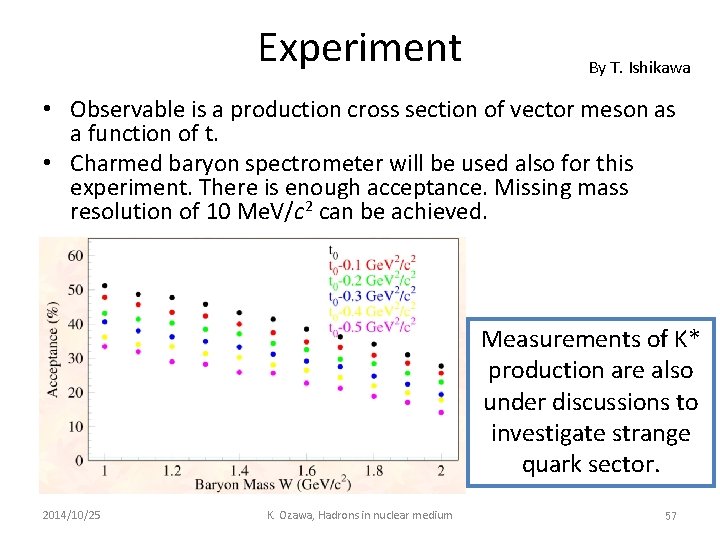
Experiment By T. Ishikawa • Observable is a production cross section of vector meson as a function of t. • Charmed baryon spectrometer will be used also for this experiment. There is enough acceptance. Missing mass resolution of 10 Me. V/c 2 can be achieved. Measurements of K* production are also under discussions to investigate strange quark sector. 2014/10/25 K. Ozawa, Hadrons in nuclear medium 57
– f mesons are produced in the beam direction with a momentum of 9. 5 Ge. V/c – f mesons are decayed into muon pairs isotropically at the f rest frame • Momentum and emitted angle of muons are calculated – Momentum distribution is almost flat • Large fraction has enough momentum Momentum distribution of muons from f decays 0 5 10 [Ge. V/c] A. U. • Simple calculation for the easiest case A. U. Muon decays of f mesons Angle distribution of muons from f decays – Muons are generated in the forward region • Acceptance is calculated – 0. 035 < θ < 0. 14 radian, 100% particle ID – 30 % of f mesons are detected 2014/10/25 0 K. Ozawa, Hadrons in nuclear medium 0. 5 1 [rad] 58