
Future observational prospects for dark energy Roberto Trotta
Future observational prospects for dark energy Roberto Trotta Oxford Astrophysics & Royal Astronomical Society
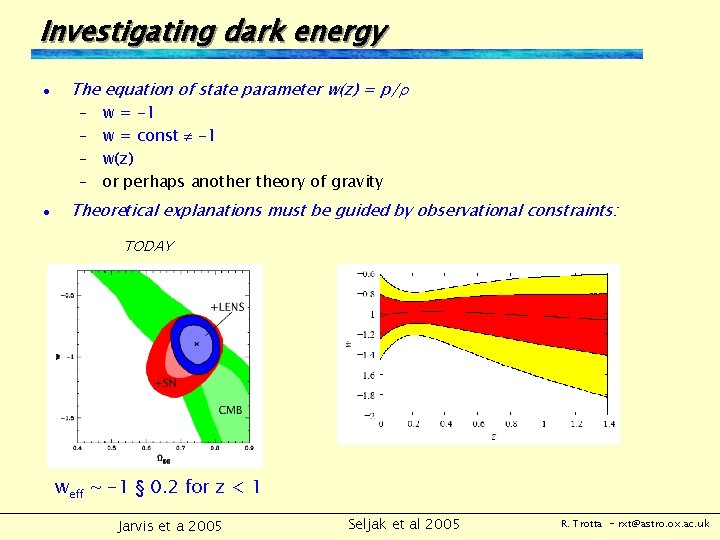
Investigating dark energy l The equation of state parameter w(z) = p/ w = -1 – w = const -1 – w(z) – or perhaps another theory of gravity – l Theoretical explanations must be guided by observational constraints: TODAY weff ~ -1 § 0. 2 for z < 1 Jarvis et a 2005 Seljak et al 2005 R. Trotta - rxt@astro. ox. ac. uk
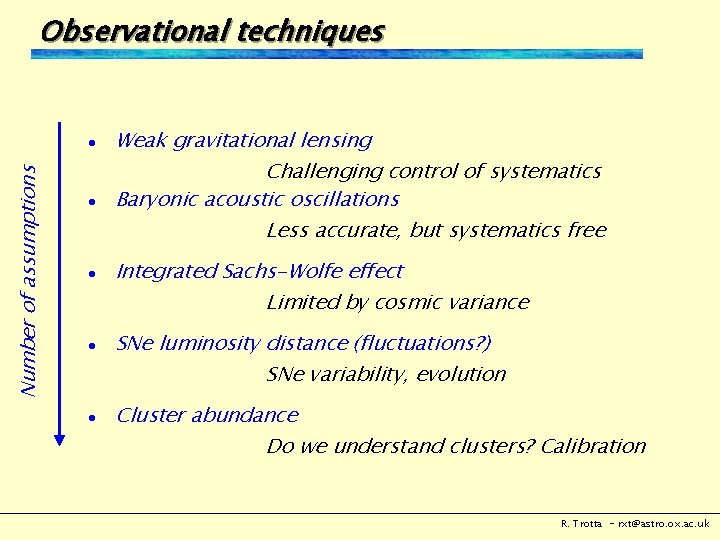
Observational techniques Number of assumptions l l l Weak gravitational lensing Challenging control of systematics Baryonic acoustic oscillations Less accurate, but systematics free Integrated Sachs-Wolfe effect Limited by cosmic variance SNe luminosity distance (fluctuations? ) SNe variability, evolution Cluster abundance Do we understand clusters? Calibration R. Trotta - rxt@astro. ox. ac. uk
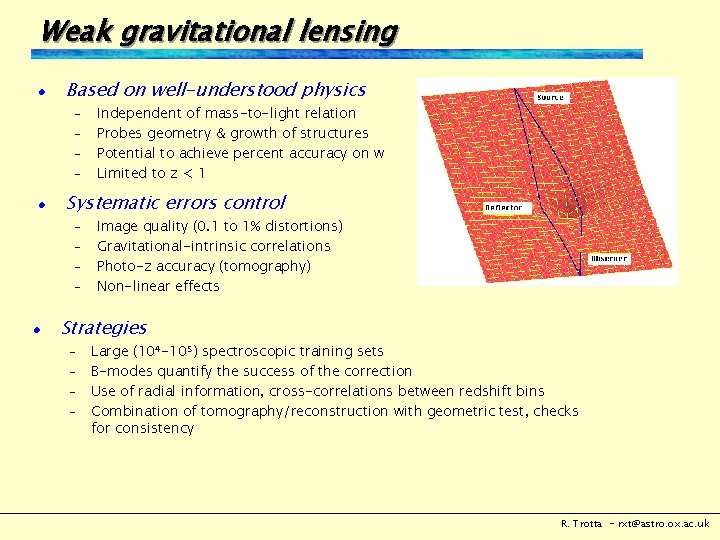
Weak gravitational lensing l Based on well-understood physics – – l Systematic errors control – – l Independent of mass-to-light relation Probes geometry & growth of structures Potential to achieve percent accuracy on w Limited to z < 1 Image quality (0. 1 to 1% distortions) Gravitational-intrinsic correlations Photo-z accuracy (tomography) Non-linear effects Strategies – – Large (104 -105) spectroscopic training sets B-modes quantify the success of the correction Use of radial information, cross-correlations between redshift bins Combination of tomography/reconstruction with geometric test, checks for consistency R. Trotta - rxt@astro. ox. ac. uk
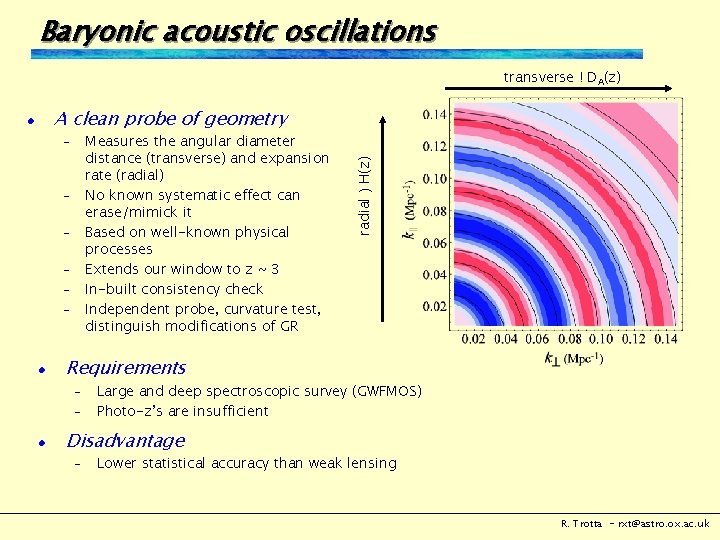
Baryonic acoustic oscillations transverse ! DA(z) Measures the angular diameter distance (transverse) and expansion rate (radial) No known systematic effect can erase/mimick it Based on well-known physical processes Extends our window to z ~ 3 In-built consistency check Independent probe, curvature test, distinguish modifications of GR – – – l Requirements – – l radial ) H(z) A clean probe of geometry l Large and deep spectroscopic survey (GWFMOS) Photo-z’s are insufficient Disadvantage – Lower statistical accuracy than weak lensing R. Trotta - rxt@astro. ox. ac. uk
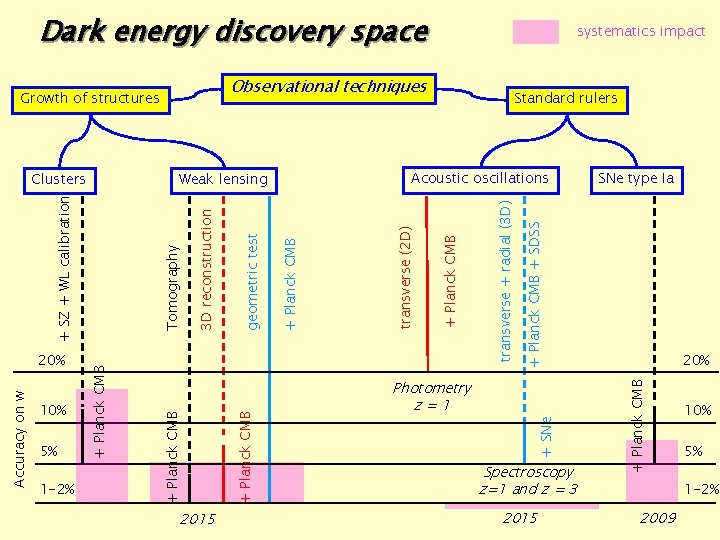
Dark energy discovery space Observational techniques SNe type Ia + Planck CMB + SDSS Spectroscopy z=1 and z = 3 2015 20% + Planck CMB + SNe Photometry z=1 transverse + radial (3 D) + Planck CMB geometric test 3 D reconstruction 2015 + Planck CMB 1 -2% + Planck CMB 5% + Planck CMB 10% Tomography + SZ + WL calibration Accuracy on w 20% Standard rulers Acoustic oscillations Weak lensing transverse (2 D) Growth of structures Clusters systematics impact 10% 5% 1 -2% 2009
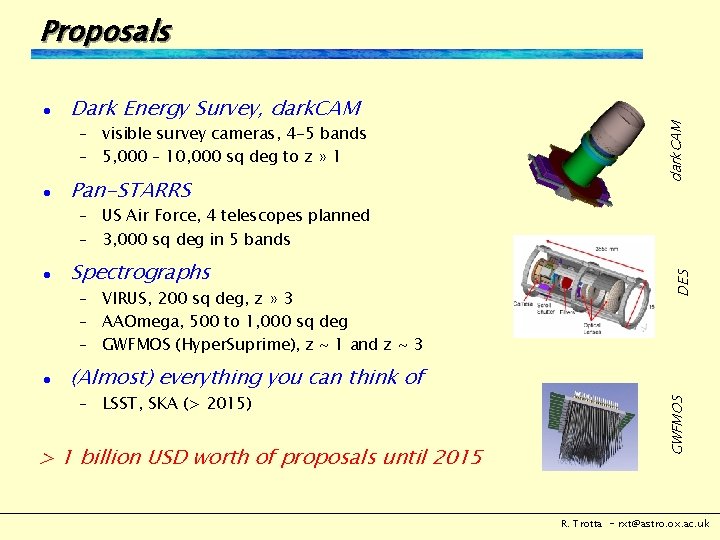
l Dark Energy Survey, dark. CAM visible survey cameras, 4 -5 bands – 5, 000 – 10, 000 sq deg to z » 1 – l Pan-STARRS dark. CAM Proposals US Air Force, 4 telescopes planned – 3, 000 sq deg in 5 bands Spectrographs VIRUS, 200 sq deg, z » 3 – AAOmega, 500 to 1, 000 sq deg – GWFMOS (Hyper. Suprime), z ~ 1 and z ~ 3 – l (Almost) everything you can think of – LSST, SKA (> 2015) > 1 billion USD worth of proposals until 2015 GWFMOS l DES – R. Trotta - rxt@astro. ox. ac. uk
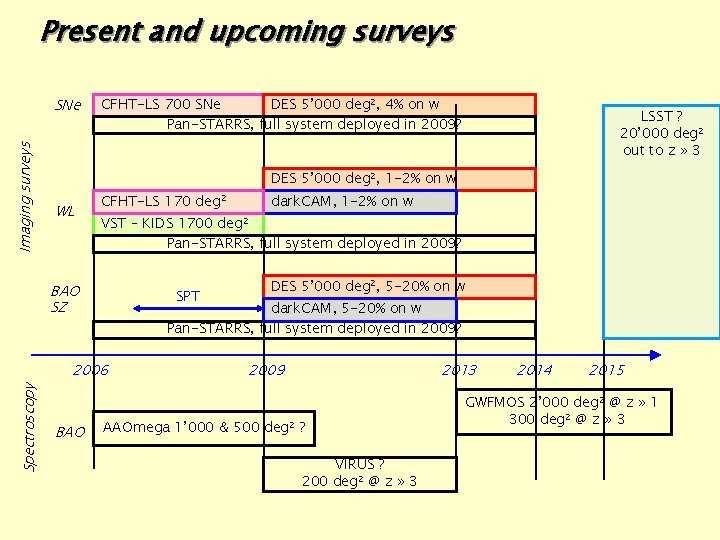
Present and upcoming surveys Imaging surveys SNe CFHT-LS 700 SNe DES 5’ 000 deg 2, 4% on w Pan-STARRS, full system deployed in 2009? DES 5’ 000 deg 2, 1 -2% on w WL CFHT-LS 170 deg 2 SPT DES 5’ 000 deg 2, 5 -20% on w dark. CAM, 5 -20% on w Pan-STARRS, full system deployed in 2009? 2006 BAO dark. CAM, 1 -2% on w VST – KIDS 1700 deg 2 Pan-STARRS, full system deployed in 2009? BAO SZ Spectroscopy LSST ? 20’ 000 deg 2 out to z » 3 2009 2013 AAOmega 1’ 000 & 500 deg 2 ? VIRUS ? 200 deg 2 @ z » 3 2014 2015 GWFMOS 2’ 000 deg 2 @ z » 1 300 deg 2 @ z » 3
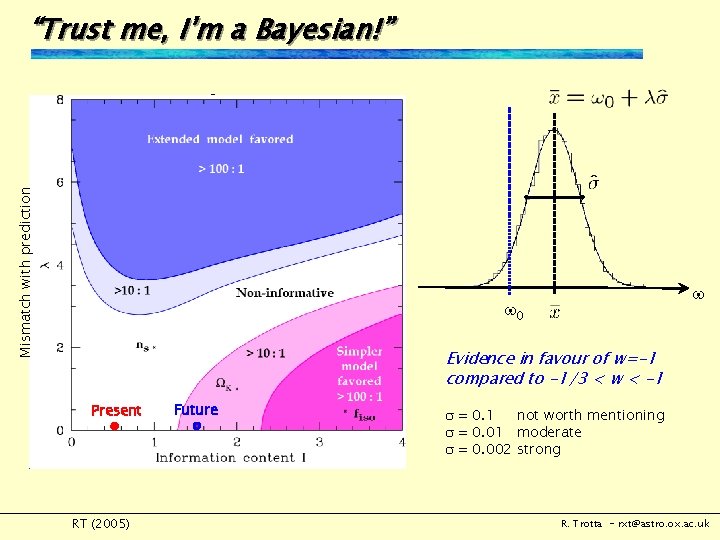
“Trust me, I’m a Bayesian!” Mismatch with prediction Bayes factor B 01 w w 0 Evidence in favour of w=-1 compared to -1/3 < w < -1 Present RT (2005) Future = 0. 1 not worth mentioning = 0. 01 moderate = 0. 002 strong R. Trotta - rxt@astro. ox. ac. uk
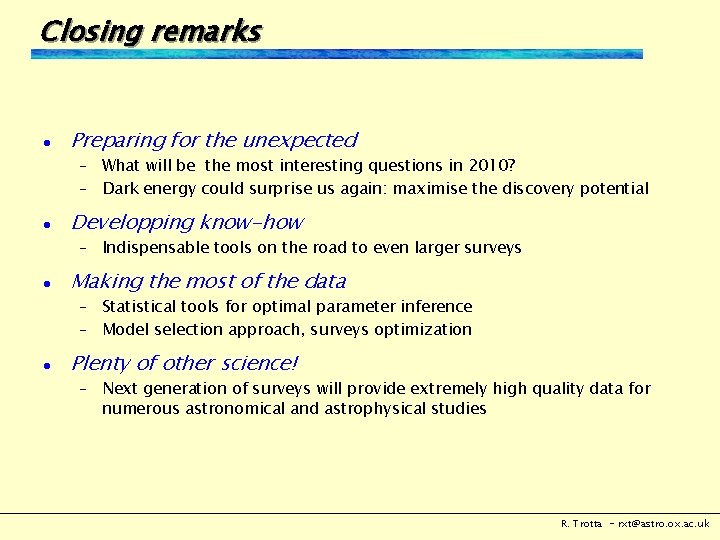
Closing remarks l Preparing for the unexpected What will be the most interesting questions in 2010? – Dark energy could surprise us again: maximise the discovery potential – l Developping know-how – l Indispensable tools on the road to even larger surveys Making the most of the data Statistical tools for optimal parameter inference – Model selection approach, surveys optimization – l Plenty of other science! – Next generation of surveys will provide extremely high quality data for numerous astronomical and astrophysical studies R. Trotta - rxt@astro. ox. ac. uk
- Slides: 10