
Future Internet Architectures FIA And GENI Darleen Fisher
- Slides: 25
Future Internet Architectures (FIA) And GENI Darleen Fisher Program Director Division of Computer & Network Systems Directorate for Computer and Information Science and Engineering National Science Foundation
Outline • FIA Vision • Future Internet Architecture (FIA) Projects • FIA Projects’ Current Ideas about Using GENI • Going Forward—What might be next for FIA & GENI? 2
Future Internet – The Vision • Society’s needs for an IT infrastructure may no longer be met by the present trajectory of incremental changes to the current Internet • Society needs the research community to create the trustworthy Future Internets that meet the needs and challenges of the 21 st Century. • Research should include intellectually distinctive ideas, driven by the requirement for long-range concepts unfettered by the current limitations of or the requirement for immediate application to the current Internet. Architecture includes all needed functionalities (overarching architecture). • Research on Future Internets create a community better informed and educated about network architecture design
Future Internet Architectures (FIA) NSF issued a call for proposals: • To support innovative and creative projects that conceive, design, and evaluate trustworthy Future Internet architectures • 4 projects awarded – A diverse portfolio – (smaller projects under consideration and expected submit to Ne. TS Large) • http: //www. nets-fia. net/ 4
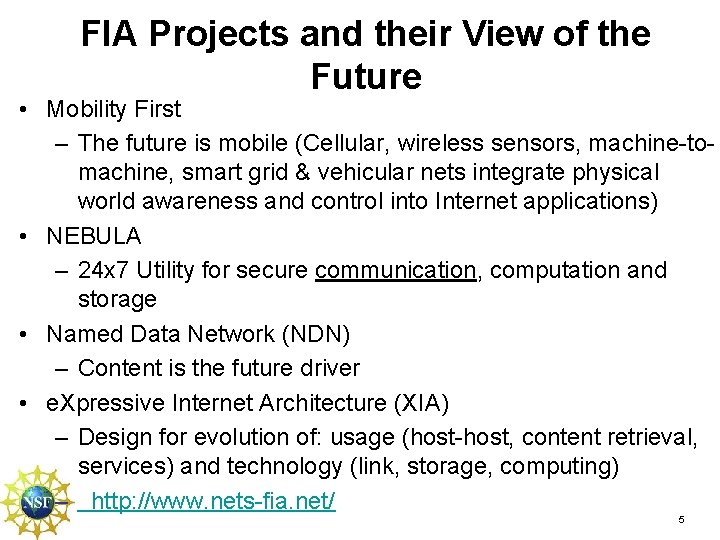
FIA Projects and their View of the Future • Mobility First – The future is mobile (Cellular, wireless sensors, machine-tomachine, smart grid & vehicular nets integrate physical world awareness and control into Internet applications) • NEBULA – 24 x 7 Utility for secure communication, computation and storage • Named Data Network (NDN) – Content is the future driver • e. Xpressive Internet Architecture (XIA) – Design for evolution of: usage (host-host, content retrieval, services) and technology (link, storage, computing) – http: //www. nets-fia. net/ 5
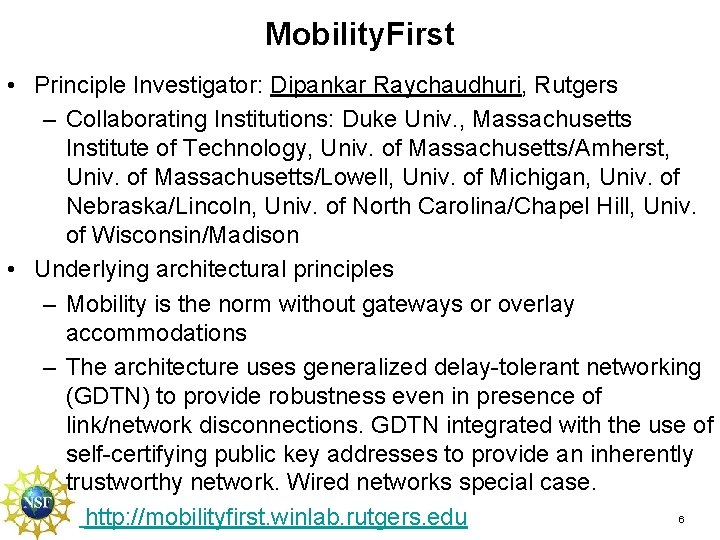
Mobility. First • Principle Investigator: Dipankar Raychaudhuri, Rutgers – Collaborating Institutions: Duke Univ. , Massachusetts Institute of Technology, Univ. of Massachusetts/Amherst, Univ. of Massachusetts/Lowell, Univ. of Michigan, Univ. of Nebraska/Lincoln, Univ. of North Carolina/Chapel Hill, Univ. of Wisconsin/Madison • Underlying architectural principles – Mobility is the norm without gateways or overlay accommodations – The architecture uses generalized delay-tolerant networking (GDTN) to provide robustness even in presence of link/network disconnections. GDTN integrated with the use of self-certifying public key addresses to provide an inherently trustworthy network. Wired networks special case. 6 http: //mobilityfirst. winlab. rutgers. edu
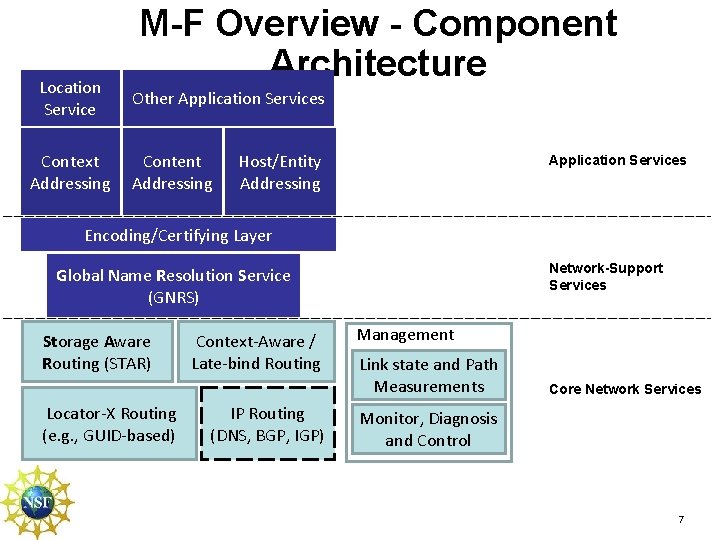
Location Service Context Addressing M-F Overview - Component Architecture Other Application Services Content Addressing Host/Entity Addressing Application Services Encoding/Certifying Layer Network-Support Services Global Name Resolution Service (GNRS) Storage Aware Routing (STAR) Locator-X Routing (e. g. , GUID-based) Context-Aware / Late-bind Routing IP Routing (DNS, BGP, IGP) Management Link state and Path Measurements Core Network Services Monitor, Diagnosis and Control 7
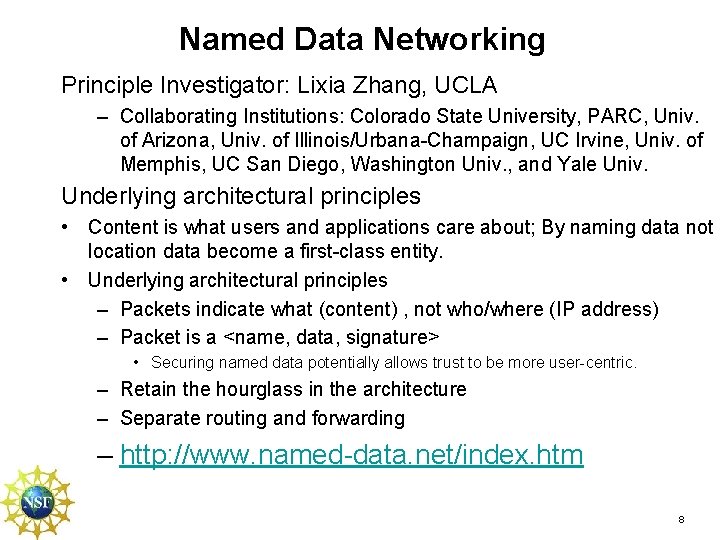
Named Data Networking Principle Investigator: Lixia Zhang, UCLA – Collaborating Institutions: Colorado State University, PARC, Univ. of Arizona, Univ. of Illinois/Urbana-Champaign, UC Irvine, Univ. of Memphis, UC San Diego, Washington Univ. , and Yale Univ. Underlying architectural principles • Content is what users and applications care about; By naming data not location data become a first-class entity. • Underlying architectural principles – Packets indicate what (content) , not who/where (IP address) – Packet is a <name, data, signature> • Securing named data potentially allows trust to be more user-centric. – Retain the hourglass in the architecture – Separate routing and forwarding – http: //www. named-data. net/index. htm 8
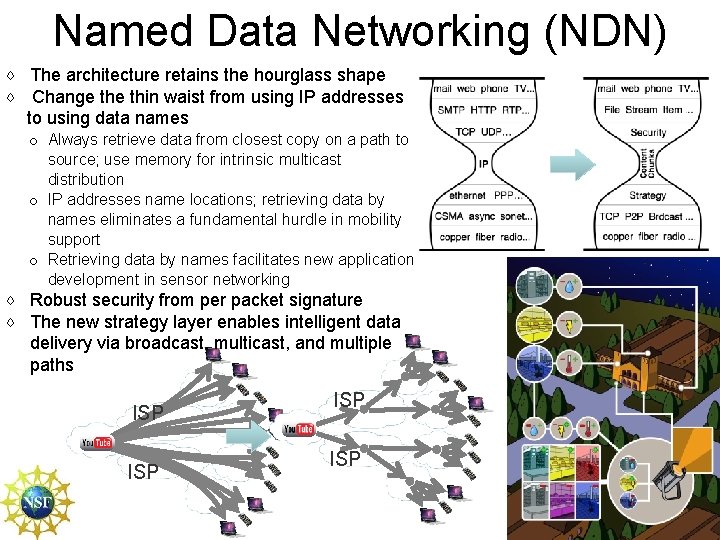
Named Data Networking (NDN) ♢ ♢ The architecture retains the hourglass shape Change thin waist from using IP addresses to using data names ♢ ♢ Always retrieve data from closest copy on a path to source; use memory for intrinsic multicast distribution IP addresses name locations; retrieving data by names eliminates a fundamental hurdle in mobility support Retrieving data by names facilitates new application development in sensor networking Robust security from per packet signature The new strategy layer enables intelligent data delivery via broadcast, multicast, and multiple paths ISP ISP 9
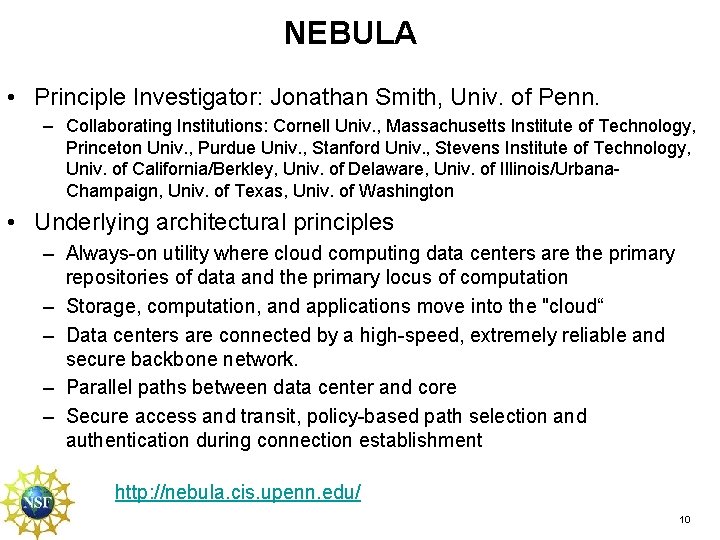
NEBULA • Principle Investigator: Jonathan Smith, Univ. of Penn. – Collaborating Institutions: Cornell Univ. , Massachusetts Institute of Technology, Princeton Univ. , Purdue Univ. , Stanford Univ. , Stevens Institute of Technology, Univ. of California/Berkley, Univ. of Delaware, Univ. of Illinois/Urbana. Champaign, Univ. of Texas, Univ. of Washington • Underlying architectural principles – Always-on utility where cloud computing data centers are the primary repositories of data and the primary locus of computation – Storage, computation, and applications move into the "cloud“ – Data centers are connected by a high-speed, extremely reliable and secure backbone network. – Parallel paths between data center and core – Secure access and transit, policy-based path selection and authentication during connection establishment http: //nebula. cis. upenn. edu/ 10
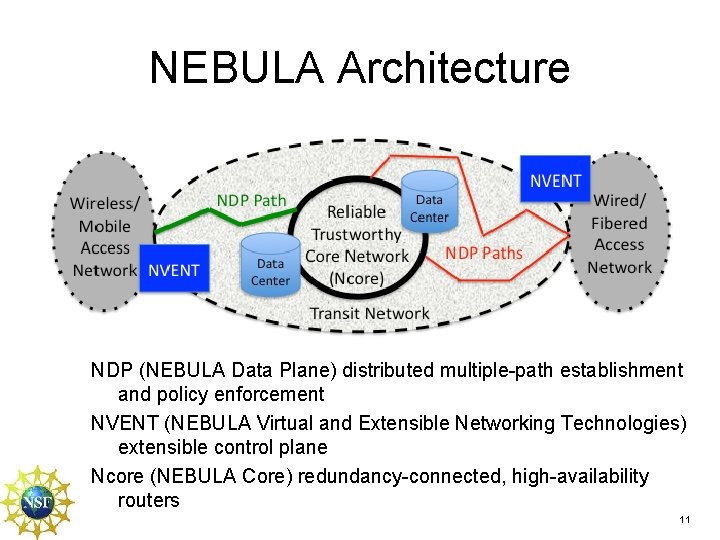
NEBULA Architecture NDP (NEBULA Data Plane) distributed multiple-path establishment and policy enforcement NVENT (NEBULA Virtual and Extensible Networking Technologies) extensible control plane Ncore (NEBULA Core) redundancy-connected, high-availability routers 11
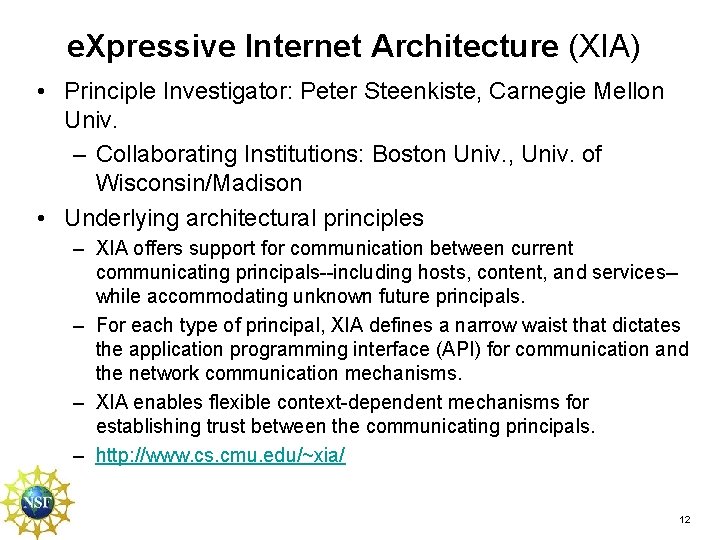
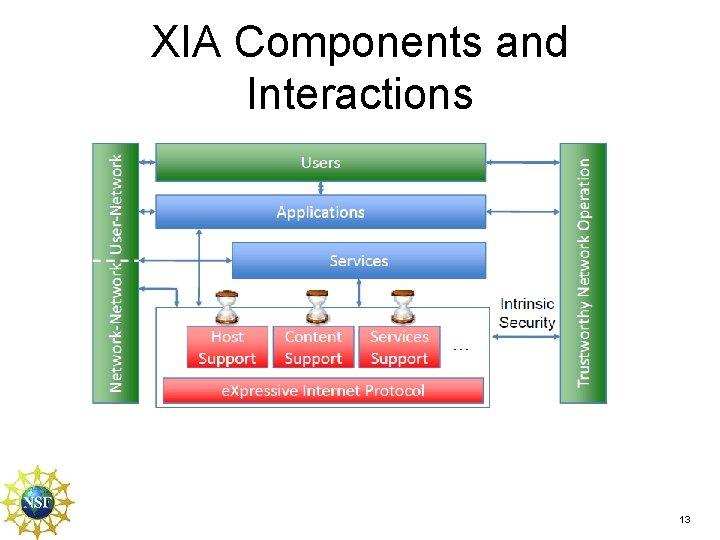
e. Xpressive Internet Architecture (XIA) • Principle Investigator: Peter Steenkiste, Carnegie Mellon Univ. – Collaborating Institutions: Boston Univ. , Univ. of Wisconsin/Madison • Underlying architectural principles – XIA offers support for communication between current communicating principals--including hosts, content, and services-while accommodating unknown future principals. – For each type of principal, XIA defines a narrow waist that dictates the application programming interface (API) for communication and the network communication mechanisms. – XIA enables flexible context-dependent mechanisms for establishing trust between the communicating principals. – http: //www. cs. cmu. edu/~xia/ 12
XIA Components and Interactions 13
FIA Projects’ Current Ideas to use GENI Project: • Just began September 1, 2010; • Are at different levels of maturity; as are • Their plans for experimentation and how they might use GENI. 14
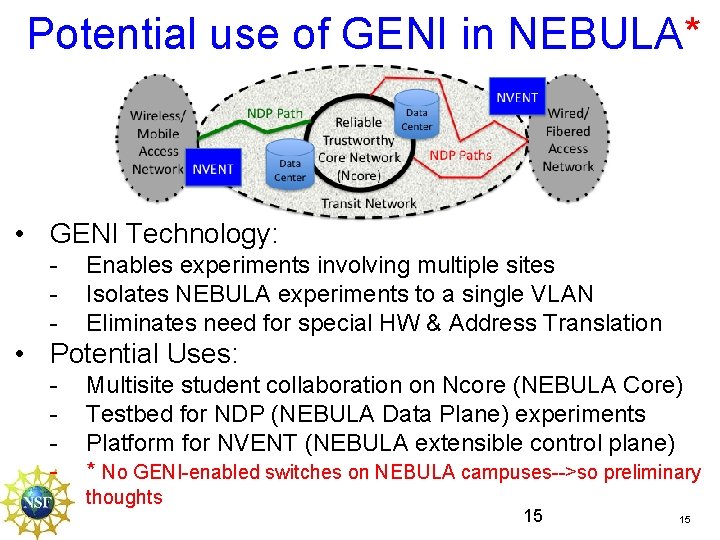
Potential use of GENI in NEBULA* • GENI Technology: - Enables experiments involving multiple sites Isolates NEBULA experiments to a single VLAN Eliminates need for special HW & Address Translation • Potential Uses: - Multisite student collaboration on Ncore (NEBULA Core) Testbed for NDP (NEBULA Data Plane) experiments Platform for NVENT (NEBULA extensible control plane) * No GENI-enabled switches on NEBULA campuses-->so preliminary thoughts 15 15
XIA Testbed Requirements • Run fairly large, geographically diverse experiments – Several tens or more nodes • High speed packet processing platform – Evaluating Openflow – XIA is very different from IP • Diverse access network technologies – Evaluate XIA over diverse networks using applications • Short learning curve for students – Avoid time sink that takes away time from research – Essential for UG and MS student participation 16
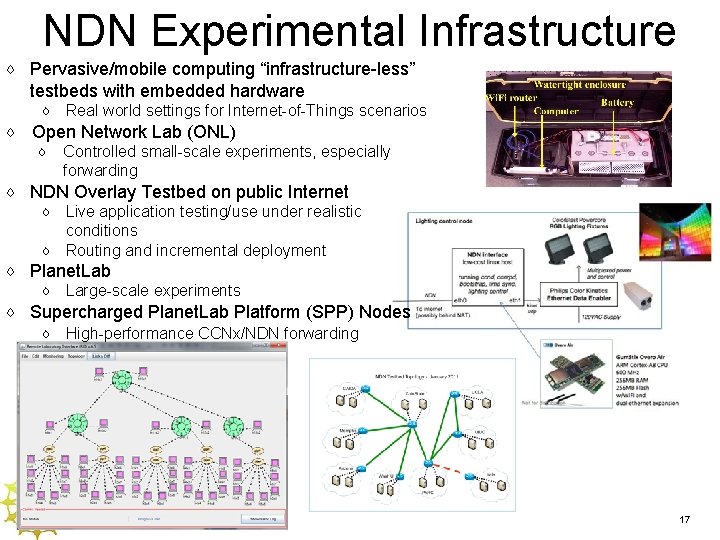
NDN Experimental Infrastructure ♢ Pervasive/mobile computing “infrastructure-less” testbeds with embedded hardware ♢ ♢ Open Network Lab (ONL) ♢ ♢ Real world settings for Internet-of-Things scenarios Controlled small-scale experiments, especially forwarding NDN Overlay Testbed on public Internet Live application testing/use under realistic conditions ♢ Routing and incremental deployment ♢ ♢ Planet. Lab ♢ ♢ Large-scale experiments Supercharged Planet. Lab Platform (SPP) Nodes ♢ High-performance CCNx/NDN forwarding 17
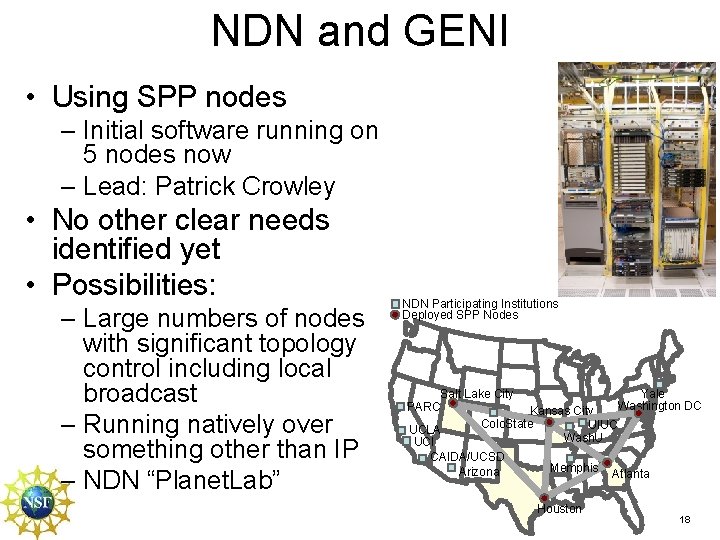
NDN and GENI • Using SPP nodes – Initial software running on 5 nodes now – Lead: Patrick Crowley • No other clear needs identified yet • Possibilities: – Large numbers of nodes with significant topology control including local broadcast – Running natively over something other than IP – NDN “Planet. Lab” NDN Participating Institutions Deployed SPP Nodes Yale Salt Lake City Washington DC PARC Kansas City Colo. State UIUC UCLA Wash. U UCI CAIDA/UCSD Memphis Arizona Atlanta Houston 18
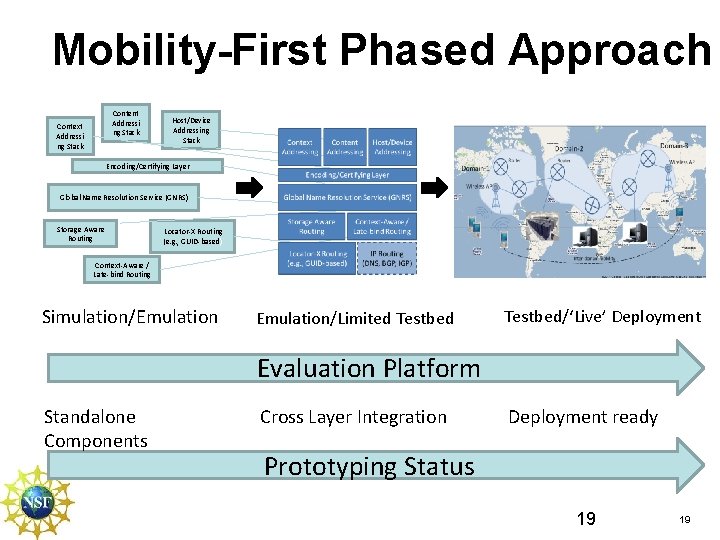
Mobility-First Phased Approach Content Addressi ng Stack Context Addressi ng Stack Host/Device Addressing Stack Encoding/Certifying Layer Global Name Resolution Service (GNRS) Storage Aware Routing Locator-X Routing (e. g. , GUID-based) Context-Aware / Late-bind Routing Simulation/Emulation/Limited Testbed/‘Live’ Deployment Evaluation Platform Standalone Components Cross Layer Integration Deployment ready Prototyping Status 19 19
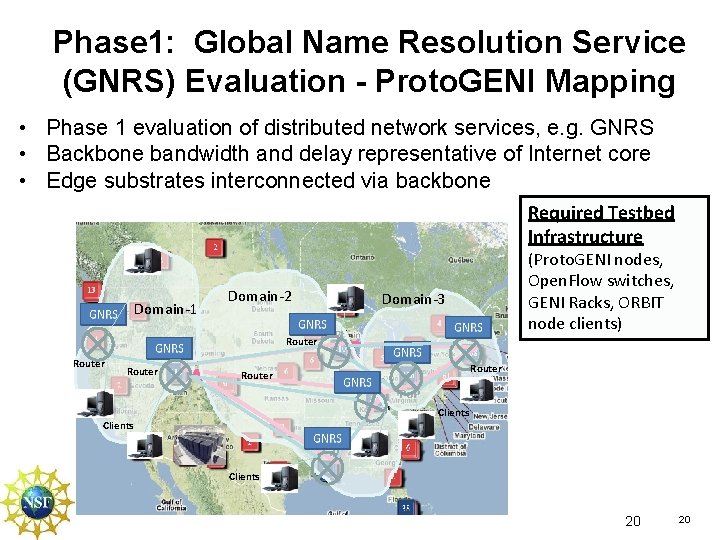
Phase 1: Global Name Resolution Service (GNRS) Evaluation - Proto. GENI Mapping • Phase 1 evaluation of distributed network services, e. g. GNRS • Backbone bandwidth and delay representative of Internet core • Edge substrates interconnected via backbone Required Testbed Infrastructure Domain-1 Domain-2 Router Domain-3 Po. P Router (Proto. GENI nodes, Open. Flow switches, GENI Racks, ORBIT node clients) Router Po. P Clients 20 20
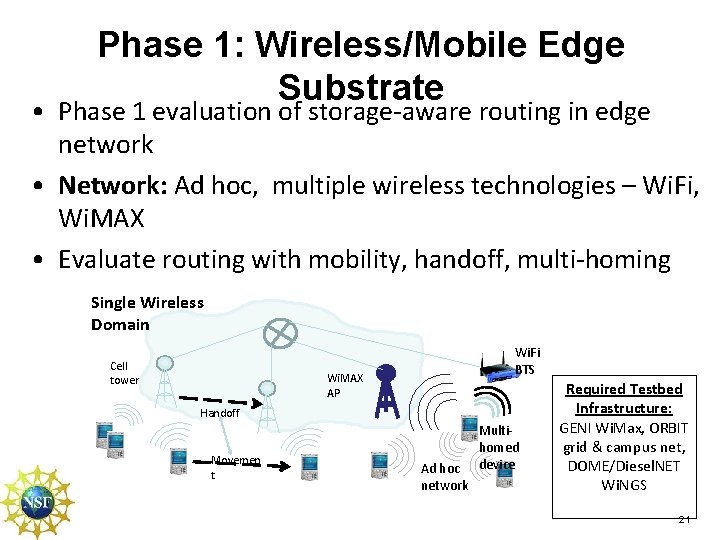
Phase 1: Wireless/Mobile Edge Substrate • Phase 1 evaluation of storage-aware routing in edge network • Network: Ad hoc, multiple wireless technologies – Wi. Fi, Wi. MAX • Evaluate routing with mobility, handoff, multi-homing Single Wireless Domain Cell tower Wi. Fi BTS Wi. MAX AP Handoff Movemen t Ad hoc network Multihomed device Required Testbed Infrastructure: GENI Wi. Max, ORBIT grid & campus net, DOME/Diesel. NET Wi. NGS 21
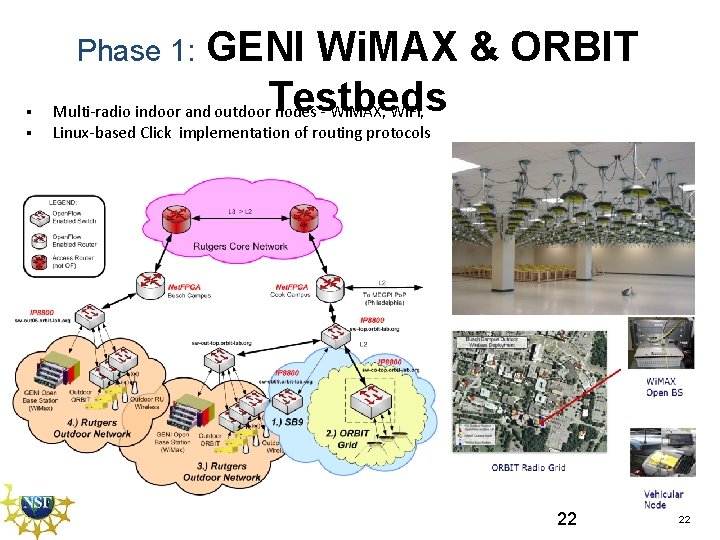
GENI Wi. MAX & ORBIT Multi-radio indoor and outdoor. Testbeds nodes - Wi. MAX, Wi. Fi, Phase 1: § § Linux-based Click implementation of routing protocols 22 22
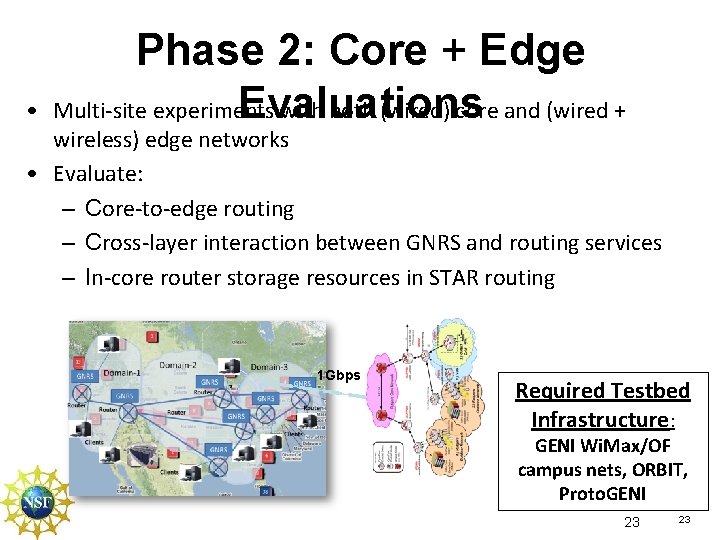
• Phase 2: Core + Edge Evaluations Multi-site experiments with both (wired) core and (wired + wireless) edge networks • Evaluate: – Core-to-edge routing – Cross-layer interaction between GNRS and routing services – In-core router storage resources in STAR routing 1 Gbps Required Testbed Infrastructure: GENI Wi. Max/OF campus nets, ORBIT, Proto. GENI 23 23
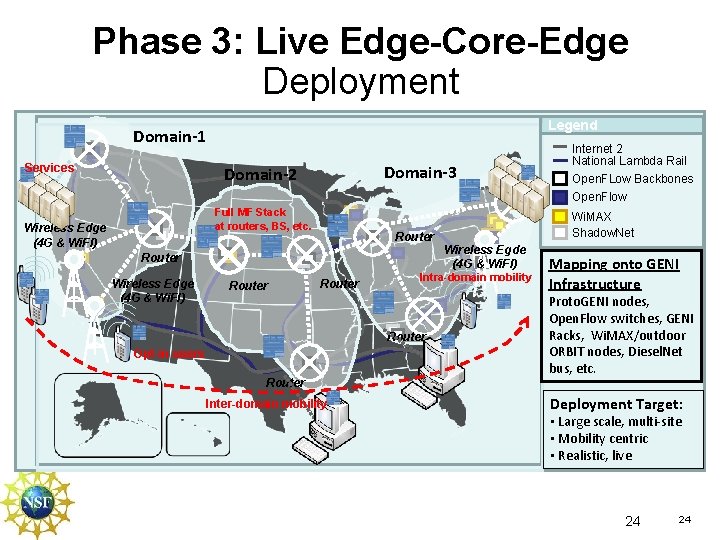
Phase 3: Live Edge-Core-Edge Deployment Legend Domain-1 Services Domain-3 Domain-2 Internet 2 National Lambda Rail Open. FLow Backbones Open. Flow Full MF Stack at routers, BS, etc. Wireless Edge (4 G & Wi. FI) Router Router Inter-domain mobility Wireless Egde (4 G & Wi. FI) Intra-domain mobility Router Opt-in users Wi. MAX Shadow. Net Mapping onto GENI Infrastructure Proto. GENI nodes, Open. Flow switches, GENI Racks, Wi. MAX/outdoor ORBIT nodes, Diesel. Net bus, etc. Deployment Target: • Large scale, multi-site • Mobility centric • Realistic, live 24 24
Going Forward FIA team members continue to participate in GENI-FIA-like Workshop? ? ? – – FIA testbed/experimentalists Reps GENI GPO Reps Working Groups Reps Other researchers working on architecture projects Other ideas? 25