
Future Hardware Platform Technologies Presented by Alexander Sack
Future Hardware Platform Technologies Presented by: Alexander Sack, Senior Developer 1

Agenda § State of the Industry § Future Technologies § § § Multi-Core SATA SAS PCI Express i. SCSI Virtualization § New SCO Hardware Support & New Hard Drive types § Nearline Hard Drive Considerations § Future Hardware Support from SCO & Current Projects § Q&A 2
Part One State of the Industry
State of the Industry § Where are we today? § 32 -bit Single or dual processor servers § I/O bandwidth bound: § Devices are faster than the interconnect or fabric they attach to § Complicated cabling schemes to attach devices § Network and storage separately managed § Platform dependent § Separate servers for separate platforms § Separate platforms for separate applications § Mixed architectural environments 4
State of the Industry § Where are we heading? § 64 -bit Multi-Core Architectures § In order to keep pace with Moore’s Law, Intel and AMD are concentrating on parallelism not clock speed. § The “Serial” Age § Next generation protocols have moved back to serial protocols: Its easier to move one bit faster than several bits simultaneously! § Wired to Wireless § In an age of mobile devices, access to the network must be unfettered! § Networked Storage § Network vs. Storage: What’s really the difference? § A Virtual World § Virtualization is no longer just an enterprise feature on big iron. 5
State of the Industry § What does this all mean? § § § Faster processing, networking and I/O power Compact design, easy assembly Designed for power management Easier access to the network Heterogeneous environments managed on one platform § Mixed platform and application environments on a single managed piece of hardware! 6

Future Technologies
Future Technologies: Multi-Core § What is it? § A multi-core CPU combines independent processors or cores onto a single silicon chip. § Intel: Distinguishes between logical and physical processors · Logical refers to the Hyperthreading side, physical means core. · An Intel Dual-Core processor has two physical processors in the same chip package. · Dual-Core Pentium 4 Xeon chips, “Paxville”, is due out 1 Q 06 or sooner! § AMD: Uses the concept of logical processor count to refer to multiple cores existing within the same chip package. · Shipping dual-core Opteron and AMD 64 (X 2) today 8
Future Technologies: Multi-Core § How does it work? § Just like SMP, when a system boots, the kernel is loaded on one processor or one core called the bootstrap processor or BSP. § The kernel queries the BSP via the CPUID instruction to determine how many logical and physical processors exist. § Based on the number of logical, physical, and licensed processors, the kernel will attempt to initialize each processor. 9
Future Technologies: Multi-Core § The OS scheduler will typically run processes in a round-robin fashion and due to our ordering scheme, usually select a physical processor before a logical processor. § The kernel relies on the ACPI CA layer if no MPS Tables are detected to route interrupts correctly. § ACPI CA based on the Intel stack § Will be updated to support newer ACPI v 3. 0 § Interrupts are load-balanced across multiple Local APICs. § APIC has a limitation of 8 CPUs since it uses 3 bits to address a processor on a separate APIC specific bus. § Latest Pentium architecture uses XAPIC which reuses the system bus to address processors, thus supporting larger than 8 CPU configurations. 10
Future Technologies: Multi-Core § Impact? § Multi-Core processors are licensed the same way as Hyperthreading technology. § SCO is ready to fully support multi-core architectures today! § OSR 6 MP 1 fully supports current Intel Dual-Core offerings § OSR 6 and UW 7 must be installed in single processor mode before enabling multi-core technology. § Working with OEM partners to have certifications ready in time for dual -core toward the end of the year. § AMD? 11

Future Technologies: SATA § What is it? § Serial ATA is the next generation of IDE designed to replace the older parallel interconnect. § Serial ATA is composed of several specifications: § Serial ATA Core Specification · Gives general protocol and physical layer descriptions Protocol pieces are slowly being folded into the T 13 AT Attachment standards. · Initially based on ATA/ATAPI-6 standard § Serial ATA II Specification · An addendum to Serial ATA Core spec · Serial ATA II DOES NOT MEAN 300 GB/s! · Adds additional features to the existing specs § Port Multiplier Specification · Specifies how port multipliers devices are incorporated into a SATA topology § Port Selector Specification · Adds redundant path capabilities to a SATA device 12
Future Technologies: SATA § Gen I: 150 MB/s Gen II: 300 MB/s § Serial Protocol means point-to-point topology. § The SATA II specs added some key features: § Native Command Queuing (NCQ) § Similar to SCSI tagged command queuing with a max queue depth 32 § First Party DMA (FPDMA) READ and WRITE § Allows target to reschedule I/O commands for quicker access times. § Hot-Plug § SATA was designed with native Hot-Plug in mind § Devices can be added and removed to a port without stopping the bus. § Staggered Spin-Up § Allows sequential start up devices to reduce peak power requirements 13
Future Technologies: SATA § How does it work? § Some SATA controllers implement a Shadow Register Block § § Remember, SATA devices do not have hardware registers. Legacy Mode means that the controller is being programmed like a IDE chipset. Allows legacy drivers to just work Awkward as some aspects of ATA can not be fully emulated like PIO mode. § Native SATA chipsets require a driver to send down Frame Information Structures (FIS). § Allows driver to use extended features like NCQ and Hot-Plug § Uses fast and efficient DMA or FPDMA mechanisms for I/O transfers § There are several kinds of FISes: · D 2 H – Register · H 2 D – Register · Set Device Bits · DMA Activate · DMA Setup · PIO Setup · DATA · BIST Activate 14
Future Technologies: SATA § Impact? § Not all controllers are Native SATA § Some controllers just use SATA PHY to either increase interconnect speed (133 to 150 MB/s) or to reuse existing fab designes § Most hardware SATA RAID are really SCSI or SCSI-like cards § Advanced Host Controller Interface (AHCI) is an Intel sponsored open specification for a native SATA chipset. · Support all of SATA II feature list · Has already multi-vendor support · OSR 6 ships with a AHCI driver § Deploy SATA with confidence! § Hardware SATA RAID is supported by the existing drivers that ship today with OSR 6! § OSR 6 will be further enhanced to support other chipsets in the future. § SATA will be the primary interconnect for lower cost storage solutions. 15
Future Technologies: SAS § What is it? § Serial Attached SCSI (SAS) is the next generation of the venerable SCSI protocol § SAS specification is maintained by the T 10 Technical Committee: § ANSI standard as of 2003 § Works on top of the existing SCSI Architecture Model-3 (SAM-3) § Roadmap: § Gen I: 3 GB/s (shipping now!) § Gen II: 6 GB/s (2006) § Gen III: 12 GB/s (2010) 16
Future Technologies: SAS § SAS has incorporated the best of various storage technologies: § Data frame based on FCP § Leverages existing SATA PHY for compatibility § Supports OOB signals SATA COMRESET, COMINIT, and COMWAKE § Adds COMSAS which is used to distinguish between a SATA and SAS PHY § Both sides must assert COMSAS to establish a SAS link § § § 17 Scalability with wide ports Dual-ported by design for high availability World-Wide Names 8 B/10 B Encoding Scheme Spread Spectrum Clocking to address EMI requirements
Future Technologies: SAS § How does it work? § Architecture Overview (SAS-1. 1 Section 4. 1. 1): § A SAS domain contains one or more SAS devices and a service delivery subsystem. § A SAS device contains one or more SAS ports. § A SAS port contains one or more phys. § A service delivery subsystem in a SAS domain may contain expander devices: · Expander devices contain expander ports and a SMP port. · An expander port contains one or more phys. · An expander device may share its phy with the SAS device contained within the expander device. 18
Future Technologies: SAS § Expander Devices § Act as hubs or routers to expand a SAS bus § Support up to 128 ports § Two types of expanders: § Edge Expanders · May not be connected to more than one fanout expander · Only two edge expander device sets in a single SAS domain § Fan-out Expanders · Used to connect multiple edge expanders · No more than one fanout expander per SAS domain 19
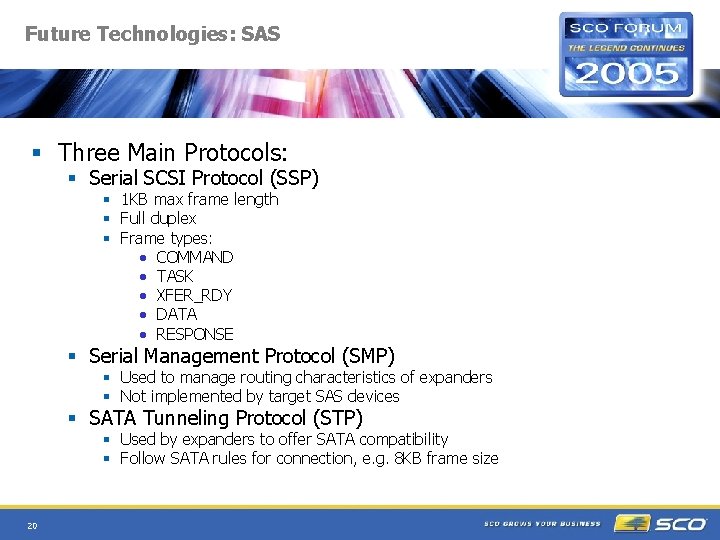
Future Technologies: SAS § Three Main Protocols: § Serial SCSI Protocol (SSP) § 1 KB max frame length § Full duplex § Frame types: · COMMAND · TASK · XFER_RDY · DATA · RESPONSE § Serial Management Protocol (SMP) § Used to manage routing characteristics of expanders § Not implemented by target SAS devices § SATA Tunneling Protocol (STP) § Used by expanders to offer SATA compatibility § Follow SATA rules for connection, e. g. 8 KB frame size 20
Future Technologies: SAS § Impact? § SAS is expected to become mainstream in 2006. § Vendors are starting to ship their SAS solutions now! § Working with partners to prepare for the SAS invasion: § OSR 6 is already certified with HP’s P 600 SAS controller § LSI working on full support for their MPT and Mega. RAID SAS controllers § Working with Adaptec to deliver full Host. RAID SAS support by end of year § Maintenance Pack update will occur to update OSR 6/UW 7 to handle SAS 21
Future Technologies: PCI Express § What is it? § PCI Express is the next generation of PCI § Initially developed by Intel as 3 GIO § Handed over to PCI SIG to become an official standard § Ratified as a standard in 2002 § Designed to look like PCI in order to smooth transition but overcome a lot of the initial limitations of PCI/PCI-X: · Point-to-point interconnections are faster · Wide parallel bus increases cost · Reference CLK signal validation is slow due to settling times · With one bus transaction in one direction at a time, arbitration for bus ownership slows down system performance 22

Future Technologies: PCI Express § Advanced Features: § Power Management § Quality of Service § Isochronous connections (time based) § Hot-Plug and Hot Swap § Multi-hierarchy and advanced peer-to-peer communications § Data Integrity § Error Handling § Process Technology Independence § Built-in standards for electrical compliance 23
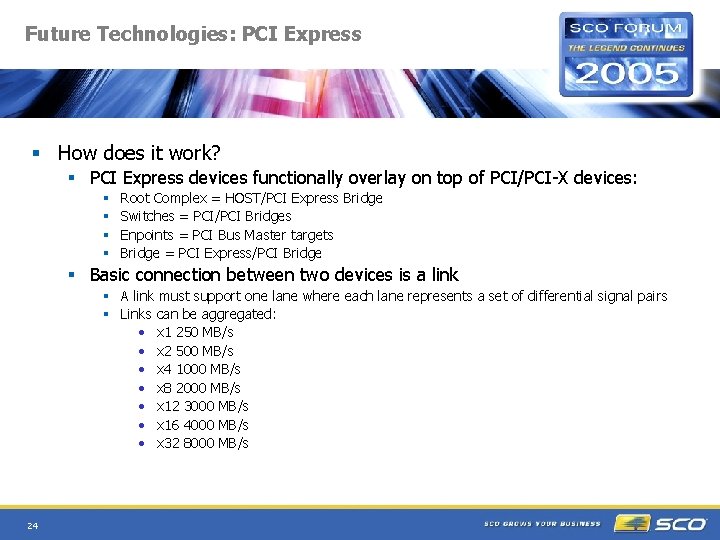
Future Technologies: PCI Express § How does it work? § PCI Express devices functionally overlay on top of PCI/PCI-X devices: § § Root Complex = HOST/PCI Express Bridge Switches = PCI/PCI Bridges Enpoints = PCI Bus Master targets Bridge = PCI Express/PCI Bridge § Basic connection between two devices is a link § A link must support one lane where each lane represents a set of differential signal pairs § Links can be aggregated: · x 1 250 MB/s · x 2 500 MB/s · x 4 1000 MB/s · x 8 2000 MB/s · x 12 3000 MB/s · x 16 4000 MB/s · x 32 8000 MB/s 24
Future Technologies: PCI Express § PCI Express protcol stack: § Transaction Layer § § Basic unit of communication is the Transaction Layer Protocol (TLP) Pipelined full split-transaction protocol Used for credit based flow control Optional support for end-to-end data integrity dectection § Data Link Layer § Transition TLPs across a link to another components Transaction Layer § Converts TLPs to Data Link Layer Packets (DLLP) § Established flow control and sequence numbers § Physical Layer § Broken down into two sub layers · Logical Sub-Block: uses 8 B/10 B encoding scheme · Electrical Sub-Block: contains transmitter and receiver 25
Future Technologies: PCI Express § Impact? § OSR 6 already supports most existing PCI Express topologies: § Vendors have certified some PCI Express cards and chipsets § Working with each partner to understand PCI Express roadmap § There are changes necessary to support all of PCI Express: § PCI Express is backwards compatible because it implements PCI/PCI-X address spaces (I/O, Memory, and Configuration) § Add new Message address space support § Native PCI Express uses Message Signal Interrupts (MSI) · Currently, Root Complexes emulate level-sensitive interrupts to mimic INTn style interrupts for compatibility § Drivers today will be updated to support future PCI Express versions 26
Future Technologies: i. SCSI § What is it? § Internet SCSI (i. SCSI) uses existing TCP/IP to transfer SCSI packets over a network. § Managed by the IETF IP Storage Group: § § § RFC 3720 – i. SCSI Standard RFC 3721 – i. SCSI Naming and Discovery RFC 3723 – Securing Block Storage Protocols over IP Internet Storage Name Service (i. SNS) draft i. SCSI Extensions for RDMA Specification i. SCSI Implementer’s Guide § i. SCSI primarily as a low cost alternative to FC 27
Future Technologies: i. SCSI § How does it work? § i. SCSI Architecture § i. SCSI Node: target or initiator § i. SCSI Session: A group of TCP connections that link an initiator with a target (“SCSI I-T Nexus”) § SCSI Command Descriptor Blocks (CDBs) are encapsulated into i. SCSI Protocol Data Units (PDUs): · Each PDU contains a 48 BYTE Base Header Segment (BHS) · Optional digest header to support encryption and IPSec · Opcodes: § NO-OP § SCSI Command § SCSI Task Management Function request § Login Request § Text Request § SCSI Data-Out § Logout Request § SNACK Request § Vendor Specific Opcodes 28
Future Technologies: i. SCSI § Login Phase § Used to establish a new session or establish a new connection within an existing connection. § Optionally allows initiator and target to negotiate parameters, security exchange, and establish what stage the initiator is ready to enter. § Full Featured Phase § Once Login has been established session enters Full Featured phase. § Initiator can now send SCSI CDBs via i. SCSI PDUs to various logical units part of the session. 29

Future Technologies: i. SCSI § i. SCSI Initiator HBA Types § Hardware Based § TCP/IP and i. SCSI ASICs on the board § The entire i. SCSI protocol is done in firmware § Looks like a regular SCSI HBA to the OS § Software Based § i. SCSI protocol done in software § Requires kernel changes to support i. SCSI § Protocol overhead is very CPU intensive: · Use NIC cards that feature TCP Offload Engines (TOE) · Intel has announced I/O Advanced Technology initiative to help network performance. 30
Future Technologies: i. SCSI § Impact? § i. SCSI is a viable low-cost alternative to FC deployments § Technology is still maturing: § Older i. SCSI targets may not be fully compliant with the latest RFC § Mixed approaches of both software and hardware solutions are prevalent § Working with IHVs to establish some form of i. SCSI solution: § Talking to Adaptec to support their hardware based i. SCSI cards § Investigating whether Intel I/O AT technology that can be leveraged for a software based i. SCSI stack solution § Estimating need based on customer feedback 31

Future Technologies: Virtualization § What is it? § Virtualization abstracts the hardware from the software. § An Guest OS runs within a virtual machine and is managed by a virtual machine monitor (VMM) § First implemented in hardware on the IBM/360 mainframe in the late 1960 s. § Used to be an enterprise feature catered to big iron: § Both Intel and AMD have announced their intention to bring virtualization technology to the x 86 architecture § Intel Vanderpool § AMD Pacifica 32
Future Technologies: Virtualization § Full vs. Para § Historically, most implementations use full virtualization: § § § Hardware is completely abstracted Guest software has no concept its running within a VM Needed custom hardware in order to scale well Requires special hardware drivers to act as middleware Examples: VMWare and Merge. PRO § Paravirtualization § § § 33 Guest software is aware of the fact its running under a VM Requires core software changes to use Paravirtualization API Scales better Finer use of privilege rings on the processor Leverages existing drivers Examples: Xen
Future Technologies: Virtualization § How does it work? § Intel Vanderpool adds new processor operation called VMX: § VMX root operation · Used to run VMM § VMX non-root operation · Used by guest software (guest OS) § VMX transitions · VMX entries: to instantiate guest software · VMX exit: to tear down a VM transfer control to the VMM · Transitions are controlled by the Virtual Machine Control Structure (VMCS) § AMD Pacifica is a superset of Vanderpool § Offers same functionality § Not binary compatible § Adds AMD 64 architectural enhancements · More modes for the onboard memory controller · Device Execution Vector (DEV) manages devices that need DMA 34
Future Technologies: Virtualization § Impact? § Virtualization will be a viable choice to manage a heterogeneous application platform on one piece of hardware! § To see real world applications, please stop by the “Windows Interopability and Tools” breakout session given by Sandy Gupta on Tuesday. § Tracking technology as it matures and becomes more prominent in the field. 35
Part Two New SCO Hardware Support & New Hard Drive types
Nearline Hard Drives
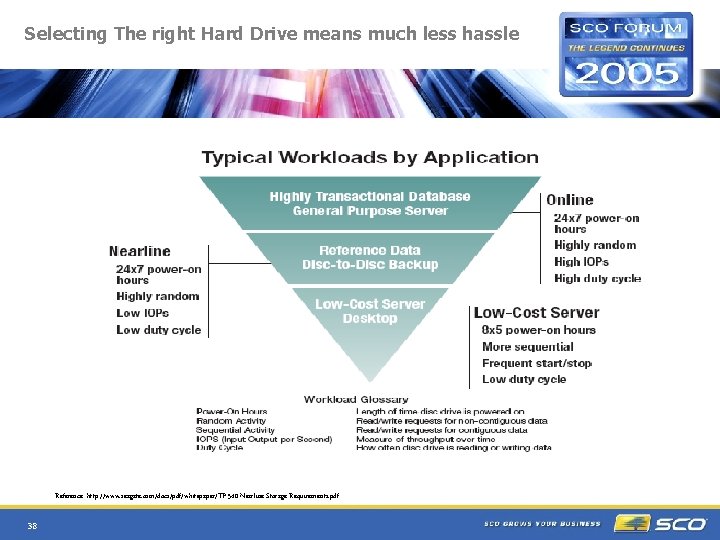
Selecting The right Hard Drive means much less hassle Reference: http: //www. seagate. com/docs/pdf/whitepaper/TP-540 -Nearline-Storage-Requirements. pdf 38
The Nearline Challenge Meeting the Nearline Challenge While nearline applications don’t require the high level of data availability and IOPS demanded by online applications, they do share the need for around-the-clock data accessibility. And though nearline data activity is far less frequent than online activity, both are highly random in nature. These random reads/writes force drive heads to rapidly and repeatedly traverse a drive’s discs. To deliver the enterprise-class reliability standard of 1. 0 million hours MTBF, nearline-ready SATA drives are specifically designed to withstand the rigors of random reads/writes and 24 x 7, always-on operation. In contrast, the typical 600, 000 hours MTBF rating of desktop-class SATA drives is obtained in the mild environment of sequential reads/writes and 8 x 5 power-on hours, and thus has no relevance when considering the use of such drives in nearline applications. But nearline reliability goes beyond MTBF ratings. Nearline-ready SATA drives also incorporate a Workload Management to dynamically protect them from excessive peak workloads. To further safeguard reliability, nearline-ready drives perform “offline scans” during drive idle time to periodically test the media surface for defects. Ref: Seagate, Corp. 39
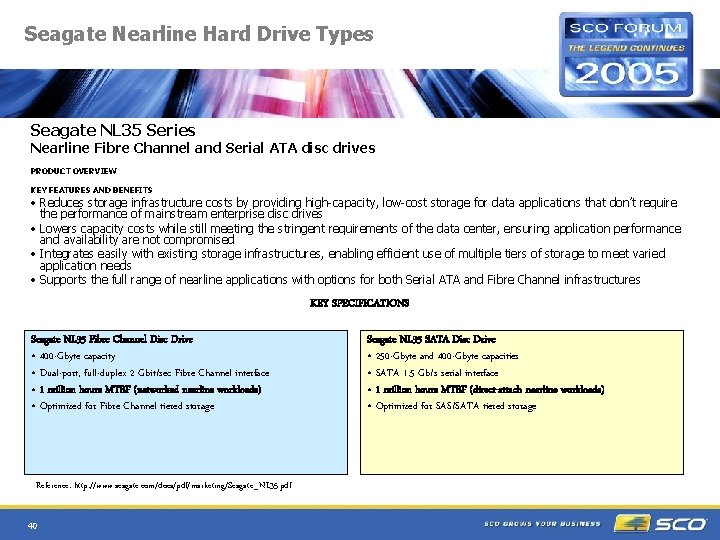
Seagate Nearline Hard Drive Types Seagate NL 35 Series Nearline Fibre Channel and Serial ATA disc drives PRODUCT OVERVIEW KEY FEATURES AND BENEFITS • Reduces storage infrastructure costs by providing high-capacity, low-cost storage for data applications that don’t require the performance of mainstream enterprise disc drives • Lowers capacity costs while still meeting the stringent requirements of the data center, ensuring application performance and availability are not compromised • Integrates easily with existing storage infrastructures, enabling efficient use of multiple tiers of storage to meet varied application needs • Supports the full range of nearline applications with options for both Serial ATA and Fibre Channel infrastructures KEY SPECIFICATIONS Seagate NL 35 Fibre Channel Disc Drive • 400 -Gbyte capacity • Dual-port, full-duplex 2 Gbit/sec Fibre Channel interface • 1 million hours MTBF (networked nearline workloads) • Optimized for Fibre Channel tiered storage Reference: http: //www. seagate. com/docs/pdf/marketing/Seagate_NL 35. pdf 40 Seagate NL 35 SATA Disc Drive • 250 -Gbyte and 400 -Gbyte capacities • SATA 1. 5 Gb/s serial interface • 1 million hours MTBF (direct-attach nearline workloads) • Optimized for SAS/SATA tiered storage
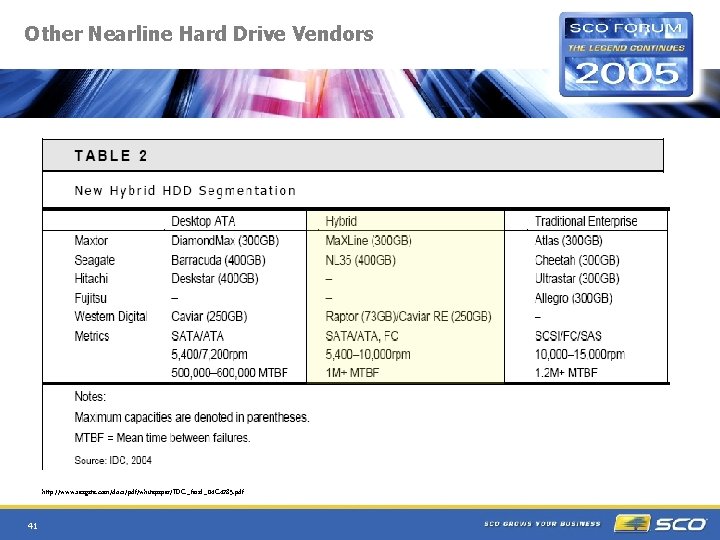
Other Nearline Hard Drive Vendors http: //www. seagate. com/docs/pdf/whitepaper/IDC_final_04 C 4285. pdf 41

Part Two Future Hardware Support from SCO & Current Projects

Future Hardware Support from SCO & Current Projects Agenda § Telephony Support § USB Update § Adaptec Host. RAID support § Parallel Card Support § SCT (System Certification Tests) update 43
Dialogic Support - Telephony Based on demand, SCO will be releasing new Dialogic Springware device drivers for Open. Server 6, Unix. Ware 7. 1. 4 and Open. Server 5. 0. 7 in Fall 2005 All Dialogic devices will be listed in the SCO Hardware Database as “compatible” due to licensing requirements Reproducible issues submitted to support will be escalated for a fix to engineering 44
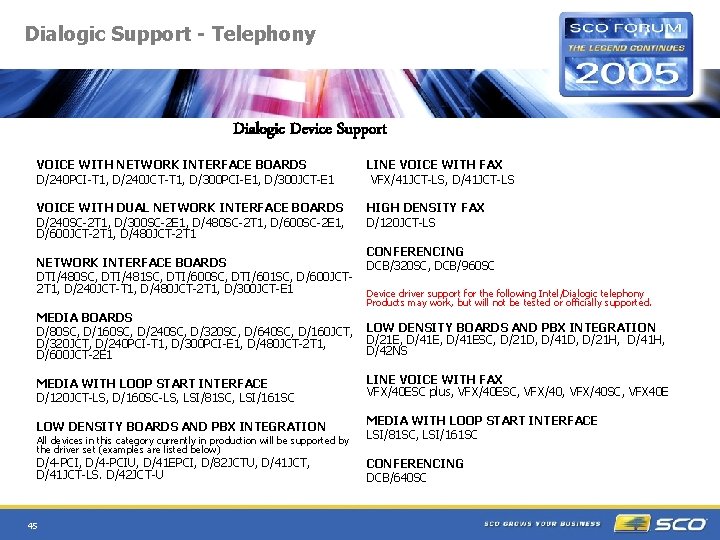
Dialogic Support - Telephony Dialogic Device Support VOICE WITH NETWORK INTERFACE BOARDS D/240 PCI-T 1, D/240 JCT-T 1, D/300 PCI-E 1, D/300 JCT-E 1 LINE VOICE WITH FAX VFX/41 JCT-LS, D/41 JCT-LS VOICE WITH DUAL NETWORK INTERFACE BOARDS D/240 SC-2 T 1, D/300 SC-2 E 1, D/480 SC-2 T 1, D/600 SC-2 E 1, D/600 JCT-2 T 1, D/480 JCT-2 T 1 HIGH DENSITY FAX D/120 JCT-LS NETWORK INTERFACE BOARDS DTI/480 SC, DTI/481 SC, DTI/600 SC, DTI/601 SC, D/600 JCT 2 T 1, D/240 JCT-T 1, D/480 JCT-2 T 1, D/300 JCT-E 1 CONFERENCING DCB/320 SC, DCB/960 SC Device driver support for the following Intel/Dialogic telephony Products may work, but will not be tested or officially supported. MEDIA BOARDS D/80 SC, D/160 SC, D/240 SC, D/320 SC, D/640 SC, D/160 JCT, D/320 JCT, D/240 PCI-T 1, D/300 PCI-E 1, D/480 JCT-2 T 1, D/600 JCT-2 E 1 LOW DENSITY BOARDS AND PBX INTEGRATION D/21 E, D/41 ESC, D/21 D, D/41 D, D/21 H, D/42 NS MEDIA WITH LOOP START INTERFACE D/120 JCT-LS, D/160 SC-LS, LSI/81 SC, LSI/161 SC LINE VOICE WITH FAX VFX/40 ESC plus, VFX/40 ESC, VFX/40 SC, VFX 40 E LOW DENSITY BOARDS AND PBX INTEGRATION MEDIA WITH LOOP START INTERFACE LSI/81 SC, LSI/161 SC D/4 -PCI, D/4 -PCIU, D/41 EPCI, D/82 JCTU, D/41 JCT-LS. D/42 JCT-U CONFERENCING DCB/640 SC All devices in this category currently in production will be supported by the driver set (examples are listed below) 45
USB Update Some inherent issues were found in the USB subsystem that made printing and serial (modem) class drivers unreliable, or hard to configure USB infrastructure is undergoing an overhaul for Open. Server 6 and Unix. Ware 7. 1. 4 Printing and serial (modem) functionality will be available in Fall 2005 as a download and made available on the next media release 46
Adaptec SAS/SATA & Host. RAID Support A new device driver (adp 94 xx) for Adaptec SAS/SATA and Host. RAID (software RAID) support is being developed now. This new driver will cover the entire line of Adaptec products This driver will be available in winter 2005 47
Parallel Card Support for standard PCI Parallel cards will be available in Open. Server 6 Maintenance Pack 2 scheduled for late October. SCO System Certification Tests (SCT) A revised version of the SCT adding functionality omitted from the original release will be made available in the fall of 2005. 48
Your SCO Hardware Team Alex Sack Mike Drangula David Wood Mohammed Ali Dean Flamberg Nigel Simpson We appreciate your attendance at this session, Dean Zimmerman Paul Hurford Souders Paul Weaver and your. Dougcontinued support of SCO Products Evan Hunt Richard Harry Jim Bonnet Robert Lipe Kerri Wallach Roger Vortman Kurt Hutchinson Simon Bordman Maxine Mc. Carthy Steve Williamson Contact Information: Q&A Alexander Sack, alexs@sco. com – Senior Developer Paul Hurford, paulhu@sco. com – Director, Hardware Strategies Mike Drangula, drangula@sco. com – Senior Developer
- Slides: 49