
Future Giant Telescope FGT Projects and Their Technological
- Slides: 52
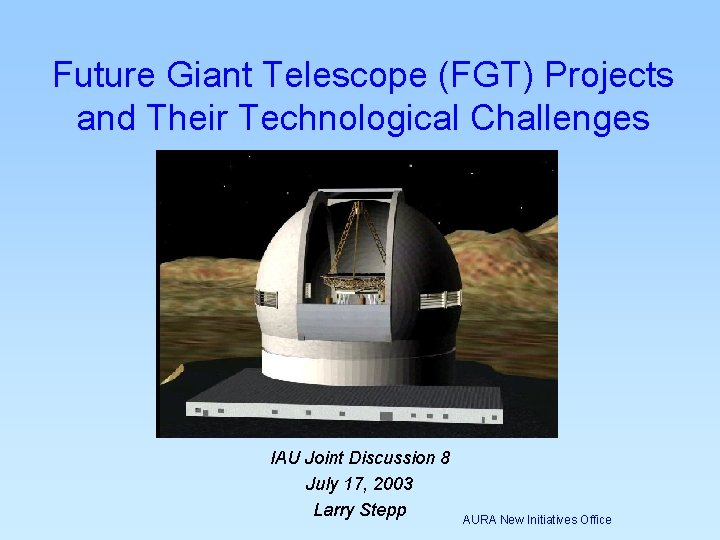
Future Giant Telescope (FGT) Projects and Their Technological Challenges IAU Joint Discussion 8 July 17, 2003 Larry Stepp AURA New Initiatives Office
Outline • Introduction: how FGTs will advance beyond current • • • generation telescopes A brief history of FGTs Current concepts for FGTs Technology challenges common to all AURA New Initiatives Office
Current-Generation Telescopes • 8 - to 10 -meter telescopes have achieved better performance at lower relative cost by reducing the size and mass of telescope & enclosure – Improvements in polishing and testing techniques have enabled faster primary mirrors – Active optics has achieved tighter alignment tolerances and enabled mirrors to be made lightweight – Faster primaries, lighter mirrors, alt-azimuth mounts & FEA have resulted in smaller, stiffer telescope structures – Smaller, stiffer structures have allowed enclosures to be smaller and better ventilated, improving local seeing • As a result, sub-half-arc-second images are becoming commonplace AURA New Initiatives Office
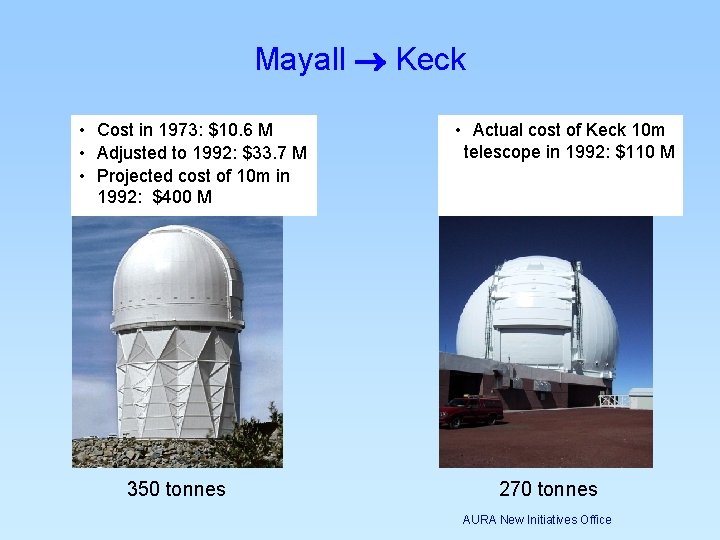
Mayall Keck • Cost in 1973: $10. 6 M • Adjusted to 1992: $33. 7 M • Projected cost of 10 m in 1992: $400 M 350 tonnes • Actual cost of Keck 10 m telescope in 1992: $110 M 270 tonnes AURA New Initiatives Office
Future Giant Telescopes • FGTs will continue the trends of the current generation – Faster primary focal ratios – Relatively lighter structures • And they will advance beyond the Current Generation – Integral adaptive optics systems – Smart structures • This will enable FGTs to have: – An order of magnitude more light-gathering power – Better image quality and resolution • Diffraction-limited at > 1 micron • However, significant technological challenges must be solved to make this possible AURA New Initiatives Office
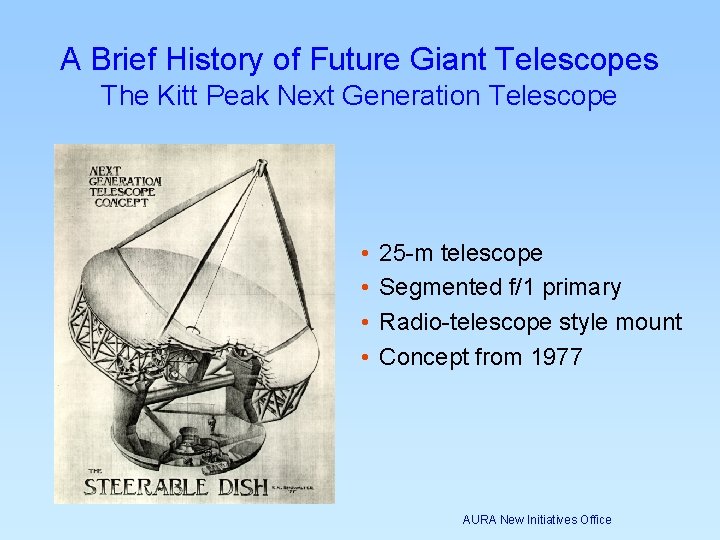
A Brief History of Future Giant Telescopes The Kitt Peak Next Generation Telescope • • 25 -m telescope Segmented f/1 primary Radio-telescope style mount Concept from 1977 AURA New Initiatives Office
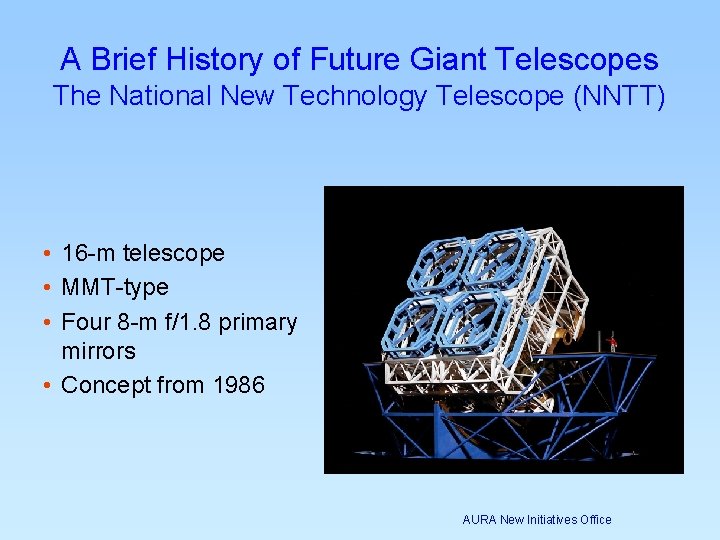
A Brief History of Future Giant Telescopes The National New Technology Telescope (NNTT) • 16 -m telescope • MMT-type • Four 8 -m f/1. 8 primary mirrors • Concept from 1986 AURA New Initiatives Office
A Brief History of Future Giant Telescopes More Concepts Were Advanced in the Early 1990 s J. R. P. Angel, Filled Aperture Telescopes in the Next Millennium, SPIE 1236, 1990. A. Ardeberg, T. Andersen, B. Lindberg, M. Owner-Petersen, T. Korhonen, P. Søndergård, Breaking the 8 m Barrier - One Approach for a 25 m Class Optical Telescope, ESO Conf. and Workshop Proc. No. 42, 1992. M. Mountain, What is beyond the current generation of ground-based 8 -m to 10 -m class telescopes and the VLT-I? , SPIE 2871, 1996. F. N. Bash, T. A. Sebring, F. B. Ray, L. W. Ramsey, The extremely large telescope: A twenty-five meter aperture for the twenty-first century, SPIE 2871, 1996. V. V. Sytchev, V. B. Kasperski, S. M. Stroganova, V. I. Travush, On conceptual design options of a large optical telescope of 10. . . 25 metre class, SPIE 2871, 1996. AURA New Initiatives Office
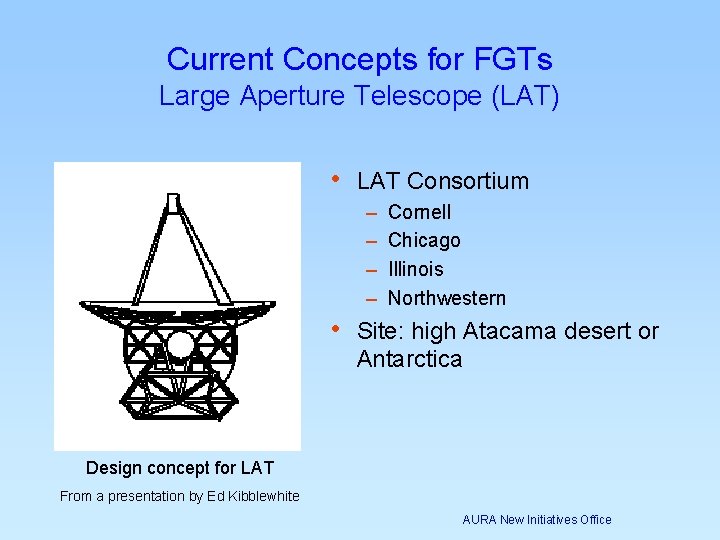
Current Concepts for FGTs Large Aperture Telescope (LAT) • LAT Consortium – – Cornell Chicago Illinois Northwestern • Site: high Atacama desert or Antarctica Design concept for LAT From a presentation by Ed Kibblewhite AURA New Initiatives Office
Large Aperture Telescope (LAT) Interesting Features of Concept: • Adaptive primary mirror – Design shown would have 36 -m primary with 28 -m adaptive central zone • Science goals emphasize IR and sub-millimeter wavelengths • Low PWV sites provide logistical challenges AURA New Initiatives Office
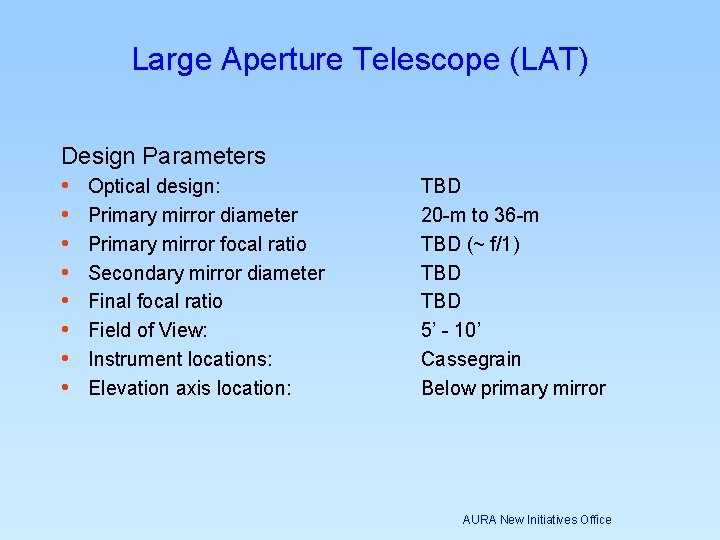
Large Aperture Telescope (LAT) Design Parameters • Optical design: • Primary mirror diameter • Primary mirror focal ratio • Secondary mirror diameter • Final focal ratio • Field of View: • Instrument locations: • Elevation axis location: TBD 20 -m to 36 -m TBD (~ f/1) TBD 5’ - 10’ Cassegrain Below primary mirror AURA New Initiatives Office
Large Aperture Telescope (LAT) Key Technical Challenges – Cost-effective fabrication of lightweight, off-axis aspheric segments – Structure needs high damping – Momentum compensation for adaptive segments – Efficient segment co-phasing systems – Laser guidestar beacons – Site survey studies of CN 2 profile More information is available at: http: //astrosun. tn. cornell. edu/atacama. html AURA New Initiatives Office
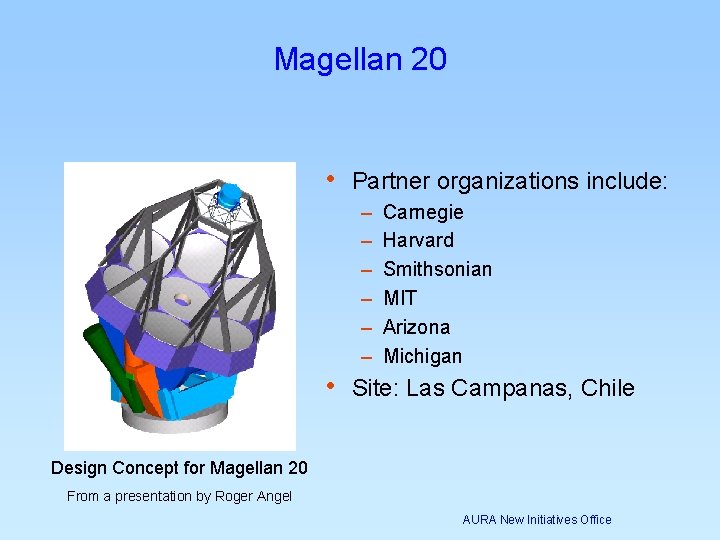
Magellan 20 • Partner organizations include: – – – Carnegie Harvard Smithsonian MIT Arizona Michigan • Site: Las Campanas, Chile Design Concept for Magellan 20 From a presentation by Roger Angel AURA New Initiatives Office
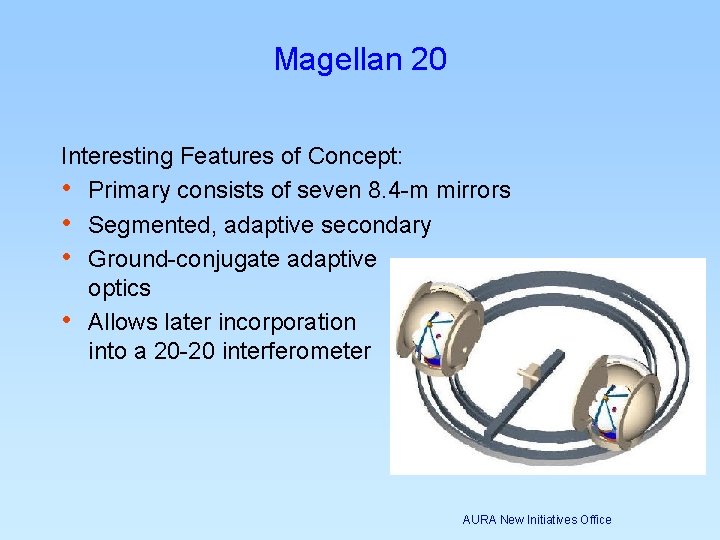
Magellan 20 Interesting Features of Concept: • Primary consists of seven 8. 4 -m mirrors • Segmented, adaptive secondary • Ground-conjugate adaptive optics • Allows later incorporation into a 20 -20 interferometer AURA New Initiatives Office
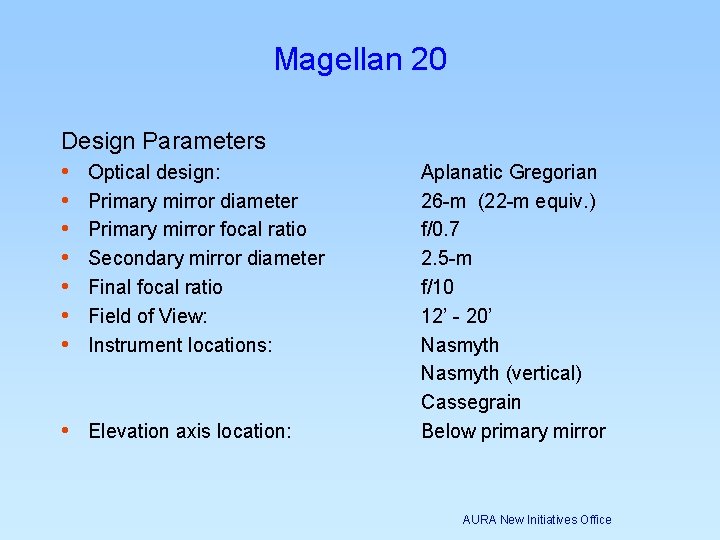
Magellan 20 Design Parameters • Optical design: • Primary mirror diameter • Primary mirror focal ratio • Secondary mirror diameter • Final focal ratio • Field of View: • Instrument locations: • Elevation axis location: Aplanatic Gregorian 26 -m (22 -m equiv. ) f/0. 7 2. 5 -m f/10 12’ - 20’ Nasmyth (vertical) Cassegrain Below primary mirror AURA New Initiatives Office
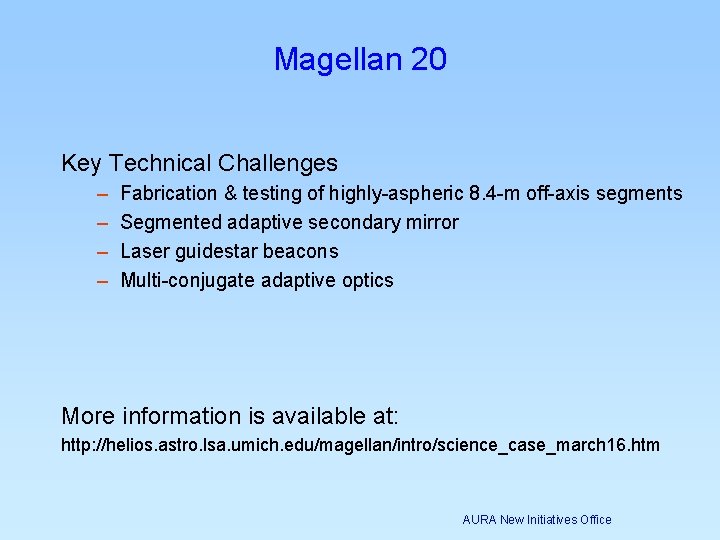
Magellan 20 Key Technical Challenges – – Fabrication & testing of highly-aspheric 8. 4 -m off-axis segments Segmented adaptive secondary mirror Laser guidestar beacons Multi-conjugate adaptive optics More information is available at: http: //helios. astro. lsa. umich. edu/magellan/intro/science_case_march 16. htm AURA New Initiatives Office
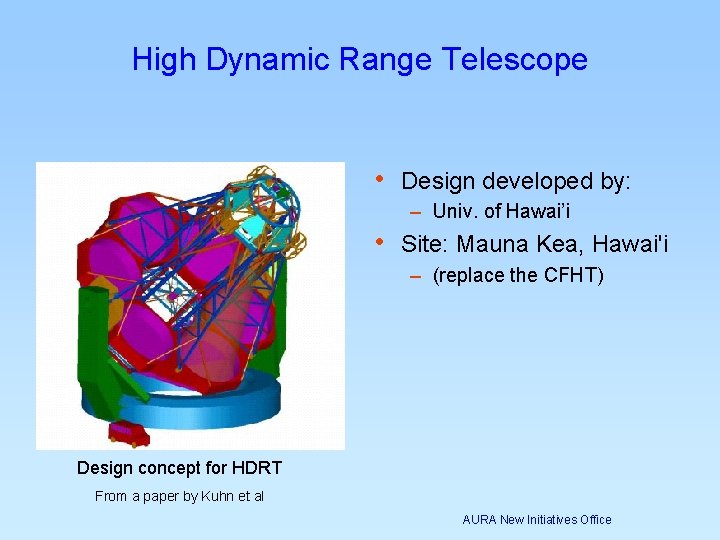
High Dynamic Range Telescope • Design developed by: – Univ. of Hawai’i • Site: Mauna Kea, Hawai'i – (replace the CFHT) Design concept for HDRT From a paper by Kuhn et al AURA New Initiatives Office
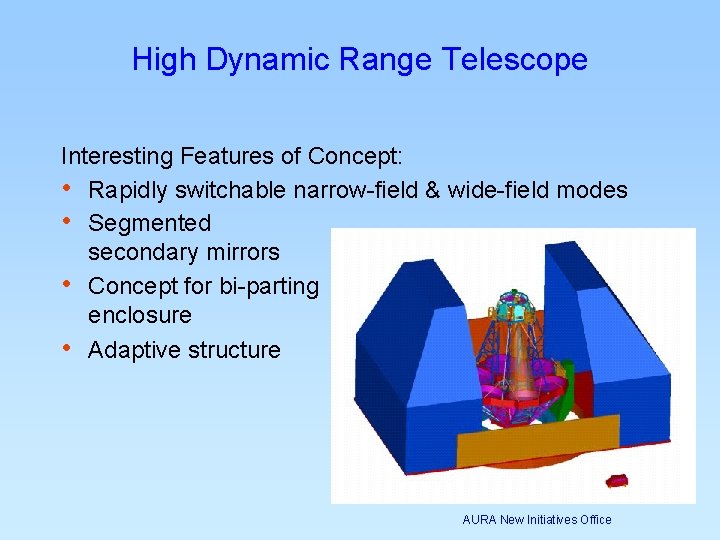
High Dynamic Range Telescope Interesting Features of Concept: • Rapidly switchable narrow-field & wide-field modes • Segmented secondary mirrors • Concept for bi-parting enclosure • Adaptive structure AURA New Initiatives Office
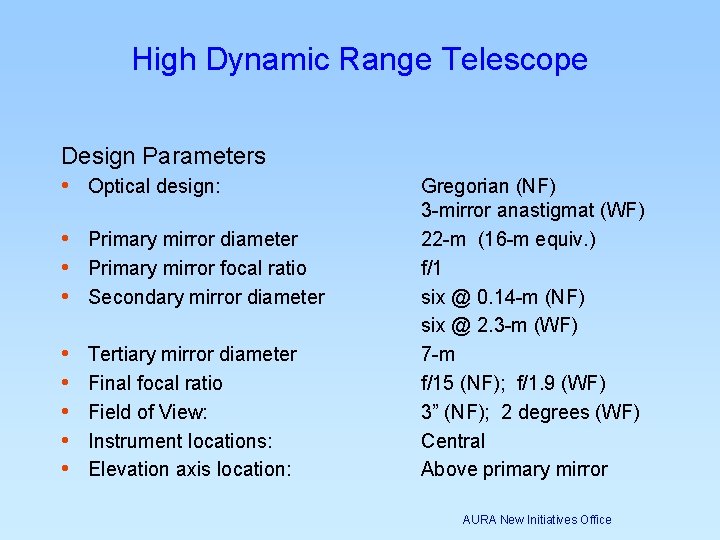
High Dynamic Range Telescope Design Parameters • Optical design: • Primary mirror diameter • Primary mirror focal ratio • Secondary mirror diameter • • • Tertiary mirror diameter Final focal ratio Field of View: Instrument locations: Elevation axis location: Gregorian (NF) 3 -mirror anastigmat (WF) 22 -m (16 -m equiv. ) f/1 six @ 0. 14 -m (NF) six @ 2. 3 -m (WF) 7 -m f/15 (NF); f/1. 9 (WF) 3” (NF); 2 degrees (WF) Central Above primary mirror AURA New Initiatives Office
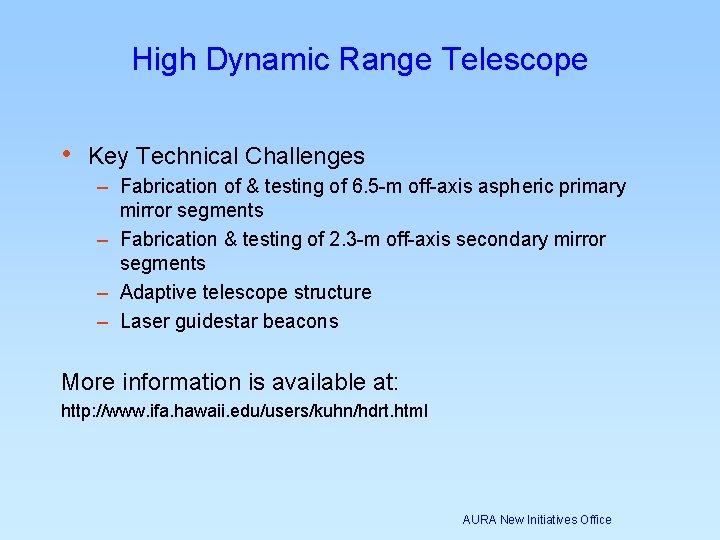
High Dynamic Range Telescope • Key Technical Challenges – Fabrication of & testing of 6. 5 -m off-axis aspheric primary mirror segments – Fabrication & testing of 2. 3 -m off-axis secondary mirror segments – Adaptive telescope structure – Laser guidestar beacons More information is available at: http: //www. ifa. hawaii. edu/users/kuhn/hdrt. html AURA New Initiatives Office
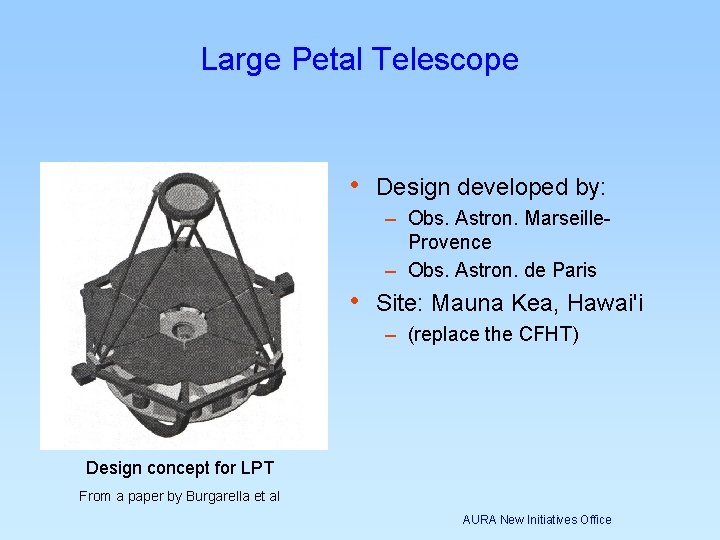
Large Petal Telescope • Design developed by: – Obs. Astron. Marseille. Provence – Obs. Astron. de Paris • Site: Mauna Kea, Hawai'i – (replace the CFHT) Design concept for LPT From a paper by Burgarella et al AURA New Initiatives Office
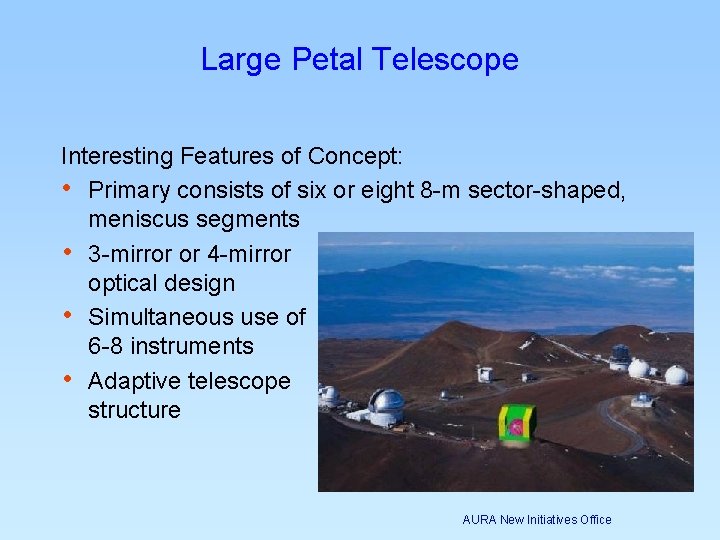
Large Petal Telescope Interesting Features of Concept: • Primary consists of six or eight 8 -m sector-shaped, meniscus segments • 3 -mirror or 4 -mirror optical design • Simultaneous use of 6 -8 instruments • Adaptive telescope structure AURA New Initiatives Office
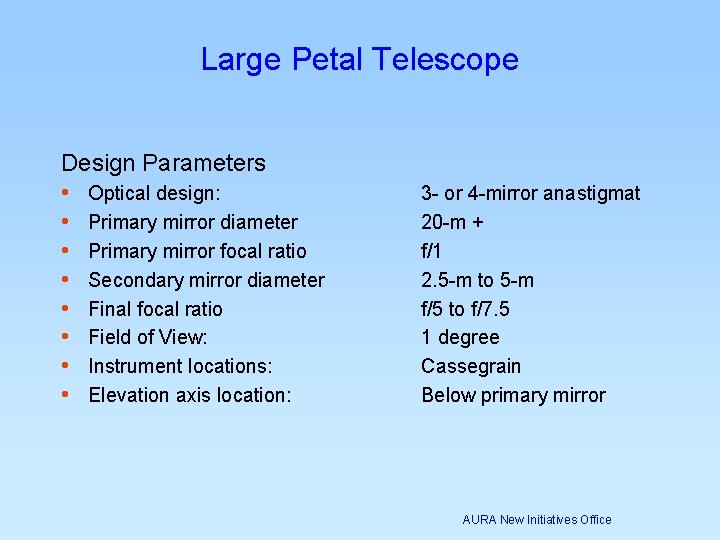
Large Petal Telescope Design Parameters • Optical design: • Primary mirror diameter • Primary mirror focal ratio • Secondary mirror diameter • Final focal ratio • Field of View: • Instrument locations: • Elevation axis location: 3 - or 4 -mirror anastigmat 20 -m + f/1 2. 5 -m to 5 -m f/5 to f/7. 5 1 degree Cassegrain Below primary mirror AURA New Initiatives Office
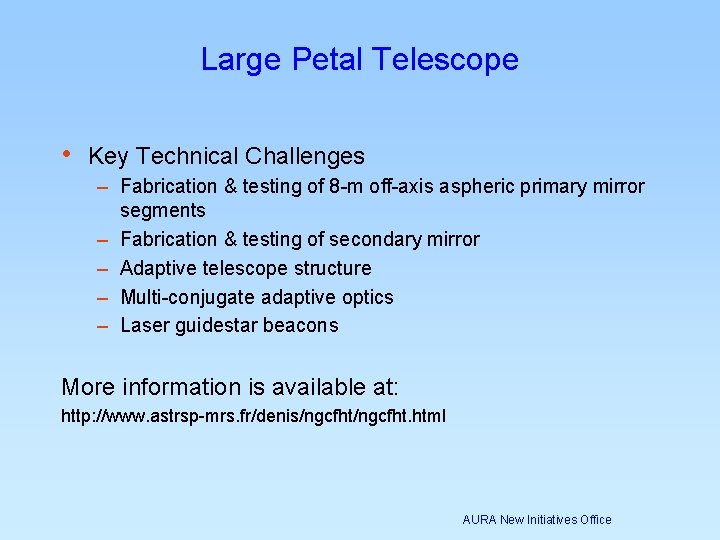
Large Petal Telescope • Key Technical Challenges – Fabrication & testing of 8 -m off-axis aspheric primary mirror segments – Fabrication & testing of secondary mirror – Adaptive telescope structure – Multi-conjugate adaptive optics – Laser guidestar beacons More information is available at: http: //www. astrsp-mrs. fr/denis/ngcfht. html AURA New Initiatives Office
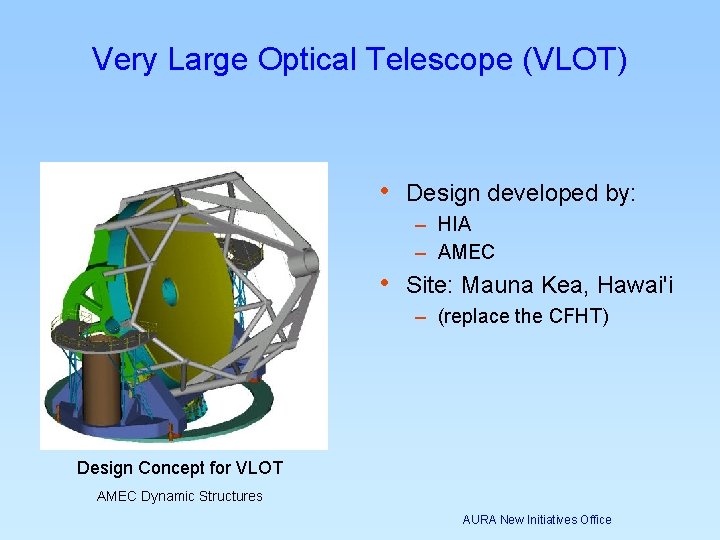
Very Large Optical Telescope (VLOT) • Design developed by: – HIA – AMEC • Site: Mauna Kea, Hawai'i – (replace the CFHT) Design Concept for VLOT AMEC Dynamic Structures AURA New Initiatives Office
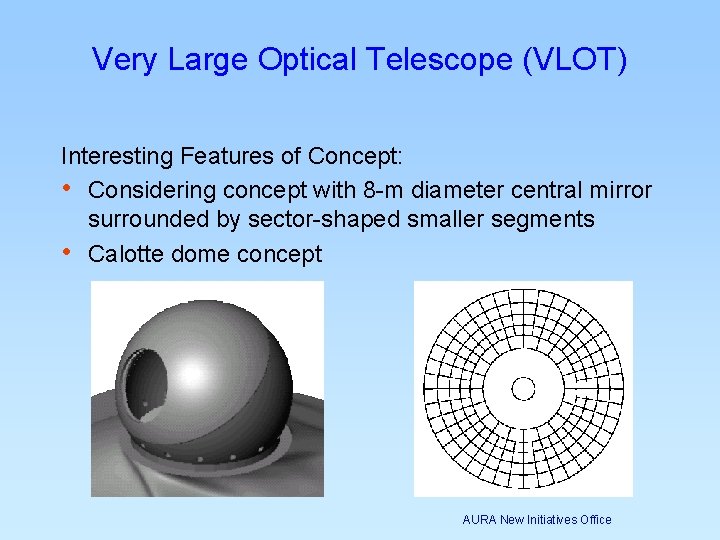
Very Large Optical Telescope (VLOT) Interesting Features of Concept: • Considering concept with 8 -m diameter central mirror surrounded by sector-shaped smaller segments • Calotte dome concept AURA New Initiatives Office
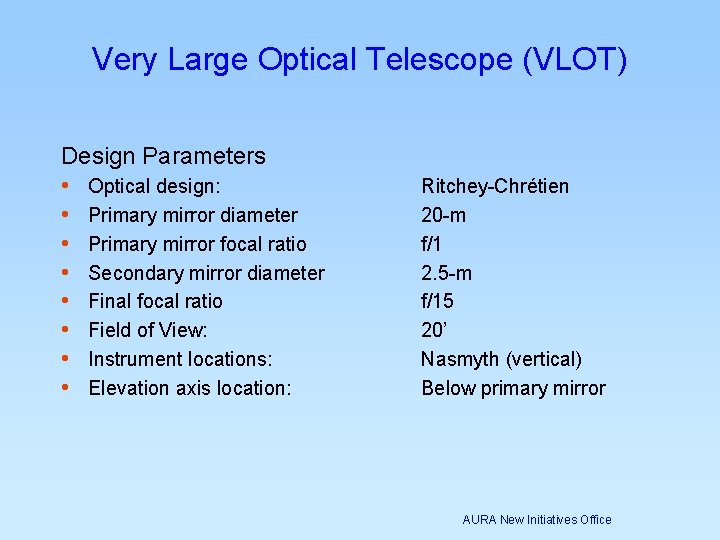
Very Large Optical Telescope (VLOT) Design Parameters • Optical design: • Primary mirror diameter • Primary mirror focal ratio • Secondary mirror diameter • Final focal ratio • Field of View: • Instrument locations: • Elevation axis location: Ritchey-Chrétien 20 -m f/1 2. 5 -m f/15 20’ Nasmyth (vertical) Below primary mirror AURA New Initiatives Office
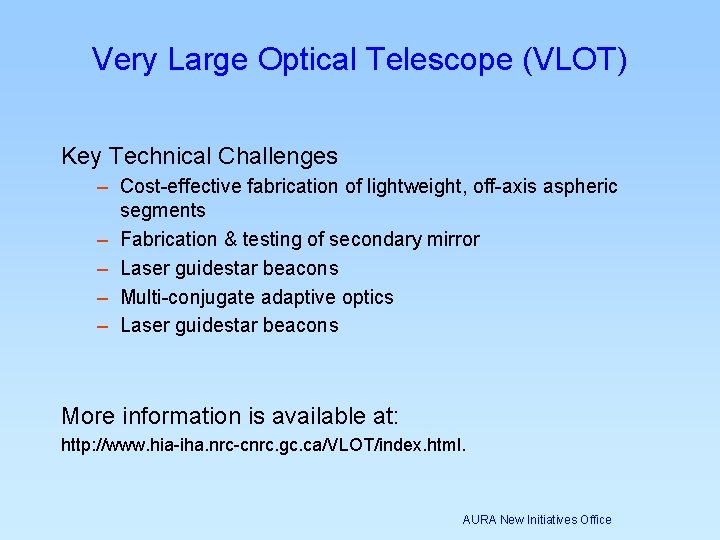
Very Large Optical Telescope (VLOT) Key Technical Challenges – Cost-effective fabrication of lightweight, off-axis aspheric segments – Fabrication & testing of secondary mirror – Laser guidestar beacons – Multi-conjugate adaptive optics – Laser guidestar beacons More information is available at: http: //www. hia-iha. nrc-cnrc. gc. ca/VLOT/index. html. AURA New Initiatives Office
California Extremely Large Telescope (CELT) • CELT Partnership – Caltech – Univ. of California • Site: TBD (Mauna Kea or northern Chile or Mexico) Design concept for CELT From the CELT Greenbook AURA New Initiatives Office
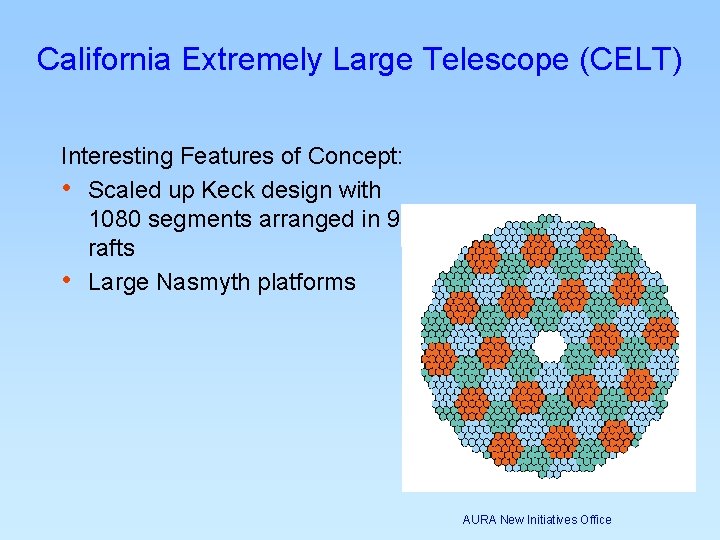
California Extremely Large Telescope (CELT) Interesting Features of Concept: • Scaled up Keck design with 1080 segments arranged in 91 rafts • Large Nasmyth platforms AURA New Initiatives Office
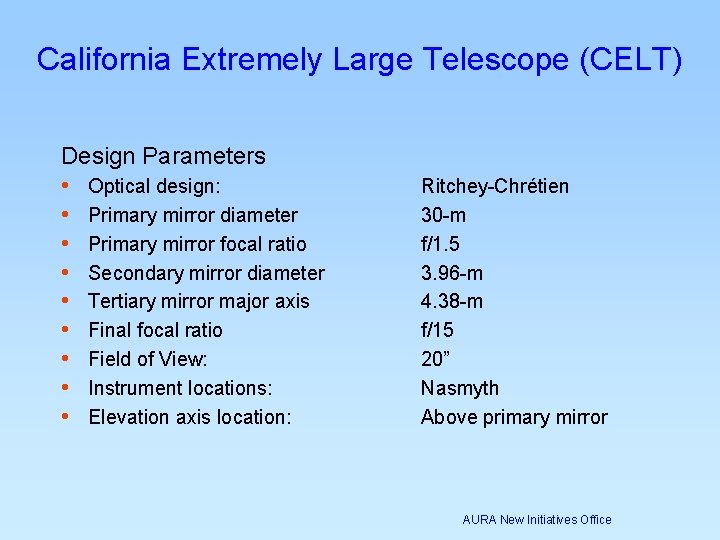
California Extremely Large Telescope (CELT) Design Parameters • Optical design: • Primary mirror diameter • Primary mirror focal ratio • Secondary mirror diameter • Tertiary mirror major axis • Final focal ratio • Field of View: • Instrument locations: • Elevation axis location: Ritchey-Chrétien 30 -m f/1. 5 3. 96 -m 4. 38 -m f/15 20” Nasmyth Above primary mirror AURA New Initiatives Office
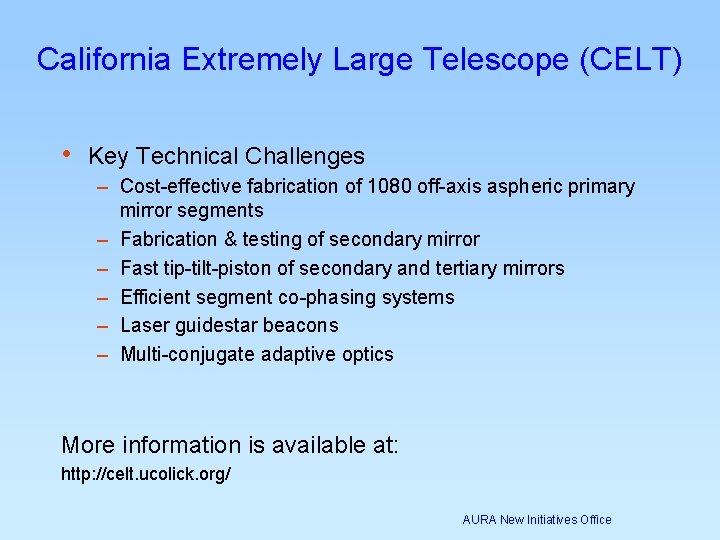
California Extremely Large Telescope (CELT) • Key Technical Challenges – Cost-effective fabrication of 1080 off-axis aspheric primary mirror segments – Fabrication & testing of secondary mirror – Fast tip-tilt-piston of secondary and tertiary mirrors – Efficient segment co-phasing systems – Laser guidestar beacons – Multi-conjugate adaptive optics More information is available at: http: //celt. ucolick. org/ AURA New Initiatives Office
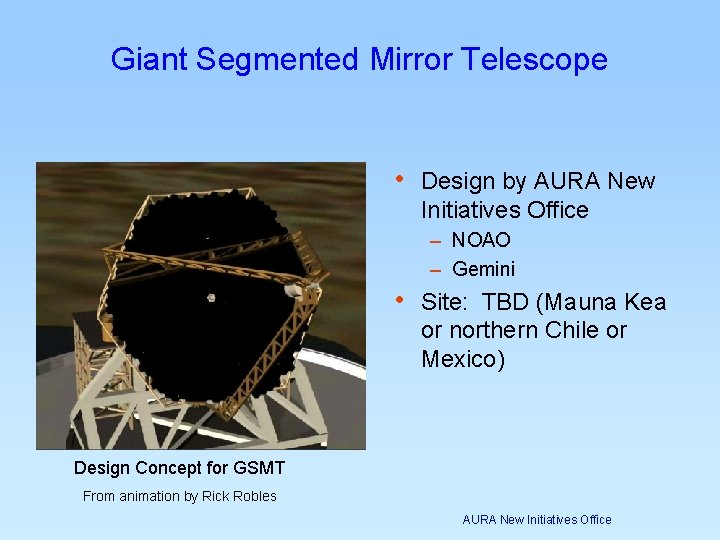
Giant Segmented Mirror Telescope • Design by AURA New Initiatives Office – NOAO – Gemini • Site: TBD (Mauna Kea or northern Chile or Mexico) Design Concept for GSMT From animation by Rick Robles AURA New Initiatives Office
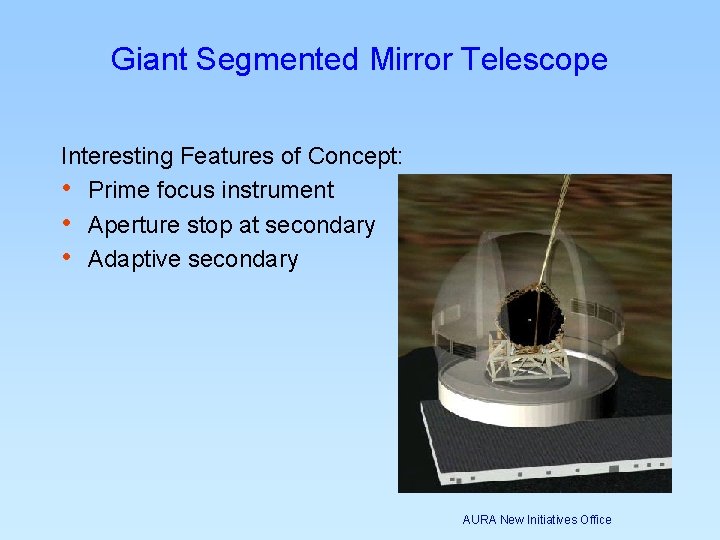
Giant Segmented Mirror Telescope Interesting Features of Concept: • Prime focus instrument • Aperture stop at secondary • Adaptive secondary AURA New Initiatives Office
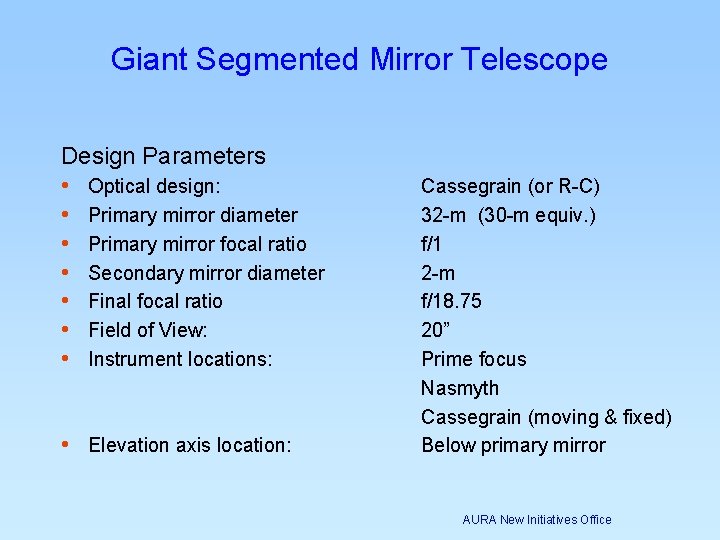
Giant Segmented Mirror Telescope Design Parameters • Optical design: • Primary mirror diameter • Primary mirror focal ratio • Secondary mirror diameter • Final focal ratio • Field of View: • Instrument locations: • Elevation axis location: Cassegrain (or R-C) 32 -m (30 -m equiv. ) f/1 2 -m f/18. 75 20” Prime focus Nasmyth Cassegrain (moving & fixed) Below primary mirror AURA New Initiatives Office
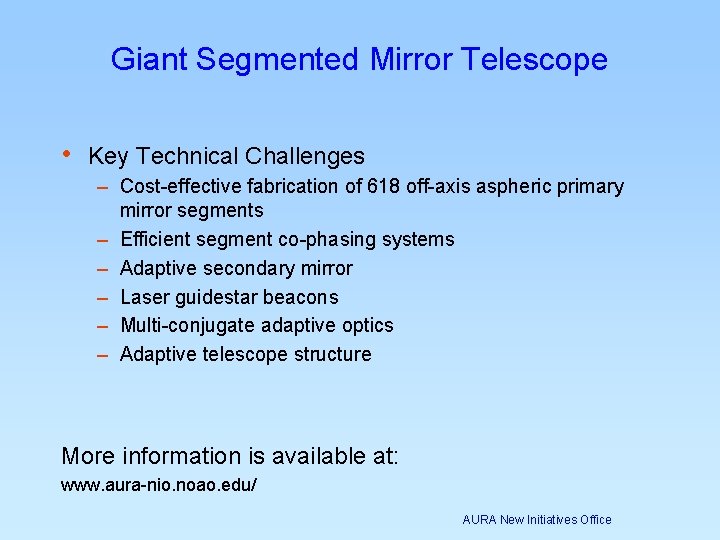
Giant Segmented Mirror Telescope • Key Technical Challenges – Cost-effective fabrication of 618 off-axis aspheric primary mirror segments – Efficient segment co-phasing systems – Adaptive secondary mirror – Laser guidestar beacons – Multi-conjugate adaptive optics – Adaptive telescope structure More information is available at: www. aura-nio. noao. edu/ AURA New Initiatives Office
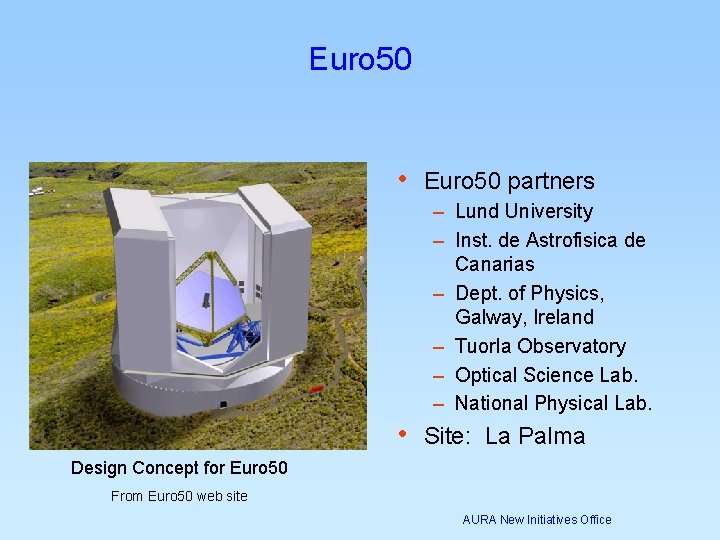
Euro 50 • Euro 50 partners – Lund University – Inst. de Astrofisica de Canarias – Dept. of Physics, Galway, Ireland – Tuorla Observatory – Optical Science Lab. – National Physical Lab. • Site: La Palma Design Concept for Euro 50 From Euro 50 web site AURA New Initiatives Office
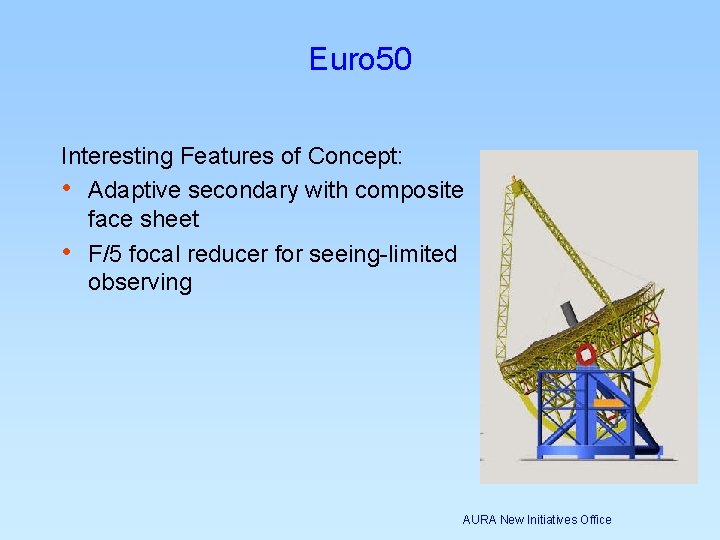
Euro 50 Interesting Features of Concept: • Adaptive secondary with composite face sheet • F/5 focal reducer for seeing-limited observing AURA New Initiatives Office
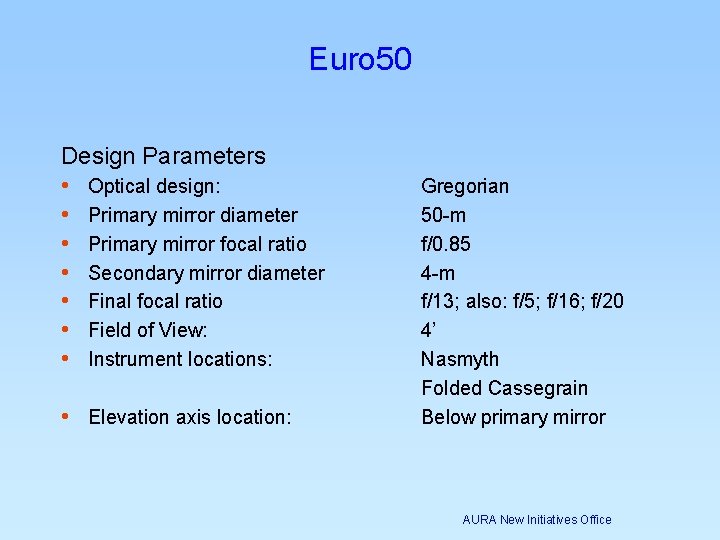
Euro 50 Design Parameters • Optical design: • Primary mirror diameter • Primary mirror focal ratio • Secondary mirror diameter • Final focal ratio • Field of View: • Instrument locations: • Elevation axis location: Gregorian 50 -m f/0. 85 4 -m f/13; also: f/5; f/16; f/20 4’ Nasmyth Folded Cassegrain Below primary mirror AURA New Initiatives Office
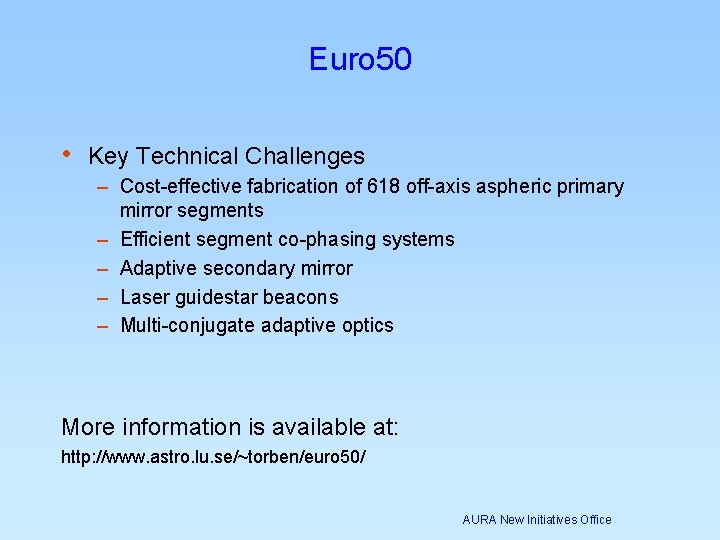
Euro 50 • Key Technical Challenges – Cost-effective fabrication of 618 off-axis aspheric primary mirror segments – Efficient segment co-phasing systems – Adaptive secondary mirror – Laser guidestar beacons – Multi-conjugate adaptive optics More information is available at: http: //www. astro. lu. se/~torben/euro 50/ AURA New Initiatives Office
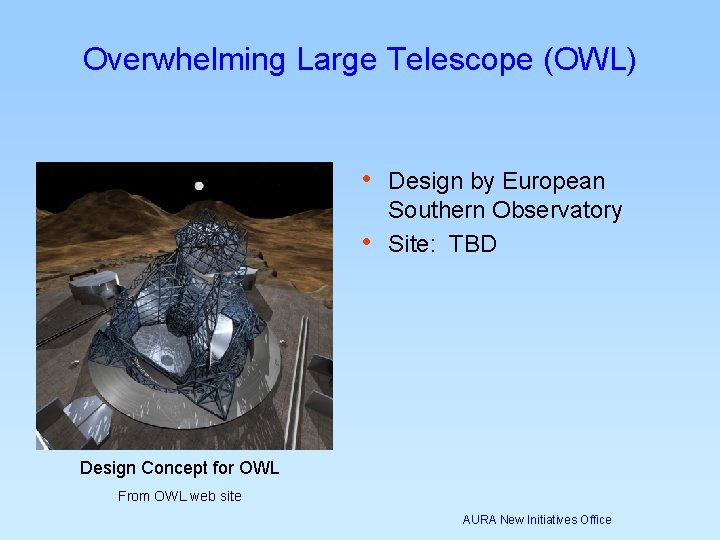
Overwhelming Large Telescope (OWL) • Design by European • Southern Observatory Site: TBD Design Concept for OWL From OWL web site AURA New Initiatives Office
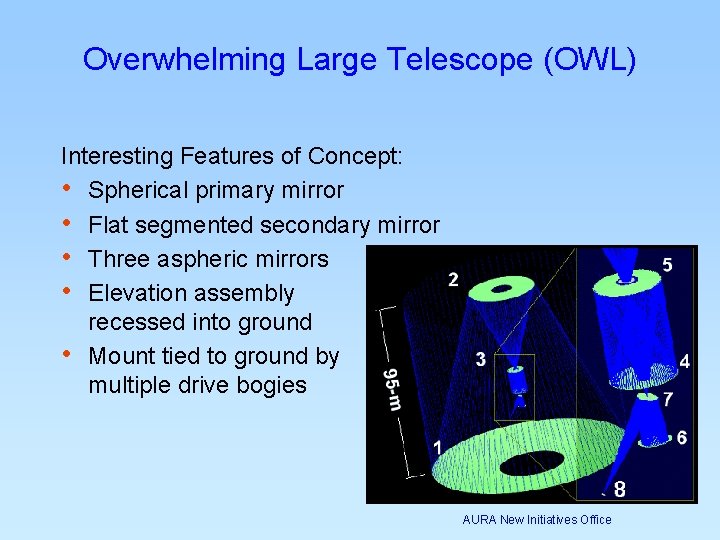
Overwhelming Large Telescope (OWL) Interesting Features of Concept: • Spherical primary mirror • Flat segmented secondary mirror • Three aspheric mirrors • Elevation assembly recessed into ground • Mount tied to ground by multiple drive bogies AURA New Initiatives Office
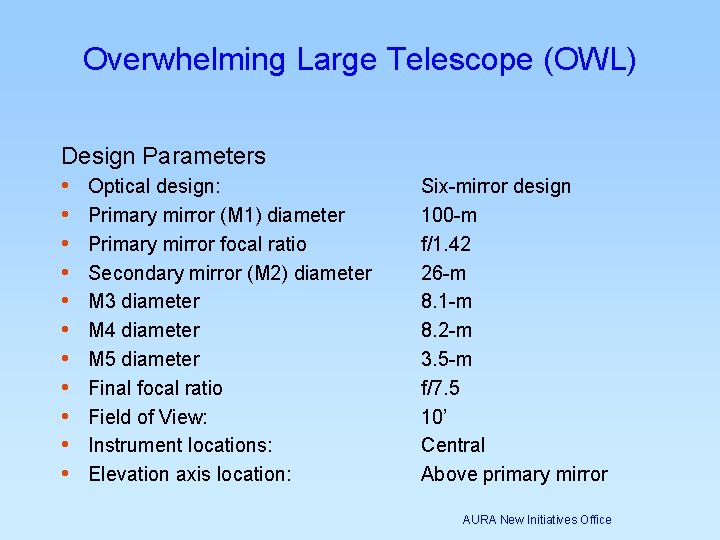
Overwhelming Large Telescope (OWL) Design Parameters • Optical design: • Primary mirror (M 1) diameter • Primary mirror focal ratio • Secondary mirror (M 2) diameter • M 3 diameter • M 4 diameter • M 5 diameter • Final focal ratio • Field of View: • Instrument locations: • Elevation axis location: Six-mirror design 100 -m f/1. 42 26 -m 8. 1 -m 8. 2 -m 3. 5 -m f/7. 5 10’ Central Above primary mirror AURA New Initiatives Office
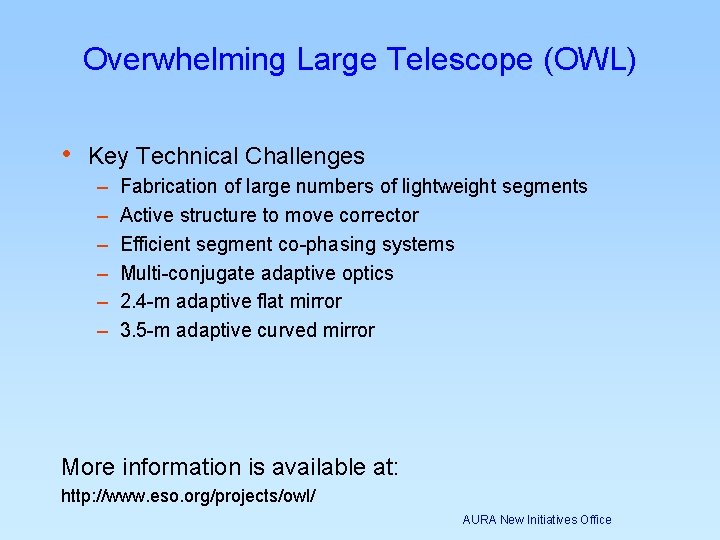
Overwhelming Large Telescope (OWL) • Key Technical Challenges – – – Fabrication of large numbers of lightweight segments Active structure to move corrector Efficient segment co-phasing systems Multi-conjugate adaptive optics 2. 4 -m adaptive flat mirror 3. 5 -m adaptive curved mirror More information is available at: http: //www. eso. org/projects/owl/ AURA New Initiatives Office
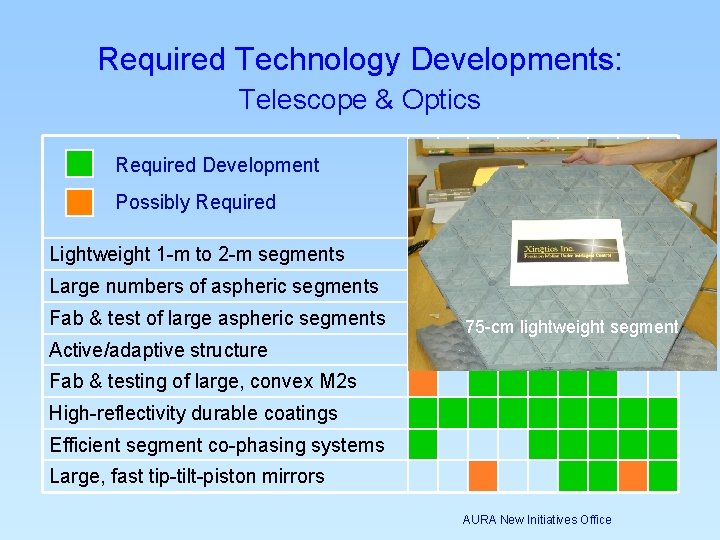
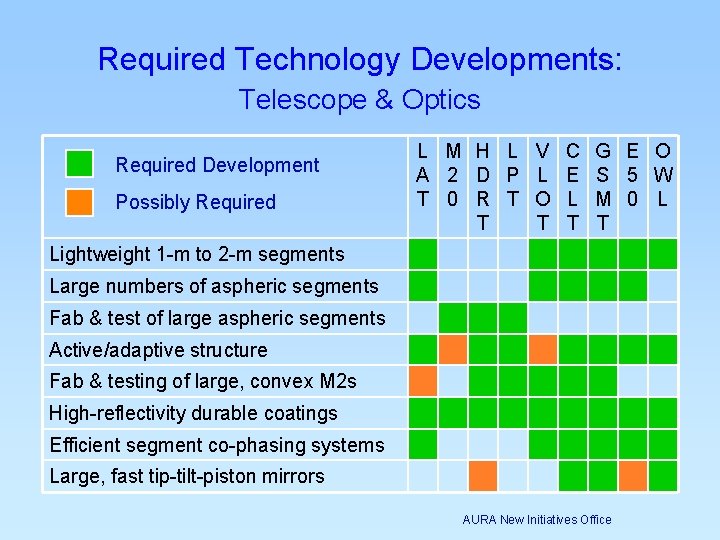
Required Technology Developments: Telescope & Optics Required Development Possibly Required L M H L A 2 D P T 0 R T T V L O T C E L T G E O S 5 W M 0 L T Lightweight 1 -m to 2 -m segments Large numbers of aspheric segments Fab & test of large aspheric segments 75 -cm lightweight segment Active/adaptive structure Fab & testing of large, convex M 2 s High-reflectivity durable coatings Efficient segment co-phasing systems Large, fast tip-tilt-piston mirrors AURA New Initiatives Office
Required Technology Developments: Telescope & Optics Required Development Possibly Required L M H L A 2 D P T 0 R T T V L O T C E L T G E O S 5 W M 0 L T Lightweight 1 -m to 2 -m segments Large numbers of aspheric segments Fab & test of large aspheric segments Active/adaptive structure Fab & testing of large, convex M 2 s High-reflectivity durable coatings Efficient segment co-phasing systems Large, fast tip-tilt-piston mirrors AURA New Initiatives Office
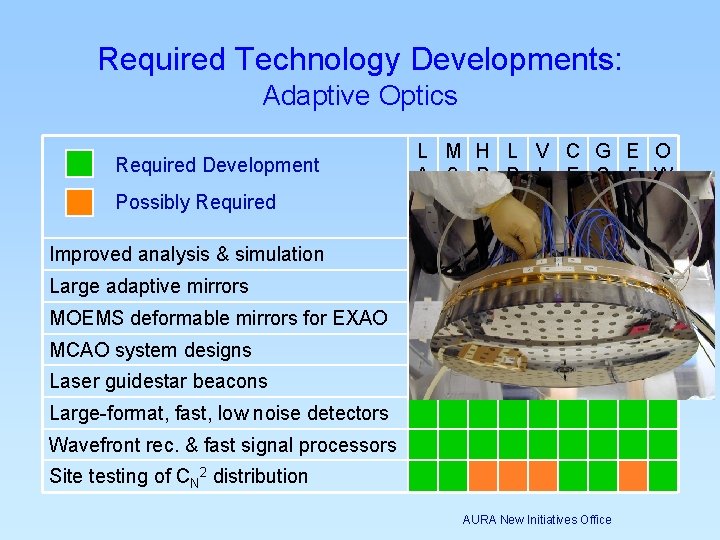
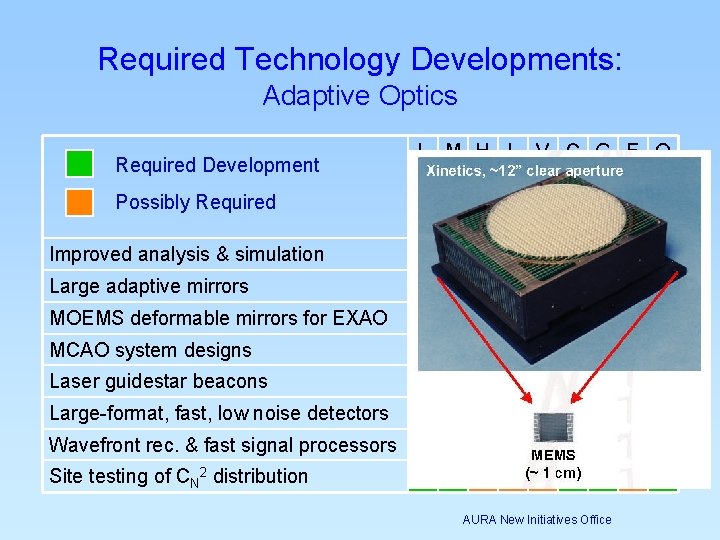
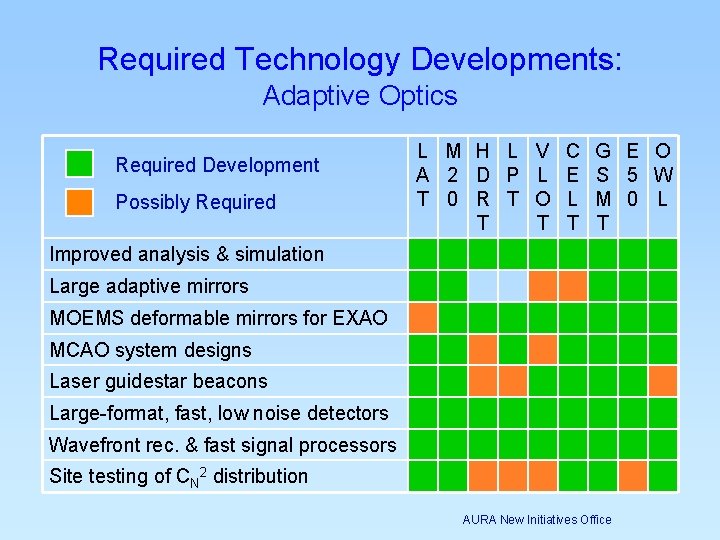
Required Technology Developments: Adaptive Optics Required Development Possibly Required L M H L A 2 D P T 0 R T T V L O T C E L T G E O S 5 W M 0 L T Improved analysis & simulation Large adaptive mirrors MOEMS deformable mirrors for EXAO MCAO system designs Laser guidestar beacons Large-format, fast, low noise detectors Wavefront rec. & fast signal processors Site testing of CN 2 distribution AURA New Initiatives Office
Required Technology Developments: Adaptive Optics Required Development Possibly Required L M H L A 2 D P T 0 R T T V L O T C E L T G E O S 5 W M 0 L T Improved analysis & simulation Large adaptive mirrors MOEMS deformable mirrors for EXAO MCAO system designs Laser guidestar beacons Large-format, fast, low noise detectors Wavefront rec. & fast signal processors Site testing of CN 2 distribution AURA New Initiatives Office
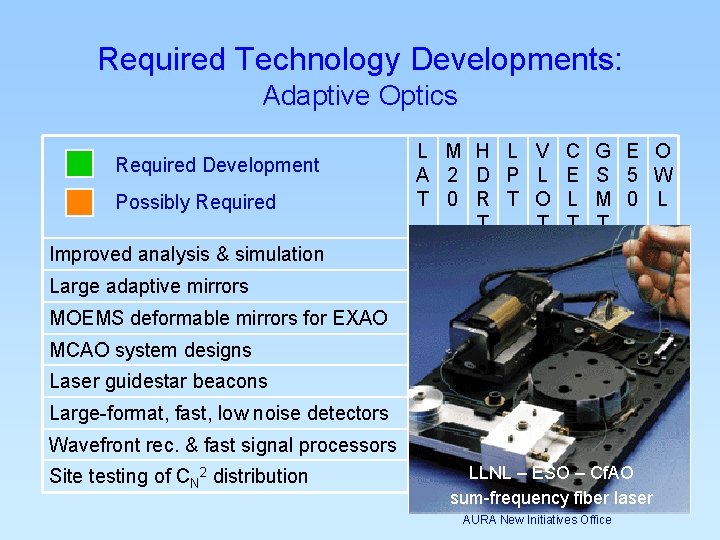
Required Technology Developments: Adaptive Optics Required Development Possibly Required L M H L A 2 D P T 0 R T T V L O T C E L T G E O S 5 W M 0 L T Improved analysis & simulation Large adaptive mirrors MOEMS deformable mirrors for EXAO MCAO system designs Laser guidestar beacons Large-format, fast, low noise detectors Wavefront rec. & fast signal processors Site testing of CN 2 distribution LLNL – ESO – Cf. AO sum-frequency fiber laser AURA New Initiatives Office
Required Technology Developments: Adaptive Optics Required Development Possibly Required L M H L A 2 D P T 0 R T T V L O T C E L T G E O S 5 W M 0 L T Improved analysis & simulation Large adaptive mirrors MOEMS deformable mirrors for EXAO MCAO system designs Laser guidestar beacons Large-format, fast, low noise detectors Wavefront rec. & fast signal processors Site testing of CN 2 distribution AURA New Initiatives Office
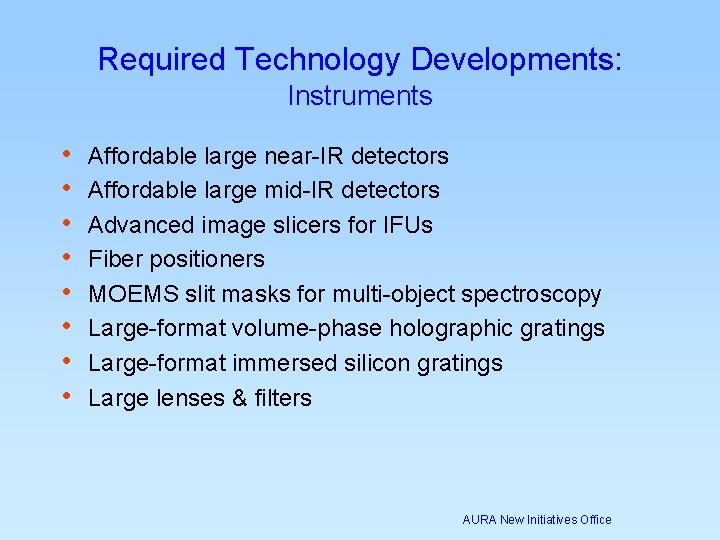
Required Technology Developments: Instruments • • Affordable large near-IR detectors Affordable large mid-IR detectors Advanced image slicers for IFUs Fiber positioners MOEMS slit masks for multi-object spectroscopy Large-format volume-phase holographic gratings Large-format immersed silicon gratings Large lenses & filters AURA New Initiatives Office
Call For International Cooperation Our needs are so similar and our resources are limited, close cooperation is essential: • Joint ventures where sensible • Coordination to ensure studies are complementary • Open sharing of information as much as possible AURA New Initiatives Office