
Future Directions for ComputeforGraphics Andrew Lauritzen Senior Rendering


![Quadtree GPU Block Reduction #define BLOCK_SIZE 16 groupshared Tile. Data tiles[BLOCK_SIZE]; groupshared float 4](https://slidetodoc.com/presentation_image_h/73ae6d47e702e526fd41afc116e97aff/image-26.jpg "Quadtree GPU Block Reduction #define BLOCK_SIZE 16 groupshared Tile. Data tiles[BLOCK_SIZE]; groupshared float 4")
![Quadtree GPU Block Reduction #define BLOCK_SIZE 16 groupshared Tile. Data tiles[BLOCK_SIZE]; groupshared float 4](https://slidetodoc.com/presentation_image_h/73ae6d47e702e526fd41afc116e97aff/image-27.jpg "Quadtree GPU Block Reduction #define BLOCK_SIZE 16 groupshared Tile. Data tiles[BLOCK_SIZE]; groupshared float 4")
![Quadtree GPU Block Reduction #define BLOCK_SIZE 16 groupshared Tile. Data tiles[BLOCK_SIZE]; groupshared float 4](https://slidetodoc.com/presentation_image_h/73ae6d47e702e526fd41afc116e97aff/image-28.jpg "Quadtree GPU Block Reduction #define BLOCK_SIZE 16 groupshared Tile. Data tiles[BLOCK_SIZE]; groupshared float 4")

- Slides: 49
Future Directions for Compute-for-Graphics Andrew Lauritzen Senior Rendering Engineer, SEED @Andrew. Lauritzen
Who am I? • Senior Rendering Engineer at SEED – Electronic Arts • @SEED, https: //www. ea. com/SEED • Previously • Graphics Software Engineer at Intel (DX 12, Vulkan, Open. CL 1. 0, GPU architecture, R&D) • Developer at Rapid. Mind (“GPGPU”, Cell SPU, x 86, ray tracing) • Notable research • Deferred shading (Beyond Programmable Shading 2010 and 2012) • Variance shadow maps, sample distribution shadow maps, etc. Open Problems in Real-Time Rendering – SIGGRAPH 2017
Renderer Complexity is Increasing Rapidly • Why? • • Demand for continued increases in quality on wide variety of hardware GPU fixed function not scaling as quickly as FLOPS Balance of GPU resources is rarely optimal for a given pass, game, etc. Power efficiency becoming a limiting factor in hardware/software design • Opportunity to render “smarter” • Less brute force use of computation and memory bandwidth • Algorithms tailored specifically for renderer needs and content Open Problems in Real-Time Rendering – SIGGRAPH 2017
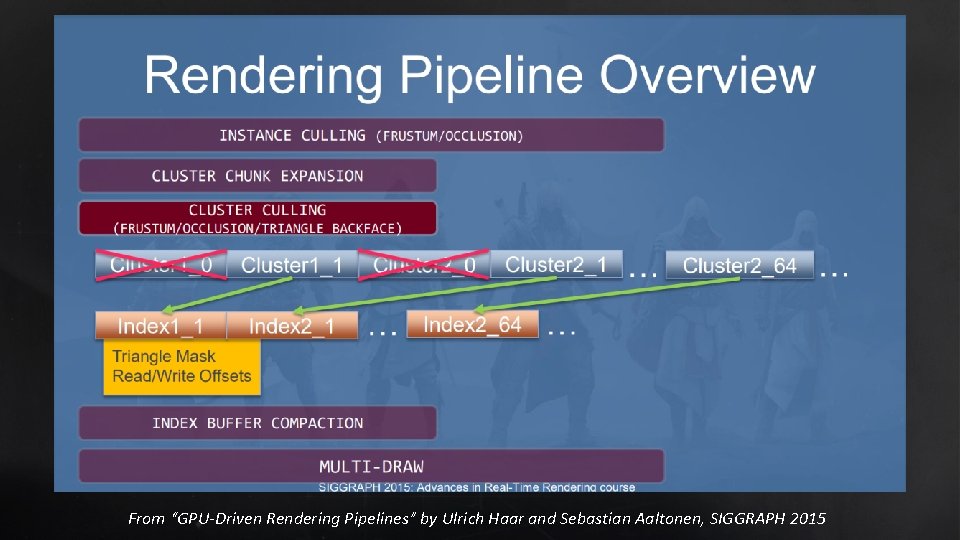
From “GPU-Driven Rendering Pipelines” by Ulrich Haar and Sebastian Aaltonen, SIGGRAPH 2015
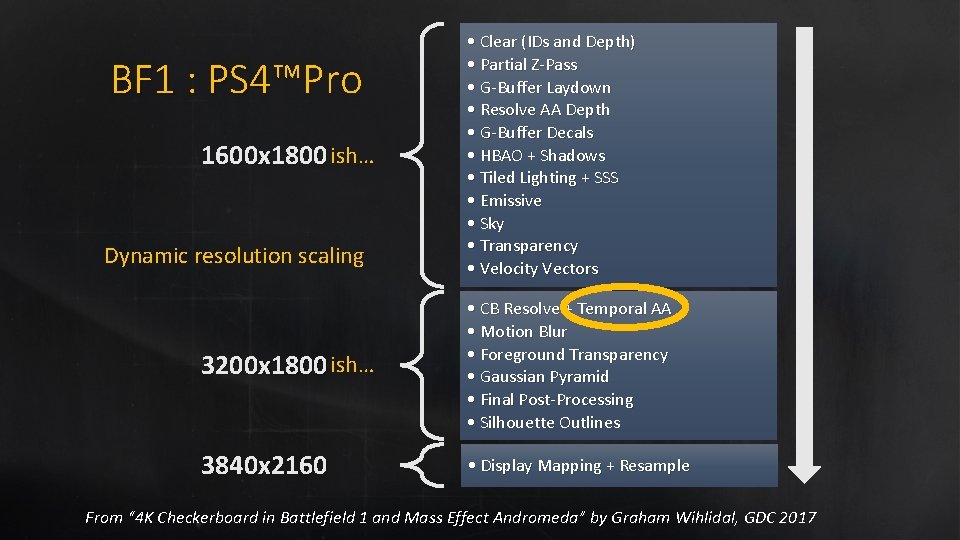
BF 1 : PS 4™Pro PS 4 1600 x 1800 ish… Dynamic resolution scaling • Clear (IDs and Depth) • Partial Z-Pass • G-Buffer Laydown • Resolve AA Depth • G-Buffer Decals • HBAO + Shadows • Tiled Lighting + SSS • Emissive • Sky • Transparency • Velocity Vectors 3200 x 1800 ish… • CB Resolve + Temporal AA • Motion Blur • Foreground Transparency • Gaussian Pyramid • Final Post-Processing • Silhouette Outlines 3840 x 2160 • Display Mapping + Resample From “ 4 K Checkerboard in Battlefield 1 and Mass Effect Andromeda” by Graham Wihlidal, GDC 2017
GPU Compute Ecosystem • Complex algorithms and data structures are impractical to express • End up micro-optimizing the simple algorithms into local optima • Significant language and hardware issues impede progress • Writing portable, composable and efficient GPU code is often impossible • GPU compute for graphics has been mostly stagnant • Most of the problems I will discuss were known ~7 years ago! [BPS 2010] • CUDA and Open. CL have progressed somewhat, but not practical for game use Open Problems in Real-Time Rendering – SIGGRAPH 2017
Case Study: Lighting and Shading
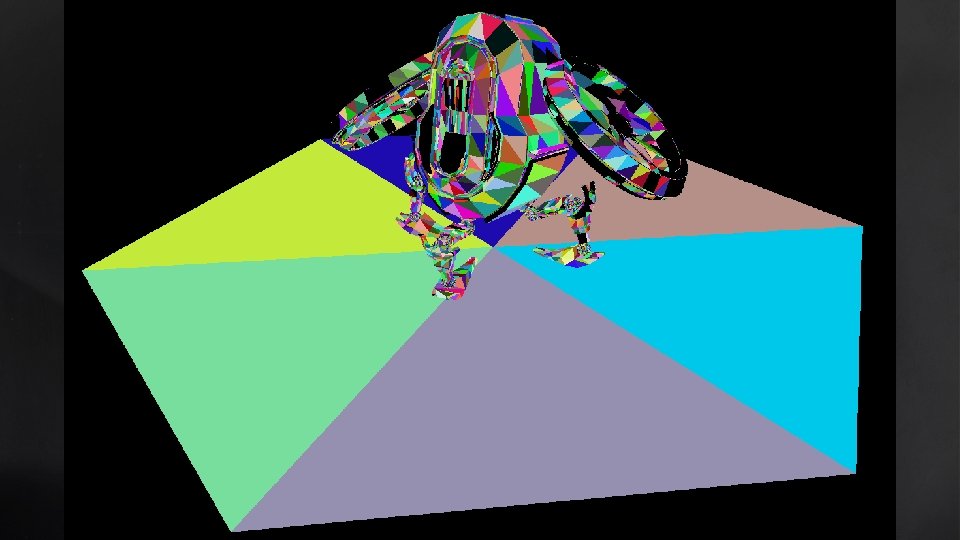
Lighting and Shading • Deferred shading gives us more control over scheduling shading work • … but still a chunk of it lives in the G-buffer pass • Per pixel state is large enough to inhibit multi-layer G-buffers • Want better control over shading rates, scheduling, etc. • Visibility Buffers [Burns and Hunt 2013] • • Follow-up work by Tomasz Stachowiak on GCN [Stachowiak 2015] Store minimal outputs from rasterization, defer attribute interpolation Possibly even defer full vertex shading Use the rasterizer just to intersect primary rays, rest in compute Open Problems in Real-Time Rendering – SIGGRAPH 2017
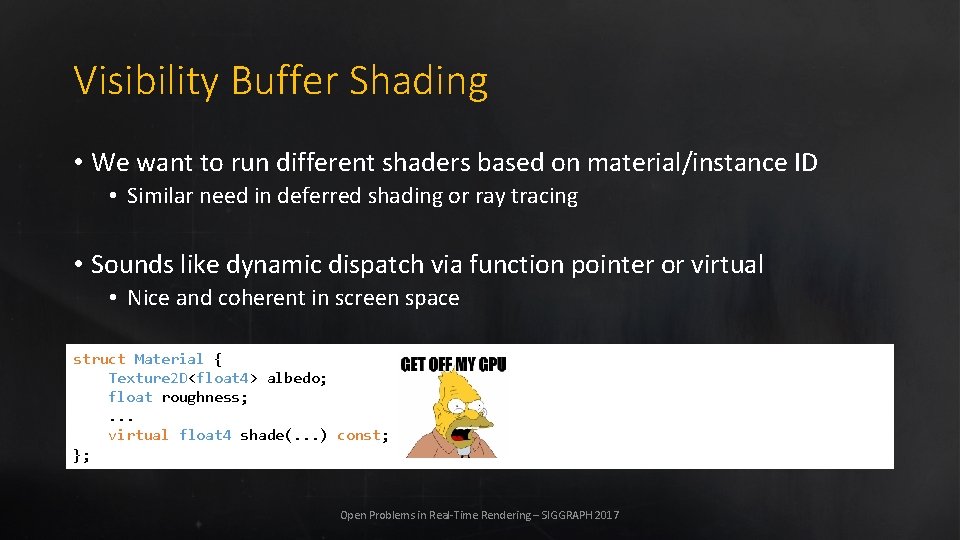
Visibility Buffer Shading • We want to run different shaders based on material/instance ID • Similar need in deferred shading or ray tracing • Sounds like dynamic dispatch via function pointer or virtual • Nice and coherent in screen space struct Material { Texture 2 D<float 4> albedo; float roughness; . . . virtual float 4 shade(. . . ) const; }; Open Problems in Real-Time Rendering – SIGGRAPH 2017
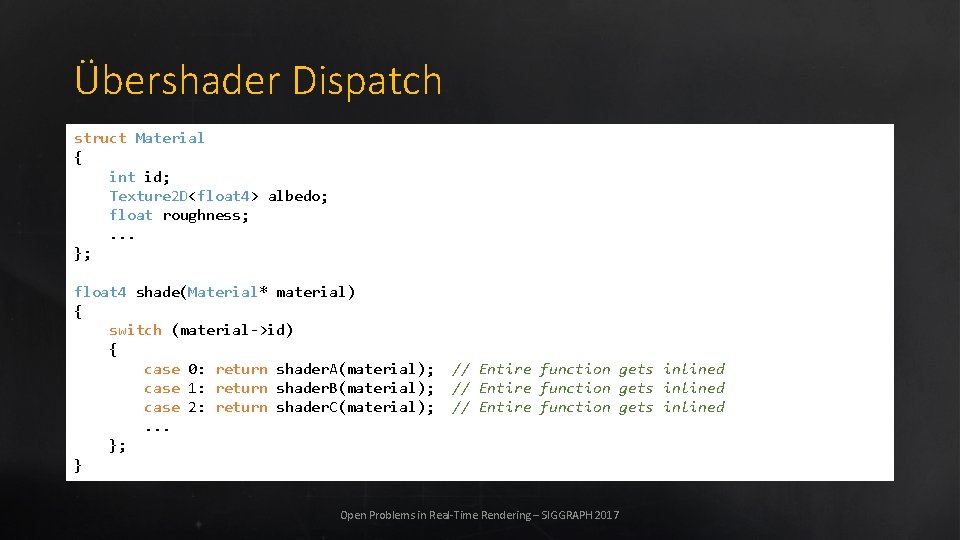
Übershader Dispatch struct Material { int id; Texture 2 D<float 4> albedo; float roughness; . . . }; float 4 shade(Material* material) { switch (material->id) { case 0: return shader. A(material); case 1: return shader. B(material); case 2: return shader. C(material); . . . }; } // Entire function gets inlined Open Problems in Real-Time Rendering – SIGGRAPH 2017
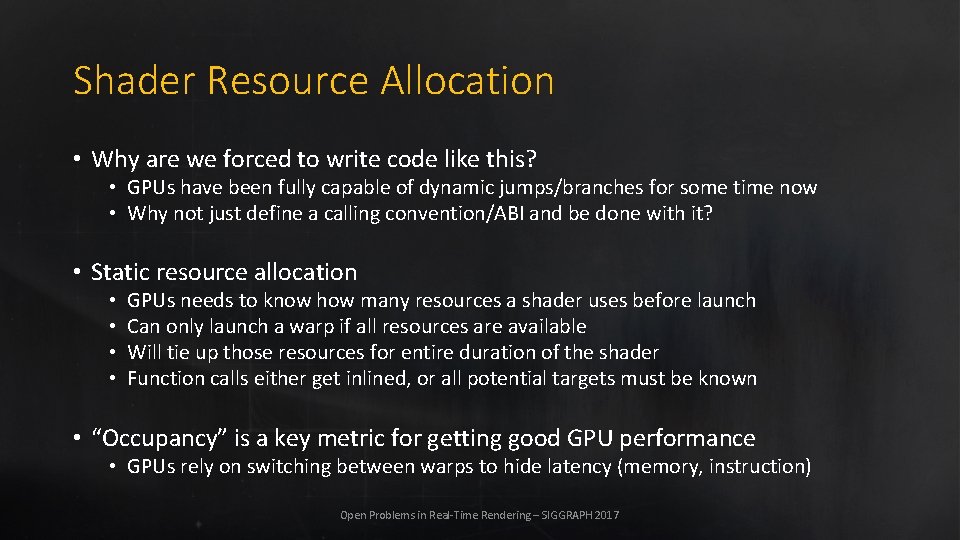
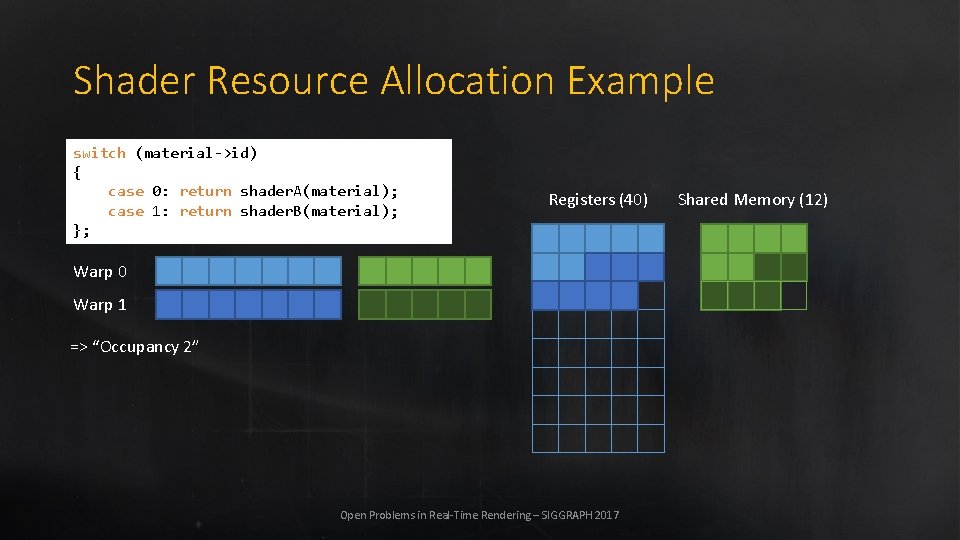
Shader Resource Allocation • Why are we forced to write code like this? • GPUs have been fully capable of dynamic jumps/branches for some time now • Why not just define a calling convention/ABI and be done with it? • Static resource allocation • • GPUs needs to know how many resources a shader uses before launch Can only launch a warp if all resources are available Will tie up those resources for entire duration of the shader Function calls either get inlined, or all potential targets must be known • “Occupancy” is a key metric for getting good GPU performance • GPUs rely on switching between warps to hide latency (memory, instruction) Open Problems in Real-Time Rendering – SIGGRAPH 2017
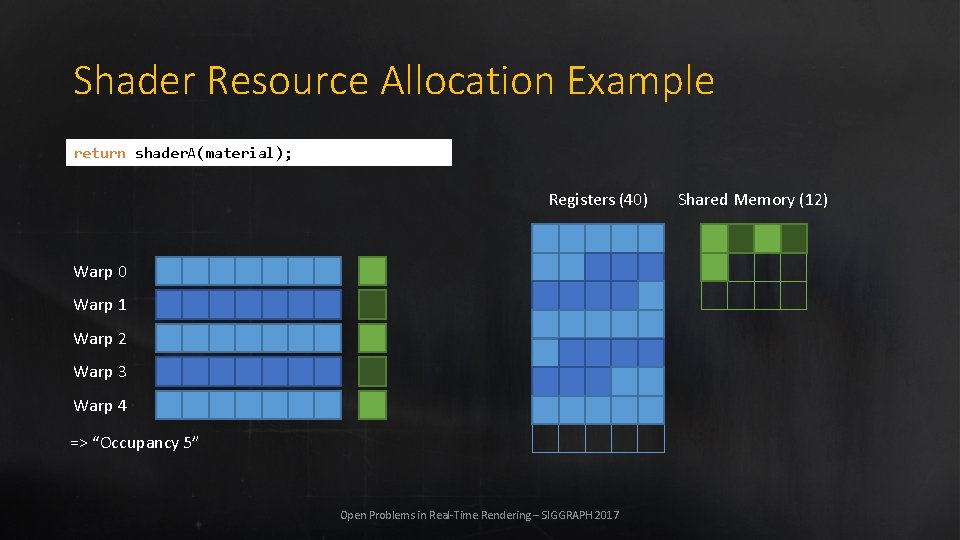
Shader Resource Allocation Example return shader. A(material); Registers (40) Warp 0 Warp 1 Warp 2 Warp 3 Warp 4 => “Occupancy 5” Open Problems in Real-Time Rendering – SIGGRAPH 2017 Shared Memory (12)
Shader Resource Allocation Example switch (material->id) { case 0: return shader. A(material); case 1: return shader. B(material); }; Registers (40) Warp 0 Warp 1 => “Occupancy 2” Open Problems in Real-Time Rendering – SIGGRAPH 2017 Shared Memory (12)
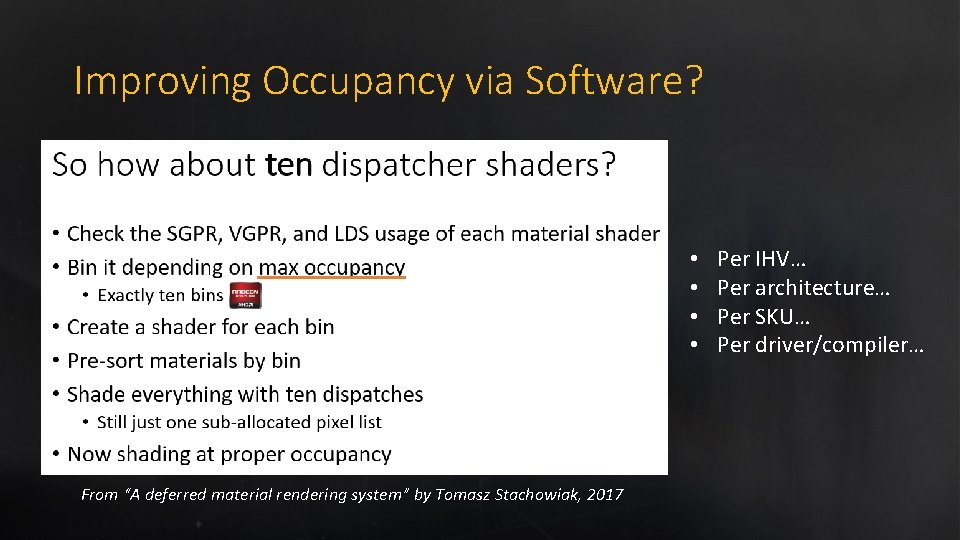
Improving Occupancy via Software? • • From “A deferred material rendering system” by Tomasz Stachowiak, 2017 Per IHV… Per architecture… Per SKU… Per driver/compiler…
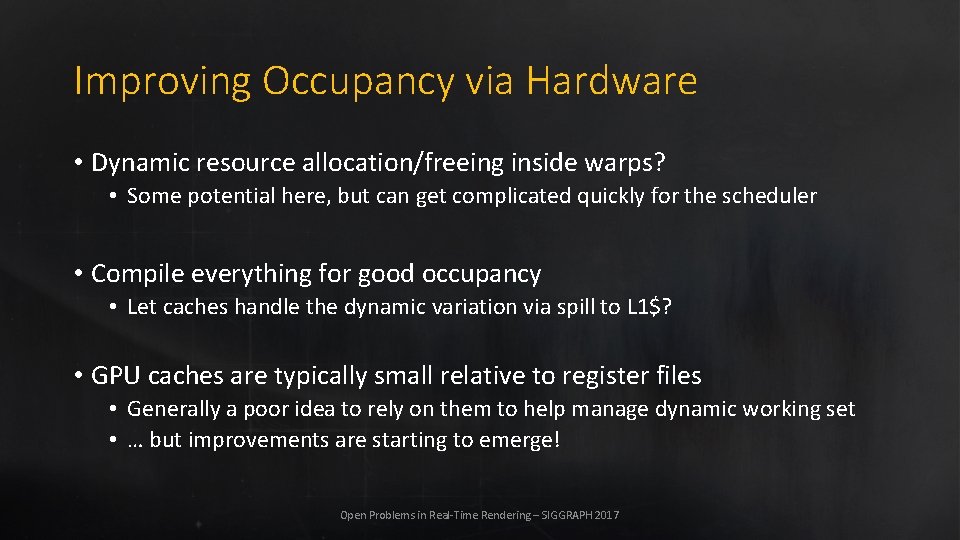
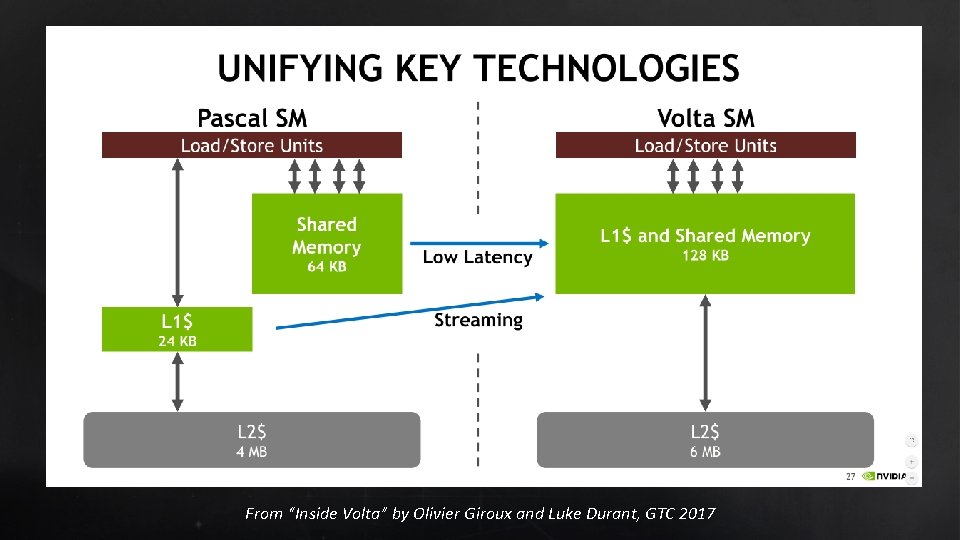
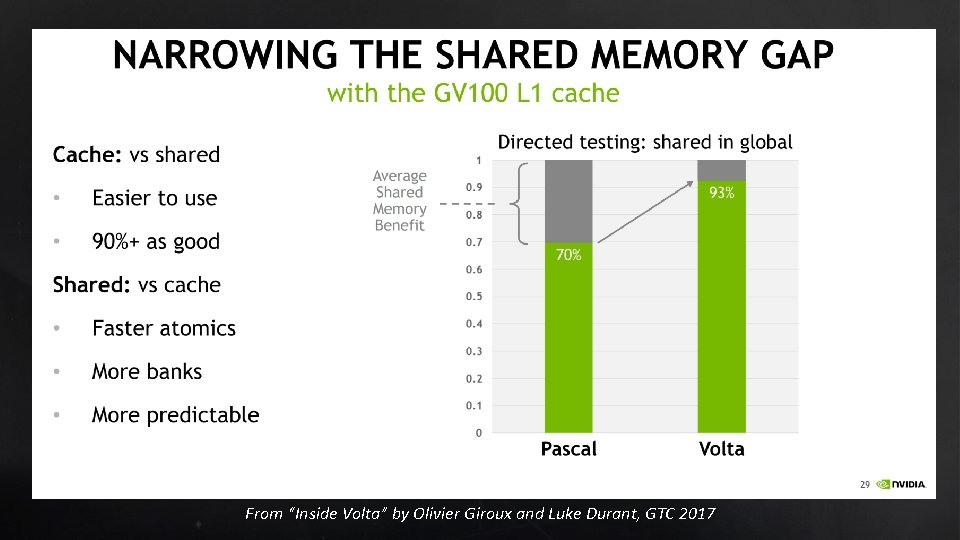
Improving Occupancy via Hardware • Dynamic resource allocation/freeing inside warps? • Some potential here, but can get complicated quickly for the scheduler • Compile everything for good occupancy • Let caches handle the dynamic variation via spill to L 1$? • GPU caches are typically small relative to register files • Generally a poor idea to rely on them to help manage dynamic working set • … but improvements are starting to emerge! Open Problems in Real-Time Rendering – SIGGRAPH 2017
From “Inside Volta” by Olivier Giroux and Luke Durant, GTC 2017
From “Inside Volta” by Olivier Giroux and Luke Durant, GTC 2017
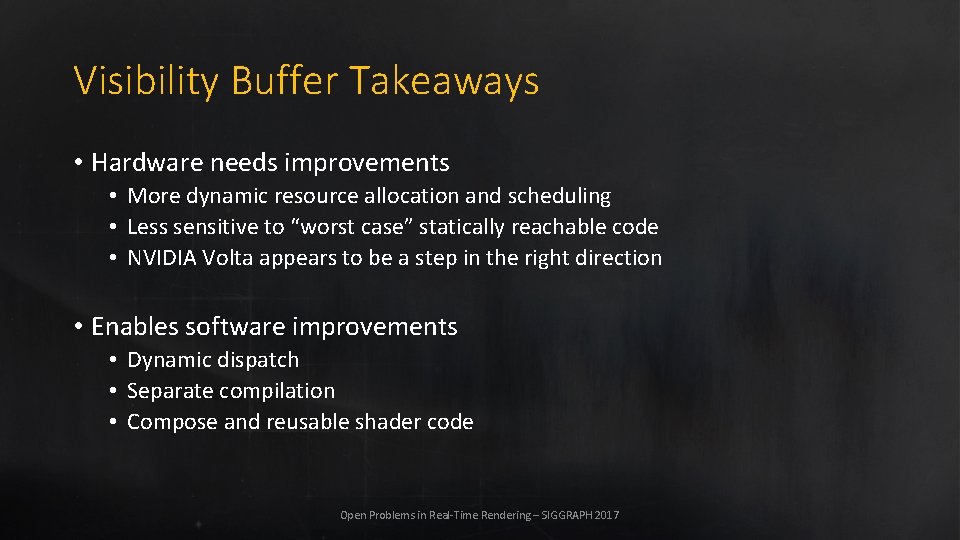
Visibility Buffer Takeaways • Hardware needs improvements • More dynamic resource allocation and scheduling • Less sensitive to “worst case” statically reachable code • NVIDIA Volta appears to be a step in the right direction • Enables software improvements • Dynamic dispatch • Separate compilation • Compose and reusable shader code Open Problems in Real-Time Rendering – SIGGRAPH 2017
Case Study: Hierarchical Structures
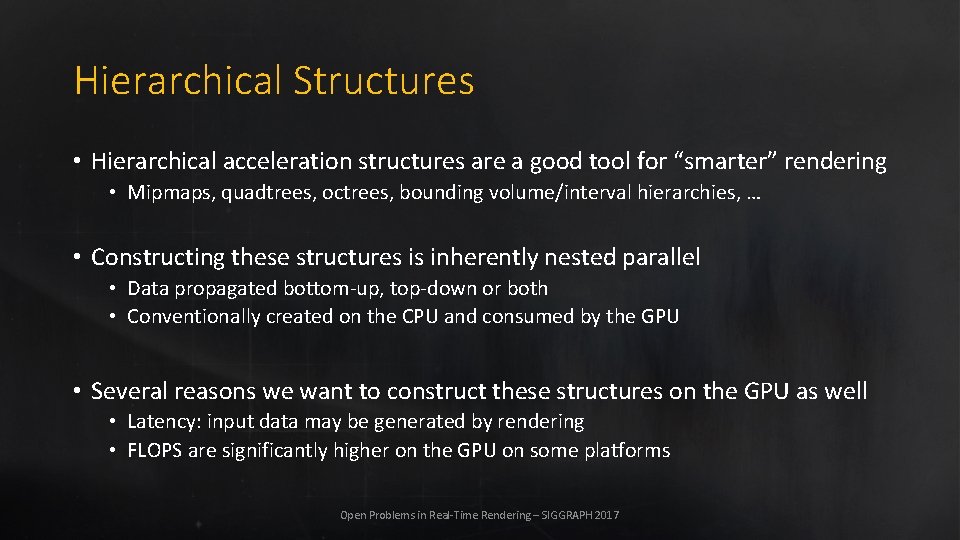
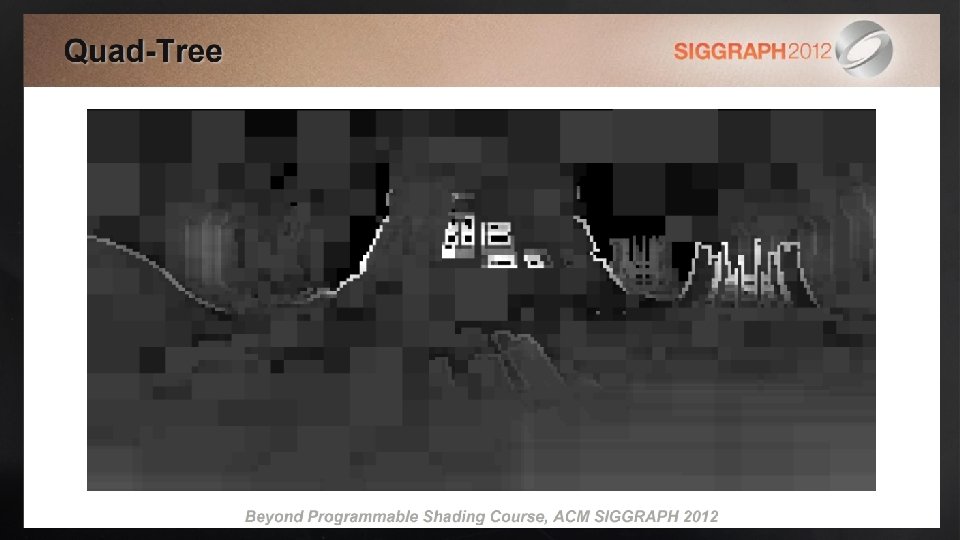
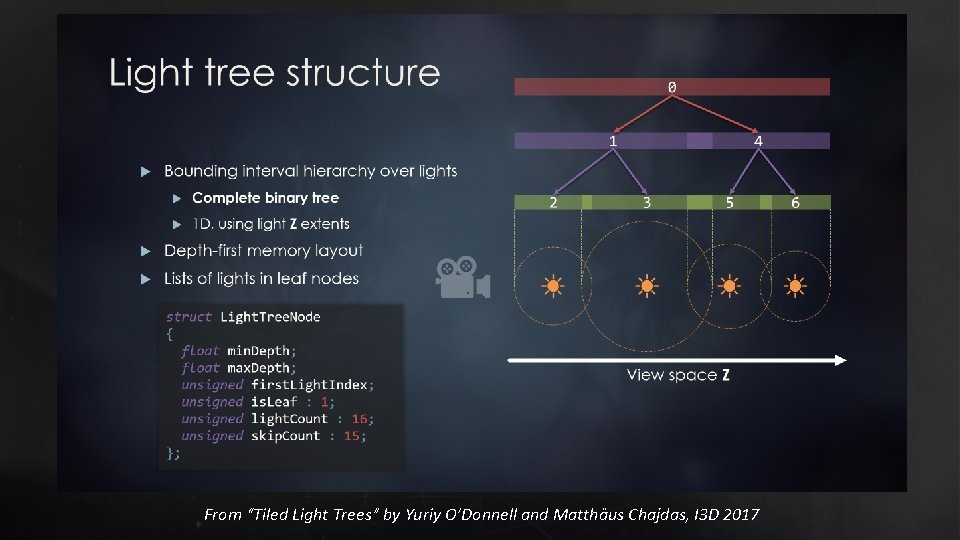
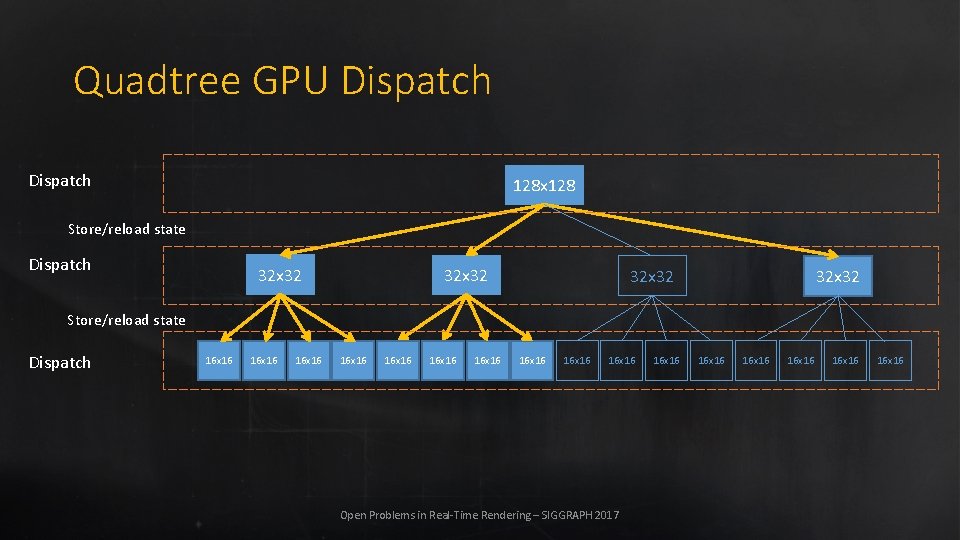
Hierarchical Structures • Hierarchical acceleration structures are a good tool for “smarter” rendering • Mipmaps, quadtrees, octrees, bounding volume/interval hierarchies, … • Constructing these structures is inherently nested parallel • Data propagated bottom-up, top-down or both • Conventionally created on the CPU and consumed by the GPU • Several reasons we want to construct these structures on the GPU as well • Latency: input data may be generated by rendering • FLOPS are significantly higher on the GPU on some platforms Open Problems in Real-Time Rendering – SIGGRAPH 2017
From “Tiled Light Trees” by Yuriy O’Donnell and Matthäus Chajdas, I 3 D 2017
Quadtree GPU Dispatch 128 x 128 Store/reload state Dispatch 32 x 32 Store/reload state Dispatch 16 x 16 16 x 16 16 x 16 Open Problems in Real-Time Rendering – SIGGRAPH 2017 16 x 16 16 x 16
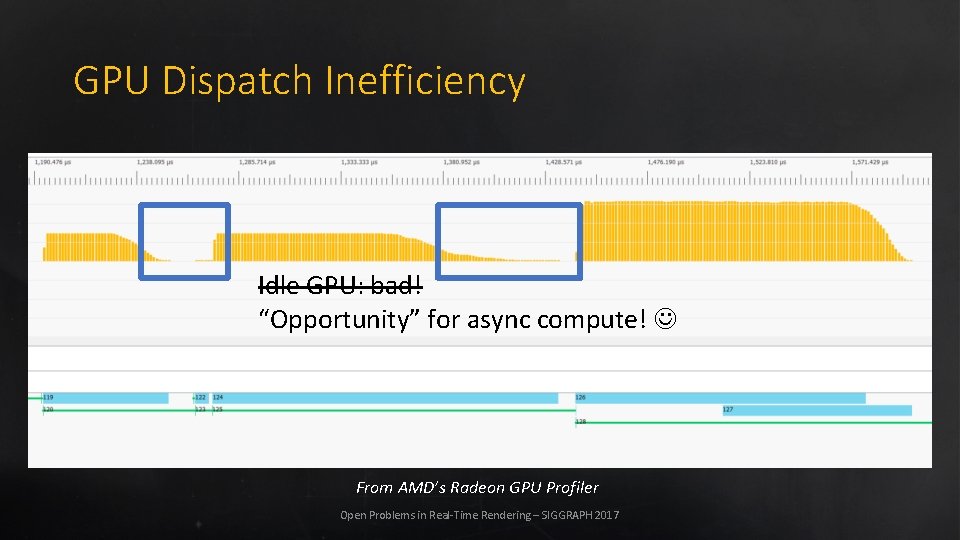
GPU Dispatch Inefficiency Idle GPU: bad! “Opportunity” for async compute! From AMD’s Radeon GPU Profiler Open Problems in Real-Time Rendering – SIGGRAPH 2017
Quadtree GPU Block Reduction #define BLOCK_SIZE 16 groupshared Tile. Data tiles[BLOCK_SIZE]; groupshared float 4 output[BLOCK_SIZE]; float 4 Tile. Flat(uint 2 tid, Tile. Data initial. Data) { bool alive = true; . . . for (int level = MAX_LEVELS; level > 0; --level) { if (alive && all(tid. xy < (1 << level))) {. . . if (is. Base. Case(tile. Data)) { output[tid] = base. Case(tile. Data); alive = false; }. . . } Group. Memory. Barrier. With. Group. Sync(); } return output[tid]; } • Baked into kernel • Optimal sizes are highly GPU dependent • May not align with optimal sizes for data • Potential occupancy issues • Some algorithms need a full Tile. Data stack Open Problems in Real-Time Rendering – SIGGRAPH 2017
Quadtree GPU Block Reduction #define BLOCK_SIZE 16 groupshared Tile. Data tiles[BLOCK_SIZE]; groupshared float 4 output[BLOCK_SIZE]; float 4 Tile. Flat(uint 2 tid, Tile. Data initial. Data) { bool alive = true; . . . for (int level = MAX_LEVELS; level > 0; --level) { if (alive && all(tid. xy < (1 << level))) {. . . if (is. Base. Case(tile. Data)) { output[tid] = base. Case(tile. Data); alive = false; }. . . } Group. Memory. Barrier. With. Group. Sync(); } return output[tid]; } • Lots of GPU threads doing useless work • Can’t terminate early • Can’t re-pack threads Open Problems in Real-Time Rendering – SIGGRAPH 2017
Quadtree GPU Block Reduction #define BLOCK_SIZE 16 groupshared Tile. Data tiles[BLOCK_SIZE]; groupshared float 4 output[BLOCK_SIZE]; float 4 Tile. Flat(uint 2 tid, Tile. Data initial. Data) { bool alive = true; . . . for (int level = MAX_LEVELS; level > 0; --level) { if (alive && all(tid. xy < (1 << level))) {. . . if (is. Base. Case(tile. Data)) { output[tid] = base. Case(tile. Data); alive = false; }. . . } Group. Memory. Barrier. With. Group. Sync(); } return output[tid]; } • Base and subdivide cases can’t do thread sync • Can’t (efficiently) use shared memory • Breaks nesting abstraction Open Problems in Real-Time Rendering – SIGGRAPH 2017
Improving Performance
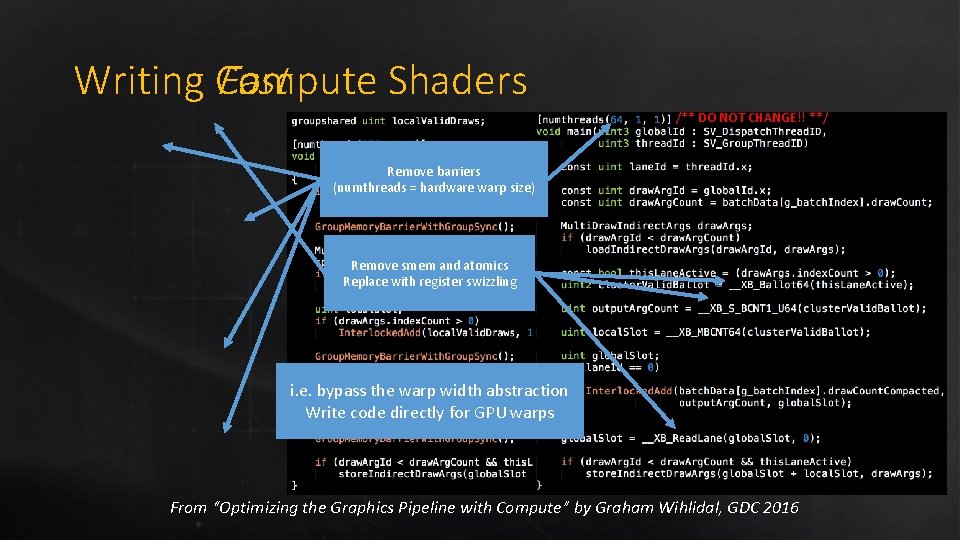
Writing Compute Fast Shaders /** DO NOT CHANGE!! **/ Remove barriers (numthreads = hardware warp size) Remove smem and atomics Replace with register swizzling i. e. bypass the warp width abstraction Write code directly for GPU warps From “Optimizing the Graphics Pipeline with Compute” by Graham Wihlidal, GDC 2016
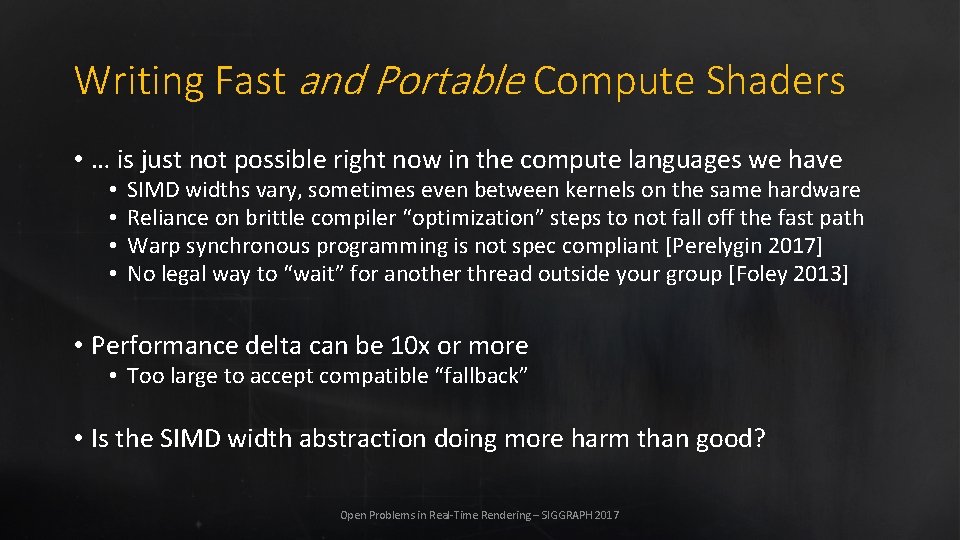
Writing Fast and Portable Compute Shaders • … is just not possible right now in the compute languages we have • • SIMD widths vary, sometimes even between kernels on the same hardware Reliance on brittle compiler “optimization” steps to not fall off the fast path Warp synchronous programming is not spec compliant [Perelygin 2017] No legal way to “wait” for another thread outside your group [Foley 2013] • Performance delta can be 10 x or more • Too large to accept compatible “fallback” • Is the SIMD width abstraction doing more harm than good? Open Problems in Real-Time Rendering – SIGGRAPH 2017
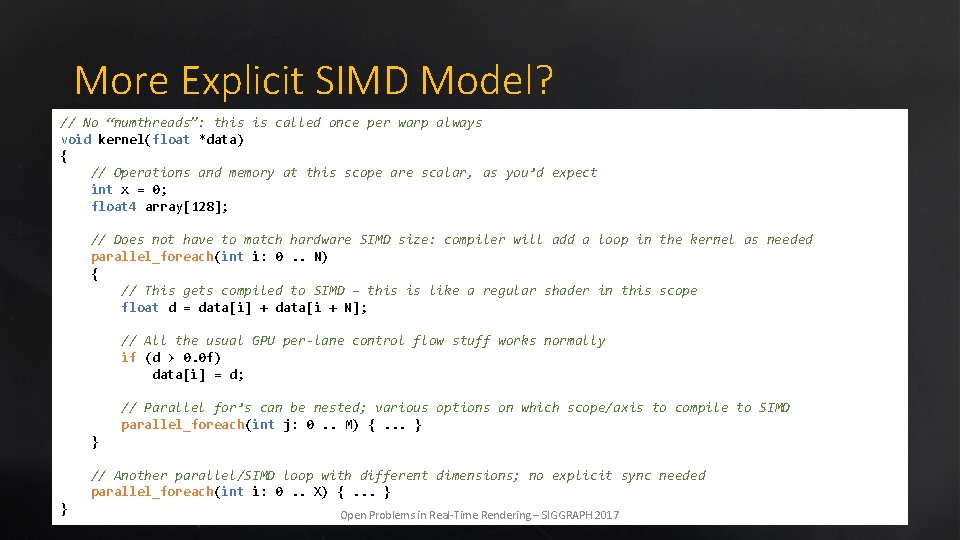
More Explicit SIMD Model? // No “numthreads”: this is called once per warp always void kernel(float *data) { // Operations and memory at this scope are scalar, as you’d expect int x = 0; float 4 array[128]; // Does not have to match hardware SIMD size: compiler will add a loop in the kernel as needed parallel_foreach(int i: 0. . N) { // This gets compiled to SIMD – this is like a regular shader in this scope float d = data[i] + data[i + N]; // All the usual GPU per-lane control flow stuff works normally if (d > 0. 0 f) data[i] = d; // Parallel for’s can be nested; various options on which scope/axis to compile to SIMD parallel_foreach(int j: 0. . M) {. . . } } // Another parallel/SIMD loop with different dimensions; no explicit sync needed parallel_foreach(int i: 0. . X) {. . . } } Open Problems in Real-Time Rendering – SIGGRAPH 2017
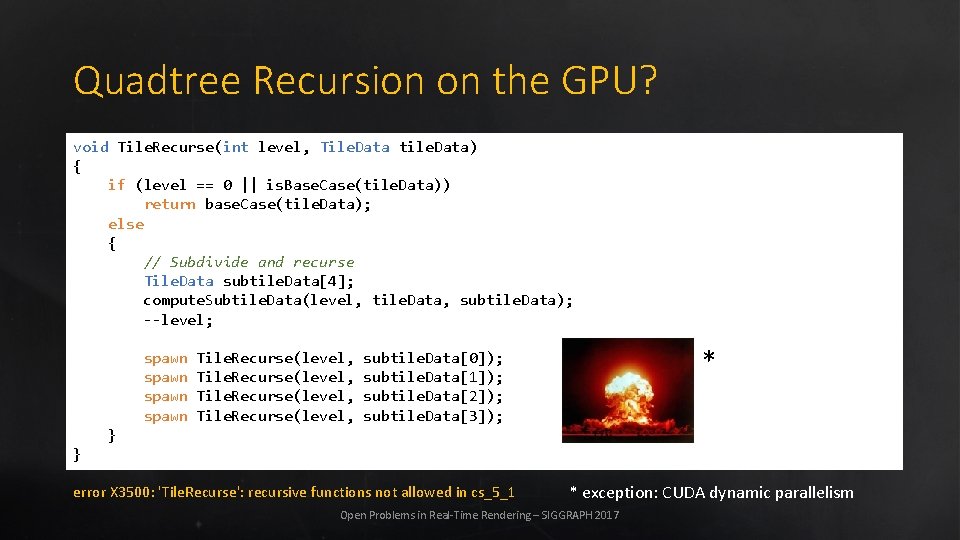
Quadtree Recursion on the GPU? void Tile. Recurse(int level, Tile. Data tile. Data) { if (level == 0 || is. Base. Case(tile. Data)) return base. Case(tile. Data); else { // Subdivide and recurse Tile. Data subtile. Data[4]; compute. Subtile. Data(level, tile. Data, subtile. Data); --level; spawn Tile. Recurse(level, * subtile. Data[0]); subtile. Data[1]); subtile. Data[2]); subtile. Data[3]); } } error X 3500: 'Tile. Recurse': recursive functions not allowed in cs_5_1 * exception: CUDA dynamic parallelism Open Problems in Real-Time Rendering – SIGGRAPH 2017
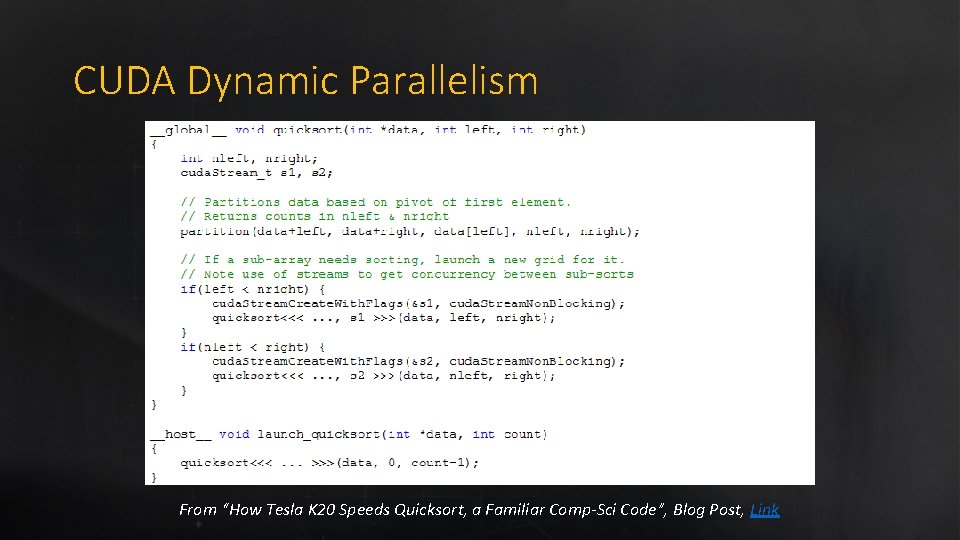
CUDA Dynamic Parallelism From “How Tesla K 20 Speeds Quicksort, a Familiar Comp-Sci Code”, Blog Post, Link
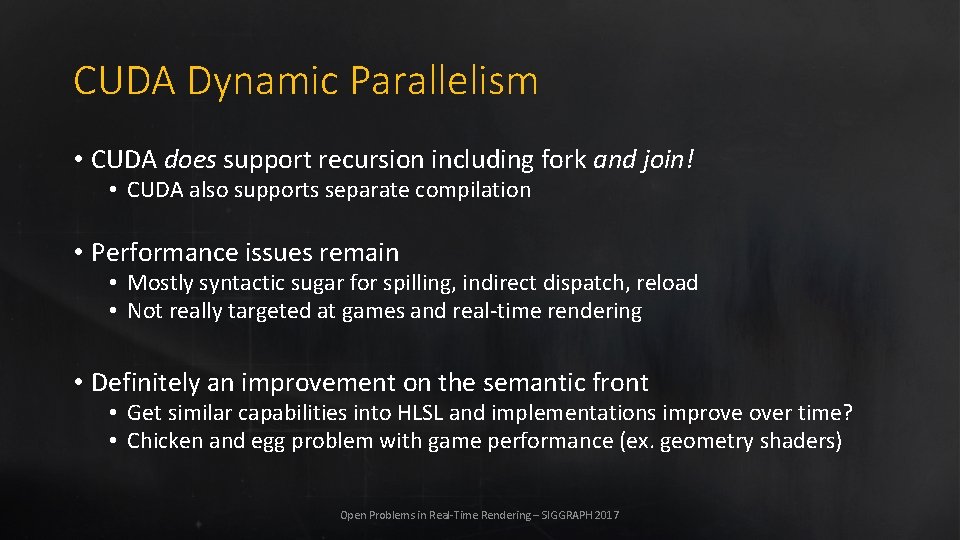
CUDA Dynamic Parallelism • CUDA does support recursion including fork and join! • CUDA also supports separate compilation • Performance issues remain • Mostly syntactic sugar for spilling, indirect dispatch, reload • Not really targeted at games and real-time rendering • Definitely an improvement on the semantic front • Get similar capabilities into HLSL and implementations improve over time? • Chicken and egg problem with game performance (ex. geometry shaders) Open Problems in Real-Time Rendering – SIGGRAPH 2017
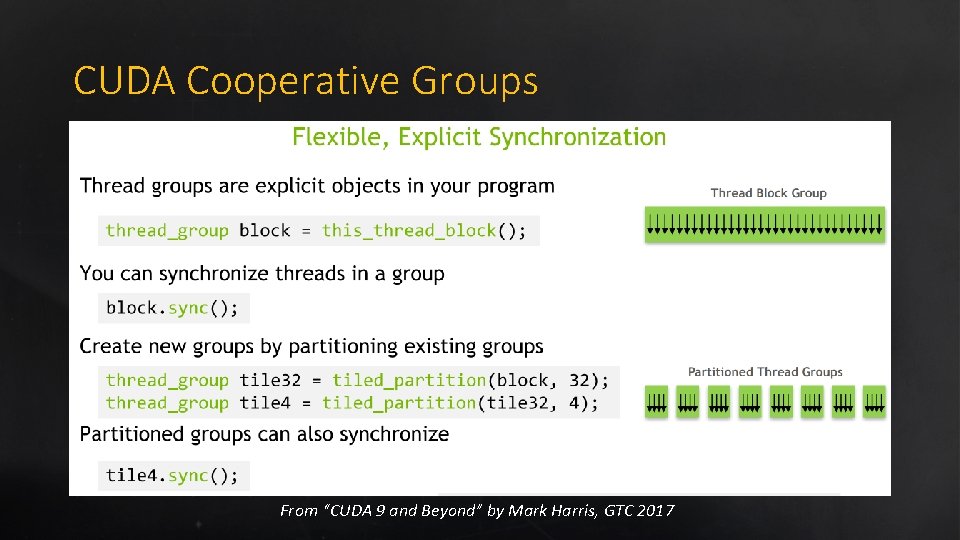
CUDA Cooperative Groups From “CUDA 9 and Beyond” by Mark Harris, GTC 2017
Hierarchical Structures Takeaways • Nested parallelism and trees are key components of many algorithms • We need an efficient, portable way to express these • Current compute languages are not particularly suitable • Only way to write efficient code is to defeat the abstractions • We need new languages and language features • Map/reduce? Fork/join? • CUDA cooperative groups? • ISPC [Pharr 2012]? BSGP [TOG 2008]? Halide [Ragan-Kelly 2013]? • Good opportunity for academia and industry collaboration! Open Problems in Real-Time Rendering – SIGGRAPH 2017
Code Compatibility and Reuse
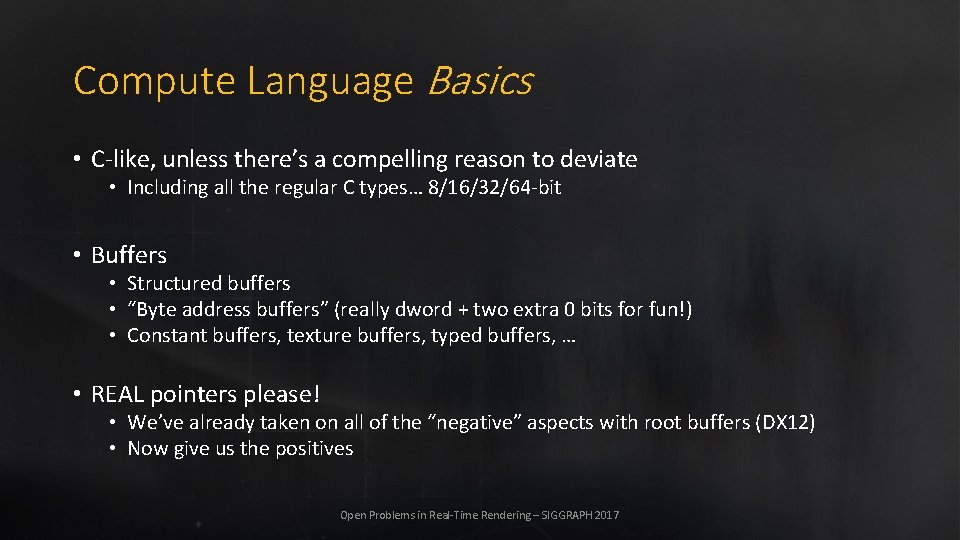
Compute Language Basics • C-like, unless there’s a compelling reason to deviate • Including all the regular C types… 8/16/32/64 -bit • Buffers • Structured buffers • “Byte address buffers” (really dword + two extra 0 bits for fun!) • Constant buffers, texture buffers, typed buffers, … • REAL pointers please! • We’ve already taken on all of the “negative” aspects with root buffers (DX 12) • Now give us the positives Open Problems in Real-Time Rendering – SIGGRAPH 2017
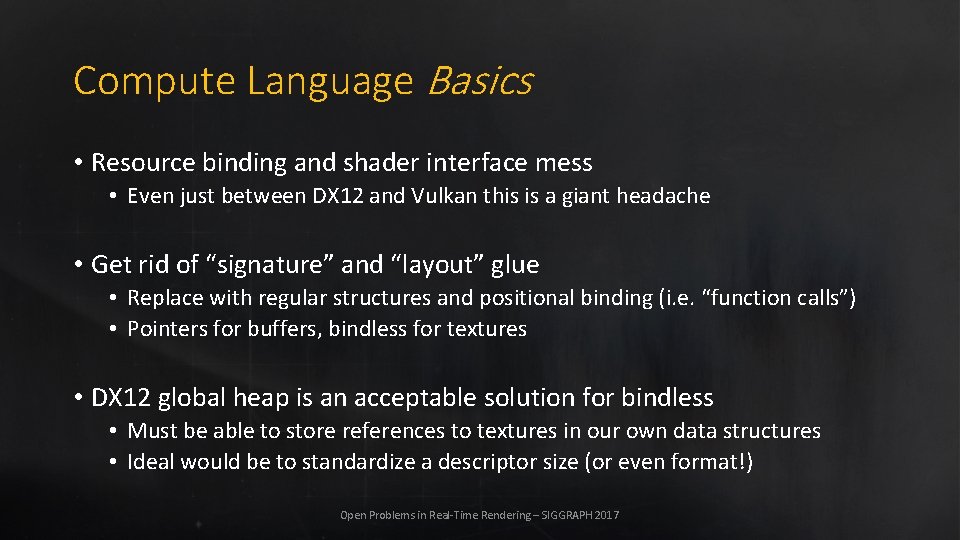
Compute Language Basics • Resource binding and shader interface mess • Even just between DX 12 and Vulkan this is a giant headache • Get rid of “signature” and “layout” glue • Replace with regular structures and positional binding (i. e. “function calls”) • Pointers for buffers, bindless for textures • DX 12 global heap is an acceptable solution for bindless • Must be able to store references to textures in our own data structures • Ideal would be to standardize a descriptor size (or even format!) Open Problems in Real-Time Rendering – SIGGRAPH 2017
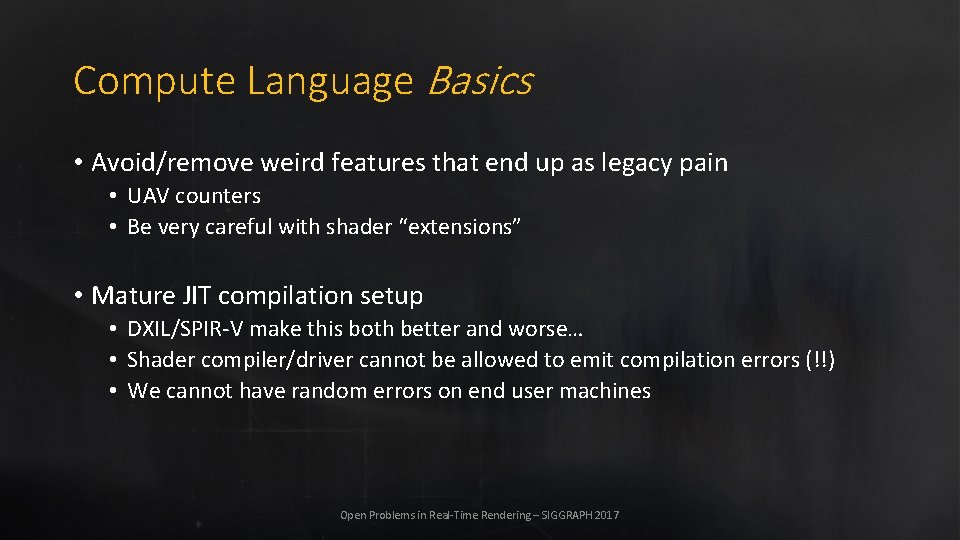
Compute Language Basics • Avoid/remove weird features that end up as legacy pain • UAV counters • Be very careful with shader “extensions” • Mature JIT compilation setup • DXIL/SPIR-V make this both better and worse… • Shader compiler/driver cannot be allowed to emit compilation errors (!!) • We cannot have random errors on end user machines Open Problems in Real-Time Rendering – SIGGRAPH 2017
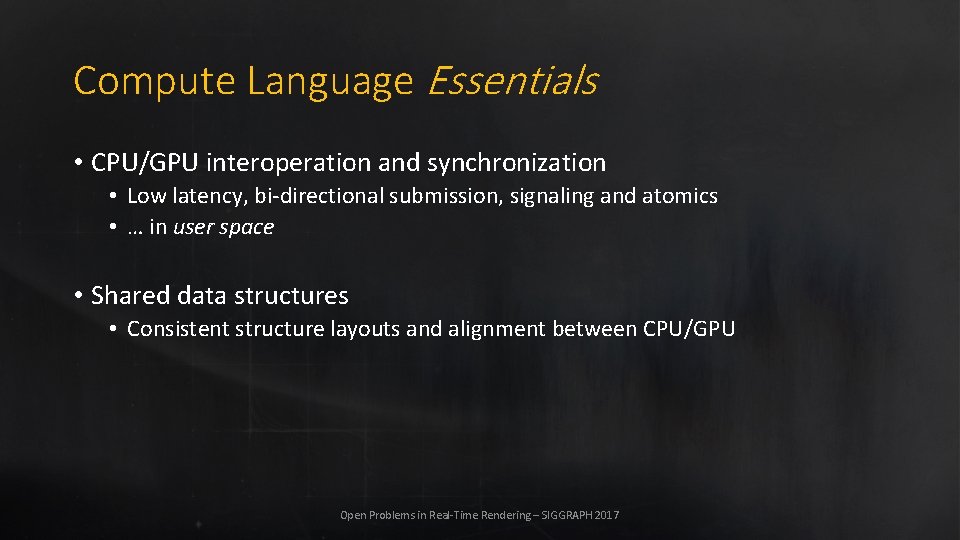
Compute Language Essentials • CPU/GPU interoperation and synchronization • Low latency, bi-directional submission, signaling and atomics • … in user space • Shared data structures • Consistent structure layouts and alignment between CPU/GPU Open Problems in Real-Time Rendering – SIGGRAPH 2017
Call to Action
Compute for Graphics Open Problems in Real-Time Rendering – SIGGRAPH 2017
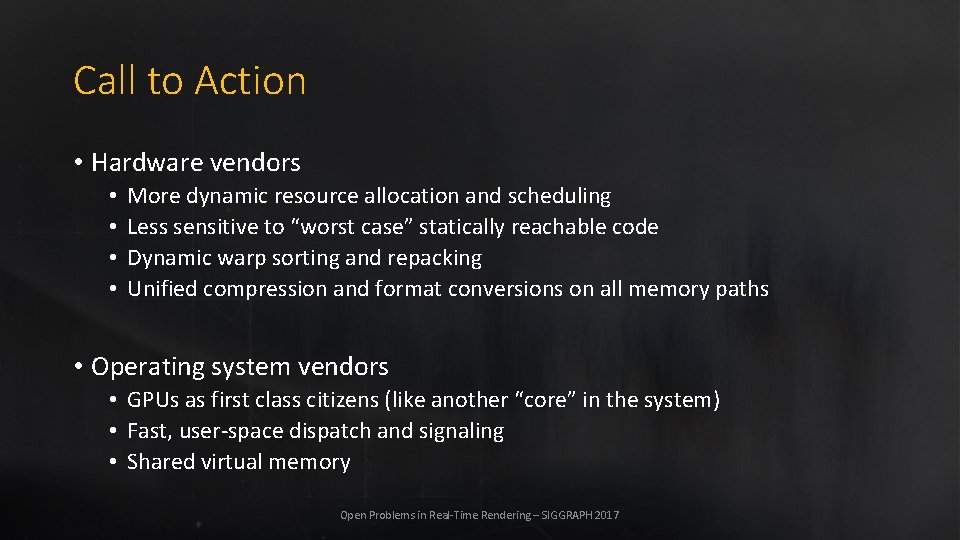
Call to Action • Hardware vendors • • More dynamic resource allocation and scheduling Less sensitive to “worst case” statically reachable code Dynamic warp sorting and repacking Unified compression and format conversions on all memory paths • Operating system vendors • GPUs as first class citizens (like another “core” in the system) • Fast, user-space dispatch and signaling • Shared virtual memory Open Problems in Real-Time Rendering – SIGGRAPH 2017
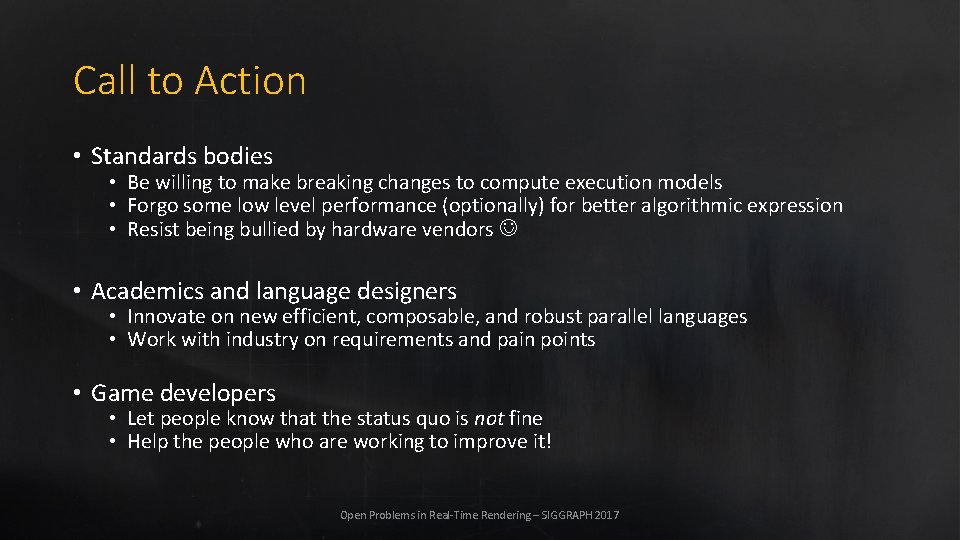
Call to Action • Standards bodies • Be willing to make breaking changes to compute execution models • Forgo some low level performance (optionally) for better algorithmic expression • Resist being bullied by hardware vendors • Academics and language designers • Innovate on new efficient, composable, and robust parallel languages • Work with industry on requirements and pain points • Game developers • Let people know that the status quo is not fine • Help the people who are working to improve it! Open Problems in Real-Time Rendering – SIGGRAPH 2017
Conclusion • Recently industry did explicit graphics APIs • Data-parallel intermediate languages (DXIL, SPIR-V) • Next problem to solve is compute • Want to take real-time graphics further • Ex. 8 k @ 90 Hz stereo VR with high quality lighting, shading and anti-aliasing • Need to render “smarter” • Requires industry-wide cooperation! Open Problems in Real-Time Rendering – SIGGRAPH 2017
Acknowledgements • Aaron Lefohn (@aaronlefohn) • Matt Pharr (@mattpharr) • Alex Fry (@The. Fryster) • Natalya Tatarchuk (@mirror 2 mask) • Colin Barré Brisebois (@Ziggurat. Vertigo) • Neil Henning (@sheredom) • Dave Oldcorn • Tim Foley (@Tangent. Vector) • Graham Wihlidal (@gwihlidal) • Timothy Lottes (@Timothy. Lottes) • Jasper Bekkers (@Jasper. Bekkers) • Tomasz Stachowiak (@h 3 r 2 tic) • Jefferson Montgomery (@jdmo 3) • Yuriy O'Donnell (@Yuriy. ODonnell) • Johan Andersson (@repi) Open Problems in Real-Time Rendering – SIGGRAPH 2017
References • • • Brodman, James et al. Writing Scalable SIMD Programs with ISPC, WPMVP 2014, Link Web Site Burns, Christopher and Hunt, Warren, The Visibility Buffer: A Cache-Friendly Approach to Deferred Shading, JCGT 2013, Link Foley, Tim, A Digression on Divergence, Blog Post in 2013, Link Giroux, Olivier and Durant, Luke, Inside Volta, GTC 2017, Link Haar, Ulrich and Aaltonen, Sebastian, GPU-Driven Rendering Pipelines, Advances in Real-Time Rendering 2015, Link Harris, Mark, CUDA 9 and Beyond, GTC 2017, Link Hou, Qiming et al. BSGP: Bulk-Synchronous GPU Programming, TOG 2008, Link Jones, Stephen, Introduction to Dynamic Parallelism, GTC 2012, Link O’Donnell, Yuriy and Chajdas, Matthäus, Tiled Light Trees, I 3 D 2017, Link Perelygin, Kyrylo and Lin, Yuan, Cooperative Groups, GTC 2017, Link Pharr, Matt and Mark, William, ISPC: A SPMD Compiler for High-Performance SIMD Programming, In. Par 2012, Link Ragan-Kelly, Jonathan et al. Halide: A Language and Compiler for Optimizing Parallelism, Locality and Recomputation in Image Processing Pipelines, PLDI 2013, Link Web Site • Stachowiak, Tomasz, A Deferred Material Rendering System, Blog Post 2015, Link • Wihlidal, Graham, 4 K Checkerboard in Battlefield 1 and Mass Effect Andromeda, GDC 2017, Link • Wihlidal, Graham, Optimizing the Graphics Pipeline with Compute, GDC 2016, Link Open Problems in Real-Time Rendering – SIGGRAPH 2017