
Future Didymos Observing Strategy Cristina Thomas Northern Arizona
Future Didymos Observing Strategy Cristina Thomas (Northern Arizona University) Andy Rivkin (JHU-APL) & the Observing Working Group 1
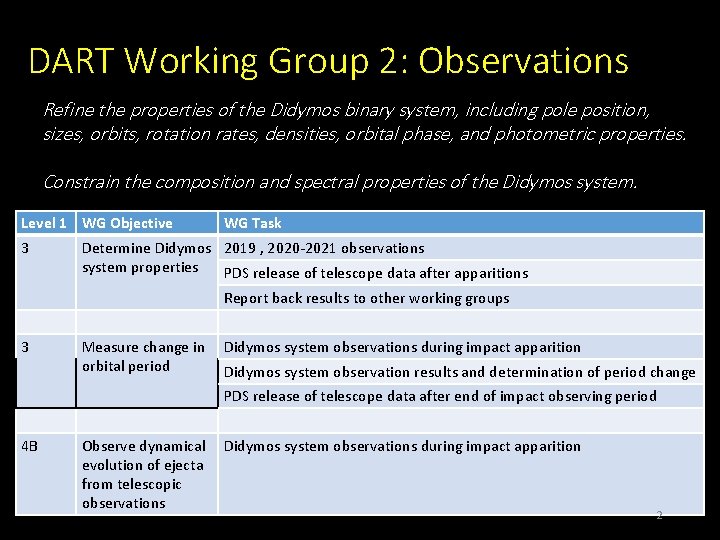
DART Working Group 2: Observations Refine the properties of the Didymos binary system, including pole position, sizes, orbits, rotation rates, densities, orbital phase, and photometric properties. Constrain the composition and spectral properties of the Didymos system. Level 1 WG Objective 3 WG Task Determine Didymos 2019 , 2020 -2021 observations system properties PDS release of telescope data after apparitions Report back results to other working groups 3 Measure change in Didymos system observations during impact apparition orbital period Didymos system observation results and determination of period change PDS release of telescope data after end of impact observing period 4 B Observe dynamical Didymos system observations during impact apparition evolution of ejecta from telescopic observations 2
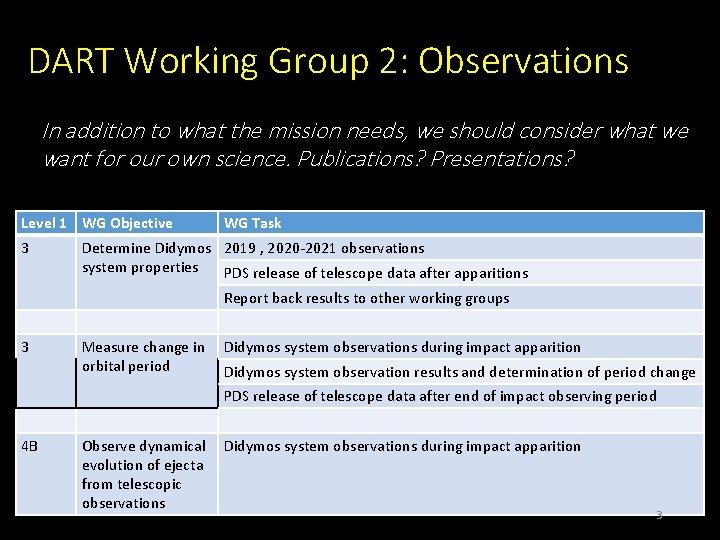
DART Working Group 2: Observations In addition to what the mission needs, we should consider what we want for our own science. Publications? Presentations? Level 1 WG Objective 3 WG Task Determine Didymos 2019 , 2020 -2021 observations system properties PDS release of telescope data after apparitions Report back results to other working groups 3 Measure change in Didymos system observations during impact apparition orbital period Didymos system observation results and determination of period change PDS release of telescope data after end of impact observing period 4 B Observe dynamical Didymos system observations during impact apparition evolution of ejecta from telescopic observations 3
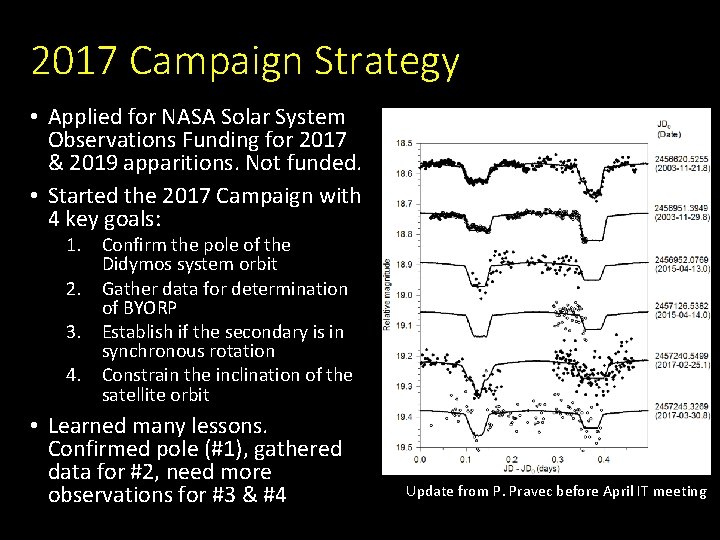
2017 Campaign Strategy • Applied for NASA Solar System Observations Funding for 2017 & 2019 apparitions. Not funded. • Started the 2017 Campaign with 4 key goals: 1. Confirm the pole of the Didymos system orbit 2. Gather data for determination of BYORP 3. Establish if the secondary is in synchronous rotation 4. Constrain the inclination of the satellite orbit • Learned many lessons. Confirmed pole (#1), gathered data for #2, need more observations for #3 & #4 Update from P. Pravec before April IT meeting
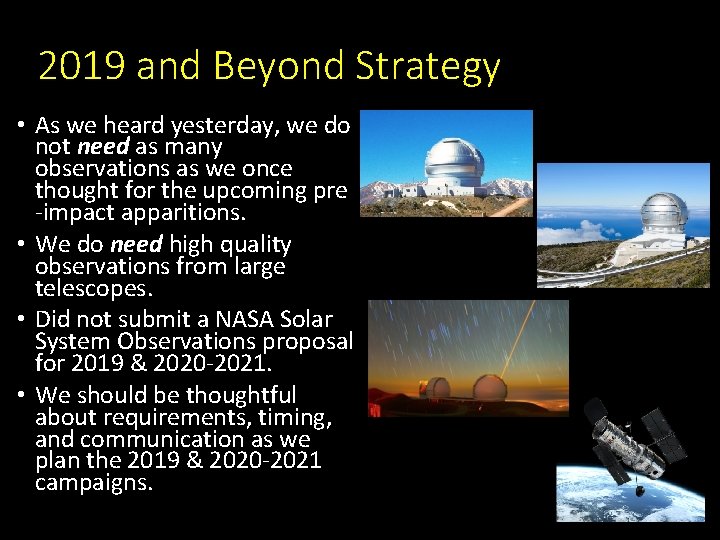
2019 and Beyond Strategy • As we heard yesterday, we do not need as many observations as we once thought for the upcoming pre -impact apparitions. • We do need high quality observations from large telescopes. • Did not submit a NASA Solar System Observations proposal for 2019 & 2020 -2021. • We should be thoughtful about requirements, timing, and communication as we plan the 2019 & 2020 -2021 campaigns.
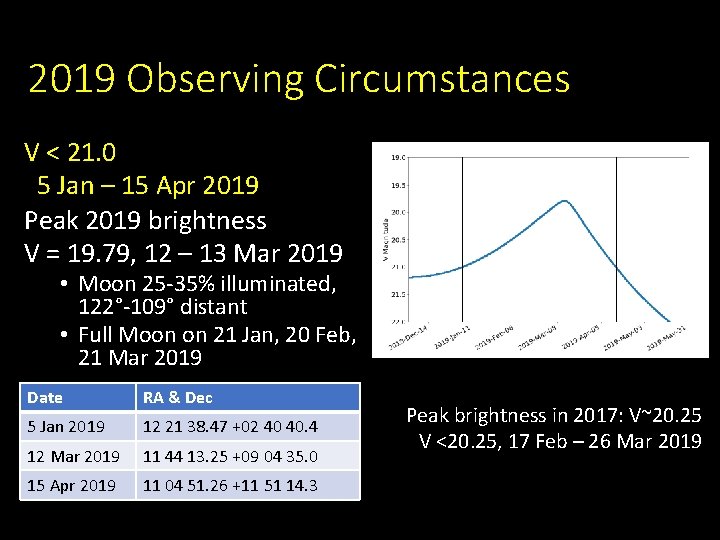
2019 Observing Circumstances V < 21. 0 5 Jan – 15 Apr 2019 Peak 2019 brightness V = 19. 79, 12 – 13 Mar 2019 • Moon 25 -35% illuminated, 122°-109° distant • Full Moon on 21 Jan, 20 Feb, 21 Mar 2019 Date RA & Dec 5 Jan 2019 12 21 38. 47 +02 40 40. 4 12 Mar 2019 11 44 13. 25 +09 04 35. 0 15 Apr 2019 11 04 51. 26 +11 51 14. 3 Peak brightness in 2017: V~20. 25 V <20. 25, 17 Feb – 26 Mar 2019
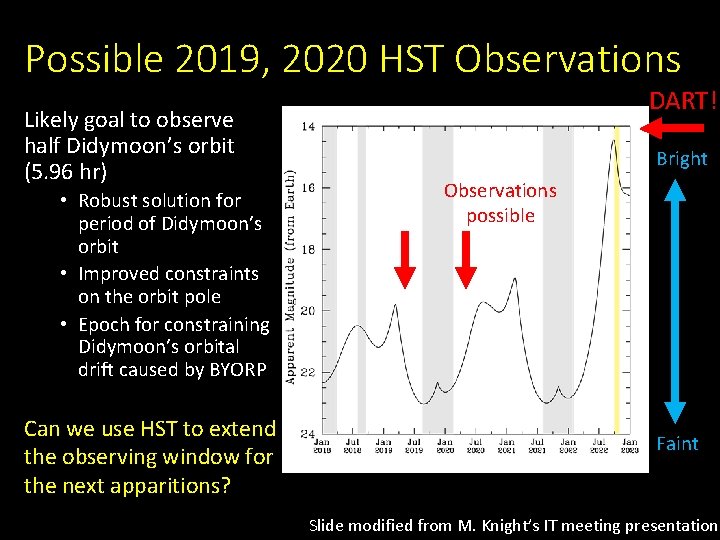
Possible 2019, 2020 HST Observations Likely goal to observe half Didymoon’s orbit (5. 96 hr) • Robust solution for period of Didymoon’s orbit • Improved constraints on the orbit pole • Epoch for constraining Didymoon’s orbital drift caused by BYORP Can we use HST to extend the observing window for the next apparitions? DART! Bright Observations possible Faint Slide modified from M. Knight’s IT meeting presentation
HST Timing Considerations • Didymos is brighter and available in 2019, 2020, 2021 • Expect there to be a mid-cycle call in September 2018 and normal call in March 2019 • Mid-cycle logistics • Time harder to get • Stronger proposal once DART moves to Phase C • Can only request up to 10 orbits • Are there any mission-critical observations will need to be done quickly? • Director’s Discretionary Time proposals are an option Slide modified from M. Knight’s IT meeting presentation
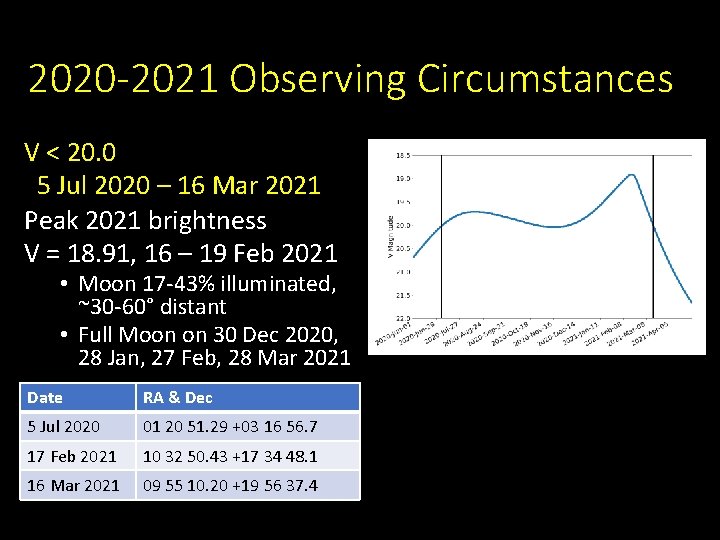
2020 -2021 Observing Circumstances V < 20. 0 5 Jul 2020 – 16 Mar 2021 Peak 2021 brightness V = 18. 91, 16 – 19 Feb 2021 • Moon 17 -43% illuminated, ~30 -60° distant • Full Moon on 30 Dec 2020, 28 Jan, 27 Feb, 28 Mar 2021 Date RA & Dec 5 Jul 2020 01 20 51. 29 +03 16 56. 7 17 Feb 2021 10 32 50. 43 +17 34 48. 1 16 Mar 2021 09 55 10. 20 +19 56 37. 4
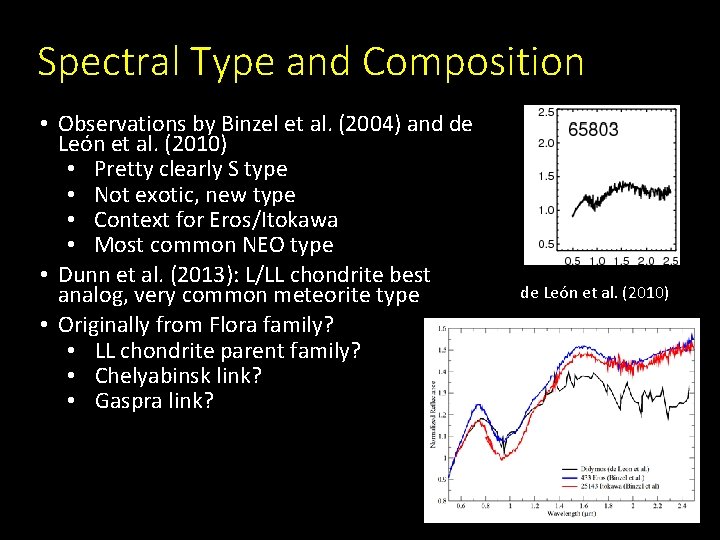
Spectral Type and Composition • Observations by Binzel et al. (2004) and de León et al. (2010) • Pretty clearly S type • Not exotic, new type • Context for Eros/Itokawa • Most common NEO type • Dunn et al. (2013): L/LL chondrite best analog, very common meteorite type • Originally from Flora family? • LL chondrite parent family? • Chelyabinsk link? • Gaspra link? de León et al. (2010)
Do we need more spectroscopy? always • Reasonably secure in terms of spectral type • Reasonably secure in terms of meteorite analog • Albedo somewhat low for S class? 0. 15 ± 0. 04 • Measure thermal inertia? • Possible to separate Didymos A and B spectra during mutual events? • Probably not • Didymos B contributes ~4% of light • Not likely that we could tell anything unless Didymos B radically different from Didymos A?
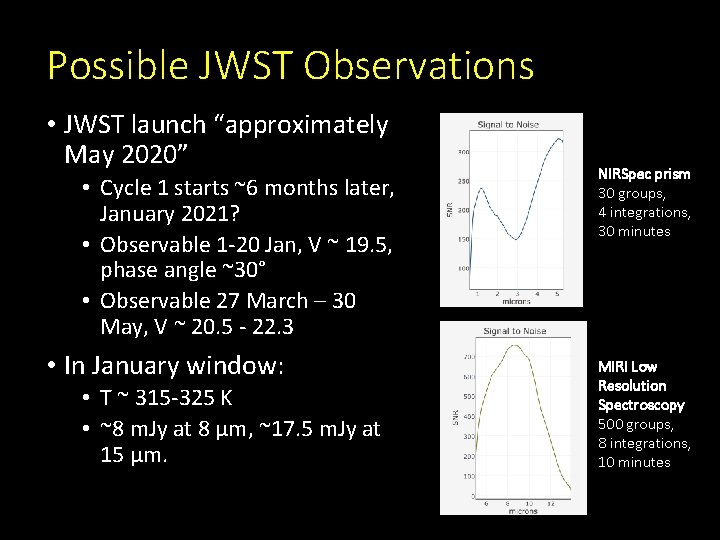
Possible JWST Observations • JWST launch “approximately May 2020” • Cycle 1 starts ~6 months later, January 2021? • Observable 1 -20 Jan, V ~ 19. 5, phase angle ~30° • Observable 27 March – 30 May, V ~ 20. 5 - 22. 3 • In January window: • T ~ 315 -325 K • ~8 m. Jy at 8 µm, ~17. 5 m. Jy at 15 µm. NIRSpec prism 30 groups, 4 integrations, 30 minutes MIRI Low Resolution Spectroscopy 500 groups, 8 integrations, 10 minutes
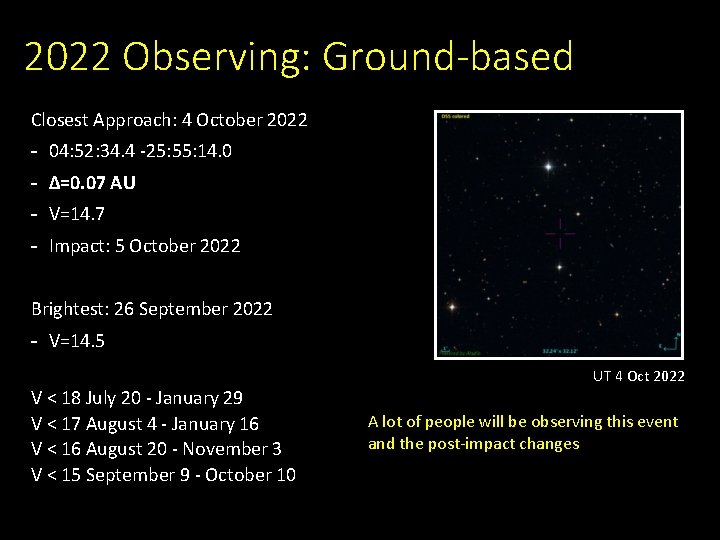
2022 Observing: Ground-based Closest Approach: 4 October 2022 - 04: 52: 34. 4 -25: 55: 14. 0 - Δ=0. 07 AU - V=14. 7 - Impact: 5 October 2022 Brightest: 26 September 2022 - V=14. 5 V < 18 July 20 - January 29 V < 17 August 4 - January 16 V < 16 August 20 - November 3 V < 15 September 9 - October 10 UT 4 Oct 2022 A lot of people will be observing this event and the post-impact changes
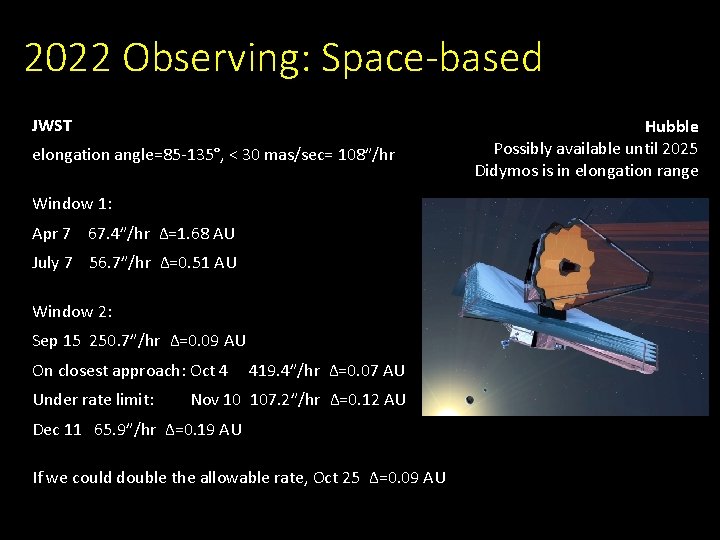
2022 Observing: Space-based JWST elongation angle=85 -135°, < 30 mas/sec= 108”/hr Window 1: Apr 7 67. 4”/hr Δ=1. 68 AU July 7 56. 7”/hr Δ=0. 51 AU Window 2: Sep 15 250. 7”/hr Δ=0. 09 AU On closest approach: Oct 4 419. 4”/hr Δ=0. 07 AU Under rate limit: Nov 10 107. 2”/hr Δ=0. 12 AU Dec 11 65. 9”/hr Δ=0. 19 AU If we could double the allowable rate, Oct 25 Δ=0. 09 AU Hubble Possibly available until 2025 Didymos is in elongation range
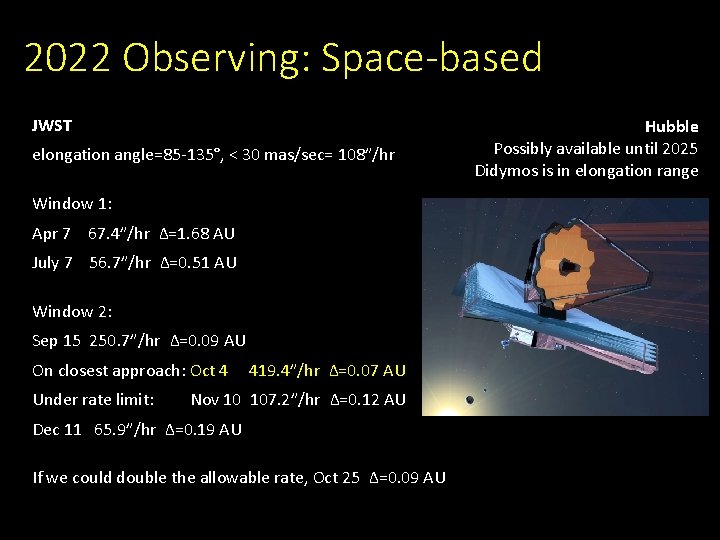
2022 Observing: Space-based JWST elongation angle=85 -135°, < 30 mas/sec= 108”/hr Window 1: Apr 7 67. 4”/hr Δ=1. 68 AU July 7 56. 7”/hr Δ=0. 51 AU Window 2: Sep 15 250. 7”/hr Δ=0. 09 AU On closest approach: Oct 4 419. 4”/hr Δ=0. 07 AU Under rate limit: Nov 10 107. 2”/hr Δ=0. 12 AU Dec 11 65. 9”/hr Δ=0. 19 AU If we could double the allowable rate, Oct 25 Δ=0. 09 AU Hubble Possibly available until 2025 Didymos is in elongation range
We have a lot of work to do, how are we going to do this well? • Coordination Platform. Website? • List of observing proposal deadlines, PIs of proposal, when observations happened, status of data • Deadlines. We need to act quickly! • This enables us to make new plans if things fail and know the quality of data while Didymos can still be observed. • Observing guide to guarantee consistency in datasets? • Sidereal vs. non-sidereal, exposure time, filters, etc. • We need to communicate effectively with each other and with the other DART Working Groups! • Do we want to observe 2001 CB 21?
- Slides: 16