
FUTURE CIRCULAR COLLIDER LOGISTICS STUDY Dr Ulrike Beiert
FUTURE CIRCULAR COLLIDER LOGISTICS STUDY Dr. Ulrike Beißert, Konstantin Horstmann, Gerd Kuhlmann, Andreas Nettsträter, Christian Prasse, Andreas Wohlfahrt © Fraunhofer · Slide 1
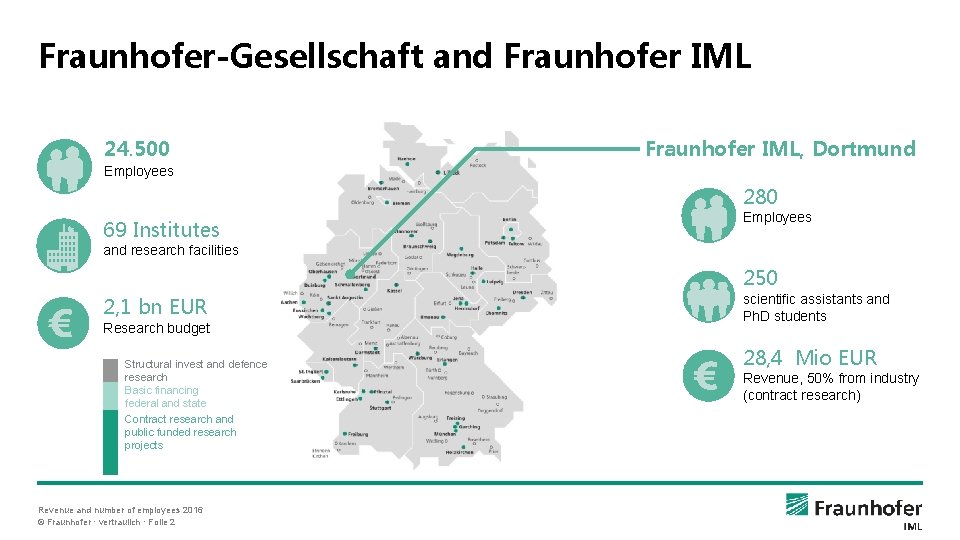
Fraunhofer-Gesellschaft and Fraunhofer IML 24. 500 Fraunhofer IML, Dortmund Employees 280 69 Institutes Employees and research facilities 250 2, 1 bn EUR Research budget Structural invest and defence research Basic financing federal and state Contract research and public funded research projects Revenue and number of employees 2016 © Fraunhofer · vertraulich · Folie 2 scientific assistants and Ph. D students 28, 4 Mio EUR Revenue, 50% from industry (contract research)
FCC Logistics Study covers fives areas Supply strategies for FCC cryo-units; Locations for the storage, assembly and testing facilities; Transport scenarios for cryo-units, including analysis of stresses and possibility of intercontinental transport; Design concept for a special purpose vehicles for the underground transportation and handling of cryo-units; Supply scenarios considering the overall FCC construction schedule. © Fraunhofer · Slide 3
The following assumptions about FCC have been taken into consideration Related to installation schedule: Cryo-unit installation phase Nov. 2035 – Nov. 2039 Related to cryo-units: Maximum shock: 0. 1 g Maximum tilt angle: 5% Weight of the cryo-unit: 60 t (Dipole Magnets) Dimension (L/W/H) 13, 4 m x 1, 5 m x 1, 64 m Amount of cryo-units to be transported: 5400 © Fraunhofer · Slide 4
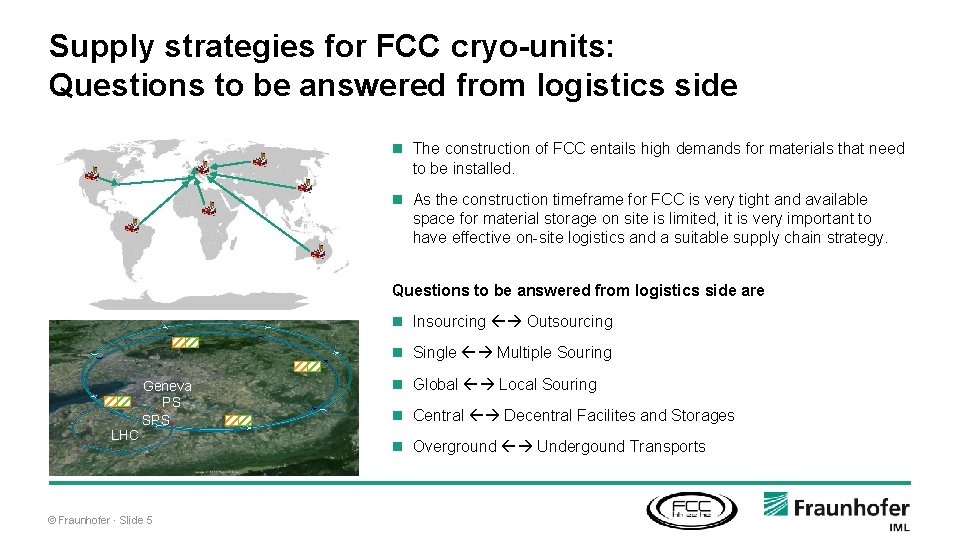
Supply strategies for FCC cryo-units: Questions to be answered from logistics side The construction of FCC entails high demands for materials that need to be installed. As the construction timeframe for FCC is very tight and available space for material storage on site is limited, it is very important to have effective on-site logistics and a suitable supply chain strategy. Questions to be answered from logistics side are Insourcing Outsourcing Single Multiple Souring LHC Geneva PS SPS © Fraunhofer · Slide 5 Global Local Souring Central Decentral Facilites and Storages Overground Undergound Transports
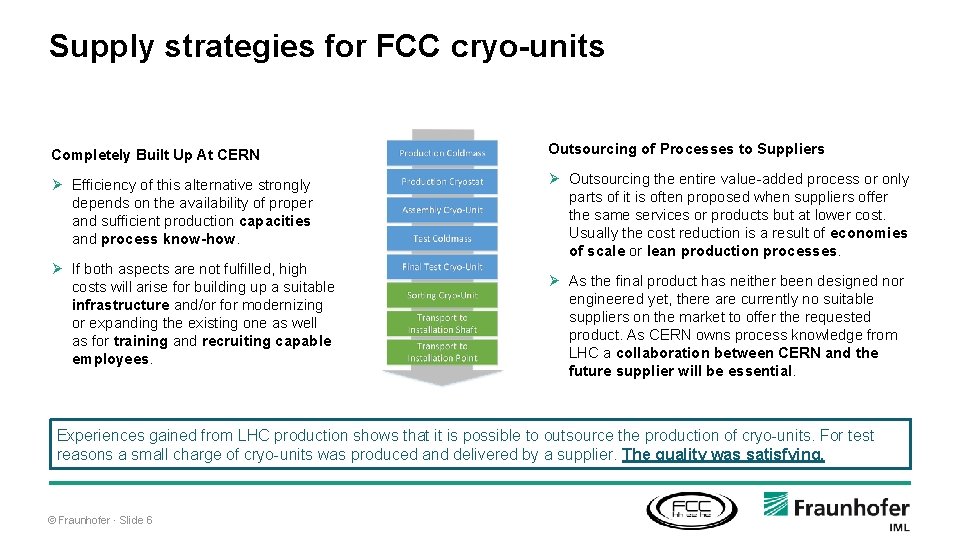
Supply strategies for FCC cryo-units Completely Built Up At CERN Outsourcing of Processes to Suppliers Ø Efficiency of this alternative strongly depends on the availability of proper and sufficient production capacities and process know-how. Ø Outsourcing the entire value-added process or only parts of it is often proposed when suppliers offer the same services or products but at lower cost. Usually the cost reduction is a result of economies of scale or lean production processes. Ø If both aspects are not fulfilled, high costs will arise for building up a suitable infrastructure and/or for modernizing or expanding the existing one as well as for training and recruiting capable employees. Ø As the final product has neither been designed nor engineered yet, there are currently no suitable suppliers on the market to offer the requested product. As CERN owns process knowledge from LHC a collaboration between CERN and the future supplier will be essential. Experiences gained from LHC production shows that it is possible to outsource the production of cryo-units. For test reasons a small charge of cryo-units was produced and delivered by a supplier. The quality was satisfying. © Fraunhofer · Slide 6
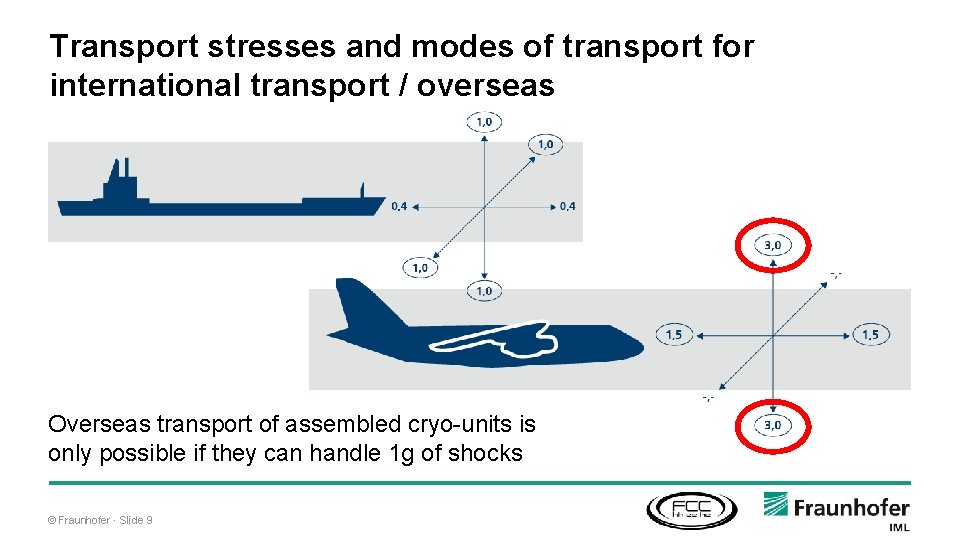
Transport stresses and modes of transport for international transport / overseas Overseas transport of assembled cryo-units is only possible if they can handle 1 g of shocks © Fraunhofer · Slide 9
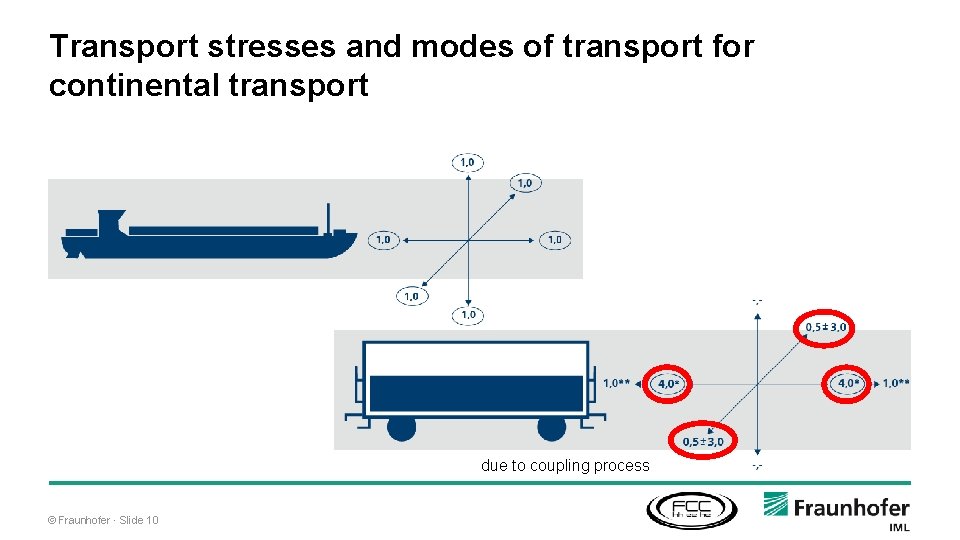
Transport stresses and modes of transport for continental transport due to coupling process © Fraunhofer · Slide 10
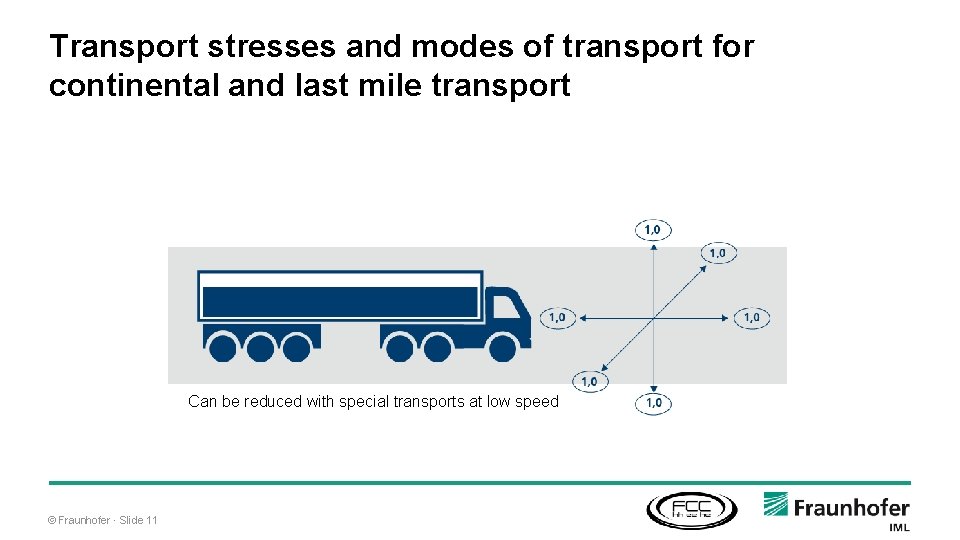
Transport stresses and modes of transport for continental and last mile transport Can be reduced with special transports at low speed © Fraunhofer · Slide 11
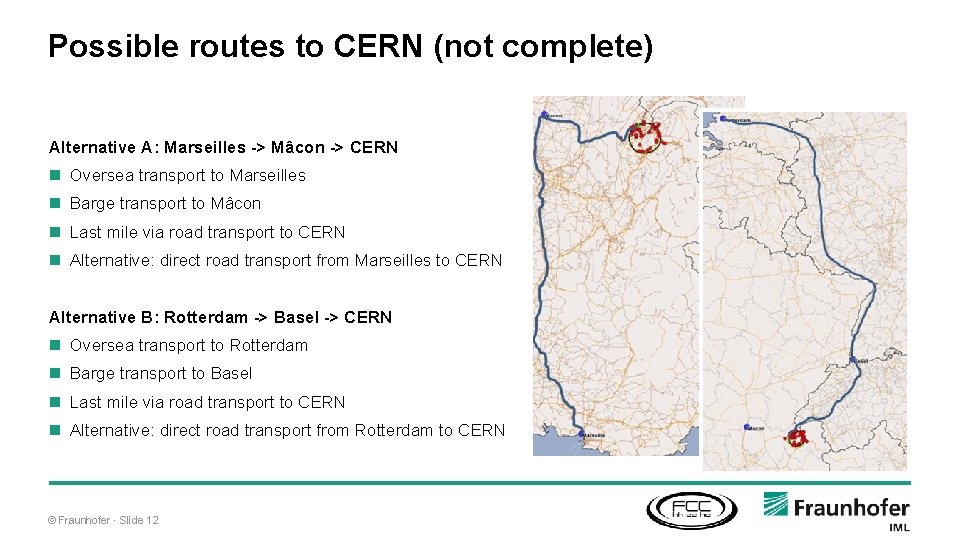
Possible routes to CERN (not complete) Alternative A: Marseilles -> Mâcon -> CERN Oversea transport to Marseilles Barge transport to Mâcon Last mile via road transport to CERN Alternative: direct road transport from Marseilles to CERN Alternative B: Rotterdam -> Basel -> CERN Oversea transport to Rotterdam Barge transport to Basel Last mile via road transport to CERN Alternative: direct road transport from Rotterdam to CERN © Fraunhofer · Slide 12
Design concept for a special purpose vehicles for the underground transportation and handling of cryo-units Main facts about vehicle concept: Maximum speed: 10 km/h – loaded, 20 km/h unloaded Maximum possible slope: ~3 Degree (ca. 5%) Battery technology based on lithium-ion batteries Autonomous driving technology based on contour navigation based on safety laser scanners and navigation scanners © Fraunhofer · Slide 13
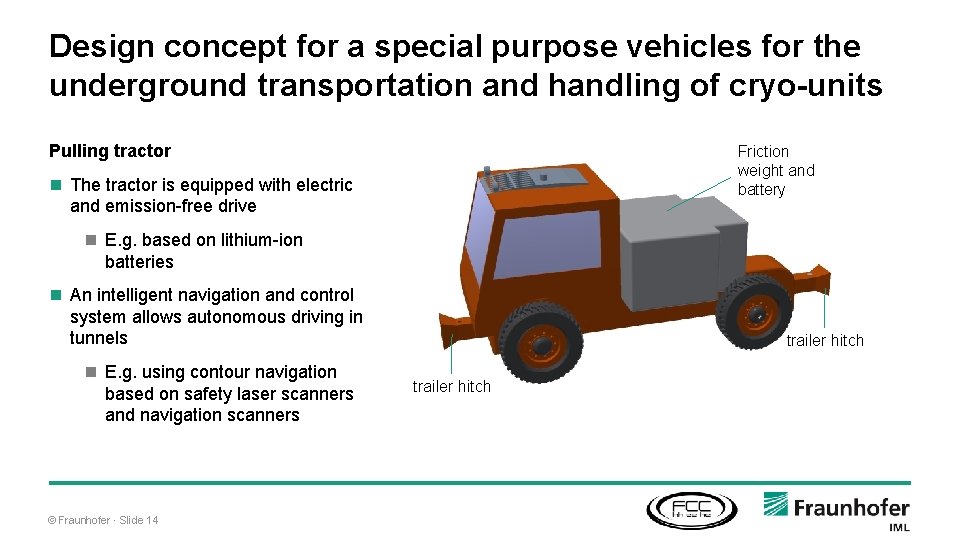
Design concept for a special purpose vehicles for the underground transportation and handling of cryo-units Pulling tractor Friction weight and battery The tractor is equipped with electric and emission-free drive E. g. based on lithium-ion batteries An intelligent navigation and control system allows autonomous driving in tunnels E. g. using contour navigation based on safety laser scanners and navigation scanners © Fraunhofer · Slide 14 trailer hitch
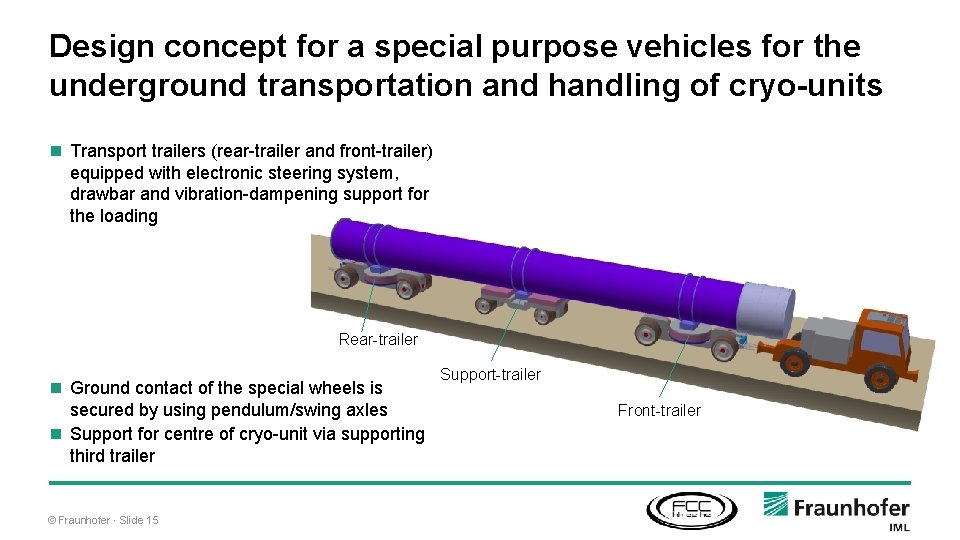
Design concept for a special purpose vehicles for the underground transportation and handling of cryo-units Transport trailers (rear-trailer and front-trailer) equipped with electronic steering system, drawbar and vibration-dampening support for the loading Rear-trailer Ground contact of the special wheels is secured by using pendulum/swing axles Support for centre of cryo-unit via supporting third trailer © Fraunhofer · Slide 15 Support-trailer Front-trailer
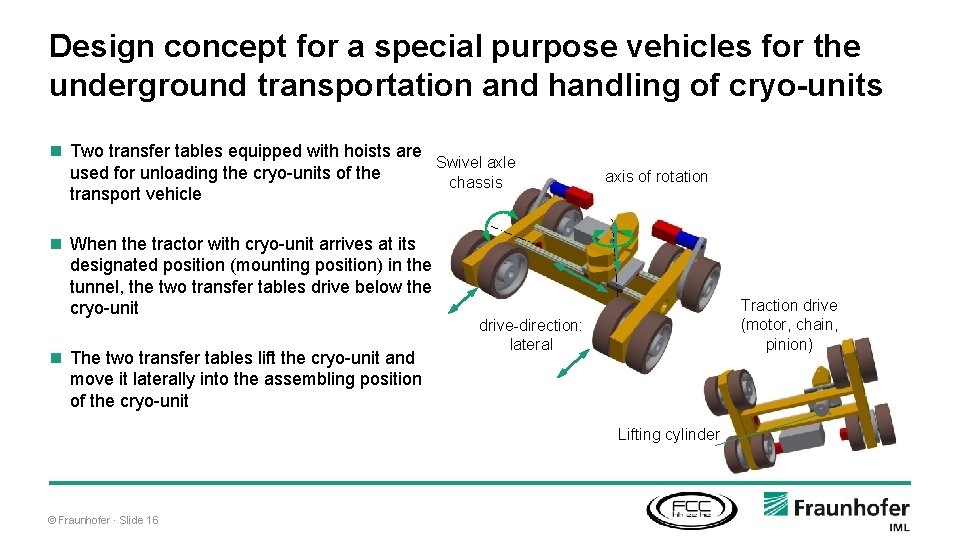
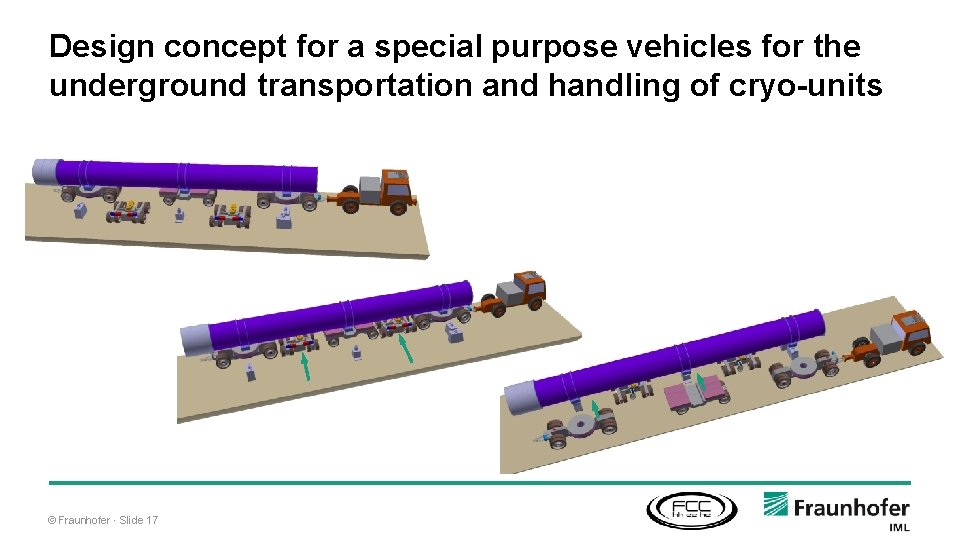
Design concept for a special purpose vehicles for the underground transportation and handling of cryo-units Two transfer tables equipped with hoists are Swivel axle used for unloading the cryo-units of the chassis transport vehicle When the tractor with cryo-unit arrives at its designated position (mounting position) in the tunnel, the two transfer tables drive below the cryo-unit The two transfer tables lift the cryo-unit and move it laterally into the assembling position of the cryo-unit axis of rotation Traction drive (motor, chain, pinion) drive-direction: lateral Lifting cylinder © Fraunhofer · Slide 16
Design concept for a special purpose vehicles for the underground transportation and handling of cryo-units © Fraunhofer · Slide 17
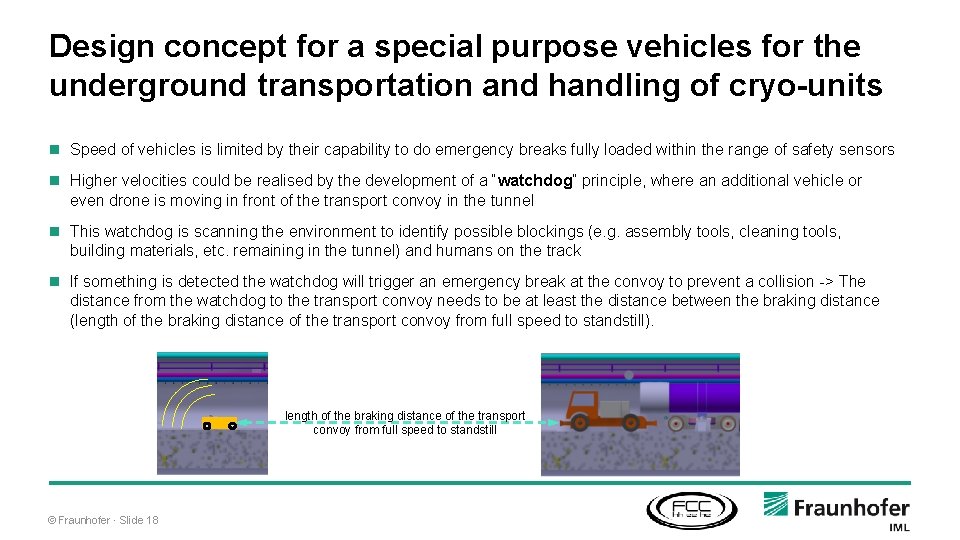
Design concept for a special purpose vehicles for the underground transportation and handling of cryo-units Speed of vehicles is limited by their capability to do emergency breaks fully loaded within the range of safety sensors Higher velocities could be realised by the development of a “watchdog” principle, where an additional vehicle or even drone is moving in front of the transport convoy in the tunnel This watchdog is scanning the environment to identify possible blockings (e. g. assembly tools, cleaning tools, building materials, etc. remaining in the tunnel) and humans on the track If something is detected the watchdog will trigger an emergency break at the convoy to prevent a collision -> The distance from the watchdog to the transport convoy needs to be at least the distance between the braking distance (length of the braking distance of the transport convoy from full speed to standstill). length of the braking distance of the transport convoy from full speed to standstill © Fraunhofer · Slide 18
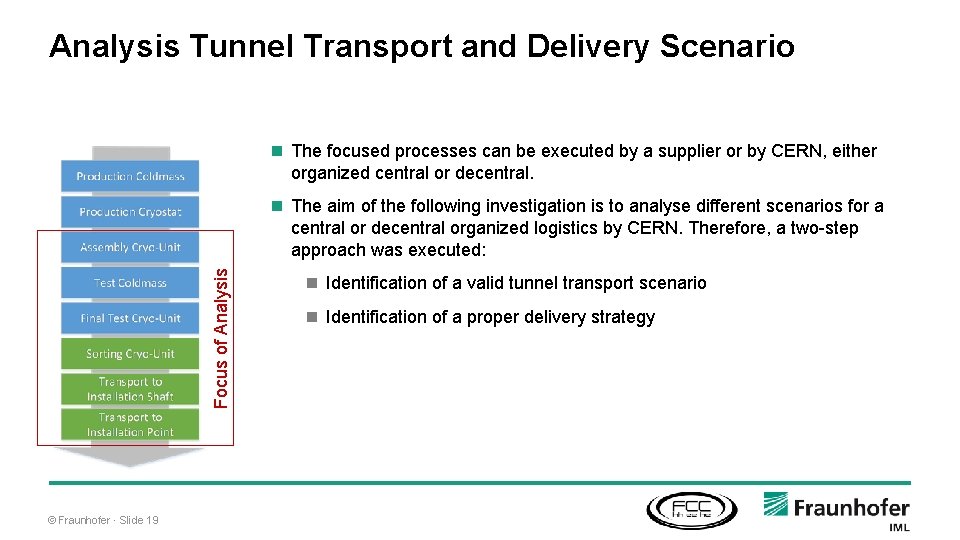
Analysis Tunnel Transport and Delivery Scenario The focused processes can be executed by a supplier or by CERN, either organized central or decentral. Focus of Analysis The aim of the following investigation is to analyse different scenarios for a central or decentral organized logistics by CERN. Therefore, a two-step approach was executed: © Fraunhofer · Slide 19 Identification of a valid tunnel transport scenario Identification of a proper delivery strategy
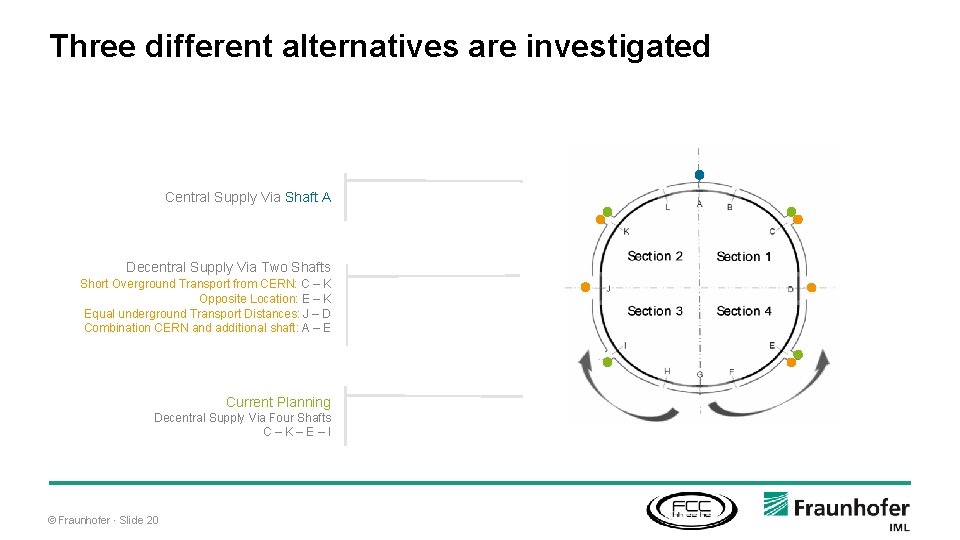
Three different alternatives are investigated Central Supply Via Shaft A Decentral Supply Via Two Shafts Short Overground Transport from CERN: C – K Opposite Location: E – K Equal underground Transport Distances: J – D Combination CERN and additional shaft: A – E Current Planning Decentral Supply Via Four Shafts C – K – E – I © Fraunhofer · Slide 20
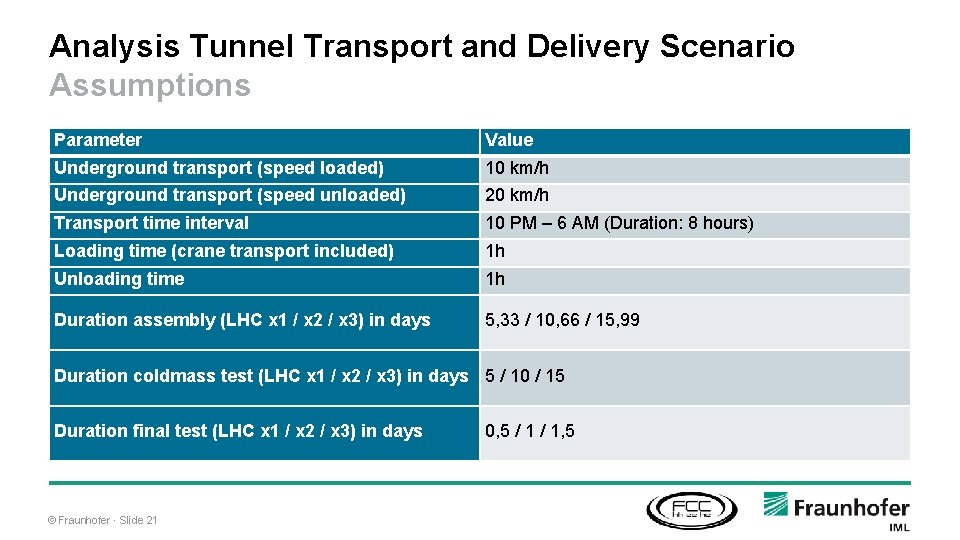
Analysis Tunnel Transport and Delivery Scenario Assumptions Parameter Value Underground transport (speed loaded) 10 km/h Underground transport (speed unloaded) 20 km/h Transport time interval 10 PM – 6 AM (Duration: 8 hours) Loading time (crane transport included) 1 h Unloading time 1 h Duration assembly (LHC x 1 / x 2 / x 3) in days 5, 33 / 10, 66 / 15, 99 Duration coldmass test (LHC x 1 / x 2 / x 3) in days 5 / 10 / 15 Duration final test (LHC x 1 / x 2 / x 3) in days © Fraunhofer · Slide 21 0, 5 / 1, 5
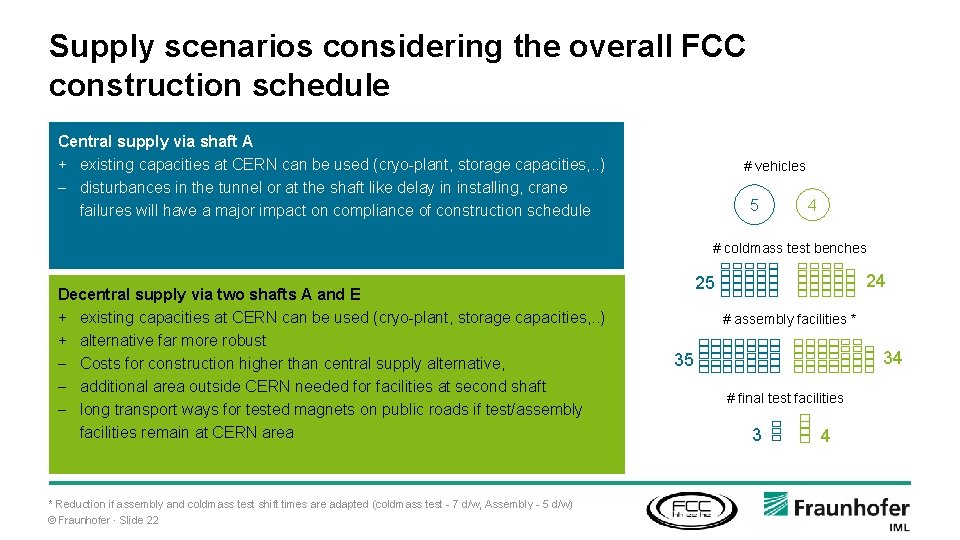
Supply scenarios considering the overall FCC construction schedule Central supply via shaft A + existing capacities at CERN can be used (cryo-plant, storage capacities, . . ) - disturbances in the tunnel or at the shaft like delay in installing, crane failures will have a major impact on compliance of construction schedule # vehicles 5 4 # coldmass test benches Decentral supply via two shafts A and E + existing capacities at CERN can be used (cryo-plant, storage capacities, . . ) + alternative far more robust - Costs for construction higher than central supply alternative, - additional area outside CERN needed for facilities at second shaft - long transport ways for tested magnets on public roads if test/assembly facilities remain at CERN area * Reduction if assembly and coldmass test shift times are adapted (coldmass test - 7 d/w, Assembly - 5 d/w) © Fraunhofer · Slide 22 24 25 # assembly facilities * 34 35 # final test facilities 3 4
Follow-up and Discussions Andreas Nettsträter Fraunhofer IML andreas. nettstraeter@iml. fraunhofer. de +49 231 9743 286 Christian Prasse Fraunhofer IML christian. Prasse@iml. fraunhofer. de +49 231 9743 269 Future Circular Collider Logistics Study: Dr. Ulrike Beißert, Konstantin Horstmann, Gerd Kuhlmann, Andreas Nettsträter, Christian Prasse, Andreas Wohlfahrt Acknowledgements: Ingo Rühl, Volker Mertens and Matti Tiirakari © Fraunhofer · Slide 23
- Slides: 21