
Future and Emerging Technologies FET Science beyond Fiction
Future and Emerging Technologies (FET) Science beyond Fiction R&D+I Transparency and accountability Scientific diplomacy 台灣大學電子所 劉致為 2021/10/25 GIEE, National Taiwan University 1
Outline ¡ Video DVD ¡ Introduction of Future and Emerging Technologies (FET) ¡ FET-OPEN - transformative and foundational research ¡ FET Proactive Initiatives – FP 7 Call 1 & Call 3 (past) ¡ FET Proactive Initiatives – FP 7 Call 4 - Call 6 ¡ Summary 2021/10/25 2
Information and Communication Technologies (ICT) Ø Information and Communication Technologies (ICTs) are critical to creating jobs and improving quality of life across Europe. - although the ICT sector is itself worth 6 -8% of the EU’s GDP, their importance goes well beyond that. Ø ICTs are also vital to: - meeting the globalization challenge by boosting innovation, creativity and competitiveness throughout the economy. - delivering cutting-edge science in all scientific and technological areas. - making Europe’s large public sector more efficient, and modernizing sectors ranging from education to energy. - tackling social challenges, improving quality of life and meeting the challenge of an ageing society. Ø The European Union made a focused and targeted investment in ICT research and development as early as 1984 with the launch of 1 st Framework Program (FP 1). 2021/10/25 3
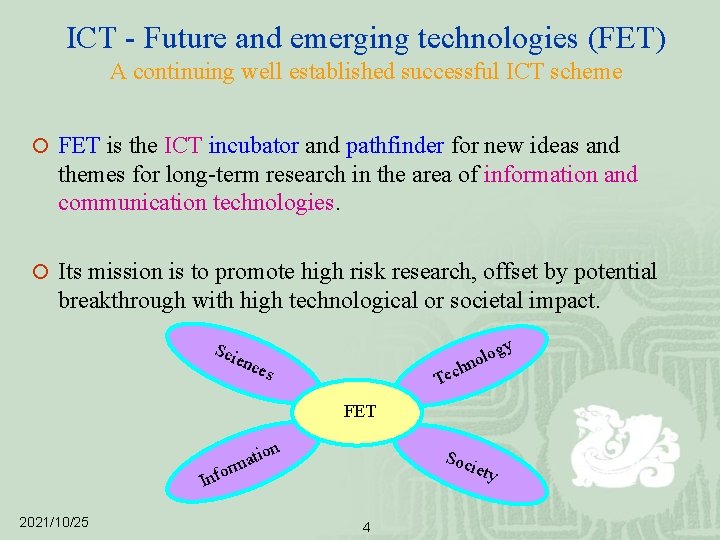
ICT - Future and emerging technologies (FET) A continuing well established successful ICT scheme ¡ FET is the ICT incubator and pathfinder for new ideas and themes for long-term research in the area of information and communication technologies. ¡ Its mission is to promote high risk research, offset by potential breakthrough with high technological or societal impact. Sci gy lo hno enc es Tec FET n tio a m r Soc iety Info 2021/10/25 4
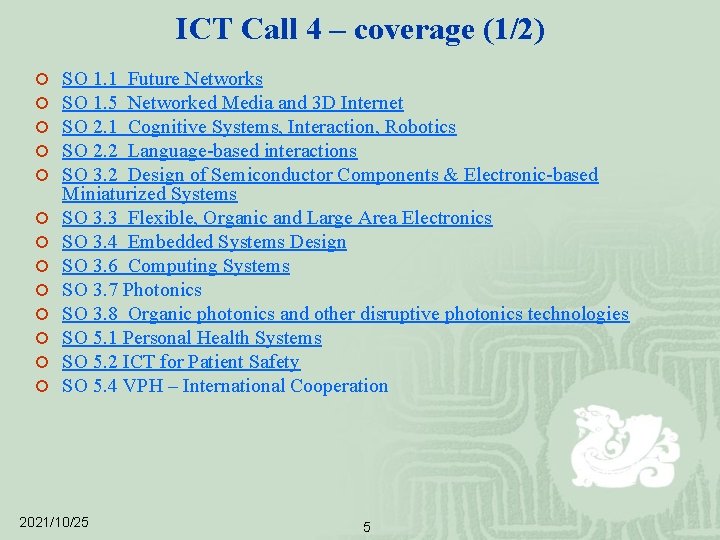
ICT Call 4 – coverage (1/2) ¡ ¡ ¡ ¡ SO 1. 1 Future Networks SO 1. 5 Networked Media and 3 D Internet SO 2. 1 Cognitive Systems, Interaction, Robotics SO 2. 2 Language-based interactions SO 3. 2 Design of Semiconductor Components & Electronic-based Miniaturized Systems SO 3. 3 Flexible, Organic and Large Area Electronics SO 3. 4 Embedded Systems Design SO 3. 6 Computing Systems SO 3. 7 Photonics SO 3. 8 Organic photonics and other disruptive photonics technologies SO 5. 1 Personal Health Systems SO 5. 2 ICT for Patient Safety SO 5. 4 VPH – International Cooperation 2021/10/25 5
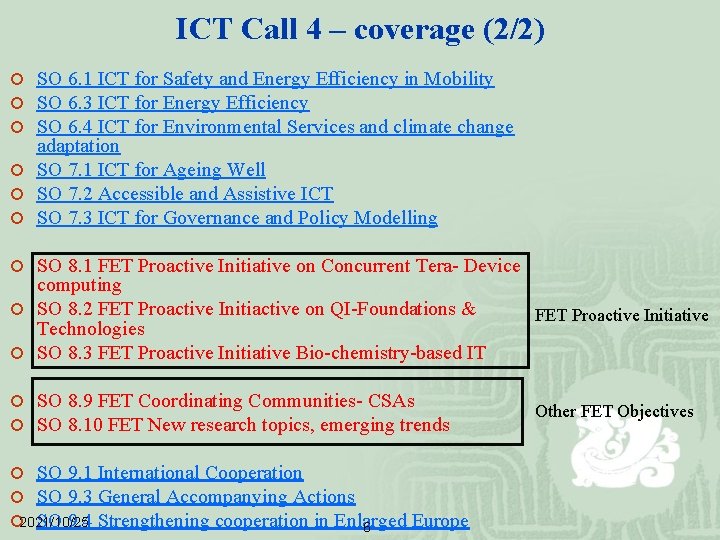
ICT Call 4 – coverage (2/2) ¡ SO 6. 1 ICT for Safety and Energy Efficiency in Mobility ¡ SO 6. 3 ICT for Energy Efficiency ¡ SO 6. 4 ICT for Environmental Services and climate change adaptation ¡ SO 7. 1 ICT for Ageing Well ¡ SO 7. 2 Accessible and Assistive ICT ¡ SO 7. 3 ICT for Governance and Policy Modelling ¡ SO 8. 1 FET Proactive Initiative on Concurrent Tera- Device computing ¡ SO 8. 2 FET Proactive Initiactive on QI-Foundations & Technologies ¡ SO 8. 3 FET Proactive Initiative Bio-chemistry-based IT FET Proactive Initiative ¡ SO 8. 9 FET Coordinating Communities- CSAs ¡ SO 8. 10 FET New research topics, emerging trends Other FET Objectives ¡ SO 9. 1 International Cooperation ¡ SO 9. 3 General Accompanying Actions ¡ 2021/10/25 SO 9. 4 Strengthening cooperation in Enlarged Europe 6
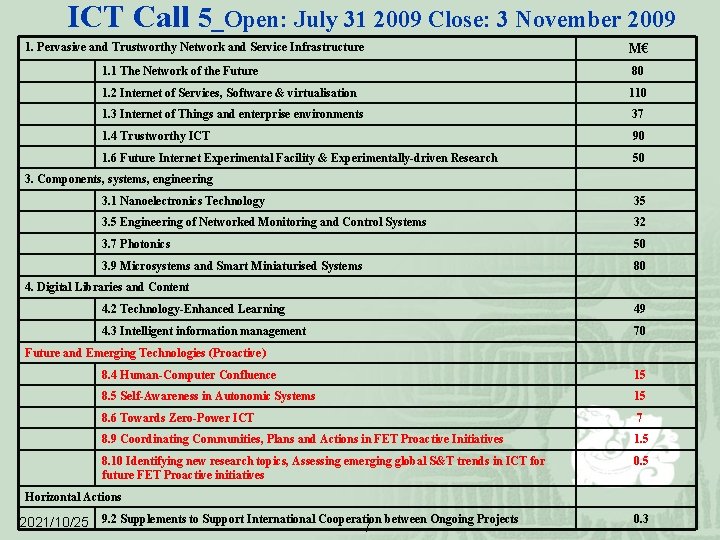
ICT Call 5_Open: July 31 2009 Close: 3 November 2009 1. Pervasive and Trustworthy Network and Service Infrastructure M€ 1. 1 The Network of the Future 80 1. 2 Internet of Services, Software & virtualisation 110 1. 3 Internet of Things and enterprise environments 37 1. 4 Trustworthy ICT 90 1. 6 Future Internet Experimental Facility & Experimentally-driven Research 50 3. Components, systems, engineering 3. 1 Nanoelectronics Technology 35 3. 5 Engineering of Networked Monitoring and Control Systems 32 3. 7 Photonics 50 3. 9 Microsystems and Smart Miniaturised Systems 80 4. Digital Libraries and Content 4. 2 Technology-Enhanced Learning 49 4. 3 Intelligent information management 70 Future and Emerging Technologies (Proactive) 8. 4 Human-Computer Confluence 15 8. 5 Self-Awareness in Autonomic Systems 15 8. 6 Towards Zero-Power ICT 7 8. 9 Coordinating Communities, Plans and Actions in FET Proactive Initiatives 1. 5 8. 10 Identifying new research topics, Assessing emerging global S&T trends in ICT for future FET Proactive initiatives 0. 5 Horizontal Actions between Ongoing Projects 2021/10/25 9. 2 Supplements to Support International Cooperation 7 0. 3
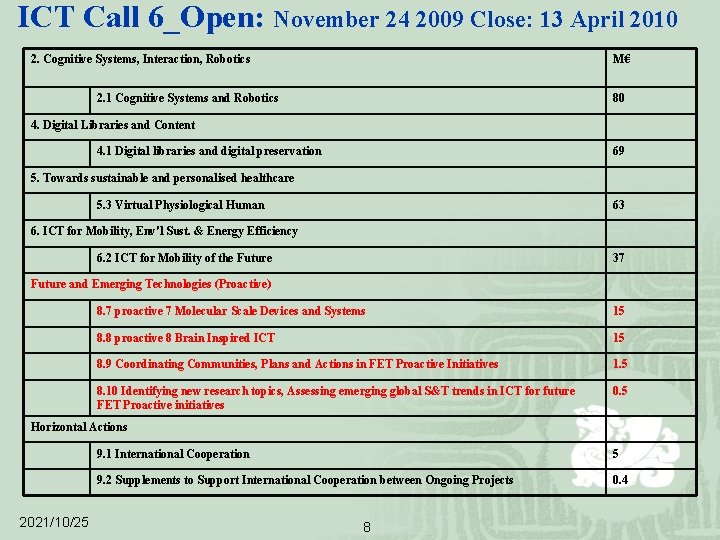
ICT Call 6_Open: November 24 2009 Close: 13 April 2010 2. Cognitive Systems, Interaction, Robotics M€ 2. 1 Cognitive Systems and Robotics 80 4. Digital Libraries and Content 4. 1 Digital libraries and digital preservation 69 5. Towards sustainable and personalised healthcare 5. 3 Virtual Physiological Human 63 6. ICT for Mobility, Env'l Sust. & Energy Efficiency 6. 2 ICT for Mobility of the Future 37 Future and Emerging Technologies (Proactive) 8. 7 proactive 7 Molecular Scale Devices and Systems 15 8. 8 proactive 8 Brain Inspired ICT 15 8. 9 Coordinating Communities, Plans and Actions in FET Proactive Initiatives 1. 5 8. 10 Identifying new research topics, Assessing emerging global S&T trends in ICT for future FET Proactive initiatives 0. 5 Horizontal Actions 2021/10/25 9. 1 International Cooperation 5 9. 2 Supplements to Support International Cooperation between Ongoing Projects 0. 4 8
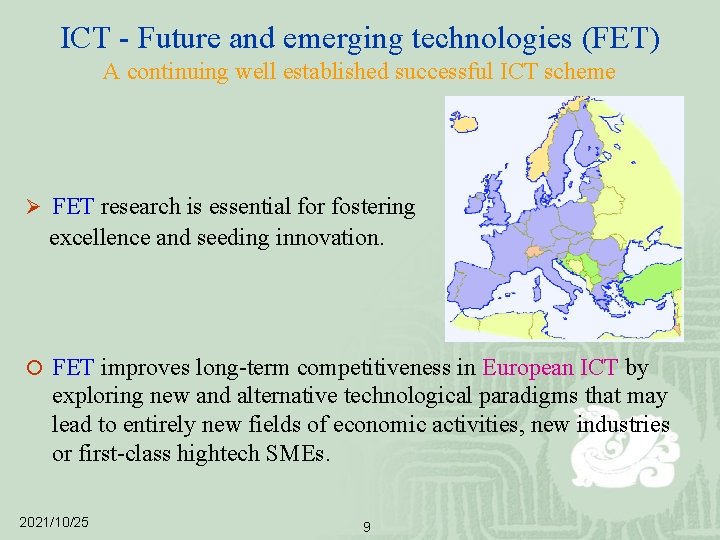
ICT - Future and emerging technologies (FET) A continuing well established successful ICT scheme Ø FET research is essential for fostering excellence and seeding innovation. ¡ FET improves long-term competitiveness in European ICT by exploring new and alternative technological paradigms that may lead to entirely new fields of economic activities, new industries or first-class hightech SMEs. 2021/10/25 9
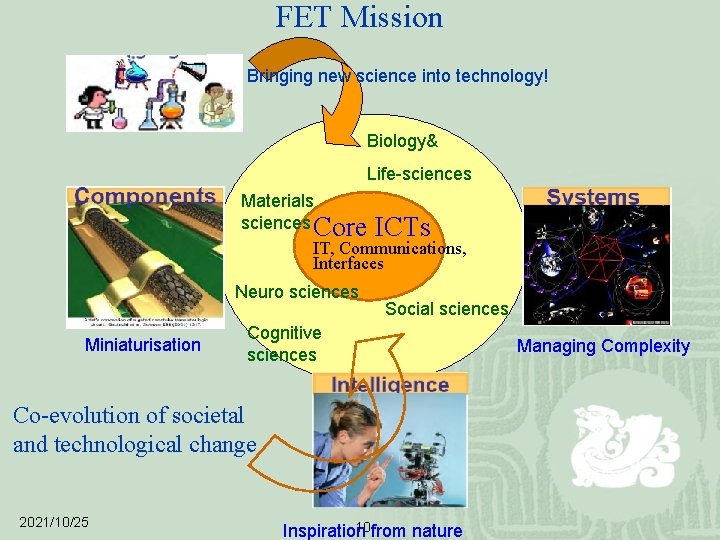
FET Mission Bringing new science into technology! Biology& Life-sciences Materials sciences Core ICTs IT, Communications, Interfaces Neuro sciences Miniaturisation Social sciences Cognitive sciences Co-evolution of societal and technological change 2021/10/25 10 from nature Inspiration Managing Complexity
FET Mission ¡ 1. Pathfinder and Incubator for exploring new visionary ideas. ¡ 2. Focusing on long term foundational research. ¡ 3. Focusing on high risk/high pay-off multi- and inter- disciplinary research aiming at S&T breakthroughs. ¡ 4. Maturing & structuring emerging research fields, research communities and research practices. 2021/10/25 11
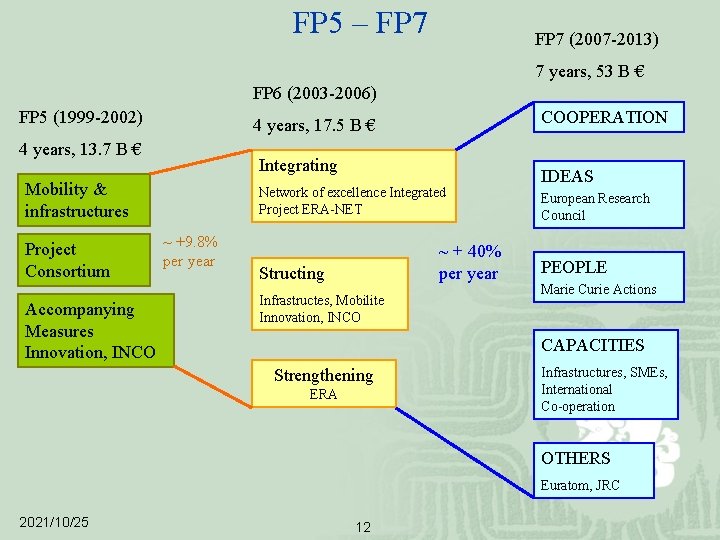
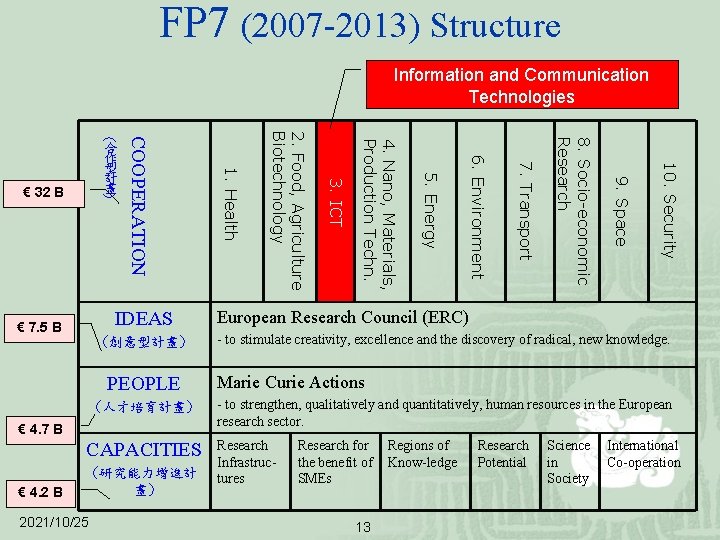
FP 5 – FP 7 (2007 -2013) 7 years, 53 B € FP 6 (2003 -2006) FP 5 (1999 -2002) 4 years, 13. 7 B € Integrating Mobility & infrastructures Project Consortium Accompanying Measures Innovation, INCO COOPERATION 4 years, 17. 5 B € Network of excellence Integrated Project ERA-NET ~ +9. 8% per year ~ + 40% per year Structing Infrastructes, Mobilite Innovation, INCO IDEAS European Research Council PEOPLE Marie Curie Actions CAPACITIES Strengthening ERA Infrastructures, SMEs, International Co-operation OTHERS Euratom, JRC 2021/10/25 12
FP 7 (2007 -2013) Structure Information and Communication Technologies 10. Security 9. Space 2021/10/25 8. Socio-economic Research € 4. 2 B (研究能力增進計 畫) 7. Transport CAPACITIES 6. Environment € 4. 7 B 5. Energy (人才培育計畫) 4. Nano, Materials, Production Techn. PEOPLE 3. ICT (創意型計畫) 2. Food, Agriculture Biotechnology IDEAS € 7. 5 B 1. Health ) € 32 B COOPERATION ( 合 作 型 計 畫 European Research Council (ERC) - to stimulate creativity, excellence and the discovery of radical, new knowledge. Marie Curie Actions - to strengthen, qualitatively and quantitatively, human resources in the European research sector. Research Infrastructures Research for the benefit of SMEs 13 Regions of Know-ledge Research Potential Science in Society International Co-operation
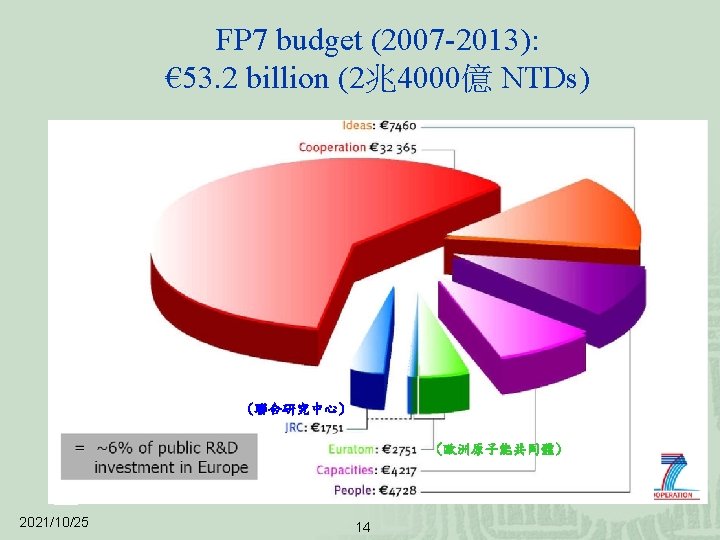
FP 7 budget (2007 -2013): € 53. 2 billion (2兆4000億 NTDs) (聯合研究中心) (歐洲原子能共同體) 2021/10/25 14
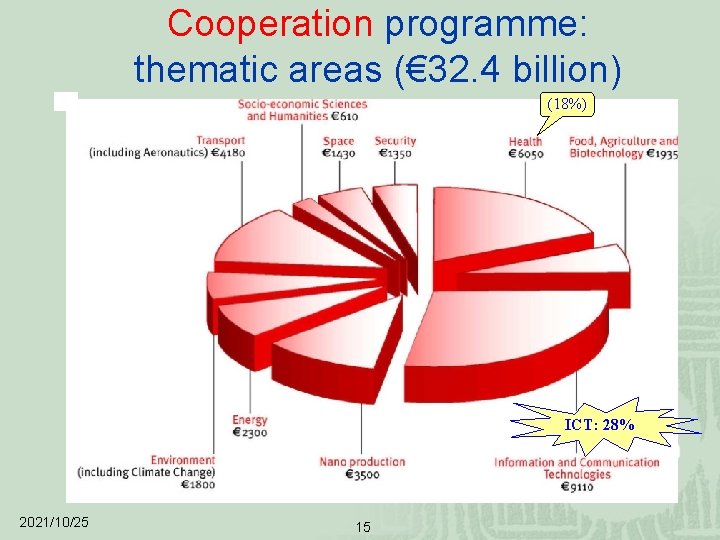
Cooperation programme: thematic areas (€ 32. 4 billion) (18%) ICT: 28% 2021/10/25 15
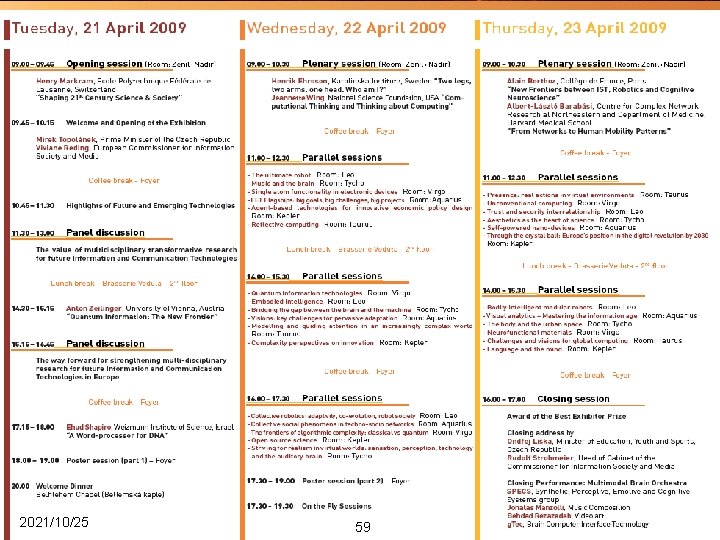
The European Future Technologies Conference FET 09, 21 -23 April 2009, Prague p The conference aims to be a European forum dedicated to visions and challenges as well as policy issues for frontier research in future and emerging information technologies. p More than 700 scientists, policy-makers, industry representatives and science journalists convened over 3 days to discuss today's frontier science, tomorrow's technologies and the impact of both on tomorrow's society. Website: http: //ec. europa. eu/information_society/events/fet/2009/index_en. htm European Commission 2021/10/25 Czech Technical University 16 Academy of Sciences of the Czech Republic
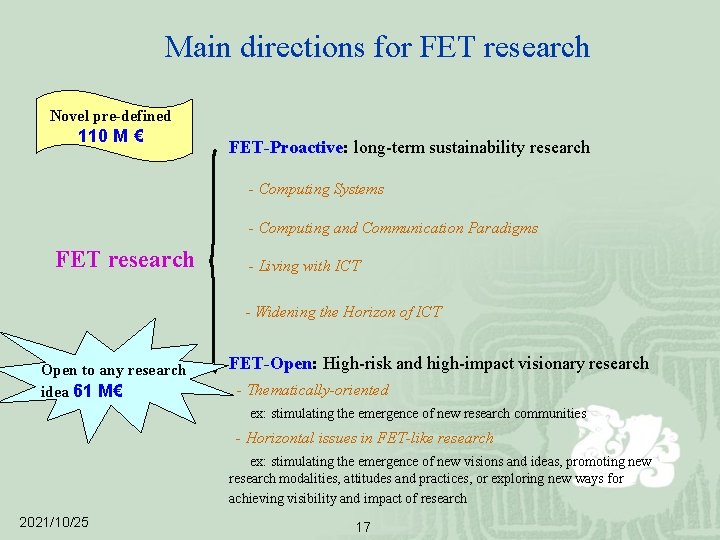
Main directions for FET research Novel pre-defined 110 M € FET-Proactive: long-term sustainability research - Computing Systems - Computing and Communication Paradigms FET research - Living with ICT - Widening the Horizon of ICT Open to any research idea 61 M€ FET-Open: High-risk and high-impact visionary research - Thematically-oriented ex: stimulating the emergence of new research communities - Horizontal issues in FET-like research ex: stimulating the emergence of new visions and ideas, promoting new research modalities, attitudes and practices, or exploring new ways for achieving visibility and impact of research 2021/10/25 17
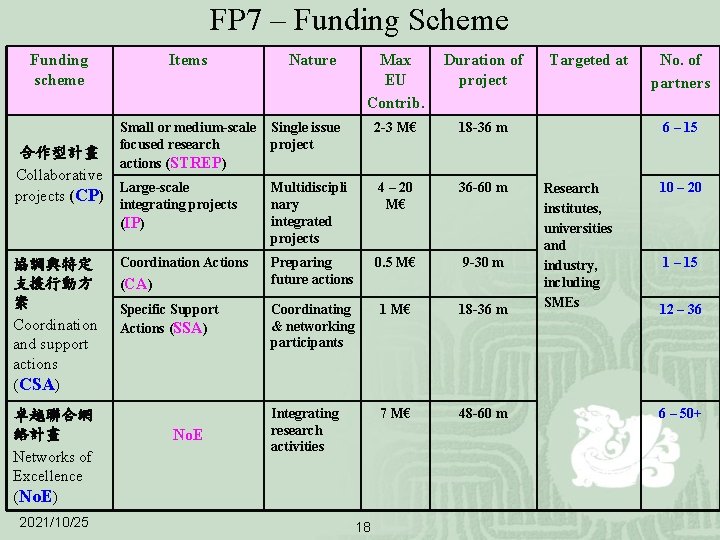
FP 7 – Funding Scheme Funding scheme Items Small or medium-scale focused research actions (STREP) 合作型計畫 Collaborative Large-scale projects (CP) integrating projects (IP) 協調與特定 支援行動方 案 Coordination and support actions (CSA) 卓越聯合網 絡計畫 Networks of Excellence (No. E) 2021/10/25 Coordination Actions (CA) Specific Support Actions (SSA) No. E Nature Max EU Contrib. Duration of project Single issue project 2 -3 M€ 18 -36 m Multidiscipli nary integrated projects 4 – 20 M€ 36 -60 m Preparing future actions 0. 5 M€ 9 -30 m Coordinating & networking participants 1 M€ 18 -36 m Integrating research activities 7 M€ 48 -60 m 18 Targeted at No. of partners 6 – 15 Research institutes, universities and industry, including SMEs 10 – 20 1 – 15 12 – 36 6 – 50+
Outline ¡ Introduction of Future and Emerging Technologies (FET) ¡ FET-OPEN - transformative and foundational research ¡ FET Proactive Initiatives – FP 7 Call 1 & Call 3 (past) ¡ FET Proactive Initiatives – FP 7 Call 4 - Call 6 ¡ Summary 2021/10/25 19
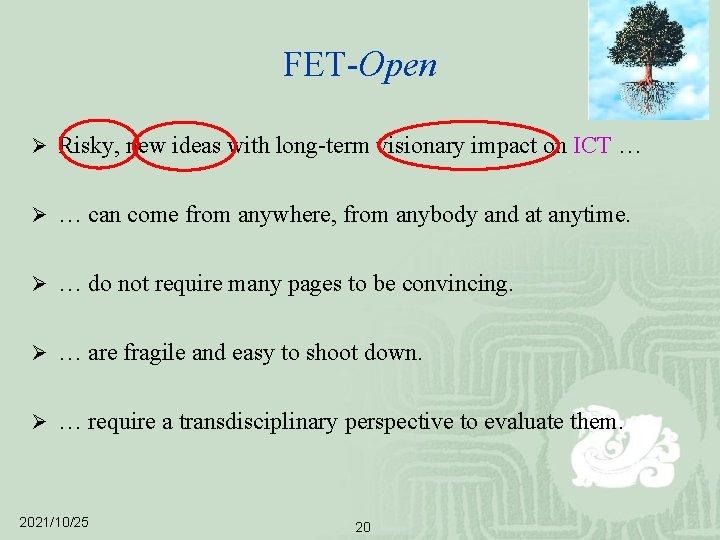
FET-Open Ø Risky, new ideas with long-term visionary impact on ICT … Ø … can come from anywhere, from anybody and at anytime. Ø … do not require many pages to be convincing. Ø … are fragile and easy to shoot down. Ø … require a transdisciplinary perspective to evaluate them. 2021/10/25 20
What is ‘open’ about FET-Open? Ø The FET-Open 'scheme', allows EC (European Commission) to be as reactive as possible to new developments and opportunities in science and technology: - FET-Open is open in terms of themes (no predefined orientation), - FET-Open is open in terms of timing (anytime submission), - FET-Open is open for its low-threshold entry point (light first submission step) - FET-Open is open for its anonymous entry point (first step evaluation). 2021/10/25 21
Want to test a FET-Open idea? European Commission DG Information Society and Media Future and Emerging Technologies Email: walter. van-de-velde@ec. europa. eu Website: http: //cordis. europa. eu/fp 7/ict/programme/fet_en. html 2021/10/25 22
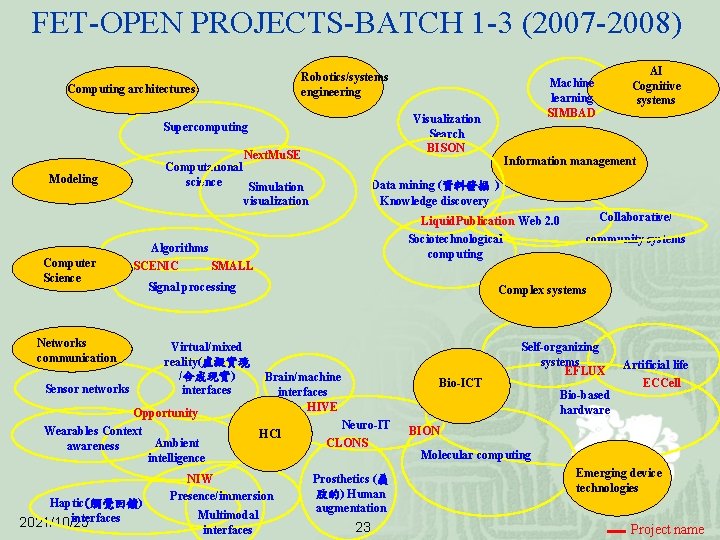
FET-OPEN PROJECTS-BATCH 1 -3 (2007 -2008) Robotics/systems engineering Computing architectures Visualization Search BISON Supercomputing Next. Mu. SE Computational science Simulation visualization Modeling Computer Science Information management Data mining (資料發掘 ) Knowledge discovery Liquid. Publication Web 2. 0 Sociotechnological computing Algorithms SCENIC SMALL Networks communication Sensor networks Signal processing Virtual/mixed reality(虛擬實境 /合成現實) interfaces Opportunity Wearables Context Ambient awareness intelligence Haptic(觸覺回饋) interfaces 2021/10/25 Collaborative/ community systems Complex systems Brain/machine interfaces HIVE HCl NIW Presence/immersion Multimodal interfaces AI Cognitive systems Machine learning SIMBAD Bio-ICT Neuro-IT CLONS Prosthetics (義 肢的) Human augmentation 23 Self-organizing systems EFLUX Bio-based hardware Artificial life ECCell BION Molecular computing Emerging device technologies Project name
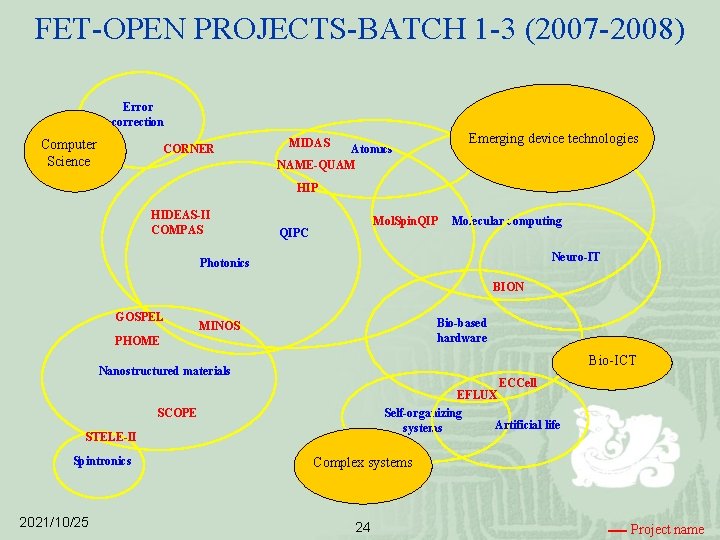
FET-OPEN PROJECTS-BATCH 1 -3 (2007 -2008) Error correction Computer Science CORNER Emerging device technologies MIDAS Atomics NAME-QUAM HIP HIDEAS-II COMPAS Mol. Spin. QIPC Molecular computing Neuro-IT Photonics BION GOSPEL Bio-based hardware MINOS PHOME Bio-ICT Nanostructured materials ECCell EFLUX Self-organizing Artificial life systems SCOPE STELE-II Spintronics 2021/10/25 Complex systems 24 Project name
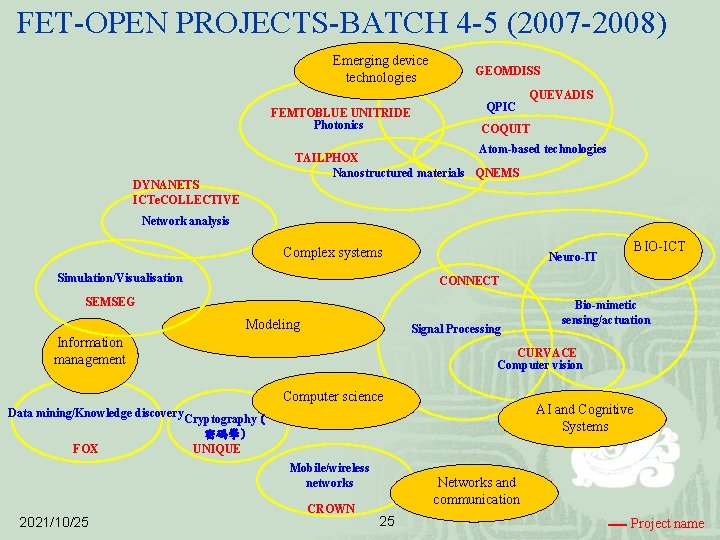
FET-OPEN PROJECTS-BATCH 4 -5 (2007 -2008) Emerging device technologies FEMTOBLUE UNITRIDE Photonics GEOMDISS QPIC QUEVADIS COQUIT Atom-based technologies TAILPHOX Nanostructured materials QNEMS DYNANETS ICTe. COLLECTIVE Network analysis Complex systems Simulation/Visualisation CONNECT SEMSEG Modeling Signal Processing Information management AI and Cognitive Systems Data mining/Knowledge discovery. Cryptography ( 密碼學) UNIQUE Mobile/wireless networks 2021/10/25 Bio-mimetic sensing/actuation CURVACE Computer vision Computer science FOX BIO-ICT Neuro-IT CROWN Networks and communication 25 Project name
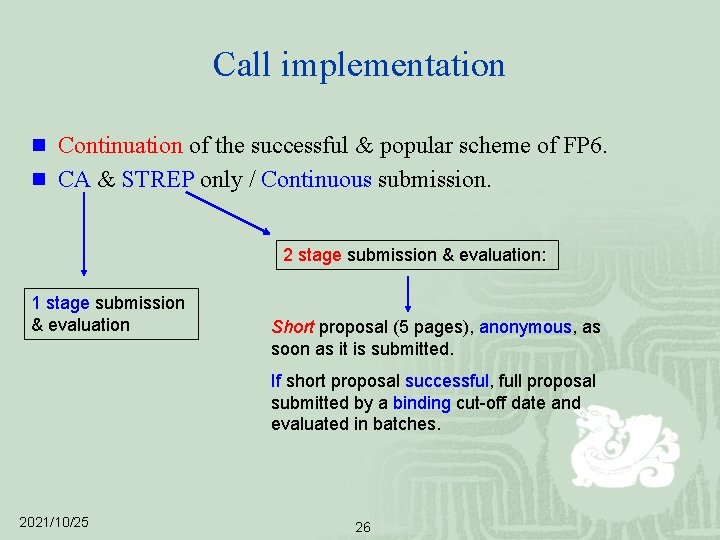
Call implementation n Continuation of the successful & popular scheme of FP 6. n CA & STREP only / Continuous submission. 2 stage submission & evaluation: 1 stage submission & evaluation Short proposal (5 pages), anonymous, as soon as it is submitted. If short proposal successful, full proposal submitted by a binding cut-off date and evaluated in batches. 2021/10/25 26
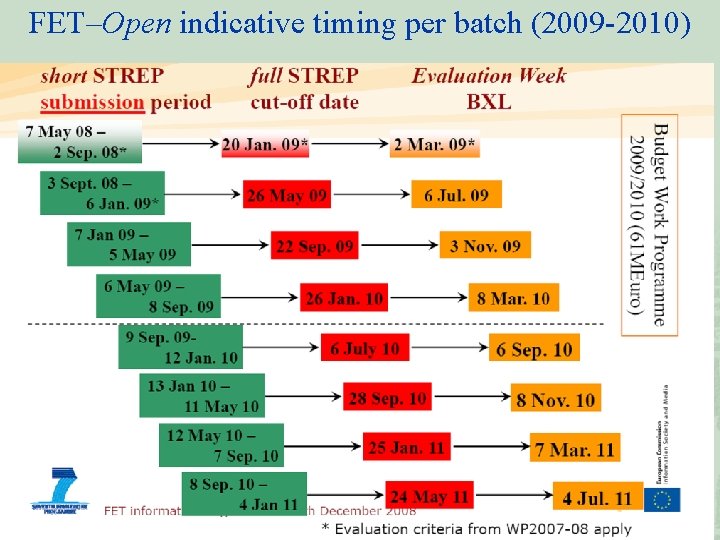
FET–Open indicative timing per batch (2009 -2010) 2021/10/25 27
Outline ¡ Introduction of Future and Emerging Technologies (FET) ¡ FET-OPEN - transformative and foundational research ¡ FET Proactive Initiatives – FP 7 Call 1 & Call 3 (past) ¡ FET Proactive Initiatives – FP 7 Call 4 - Call 6 ¡ Summary and Video DVD 2021/10/25 28
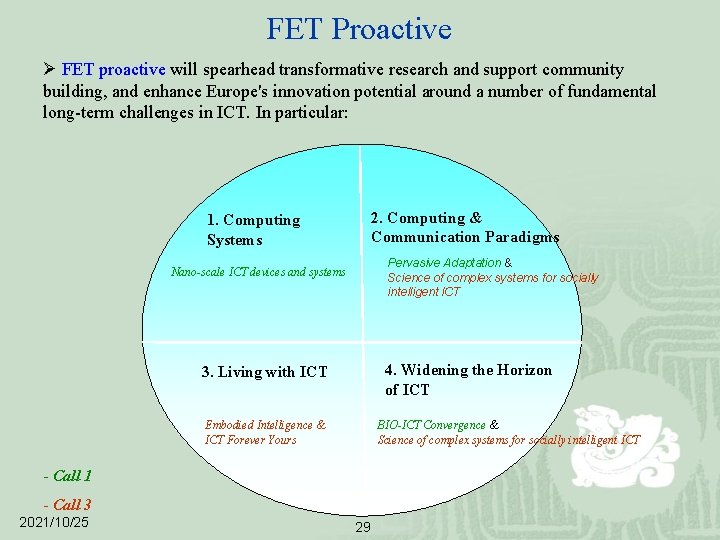
FET Proactive Ø FET proactive will spearhead transformative research and support community building, and enhance Europe's innovation potential around a number of fundamental long-term challenges in ICT. In particular: 2. Computing & Communication Paradigms 1. Computing Systems Pervasive Adaptation & Science of complex systems for socially intelligent ICT Nano-scale ICT devices and systems 4. Widening the Horizon of ICT 3. Living with ICT Embodied Intelligence & ICT Forever Yours BIO-ICT Convergence & Science of complex systems for socially intelligent ICT - Call 1 - Call 3 2021/10/25 29
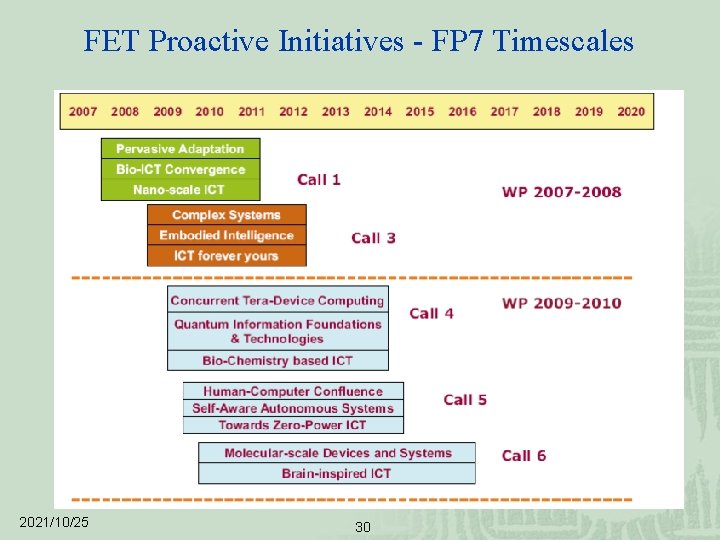
FET Proactive Initiatives - FP 7 Timescales 2021/10/25 30
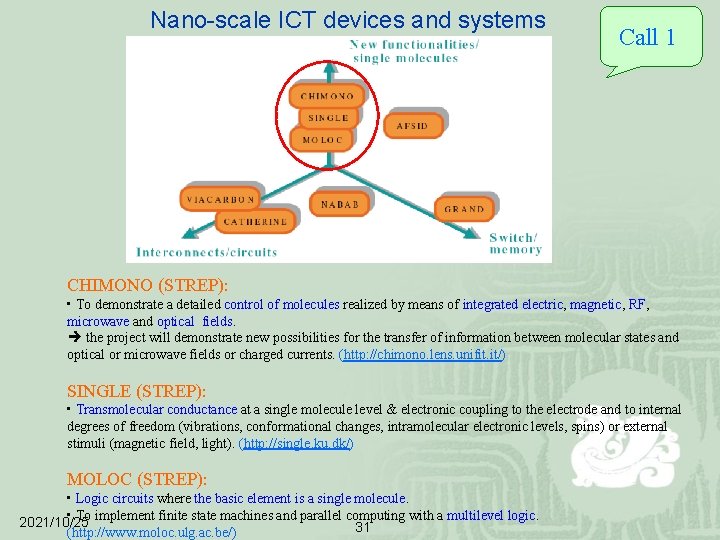
Nano-scale ICT devices and systems Call 1 CHIMONO (STREP): • To demonstrate a detailed control of molecules realized by means of integrated electric, magnetic, RF, microwave and optical fields. the project will demonstrate new possibilities for the transfer of information between molecular states and optical or microwave fields or charged currents. (http: //chimono. lens. unifit. it/) SINGLE (STREP): • Transmolecular conductance at a single molecule level & electronic coupling to the electrode and to internal degrees of freedom (vibrations, conformational changes, intramolecular electronic levels, spins) or external stimuli (magnetic field, light). (http: //single. ku. dk/) MOLOC (STREP): • Logic circuits where the basic element is a single molecule. • To implement finite state machines and parallel computing with a multilevel logic. 2021/10/25 31 (http: //www. moloc. ulg. ac. be/)
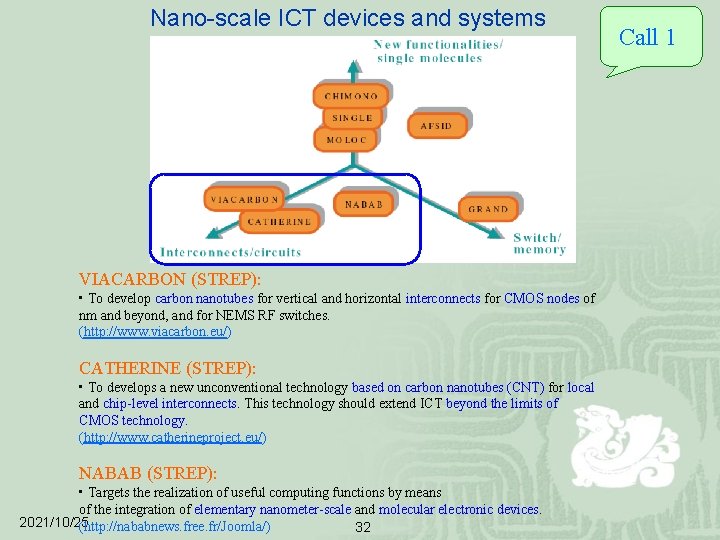
Nano-scale ICT devices and systems VIACARBON (STREP): • To develop carbon nanotubes for vertical and horizontal interconnects for CMOS nodes of nm and beyond, and for NEMS RF switches. (http: //www. viacarbon. eu/) CATHERINE (STREP): • To develops a new unconventional technology based on carbon nanotubes (CNT) for local and chip-level interconnects. This technology should extend ICT beyond the limits of CMOS technology. (http: //www. catherineproject. eu/) NABAB (STREP): • Targets the realization of useful computing functions by means of the integration of elementary nanometer-scale and molecular electronic devices. 2021/10/25 (http: //nababnews. free. fr/Joomla/) 32 Call 1
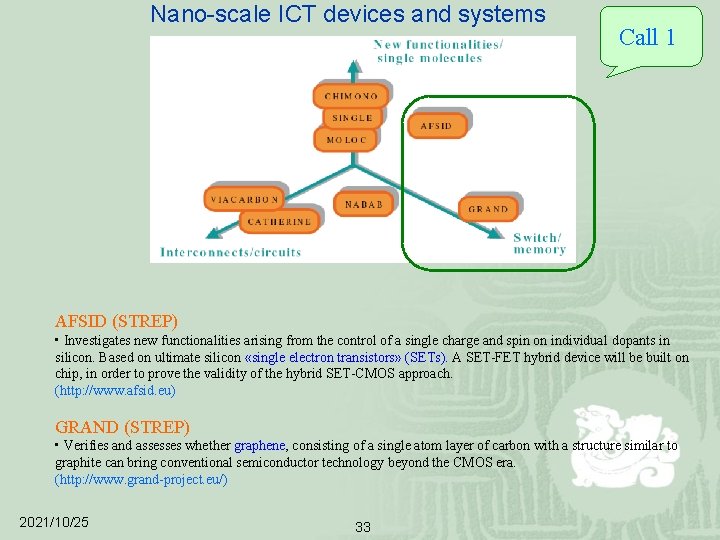
Nano-scale ICT devices and systems Call 1 AFSID (STREP) • Investigates new functionalities arising from the control of a single charge and spin on individual dopants in silicon. Based on ultimate silicon «single electron transistors» (SETs). A SET-FET hybrid device will be built on chip, in order to prove the validity of the hybrid SET-CMOS approach. (http: //www. afsid. eu) GRAND (STREP) • Verifies and assesses whether graphene, consisting of a single atom layer of carbon with a structure similar to graphite can bring conventional semiconductor technology beyond the CMOS era. (http: //www. grand-project. eu/) 2021/10/25 33
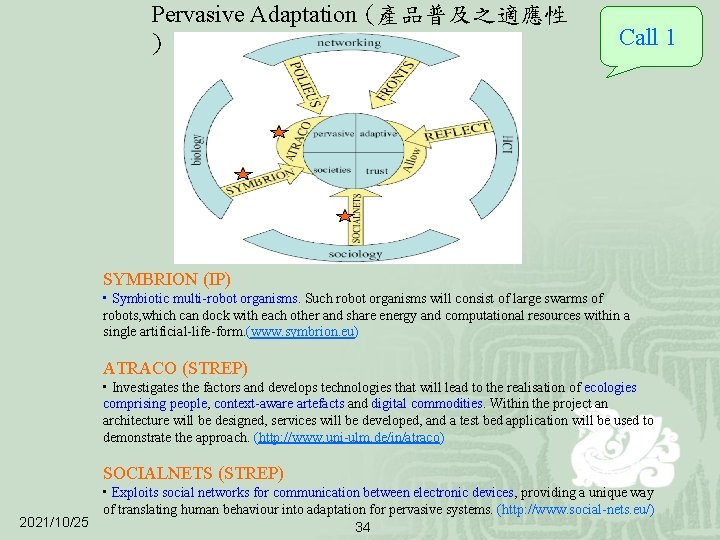
Pervasive Adaptation (產品普及之適應性 ) Call 1 SYMBRION (IP) • Symbiotic multi-robot organisms. Such robot organisms will consist of large swarms of robots, which can dock with each other and share energy and computational resources within a single artificial-life-form. (www. symbrion. eu) ATRACO (STREP) • Investigates the factors and develops technologies that will lead to the realisation of ecologies comprising people, context-aware artefacts and digital commodities. Within the project an architecture will be designed, services will be developed, and a test bed application will be used to demonstrate the approach. (http: //www. uni-ulm. de/in/atraco) SOCIALNETS (STREP) • Exploits social networks for communication between electronic devices, providing a unique way of translating human behaviour into adaptation for pervasive systems. (http: //www. social-nets. eu/) 2021/10/25 34
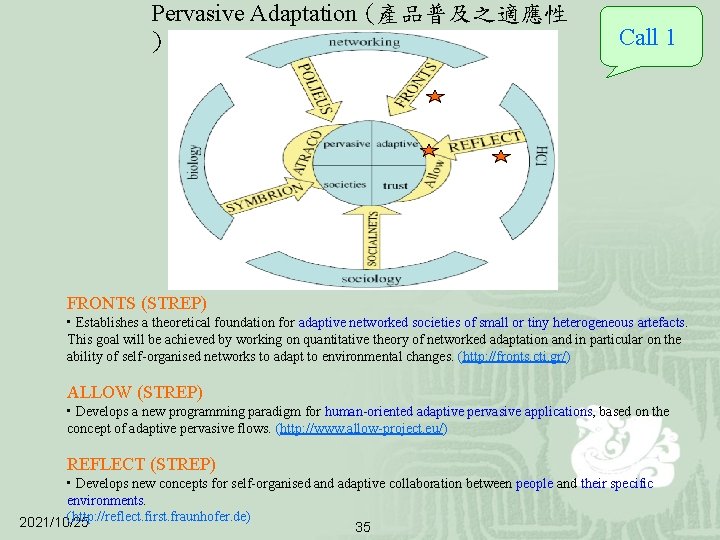
Pervasive Adaptation (產品普及之適應性 ) Call 1 FRONTS (STREP) • Establishes a theoretical foundation for adaptive networked societies of small or tiny heterogeneous artefacts. This goal will be achieved by working on quantitative theory of networked adaptation and in particular on the ability of self-organised networks to adapt to environmental changes. (http: //fronts. cti. gr/) ALLOW (STREP) • Develops a new programming paradigm for human-oriented adaptive pervasive applications, based on the concept of adaptive pervasive flows. (http: //www. allow-project. eu/) REFLECT (STREP) • Develops new concepts for self-organised and adaptive collaboration between people and their specific environments. (http: //reflect. first. fraunhofer. de) 2021/10/25 35
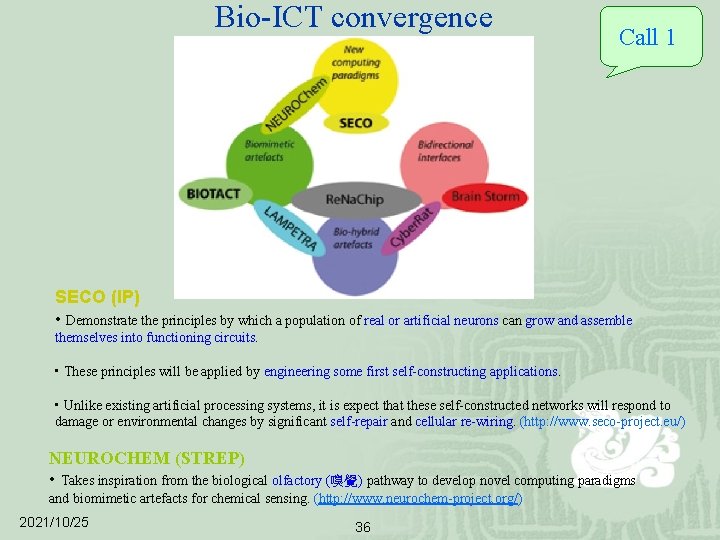
Bio-ICT convergence Call 1 SECO (IP) • Demonstrate the principles by which a population of real or artificial neurons can grow and assemble themselves into functioning circuits. • These principles will be applied by engineering some first self-constructing applications. • Unlike existing artificial processing systems, it is expect that these self-constructed networks will respond to damage or environmental changes by significant self-repair and cellular re-wiring. (http: //www. seco-project. eu/) NEUROCHEM (STREP) • Takes inspiration from the biological olfactory (嗅覺) pathway to develop novel computing paradigms and biomimetic artefacts for chemical sensing. (http: //www. neurochem-project. org/) 2021/10/25 36
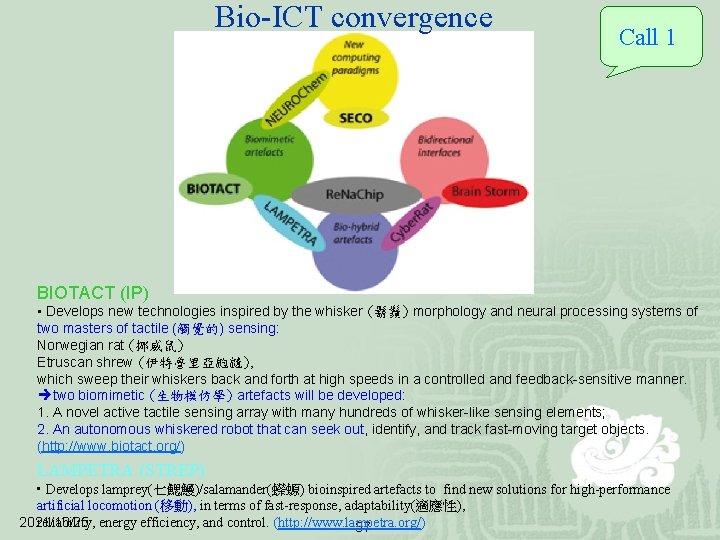
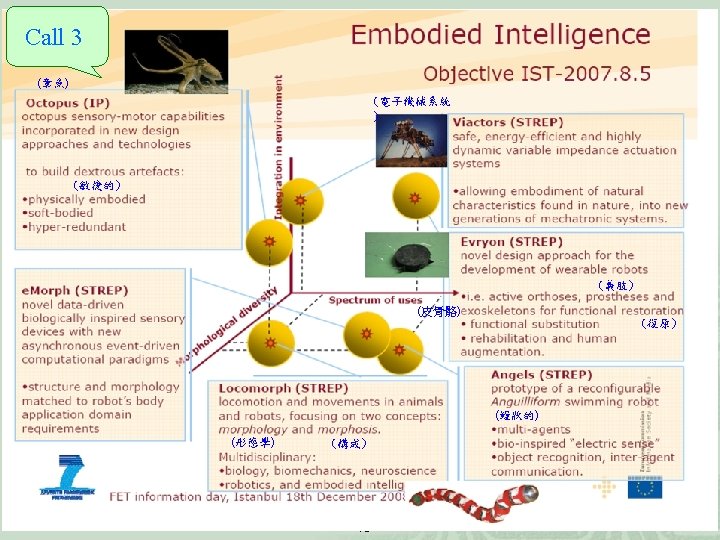
Bio-ICT convergence Call 1 BIOTACT (IP) • Develops new technologies inspired by the whisker (鬍鬚) morphology and neural processing systems of two masters of tactile (觸覺的) sensing: Norwegian rat (挪威鼠) Etruscan shrew (伊特魯里亞鼩鼱), which sweep their whiskers back and forth at high speeds in a controlled and feedback-sensitive manner. two biomimetic (生物模仿學) artefacts will be developed: 1. A novel active tactile sensing array with many hundreds of whisker-like sensing elements; 2. An autonomous whiskered robot that can seek out, identify, and track fast-moving target objects. (http: //www. biotact. org/) LAMPETRA (STREP) • Develops lamprey(七鰓鰻)/salamander(蠑螈) bioinspired artefacts to find new solutions for high-performance artificial locomotion (移動), in terms of fast-response, adaptability(適應性), reliability, energy efficiency, and control. (http: //www. lampetra. org/) 2021/10/25 37
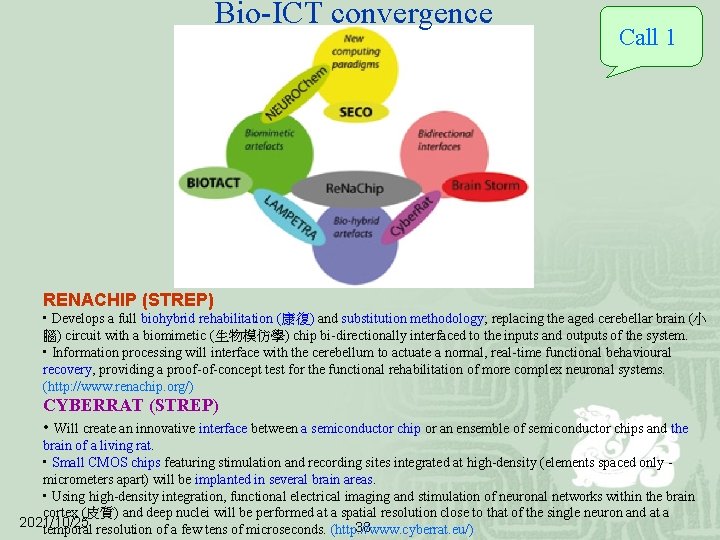
Bio-ICT convergence Call 1 RENACHIP (STREP) • Develops a full biohybrid rehabilitation (康復) and substitution methodology; replacing the aged cerebellar brain (小 腦) circuit with a biomimetic (生物模仿學) chip bi-directionally interfaced to the inputs and outputs of the system. • Information processing will interface with the cerebellum to actuate a normal, real-time functional behavioural recovery, providing a proof-of-concept test for the functional rehabilitation of more complex neuronal systems. (http: //www. renachip. org/) CYBERRAT (STREP) • Will create an innovative interface between a semiconductor chip or an ensemble of semiconductor chips and the brain of a living rat. • Small CMOS chips featuring stimulation and recording sites integrated at high-density (elements spaced only micrometers apart) will be implanted in several brain areas. • Using high-density integration, functional electrical imaging and stimulation of neuronal networks within the brain cortex (皮質) and deep nuclei will be performed at a spatial resolution close to that of the single neuron and at a 2021/10/25 38 temporal resolution of a few tens of microseconds. (http: //www. cyberrat. eu/)
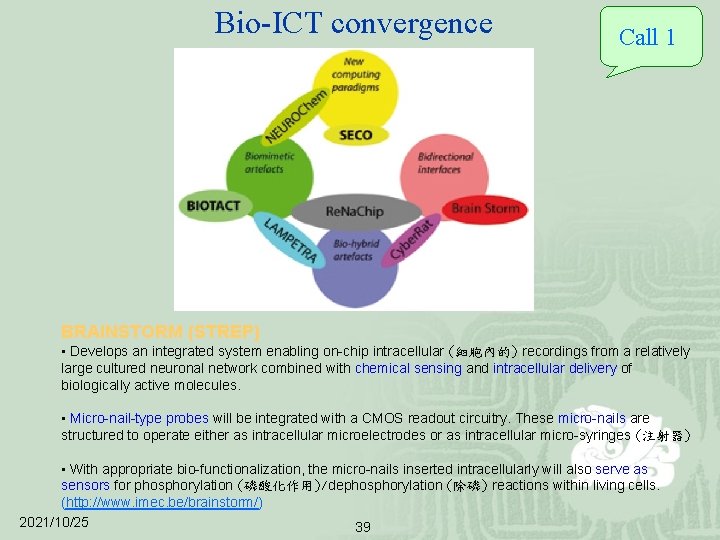
Bio-ICT convergence Call 1 BRAINSTORM (STREP) • Develops an integrated system enabling on-chip intracellular (細胞內的) recordings from a relatively large cultured neuronal network combined with chemical sensing and intracellular delivery of biologically active molecules. • Micro-nail-type probes will be integrated with a CMOS readout circuitry. These micro-nails are structured to operate either as intracellular microelectrodes or as intracellular micro-syringes (注射器) • With appropriate bio-functionalization, the micro-nails inserted intracellularly will also serve as sensors for phosphorylation (磷酸化作用)/dephosphorylation (除磷) reactions within living cells. (http: //www. imec. be/brainstorm/) 2021/10/25 39
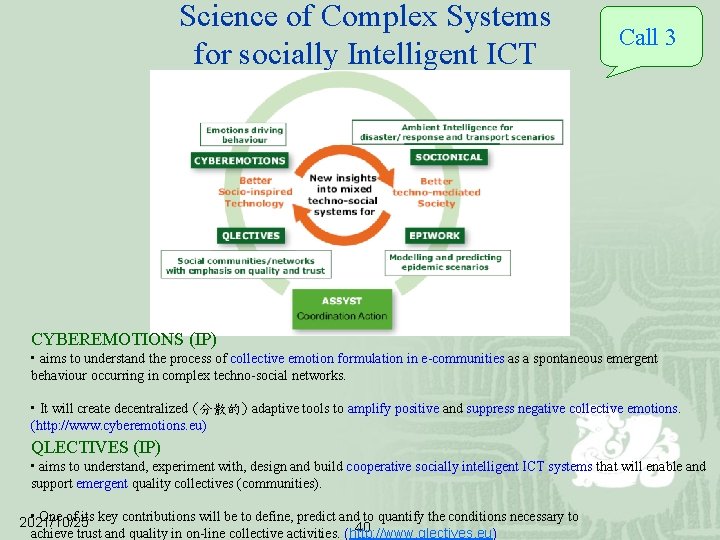
Science of Complex Systems for socially Intelligent ICT Call 3 CYBEREMOTIONS (IP) • aims to understand the process of collective emotion formulation in e-communities as a spontaneous emergent behaviour occurring in complex techno-social networks. • It will create decentralized (分散的) adaptive tools to amplify positive and suppress negative collective emotions. (http: //www. cyberemotions. eu) QLECTIVES (IP) • aims to understand, experiment with, design and build cooperative socially intelligent ICT systems that will enable and support emergent quality collectives (communities). • One of its key contributions will be to define, predict and to quantify the conditions necessary to 2021/10/25 40 achieve trust and quality in on-line collective activities. (http: //www. qlectives. eu)
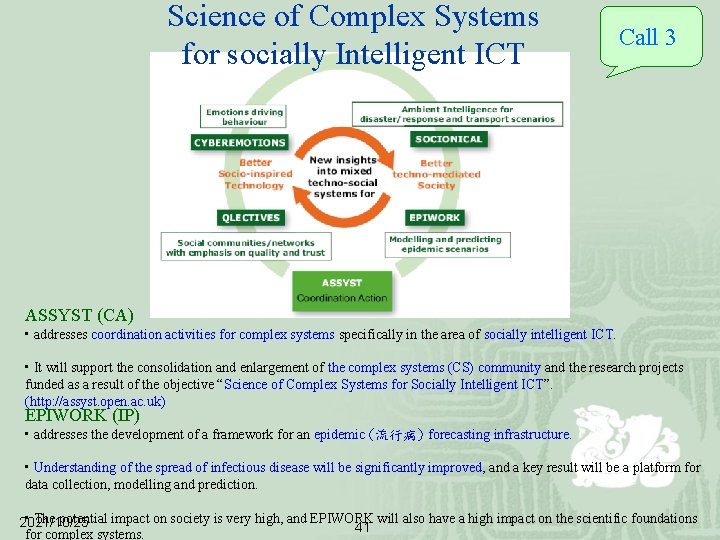
Science of Complex Systems for socially Intelligent ICT Call 3 ASSYST (CA) • addresses coordination activities for complex systems specifically in the area of socially intelligent ICT. • It will support the consolidation and enlargement of the complex systems (CS) community and the research projects funded as a result of the objective “Science of Complex Systems for Socially Intelligent ICT”. (http: //assyst. open. ac. uk) EPIWORK (IP) • addresses the development of a framework for an epidemic (流行病) forecasting infrastructure. • Understanding of the spread of infectious disease will be significantly improved, and a key result will be a platform for data collection, modelling and prediction. • The potential impact on society is very high, and EPIWORK will also have a high impact on the scientific foundations 2021/10/25 41 for complex systems.
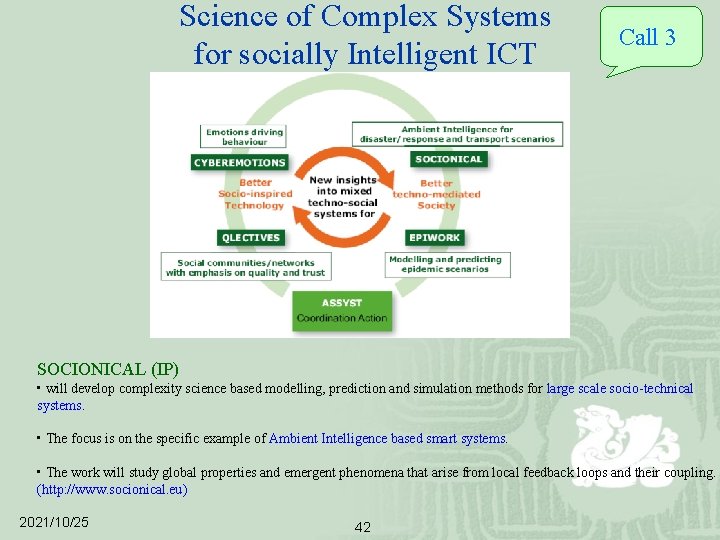
Science of Complex Systems for socially Intelligent ICT Call 3 SOCIONICAL (IP) • will develop complexity science based modelling, prediction and simulation methods for large scale socio-technical systems. • The focus is on the specific example of Ambient Intelligence based smart systems. • The work will study global properties and emergent phenomena that arise from local feedback loops and their coupling. (http: //www. socionical. eu) 2021/10/25 42
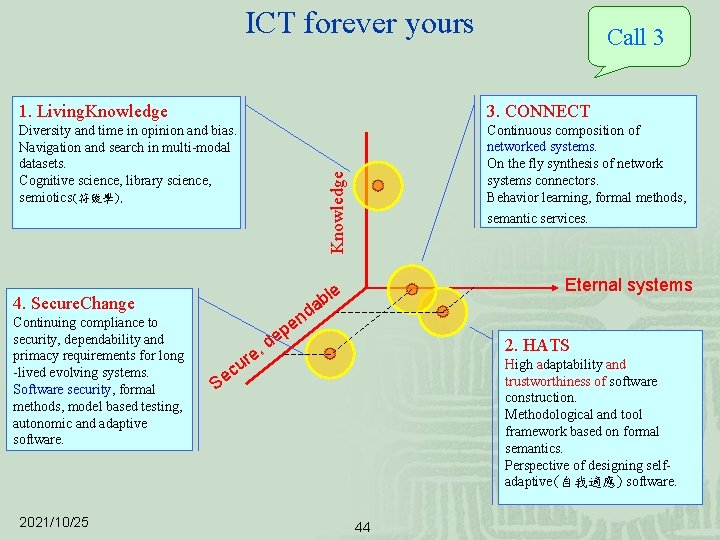
ICT forever yours Call 3 3. CONNECT Diversity and time in opinion and bias. Navigation and search in multi-modal datasets. Cognitive science, library science, semiotics(符號學). Continuous composition of networked systems. On the fly synthesis of network systems connectors. Behavior learning, formal methods, semantic services. Knowledge 1. Living. Knowledge 4. Secure. Change Continuing compliance to security, dependability and primacy requirements for long -lived evolving systems. Software security, formal methods, model based testing, autonomic and adaptive software. 2021/10/25 Eternal systems ble da n e ep d , 2. HATS re u c Se High adaptability and trustworthiness of software construction. Methodological and tool framework based on formal semantics. Perspective of designing selfadaptive(自我適應) software. 44
Outline ¡ Introduction of Future and Emerging Technologies (FET) ¡ FET-OPEN - transformative and foundational research ¡ FET Proactive Initiatives – FP 7 Call 1 & Call 3 (past) ¡ FET Proactive Initiatives – FP 7 Call 4 - Call 6 ¡ Summary and Video DVD 2021/10/25 45
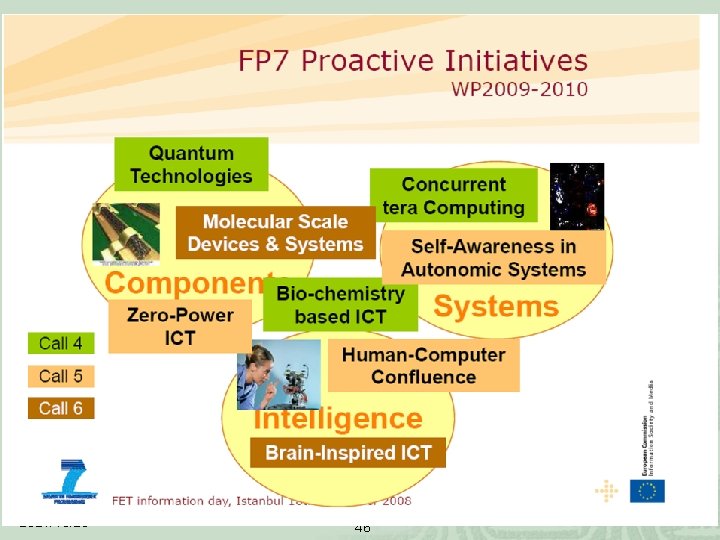
2021/10/25 46
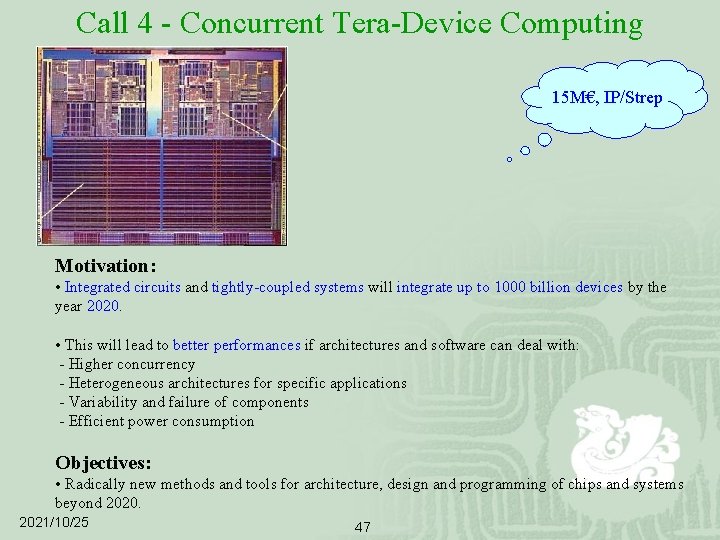
Call 4 - Concurrent Tera-Device Computing 15 M€, IP/Strep Motivation: • Integrated circuits and tightly-coupled systems will integrate up to 1000 billion devices by the year 2020. • This will lead to better performances if architectures and software can deal with: - Higher concurrency - Heterogeneous architectures for specific applications - Variability and failure of components - Efficient power consumption Objectives: • Radically new methods and tools for architecture, design and programming of chips and systems beyond 2020. 2021/10/25 47
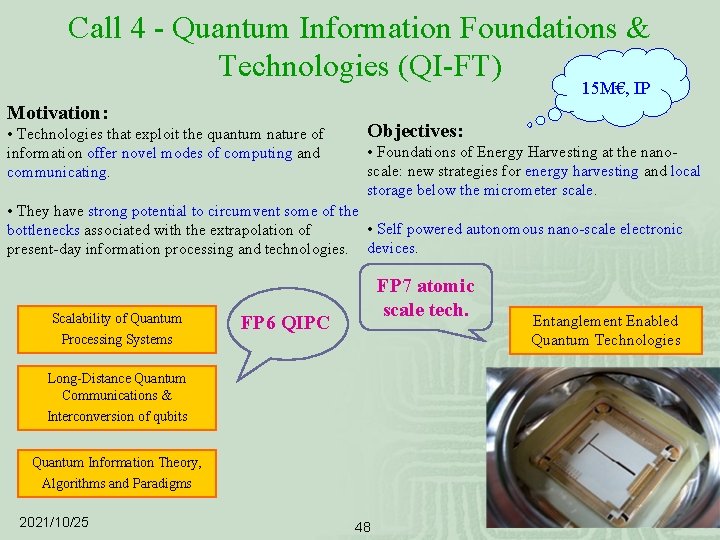
Call 4 - Quantum Information Foundations & Technologies (QI-FT) 15 M€, IP Motivation: • Technologies that exploit the quantum nature of information offer novel modes of computing and communicating. Objectives: • Foundations of Energy Harvesting at the nanoscale: new strategies for energy harvesting and local storage below the micrometer scale. • They have strong potential to circumvent some of the • Self powered autonomous nano-scale electronic bottlenecks associated with the extrapolation of present-day information processing and technologies. devices. Scalability of Quantum Processing Systems FP 7 atomic scale tech. FP 6 QIPC Long-Distance Quantum Communications & Interconversion of qubits Quantum Information Theory, Algorithms and Paradigms 2021/10/25 48 Entanglement Enabled Quantum Technologies
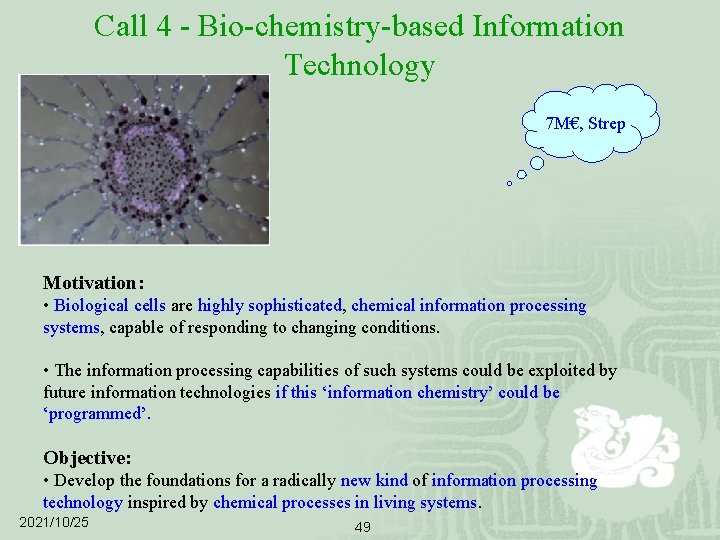
Call 4 - Bio-chemistry-based Information Technology 7 M€, Strep Motivation: • Biological cells are highly sophisticated, chemical information processing systems, capable of responding to changing conditions. • The information processing capabilities of such systems could be exploited by future information technologies if this ‘information chemistry’ could be ‘programmed’. Objective: • Develop the foundations for a radically new kind of information processing technology inspired by chemical processes in living systems. 2021/10/25 49
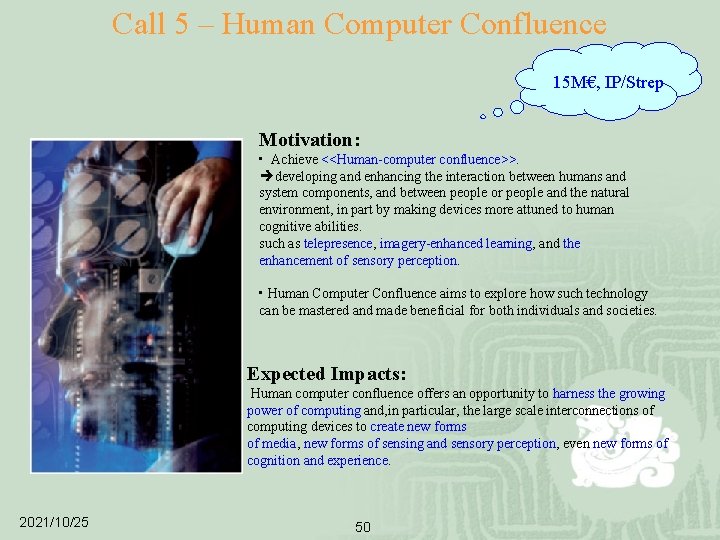
Call 5 – Human Computer Confluence 15 M€, IP/Strep Motivation: • Achieve <<Human-computer confluence>>. developing and enhancing the interaction between humans and system components, and between people or people and the natural environment, in part by making devices more attuned to human cognitive abilities. such as telepresence, imagery-enhanced learning, and the enhancement of sensory perception. • Human Computer Confluence aims to explore how such technology can be mastered and made beneficial for both individuals and societies. Expected Impacts: Human computer confluence offers an opportunity to harness the growing power of computing and, in particular, the large scale interconnections of computing devices to create new forms of media, new forms of sensing and sensory perception, even new forms of cognition and experience. 2021/10/25 50
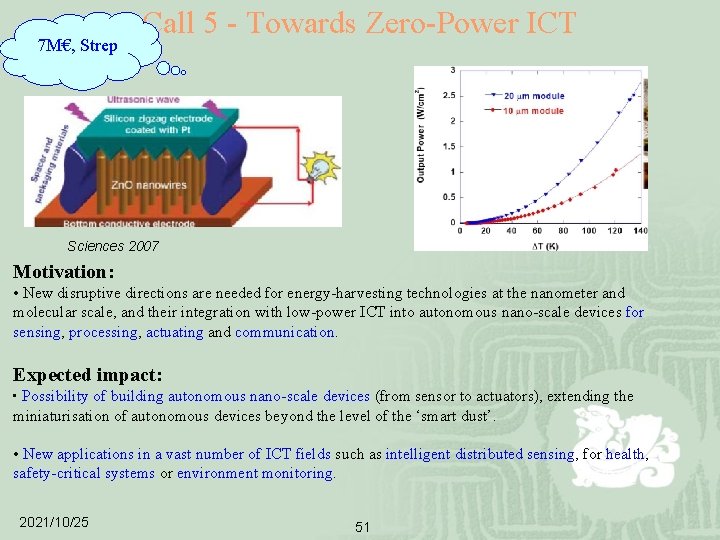
7 M€, Strep Call 5 - Towards Zero-Power ICT Sciences 2007 Motivation: • New disruptive directions are needed for energy-harvesting technologies at the nanometer and molecular scale, and their integration with low-power ICT into autonomous nano-scale devices for sensing, processing, actuating and communication. Expected impact: • Possibility of building autonomous nano-scale devices (from sensor to actuators), extending the miniaturisation of autonomous devices beyond the level of the ‘smart dust’. • New applications in a vast number of ICT fields such as intelligent distributed sensing, for health, safety-critical systems or environment monitoring. 2021/10/25 51
Call 5 - Self-awareness in Autonomic Systems Motivation: Create autonomic computing and communication systems able to optimise overall performance and resource usage in response to changing conditions, adapting to both context (such as user behaviour) and internal changes (such as topology). Expected impact: • Creating awareness at level of autonomic nodes: - awareness at the level of autonomic nodes, by allowing them to interactively and selectively collect information about the system, - and use it effectively. • Dynamic self-expression: - namely the ability to autonomically use awareness to adapt the trade-off between abstraction and optimisation. 2021/10/25 52
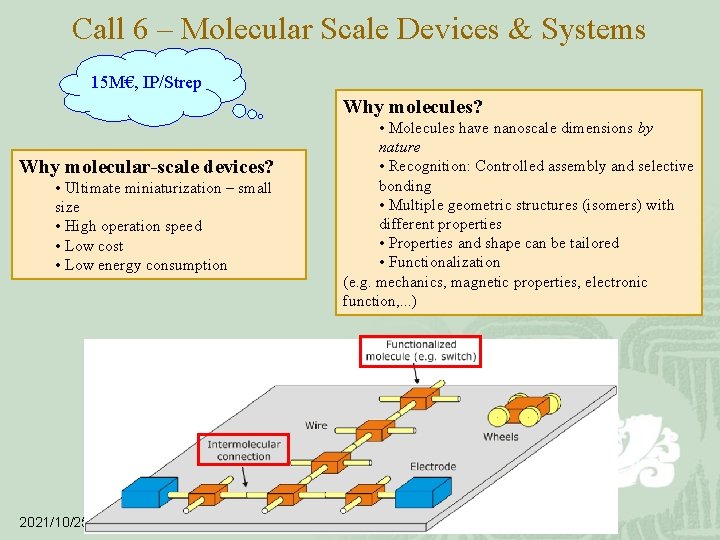
Call 6 – Molecular Scale Devices & Systems 15 M€, IP/Strep Why molecules? Why molecular-scale devices? • Ultimate miniaturization – small size • High operation speed • Low cost • Low energy consumption 2021/10/25 • Molecules have nanoscale dimensions by nature • Recognition: Controlled assembly and selective bonding • Multiple geometric structures (isomers) with different properties • Properties and shape can be tailored • Functionalization (e. g. mechanics, magnetic properties, electronic function, . . . ) 53
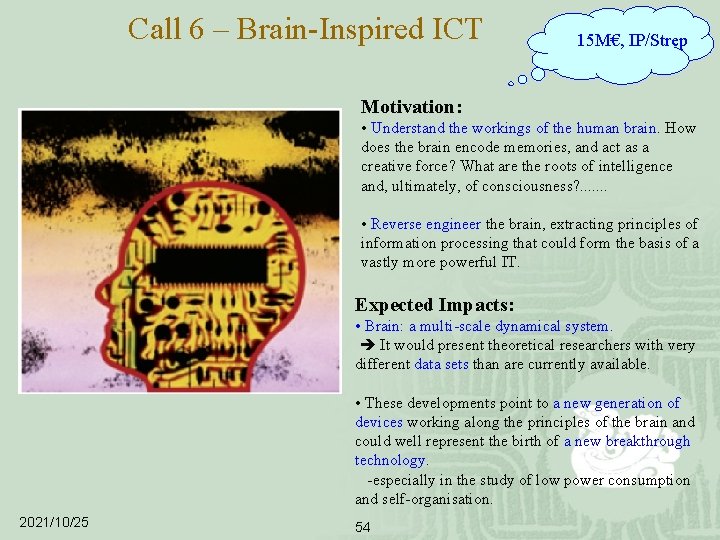
Call 6 – Brain-Inspired ICT 15 M€, IP/Strep Motivation: • Understand the workings of the human brain. How does the brain encode memories, and act as a creative force? What are the roots of intelligence and, ultimately, of consciousness? . . . . • Reverse engineer the brain, extracting principles of information processing that could form the basis of a vastly more powerful IT. Expected Impacts: • Brain: a multi-scale dynamical system. It would present theoretical researchers with very different data sets than are currently available. • These developments point to a new generation of devices working along the principles of the brain and could well represent the birth of a new breakthrough technology. -especially in the study of low power consumption and self-organisation. 2021/10/25 54
Outline ¡ Introduction of Future and Emerging Technologies (FET) ¡ FET-OPEN - transformative and foundational research ¡ FET Proactive Initiatives – FP 7 Call 1 & Call 3 (past) ¡ FET Proactive Initiatives – FP 7 Call 4 - Call 6 ¡ Summary and Video DVD 2021/10/25 55
Summary ¡ FET is the home for top quality scientific excellence ¡ … has an excellent track record on impacting main-stream ICT research ¡ … is a very successful pathfinder and seeds innovation ¡ … is a strong asset to ICT - different and unique ¡ … is open for cooperation with partners from outside Europe 2021/10/25 56

Thank you 2021/10/25 57

- back up - 2021/10/25 58
2021/10/25 59
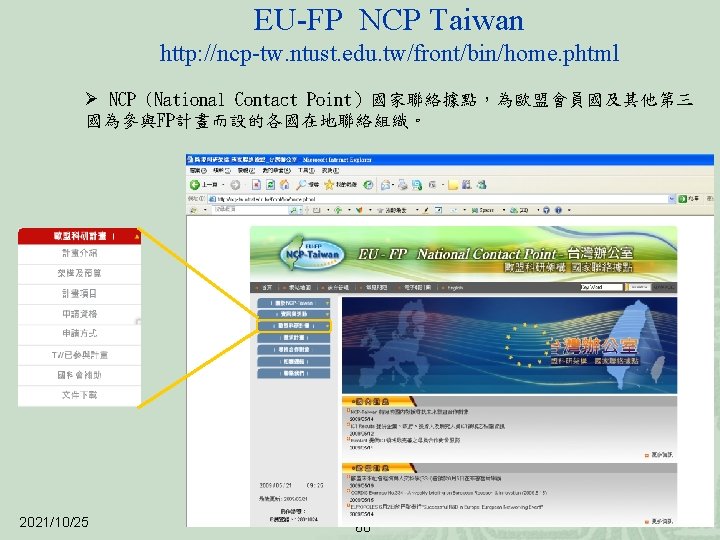
EU-FP NCP Taiwan http: //ncp-tw. ntust. edu. tw/front/bin/home. phtml Ø NCP (National Contact Point)國家聯絡據點,為歐盟會員國及其他第三 國為參與FP計畫而設的各國在地聯絡組織。 2021/10/25 60
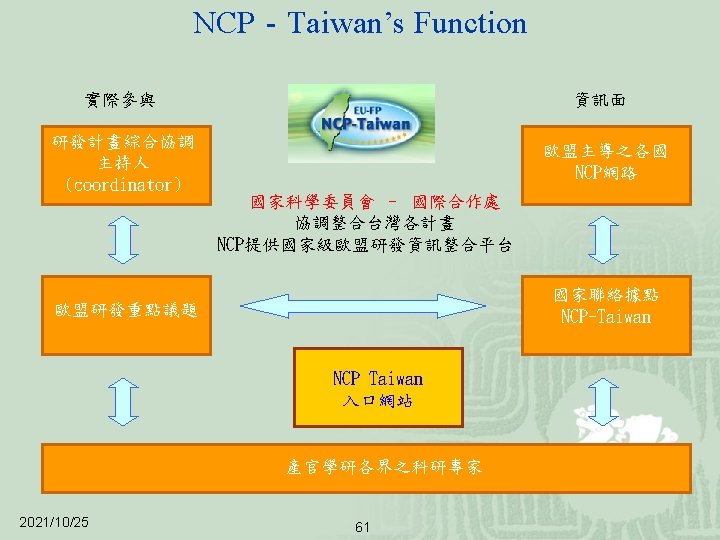
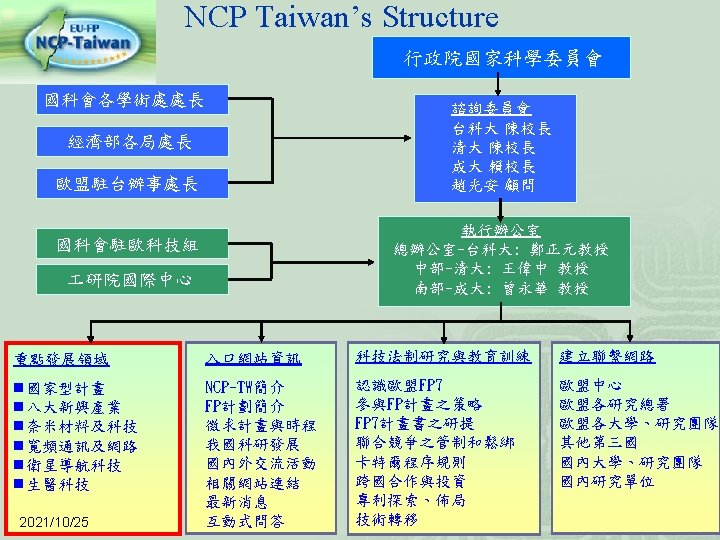
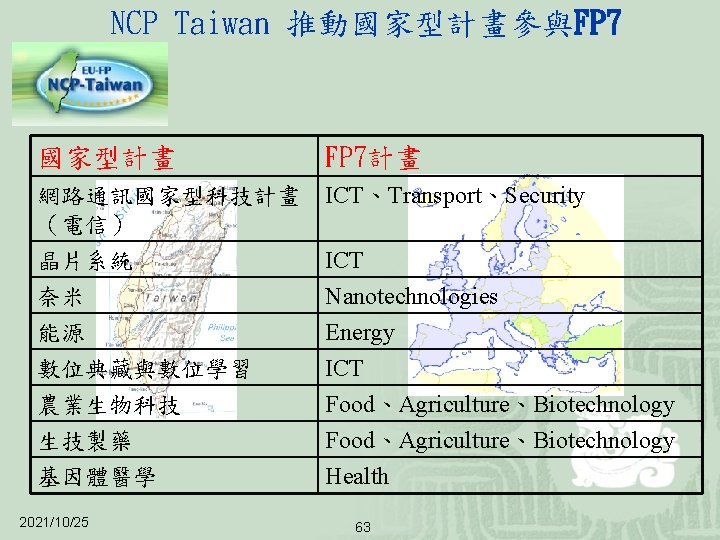
NCP Taiwan 推動國家型計畫參與FP 7 國家型計畫 FP 7計畫 網路通訊國家型科技計畫 (電信) ICT、Transport、Security 晶片系統 ICT 奈米 能源 數位典藏與數位學習 農業生物科技 生技製藥 基因體醫學 Nanotechnologies Energy ICT Food、Agriculture、Biotechnology 2021/10/25 Health 63
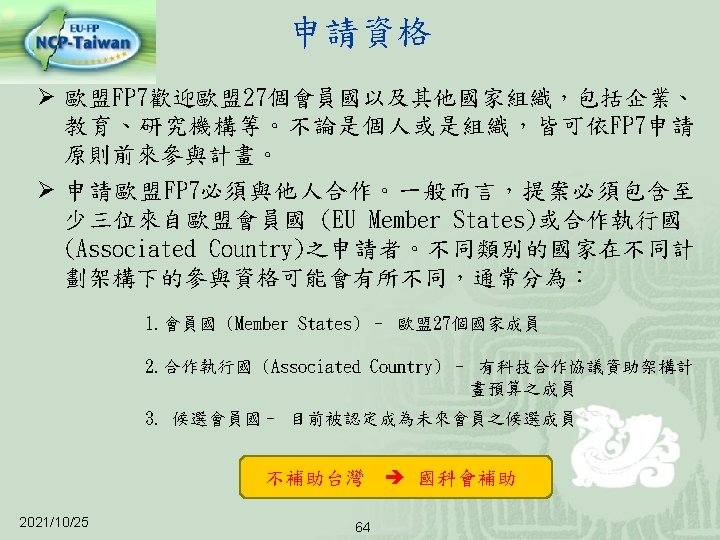
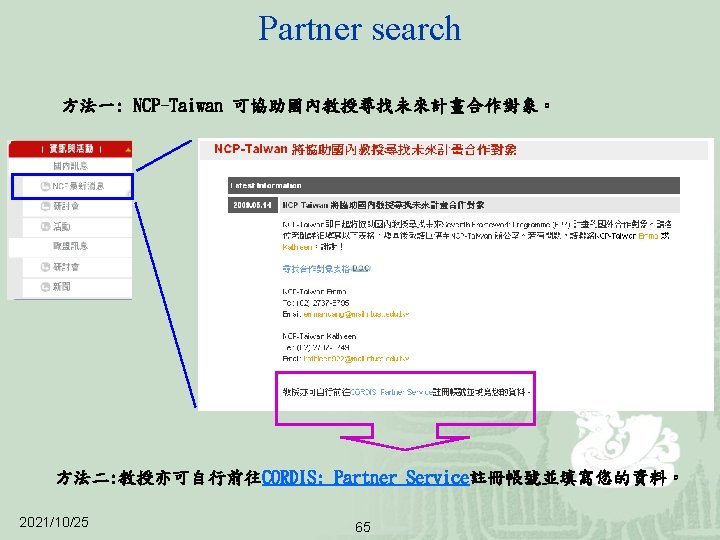
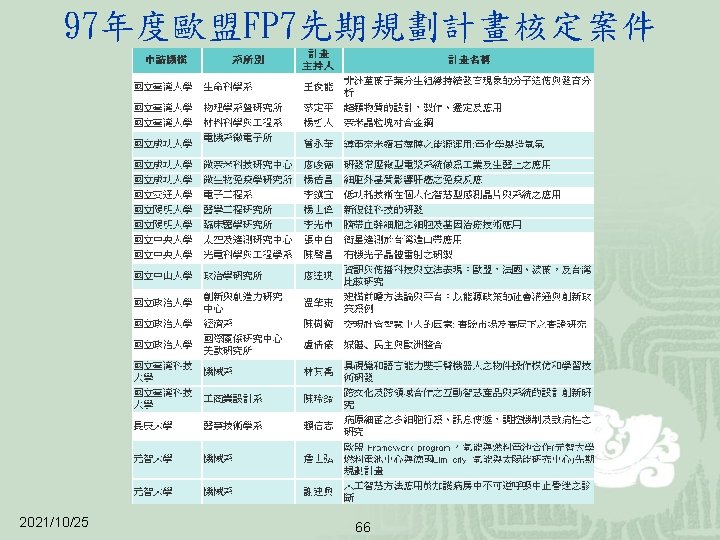
- Slides: 66