
Fusion Power Associates Annual Meeting and Symposium October
Fusion Power Associates Annual Meeting and Symposium October 11 -12 in Washington, DC Fusion Energy Development in Japan Masahiro SEKI Director General Fusion Energy Research Directorate Naka Fusion Institute Japan Atomic Energy Agency
OUTLINE 1. Road map to Fusion Energy 2. Broader Approach Projects Candidate Projects Investigations in JA Discussions between EU and JA, 3. Fusion Energy Research in JAEA - New Organization JAERI + JNC Recent Outcomes and Future Plan 1. 4. Summary
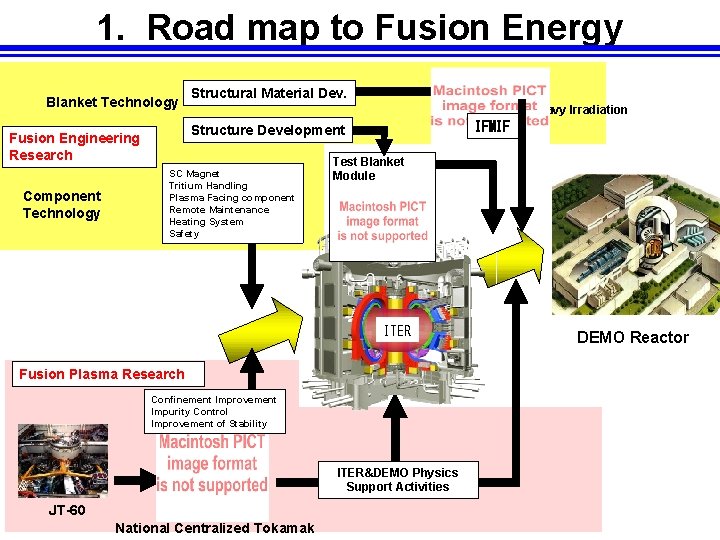
1. Road map to Fusion Energy Blanket Technology Heavy Irradiation IFMIF Structure Development Fusion Engineering Research Component Technology Structural Material Dev. SC Magnet Tritium Handling Plasma Facing component Remote Maintenance Heating System Safety Test Blanket Module ITER Fusion Plasma Research Confinement Improvement Impurity Control Improvement of Stability ITER&DEMO Physics Support Activities JT-60 National Centralized Tokamak DEMO Reactor
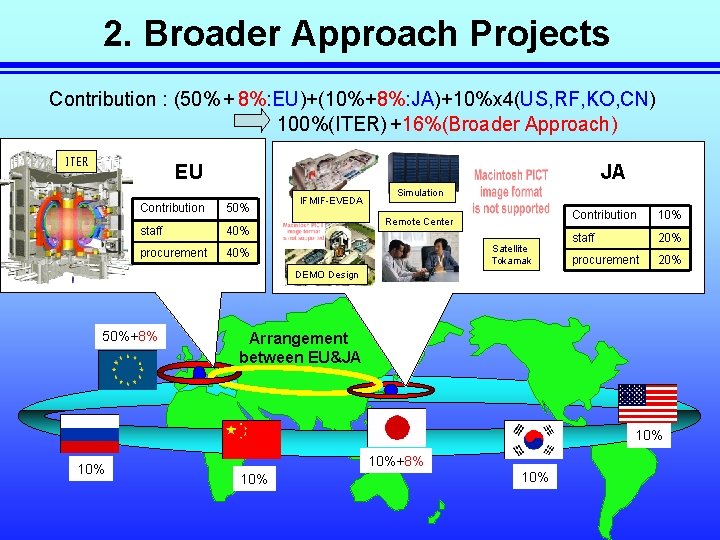
2. Broader Approach Projects Contribution : (50% + 8%: EU)+(10%+8%: JA)+10%x 4(US, RF, KO, CN) 100%(ITER) +16%(Broader Approach) ITER EU Contribution staff procurement JA 50% Simulation IFMIF-EVEDA Remote Center 40% Cont Satellite Tokamak Contribution 10% staff 20% procurement 20% DEMO Design 50%+8% Arrangement between EU&JA 10% 10%+8% 10%
Candidate Projects Candidate projects, identified in the final report of the six-party broader approach workshops in January 2004, include: -IFMIF (EVEDA and/or facility) -ITER Research Center(s) including a computer simulation center for fusion science a center for remote experimentation -Fusion power plant technology coordination center, including center for international design activities for demonstration reactors -A new plasma experimental device (Satellite Tokamak) Projects which are not included in the above list could be chosen at the initiative of the non-Host provided that they contribute to early realization of fusion energy and the Host and non-Host jointly decide to undertake them.
Discussions in Japan Committee on ITER Project Promotion Chair: A. Arima (Former Minister of Education, and Science&Technology) S. Takamura(Nagoya Univ. ), S. Tanaka(Tokyo Univ. ), S. Matsuda(JAERI), O. Motojima(NIFS) Report of Committee Important Points contribute to early realization of fusion energy make the best use of fusion research potential in Japan attractive projects for fusion scientists in the world balanced approach through multiple projects for synergy and long term personnel training Recommended Projects International Fusion Energy Research Center (ITER Remote Experimentation Center, Fusion Simulation Center, Fusion Power Plant Technology Coordination Center, IFMIF-EVEDA) Satellite Tokamak (Superconducting Modification of JT-60)
EU-JA Bilateral Discussion 2005. 07. 21 2005. 08. 25 2005. 08. 26 2005. 09. 15 2005. 09. 19 2005. 10. 05 EU-JA Technical Meeting (Garching) EU-JA IFMIF-EVEDA Meeting(Naka) EU-JA Technical Meeting (Tokyo) EU-JA Technical Meeting (Paris) Informal Meeting on Satellite Tokamak(Geneva) EU-JA Satellite Tokamak Meeting(Naka) IFMIF-EVEDA: Common Understanding reached on work plan of EVEDA Satellite Tokamak: Interim Report expected in Mid. Nov. 2005 Remote Center: Discussed a concept of Remote Experimentation Center Simulation Center&DEMO Centers: Importance recognized By the end of 2005, selection of the projects is to be finalized.
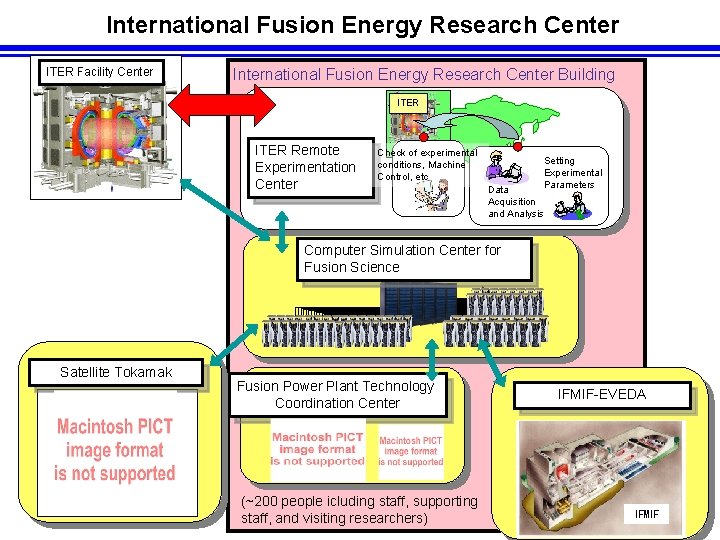
International Fusion Energy Research Center ITER Facility Center International Fusion Energy Research Center Building ITER Remote Experimentation Center Check of experimental conditions, Machine Control, etc Setting Experimental Parameters Data Acquisition and Analysis Computer Simulation Center for Fusion Science Satellite Tokamak Fusion Power Plant Technology Coordination Center (~200 people icluding staff, supporting staff, and visiting researchers) IFMIF-EVEDA IFMIF
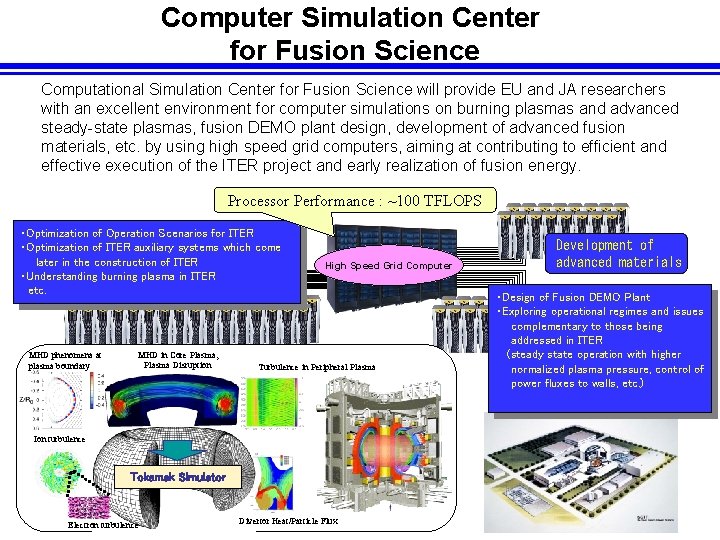
Computer Simulation Center for Fusion Science Computational Simulation Center for Fusion Science will provide EU and JA researchers with an excellent environment for computer simulations on burning plasmas and advanced steady-state plasmas, fusion DEMO plant design, development of advanced fusion materials, etc. by using high speed grid computers, aiming at contributing to efficient and effective execution of the ITER project and early realization of fusion energy. Processor Performance : ~100 TFLOPS ・Optimization of Operation Scenarios for ITER ・Optimization of ITER auxiliary systems which come later in the construction of ITER ・Understanding burning plasma in ITER etc. MHD phenomena at plasma boundary MHD in Core Plasma, Plasma Disruption High Speed Grid Computer Turbulence in Peripheral Plasma Ion turbulence Tokamak Simulator Electron turbulence Divertor Heat/Particle Flux Development of advanced materials ・Design of Fusion DEMO Plant ・Exploring operational regimes and issues complementary to those being addressed in ITER (steady state operation with higher normalized plasma pressure, control of power fluxes to walls, etc. )
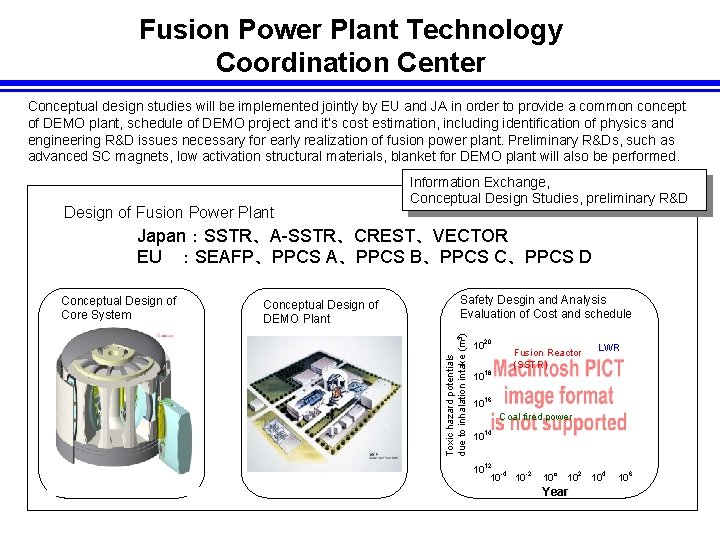
Fusion Power Plant Technology Coordination Center Conceptual design studies will be implemented jointly by EU and JA in order to provide a common concept of DEMO plant, schedule of DEMO project and it’s cost estimation, including identification of physics and engineering R&D issues necessary for early realization of fusion power plant. Preliminary R&Ds, such as advanced SC magnets, low activation structural materials, blanket for DEMO plant will also be performed. Design of Fusion Power Plant Information Exchange, Conceptual Design Studies, preliminary R&D Japan:SSTR、A-SSTR、CREST、VECTOR EU :SEAFP、PPCS A、PPCS B、PPCS C、PPCS D Conceptual Design of DEMO Plant Safety Desgin and Analysis Evaluation of Cost and schedule Toxic hazard potentials due to inhalation intake (m 3) Conceptual Design of Core System 20 10 Fusion Reactor (SSTR) 18 LWR 10 16 10 Coal fired power 14 10 12 10 -4 10 -2 10 o 10 2 10 Year 4 10 6 10
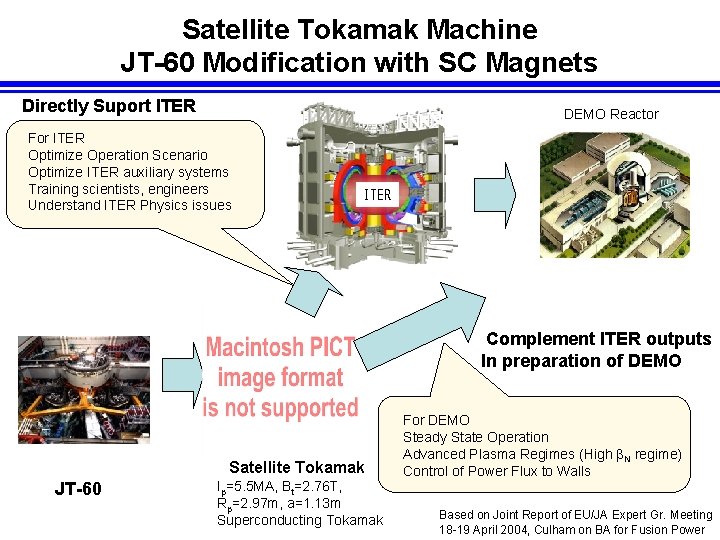
Satellite Tokamak Machine JT-60 Modification with SC Magnets Directly Suport ITER DEMO Reactor For ITER Optimize Operation Scenario Optimize ITER auxiliary systems Training scientists, engineers Understand ITER Physics issues ITER Complement ITER outputs In preparation of DEMO Satellite Tokamak JT-60 Ip=5. 5 MA, Bt=2. 76 T, Rp=2. 97 m, a=1. 13 m Superconducting Tokamak For DEMO Steady State Operation Advanced Plasma Regimes (High N regime) Control of Power Flux to Walls Based on Joint Report of EU/JA Expert Gr. Meeting 18 -19 April 2004, Culham on BA for Fusion Power
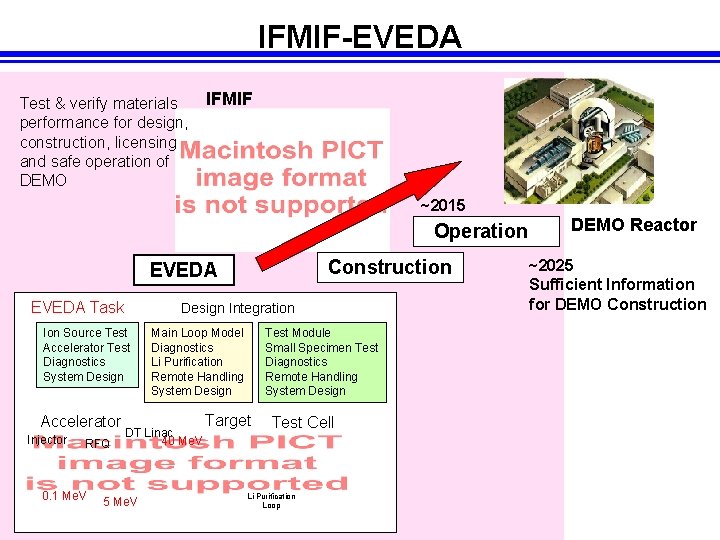
IFMIF-EVEDA Test & verify materials performance for design, construction, licensing and safe operation of DEMO IFMIF ~2015 Operation Construction EVEDA Task Design Integration Ion Source Test Accelerator Test Diagnostics System Design Accelerator Injector RFQ 0. 1 Me. V Main Loop Model Diagnostics Li Purification Remote Handling System Design DT Linac 40 Me. V 5 Me. V Test Module Small Specimen Test Diagnostics Remote Handling System Design Target Test Cell Li Purification Loop DEMO Reactor ~2025 Sufficient Information for DEMO Construction
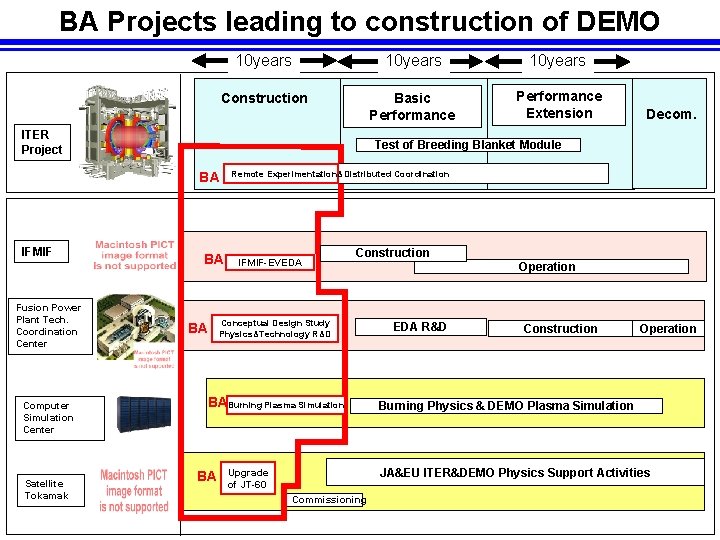
BA Projects leading to construction of DEMO 10 years Construction Basic Performance Extension ITER Project Test of Breeding Blanket Module BA IFMIF Fusion Power Plant Tech. Coordination Center Computer Simulation Center Satellite Tokamak Decom. BA BA Remote Experimentation&Distributed Coordination IFMIF-EVEDA Construction Conceptual Design Study Physics&Technology R&D BABurning Plasma Simulation BA EDA R&D Operation Construction Operation Burning Physics & DEMO Plasma Simulation JA&EU ITER&DEMO Physics Support Activities Upgrade of JT-60 Commissioning
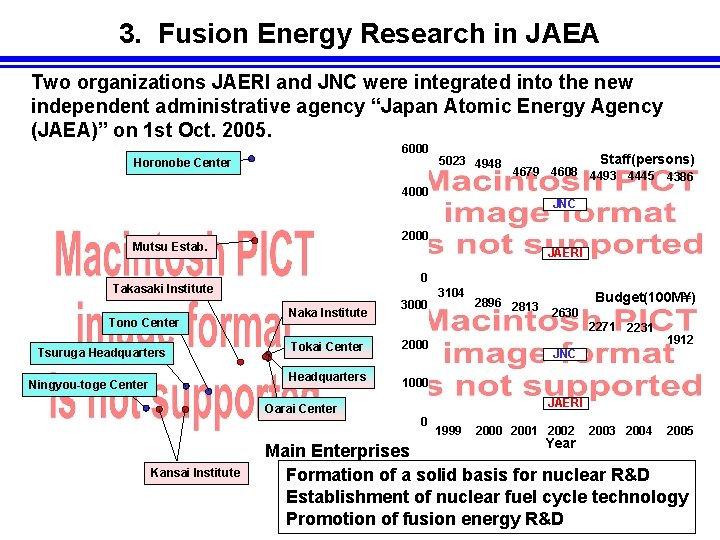
3. Fusion Energy Research in JAEA Two organizations JAERI and JNC were integrated into the new independent administrative agency “Japan Atomic Energy Agency (JAEA)” on 1 st Oct. 2005. 6000 Horonobe Center 5023 4948 4679 4608 4000 Ningyou-toge Center 0 Naka Institute 3000 3104 2896 2813 Budget(100 M¥) 2630 2271 2231 Tokai Center 2000 Headquarters 1000 Oarai Center Kansai Institute JNC JAERI Takasaki Institute Tsuruga Headquarters 4386 2000 Mutsu Estab. Tono Center Staff(persons) 4493 4445 1912 JNC JAERI 0 1999 2000 2001 2002 Year 2003 2004 2005 Main Enterprises Formation of a solid basis for nuclear R&D Establishment of nuclear fuel cycle technology Promotion of fusion energy R&D
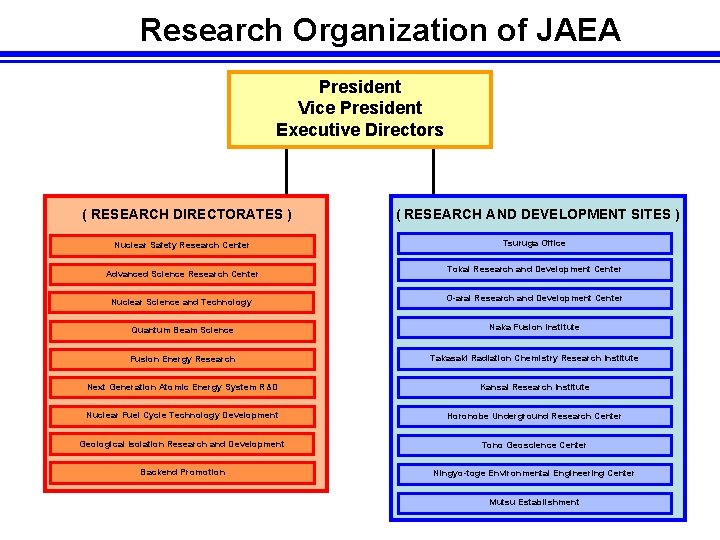
Research Organization of JAEA President Vice President Executive Directors ( RESEARCH DIRECTORATES ) ( RESEARCH AND DEVELOPMENT SITES ) Nuclear Safety Research Center Tsuruga Office Advanced Science Research Center Tokai Research and Development Center Nuclear Science and Technology O-arai Research and Development Center Quantum Beam Science Naka Fusion Institute Fusion Energy Research Takasaki Radiation Chemistry Research Institute Next Generation Atomic Energy System R&D Kansai Research Institute Nuclear Fuel Cycle Technology Development Horonobe Underground Research Center Geological Isolation Research and Development Tono Geoscience Center Backend Promotion Ningyo-toge Environmental Engineering Center Mutsu Establishment
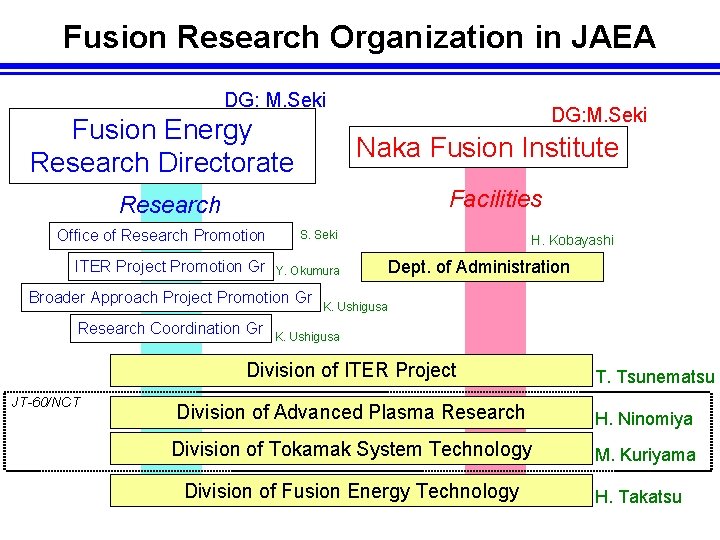
Fusion Research Organization in JAEA DG: M. Seki Fusion Energy Research Directorate DG: M. Seki Naka Fusion Institute Facilities Research Office of Research Promotion S. Seki ITER Project Promotion Gr Y. Okumura Broader Approach Project Promotion Gr Research Coordination Gr H. Kobayashi Dept. of Administration K. Ushigusa Division of ITER Project JT-60/NCT T. Tsunematsu Division of Advanced Plasma Research H. Ninomiya Division of Tokamak System Technology M. Kuriyama Division of Fusion Energy Technology H. Takatsu
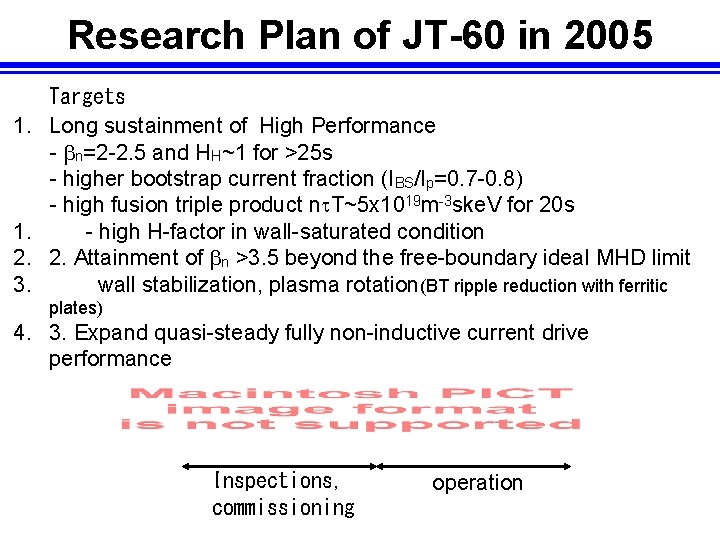
Research Plan of JT-60 in 2005 1. 2. 3. Targets Long sustainment of High Performance - n=2 -2. 5 and HH~1 for >25 s - higher bootstrap current fraction (IBS/Ip=0. 7 -0. 8) - high fusion triple product n T~5 x 10¹⁹ m-3 ske. V for 20 s - high H-factor in wall-saturated condition 2. Attainment of n >3. 5 beyond the free-boundary ideal MHD limit wall stabilization, plasma rotation(BT ripple reduction with ferritic plates) 4. 3. Expand quasi-steady fully non-inductive current drive performance Inspections, commissioning operation
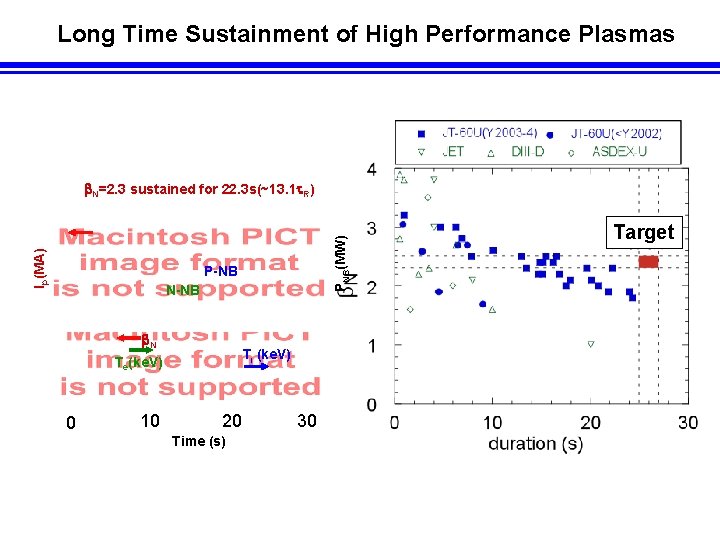
Long Time Sustainment of High Performance Plasmas PNB(MW) Ip(MA) N=2. 3 sustained for 22. 3 s(~13. 1 R) P-NB N Ti (ke. V) Te(ke. V) 0 10 20 Time (s) 30 Target
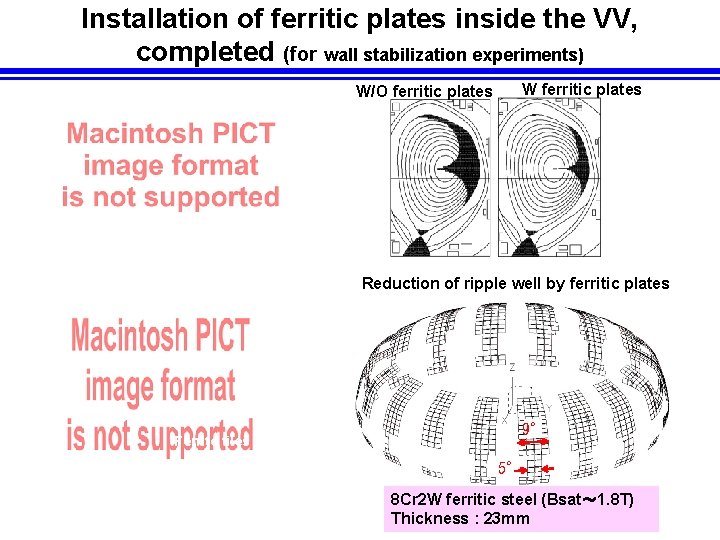
Installation of ferritic plates inside the VV, completed (for wall stabilization experiments) W ferritic plates W/O ferritic plates May, 2005 Reduction of ripple well by ferritic plates June, 2005 () 9° Ferrite tiles Graphite tiles 5° 8 Cr 2 W ferritic steel (Bsat〜 1. 8 T) Thickness : 23 mm
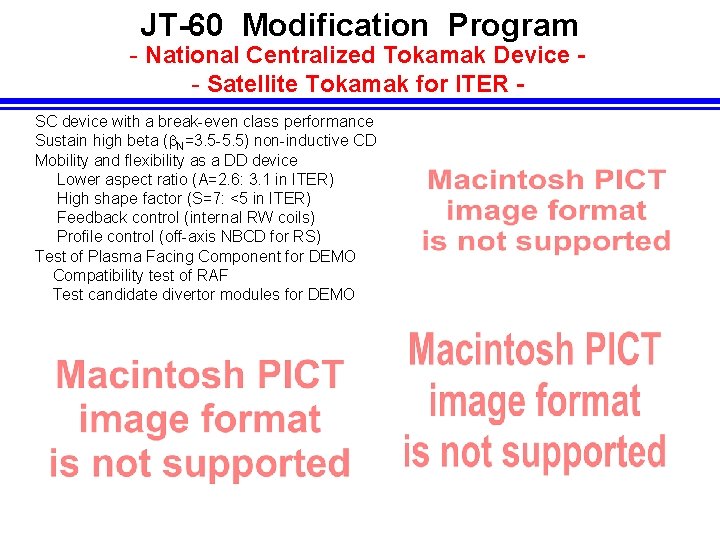
JT-60 Modification Program - National Centralized Tokamak Device - Satellite Tokamak for ITER SC device with a break-even class performance Sustain high beta ( N=3. 5 -5. 5) non-inductive CD Mobility and flexibility as a DD device Lower aspect ratio (A=2. 6: 3. 1 in ITER) High shape factor (S=7: <5 in ITER) Feedback control (internal RW coils) Profile control (off-axis NBCD for RS) Test of Plasma Facing Component for DEMO Compatibility test of RAF Test candidate divertor modules for DEMO Sample station (material plasma test)
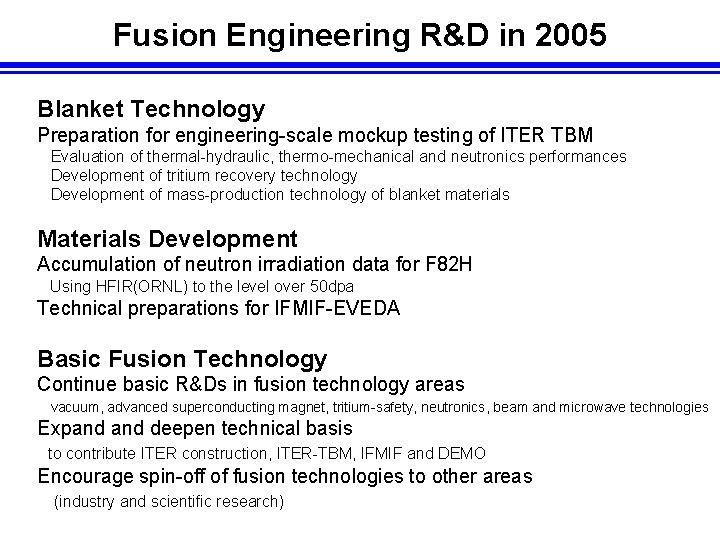
Fusion Engineering R&D in 2005 Blanket Technology Preparation for engineering-scale mockup testing of ITER TBM Evaluation of thermal-hydraulic, thermo-mechanical and neutronics performances Development of tritium recovery technology Development of mass-production technology of blanket materials Materials Development Accumulation of neutron irradiation data for F 82 H Using HFIR(ORNL) to the level over 50 dpa Technical preparations for IFMIF-EVEDA Basic Fusion Technology Continue basic R&Ds in fusion technology areas vacuum, advanced superconducting magnet, tritium-safety, neutronics, beam and microwave technologies Expand deepen technical basis to contribute ITER construction, ITER-TBM, IFMIF and DEMO Encourage spin-off of fusion technologies to other areas (industry and scientific research)
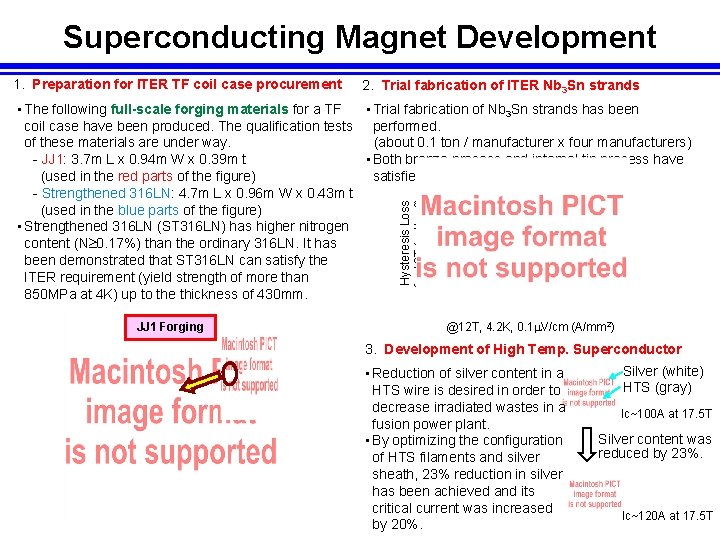
Superconducting Magnet Development 1. Preparation for ITER TF coil case procurement 2. Trial fabrication of ITER Nb 3 Sn strands Hysteresis Loss for 3 T (m. J/cm 3) • The following full-scale forging materials for a TF • Trial fabrication of Nb 3 Sn strands has been coil case have been produced. The qualification tests performed. of these materials are under way. (about 0. 1 ton / manufacturer x four manufacturers) - JJ 1: 3. 7 m L x 0. 94 m W x 0. 39 m t • Both bronze process and internal tin process have (used in the red parts of the figure) satisfied the ITER requirements. - Strengthened 316 LN: 4. 7 m L x 0. 96 m W x 0. 43 m t Results of trial fabrication (used in the blue parts of the figure) (Internal Tin) • Strengthened 316 LN (ST 316 LN) has higher nitrogen (Bronze) content (N 0. 17%) than the ordinary 316 LN. It has Spec. for Bronze process been demonstrated that ST 316 LN can satisfy the Spec. for Internal Tin ITER requirement (yield strength of more than 850 MPa at 4 K) up to the thickness of 430 mm. JJ 1 Forging Critical Current Density @12 T, 4. 2 K, 0. 1 m. V/cm (A/mm 2) 3. Development of High Temp. Superconductor • Reduction of silver content in a HTS wire is desired in order to decrease irradiated wastes in a fusion power plant. • By optimizing the configuration of HTS filaments and silver sheath, 23% reduction in silver has been achieved and its critical current was increased by 20%. Silver (white) HTS (gray) Ic~100 A at 17. 5 T Silver content was reduced by 23%. Ic~120 A at 17. 5 T
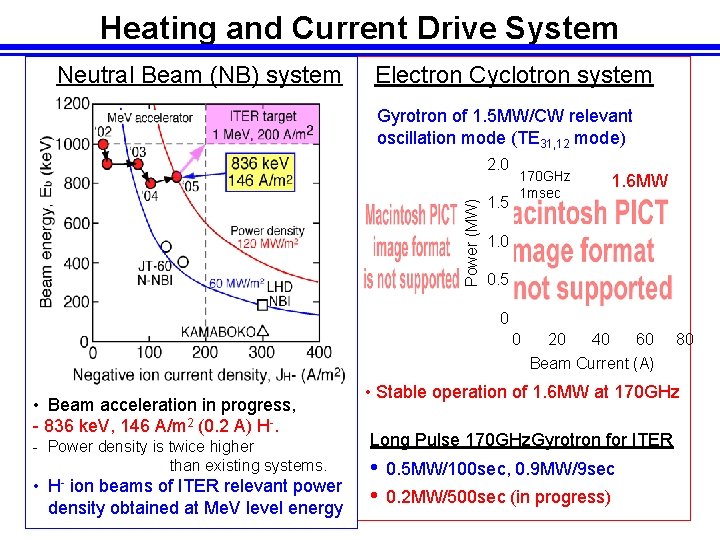
Heating and Current Drive System Neutral Beam (NB) system Electron Cyclotron system Gyrotron of 1. 5 MW/CW relevant oscillation mode (TE 31, 12 mode) 1. 5 170 GHz 1 msec 1. 6 MW 出力 Power (MW) 2. 0 1. 0 0. 5 0 0 • Beam acceleration in progress, - 836 ke. V, 146 A/m 2 (0. 2 A) H-. - Power density is twice higher than existing systems. • H- ion beams of ITER relevant power density obtained at Me. V level energy 20 40 60 Beam Current (A) 80 • Stable operation of 1. 6 MW at 170 GHz Long Pulse 170 GHz. Gyrotron for ITER • 0. 5 MW/100 sec, 0. 9 MW/9 sec • 0. 2 MW/500 sec (in progress)
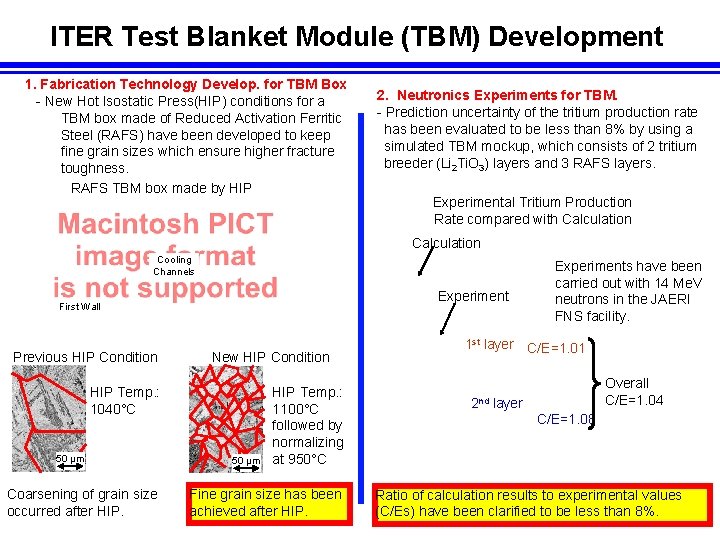
ITER Test Blanket Module (TBM) Development 1. Fabrication Technology Develop. for TBM Box - New Hot Isostatic Press(HIP) conditions for a TBM box made of Reduced Activation Ferritic Steel (RAFS) have been developed to keep fine grain sizes which ensure higher fracture toughness. RAFS TBM box made by HIP 2. Neutronics Experiments for TBM. - Prediction uncertainty of the tritium production rate has been evaluated to be less than 8% by using a simulated TBM mockup, which consists of 2 tritium breeder (Li 2 Ti. O 3) layers and 3 RAFS layers. Experimental Tritium Production Rate compared with Calculation Cooling Channels Experiment First Wall Previous HIP Condition New HIP Condition HIP Temp. : 1040°C 50 µm Coarsening of grain size occurred after HIP. 50 µm HIP Temp. : 1100°C followed by normalizing at 950°C Fine grain size has been achieved after HIP. Experiments have been carried out with 14 Me. V neutrons in the JAERI FNS facility. 1 st layer C/E=1. 01 2 nd layer Overall C/E=1. 04 C/E=1. 08 Ratio of calculation results to experimental values (C/Es) have been clarified to be less than 8%.
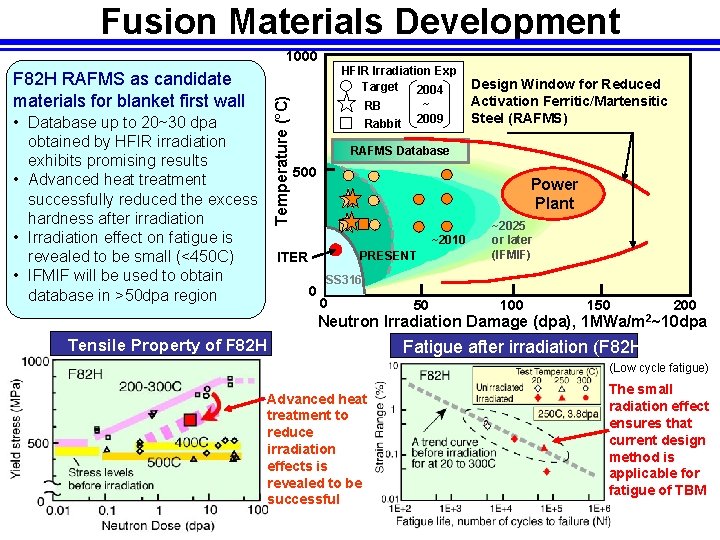
Fusion Materials Development 1000 Temperature (°C) F 82 H RAFMS as candidate materials for blanket first wall • Database up to 20~30 dpa obtained by HFIR irradiation exhibits promising results • Advanced heat treatment successfully reduced the excess hardness after irradiation • Irradiation effect on fatigue is revealed to be small (<450 C) • IFMIF will be used to obtain database in >50 dpa region HFIR Irradiation Exp Target 2004 ~ RB 2009 Rabbit Design Window for Reduced Activation Ferritic/Martensitic Steel (RAFMS) RAFMS Database 500 Power Plant ~2010 PRESENT ITER 0 ~2025 or later (IFMIF) SS 316 0 50 100 Neutron Irradiation Damage (dpa), Tensile Property of F 82 H 150 200 1 MWa/m 2~10 dpa Fatigue after irradiation (F 82 H) (Low cycle fatigue) Advanced heat treatment to reduce irradiation effects is revealed to be successful The small radiation effect ensures that current design method is applicable for fatigue of TBM
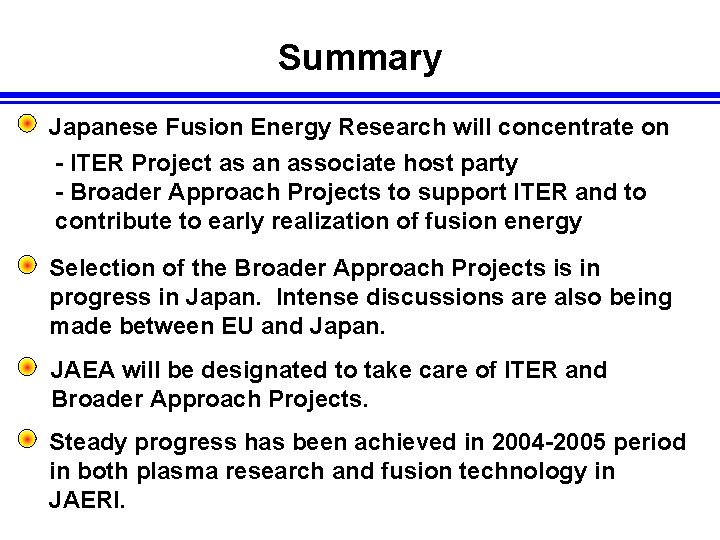
Summary Japanese Fusion Energy Research will concentrate on - ITER Project as an associate host party - Broader Approach Projects to support ITER and to contribute to early realization of fusion energy Selection of the Broader Approach Projects is in progress in Japan. Intense discussions are also being made between EU and Japan. JAEA will be designated to take care of ITER and Broader Approach Projects. Steady progress has been achieved in 2004 -2005 period in both plasma research and fusion technology in JAERI.
- Slides: 26