
Further Validation of the Personal Growth Initiative Scale
- Slides: 1
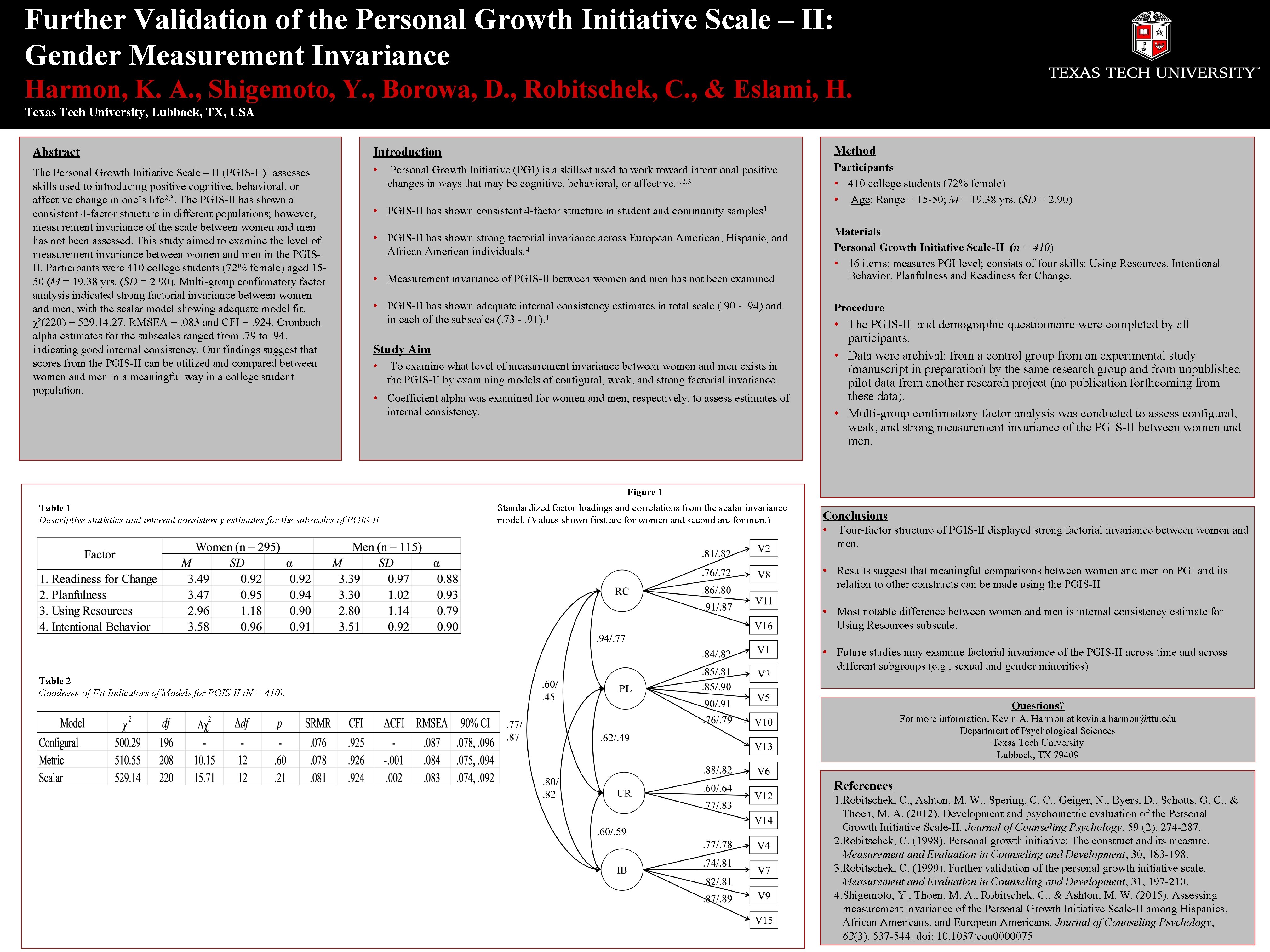
Further Validation of the Personal Growth Initiative Scale – II: Gender Measurement Invariance Harmon, K. A. , Shigemoto, Y. , Borowa, D. , Robitschek, C. , & Eslami, H. Texas Tech University, Lubbock, TX, USA Abstract (PGIS-II)1 The Personal Growth Initiative Scale – II assesses skills used to introducing positive cognitive, behavioral, or affective change in one’s life 2, 3. The PGIS-II has shown a consistent 4 -factor structure in different populations; however, measurement invariance of the scale between women and men has not been assessed. This study aimed to examine the level of measurement invariance between women and men in the PGISII. Participants were 410 college students (72% female) aged 1550 (M = 19. 38 yrs. (SD = 2. 90). Multi-group confirmatory factor analysis indicated strong factorial invariance between women and men, with the scalar model showing adequate model fit, χ²(220) = 529. 14. 27, RMSEA =. 083 and CFI =. 924. Cronbach alpha estimates for the subscales ranged from. 79 to. 94, indicating good internal consistency. Our findings suggest that scores from the PGIS-II can be utilized and compared between women and men in a meaningful way in a college student population. Introduction Method • Participants • 410 college students (72% female) • Age: Range = 15 -50; M = 19. 38 yrs. (SD = 2. 90) Personal Growth Initiative (PGI) is a skillset used to work toward intentional positive changes in ways that may be cognitive, behavioral, or affective. 1, 2, 3 • PGIS-II has shown consistent 4 -factor structure in student and community samples 1 Materials Personal Growth Initiative Scale-II (n = 410) • 16 items; measures PGI level; consists of four skills: Using Resources, Intentional Behavior, Planfulness and Readiness for Change. • PGIS-II has shown strong factorial invariance across European American, Hispanic, and African American individuals. 4 • Measurement invariance of PGIS-II between women and men has not been examined • PGIS-II has shown adequate internal consistency estimates in total scale (. 90 -. 94) and in each of the subscales (. 73 -. 91). 1 Procedure • The PGIS-II and demographic questionnaire were completed by all participants. • Data were archival: from a control group from an experimental study (manuscript in preparation) by the same research group and from unpublished pilot data from another research project (no publication forthcoming from these data). • Multi-group confirmatory factor analysis was conducted to assess configural, weak, and strong measurement invariance of the PGIS-II between women and men. Study Aim • To examine what level of measurement invariance between women and men exists in the PGIS-II by examining models of configural, weak, and strong factorial invariance. • Coefficient alpha was examined for women and men, respectively, to assess estimates of internal consistency. Figure 1 Table 1 Descriptive statistics and internal consistency estimates for the subscales of PGIS-II Standardized factor loadings and correlations from the scalar invariance model. (Values shown first are for women and second are for men. ) Conclusions • Four-factor structure of PGIS-II displayed strong factorial invariance between women and men. • Results suggest that meaningful comparisons between women and men on PGI and its relation to other constructs can be made using the PGIS-II • Most notable difference between women and men is internal consistency estimate for Using Resources subscale. • Future studies may examine factorial invariance of the PGIS-II across time and across different subgroups (e. g. , sexual and gender minorities) Table 2 Goodness-of-Fit Indicators of Models for PGIS-II (N = 410). Questions? For more information, Kevin A. Harmon at kevin. a. harmon@ttu. edu Department of Psychological Sciences Texas Tech University Lubbock, TX 79409 References 1. Robitschek, C. , Ashton, M. W. , Spering, C. C. , Geiger, N. , Byers, D. , Schotts, G. C. , & Thoen, M. A. (2012). Development and psychometric evaluation of the Personal Growth Initiative Scale-II. Journal of Counseling Psychology, 59 (2), 274 -287. 2. Robitschek, C. (1998). Personal growth initiative: The construct and its measure. Measurement and Evaluation in Counseling and Development, 30, 183 -198. 3. Robitschek, C. (1999). Further validation of the personal growth initiative scale. Measurement and Evaluation in Counseling and Development, 31, 197 -210. 4. Shigemoto, Y. , Thoen, M. A. , Robitschek, C. , & Ashton, M. W. (2015). Assessing measurement invariance of the Personal Growth Initiative Scale-II among Hispanics, African Americans, and European Americans. Journal of Counseling Psychology, 62(3), 537 -544. doi: 10. 1037/cou 0000075