
Further Topics on Random Variables Transforms Moment Generating
Further Topics on Random Variables: Transforms (Moment Generating Functions) Berlin Chen Department of Computer Science & Information Engineering National Taiwan Normal University Reference: - D. P. Bertsekas, J. N. Tsitsiklis, Introduction to Probability , Section 4. 1
Aims of This Chapter • Introduce methods that are useful in – Dealing with the sum of independent random variables, including the case where the number of random variables is itself random – Addressing problems of estimation or prediction of an unknown random variable on the basis of observed values of other random variables 2
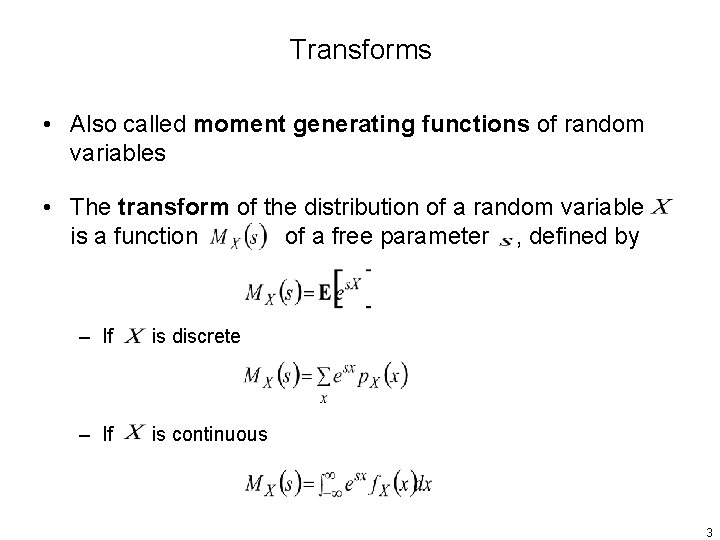
Transforms • Also called moment generating functions of random variables • The transform of the distribution of a random variable is a function of a free parameter , defined by – If is discrete – If is continuous 3
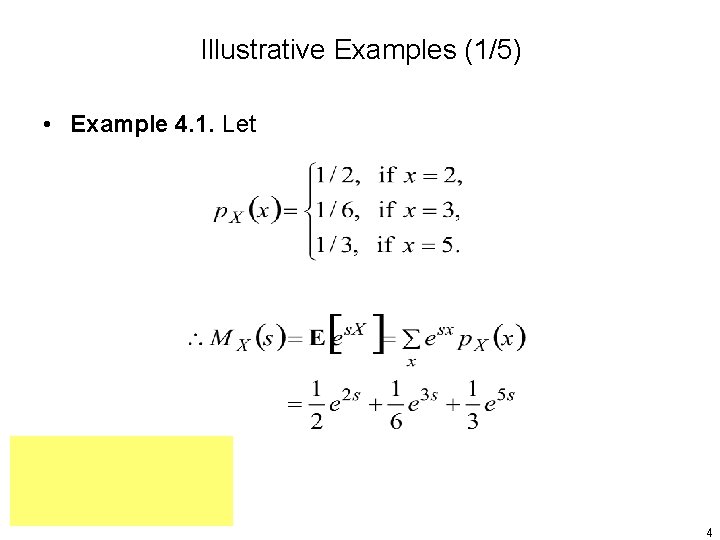
Illustrative Examples (1/5) • Example 4. 1. Let 4
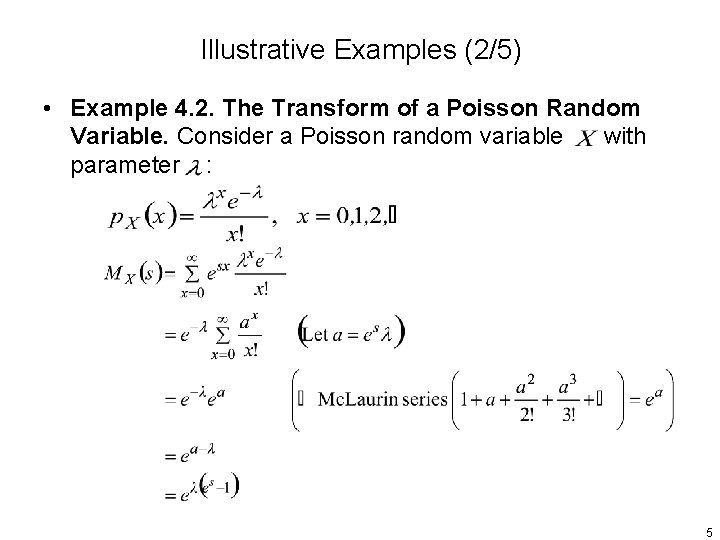
Illustrative Examples (2/5) • Example 4. 2. The Transform of a Poisson Random Variable. Consider a Poisson random variable with parameter : 5
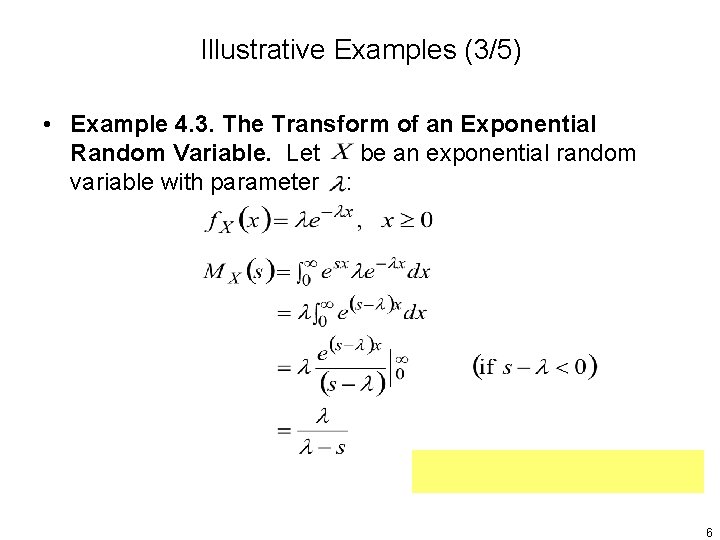
Illustrative Examples (3/5) • Example 4. 3. The Transform of an Exponential Random Variable. Let be an exponential random variable with parameter : 6
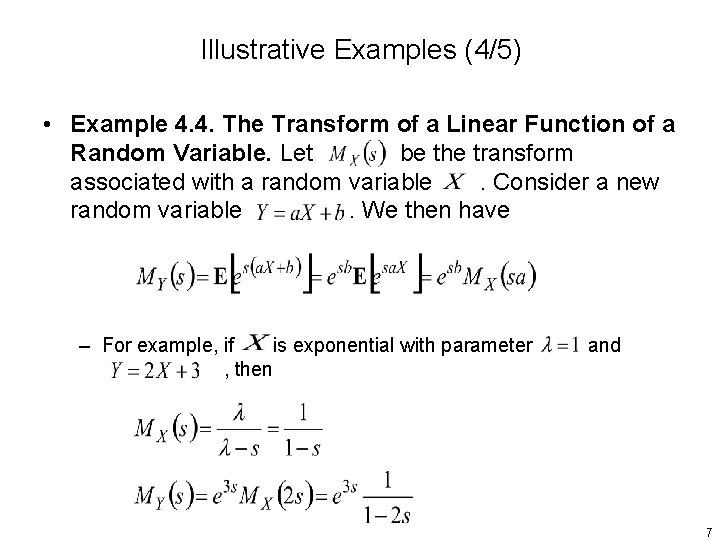
Illustrative Examples (4/5) • Example 4. 4. The Transform of a Linear Function of a Random Variable. Let be the transform associated with a random variable. Consider a new random variable. We then have – For example, if is exponential with parameter , then and 7
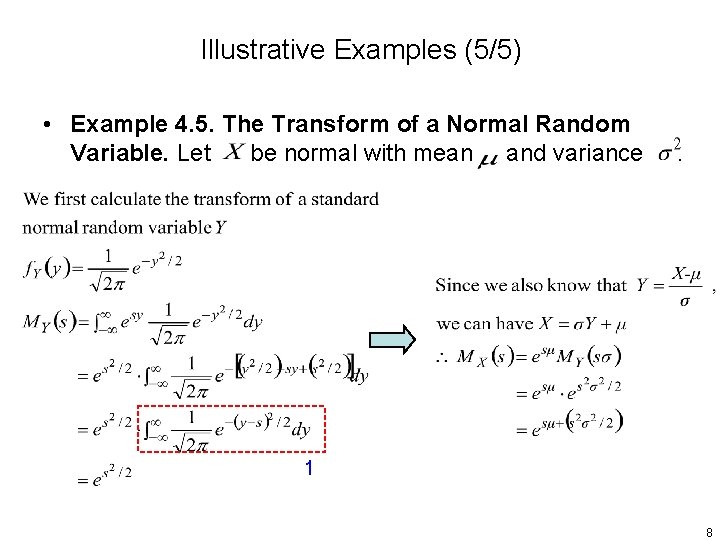
Illustrative Examples (5/5) • Example 4. 5. The Transform of a Normal Random Variable. Let be normal with mean and variance . 1 8
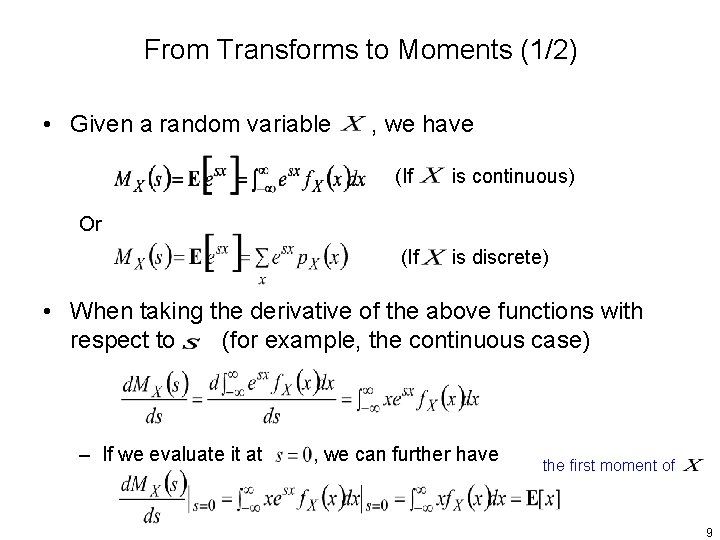
From Transforms to Moments (1/2) • Given a random variable , we have (If is continuous) (If is discrete) Or • When taking the derivative of the above functions with respect to (for example, the continuous case) – If we evaluate it at , we can further have the first moment of 9
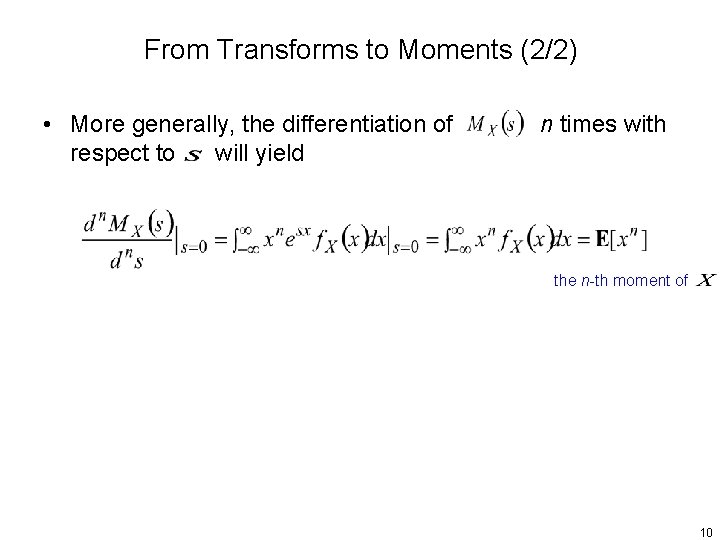
From Transforms to Moments (2/2) • More generally, the differentiation of respect to will yield n times with the n-th moment of 10
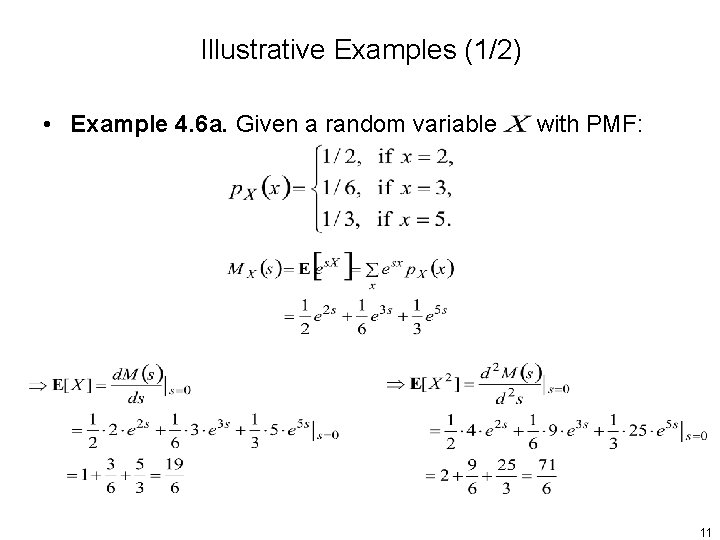
Illustrative Examples (1/2) • Example 4. 6 a. Given a random variable with PMF: 11
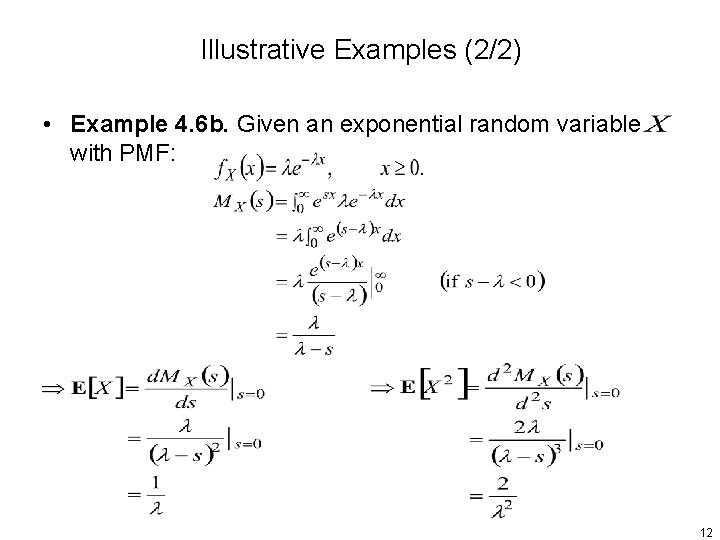
Illustrative Examples (2/2) • Example 4. 6 b. Given an exponential random variable with PMF: 12
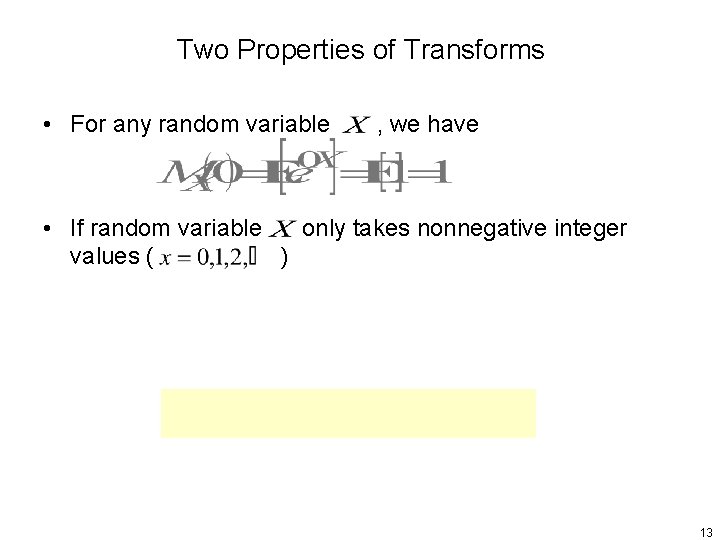
Two Properties of Transforms • For any random variable , we have • If random variable only takes nonnegative integer values ( ) 13
Inversion of Transforms • Inversion Property – The transform associated with a random variable uniquely determines the probability law of , assuming that is finite for all in an interval • The determination of the probability law of a random variable => The PDF and CDF • In particular, if random variables and for all in , then the have the same probability law 14
Illustrative Examples (1/2) • Example 4. 7. We are told that the transform associated with a random variable is 15
Illustrative Examples (2/2) • Example 4. 8. The Transform of a Geometric Random Variable. We are told that the transform associated with random variable is of the form • Where 16
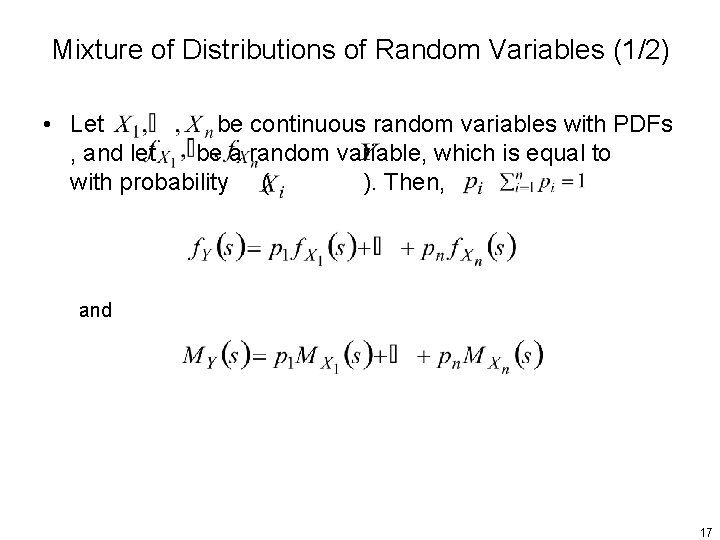
Mixture of Distributions of Random Variables (1/2) • Let be continuous random variables with PDFs , and let be a random variable, which is equal to with probability ( ). Then, and 17
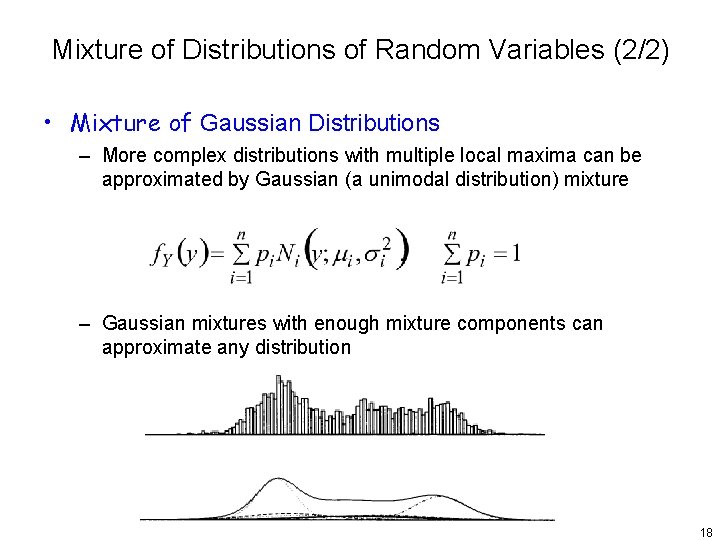
Mixture of Distributions of Random Variables (2/2) • Mixture of Gaussian Distributions – More complex distributions with multiple local maxima can be approximated by Gaussian (a unimodal distribution) mixture – Gaussian mixtures with enough mixture components can approximate any distribution 18
An Illustrative Example (1/2) • Example 4. 9. The Transform of a Mixture of Two Distributions. The neighborhood bank has three tellers, two of them fast, one slow. The time to assist a customer is exponentially distributed with parameter λ = 6 at the fast tellers, and λ = 4 at the slow teller. Jane enters the bank and chooses a teller at random, each one with probability 1/3. Find the PDF of the time it takes to assist Jane and the associated transform 19
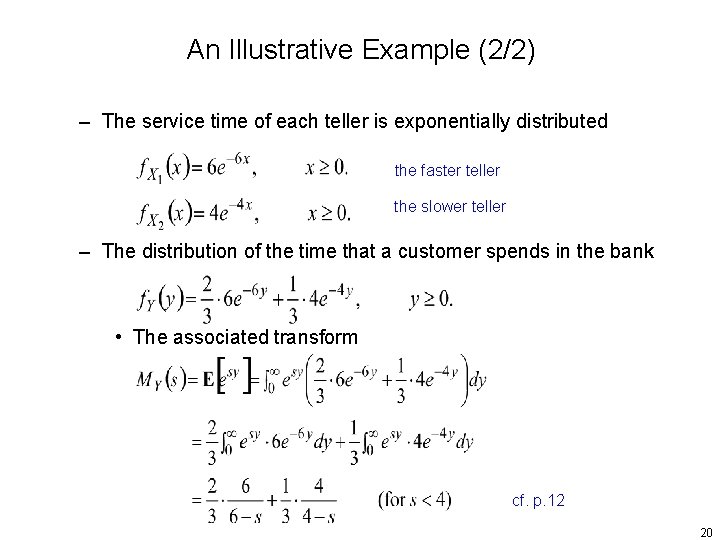
An Illustrative Example (2/2) – The service time of each teller is exponentially distributed the faster teller the slower teller – The distribution of the time that a customer spends in the bank • The associated transform cf. p. 12 20
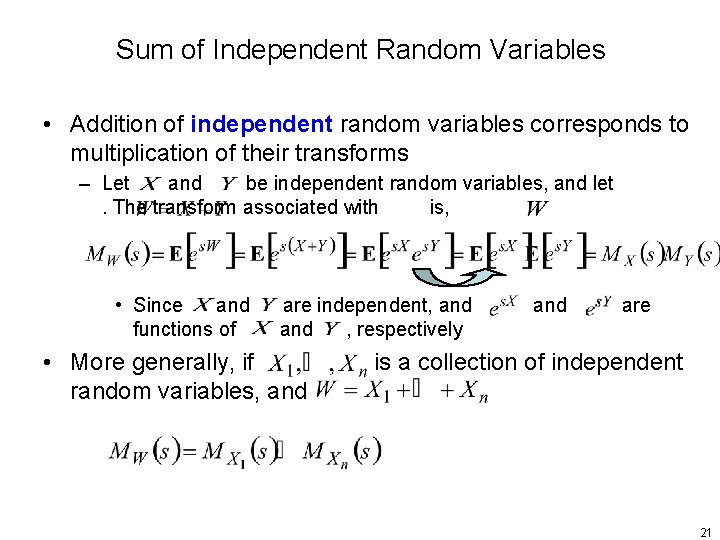
Sum of Independent Random Variables • Addition of independent random variables corresponds to multiplication of their transforms – Let and be independent random variables, and let. The transform associated with is, • Since and functions of are independent, and , respectively • More generally, if random variables, and are is a collection of independent 21
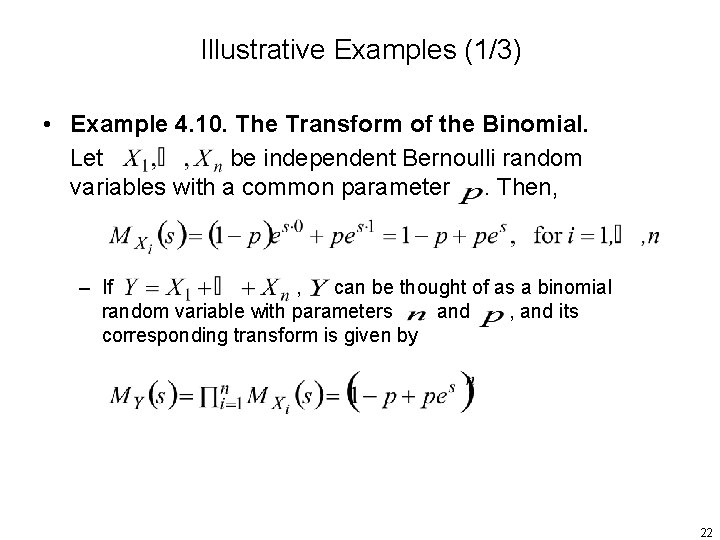
Illustrative Examples (1/3) • Example 4. 10. The Transform of the Binomial. Let be independent Bernoulli random variables with a common parameter. Then, – If , can be thought of as a binomial random variable with parameters and , and its corresponding transform is given by 22
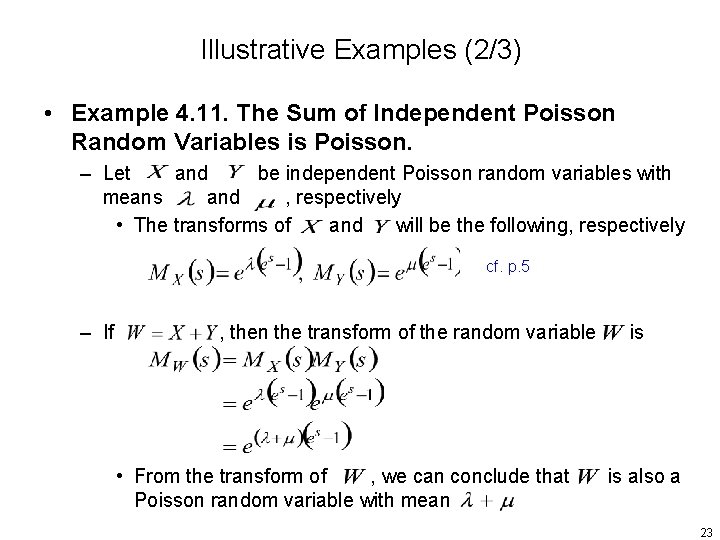
Illustrative Examples (2/3) • Example 4. 11. The Sum of Independent Poisson Random Variables is Poisson. – Let and be independent Poisson random variables with means and , respectively • The transforms of and will be the following, respectively cf. p. 5 – If , then the transform of the random variable • From the transform of , we can conclude that Poisson random variable with mean is is also a 23
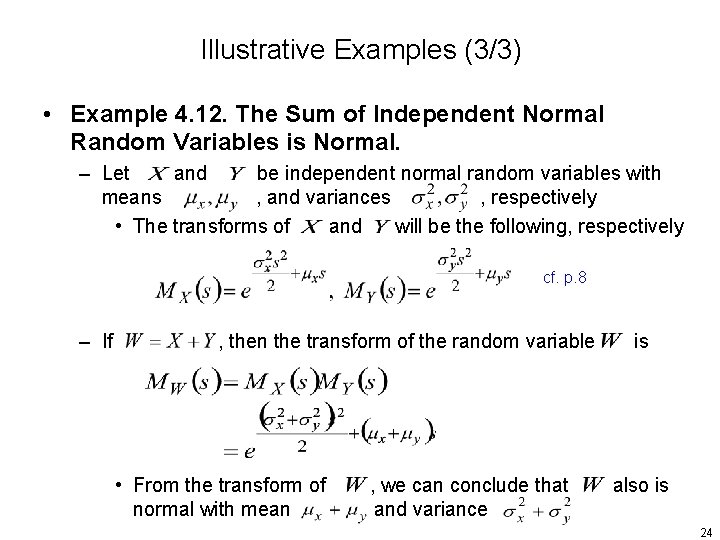
Illustrative Examples (3/3) • Example 4. 12. The Sum of Independent Normal Random Variables is Normal. – Let and be independent normal random variables with means , and variances , respectively • The transforms of and will be the following, respectively cf. p. 8 – If , then the transform of the random variable • From the transform of normal with mean , we can conclude that and variance is also is 24
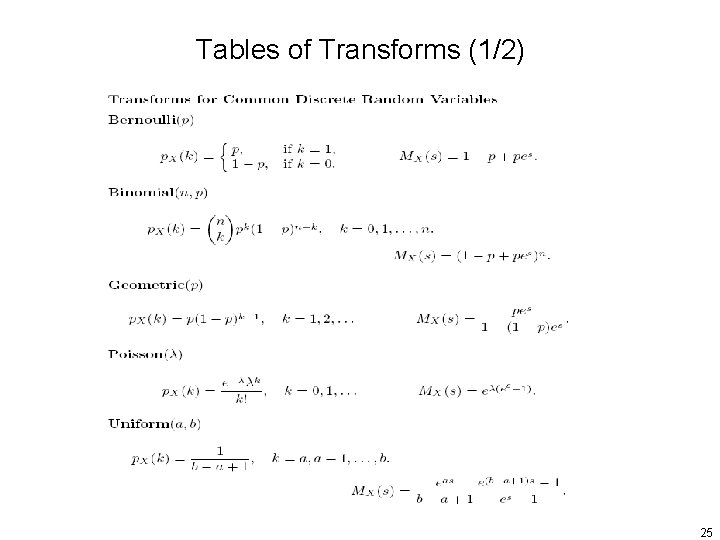
Tables of Transforms (1/2) 25
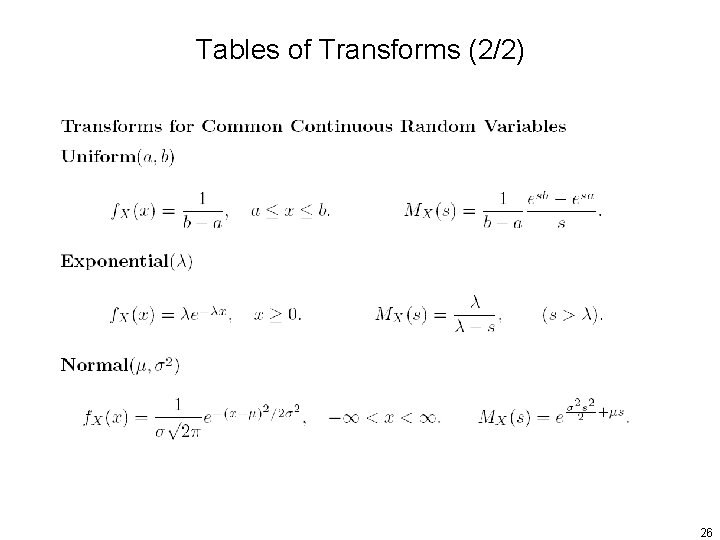
Tables of Transforms (2/2) 26
Recitation • SECTION 4. 1 Transforms – Problems 2, 4, 5, 7, 8 27
- Slides: 27