
Further Topics on Random Variables Conditional Expectation and
Further Topics on Random Variables: Conditional Expectation and Variance Revisited Berlin Chen Department of Computer Science & Information Engineering National Taiwan Normal University Reference: - D. P. Bertsekas, J. N. Tsitsiklis, Introduction to Probability , Section 4. 3
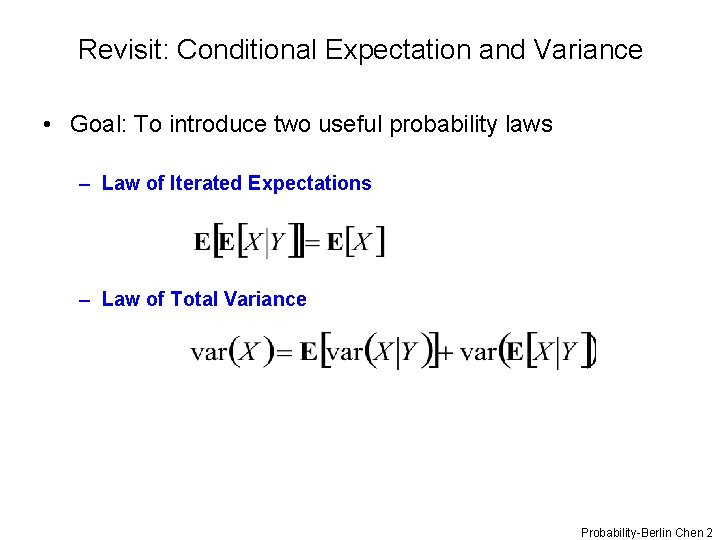
Revisit: Conditional Expectation and Variance • Goal: To introduce two useful probability laws – Law of Iterated Expectations – Law of Total Variance Probability-Berlin Chen 2
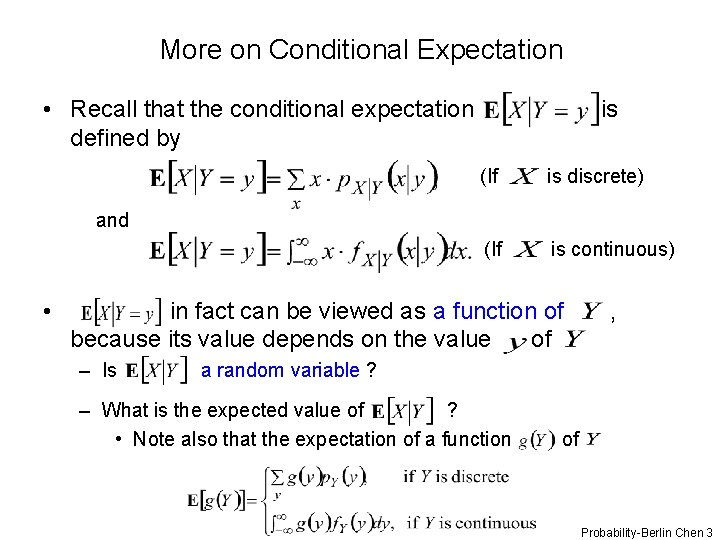
More on Conditional Expectation • Recall that the conditional expectation defined by is (If is discrete) (If is continuous) and • in fact can be viewed as a function of because its value depends on the value of – Is , a random variable ? – What is the expected value of ? • Note also that the expectation of a function of Probability-Berlin Chen 3
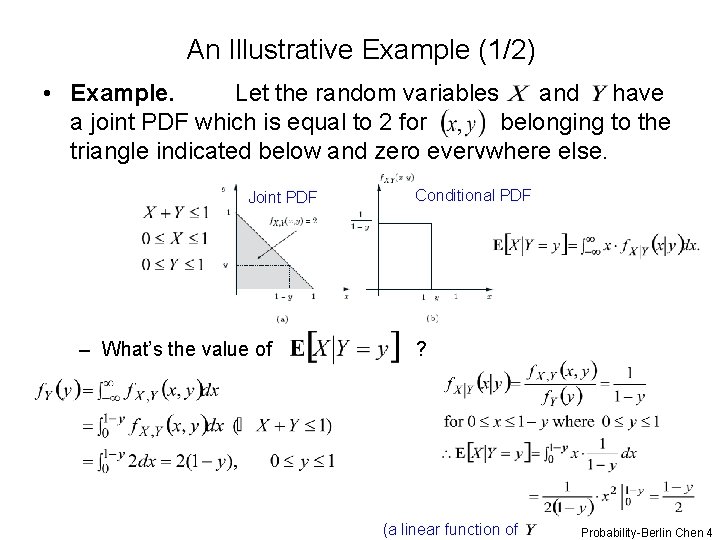
An Illustrative Example (1/2) • Example. Let the random variables and have a joint PDF which is equal to 2 for belonging to the triangle indicated below and zero everywhere else. Joint PDF – What’s the value of Conditional PDF ? (a linear function of Probability-Berlin Chen 4
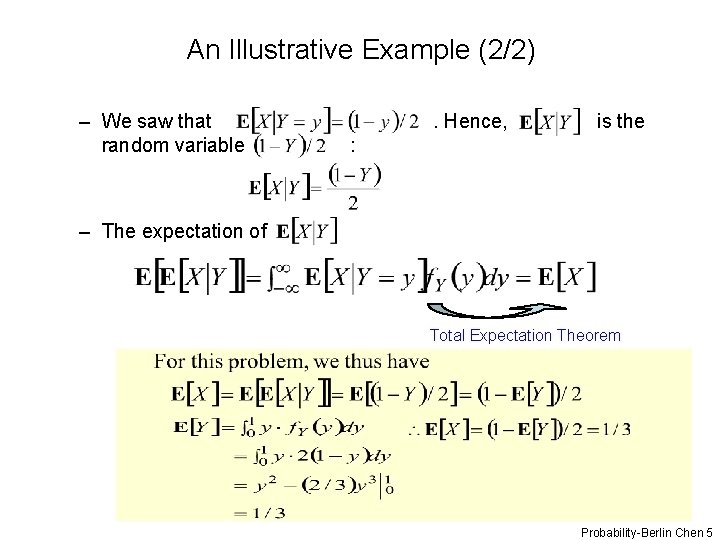
An Illustrative Example (2/2) – We saw that random variable . Hence, is the : – The expectation of Total Expectation Theorem Probability-Berlin Chen 5
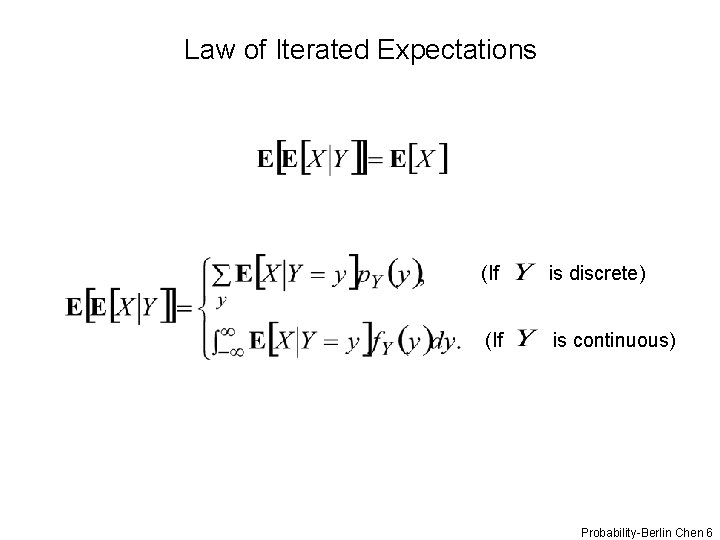
Law of Iterated Expectations (If is discrete) (If is continuous) Probability-Berlin Chen 6
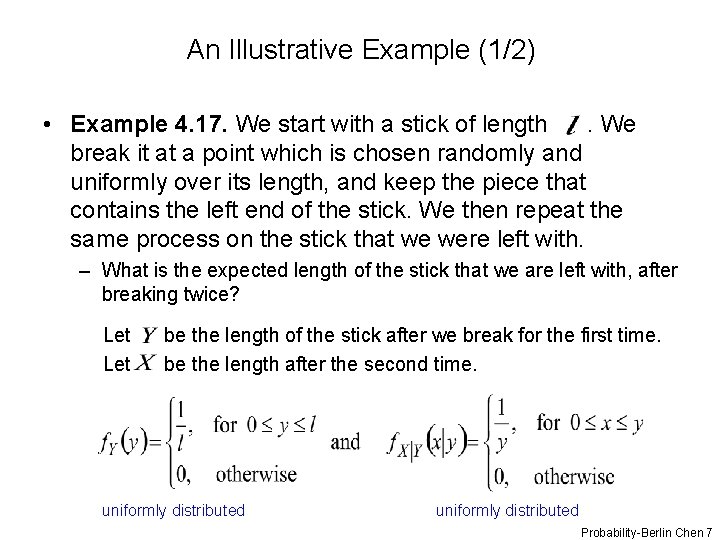
An Illustrative Example (1/2) • Example 4. 17. We start with a stick of length. We break it at a point which is chosen randomly and uniformly over its length, and keep the piece that contains the left end of the stick. We then repeat the same process on the stick that we were left with. – What is the expected length of the stick that we are left with, after breaking twice? Let be the length of the stick after we break for the first time. be the length after the second time. uniformly distributed Probability-Berlin Chen 7
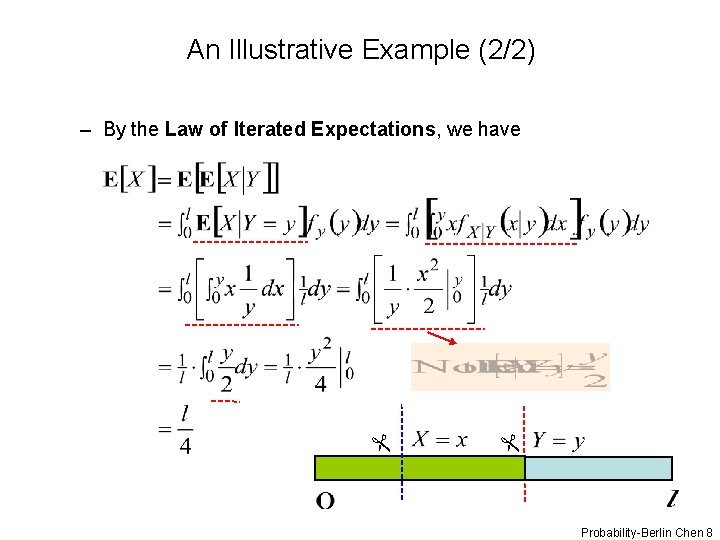
An Illustrative Example (2/2) – By the Law of Iterated Expectations, we have Probability-Berlin Chen 8
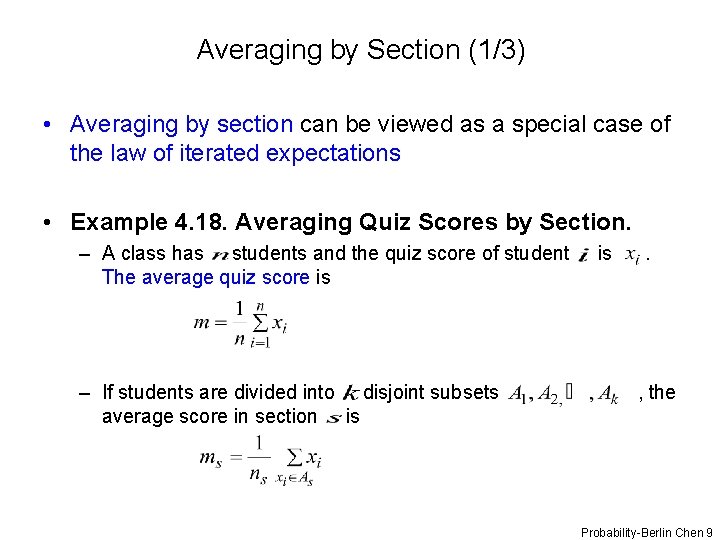
Averaging by Section (1/3) • Averaging by section can be viewed as a special case of the law of iterated expectations • Example 4. 18. Averaging Quiz Scores by Section. – A class has students and the quiz score of student The average quiz score is – If students are divided into disjoint subsets average score in section is is . , the Probability-Berlin Chen 9
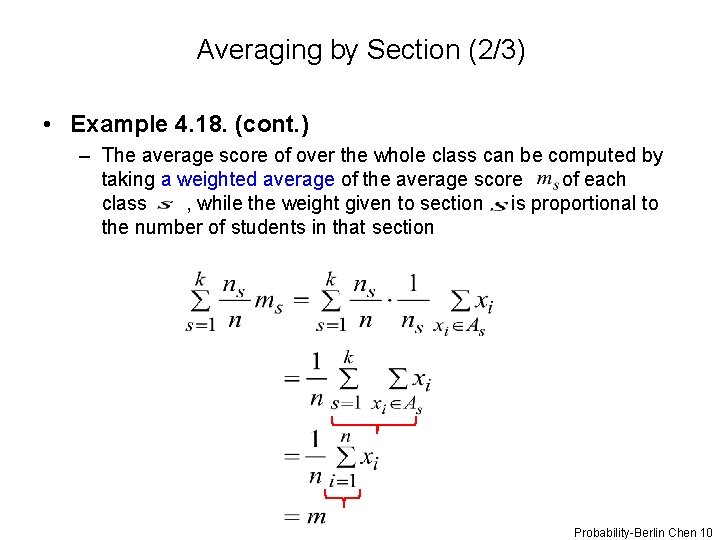
Averaging by Section (2/3) • Example 4. 18. (cont. ) – The average score of over the whole class can be computed by taking a weighted average of the average score of each class , while the weight given to section is proportional to the number of students in that section Probability-Berlin Chen 10
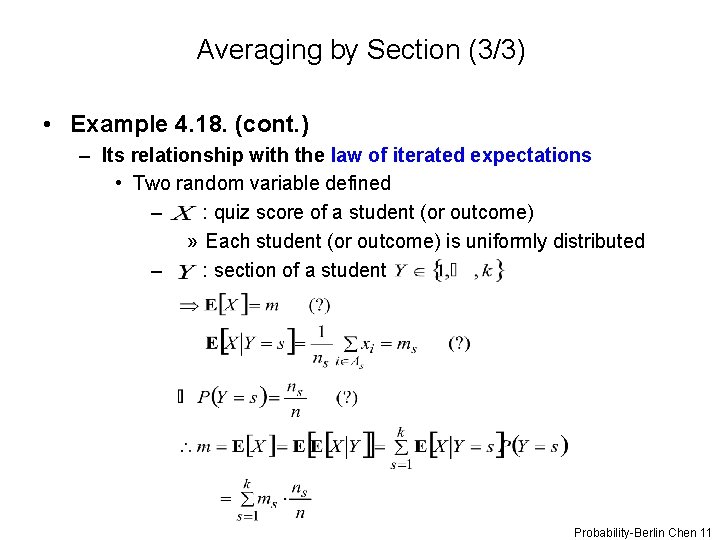
Averaging by Section (3/3) • Example 4. 18. (cont. ) – Its relationship with the law of iterated expectations • Two random variable defined – : quiz score of a student (or outcome) » Each student (or outcome) is uniformly distributed – : section of a student Probability-Berlin Chen 11
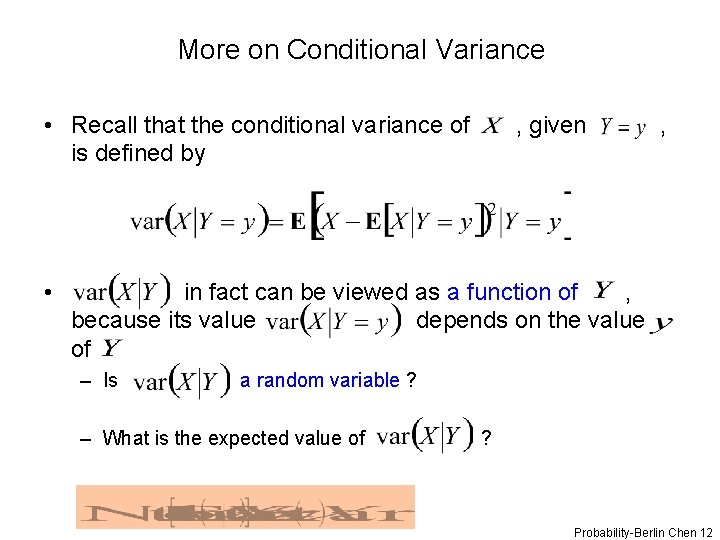
More on Conditional Variance • Recall that the conditional variance of is defined by • , given , in fact can be viewed as a function of , because its value depends on the value of – Is a random variable ? – What is the expected value of ? Probability-Berlin Chen 12
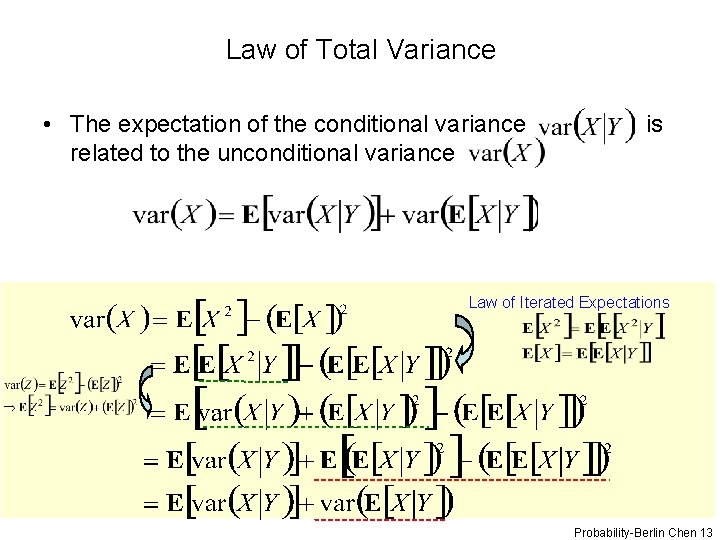
Law of Total Variance • The expectation of the conditional variance related to the unconditional variance is Law of Iterated Expectations Probability-Berlin Chen 13
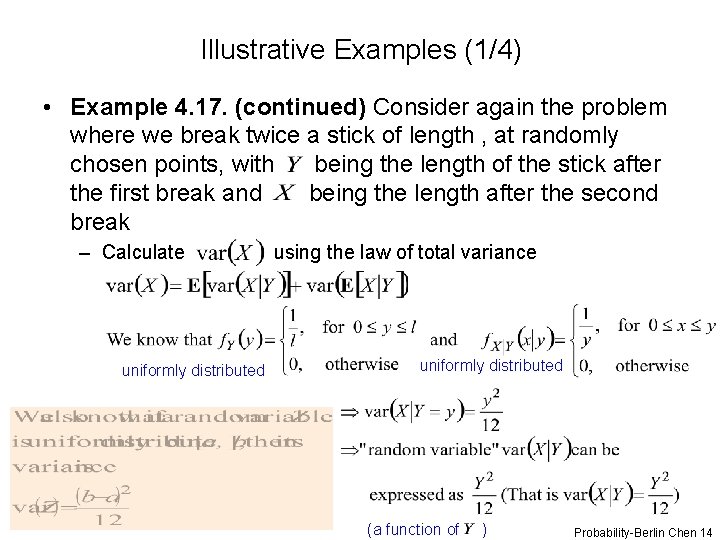
Illustrative Examples (1/4) • Example 4. 17. (continued) Consider again the problem where we break twice a stick of length , at randomly chosen points, with being the length of the stick after the first break and being the length after the second break – Calculate uniformly distributed using the law of total variance uniformly distributed (a function of ) Probability-Berlin Chen 14
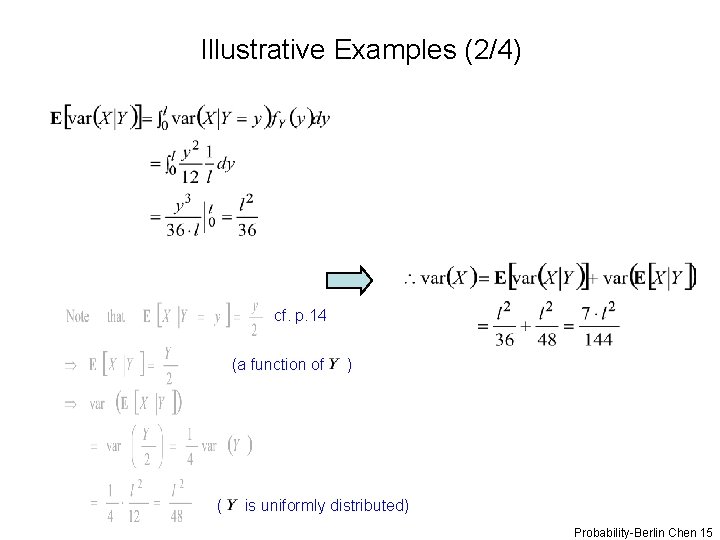
Illustrative Examples (2/4) cf. p. 14 (a function of ( ) is uniformly distributed) Probability-Berlin Chen 15
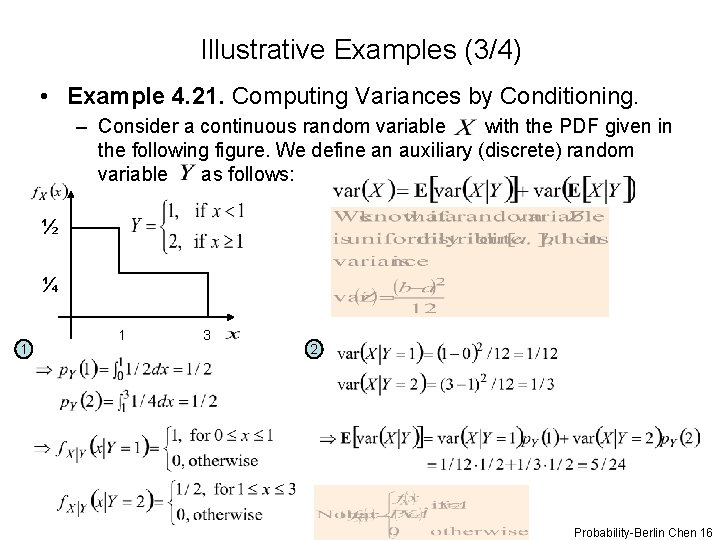
Illustrative Examples (3/4) • Example 4. 21. Computing Variances by Conditioning. – Consider a continuous random variable with the PDF given in the following figure. We define an auxiliary (discrete) random variable as follows: ½ ¼ 1 1 3 2 Probability-Berlin Chen 16
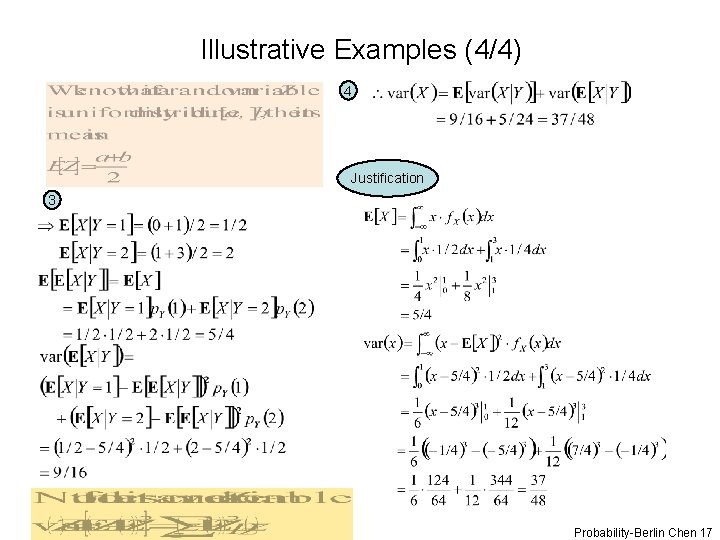
Illustrative Examples (4/4) 4 Justification 3 Probability-Berlin Chen 17
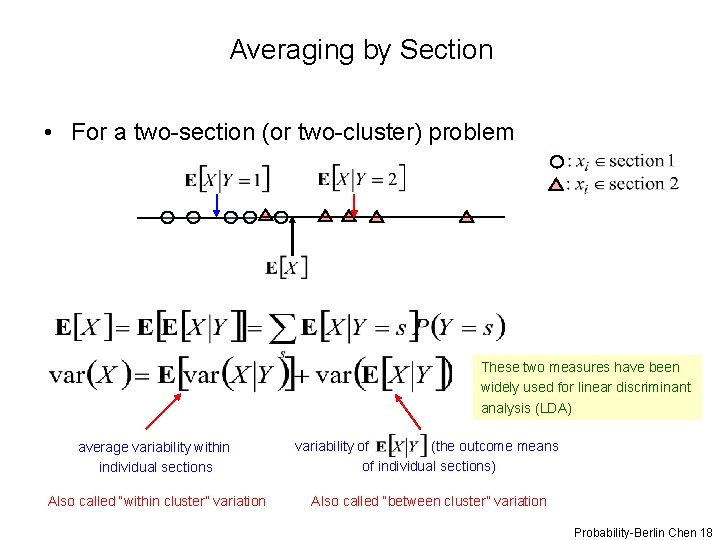
Averaging by Section • For a two-section (or two-cluster) problem These two measures have been widely used for linear discriminant analysis (LDA) average variability within individual sections variability of (the outcome means of individual sections) Also called “within cluster” variation Also called “between cluster” variation Probability-Berlin Chen 18
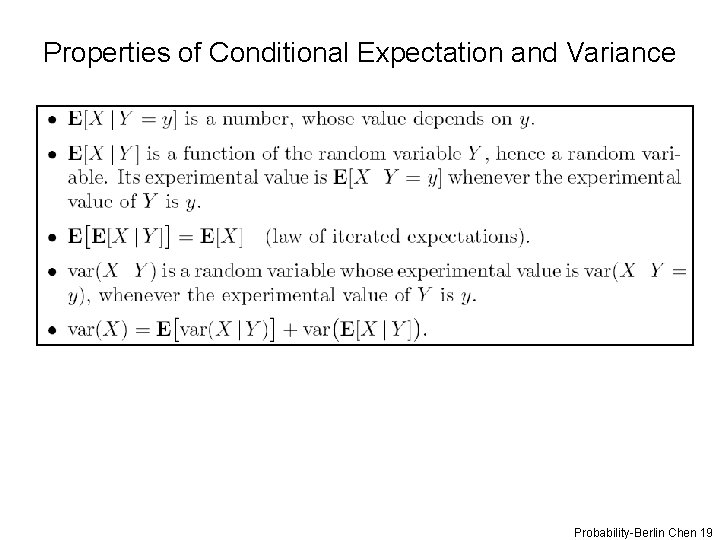
Properties of Conditional Expectation and Variance Probability-Berlin Chen 19
- Slides: 19