
Funding Strategic Initiatives in Academic Technology A Process







- Slides: 23
Funding Strategic Initiatives in Academic Technology A Process for Identifying, Cataloging, and Categorizing IT Needs Campuswide Copyright© D. Tebbetts, T. Winters, 2002. . This work is the intellectual property of the authors. Permission is granted for this material to be shared for non-commercial, educational purposes, provided that this copyright statement appears on the reproduced materials and notice is given that the copying is by permission of the author. To disseminate otherwise or to republish requires written permission from the author.
University of New Hampshire Diane R. Tebbetts, Associate University Librarian (diane. tebbetts@unh. edu) Terri S. Winters, Director, Academic Technology (terri. winters@unh. edu)
Statement of Problem Budgets shrinking while IT needs increasing l Instructional technologies and demand for services in this area are growing l Needs can be discipline-specific and not known or understood by central IT organization l Need to understand these new needs in relation to other needs l
Background on Technology Funding Lack of long-term funding strategies l No attempt to categorize IT needs l Appropriate funding sources unidentified l No matching of funding sources with needs l
Categories of IT Needs Initial expenditures l Recurring costs l
IT Needs Linked to Funding Streams Hardware l Software l Infrastructure (wiring, facilities upgrades, electrical outlets, etc. ) l Telecommunications (networks, data connections, etc. ) l Personnel l
Funding Strategies l Revenue generation Ø User fees Ø Fundraising l Purchasing options Ø Vendor arrangements Ø Leasing/rental Ø Consortia agreements l Other creative approaches
IT Development at UNH l l Background on UNH IT Initiatives Electronic campus initiative (1997) Ø Instituted student technology fee (1999) Ø Created “Academic Technology Liaisons” (2000) Ø Instituted 4 -year faculty desktop replacement program (2001) Ø Began Faculty Instructional Technology Development Grant program (2001) Ø
Library and IT/CIS Collaboration Studio 521 l Library Student Computing Cluster l Blackboard Project l Theme-based conferences l Zeke’s World l
Capital Campaign: Learning Tools/Technology Instructional Technology l University Librarian and AVP for Computing & Information Services charged to identify appropriate projects for the campaign l Project expanded to identification of all academic technological needs across campus l
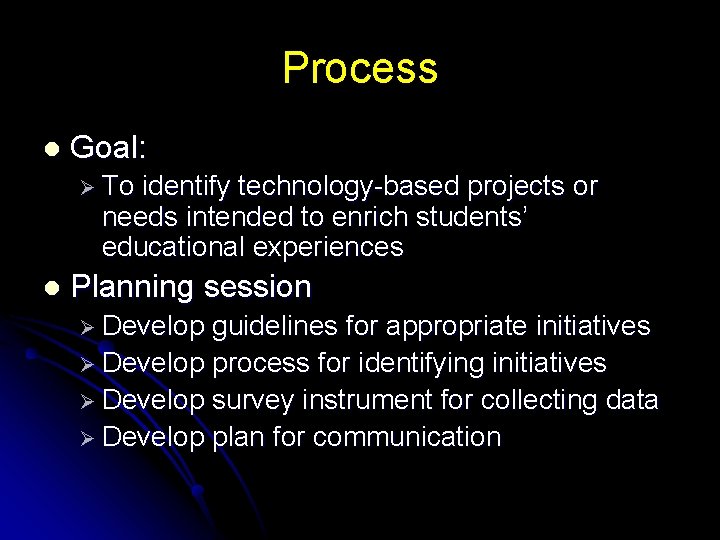
Process l Goal: Ø To identify technology-based projects or needs intended to enrich students’ educational experiences l Planning session Ø Develop guidelines for appropriate initiatives Ø Develop process for identifying initiatives Ø Develop survey instrument for collecting data Ø Develop plan for communication
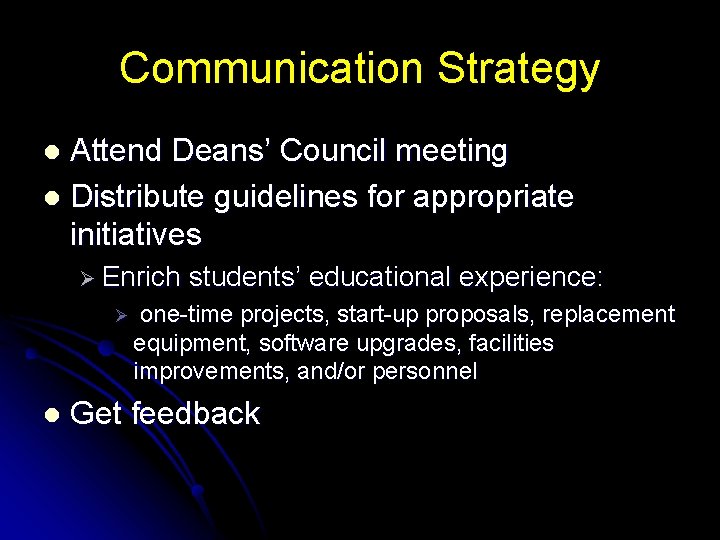
Communication Strategy Attend Deans’ Council meeting l Distribute guidelines for appropriate initiatives l Ø Enrich Ø l students’ educational experience: one-time projects, start-up proposals, replacement equipment, software upgrades, facilities improvements, and/or personnel Get feedback
Feedback l Concerns regarding Ø comparing apples to oranges Ø how judgments regarding worthiness of initiatives would be made Ø how initiatives would be prioritized Ø who would be solicited to put forward initiatives
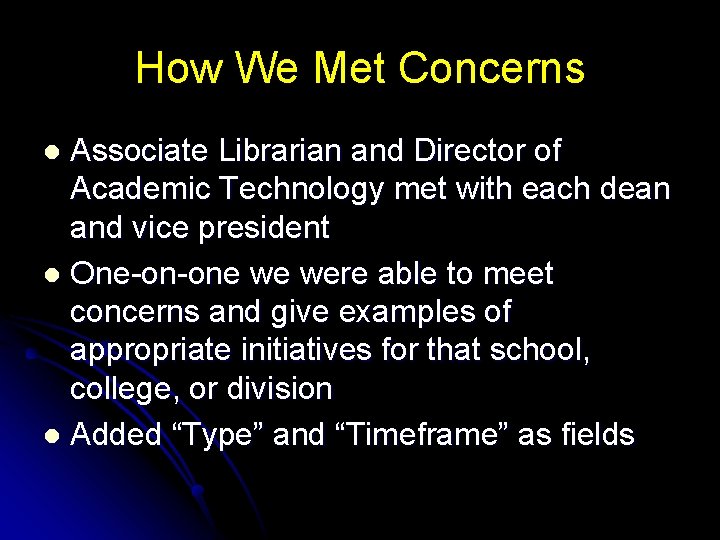
How We Met Concerns Associate Librarian and Director of Academic Technology met with each dean and vice president l One-on-one we were able to meet concerns and give examples of appropriate initiatives for that school, college, or division l Added “Type” and “Timeframe” as fields l
Gathering the Data Participants used a web-based entry form l Data was then dumped into an Access database l
Analysis Received 45 projects l All Stakeholders participated l One-time requests totalled $4, 709, 528 l Ongoing annual costs totalled $1, 480, 344 l
Analysis l 8 Categories identified in data: Ø Digital Resources (56%) Ø Clusters & Instructional Facilities (26%) Ø Personnel (7%) Ø Hardware Upgrades/Replacements (5%) Ø Infrastructure (5%) Ø Instruction Design/Development (1%) Ø Education & Training (1%) Ø Web Development (0. 3%)
Analysis l Initiatives by School/College/Division Library (61%) Ø Engineering (11%) Ø Cooperative Ext (11%) Ø Computing & Info Services (5%) Ø Whittemore School of Business (4%) Ø Liberal Arts (3%) Ø Health & Human Services (3%) Ø Life Sciences (1%) Ø Student Affairs (1%) Ø UNH-Manchester (1%) Ø
Analysis l Timeframes represented in data: Ø 6 -18 months (77%) Ø 18 -36 months (20%) Ø 36+ months (3%)
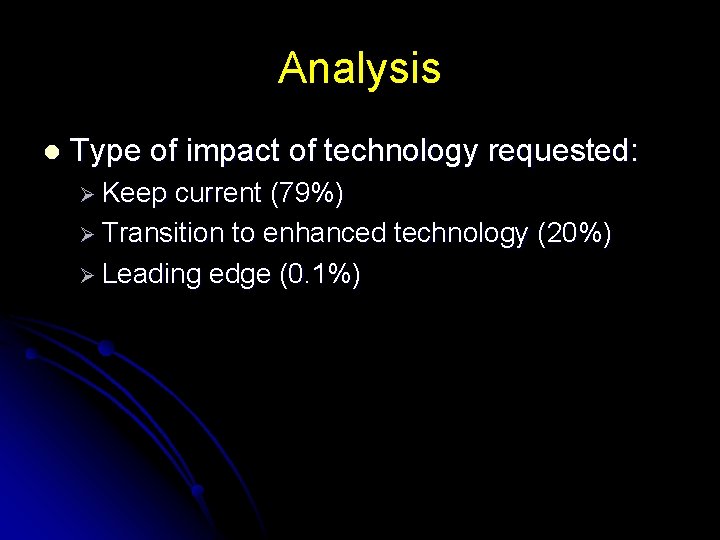
Analysis l Type of impact of technology requested: Ø Keep current (79%) Ø Transition to enhanced technology (20%) Ø Leading edge (0. 1%)
Conclusion Most important part – High level support l Some concrete results – projects funded for Summer 2002 l Lead to more innovative ideas l Ø Ongoing event process Ø Request to Provost, Deans, etc. entered into database l Lead to more long-term, strategic thinking
Next Steps Develop recommendations l Develop ongoing process to keep data updated l Identify cross-college, cross-division needs and forge partnerships l