
Funding Contingency Operations Learning Objectives Terminal Objectives Verify
Funding Contingency Operations
Learning Objectives Terminal Objectives Verify that a Purchase Request document is properly documented and certified Enabling Objectives Identify types of contingency funding Discriminate between various lines of accounting Learn. Perform. Succeed. 11 - 2
Fiscal Law Overview Appropriated funds are subject to three basic fiscal constraints: Time, Purpose, and Amount. Time control includes two major elements: 1 st, appropriations have a definite life span. 2 nd, appropriations normally must be used for needs that arise during their period of availability, “current funds must be used for current needs. ” Purpose statute, prohibits spending money on objects other than those for which appropriations were made. The purpose statute typically refers to the concept of “color of money”. Amount, of paramount concern is ensuring that the Do. D complies with the "Anti-Deficiency Act, " 31 USC § 1341(a), which prohibits obligating or spending money before it is appropriated or in amounts in excess of the amount appropriated. Learn. Perform. Succeed. 11 - 3

Appropriations “The Color of Money” APPROPRIATION CATEGORIES OBLIGATION TIME LIMITS Operations and Maintenance (O&M) One (1) Year Research, Development, Test and Evaluation (RDT&E) Two (2) Years Procurement Three Years Military Construction Five (5) Years Learn. Perform. Succeed. 11 - 4

Appropriation Life-Cycle Account Title Years After Appropriation First Authorized 1 2 3 4 5 6 7 8 9 10 11 12 O&M C E E E X X X RDT&E C C E E E X X X PROCUREME NT C C C E E E X X C C C = Current C C E E =CExpired E MILCON / SCN Available for New Obligations & Payments Learn. Perform. Succeed. Available for Upward Obligations, Adjustments, & Payments on Prior Obligations. • Not Available for New Obligations E E X XE = Canceled X No Longer Available for Upwards Adjustments to Obligations or to Liquidate Recorded Obligations • Closed 11 - 5
![Fiscal Law Constraints Appropriation Act [Title 31, U. S. Code, Sec 1301] • Requires](http://slidetodoc.com/presentation_image_h2/a93eef774b7f13c6a9c2e48d4229855d/image-6.jpg "Fiscal Law Constraints Appropriation Act [Title 31, U. S. Code, Sec 1301] • Requires")
Fiscal Law Constraints Appropriation Act [Title 31, U. S. Code, Sec 1301] • Requires funds to be used only for the purposes and programs for which the appropriation was made • AKA “The Purpose Statute” • Violations are misappropriations Anti-Deficiency Act [Title 31, U. S. Code, Sec 1341 & 1517 ] • Prohibits making or authorizing an obligation in excess of the amount available • Forbids obligation to pay money from the US Treasury in advance of an appropriation • Requires agency to fix responsibility for violations of the Act Bona Fide Needs Rule • Requires funds to be used only for needs or services in the year of the appropriations obligation period Learn. Perform. Succeed. 11 - 6
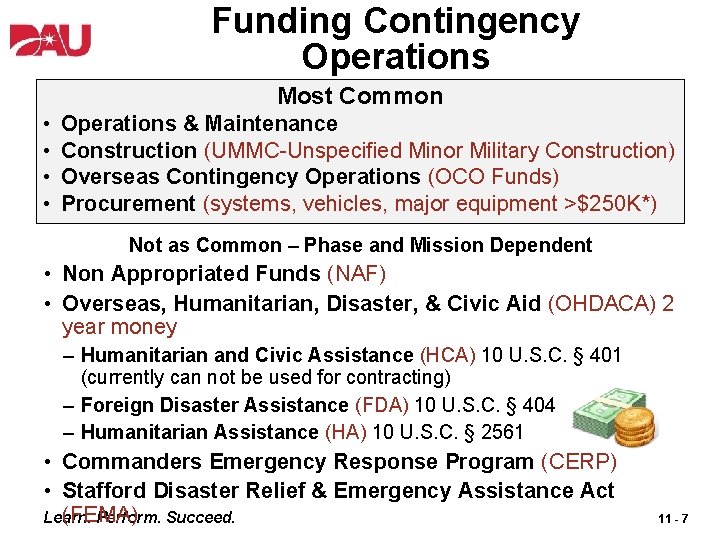
Funding Contingency Operations Most Common • • Operations & Maintenance Construction (UMMC-Unspecified Minor Military Construction) Overseas Contingency Operations (OCO Funds) Procurement (systems, vehicles, major equipment >$250 K*) Not as Common – Phase and Mission Dependent • Non Appropriated Funds (NAF) • Overseas, Humanitarian, Disaster, & Civic Aid (OHDACA) 2 year money – Humanitarian and Civic Assistance (HCA) 10 U. S. C. § 401 (currently can not be used for contracting) – Foreign Disaster Assistance (FDA) 10 U. S. C. § 404 – Humanitarian Assistance (HA) 10 U. S. C. § 2561 • Commanders Emergency Response Program (CERP) • Stafford Disaster Relief & Emergency Assistance Act (FEMA) Learn. Perform. Succeed. 11 - 7
Other O&M Sub-Appropriations Emergency and Extraordinary Expenses (EE&E) 10 U. S. C. § 127. – Funds to pay for any emergency or extraordinary expense which cannot be anticipated or classified – Potential funding source for exercises were purpose is to conduct “interoperability” training with foreign forces – Official Representation Funds (ORF) • O&M subset of EE&E • Used to maintain the standing and prestige of the US by extending courtesies to guests of the Do. D Combatant Commander Initiative Funds (CCIF) 10 U. S. C. § 166 a. – Enables CJCS to support Combatant Commanders to solve emergent challenges and unforeseen contingency requirements critical to joint war fighting (fund contingencies, selected operations, special training, humanitarian assistance, and civic assistance) Joint Combined Exchange Training (JCET) 10 U. S. C. § 2011 – Pay training expenses for SOF forces assigned to a combatant command Learn. Perform. Succeed. 11 - 8
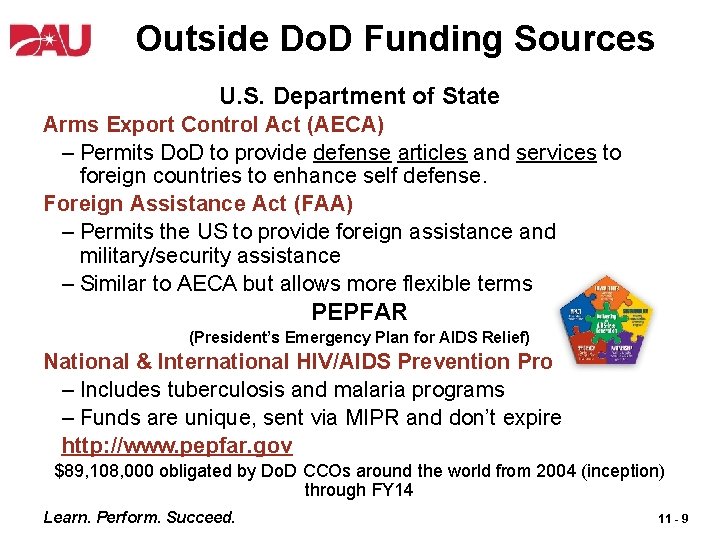
Outside Do. D Funding Sources U. S. Department of State Arms Export Control Act (AECA) – Permits Do. D to provide defense articles and services to foreign countries to enhance self defense. Foreign Assistance Act (FAA) – Permits the US to provide foreign assistance and military/security assistance – Similar to AECA but allows more flexible terms PEPFAR (President’s Emergency Plan for AIDS Relief) National & International HIV/AIDS Prevention Program – Includes tuberculosis and malaria programs – Funds are unique, sent via MIPR and don’t expire http: //www. pepfar. gov $89, 108, 000 obligated by Do. D CCOs around the world from 2004 (inception) through FY 14 Learn. Perform. Succeed. 11 - 9
Foreign Funding Options Foreign Assistance Act of 1961 22 U. S. C. § 2151 • Authorizes US government to furnish commodities and services to friendly foreign countries, includes peacekeeping and disaster relief efforts on a reimbursable basis Section 7 United Nations Participation Act (UNPA) 22 U. S. C. § 287 d-1 • Authorizes US to furnish services, facilities, or other assistance when requested by the United Nations on a reimbursable basis, unless waived by the SECSTATE (after consulting with SECDEF) Acquisition and Cross Servicing Agreement, NATO Mutual Support Act 10 U. S. C. §§ 2341– 23507 (Public Law 96 -323) • Provides Do. D with simplified authority to acquire logistics support without resorting to AECA (Arms 11 Export Control Act) Learn. Perform. Succeed. 10
Construction Funding • Operations and Maintenance or OCO O&M – Projects under $1, 000 ($1 M) – Requires Congressional notification – Projects documented/approved via DD Form 1391 or service component form – Most common contingency construction most CCOs will see • Unspecified Minor Military Construction (UMMC) – $1, 000 to $3 M per project Repair and Maintenance of Real Property • Most – Requires Congressional notification (21 day rule)routine repair and maintenance is not – Projects documented on the DD Form 1391 defined as “construction” and – Is a MILCON appropriation (5 years) therefore O&M is appropriate • Specified Military Construction (MILCON) • However, there are – Projects exceeding $3 M exceptions such as “movement of load – Requires Congressional approval bearing walls” Do your research! 11 Learn. Perform. Succeed. 11 • $4 M if life, health, or safety (LHS) concerns
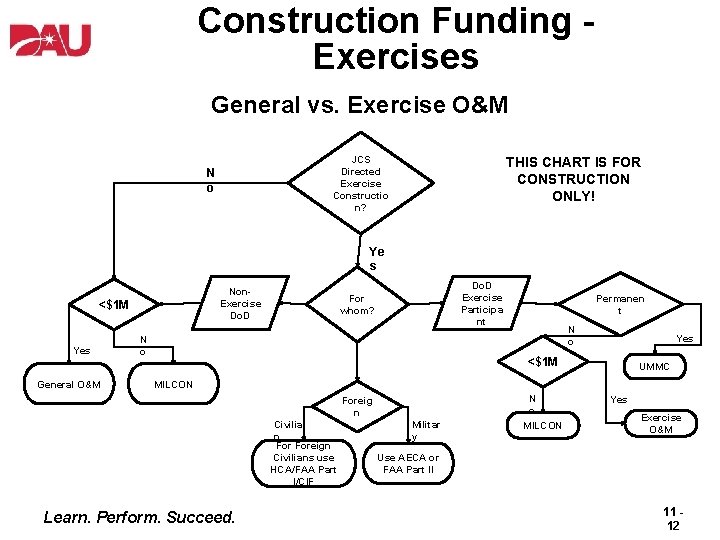
Construction Funding Exercises General vs. Exercise O&M JCS Directed Exercise Constructio n? N o THIS CHART IS FOR CONSTRUCTION ONLY! Ye s Non. Exercise Do. D <$1 M Yes General O&M Do. D Exercise Participa nt For whom? N o Permanen t N o Yes <$1 M UMMC MILCON N o Foreig n Civilia n Foreign Civilians use HCA/FAA Part I/CIF Learn. Perform. Succeed. Militar y MILCON Yes Exercise O&M Use AECA or FAA Part II 11 12
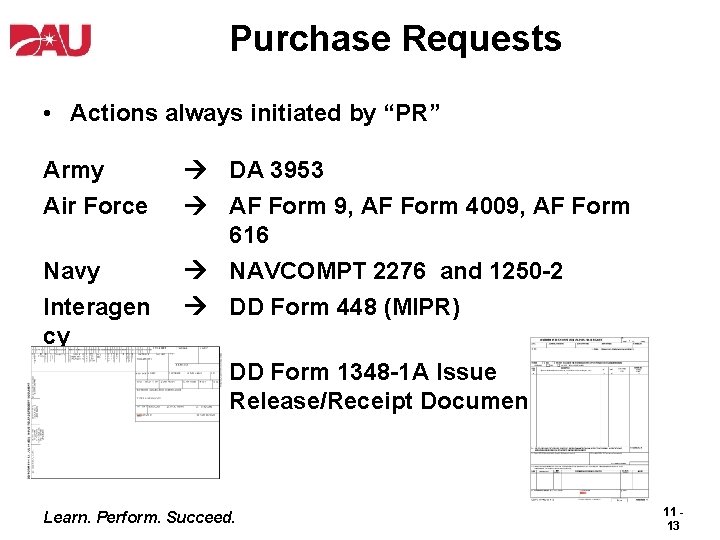
Purchase Requests • Actions always initiated by “PR” Army Air Force Navy Interagen cy Generic DA 3953 AF Form 9, AF Form 4009, AF Form 616 NAVCOMPT 2276 and 1250 -2 DD Form 448 (MIPR) DD Form 1348 -1 A Issue Release/Receipt Document Learn. Perform. Succeed. 11 13
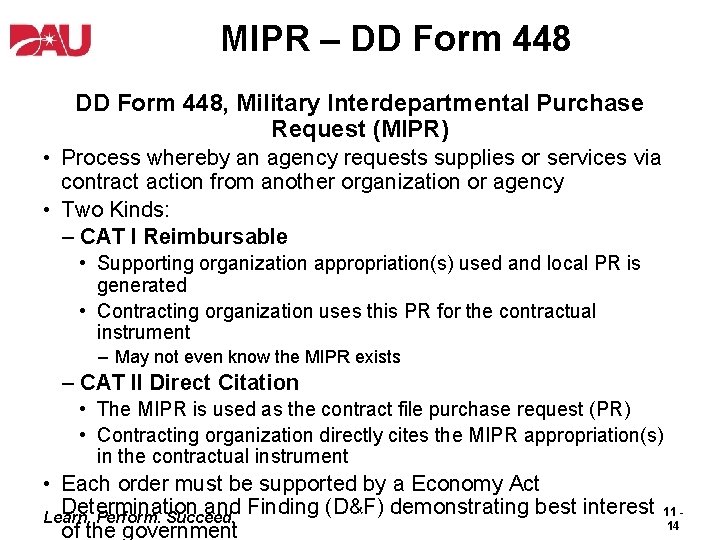
MIPR – DD Form 448, Military Interdepartmental Purchase Request (MIPR) • Process whereby an agency requests supplies or services via contract action from another organization or agency • Two Kinds: – CAT I Reimbursable • Supporting organization appropriation(s) used and local PR is generated • Contracting organization uses this PR for the contractual instrument – May not even know the MIPR exists – CAT II Direct Citation • The MIPR is used as the contract file purchase request (PR) • Contracting organization directly cites the MIPR appropriation(s) in the contractual instrument • Each order must be supported by a Economy Act Determination and Finding (D&F) demonstrating best interest Learn. Perform. Succeed. of the government 11 14
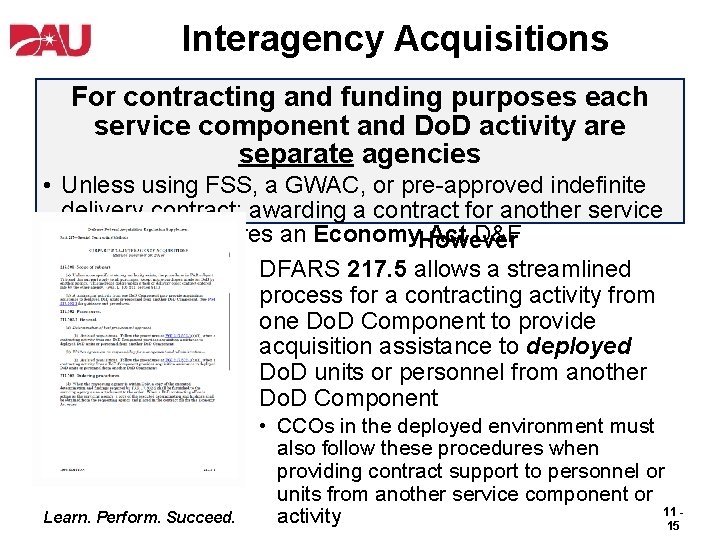
Interagency Acquisitions For contracting and funding purposes each service component and Do. D activity are separate agencies • Unless using FSS, a GWAC, or pre-approved indefinite delivery contract; awarding a contract for another service component requires an Economy. However Act D&F DFARS 217. 5 allows a streamlined process for a contracting activity from one Do. D Component to provide acquisition assistance to deployed Do. D units or personnel from another Do. D Component Learn. Perform. Succeed. • CCOs in the deployed environment must also follow these procedures when providing contract support to personnel or units from another service component or 11 activity 15
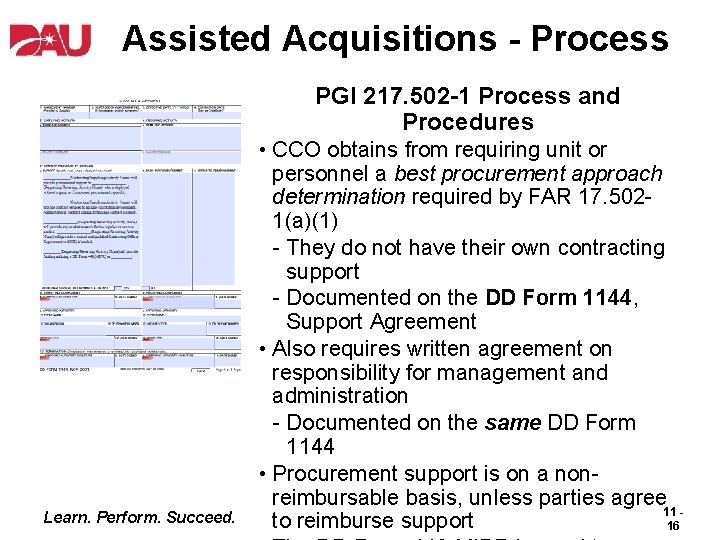
Assisted Acquisitions - Process PGI 217. 502 -1 Process and Procedures Learn. Perform. Succeed. • CCO obtains from requiring unit or personnel a best procurement approach determination required by FAR 17. 5021(a)(1) - They do not have their own contracting support - Documented on the DD Form 1144, Support Agreement • Also requires written agreement on responsibility for management and administration - Documented on the same DD Form 1144 • Procurement support is on a nonreimbursable basis, unless parties agree 11 to reimburse support 16
Preparing the PR • • • What should the PR describe? Who should write the PR? Who should be available for questions? What if there are problems with the PR? Who writes the SOW/ PWS? Who approves the PR? Learn. Perform. Succeed. 11 17
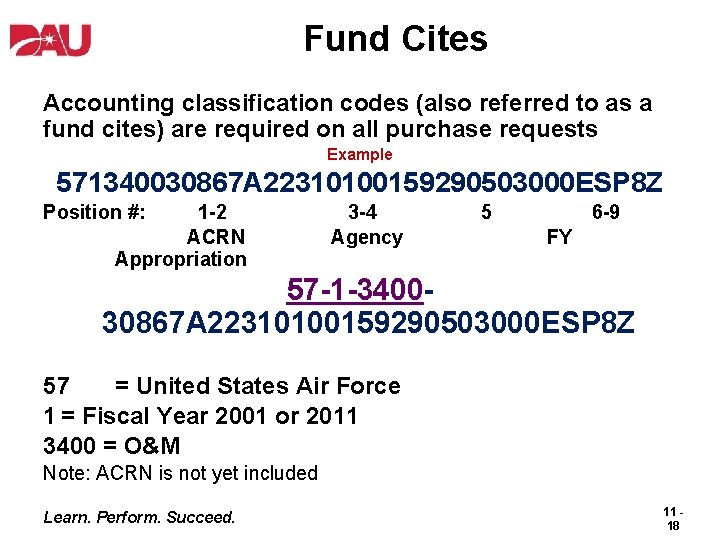
Fund Cites Accounting classification codes (also referred to as a fund cites) are required on all purchase requests Example 571340030867 A 22310100159290503000 ESP 8 Z Position #: 1 -2 ACRN Appropriation 3 -4 Agency 5 6 -9 FY 57 -1 -340030867 A 22310100159290503000 ESP 8 Z 57 = United States Air Force 1 = Fiscal Year 2001 or 2011 3400 = O&M Note: ACRN is not yet included Learn. Perform. Succeed. 11 18
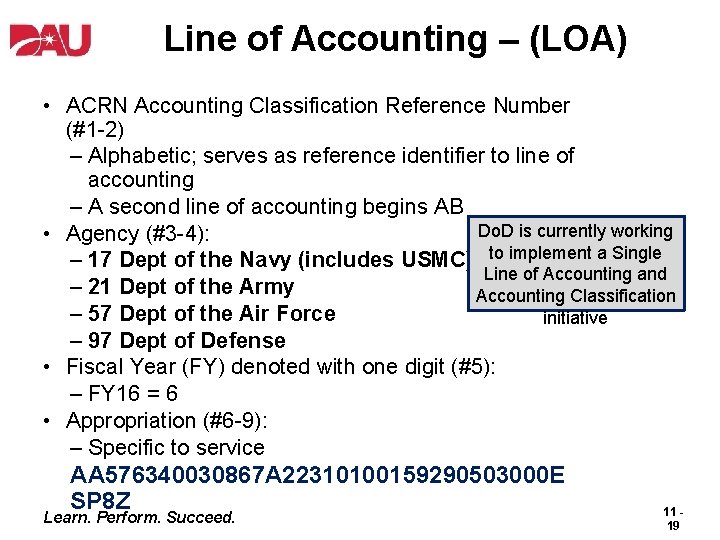
Line of Accounting – (LOA) • ACRN Accounting Classification Reference Number (#1 -2) – Alphabetic; serves as reference identifier to line of accounting – A second line of accounting begins AB Do. D is currently working • Agency (#3 -4): – 17 Dept of the Navy (includes USMC) to implement a Single Line of Accounting and – 21 Dept of the Army Accounting Classification – 57 Dept of the Air Force initiative – 97 Dept of Defense • Fiscal Year (FY) denoted with one digit (#5): – FY 16 = 6 • Appropriation (#6 -9): – Specific to service AA 576340030867 A 22310100159290503000 E SP 8 Z Learn. Perform. Succeed. 11 19
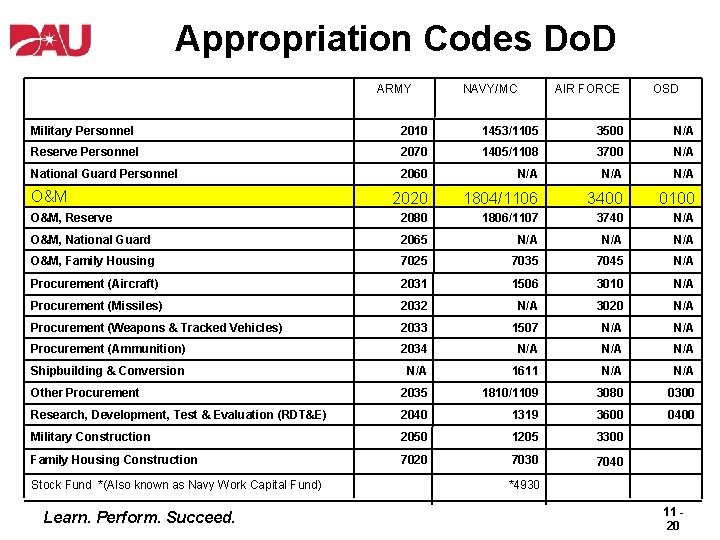
Appropriation Codes Do. D ARMY NAVY/MC AIR FORCE OSD Military Personnel 2010 1453/1105 3500 N/A Reserve Personnel 2070 1405/1108 3700 N/A National Guard Personnel 2060 N/A N/A 2020 1804/1106 3400 0100 O&M, Reserve 2080 1806/1107 3740 N/A O&M, National Guard 2065 N/A N/A O&M, Family Housing 7025 7035 7045 N/A Procurement (Aircraft) 2031 1506 3010 N/A Procurement (Missiles) 2032 N/A 3020 N/A Procurement (Weapons & Tracked Vehicles) 2033 1507 N/A Procurement (Ammunition) 2034 N/A N/A Shipbuilding & Conversion N/A 1611 N/A Other Procurement 2035 1810/1109 3080 0300 Research, Development, Test & Evaluation (RDT&E) 2040 1319 3600 0400 Military Construction 2050 1205 3300 Family Housing Construction 7020 7030 7040 O&M Stock Fund *(Also known as Navy Work Capital Fund) Learn. Perform. Succeed. *4930 11 20
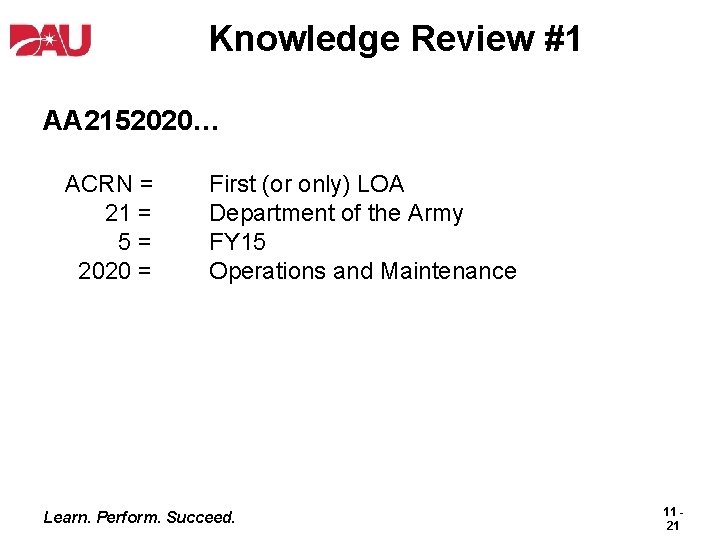
Knowledge Review #1 AA 2152020… ACRN = 21 = 5= 2020 = First (or only) LOA Department of the Army FY 15 Operations and Maintenance Learn. Perform. Succeed. 11 21
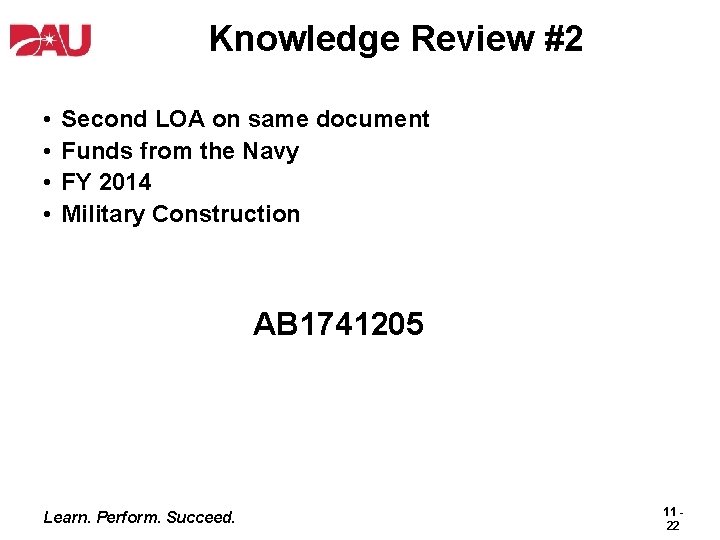
Knowledge Review #2 • • Second LOA on same document Funds from the Navy FY 2014 Military Construction AB 1741205 Learn. Perform. Succeed. 11 22
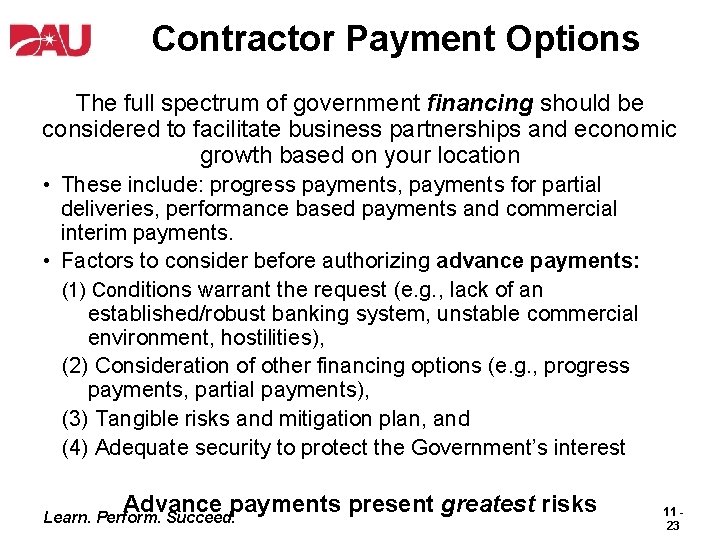
Contractor Payment Options The full spectrum of government financing should be considered to facilitate business partnerships and economic growth based on your location • These include: progress payments, payments for partial deliveries, performance based payments and commercial interim payments. • Factors to consider before authorizing advance payments: (1) Conditions warrant the request (e. g. , lack of an established/robust banking system, unstable commercial environment, hostilities), (2) Consideration of other financing options (e. g. , progress payments, partial payments), (3) Tangible risks and mitigation plan, and (4) Adequate security to protect the Government’s interest Advance payments present greatest risks Learn. Perform. Succeed. 11 23
Contract Payment Important as any other aspect of contract monitoring • 1. Ensure Payment to theis contractor the supplies and services payment made only tofor contractors delivered the Government's obligation under the who performisaccording to contract terms and conditions contract 2. Payment due based on receipt of a proper invoice and satisfactory performance 3. Generally due within 30 days of invoice date or government acceptance Otherwise interest accrues and is due to the contractor 4. Government has seven (7) days from receipt to notify the contractor if invoice is improper 5. Prompt Payment clause needs to be in all contracts * Finally, ensure payment is made to the correct contractor and their “authorized” representative Learn. Perform. Succeed. Three things needed for finance office to pay contractor: 1. Copy of the contract 2. Receiving Report 3. Proper Invoice 11 24
Electronic Invoicing and Payment • DFARS 232. 7002 Policy (a) Contractors shall submit payment requests and receiving reports in electronic form, except for— (2) Awards made to foreign vendors for work performed outside the United States; (4) Contracts awarded by deployed contracting officers in the course of military operations, including, but not limited to, contingency operations as… or humanitarian or peacekeeping operations… or contracts awarded by contracting officers in the conduct of emergency operations, such as responses to natural disasters or national or civil emergencies; • DFARS Clause 252. 232 -7003 (June 2012) – Requires electronic invoicing – Requires electronic supporting documentation – Identifies three acceptable electronic forms for transmission of invoices (WIn. S, WAWF and EDI) – Identifies situations where EC is not required Finance will want to move to EFT as rapidly as 9122 possible! 9122 Learn. Perform. Succeed. 11 25
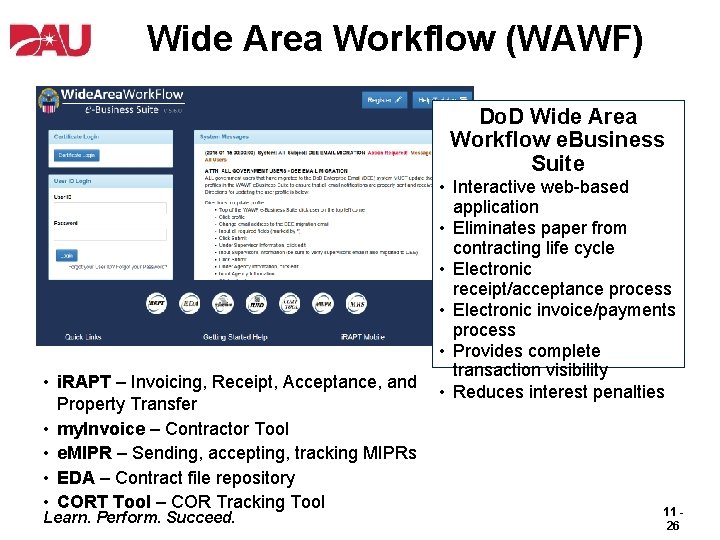
Wide Area Workflow (WAWF) Do. D Wide Area Workflow e. Business Suite • i. RAPT – Invoicing, Receipt, Acceptance, and Property Transfer • my. Invoice – Contractor Tool • e. MIPR – Sending, accepting, tracking MIPRs • EDA – Contract file repository • CORT Tool – COR Tracking Tool Learn. Perform. Succeed. • Interactive web-based application • Eliminates paper from contracting life cycle • Electronic receipt/acceptance process • Electronic invoice/payments process • Provides complete transaction visibility • Reduces interest penalties 11 26
- Slides: 26