
Funded by the European Union A8 EU External

Funded by the European Union A-8 EU External Competence Lecturer: Implemented by a Consortium led by GFA Consulting Group Gmb. H
Funded by the European Union Aims of the module • To familiarize participants with external competences of the European Union, • To enhance the general knowledge of EU external policies among the Ukrainian civil servants, • To facilitate understanding of the EU’s external policies and contractual relations with third countries. Implemented by a Consortium led by GFA Consulting Group Gmb. H
Funded by the European Union Horizontal objectives of EU External Action • Article 3 TEU (general objectives): ‘The Union's aim is to promote peace, its values and the well-being of its peoples’, • Article 21 TEU (specific objectives): inter alia, seeking to develop relations and build partnerships with third countries, promotion of multilateral solutions to common problems. Implemented by a Consortium led by GFA Consulting Group Gmb. H
Funded by the European Union Principles of the EU External Action Principle of sincere co-operation (Article 4(3) TEU): “the Union and the Member States shall, in full mutual respect, assist each other in carrying out tasks which flow from the Treaties. The Member States shall take any appropriate measure, general or particular, to ensure fulfilment of the obligations arising out of the Treaties or resulting from the acts of the institutions of the Union. The Member States shall facilitate the achievement of the Union's tasks and refrain from any measure which could jeopardise the attainment of the Union's objectives”. Implemented by a Consortium led by GFA Consulting Group Gmb. H
Funded by the European Union Principles of the EU External Policy Principle of coherence (Article 7 TFEU): “The Union shall ensure consistency between its policies and activities, taking all of its objectives into account and in accordance with the principle of conferral of powers. ” Implemented by a Consortium led by GFA Consulting Group Gmb. H
Funded by the European Union EU external competences • EU internally and externally operates under the principle of attributed powers (conferral), • Catalogue is available in Articles 3 -6 Treaty on the Functioning of the European Union (Tf. EU), • In case of external action, it codifies the case-law of the Court of Justice. Implemented by a Consortium led by GFA Consulting Group Gmb. H
Funded by the European Union EU external competences • The key question is if the EU has the competence and what is its character, • Note: EU external competence can be either explicit (regulated in the Founding Treaties) or implicit, • Note: EU may have an exclusive competence or it shares it with the Member States, • The system has evolved qua jurisprudence of the Court of Justice and revisions of the Founding Treaties. Implemented by a Consortium led by GFA Consulting Group Gmb. H
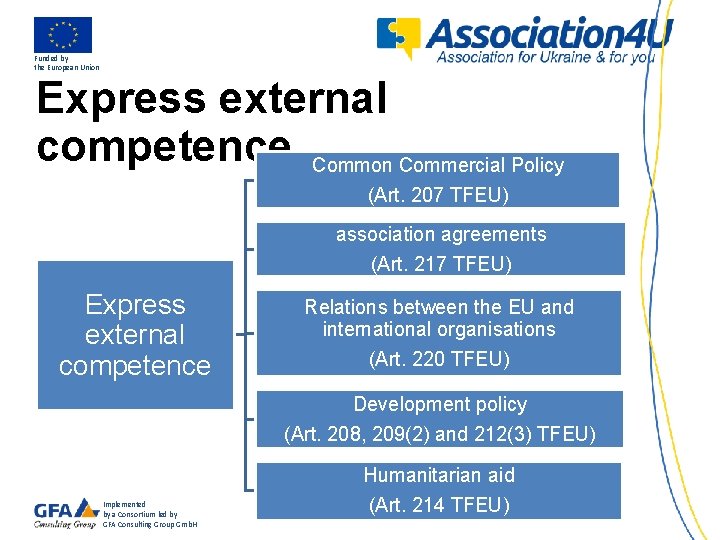
Funded by the European Union Express external competence Common Commercial Policy (Art. 207 TFEU) association agreements (Art. 217 TFEU) Express external competence Relations between the EU and international organisations (Art. 220 TFEU) Development policy (Art. 208, 209(2) and 212(3) TFEU) Implemented by a Consortium led by GFA Consulting Group Gmb. H Humanitarian aid (Art. 214 TFEU)
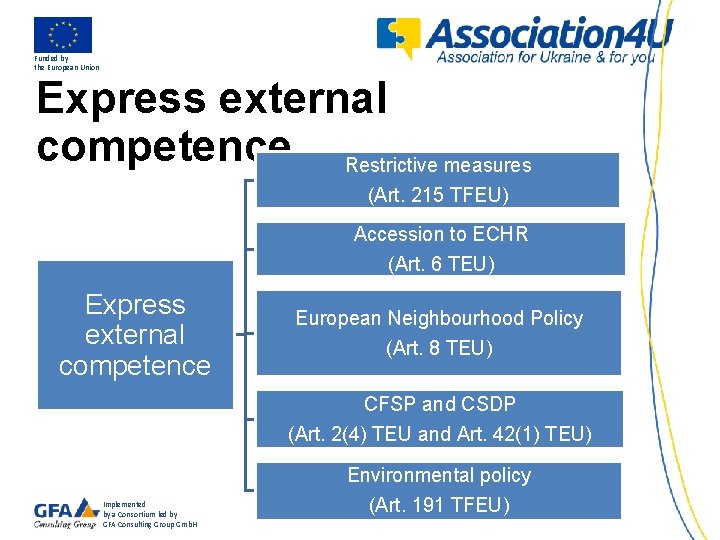
Funded by the European Union Express external competence Restrictive measures (Art. 215 TFEU) Accession to ECHR (Art. 6 TEU) Express external competence European Neighbourhood Policy (Art. 8 TEU) CFSP and CSDP (Art. 2(4) TEU and Art. 42(1) TEU) Implemented by a Consortium led by GFA Consulting Group Gmb. H Environmental policy (Art. 191 TFEU)
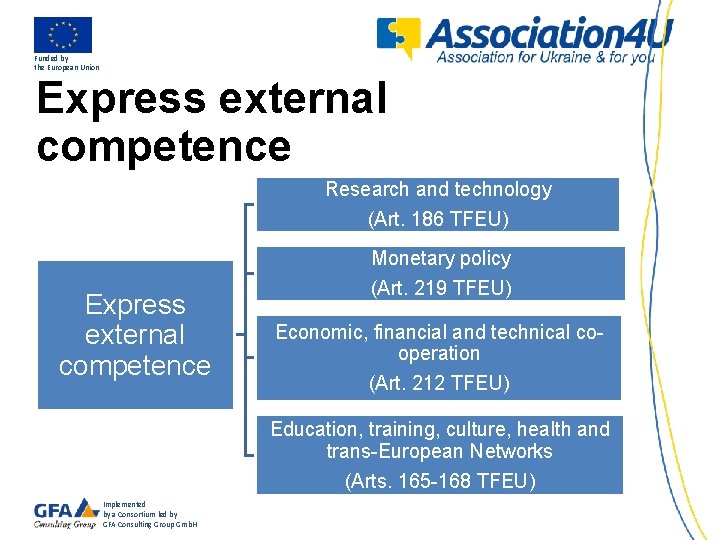
Funded by the European Union Express external competence Research and technology (Art. 186 TFEU) Express external competence Monetary policy (Art. 219 TFEU) Economic, financial and technical cooperation (Art. 212 TFEU) Education, training, culture, health and trans-European Networks (Arts. 165 -168 TFEU) Implemented by a Consortium led by GFA Consulting Group Gmb. H
Funded by the European Union EU implied external competence • • The EU is empowered to conclude international agreements necessary for attainment of internal objectives even in the absence of expressed competence in the founding treaties (Case Kramer [1976], Opinions 1/76, 2/91), The EU implied external competence depends on actual exercise of its internal competence not their mere existence (Opinion 1/94 WTO), The actual exercise could be either before or after an international agreement is concluded – if it was impossible to adopt these measures before (Open Skies Case), ‘an area which is already covered to a large extent by Community rules’ (Opinion 2/91). Implemented by a Consortium led by GFA Consulting Group Gmb. H
Funded by the European Union EU implied external competence • Principle of parallelism: the EU external competence mirrors the EU internal competence, • The EU implied external competence could be either exclusive or shared (Opinion 1/03 Lugano); • Where the EU exercised its powers internally then it gives rise to the EU exclusive external competence when it is needed “to preserve the effectiveness of EC law and the proper functioning of its rules…Account must be taken not only of the area covered by [EU] rules and by the provisions of [an agreement] but also of content and nature of those rules and provisions, to ensure that the agreement is not capable of undermining the uniform and consistent application of [EU] rules and the proper functioning of the system they establish” (Opinion 1/03 Lugano). Implemented by a Consortium led by GFA Consulting Group Gmb. H
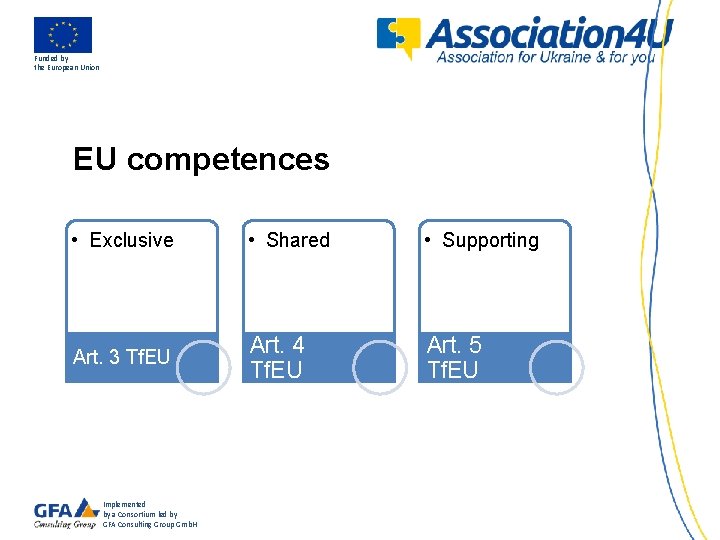
Funded by the European Union EU competences • Exclusive • Shared • Supporting Art. 3 Tf. EU Art. 4 Tf. EU Art. 5 Tf. EU Implemented by a Consortium led by GFA Consulting Group Gmb. H
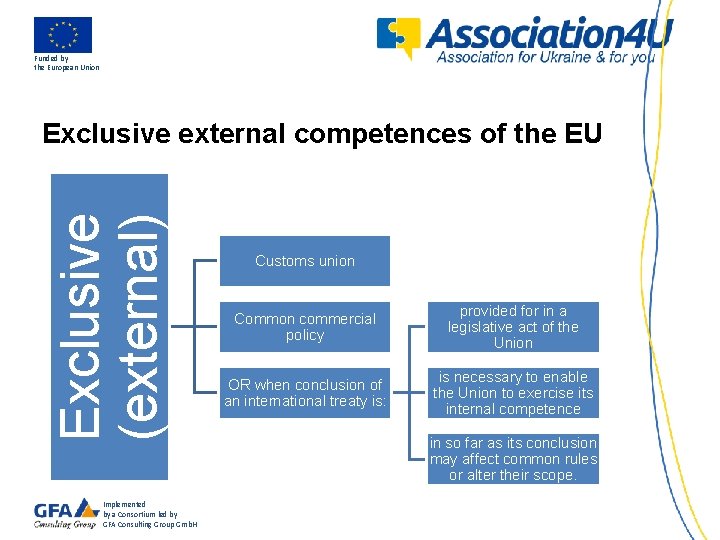
Funded by the European Union Exclusive (external) Exclusive external competences of the EU Implemented by a Consortium led by GFA Consulting Group Gmb. H Customs union Common commercial policy provided for in a legislative act of the Union OR when conclusion of an international treaty is: is necessary to enable the Union to exercise its internal competence in so far as its conclusion may affect common rules or alter their scope.
Funded by the European Union Things to remember • EU operates under the principle of conferral – it can only do when it is permitted to do so in the EU Treaties, • Competences are divided into three main categories: exclusive, shared and supporting, • In external relations EU’s competence is either explicitly regulated in the Founding Treaties or it is implied, • All of this has implications for Ukraine: it determines the scope and depth of EU secondary legislation that Ukraine has to Implemented by a Consortium led by GFA Consulting Group Gmb. H
- Slides: 15