
FUNDAMENTALS OF WELDING 1 Overview of Welding Technology
- Slides: 25
FUNDAMENTALS OF WELDING 1. Overview of Welding Technology 2. The Weld Joint © 2007 John Wiley & Sons, Inc. M P Groover, Fundamentals of Modern Manufacturing 3/e
Joining and Assembly Distinguished Joining - welding, brazing, soldering, and adhesive bonding § These processes form a permanent joint between parts Assembly - mechanical methods (usually) of fastening parts together § Some of these methods allow for easy disassembly, while others do not © 2007 John Wiley & Sons, Inc. M P Groover, Fundamentals of Modern Manufacturing 3/e
Welding Joining process in which two (or more) parts are coalesced at their contacting surfaces by application of heat and/or pressure § Many welding processes are accomplished by heat alone, with no pressure applied § Others by a combination of heat and pressure § Still others by pressure alone with no external heat § In some welding processes a filler material is added to facilitate coalescence © 2007 John Wiley & Sons, Inc. M P Groover, Fundamentals of Modern Manufacturing 3/e
Why Welding is Important § Provides a permanent joint § Welded components become a single entity § Usually the most economical way to join parts in terms of material usage and fabrication costs § Mechanical fastening usually requires additional hardware components (e. g. , screws and nuts) and geometric alterations of the parts being assembled (e. g. , holes) § Not restricted to a factory environment § Welding can be accomplished "in the field" © 2007 John Wiley & Sons, Inc. M P Groover, Fundamentals of Modern Manufacturing 3/e
Limitations and Drawbacks of Welding § Most welding operations are performed manually and are expensive in terms of labor cost § Most welding processes utilize high energy and are inherently dangerous § Welded joints do not allow for convenient disassembly § Welded joints can have quality defects that are difficult to detect © 2007 John Wiley & Sons, Inc. M P Groover, Fundamentals of Modern Manufacturing 3/e
Faying Surfaces in Welding The part surfaces in contact or close proximity that are being joined § Welding involves localized coalescence of the two metallic parts at their faying surfaces § Welding is usually performed on parts made of the same metal § However, some welding operations can be used to join dissimilar metals © 2007 John Wiley & Sons, Inc. M P Groover, Fundamentals of Modern Manufacturing 3/e
Types of Welding Processes § Some 50 different types of welding processes have been catalogued by the American Welding Society (AWS) § Welding processes can be divided into two major categories: § Fusion welding § Solid state welding © 2007 John Wiley & Sons, Inc. M P Groover, Fundamentals of Modern Manufacturing 3/e
Fusion Welding Joining processes that melt the base metals § In many fusion welding operations, a filler metal is added to the molten pool to facilitate the process and provide bulk and added strength to the welded joint § A fusion welding operation in which no filler metal is added is called an autogenous weld © 2007 John Wiley & Sons, Inc. M P Groover, Fundamentals of Modern Manufacturing 3/e
Some Fusion Welding Processes § Arc welding (AW) – melting of the metals is accomplished by electric arc § Resistance welding (RW) ‑ melting is accomplished by heat from resistance to an electrical current between faying surfaces held together under pressure § Oxyfuel gas welding (OFW) ‑ melting is accomplished by an oxyfuel gas such as acetylene © 2007 John Wiley & Sons, Inc. M P Groover, Fundamentals of Modern Manufacturing 3/e
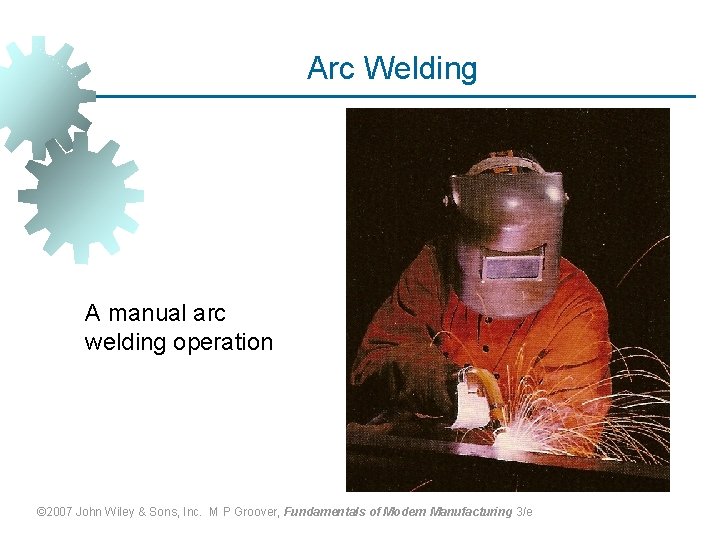
Arc Welding A manual arc welding operation © 2007 John Wiley & Sons, Inc. M P Groover, Fundamentals of Modern Manufacturing 3/e
Solid State Welding Joining processes in which coalescence results from application of pressure alone or a combination of heat and pressure § If heat is used, temperature is below melting point of metals being welded § No filler metal is added in solid state welding © 2007 John Wiley & Sons, Inc. M P Groover, Fundamentals of Modern Manufacturing 3/e
Some Solid State Welding Processes § Diffusion welding (DFW) –coalescence is by solid state fusion between two surfaces held together under pressure at elevated temperature § Friction welding (FRW) ‑ coalescence by heat of friction between two surfaces § Ultrasonic welding (USW) ‑ coalescence by ultrasonic oscillating motion in a direction parallel to contacting surfaces of two parts held together under pressure © 2007 John Wiley & Sons, Inc. M P Groover, Fundamentals of Modern Manufacturing 3/e
Principal Applications of Welding § Construction - buildings and bridges § Piping, pressure vessels, boilers, and storage tanks § Shipbuilding § Aircraft and aerospace § Automotive § Railroad © 2007 John Wiley & Sons, Inc. M P Groover, Fundamentals of Modern Manufacturing 3/e
Welder and Fitter § Welder - manually controls path or placement of welding gun § Often assisted by second worker, called a fitter, who arranges the parts prior to welding § Welding fixtures and positioners are used to assist in this function © 2007 John Wiley & Sons, Inc. M P Groover, Fundamentals of Modern Manufacturing 3/e
The Safety Issue § Welding is inherently dangerous to human workers § High temperatures of molten metals § In gas welding, fuels (e. g. , acetylene) are a fire hazard § Many welding processes use electrical power, so electrical shock is a hazard © 2007 John Wiley & Sons, Inc. M P Groover, Fundamentals of Modern Manufacturing 3/e
Special Hazards in Arc Welding § Ultraviolet radiation emitted in arc welding is injurious to human vision § Welder must wear a special helmet with a dark viewing window § Filters out dangerous radiation but welder is blind except when arc is struck § Sparks, spatters of molten metal, smoke, and fumes add to the risks § Ventilation needed to exhaust dangerous fumes from fluxes and molten metals © 2007 John Wiley & Sons, Inc. M P Groover, Fundamentals of Modern Manufacturing 3/e
Automation in Welding § Because of the hazards of manual welding, and to increase productivity and improve quality, various forms of mechanization and automation are used § Machine welding – mechanized welding under supervision and control of human operator § Automatic welding – equipment performs welding without operator control § Robotic welding - automatic welding implemented by industrial robot © 2007 John Wiley & Sons, Inc. M P Groover, Fundamentals of Modern Manufacturing 3/e
The Weld Joint The junction of the edges or surfaces of parts that have been joined by welding § Two issues about weld joints: § Types of joints § Types of welds used to join the pieces that form the joints © 2007 John Wiley & Sons, Inc. M P Groover, Fundamentals of Modern Manufacturing 3/e
Five Types of Joints 1. 2. 3. 4. 5. Butt joint Corner joint Lap joint Tee joint Edge joint © 2007 John Wiley & Sons, Inc. M P Groover, Fundamentals of Modern Manufacturing 3/e
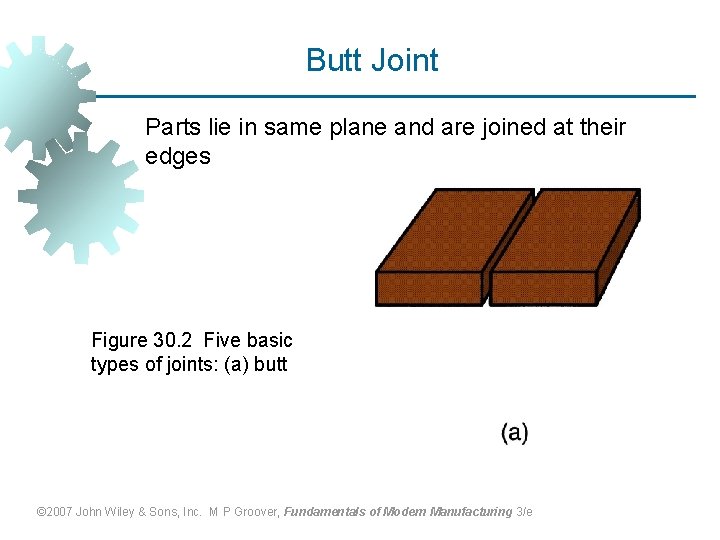
Butt Joint Parts lie in same plane and are joined at their edges Figure 30. 2 Five basic types of joints: (a) butt © 2007 John Wiley & Sons, Inc. M P Groover, Fundamentals of Modern Manufacturing 3/e
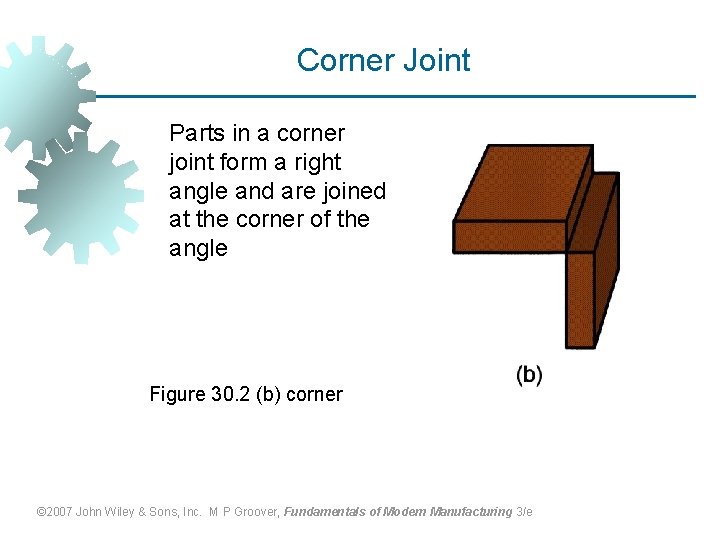
Corner Joint Parts in a corner joint form a right angle and are joined at the corner of the angle Figure 30. 2 (b) corner © 2007 John Wiley & Sons, Inc. M P Groover, Fundamentals of Modern Manufacturing 3/e
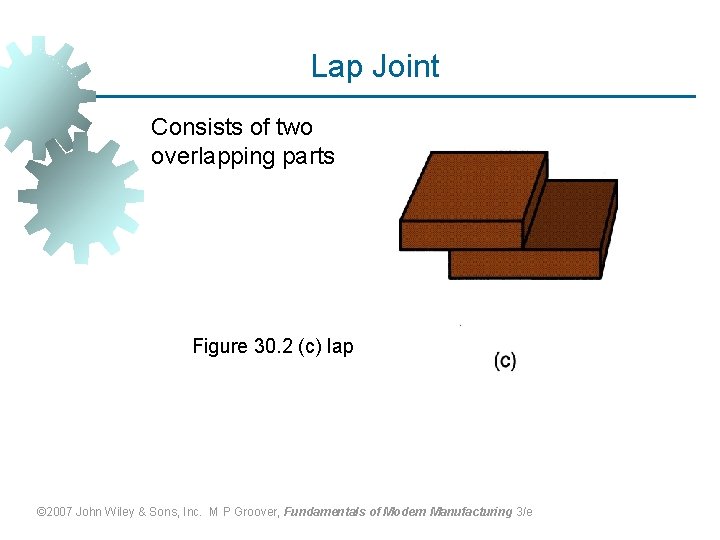
Lap Joint Consists of two overlapping parts Figure 30. 2 (c) lap © 2007 John Wiley & Sons, Inc. M P Groover, Fundamentals of Modern Manufacturing 3/e
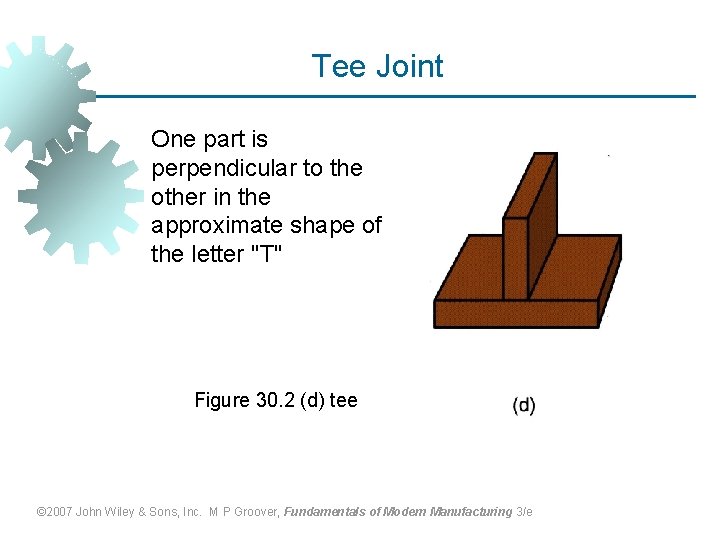
Tee Joint One part is perpendicular to the other in the approximate shape of the letter "T" Figure 30. 2 (d) tee © 2007 John Wiley & Sons, Inc. M P Groover, Fundamentals of Modern Manufacturing 3/e
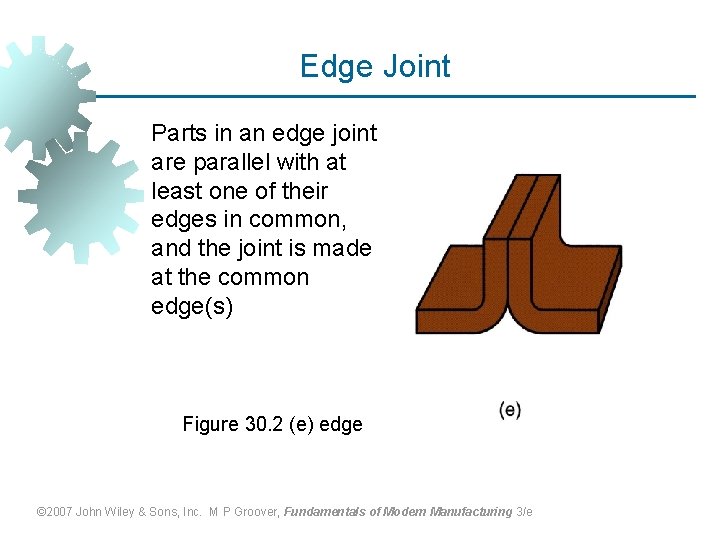
Edge Joint Parts in an edge joint are parallel with at least one of their edges in common, and the joint is made at the common edge(s) Figure 30. 2 (e) edge © 2007 John Wiley & Sons, Inc. M P Groover, Fundamentals of Modern Manufacturing 3/e
Thanks © 2007 John Wiley & Sons, Inc. M P Groover, Fundamentals of Modern Manufacturing 3/e