
Fundamentals of VLSI Chip Design VLSI Design What
- Slides: 13
Fundamentals of VLSI Chip Design
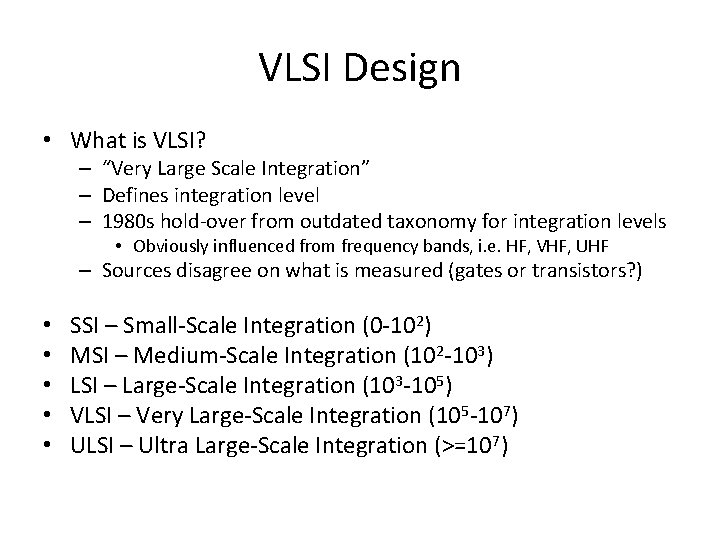
VLSI Design • What is VLSI? – “Very Large Scale Integration” – Defines integration level – 1980 s hold-over from outdated taxonomy for integration levels • Obviously influenced from frequency bands, i. e. HF, VHF, UHF – Sources disagree on what is measured (gates or transistors? ) • • • SSI – Small-Scale Integration (0 -102) MSI – Medium-Scale Integration (102 -103) LSI – Large-Scale Integration (103 -105) VLSI – Very Large-Scale Integration (105 -107) ULSI – Ultra Large-Scale Integration (>=107)
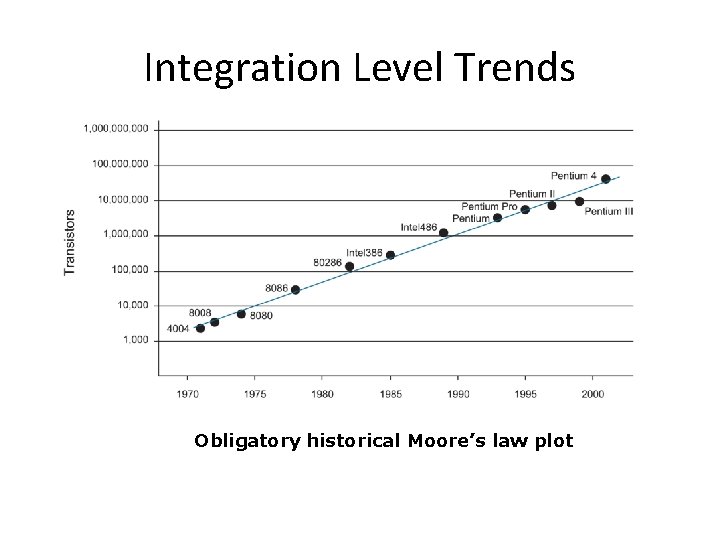
Integration Level Trends Obligatory historical Moore’s law plot
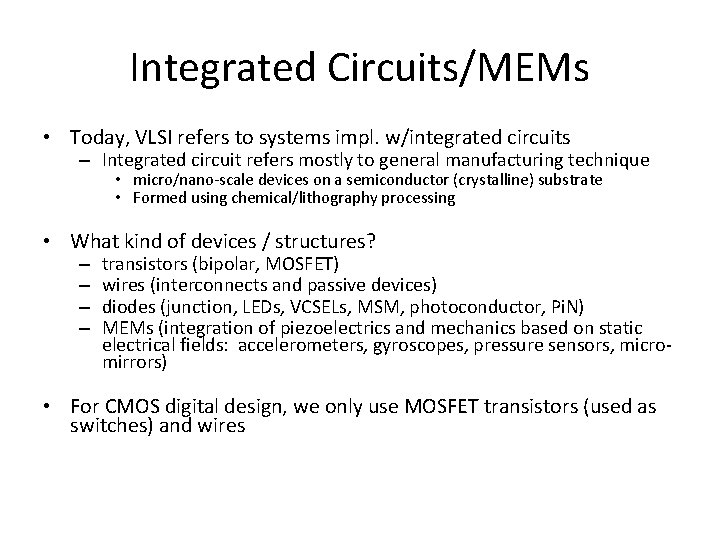
Integrated Circuits/MEMs • Today, VLSI refers to systems impl. w/integrated circuits – Integrated circuit refers mostly to general manufacturing technique • micro/nano-scale devices on a semiconductor (crystalline) substrate • Formed using chemical/lithography processing • What kind of devices / structures? – – transistors (bipolar, MOSFET) wires (interconnects and passive devices) diodes (junction, LEDs, VCSELs, MSM, photoconductor, Pi. N) MEMs (integration of piezoelectrics and mechanics based on static electrical fields: accelerometers, gyroscopes, pressure sensors, micromirrors) • For CMOS digital design, we only use MOSFET transistors (used as switches) and wires
Chips • Integrated circuits consist of: – A small square or rectangular “die”, < 1 mm thick • Small die: 1. 5 mm x 1. 5 mm => 2. 25 mm 2 • Large die: 15 mm x 15 mm => 225 mm 2 – Larger die sizes mean: • More logic, memory • Less volume • Less yield – Dies are made from silicon (substrate) • Substrate provides mechanical support and electrical common point
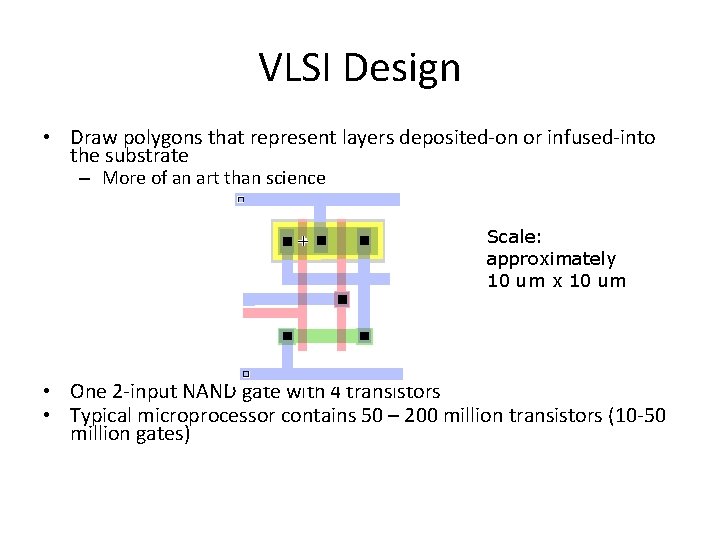
VLSI Design • Draw polygons that represent layers deposited-on or infused-into the substrate – More of an art than science Scale: approximately 10 um x 10 um • One 2 -input NAND gate with 4 transistors • Typical microprocessor contains 50 – 200 million transistors (10 -50 million gates)
VLSI Design • • Manual layout design is obviously not practical Design complexity: – Manually drawing layout for a billion transistors would take too long – Even if we could… • How to verify (test) designs for functionality, speed, power, etc. ? – • • Complexity scales faster than actual design How to reuse designs? How to create human-readable designs? How to speed-up design process? These problems form a great deal of work – Electronic Design Automation (EDA) – a. k. a. CAD • Advancing EDA technology, fabrication technology, designs and microarchitectures, and IP form bulk of work (and money) in the industry
EDA Tools • Conclusion: – This course is about using design tools to manage design complexity of VLSI systems – Only way to learn tools: practice and work with tools individually – Must teach IC fundamentals, but prevent course from becoming semiconductor theory, analog electronics, circuits, or digital logic course • Target large-scale integration and EDA • Reach good balance between fundamental IC theory and automated largescale design methodology • 80 -90% of course time will be spent in lab – Tutorials will provide basic knowledge – Must learn the tools on your own (assisted by instructor)
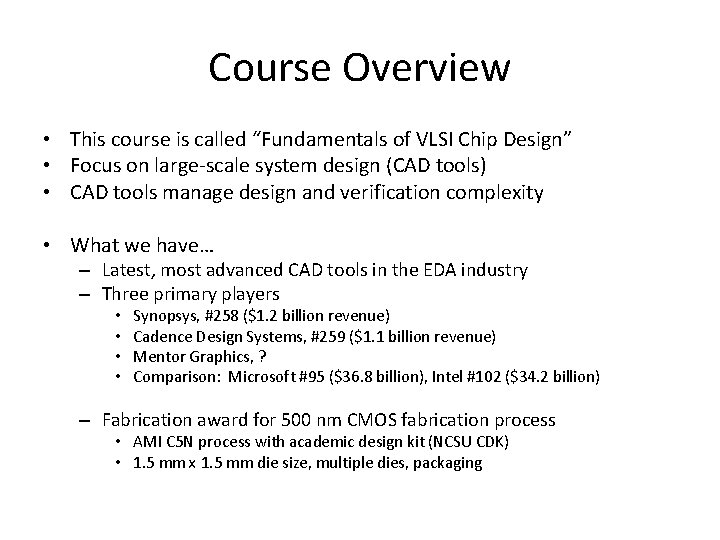
Course Overview • This course is called “Fundamentals of VLSI Chip Design” • Focus on large-scale system design (CAD tools) • CAD tools manage design and verification complexity • What we have… – Latest, most advanced CAD tools in the EDA industry – Three primary players • • Synopsys, #258 ($1. 2 billion revenue) Cadence Design Systems, #259 ($1. 1 billion revenue) Mentor Graphics, ? Comparison: Microsoft #95 ($36. 8 billion), Intel #102 ($34. 2 billion) – Fabrication award for 500 nm CMOS fabrication process • AMI C 5 N process with academic design kit (NCSU CDK) • 1. 5 mm x 1. 5 mm die size, multiple dies, packaging
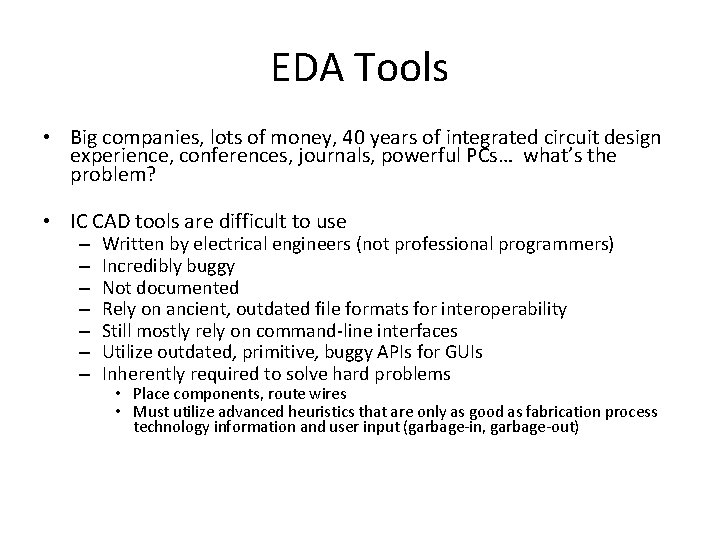
EDA Tools • Big companies, lots of money, 40 years of integrated circuit design experience, conferences, journals, powerful PCs… what’s the problem? • IC CAD tools are difficult to use – – – – Written by electrical engineers (not professional programmers) Incredibly buggy Not documented Rely on ancient, outdated file formats for interoperability Still mostly rely on command-line interfaces Utilize outdated, primitive, buggy APIs for GUIs Inherently required to solve hard problems • Place components, route wires • Must utilize advanced heuristics that are only as good as fabrication process technology information and user input (garbage-in, garbage-out)
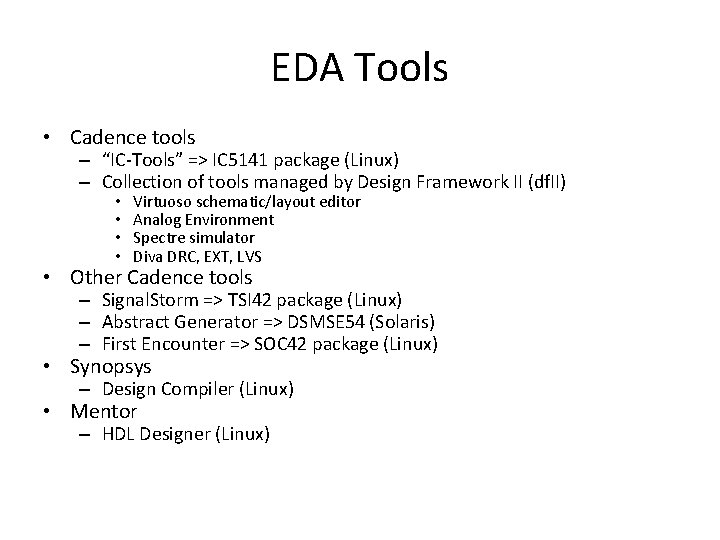
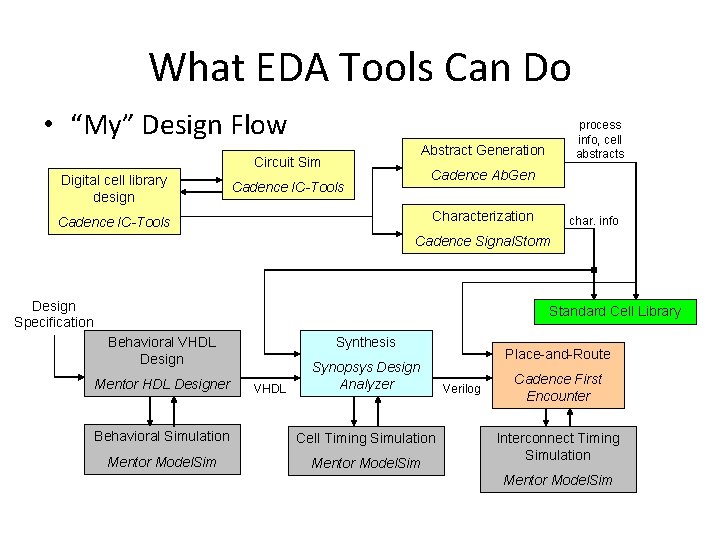
EDA Tools • Cadence tools – “IC-Tools” => IC 5141 package (Linux) – Collection of tools managed by Design Framework II (df. II) • • Virtuoso schematic/layout editor Analog Environment Spectre simulator Diva DRC, EXT, LVS • Other Cadence tools – Signal. Storm => TSI 42 package (Linux) – Abstract Generator => DSMSE 54 (Solaris) – First Encounter => SOC 42 package (Linux) • Synopsys – Design Compiler (Linux) • Mentor – HDL Designer (Linux)
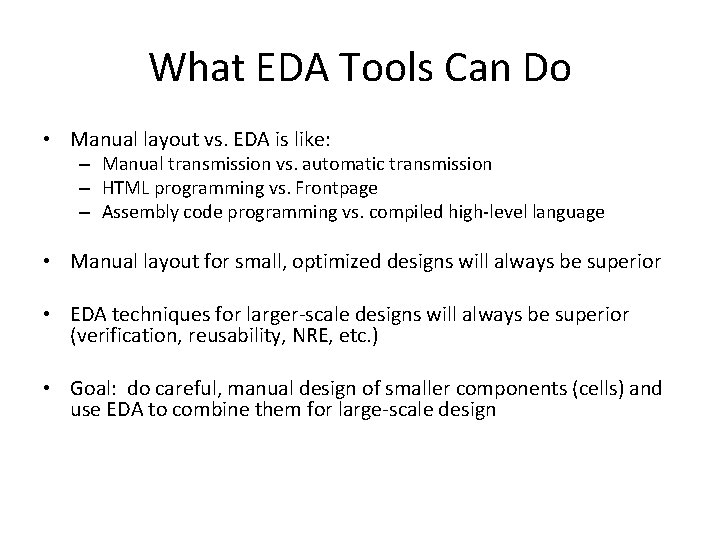
What EDA Tools Can Do • Manual layout vs. EDA is like: – Manual transmission vs. automatic transmission – HTML programming vs. Frontpage – Assembly code programming vs. compiled high-level language • Manual layout for small, optimized designs will always be superior • EDA techniques for larger-scale designs will always be superior (verification, reusability, NRE, etc. ) • Goal: do careful, manual design of smaller components (cells) and use EDA to combine them for large-scale design
What EDA Tools Can Do • “My” Design Flow Abstract Generation Circuit Sim Digital cell library design process info, cell abstracts Cadence Ab. Gen Cadence IC-Tools Characterization Cadence IC-Tools char. info Cadence Signal. Storm Design Specification Standard Cell Library Behavioral VHDL Design Mentor HDL Designer Synthesis VHDL Synopsys Design Analyzer Behavioral Simulation Cell Timing Simulation Mentor Model. Sim Place-and-Route Verilog Cadence First Encounter Interconnect Timing Simulation Mentor Model. Sim