
Fundamentals of Robotics Ch 6 Robot Sensors zxcai
机器人学基础 第六章 机器人传感器 Fundamentals of Robotics Ch. 6 Robot Sensors 中南大学 蔡自兴,谢 斌 zxcai, xiebin@mail. csu. edu. cn 2010 Fundamentals of Robotics 1
Ch. 6 Robot Sensors 6. 1 Introduction to Robot Sensors 6. 2 Internal Sensors(内部传感器) 6. 3 External Sensors(外部传感器) 6. 4 Robot Sensor Application Considerations 6. 5 Summary Ch. 6 Robot Sensors 2
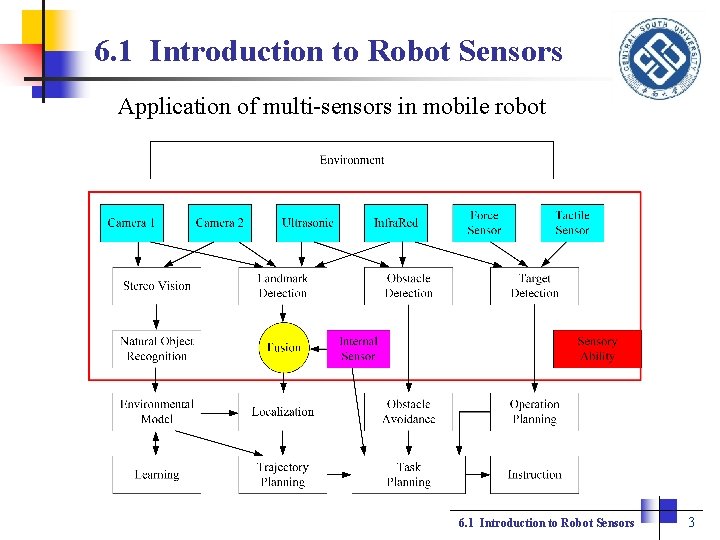
6. 1 Introduction to Robot Sensors Application of multi-sensors in mobile robot 6. 1 Introduction to Robot Sensors 3
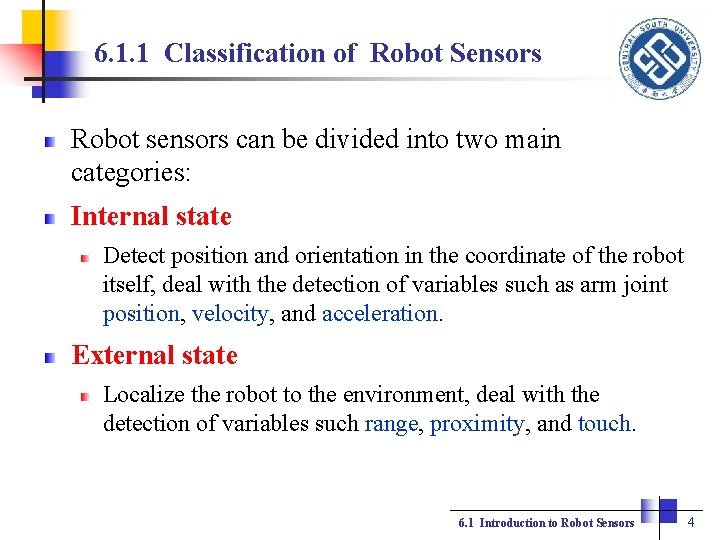
6. 1. 1 Classification of Robot Sensors Robot sensors can be divided into two main categories: Internal state Detect position and orientation in the coordinate of the robot itself, deal with the detection of variables such as arm joint position, velocity, and acceleration. External state Localize the robot to the environment, deal with the detection of variables such range, proximity, and touch. 6. 1 Introduction to Robot Sensors 4
6. 1. 1 Classification of Robot Sensors Most needed sensory abilities for robot: Simple Touch: detect whether the object is there or not. Compound Touch: detect the size and shape of the object. Simple Force: detect force along one direction. Compound Force: detect forces along multiple directions. Proximity: non-contact detection of objects. Simple Vision: detect feature such as holes, lines, and corners. Compound Vision: recognition of object. 6. 1 Introduction to Robot Sensors 5
6. 1 Introduction to Robot Sensors 6. 2 Internal Sensors(内部传感器) 6. 3 External Sensors(外部传感器) 6. 4 Robot Sensor Application Considerations 6. 5 Summary Ch. 6 Robot Sensors 6
6. 2 Internal Sensors 6. 2. 1 Position/Displacement Sensors 位置传感器 A position sensor is any idea that permits position measurement. It can either be an absolute position sensor or a relative one (displacement sensor). Position sensors can be either linear or angular. Inductive Non-Contact Position Sensors, String Potentiometer, Linear variable differential transformer (LVDT) , Potentiometer, Capacitive transducer, Hall effect sensor, Proximity sensor (optical), Grating sensor, Rotary encoder (angular), Photodiode array, etc. 6. 2 Internal Sensors 7
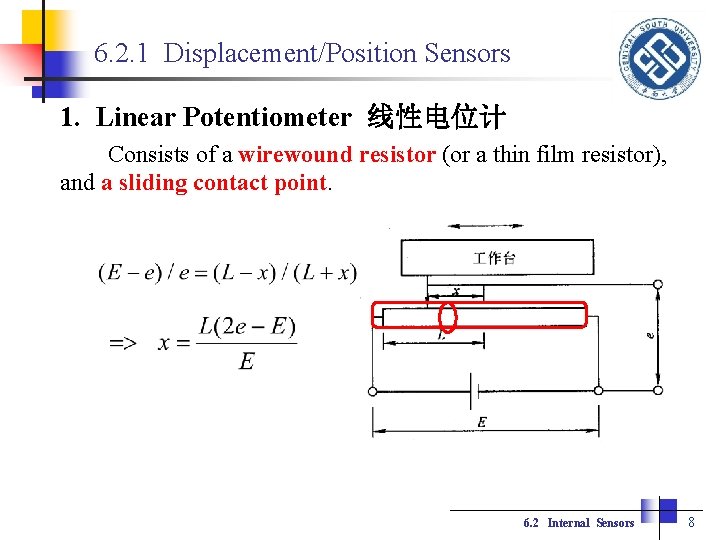
6. 2. 1 Displacement/Position Sensors 1. Linear Potentiometer 线性电位计 Consists of a wirewound resistor (or a thin film resistor), and a sliding contact point. 6. 2 Internal Sensors 8
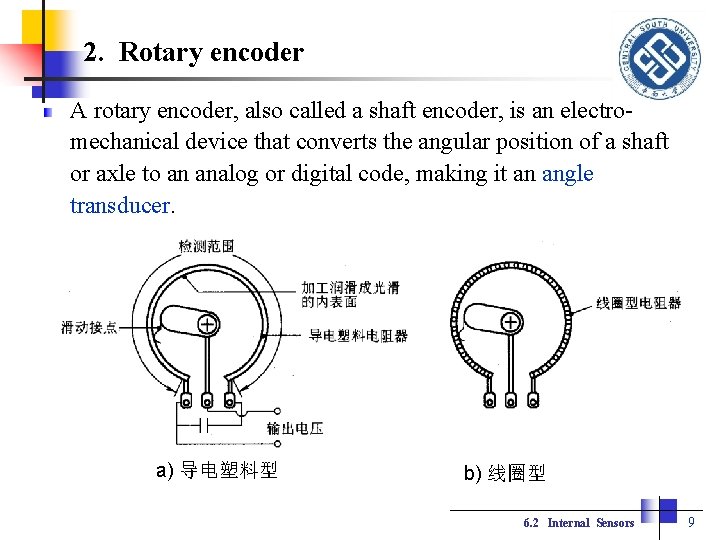
2. Rotary encoder A rotary encoder, also called a shaft encoder, is an electromechanical device that converts the angular position of a shaft or axle to an analog or digital code, making it an angle transducer. a) 导电塑料型 b) 线圈型 6. 2 Internal Sensors 9
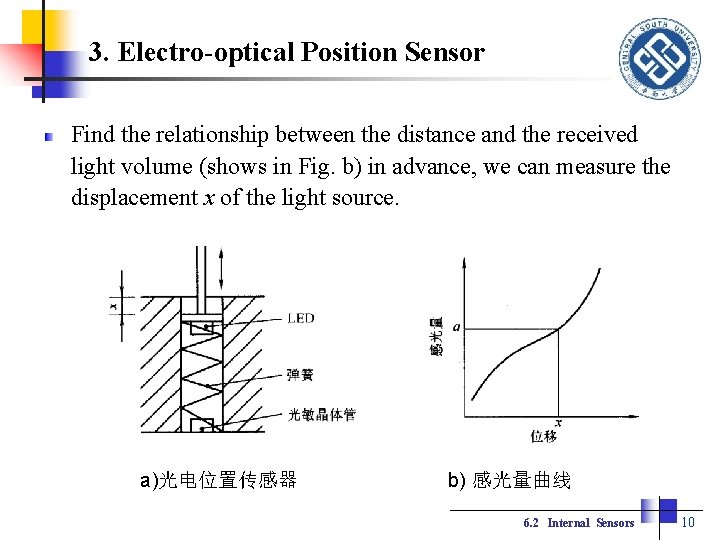
3. Electro-optical Position Sensor Find the relationship between the distance and the received light volume (shows in Fig. b) in advance, we can measure the displacement x of the light source. a)光电位置传感器 b) 感光量曲线 6. 2 Internal Sensors 10
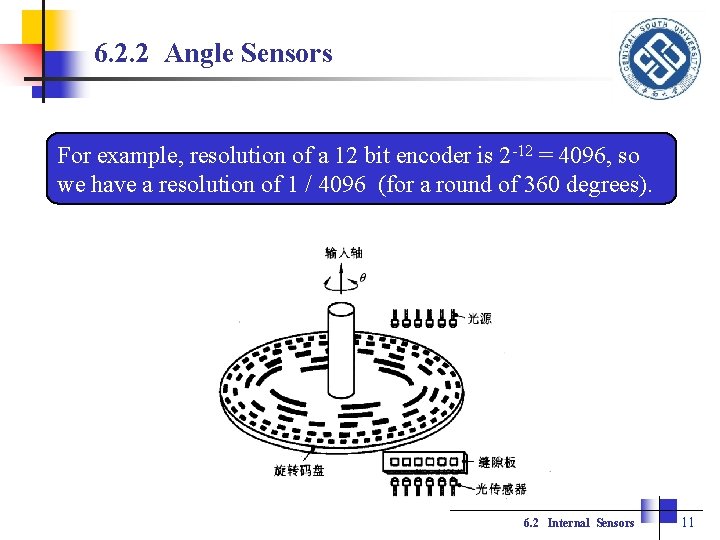
6. 2. 2 Angle Sensors 1.Absolute Optical Angle Sensor For example, resolution of a 12 bit encoder is 2 -12 = 4096, so we have光学式绝对型旋转编码器 a resolution of 1 / 4096 (for a round of 360 degrees). 6. 2 Internal Sensors 11

1.Absolute Optical Angle Sensor Absolute rotary encoders can also be used to detect angular velocity. By comparing current value and stored values, we can obtain the corresponding angular velocity. 6. 2 Internal Sensors 12

2.Relative Angle Sensor 光学式增量型旋转编码器 Counting the number of conversions to calculate relative Incremental rotary encoder can only measure relative angle. from initial value to current one. Therefore, in order to know the exact current angle value, some other methods (such as the absolute encoder) are needed to identify the initial value of angle. 6. 2 Internal Sensors 13
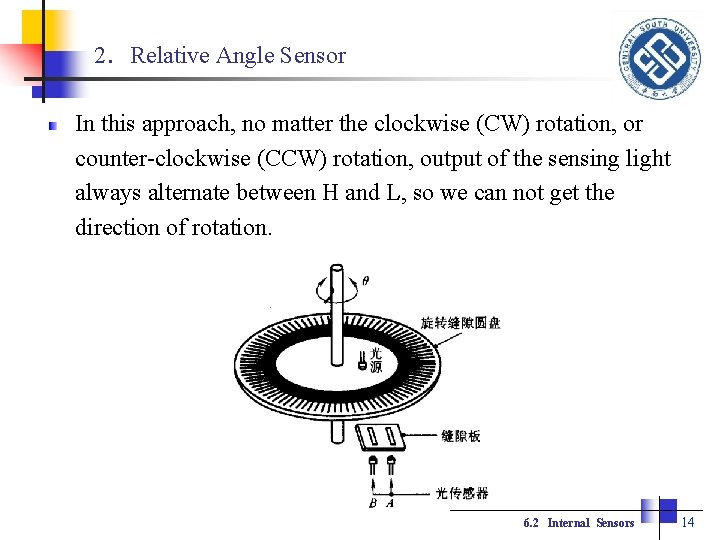
2.Relative Angle Sensor In this approach, no matter the clockwise (CW) rotation, or counter-clockwise (CCW) rotation, output of the sensing light always alternate between H and L, so we can not get the direction of rotation. 6. 2 Internal Sensors 14
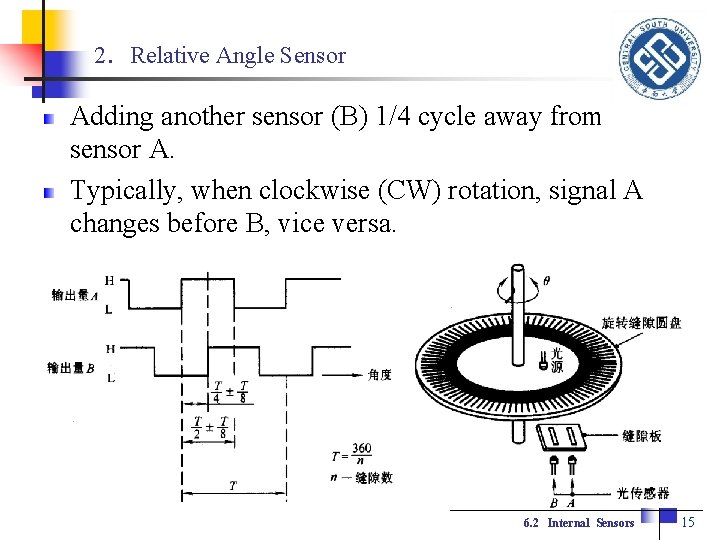
2.Relative Angle Sensor Adding another sensor (B) 1/4 cycle away from sensor A. Typically, when clockwise (CW) rotation, signal A changes before B, vice versa. 6. 2 Internal Sensors 15
6. 2. 3 Attitude Sensors 姿态传感器 Attitude sensors are used to detect the relative relationship between the robot and ground. When the robot is fixed (just as the majority of industrial robot), there is no need to install such sensors. Attitude sensors are essential for mobile robots. Attitude sensors detect moving changes in position and orientation of the robot that can be used to control the robot implement desired instruction. 6. 2 Internal Sensors 16
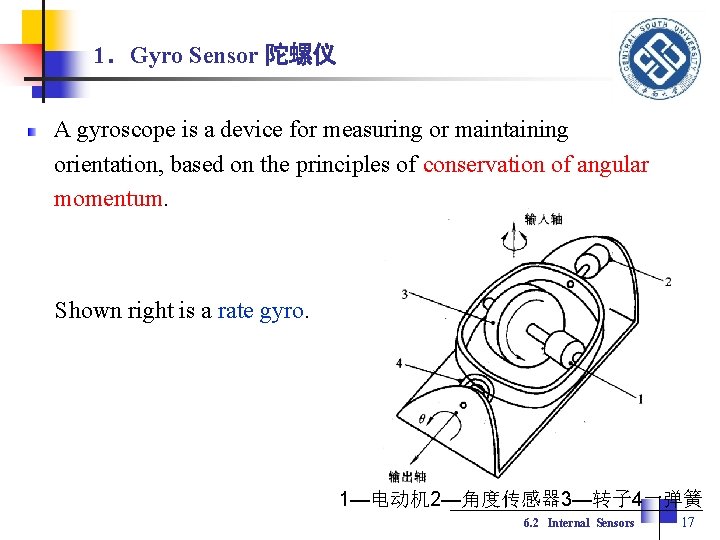
1.Gyro Sensor 陀螺仪 A gyroscope is a device for measuring or maintaining orientation, based on the principles of conservation of angular momentum. Shown right is a rate gyro. 1—电动机 2—角度传感器 3—转子 4一弹簧 6. 2 Internal Sensors 17
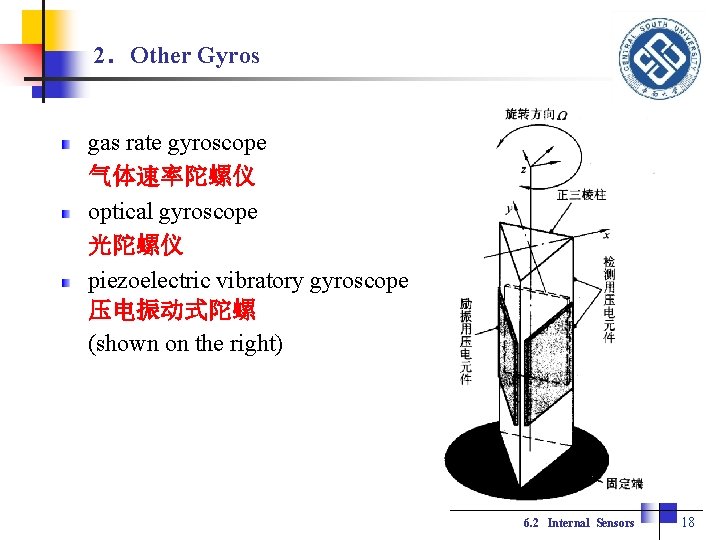
2.Other Gyros gas rate gyroscope 气体速率陀螺仪 optical gyroscope 光陀螺仪 piezoelectric vibratory gyroscope 压电振动式陀螺 (shown on the right) 6. 2 Internal Sensors 18
6. 1 Introduction to Robot Sensors 6. 2 Internal Sensors(内部传感器) 6. 3 External Sensors(外部传感器) 6. 4 Robot Sensor Application Considerations 6. 5 Summary Ch. 6 Robot Sensors 19
6. 3 External Sensors 内传感器 6. 3. 1 Tactile Sensors 触觉传感器 The prototype of robot tactile sensor is an imitation of human tactile sense of touch functions: Tactile sense Pressure sense Slip sense Force sense 6. 3 External Sensors 20
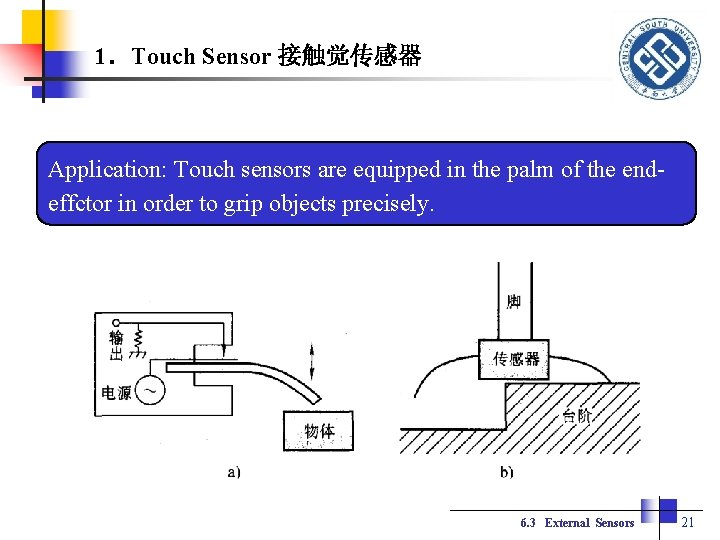
1.Touch Sensor 接触觉传感器 Application: Touch sensors are equipped in the palm of the endeffctor in order to grip objects precisely. 6. 3 External Sensors 21
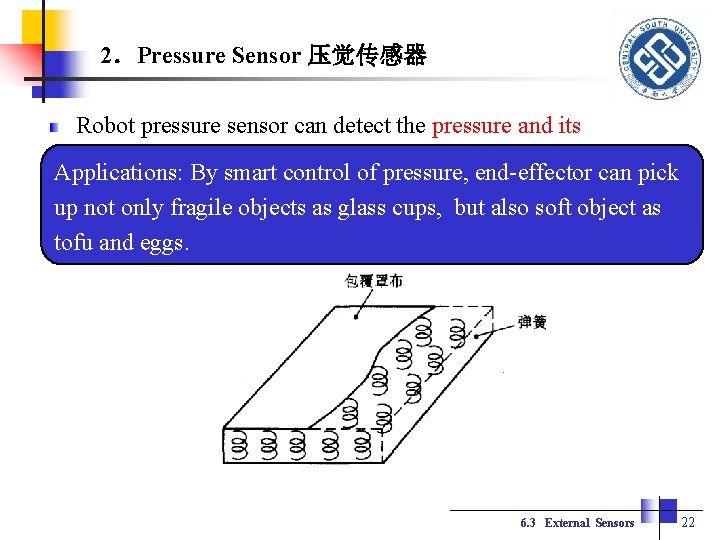
2.Pressure Sensor 压觉传感器 Robot pressure sensor can detect the pressure and its distribution through an array of piezoelectric elements. (Eg. Applications: By smart control of pressure, end-effector can pick Springs (弹簧) for mechanical detecting). up not only fragile objects as glass cups, but also soft object as tofu and eggs. 6. 3 External Sensors 22
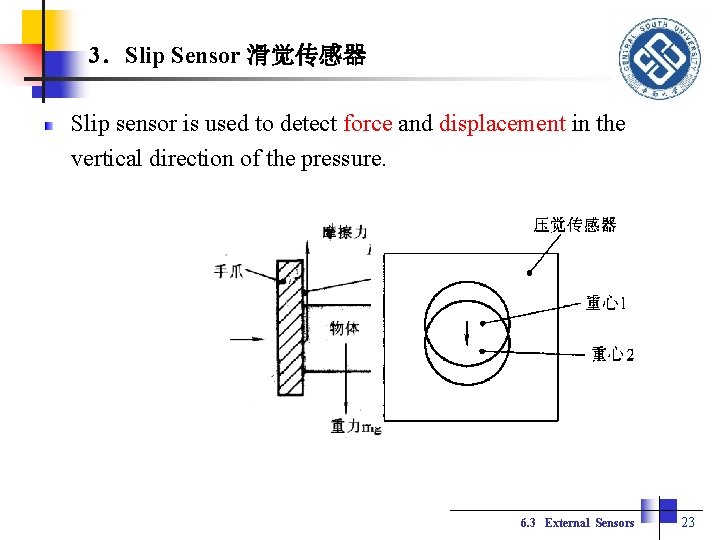
3.Slip Sensor 滑觉传感器 Slip sensor is used to detect force and displacement in the vertical direction of the pressure. 6. 3 External Sensors 23
4.Force Sensor 力觉传感器 Robot Force sensors can be divided into 3 categories: Joint force sensor, installed in the joint actuator, measure the output force and torque of the actuator itself, is used to control the feedback of the force. Wrist force sensor, mounted between the end-effector and the last joint, measure forces and torques on the end-effector for all directions. Finger force sensor, installed in the robot finger joints, measure the clamping force of an object. 6. 3 External Sensors 24
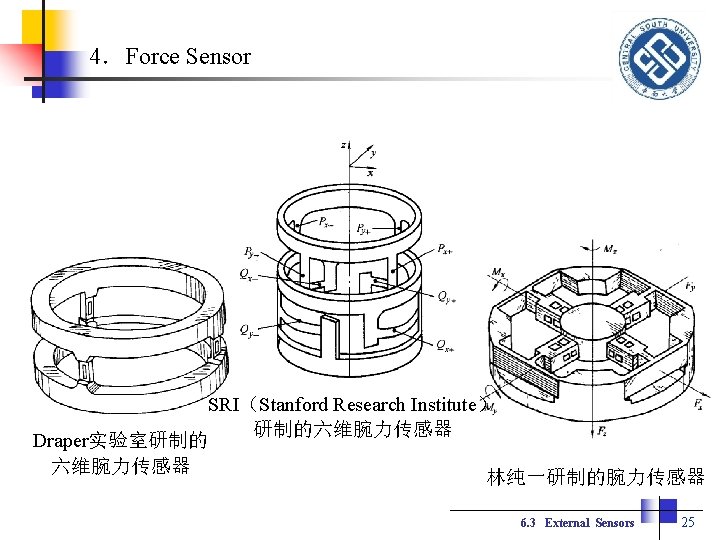
4.Force Sensor Draper实验室研制的 六维腕力传感器 SRI(Stanford Research Institute) 研制的六维腕力传感器 林纯一研制的腕力传感器 6. 3 External Sensors 25
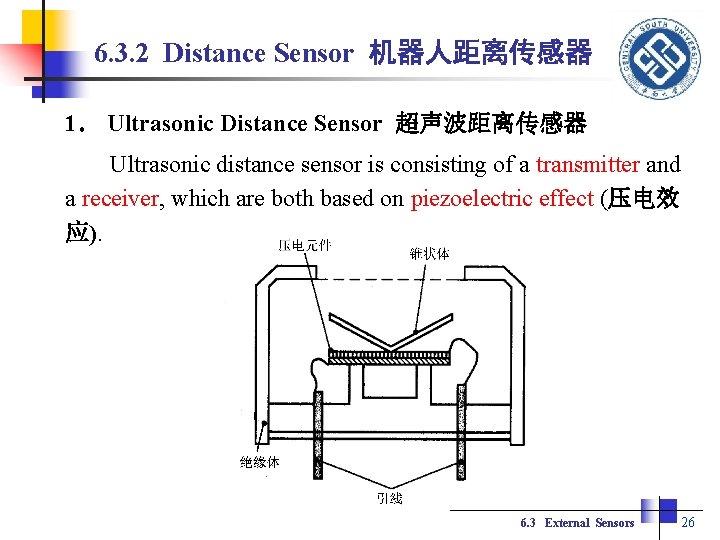
6. 3. 2 Distance Sensor 机器人距离传感器 1. Ultrasonic Distance Sensor 超声波距离传感器 Ultrasonic distance sensor is consisting of a transmitter and a receiver, which are both based on piezoelectric effect (压电效 应). 6. 3 External Sensors 26
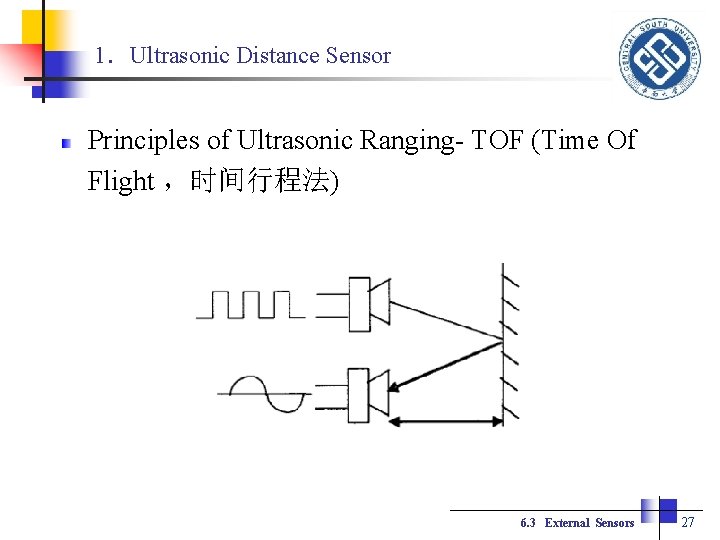
1.Ultrasonic Distance Sensor Principles of Ultrasonic Ranging- TOF (Time Of Flight ,时间行程法) 超声波测距原理图 6. 3 External Sensors 27
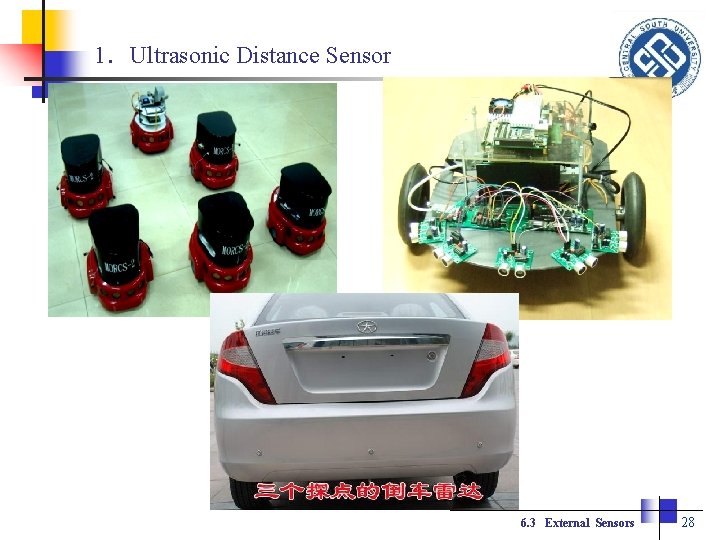
1.Ultrasonic Distance Sensor 6. 3 External Sensors 28
2.Proximity Sensors 接近觉传感器 A proximity sensor is a sensor able to detect the presence of nearby objects without any physical contact. A proximity sensor often emits an electromagnetic or electrostatic field, or a beam of electromagnetic radiation (infrared, for instance), and looks for changes in the field or return signal. The object being sensed is often referred to as the proximity sensor's target. 6. 3 External Sensors 29
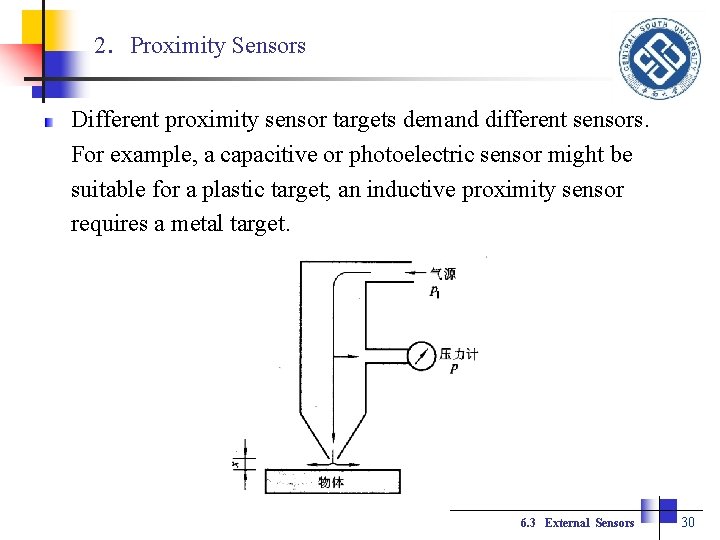
2.Proximity Sensors Different proximity sensor targets demand different sensors. For example, a capacitive or photoelectric sensor might be suitable for a plastic target; an inductive proximity sensor requires a metal target. 6. 3 External Sensors 30
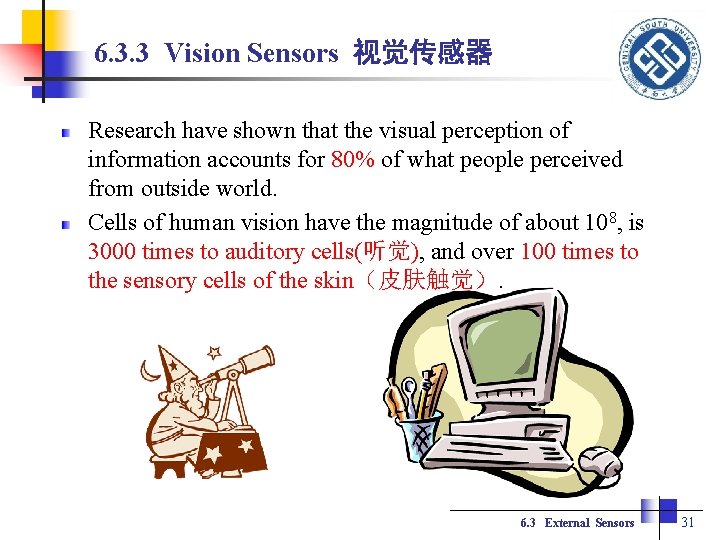
6. 3. 3 Vision Sensors 视觉传感器 Research have shown that the visual perception of information accounts for 80% of what people perceived from outside world. Cells of human vision have the magnitude of about 108, is 3000 times to auditory cells(听觉), and over 100 times to the sensory cells of the skin(皮肤触觉). 6. 3 External Sensors 31
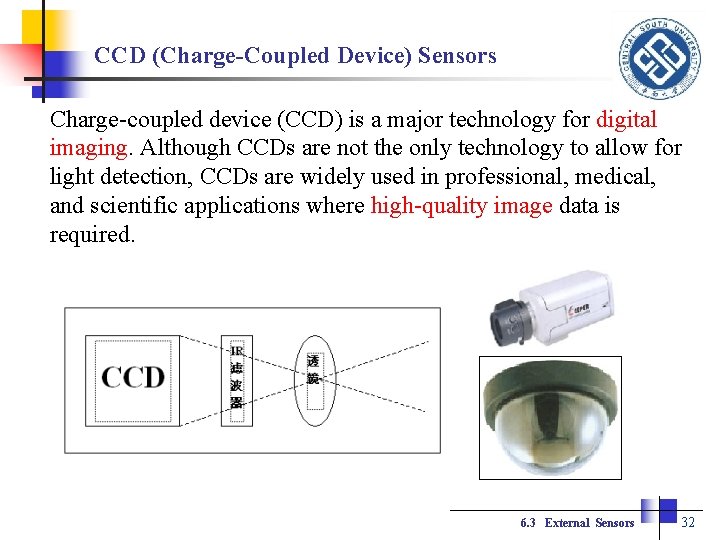
CCD (Charge-Coupled Device) Sensors Charge-coupled device (CCD) is a major technology for digital imaging. Although CCDs are not the only technology to allow for light detection, CCDs are widely used in professional, medical, and scientific applications where high-quality image data is required. 6. 3 External Sensors 32
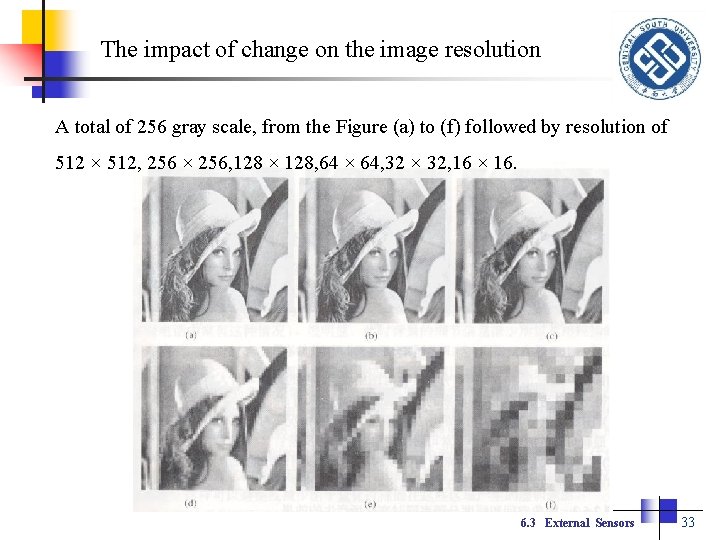
The impact of change on the image resolution A total of 256 gray scale, from the Figure (a) to (f) followed by resolution of 512 × 512, 256 × 256, 128 × 128, 64 × 64, 32 × 32, 16 × 16. 6. 3 External Sensors 33
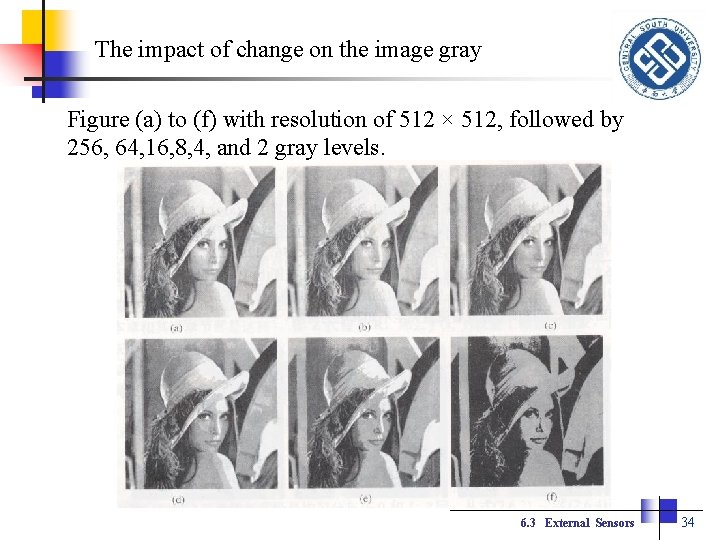
The impact of change on the image gray Figure (a) to (f) with resolution of 512 × 512, followed by 256, 64, 16, 8, 4, and 2 gray levels. 6. 3 External Sensors 34
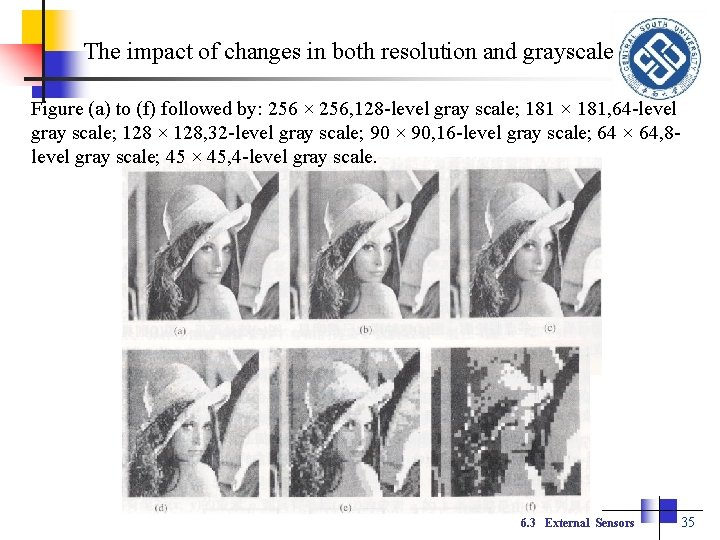
The impact of changes in both resolution and grayscale Figure (a) to (f) followed by: 256 × 256, 128 -level gray scale; 181 × 181, 64 -level gray scale; 128 × 128, 32 -level gray scale; 90 × 90, 16 -level gray scale; 64 × 64, 8 level gray scale; 45 × 45, 4 -level gray scale. 6. 3 External Sensors 35
6. 1 Introduction to Robot Sensors 6. 2 Internal Sensors(内部传感器) 6. 3 External Sensors(外部传感器) 6. 4 Robot Sensor Application Considerations 6. 5 Summary Ch. 6 Robot Sensors 36
6. 4 Considerations in Robot Sensor Application 机器人传感器应用中考虑的问题 High precision, good repeatability Good stability, high reliability Strong anti-interference ability Light weight, small size, easy installation Cheap 6. 4 Robot Sensor Application Considerations 37
6. 1 Introduction to Robot Sensors 6. 2 Internal Sensors(内部传感器) 6. 3 External Sensors(外部传感器) 6. 4 Robot Sensor Application Considerations 6. 5 Summary Ch. 6 Robot Sensors 38

Thank you For Attention! Fundamentals of Robotics 41
- Slides: 41