
Fundamentals of Rendering Reflectance Functions Chapter 9 of

- Slides: 78
Fundamentals of Rendering Reflectance Functions Chapter 9 of “Physically Based Rendering” by Pharr&Humphreys
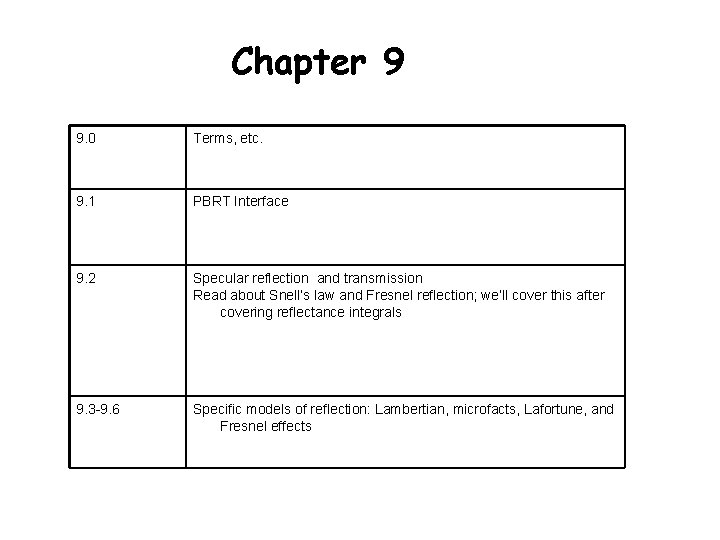
Chapter 9 9. 0 Terms, etc. 9. 1 PBRT Interface 9. 2 Specular reflection and transmission Read about Snell’s law and Fresnel reflection; we’ll cover this after covering reflectance integrals 9. 3 -9. 6 Specific models of reflection: Lambertian, microfacts, Lafortune, and Fresnel effects
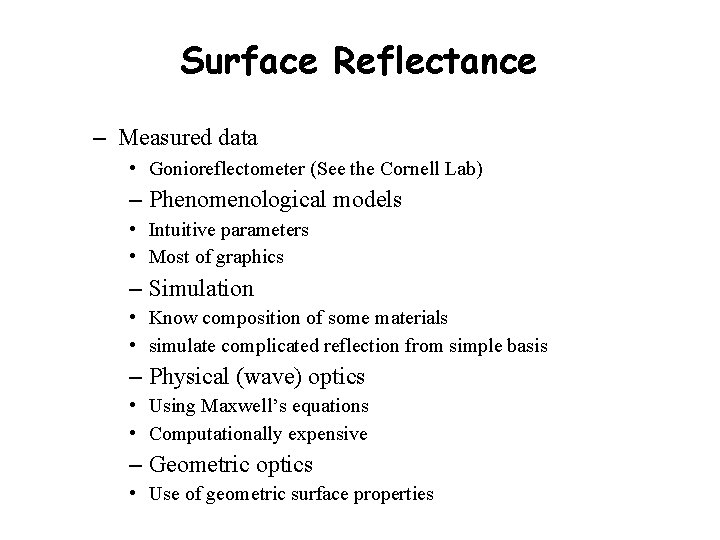
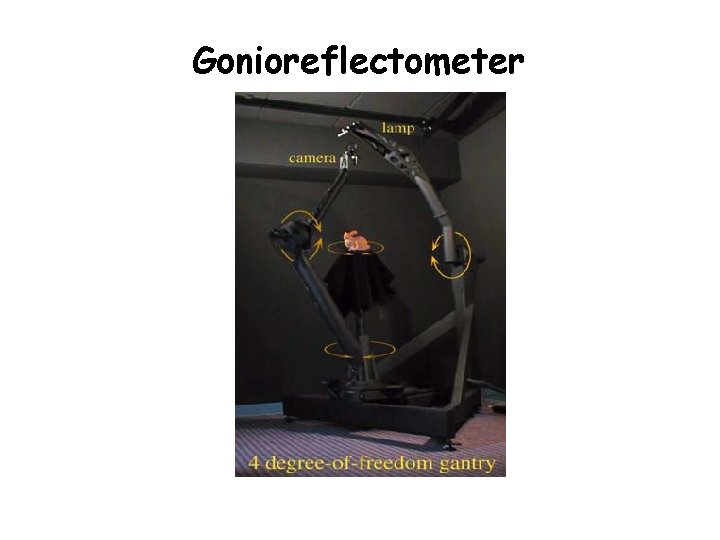
Surface Reflectance – Measured data • Gonioreflectometer (See the Cornell Lab) – Phenomenological models • Intuitive parameters • Most of graphics – Simulation • Know composition of some materials • simulate complicated reflection from simple basis – Physical (wave) optics • Using Maxwell’s equations • Computationally expensive – Geometric optics • Use of geometric surface properties
Gonioreflectometer
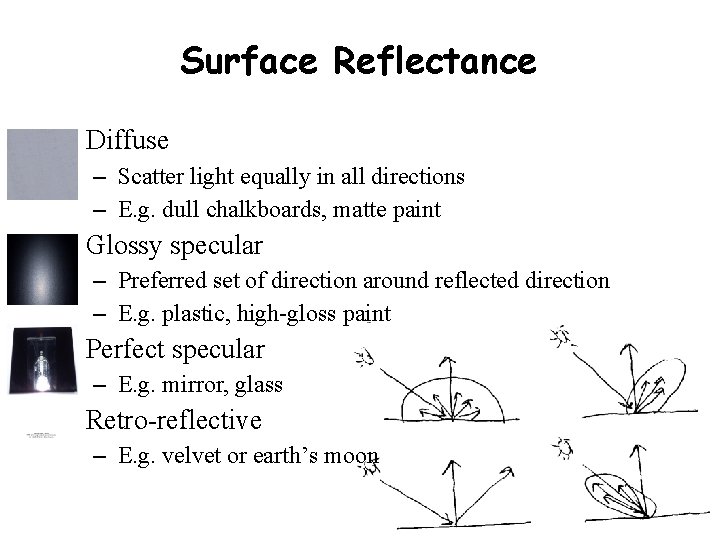
Surface Reflectance • Diffuse – Scatter light equally in all directions – E. g. dull chalkboards, matte paint • Glossy specular – Preferred set of direction around reflected direction – E. g. plastic, high-gloss paint • Perfect specular – E. g. mirror, glass • Retro-reflective – E. g. velvet or earth’s moon
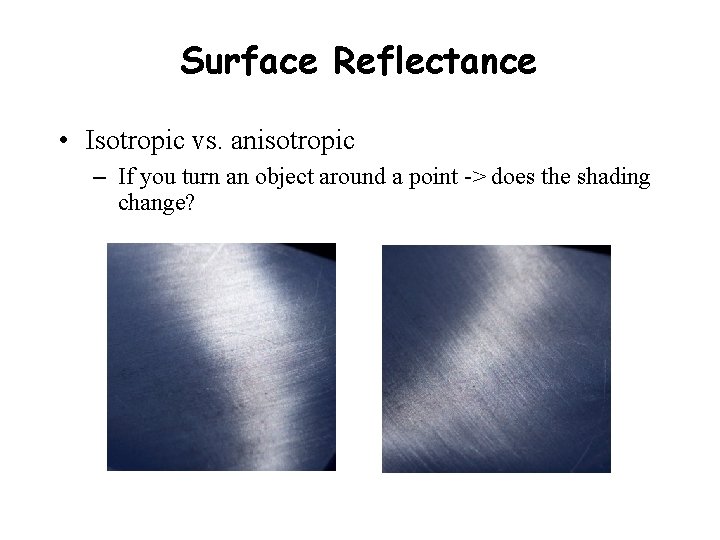
Surface Reflectance • Isotropic vs. anisotropic – If you turn an object around a point -> does the shading change?
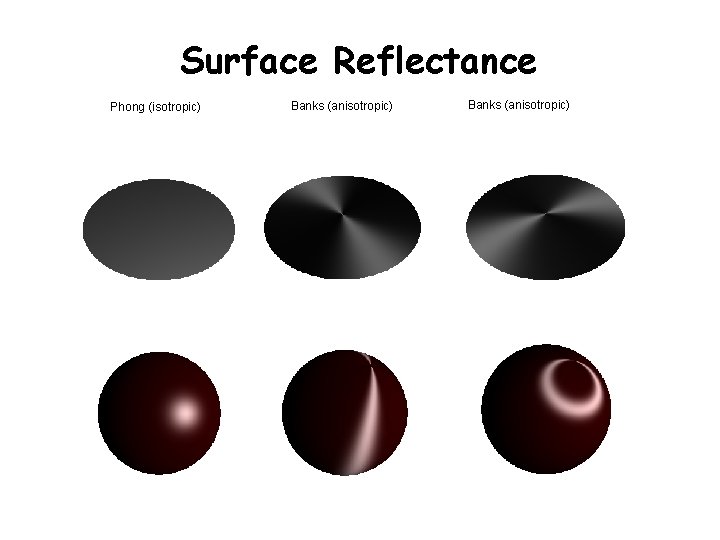
Surface Reflectance Phong (isotropic) Banks (anisotropic)
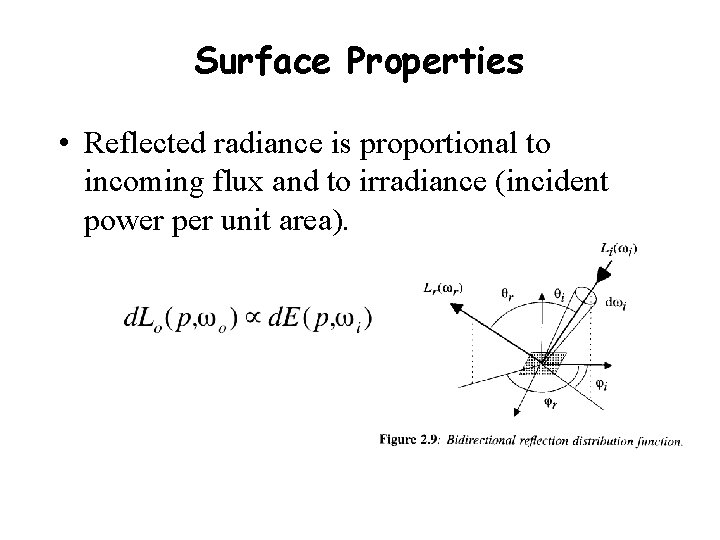
Surface Properties • Reflected radiance is proportional to incoming flux and to irradiance (incident power per unit area).
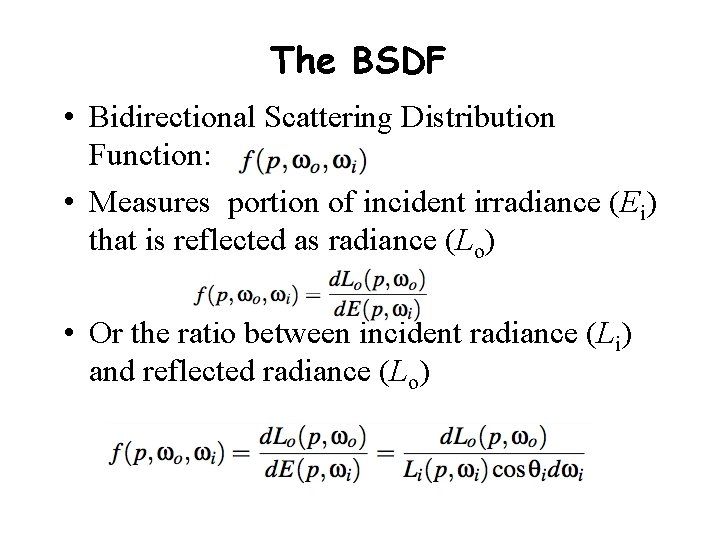
The BSDF • Bidirectional Scattering Distribution Function: • Measures portion of incident irradiance (Ei) that is reflected as radiance (Lo) • Or the ratio between incident radiance (Li) and reflected radiance (Lo)
The BRDF and the BTDF • Bidirectional Reflectance Distribution Function (BRDF) – Describes distribution of reflected light • Bidirectional Transmittance Distribution Function (BTDF) – Describes distribution of transmitted light • BSDF = BRDF + BTDF
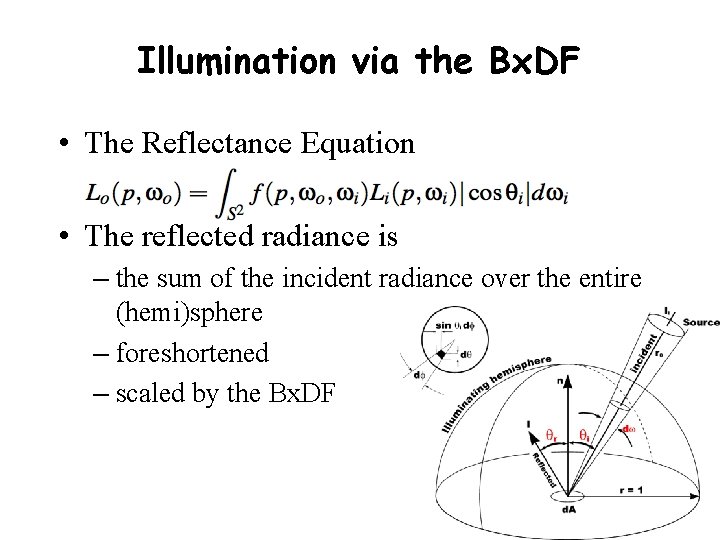
Illumination via the Bx. DF • The Reflectance Equation • The reflected radiance is – the sum of the incident radiance over the entire (hemi)sphere – foreshortened – scaled by the Bx. DF
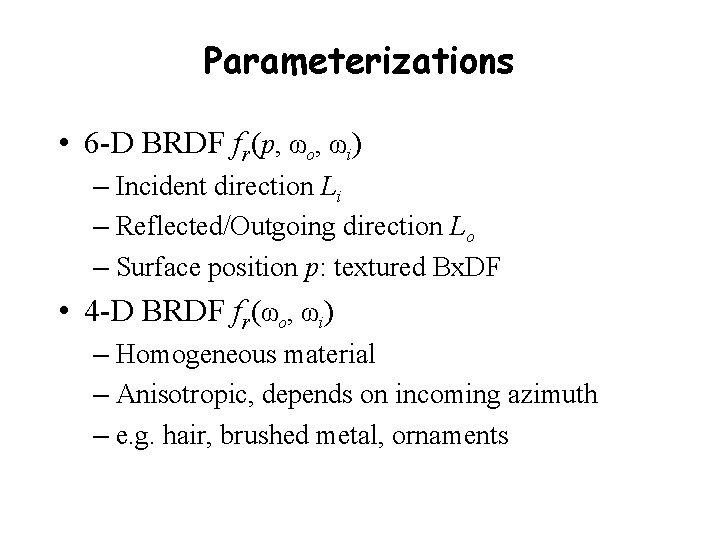
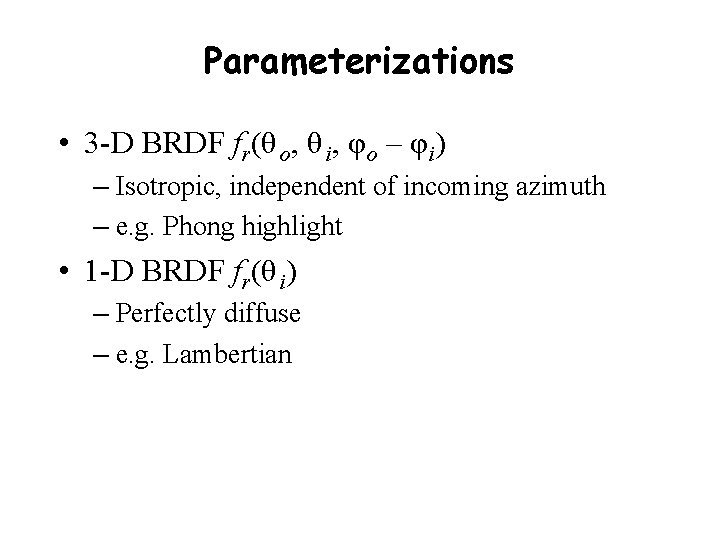
Parameterizations • 6 -D BRDF fr(p, ωo, ωi) – Incident direction Li – Reflected/Outgoing direction Lo – Surface position p: textured Bx. DF • 4 -D BRDF fr(ωo, ωi) – Homogeneous material – Anisotropic, depends on incoming azimuth – e. g. hair, brushed metal, ornaments
Parameterizations • 3 -D BRDF fr(θ o, θ i, φo – φi) – Isotropic, independent of incoming azimuth – e. g. Phong highlight • 1 -D BRDF fr(θ i) – Perfectly diffuse – e. g. Lambertian
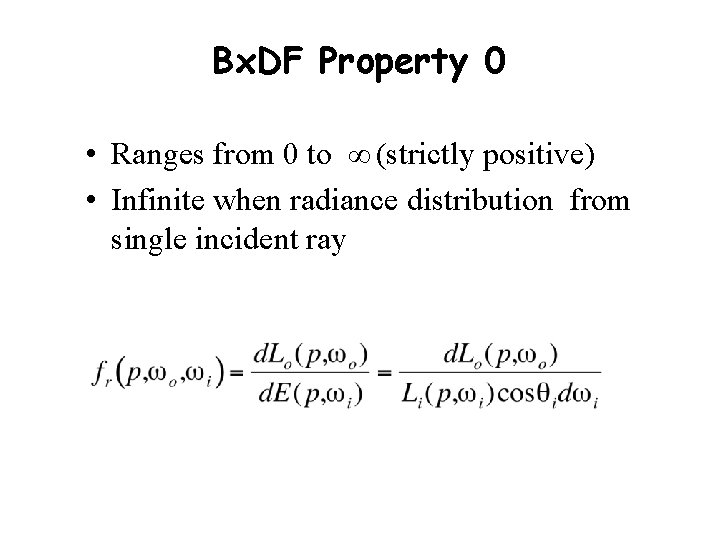
Bx. DF Property 0 • Ranges from 0 to ∞ (strictly positive) • Infinite when radiance distribution from single incident ray
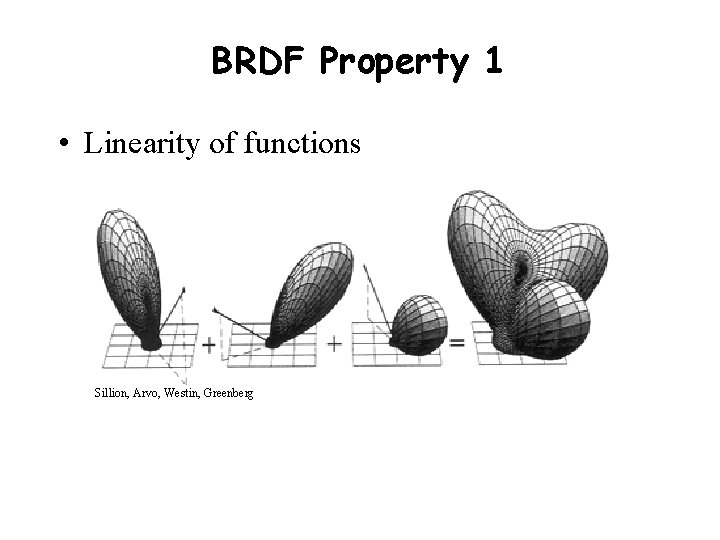
BRDF Property 1 • Linearity of functions Sillion, Arvo, Westin, Greenberg
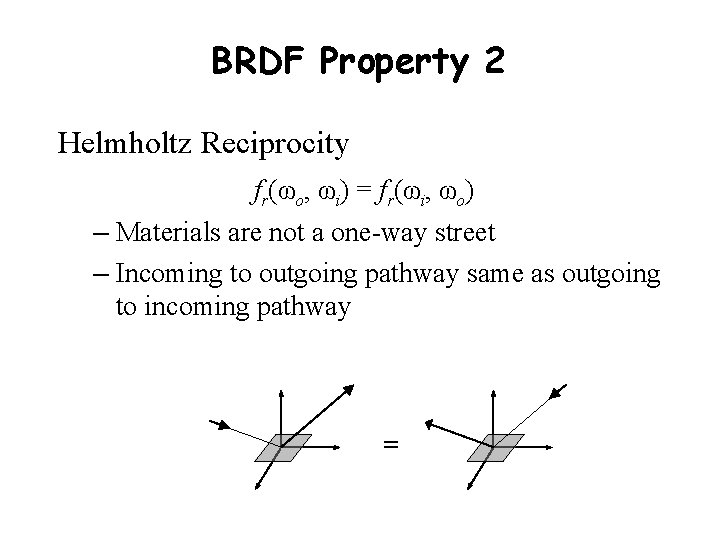
BRDF Property 2 Helmholtz Reciprocity fr(ωo, ωi) = fr(ωi, ωo) – Materials are not a one-way street – Incoming to outgoing pathway same as outgoing to incoming pathway =
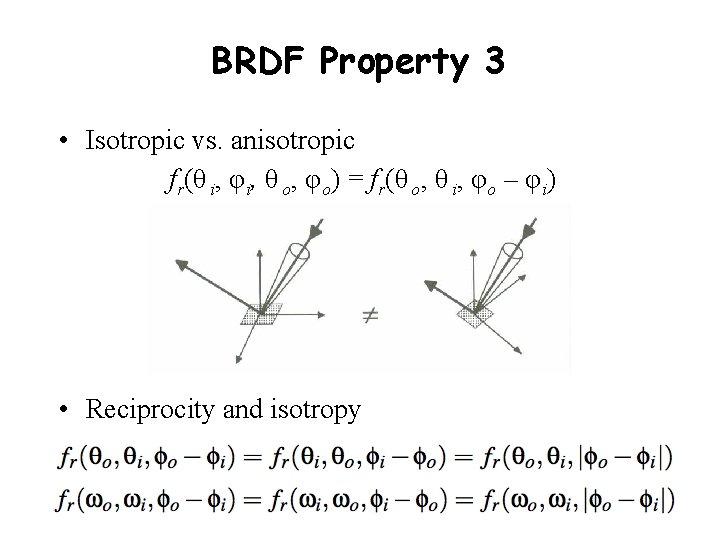
BRDF Property 3 • Isotropic vs. anisotropic fr(θ i, φi, θ o, φo) = fr(θ o, θ i, φo – φi) • Reciprocity and isotropy
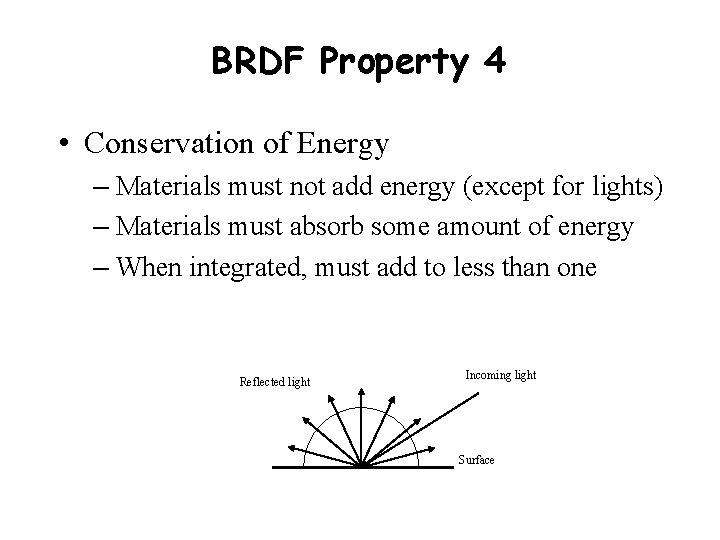
BRDF Property 4 • Conservation of Energy – Materials must not add energy (except for lights) – Materials must absorb some amount of energy – When integrated, must add to less than one Reflected light Incoming light Surface
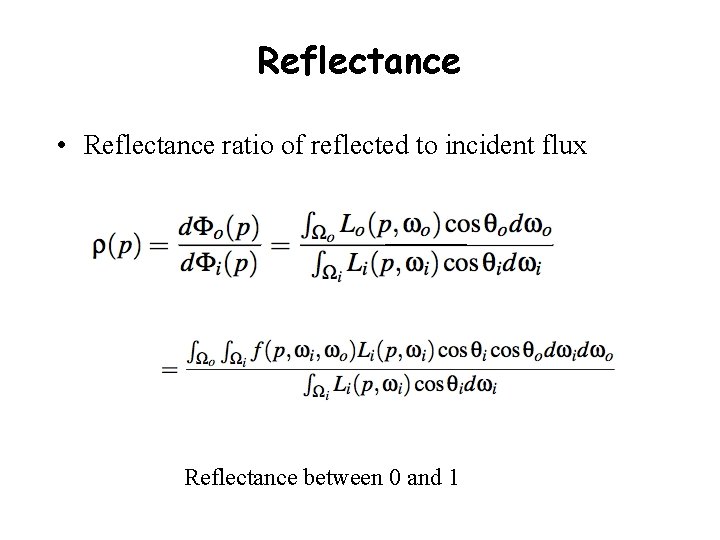
Reflectance • Reflectance ratio of reflected to incident flux Reflectance between 0 and 1
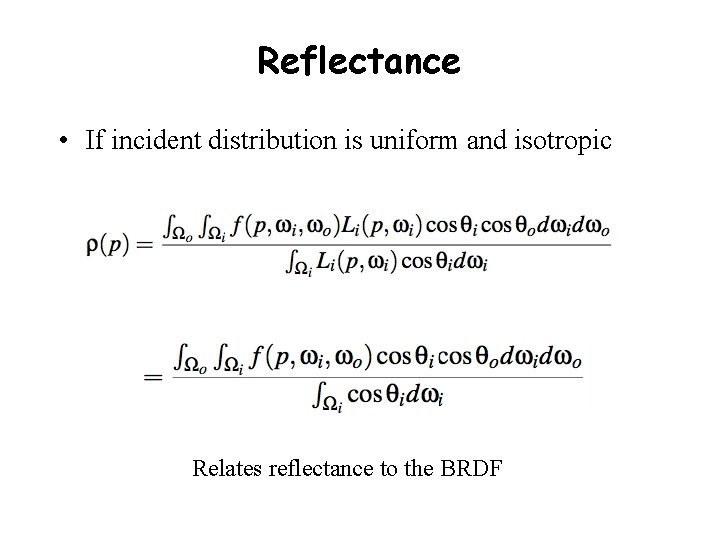
Reflectance • If incident distribution is uniform and isotropic Relates reflectance to the BRDF
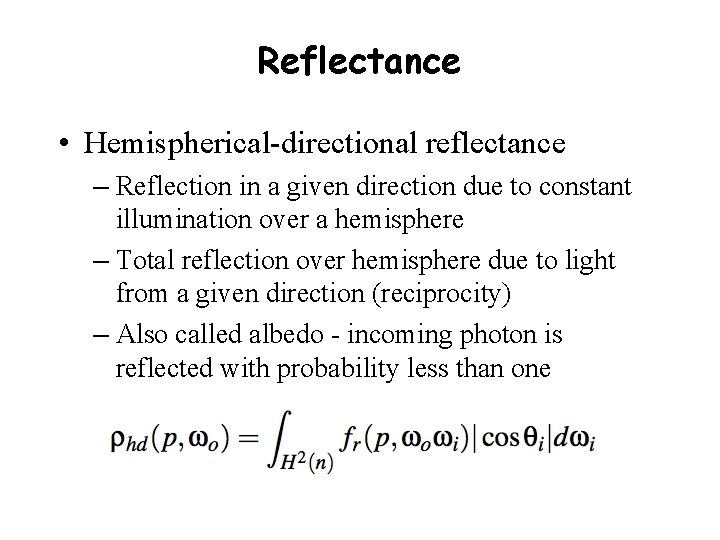
Reflectance • Hemispherical-directional reflectance – Reflection in a given direction due to constant illumination over a hemisphere – Total reflection over hemisphere due to light from a given direction (reciprocity) – Also called albedo - incoming photon is reflected with probability less than one
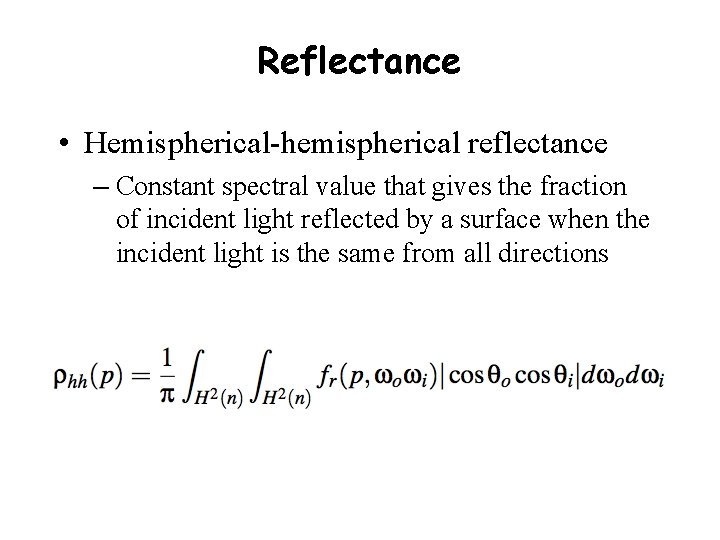
Reflectance • Hemispherical-hemispherical reflectance – Constant spectral value that gives the fraction of incident light reflected by a surface when the incident light is the same from all directions
Representations • Tabulated BRDF’s – Require dense sampling and interpolation scheme • Factorization – Into two 2 D functions for data reduction (often after reparameterization) • Basis Functions (Spherical Harmonics) – Loss of quality for high frequencies • Analytical Models – Rough approximation only – Very compact – Most often represented as parametric equation (Phong, Cook-Torrance, etc. )
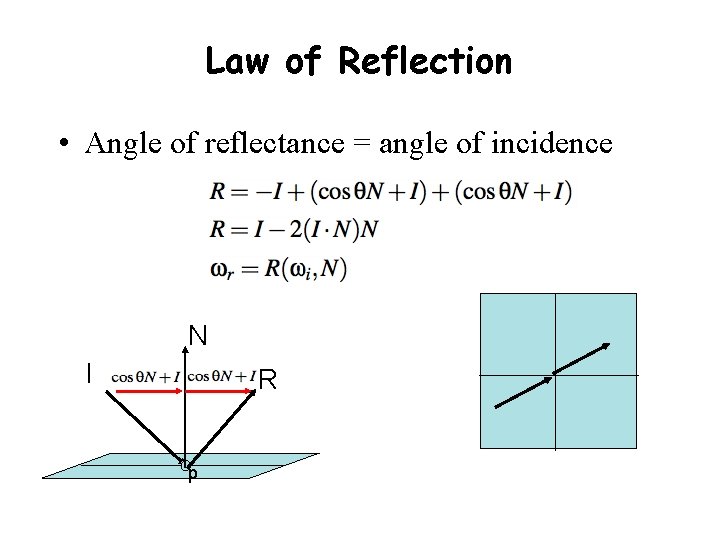
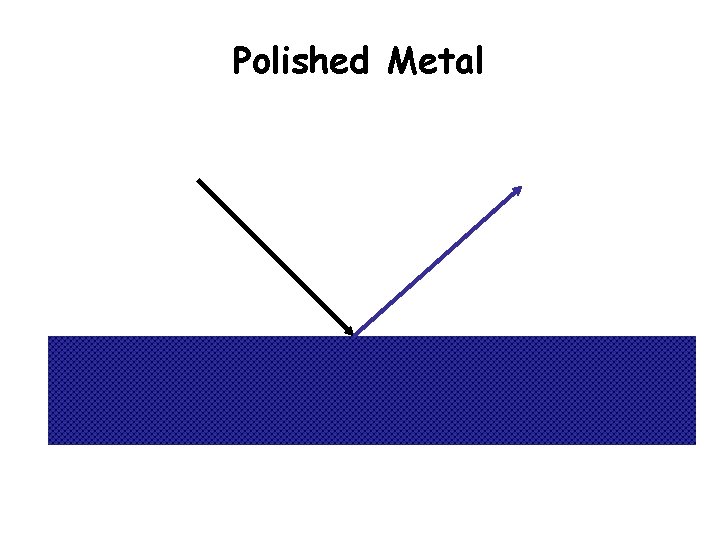
Law of Reflection • Angle of reflectance = angle of incidence N I R p
Polished Metal
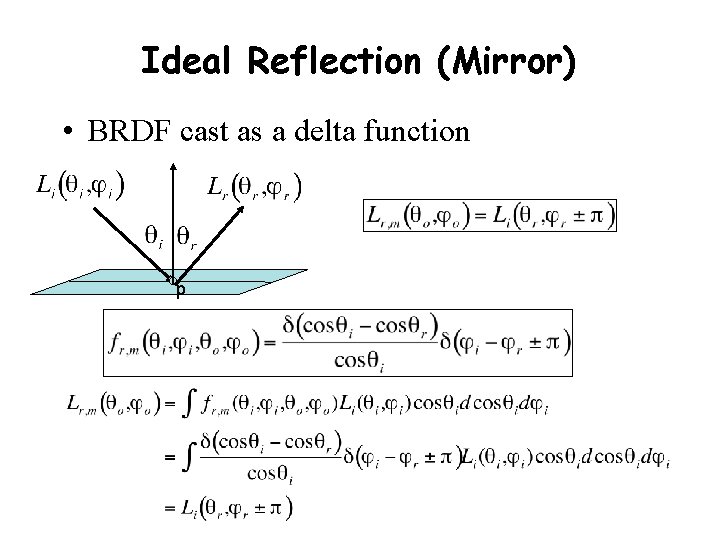
Ideal Reflection (Mirror) • BRDF cast as a delta function p
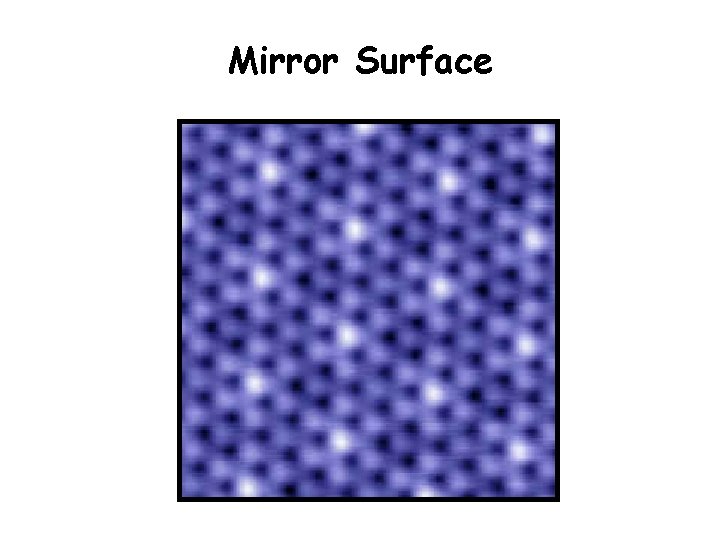
Mirror Surface
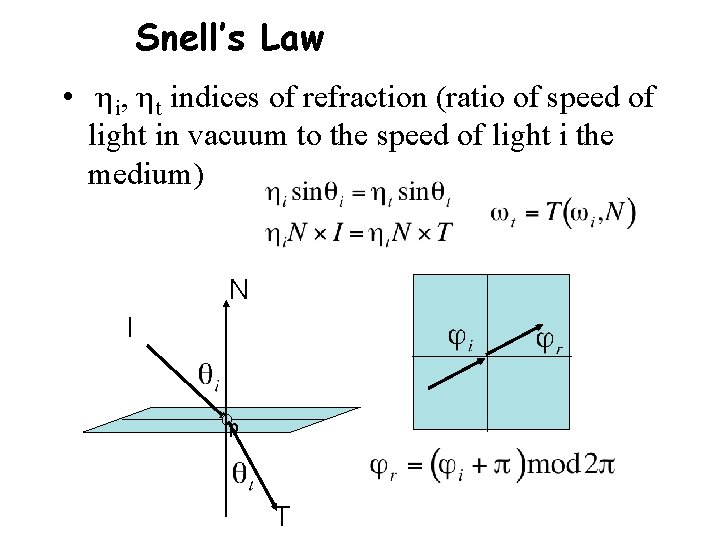
Snell’s Law • η i, η t indices of refraction (ratio of speed of light in vacuum to the speed of light i the medium) N I p T
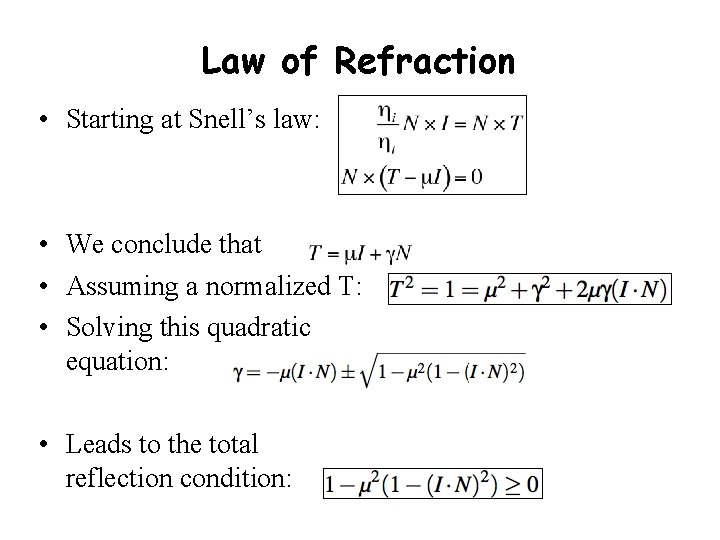
Law of Refraction • Starting at Snell’s law: • We conclude that • Assuming a normalized T: • Solving this quadratic equation: • Leads to the total reflection condition:
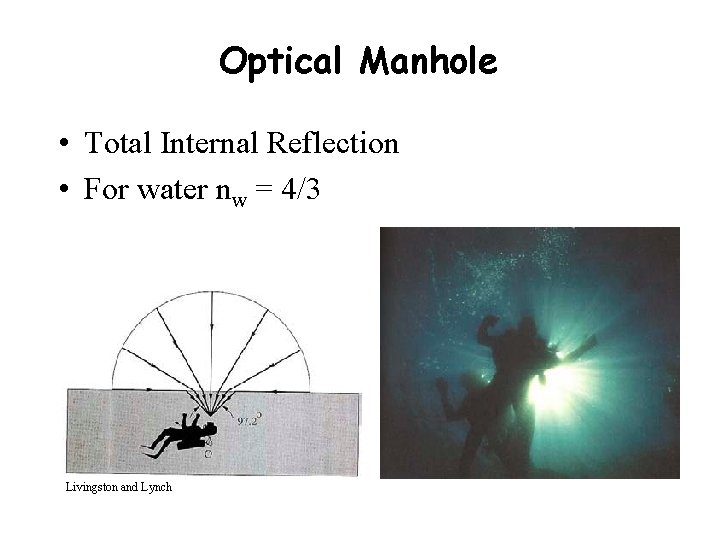
Optical Manhole • Total Internal Reflection • For water nw = 4/3 Livingston and Lynch
Fresnel Reflection • At top layer interface – Some light is reflected, – Remainder is transmitted through • Simple ray-tracers: just given as a constant • Physically based - depends on – incident angle – Polarization of light – wavelength • Solution of Maxwell’s equations to smooth surfaces • Dielectrics vs. conductors
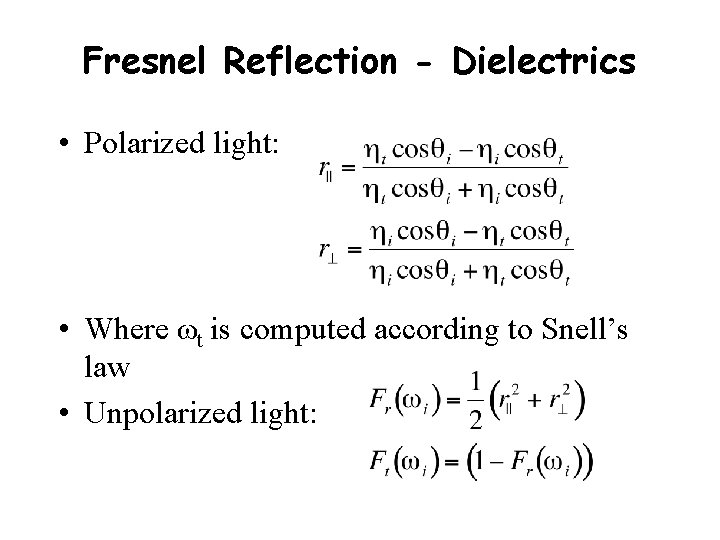
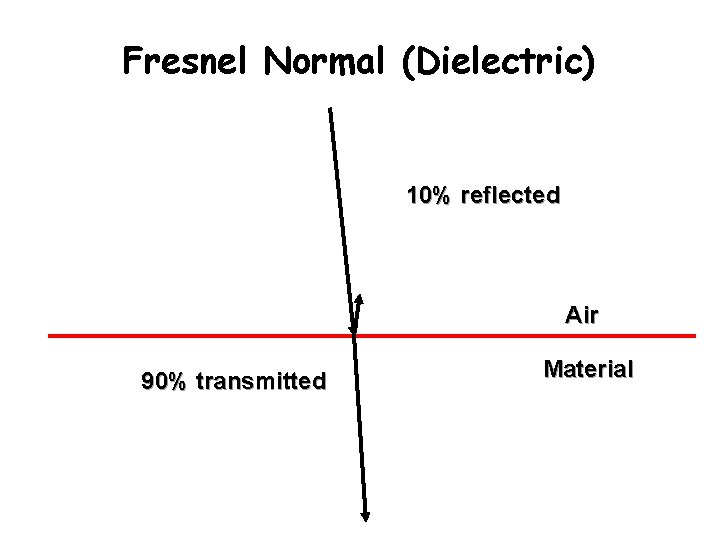
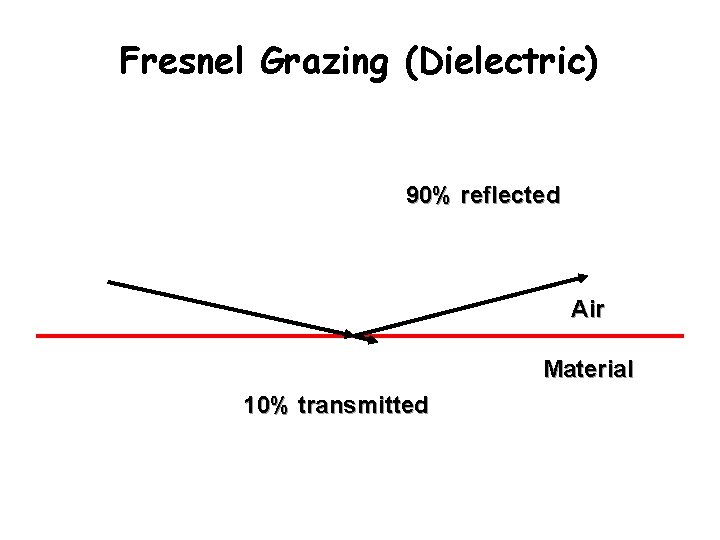
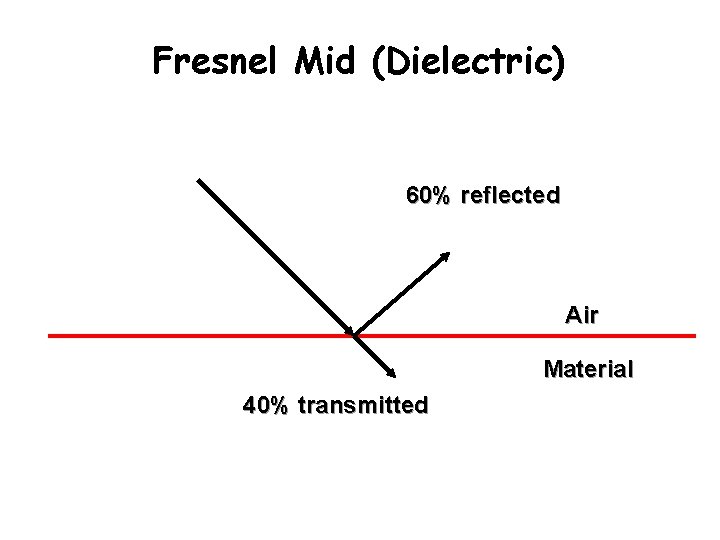
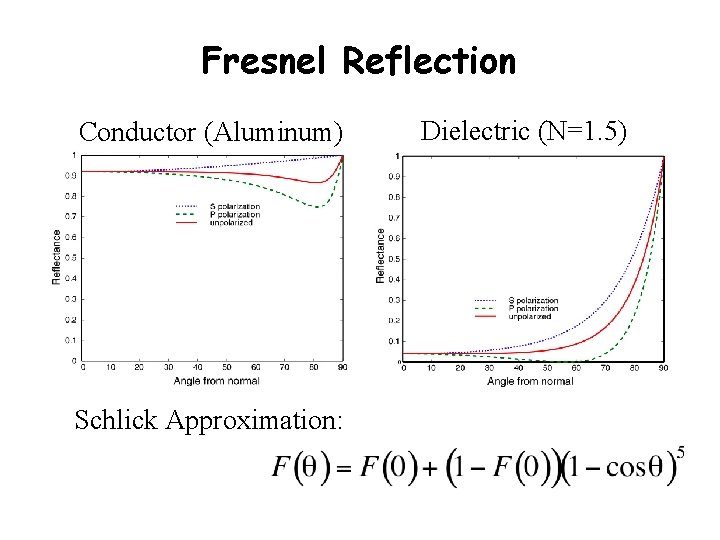
Fresnel Reflection - Dielectrics • Objects that don’t conduct electricity (e. g. glass) • Fresnel term F for a dielectric is proportion of reflection (e. g. glass, plastic) – grazing angles: 100% reflected (see the material well!) – normal angles: 5% reflected (almost mirror-like)
Fresnel Reflection - Dielectrics • Polarized light: • Where ωt is computed according to Snell’s law • Unpolarized light:
Fresnel Reflection - Dielectrics
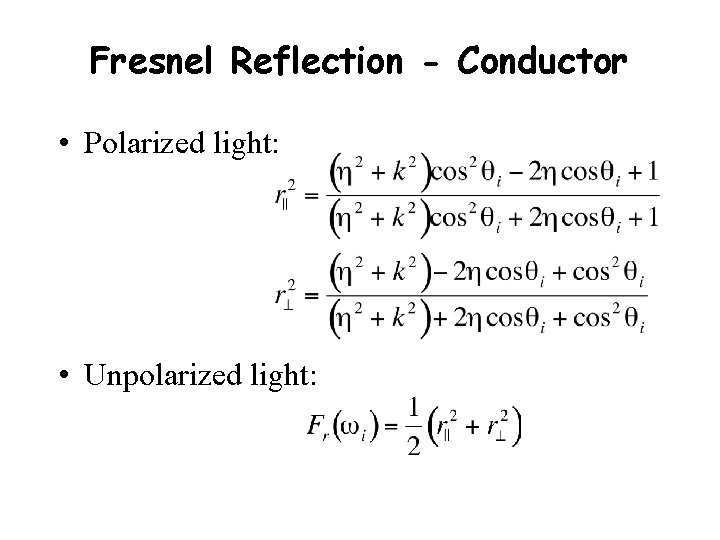
Fresnel Reflection - Conductor • Typically metals • No transmission • Absorption coefficient k
Fresnel Reflection - Conductor • Polarized light: • Unpolarized light:
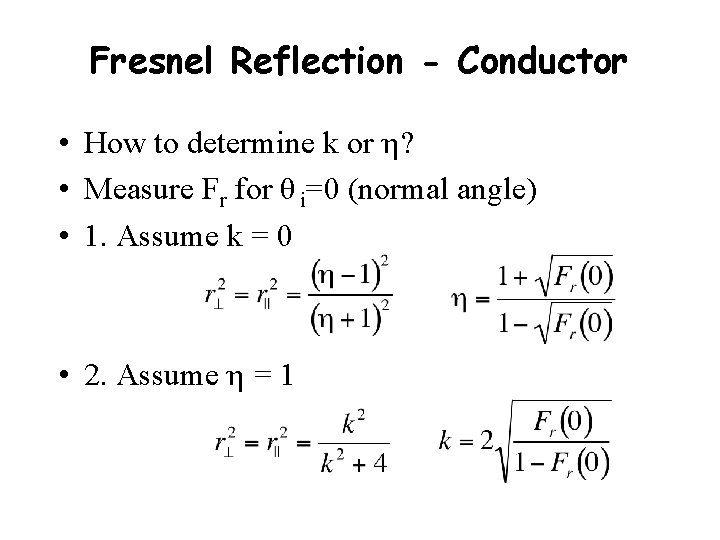
Fresnel Reflection - Conductor • How to determine k or η? • Measure Fr for θ i=0 (normal angle) • 1. Assume k = 0 • 2. Assume η = 1
Fresnel Normal (Dielectric) 10% reflected Air 90% transmitted Material
Fresnel Grazing (Dielectric) 90% reflected Air Material 10% transmitted
Fresnel Mid (Dielectric) 60% reflected Air Material 40% transmitted
Fresnel Reflection Conductor (Aluminum) Schlick Approximation: Dielectric (N=1. 5)
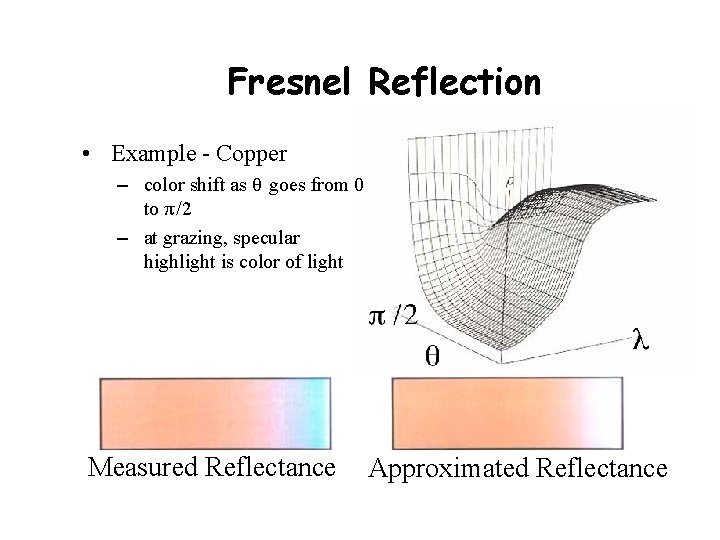
Fresnel Reflection • Example - Copper – color shift as θ goes from 0 to π/2 – at grazing, specular highlight is color of light Measured Reflectance Approximated Reflectance
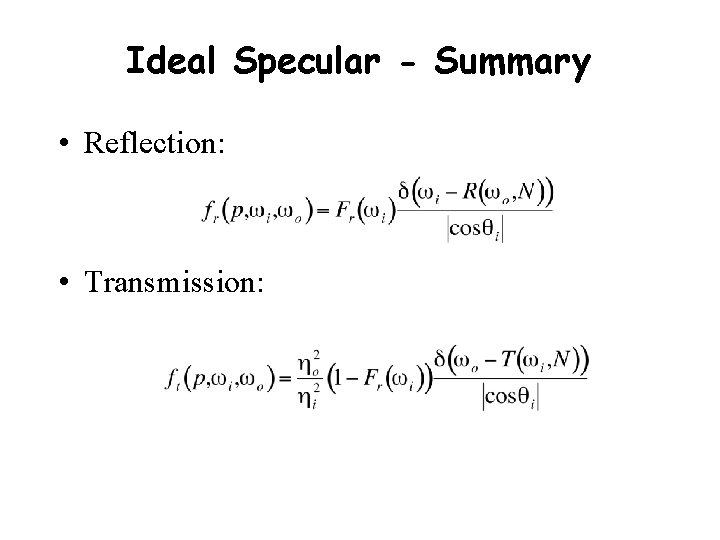
Ideal Specular - Summary • Reflection: • Transmission:
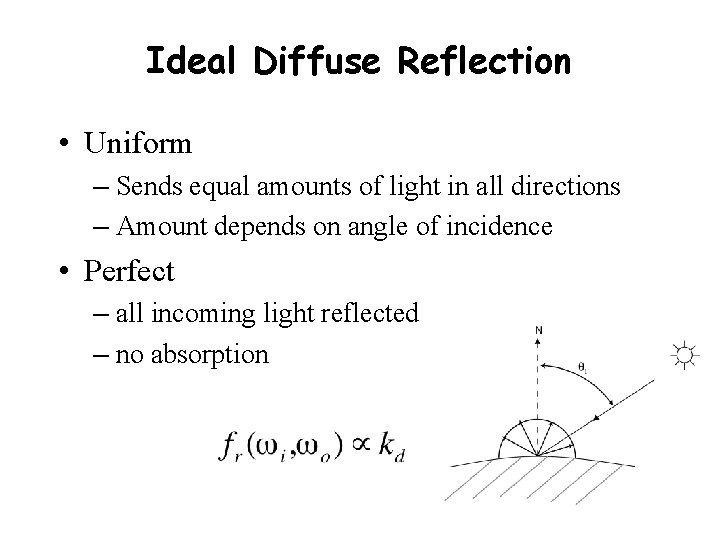
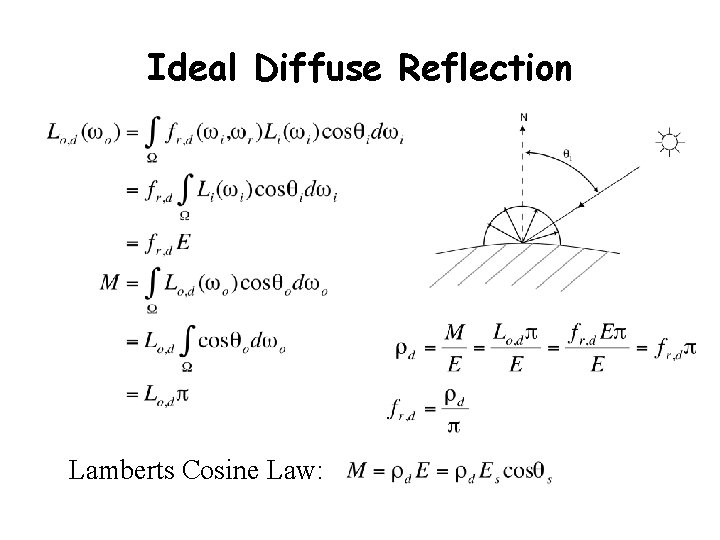
Ideal Diffuse Reflection • Uniform – Sends equal amounts of light in all directions – Amount depends on angle of incidence • Perfect – all incoming light reflected – no absorption
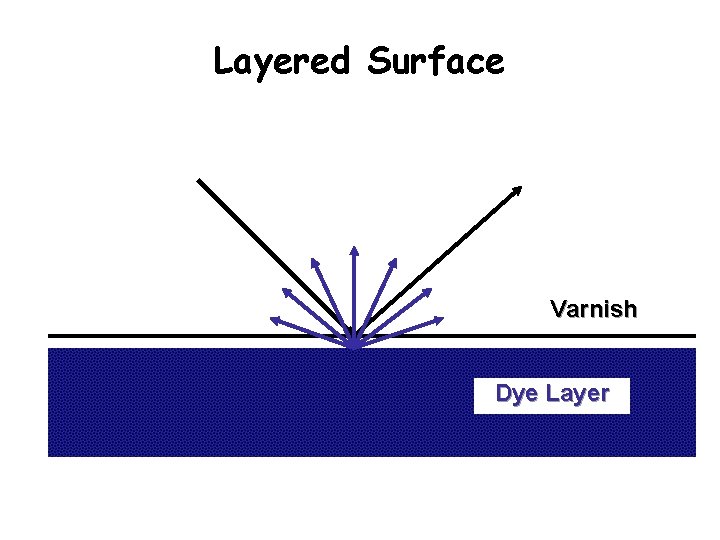
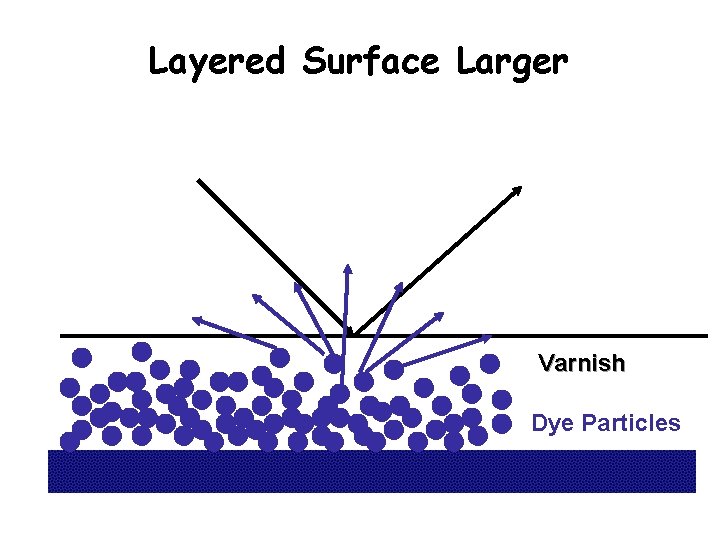
Layered Surface Varnish Dye Layer
Layered Surface Larger Varnish Dye Particles
Ideal Diffuse Reflection Lamberts Cosine Law:
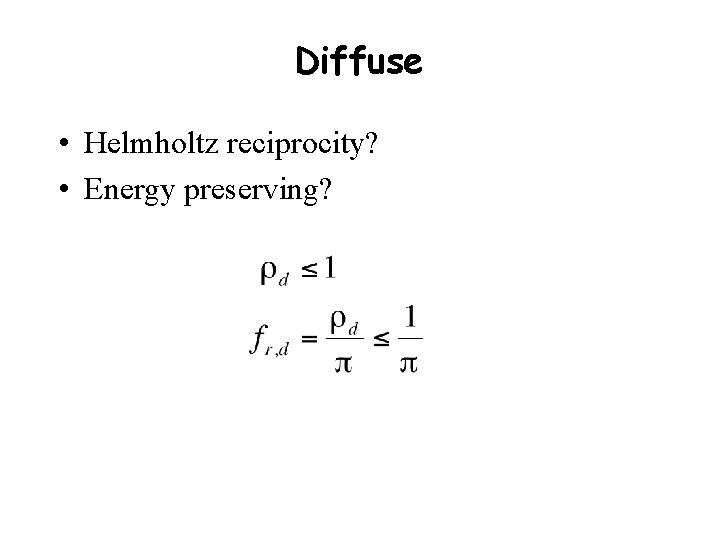
Diffuse • Helmholtz reciprocity? • Energy preserving?
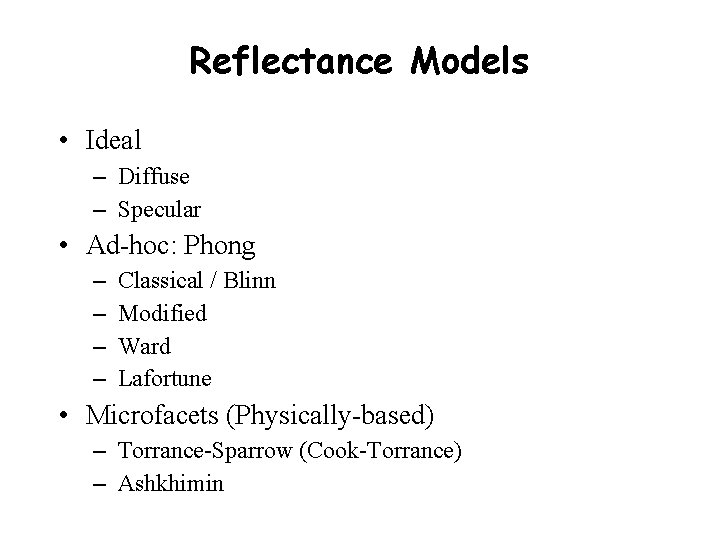
Reflectance Models • Ideal – Diffuse – Specular • Ad-hoc: Phong – – Classical / Blinn Modified Ward Lafortune • Microfacets (Physically-based) – Torrance-Sparrow (Cook-Torrance) – Ashkhimin
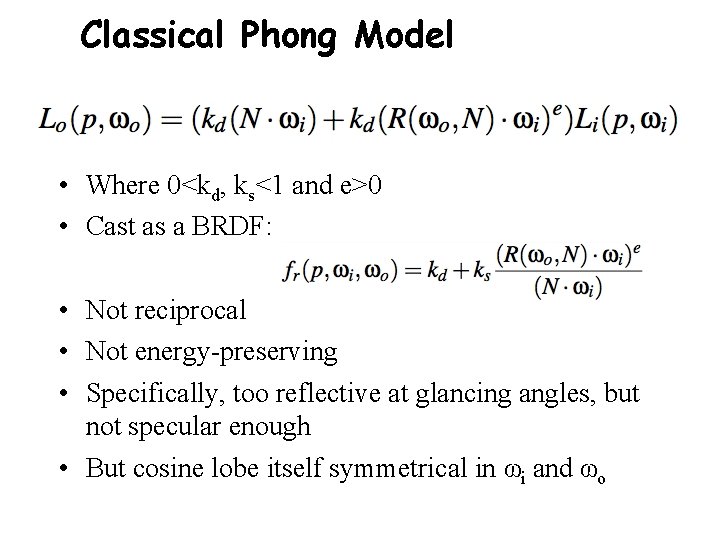
Classical Phong Model • Where 0<kd, ks<1 and e>0 • Cast as a BRDF: • Not reciprocal • Not energy-preserving • Specifically, too reflective at glancing angles, but not specular enough • But cosine lobe itself symmetrical in ωi and ωo
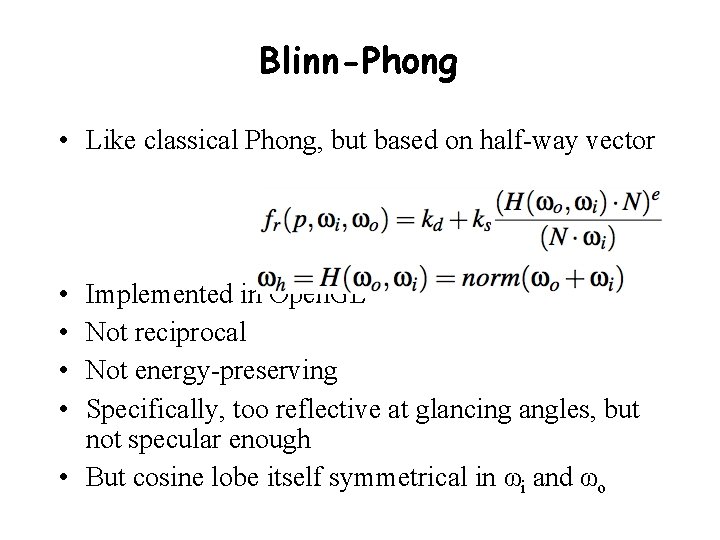
Blinn-Phong • Like classical Phong, but based on half-way vector • • Implemented in Open. GL Not reciprocal Not energy-preserving Specifically, too reflective at glancing angles, but not specular enough • But cosine lobe itself symmetrical in ωi and ωo
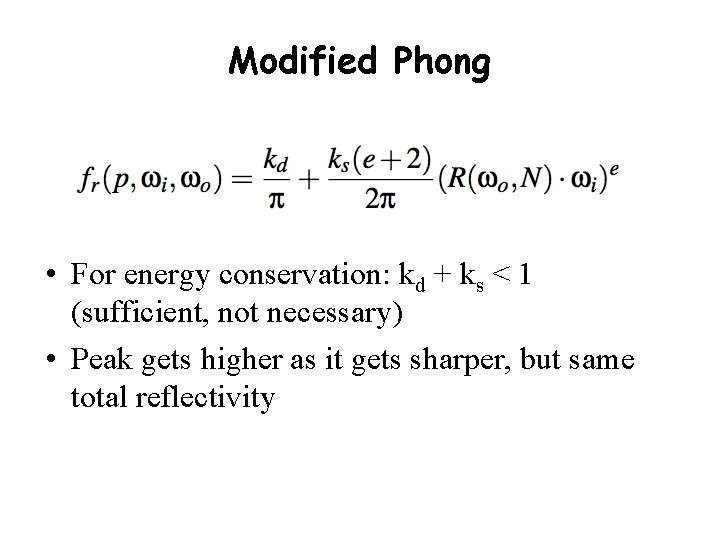
Modified Phong • For energy conservation: kd + ks < 1 (sufficient, not necessary) • Peak gets higher as it gets sharper, but same total reflectivity
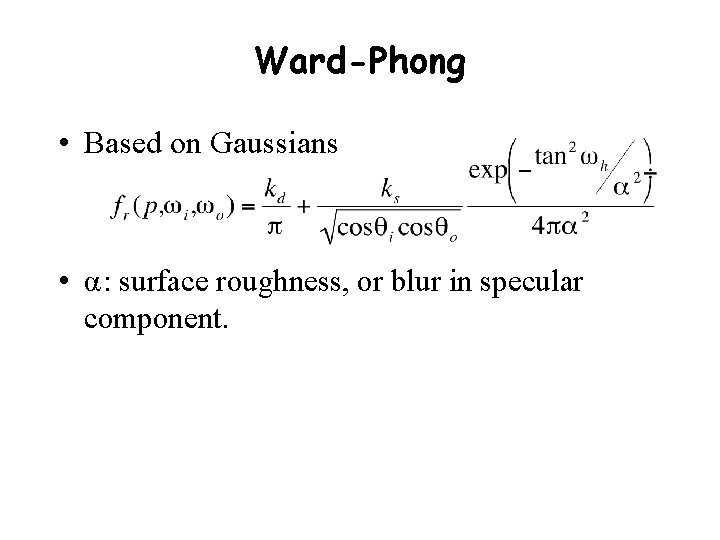
Ward-Phong • Based on Gaussians • α: surface roughness, or blur in specular component.
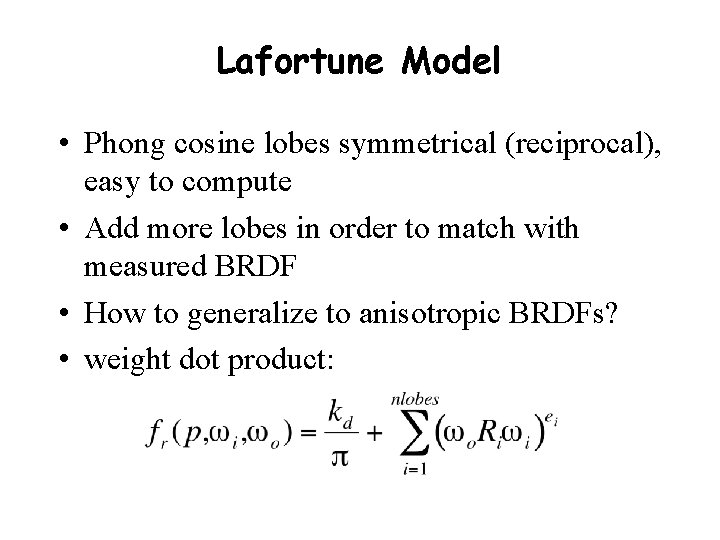
Lafortune Model • Phong cosine lobes symmetrical (reciprocal), easy to compute • Add more lobes in order to match with measured BRDF • How to generalize to anisotropic BRDFs? • weight dot product:
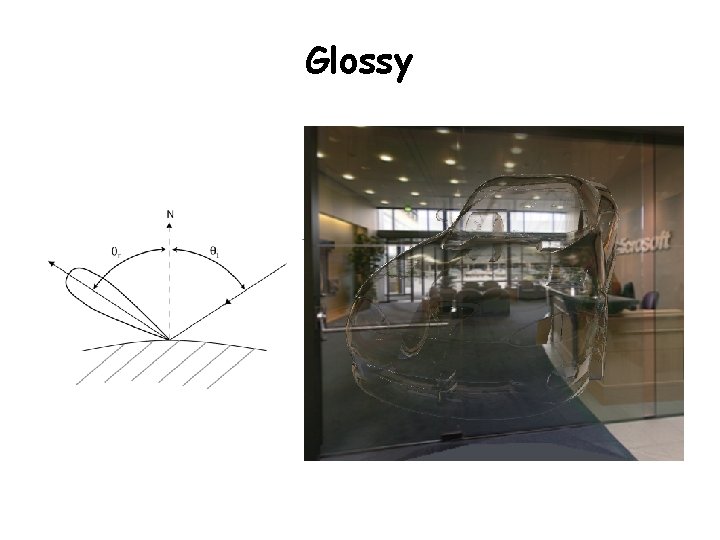
Glossy
Physically-based Models • Some basic principles common to many models: – Fresnel effect – Surface self-shadowing – Microfacets • To really model well how surfaces reflect light, need to eventually move beyond BRDF • Different physical models required for different kinds of materials • Some kinds of materials don’t have good models • Remember that BRDF makes approximation of completely local surface reflectance!
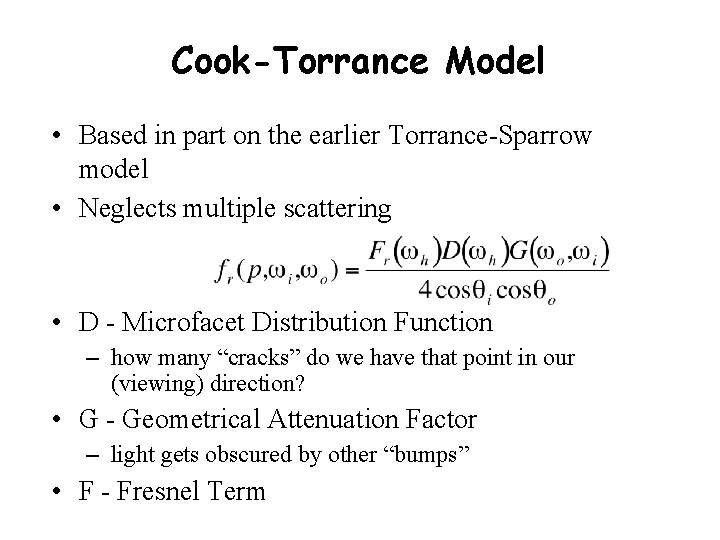
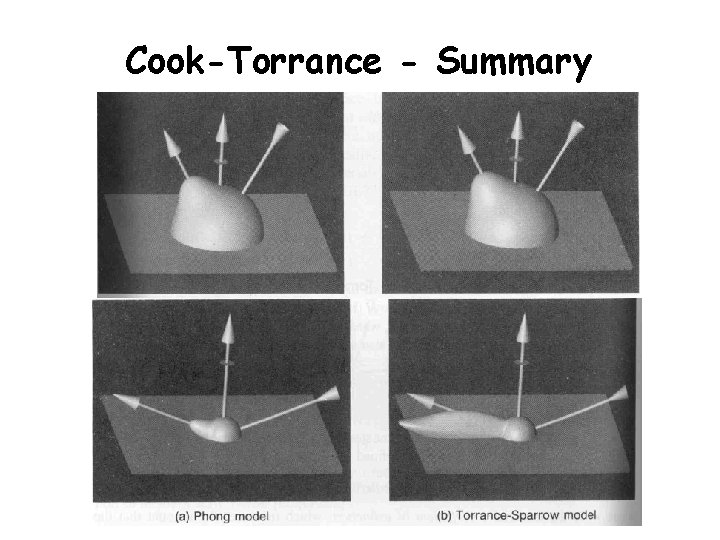
Cook-Torrance Model • Based in part on the earlier Torrance-Sparrow model • Neglects multiple scattering • D - Microfacet Distribution Function – how many “cracks” do we have that point in our (viewing) direction? • G - Geometrical Attenuation Factor – light gets obscured by other “bumps” • F - Fresnel Term
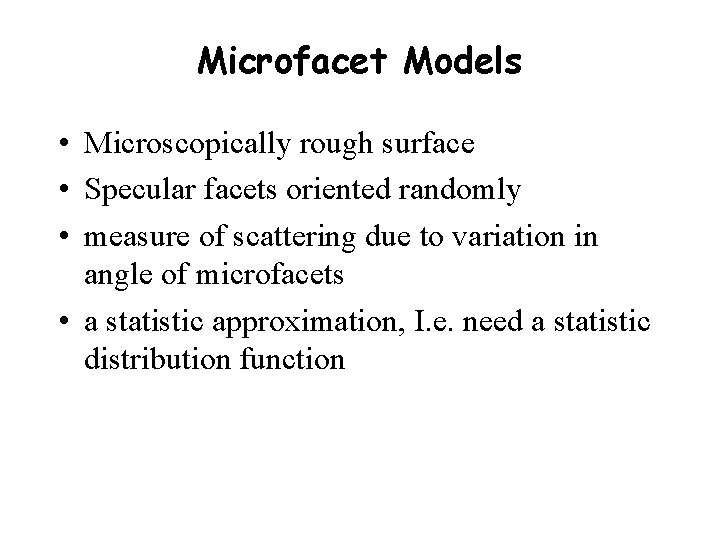
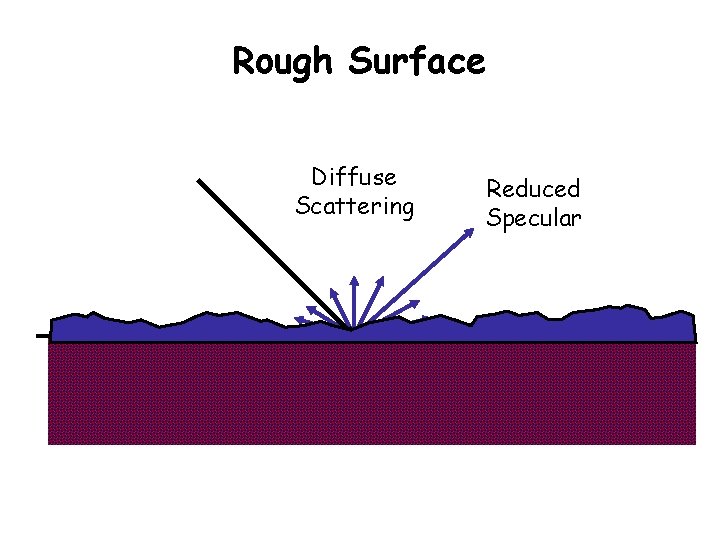
Microfacet Models • Microscopically rough surface • Specular facets oriented randomly • measure of scattering due to variation in angle of microfacets • a statistic approximation, I. e. need a statistic distribution function
Rough Surface Diffuse Scattering Reduced Specular
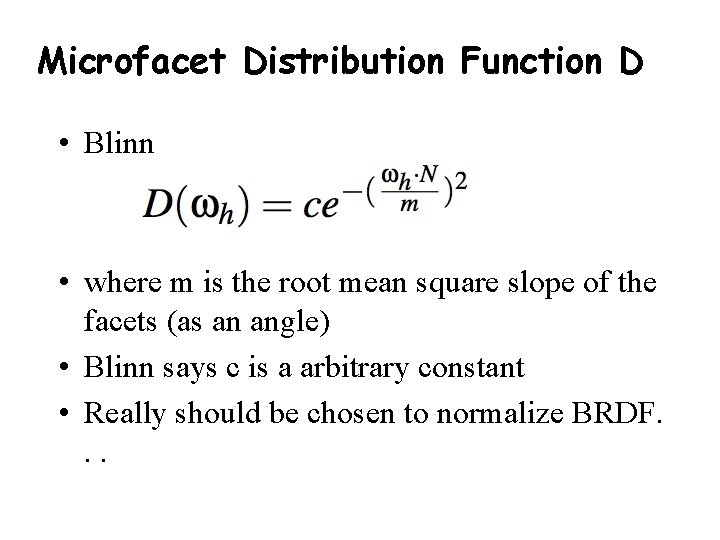
Microfacet Distribution Function D • Blinn • where m is the root mean square slope of the facets (as an angle) • Blinn says c is a arbitrary constant • Really should be chosen to normalize BRDF. . .
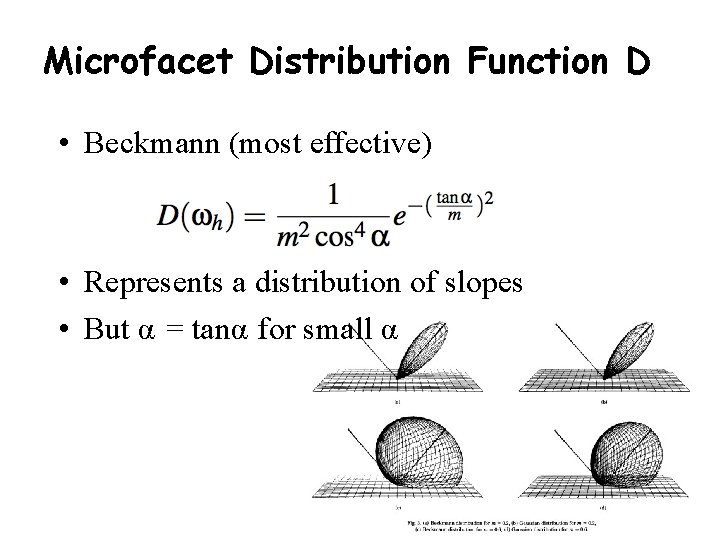
Microfacet Distribution Function D • Beckmann (most effective) • Represents a distribution of slopes • But α = tanα for small α
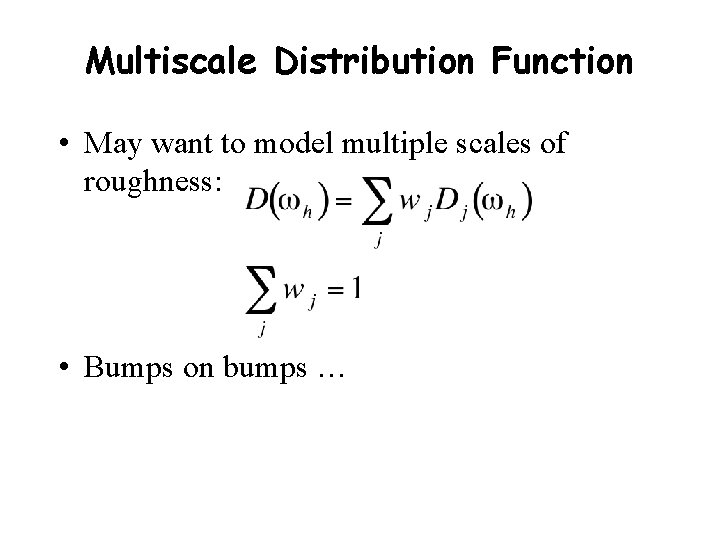
Multiscale Distribution Function • May want to model multiple scales of roughness: • Bumps on bumps …
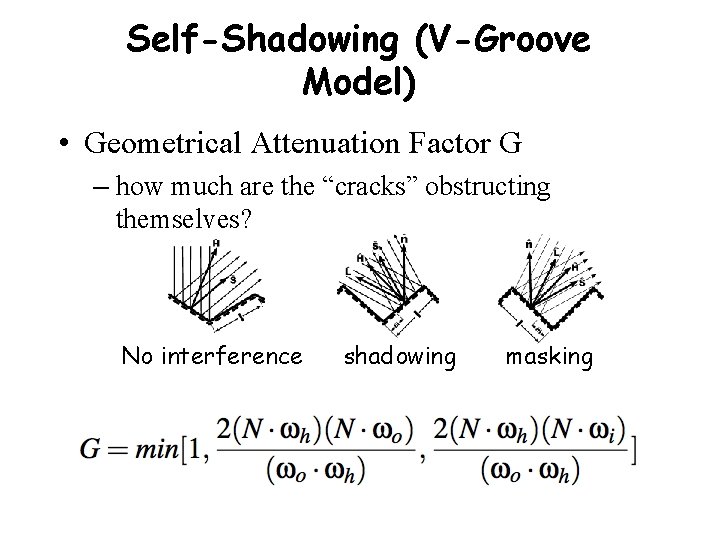
Self-Shadowing (V-Groove Model) • Geometrical Attenuation Factor G – how much are the “cracks” obstructing themselves? No interference shadowing masking
Cook-Torrance - Summary
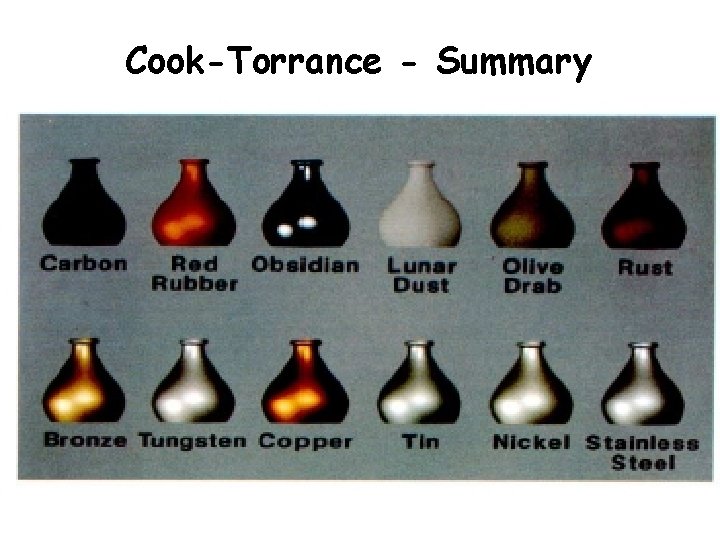
Cook-Torrance - Summary
Ashkhimin Model • Modern Phong • Phenomological, but: – Physically plausible – Anisotropic • Good for both Monte-Carlo and HW implementation
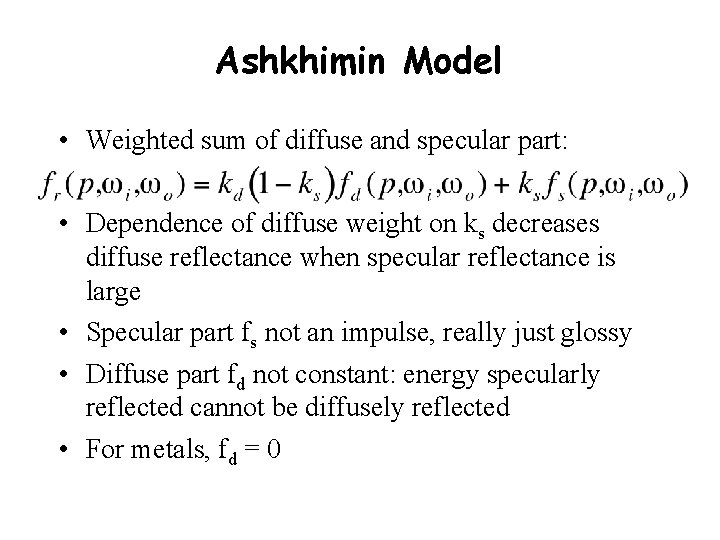
Ashkhimin Model • Weighted sum of diffuse and specular part: • Dependence of diffuse weight on ks decreases diffuse reflectance when specular reflectance is large • Specular part fs not an impulse, really just glossy • Diffuse part fd not constant: energy specularly reflected cannot be diffusely reflected • For metals, fd = 0
Ashkhimin Model • ks: Spectrum or color of specular reflectance at normal incidence. • kd: Spectrum or color of diffuse reflectance (away from the specular peak). • qu, qv: Exponents to control shape of specular peak. – – – Similar effects to Blinn-Phong model If an isotropic model is desired, use single value q A larger value gives a sharper peak Anisotropic model requires two tangent vectors u and v The value qu controls sharpness in the direction of u The value qv controls sharpness in the direction of v
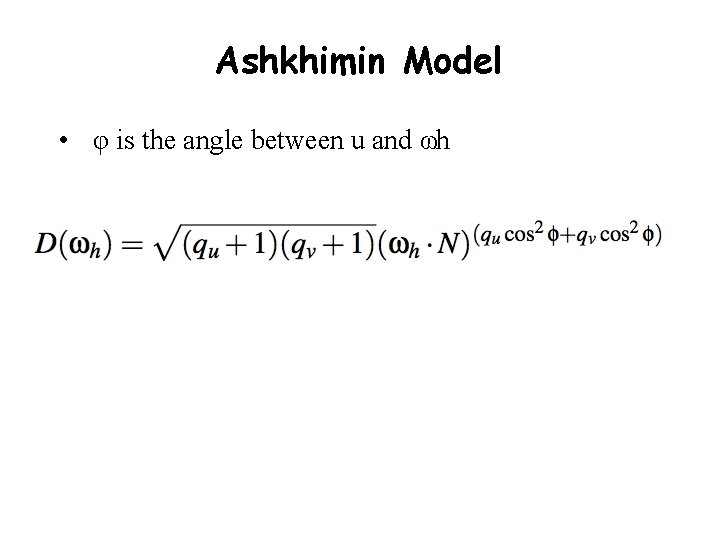
Ashkhimin Model • φ is the angle between u and ωh
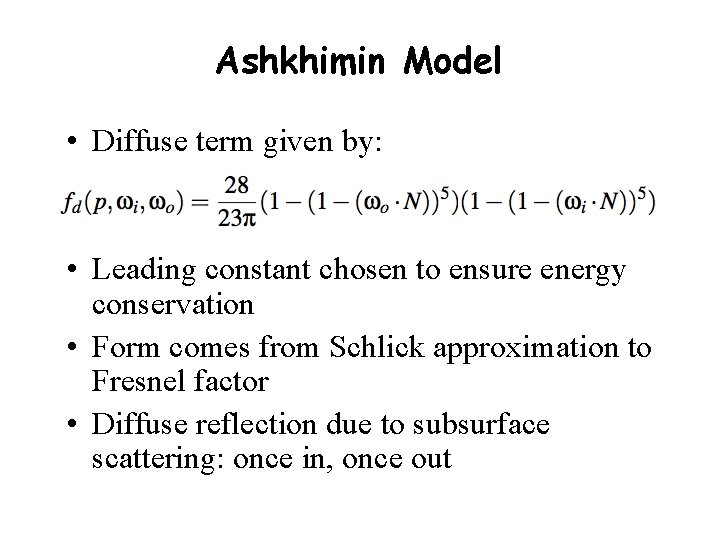
Ashkhimin Model • Diffuse term given by: • Leading constant chosen to ensure energy conservation • Form comes from Schlick approximation to Fresnel factor • Diffuse reflection due to subsurface scattering: once in, once out
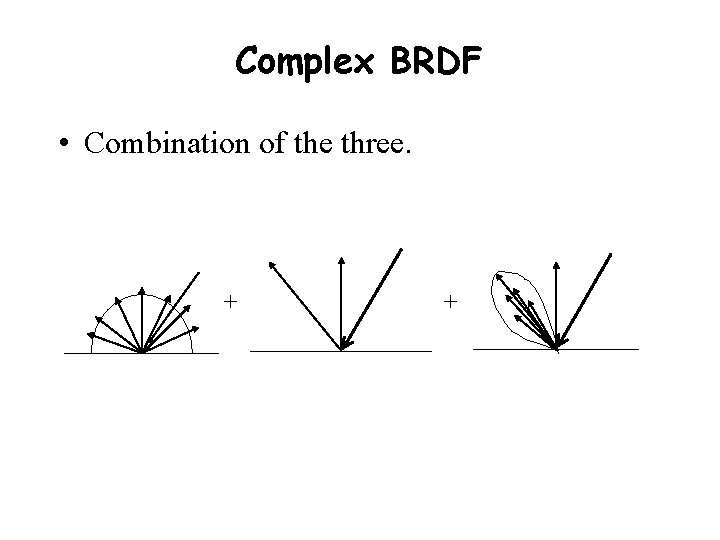
Complex BRDF • Combination of the three. + +
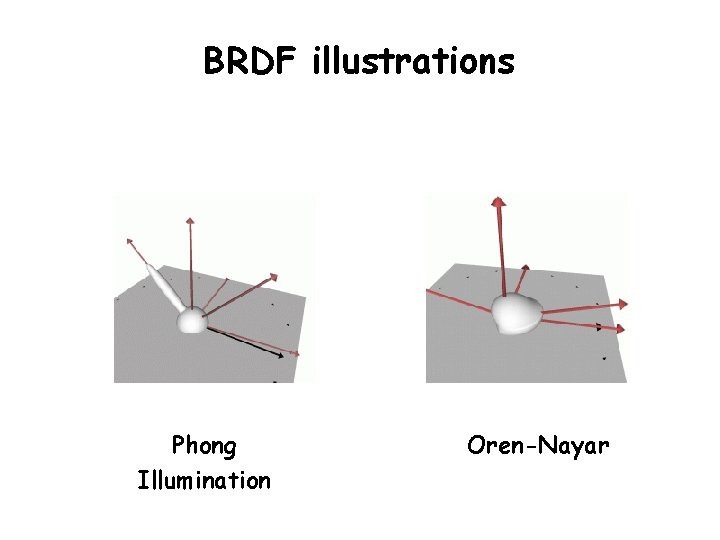
BRDF illustrations Phong Illumination Oren-Nayar
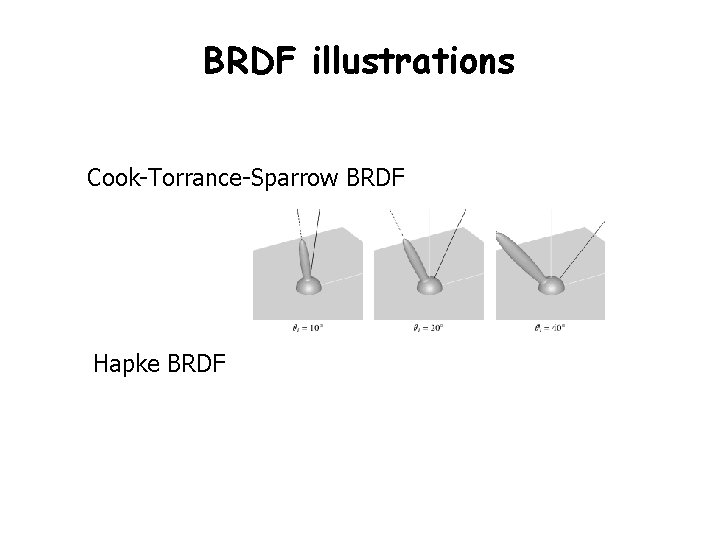
BRDF illustrations Cook-Torrance-Sparrow BRDF Hapke BRDF
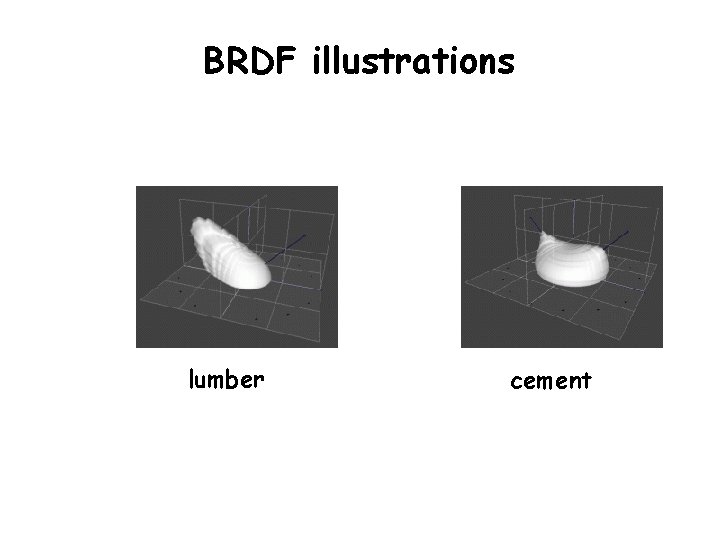
BRDF illustrations lumber cement
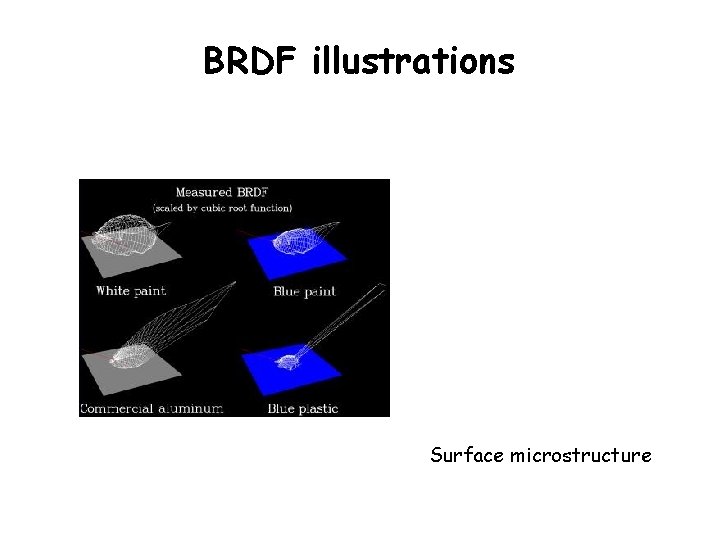
BRDF illustrations Surface microstructure
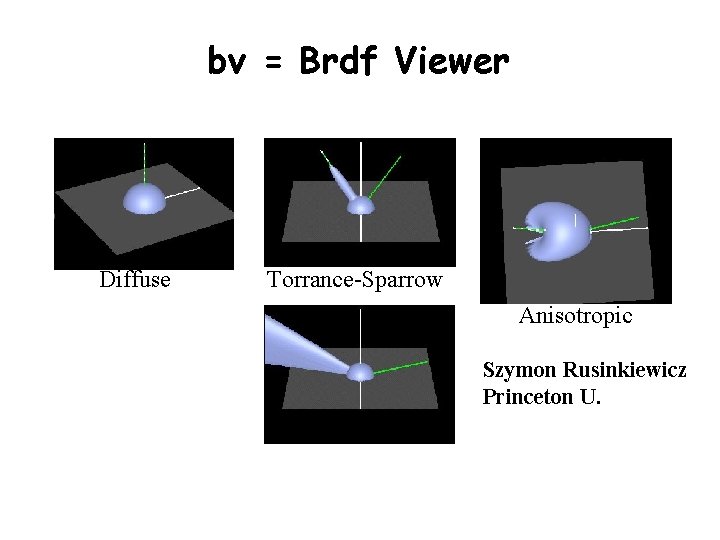
bv = Brdf Viewer Diffuse Torrance-Sparrow Anisotropic Szymon Rusinkiewicz Princeton U.
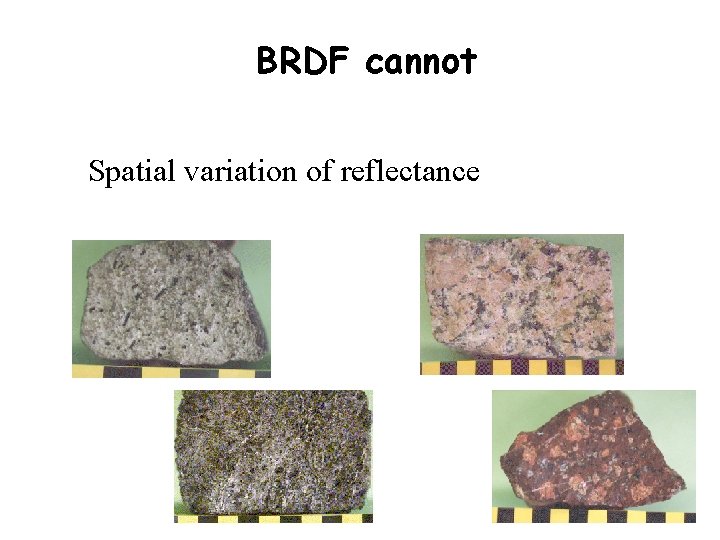
BRDF cannot Spatial variation of reflectance
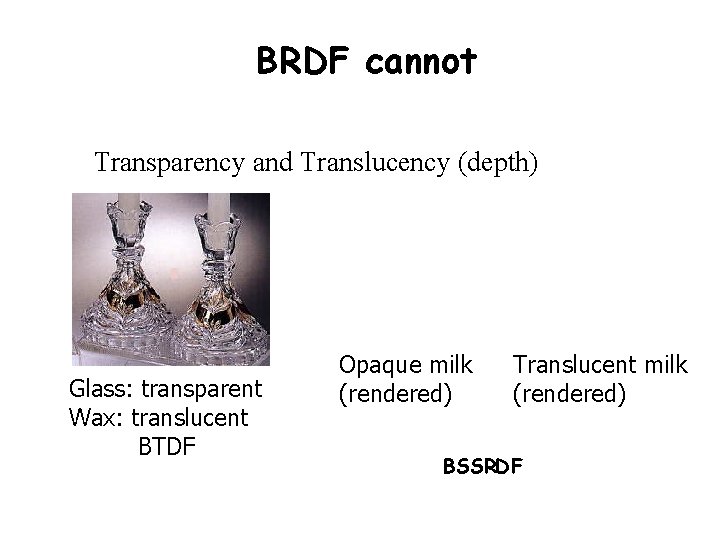
BRDF cannot Transparency and Translucency (depth) Glass: transparent Wax: translucent BTDF Opaque milk (rendered) Translucent milk (rendered) BSSRDF