
Fundamentals of Plant Pathology Plant Path 121 1


- Slides: 33
Fundamentals of Plant Pathology Plant Path - 121 1 Don Bosco College of Agriculture
Fundamentals of Plant Pathology – Plant Path - 121 Syllabus Lecture nos – 34, 35, 36 First year B Sc (Hons. ) Agriculture Topic: Mode of action and formulations of Fungicides and Antibiotics Suresh Kunkalikar 2
3
Mode of action and formulations of Fungicides 4
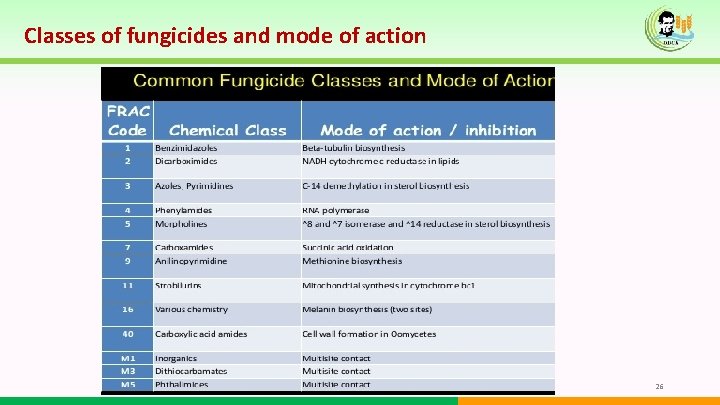
Mode of action of a fungicides • The mode of action of a fungicide describes how the active ingredient affects the fungal pathogen. • Depending on the fungicide, mode of action may be described at several different physiological levels including morphological changes, affected cellular components or biochemical processes, and sites of molecular activity. • Fungicides are synthesized towards various biochemical and structural features which leads to specific activity against fungi i. e. killing or inhibiting growth • The typical target of the fungicides is chitin which is a component of fungal cell wall and Ergosterol, which is component of cell membrane. • Ergosterol is absent in animal and plant cell membrane. • Ergosterol and various steps in its synthesis pathway has important implication in resistance management. Fungicides - Fungicides are synthetic or natural chemical compound or biological organisms, which kill or inhibit the growth of fungus and spore germination. 5
How fungicides kill fungal pathogens Fungicides kill by: • Damaging cell membranes. • Inactivating critical enzymes or proteins. • Interfering with key metabolic processes, e. g. respiration Fungicides can be: 1. Contact. 2. Translaminar. 3. Systemic. 6
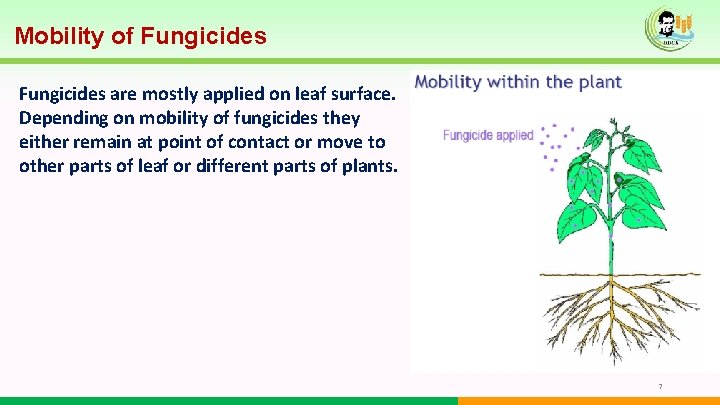
Mobility of Fungicides are mostly applied on leaf surface. Depending on mobility of fungicides they either remain at point of contact or move to other parts of leaf or different parts of plants. 7
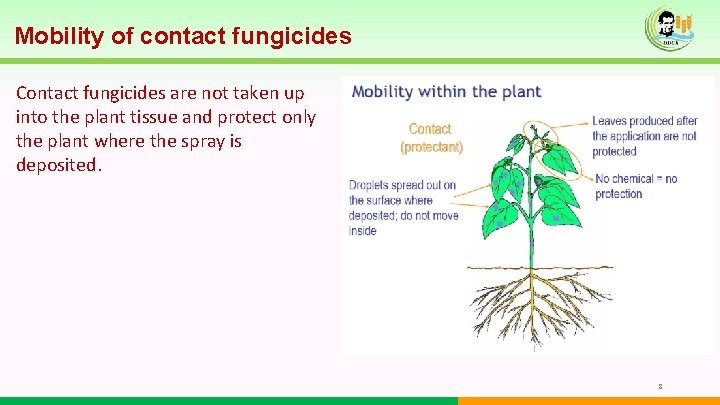
Mobility of contact fungicides Contact fungicides are not taken up into the plant tissue and protect only the plant where the spray is deposited. 8
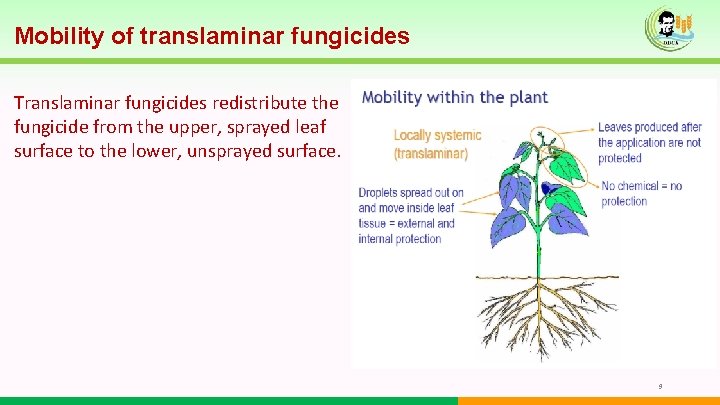
Mobility of translaminar fungicides Translaminar fungicides redistribute the fungicide from the upper, sprayed leaf surface to the lower, unsprayed surface. 9
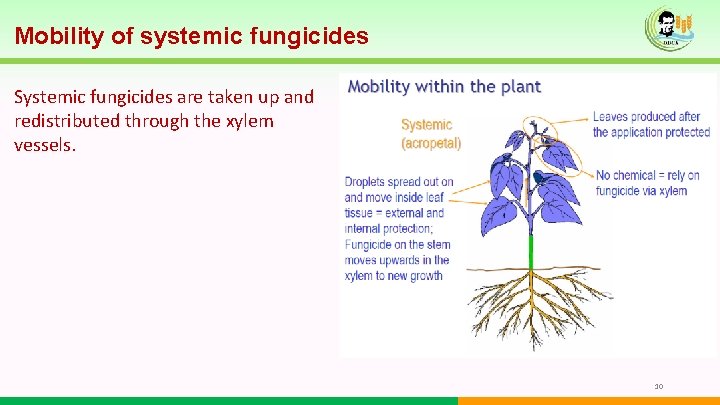
Mobility of systemic fungicides Systemic fungicides are taken up and redistributed through the xylem vessels. 10
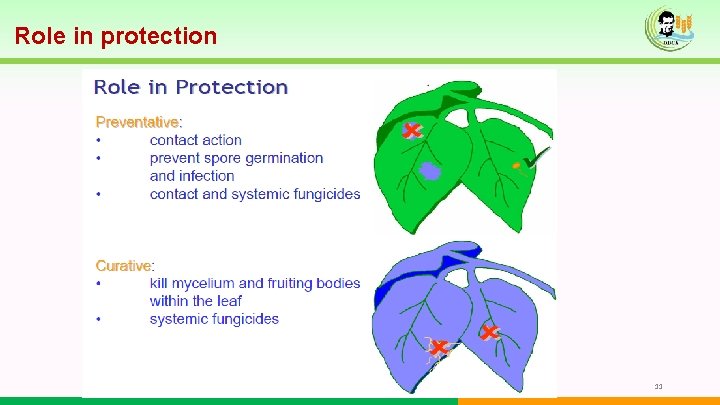
Role in protection 11
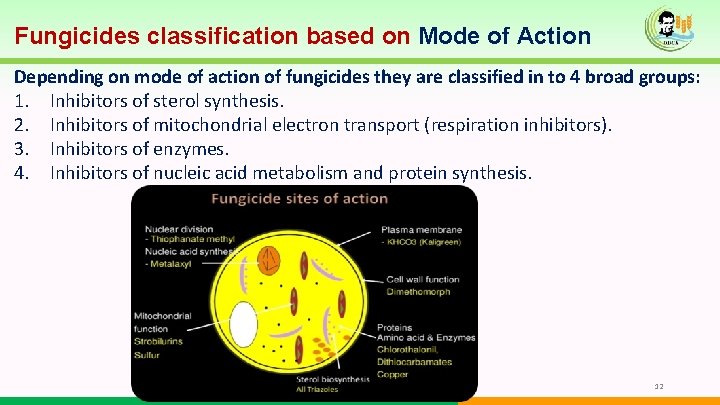
Fungicides classification based on Mode of Action Depending on mode of action of fungicides they are classified in to 4 broad groups: 1. Inhibitors of sterol synthesis. 2. Inhibitors of mitochondrial electron transport (respiration inhibitors). 3. Inhibitors of enzymes. 4. Inhibitors of nucleic acid metabolism and protein synthesis. 12
Mode of Action 1. Inhibitors of sterol synthesis. Ergosterol is a component of fungal cell membranes necessary for membrane structure, integrity and function. It is formed from its precursor via a multistep ergosterol synthesis pathway. First group of inhibitors are Demethylation inhibitors (DMIs) and are systemic fungicides. They target cell membrane integrity through the inhibition of C 14 -demethylation during ergosterol biosynthesis. • These fungicides target a single metabolic site hence the risk of resistance is high unless they are used with other fungicides having different modes of action. • Their primary efficacy is against Basidiomycetes (rust pathogens), followed by Deuteromycetes (Septoria) and to a lesser extent Ascomycetes (Powdery Mildews). 1. Ex: Imidazoles, Pyrimidines and Triazoles with primary primarily curative activity. 2. Their primary efficacy is against Basidiomycetes (rust pathogens), followed by Deuteromycetes (Septoria) and to a lesser extent Ascomycetes (Powdery Mildews) 13 Ex: Imidazoles, Pyrimidines and Triazoles with primary primarily curative activity. • •
• The second type in sterol inhibitors are morpholines, which act by inhibiting the sterol reductase and sterol isomerase enzymes of the ergosterol synthesis pathway. • They have curative systemic activity and in contrast to DMIs is effective against Ascomycetes. • They have multiple sites of action hence the risk of resistance development is low for this group. • Morpholines can be used in tank or formulated mixtures with DMIs, broadening the spectrum of activity. • Morpholines are less costly than DMIs, and combinations of these products can reduce the overall cost of pathogen control. 14
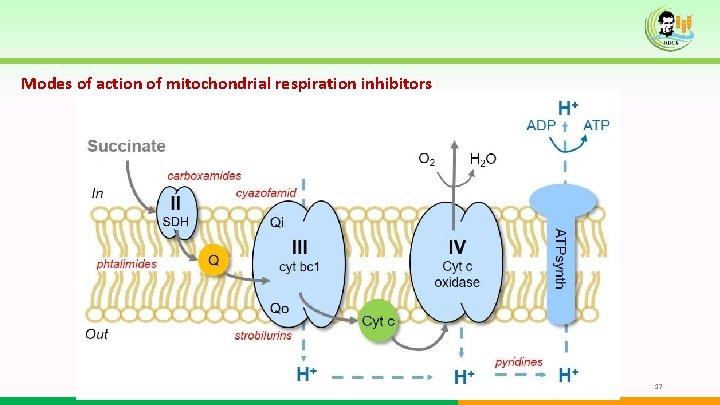
2. Inhibitors of mitochondrial electron transport (respiration inhibitors). • Respiration is a most common process across all the living organisms and there can be a risk of selectivity while selecting a target. • However most fungicides in this group show selective toxicity towards fungi, in part due to selective uptake and translocation. • Strobilurins form part of the group of quinone-outside inhibitor (Qo. I) fungicides, inhibiting mitochondrial respiration at the Qo site of cytochrome b, part of the cytochrome bc 1 complex (Complex III), preventing spore germination and mycelial growth in fungal pathogens. • They are active against most cereal fungal diseases, including septoria, rusts and mildew • Strobilurins are partially systemic and have a great residual long-term activity, and can be used in tank or formulated mixtures with triazoles, broadening the spectrum of activity and permitting greater flexibility of spray timing. 15
• Carboxamides form part of the group of succinate dehydrogenase inhibitors (SDHIs), inhibiting the activity of mitochondrial Complex II (succinate dehydrogenase) and thus respiration in fungal cells. • As Complex II is a common mitochondrial enzyme system found in eukaryotic and prokaryotic organisms, non-target effects of complex II inhibitors must be considered. • The Pyridine group of fungicides are proton gradient uncouplers, inhibiting mitochondrial respiration in fungal pathogens by uncoupling the proton gradient and reducing the proton driven synthesis of ATP via the enzyme ATP synthase. • Folpet and the phthalimide fungicide Captan are thiol reactants, blocking the activity of thiol-containing enzymes involved in mitochondrial respiration in fungal spores. • Their protective action is mainly due to inhibition of spore germination. • As for many other respiration inhibitors, they are also active against certain oomycetes, such as Pythium. 16
Modes of action of mitochondrial respiration inhibitors 17
3. Inhibitors of enzymes. Multi-site enzyme inhibitors inhibit several thiol-containing enzymes involved in respiration. Ex. Chlorothalonil and Thiram. Single site fungicides, only inhibit single, specific metabolic process. Ex. Epoxiconazole and azoxystrobin. 18
4. Inhibitors of nucleic acid metabolism and protein synthesis. Nucleic acid metabolism and protein synthesis inhibitors inhibit DNA as well as RNA synthesis, affecting cell division and cellular metabolism. Ex. Benzimidazoles, phenylamides and dicarboximides, and 19
Formulations of fungicides Fungicide formulation – It is a mixture of the active and inert ingredients in the fungicide. • The active ingredients are the chemicals that affect the target pest. • The inert ingredients are all other ingredients in the fungicide, and are also calledinactive ingredients. • Inert ingredients are used to dilute the active ingredient or make it safer, easier to handle, and more effective. • Some formulations are ready to use, others must be further diluted by air (air-blast sprayer), water, or a petroleum-based solvent. • A single active ingredient is often sold in multiple formulations - you must choose the formulation that works best for you. 20
Formulations a) Solid/Dry b) Liquid c) Other a) Solid/Dry • Dusts - are free flowing powders containing technical material in the range of 2 to 10 per cent and inert carrier. • Granule - products contain technical material in the range of 3 to 10 per cent and granule base. • Water dispersible powders or Wettable Powders (WP) - are free flowing powders containing technical material mostly in the range of 25 to 75 per cent, and contain wetting and dispersing agents and carriers. 21
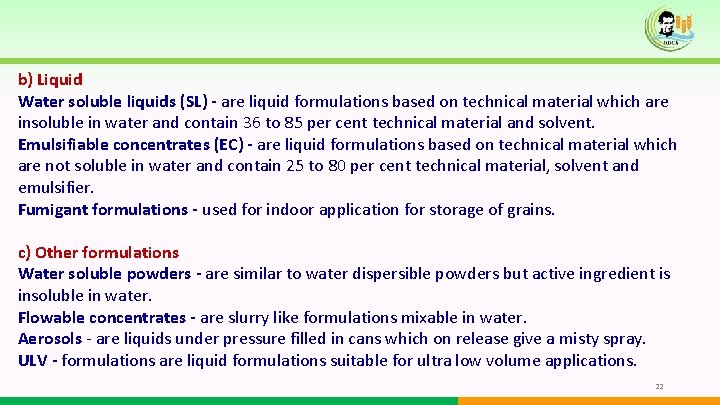
b) Liquid Water soluble liquids (SL) - are liquid formulations based on technical material which are insoluble in water and contain 36 to 85 per cent technical material and solvent. Emulsifiable concentrates (EC) - are liquid formulations based on technical material which are not soluble in water and contain 25 to 80 per cent technical material, solvent and emulsifier. Fumigant formulations - used for indoor application for storage of grains. c) Other formulations Water soluble powders - are similar to water dispersible powders but active ingredient is insoluble in water. Flowable concentrates - are slurry like formulations mixable in water. Aerosols - are liquids under pressure filled in cans which on release give a misty spray. ULV - formulations are liquid formulations suitable for ultra low volume applications. 22
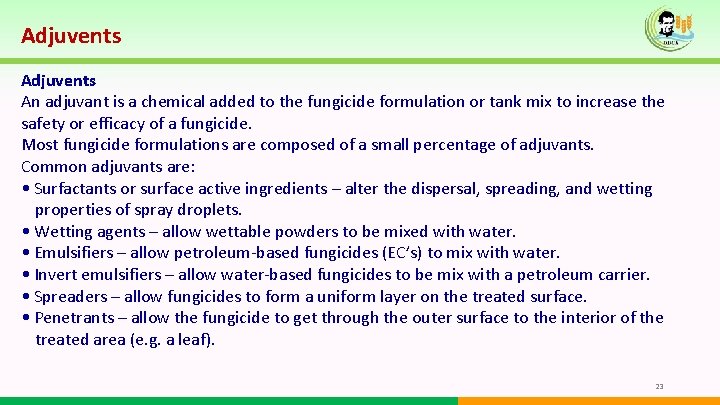
Adjuvents An adjuvant is a chemical added to the fungicide formulation or tank mix to increase the safety or efficacy of a fungicide. Most fungicide formulations are composed of a small percentage of adjuvants. Common adjuvants are: • Surfactants or surface active ingredients – alter the dispersal, spreading, and wetting properties of spray droplets. • Wetting agents – allow wettable powders to be mixed with water. • Emulsifiers – allow petroleum-based fungicides (EC’s) to mix with water. • Invert emulsifiers – allow water-based fungicides to be mix with a petroleum carrier. • Spreaders – allow fungicides to form a uniform layer on the treated surface. • Penetrants – allow the fungicide to get through the outer surface to the interior of the treated area (e. g. a leaf). 23
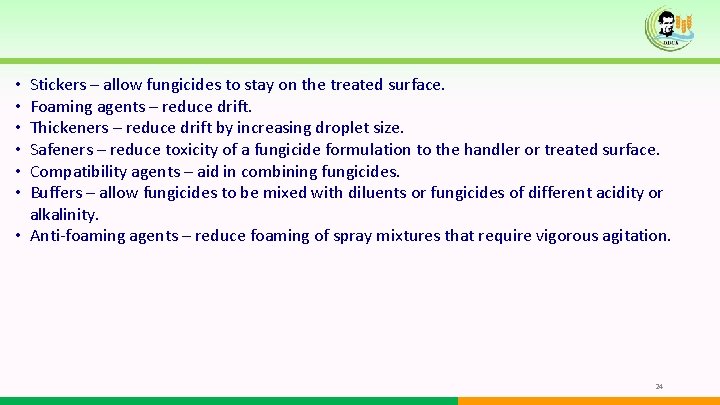
Stickers – allow fungicides to stay on the treated surface. Foaming agents – reduce drift. Thickeners – reduce drift by increasing droplet size. Safeners – reduce toxicity of a fungicide formulation to the handler or treated surface. Compatibility agents – aid in combining fungicides. Buffers – allow fungicides to be mixed with diluents or fungicides of different acidity or alkalinity. • Anti-foaming agents – reduce foaming of spray mixtures that require vigorous agitation. • • • 24
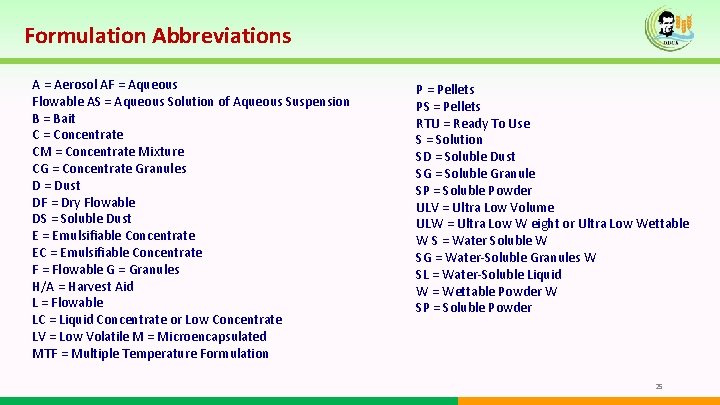
Formulation Abbreviations A = Aerosol AF = Aqueous Flowable AS = Aqueous Solution of Aqueous Suspension B = Bait C = Concentrate CM = Concentrate Mixture CG = Concentrate Granules D = Dust DF = Dry Flowable DS = Soluble Dust E = Emulsifiable Concentrate EC = Emulsifiable Concentrate F = Flowable G = Granules H/A = Harvest Aid L = Flowable LC = Liquid Concentrate or Low Concentrate LV = Low Volatile M = Microencapsulated MTF = Multiple Temperature Formulation P = Pellets PS = Pellets RTU = Ready To Use S = Solution SD = Soluble Dust SG = Soluble Granule SP = Soluble Powder ULV = Ultra Low Volume ULW = Ultra Low W eight or Ultra Low Wettable W S = Water Soluble W SG = Water-Soluble Granules W SL = Water-Soluble Liquid W = Wettable Powder W SP = Soluble Powder 25
Classes of fungicides and mode of action 26
Mode of action and formulations of Antibiotics 27
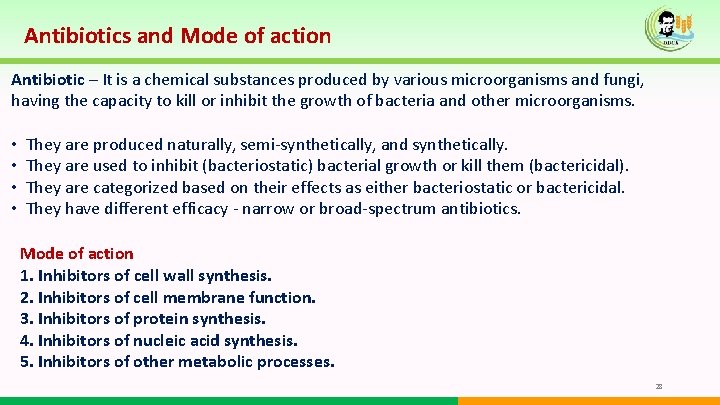
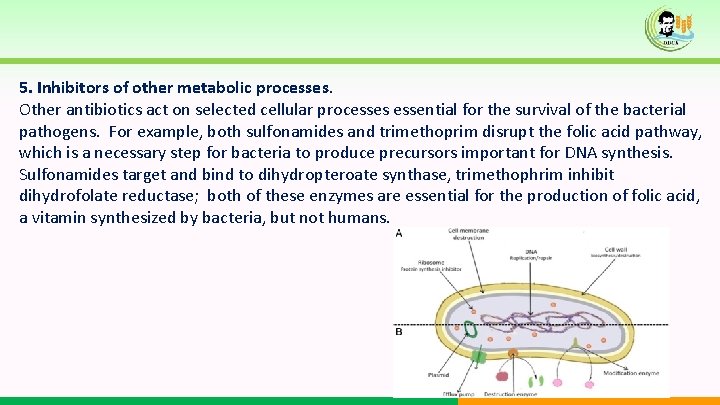
Antibiotics and Mode of action Antibiotic – It is a chemical substances produced by various microorganisms and fungi, having the capacity to kill or inhibit the growth of bacteria and other microorganisms. • • They are produced naturally, semi-synthetically, and synthetically. They are used to inhibit (bacteriostatic) bacterial growth or kill them (bactericidal). They are categorized based on their effects as either bacteriostatic or bactericidal. They have different efficacy - narrow or broad-spectrum antibiotics. Mode of action 1. Inhibitors of cell wall synthesis. 2. Inhibitors of cell membrane function. 3. Inhibitors of protein synthesis. 4. Inhibitors of nucleic acid synthesis. 5. Inhibitors of other metabolic processes. 28
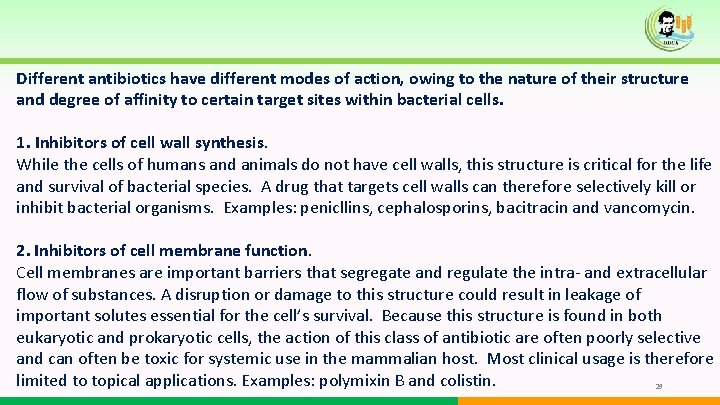
Different antibiotics have different modes of action, owing to the nature of their structure and degree of affinity to certain target sites within bacterial cells. 1. Inhibitors of cell wall synthesis. While the cells of humans and animals do not have cell walls, this structure is critical for the life and survival of bacterial species. A drug that targets cell walls can therefore selectively kill or inhibit bacterial organisms. Examples: penicllins, cephalosporins, bacitracin and vancomycin. 2. Inhibitors of cell membrane function. Cell membranes are important barriers that segregate and regulate the intra- and extracellular flow of substances. A disruption or damage to this structure could result in leakage of important solutes essential for the cell’s survival. Because this structure is found in both eukaryotic and prokaryotic cells, the action of this class of antibiotic are often poorly selective and can often be toxic for systemic use in the mammalian host. Most clinical usage is therefore limited to topical applications. Examples: polymixin B and colistin. 29
3. Inhibitors of protein synthesis. Enzymes and cellular structures are primarily made of proteins. Protein synthesis is an essential process necessary for the multiplication and survival of all bacterial cells. Several types of antibacterial agents target bacterial protein synthesis by binding to either the 30 S or 50 S subunits of the intracellular ribosomes. This activity then results in the disruption of the normal cellular metabolism of the bacteria, and consequently leads to the death of the organism or the inhibition of its growth and multiplication. Examples: Aminoglycosides, macrolides, lincosamides, streptogramins, chloramphenicol, tetracyclines. 4. Inhibitors of nucleic acid synthesis. DNA and RNA are keys to the replication of all living forms, including bacteria. Some antibiotics work by binding to components involved in the process of DNA or RNA synthesis, which causes interference of the normal cellular processes which will ultimately compromise bacterial multiplication and survival. Examples: quinolones, metronidazole, and rifampin. 30
5. Inhibitors of other metabolic processes. Other antibiotics act on selected cellular processes essential for the survival of the bacterial pathogens. For example, both sulfonamides and trimethoprim disrupt the folic acid pathway, which is a necessary step for bacteria to produce precursors important for DNA synthesis. Sulfonamides target and bind to dihydropteroate synthase, trimethophrim inhibit dihydrofolate reductase; both of these enzymes are essential for the production of folic acid, a vitamin synthesized by bacteria, but not humans. 31
Formulations of antibiotics Formulation is the process of combining various chemical substances with the active drug to form a final medicinal product, which is called a drug mixture or drug formulation. Formulations of antibiotics 1. Powder 2. Granules 3. Tablets 4. Capsules 5. Liquid 6. Lyophilised powder 7. Drops 8. Cremes 9. Gels 10. Inhalers 32
Thank You 33