
Fundamentals Of Planning Definition of Planning Dalton E
- Slides: 35
Fundamentals Of Planning
Definition of Planning
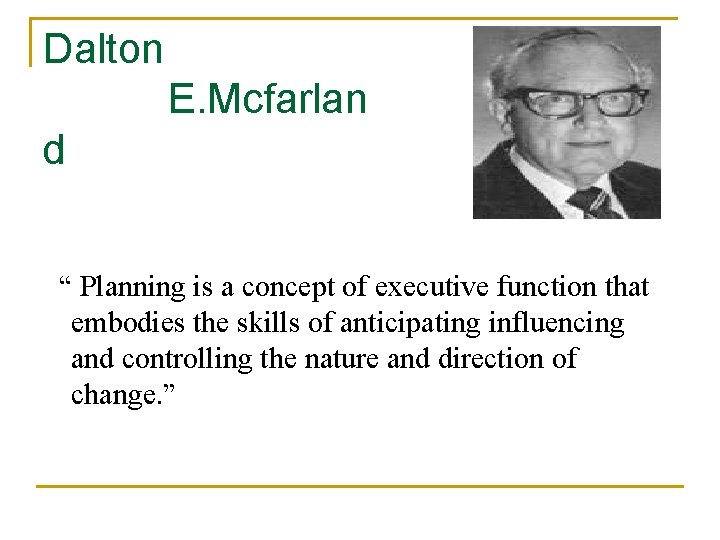
Dalton E. Mcfarlan d “ Planning is a concept of executive function that embodies the skills of anticipating influencing and controlling the nature and direction of change. ”
� “Planning is a trap laid down to capture the future” (Allen) �“Deciding in advance what is to be done in future” (Koontz) �“Informed anticipation of future”( Haimann) �Anticipatory decision making” (R L Ackoff) � 5
“Planning is a thinking process, an organized foresight, a vision based on fact and experience that is required for intelligent action”( Alford & Beatty) �“Deciding in advance what to do, how to do it, when to do it and who has to do it” ( Koontz & O’ Donnell) � Planning focuses on future and it involves all the activities that determine objectives for the future and the appropriate means for achieving those objectives. Outcome of planning is a plan, which is a document that specifies the course of action the organization will take. 6
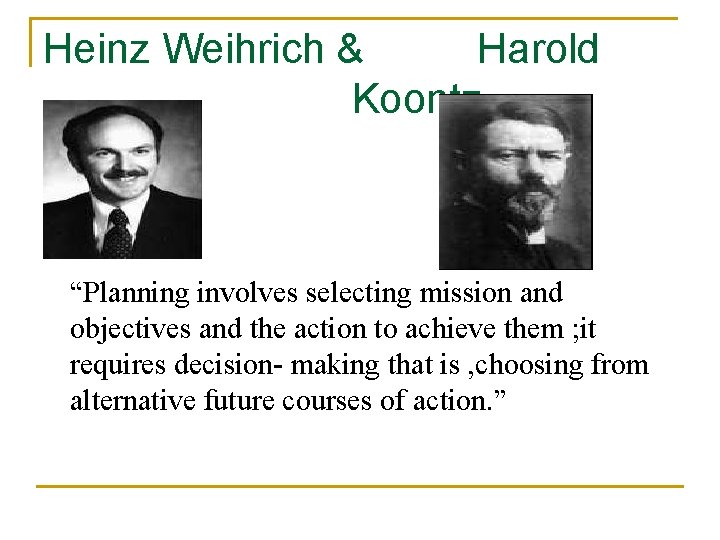
Heinz Weihrich & Harold Koontz “Planning involves selecting mission and objectives and the action to achieve them ; it requires decision- making that is , choosing from alternative future courses of action. ”
Nature of Planning is goal oriented Planning is an intellectual or rational Process Planning is a primary function. Planning is All- pervasive Planning is forward –looking Planning is continuous process. Planning is an Integrated Process. Planning Involves Choice.
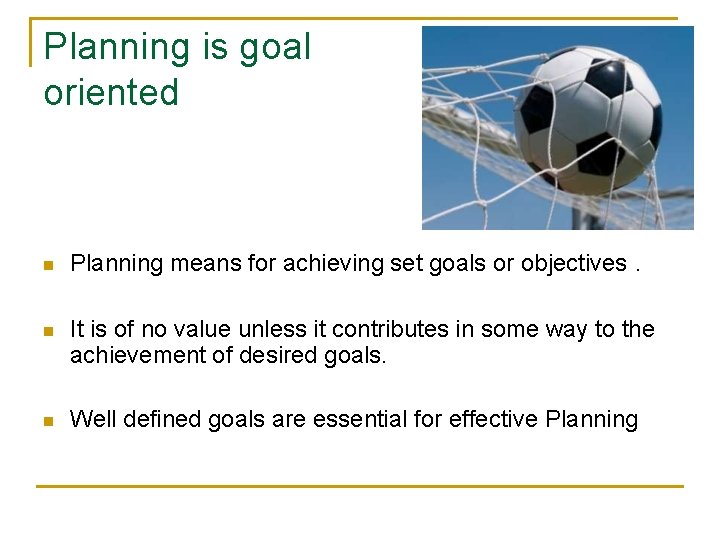
Planning is goal oriented Planning means for achieving set goals or objectives. It is of no value unless it contributes in some way to the achievement of desired goals. Well defined goals are essential for effective Planning
Planning is an intellectual or rational Process Planning requires managers to apply their imagination, creativity and their analytical skills to tackle problematic situations. Planning also requires foresight and sound judgement on the part of a manager. Planning can be regarded as the outcome of an intellectual or balanced process.
Planning is a primary function Planning is the initial activity in the management process. All other functions of management can be carried out effectively only if they have been properly planned. Planning thus precedes the execution of all other managerial functions
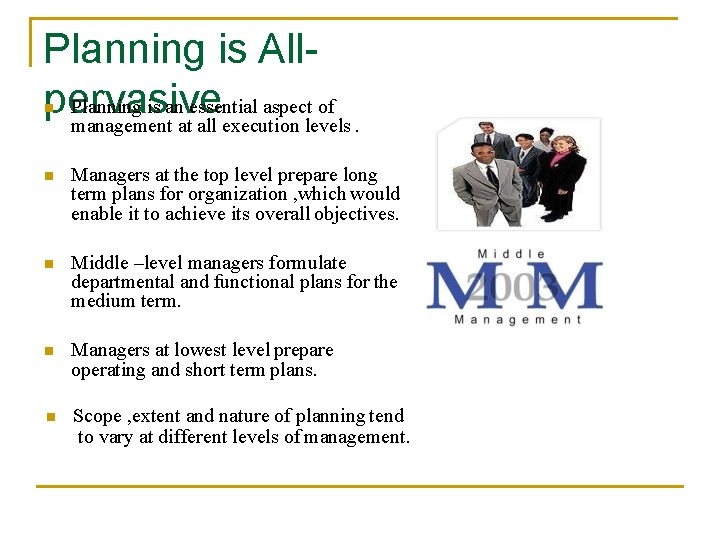
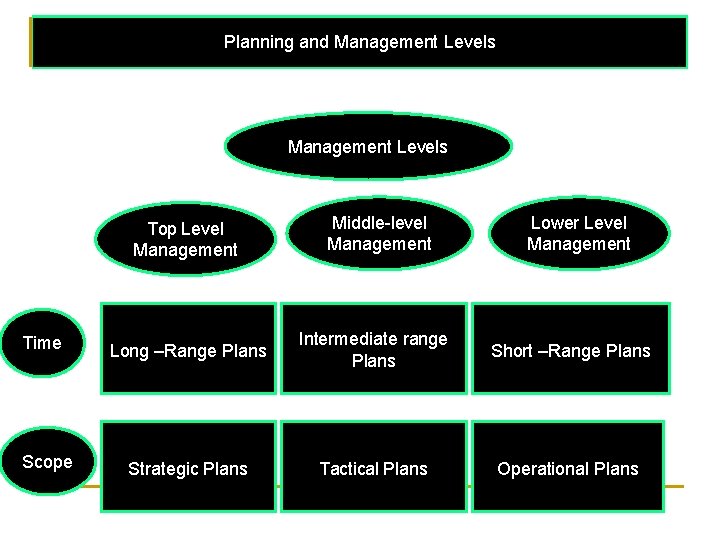
Planning is All. Planning is an essential aspect of pervasive management at all execution levels. Managers at the top level prepare long term plans for organization , which would enable it to achieve its overall objectives. Middle –level managers formulate departmental and functional plans for the medium term. Managers at lowest level prepare operating and short term plans. Scope , extent and nature of planning tend to vary at different levels of management.
Planning is forward – looking Planning is primarily concerned with anticipating the future. Predicting future trends and preparing for them is an integral part of planning. Thus accurate forecasting is essential for planning.
Planning is continuous process Planning goes on as long as an organization exists. Plans may be updated , modified or replaced by new ones. New set of goals for every new situation. Plans are changed or modified by never abandoned.
Planning is an Integrated Process Plans made at different levels are independent and interrelated. Whatever be the term of the plan , they should be well coordinated so as to achieve the goals of the organization within a definite time.
Planning Involves Choic e Planning is essentially a decision making process that involves the selection of a suitable course of action. Usually , several alternatives are available for achieving a particular objective or set of objectives, all may not be equally feasible and suitable for the organization , only the best among the alternatives has to be selected. Thus plans are decisions made after evaluation of alternative courses of action.
Significance of Planning
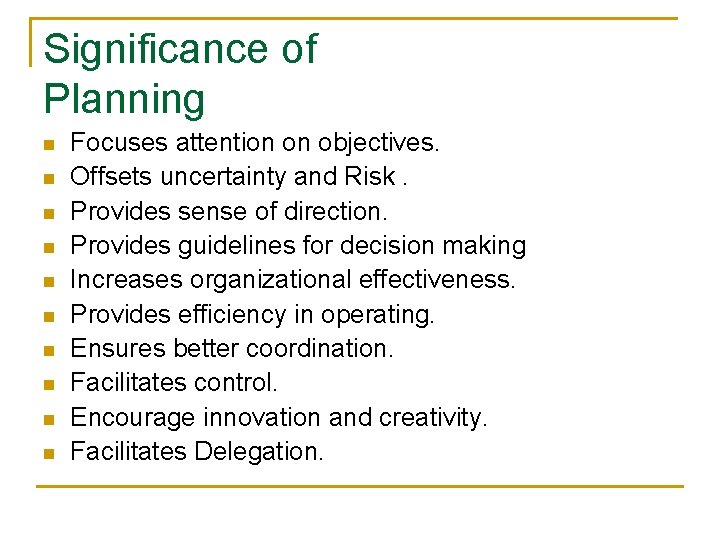
Significance of Planning Focuses attention on objectives. Offsets uncertainty and Risk. Provides sense of direction. Provides guidelines for decision making Increases organizational effectiveness. Provides efficiency in operating. Ensures better coordination. Facilitates control. Encourage innovation and creativity. Facilitates Delegation.
Types Of Plans
Planning and Management Levels Top Level Management Time Scope Middle-level Management Lower Level Management Long –Range Plans Intermediate range Plans Short –Range Plans Strategic Plans Tactical Plans Operational Plans
Plans based on Organizational Level. Strategic Plans Tactical Plans Operational Plans.
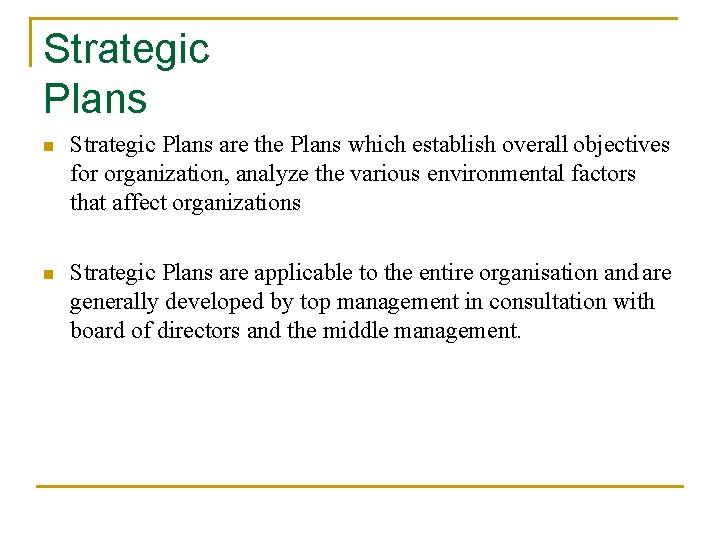
Strategic Plans are the Plans which establish overall objectives for organization, analyze the various environmental factors that affect organizations Strategic Plans are applicable to the entire organisation and are generally developed by top management in consultation with board of directors and the middle management.
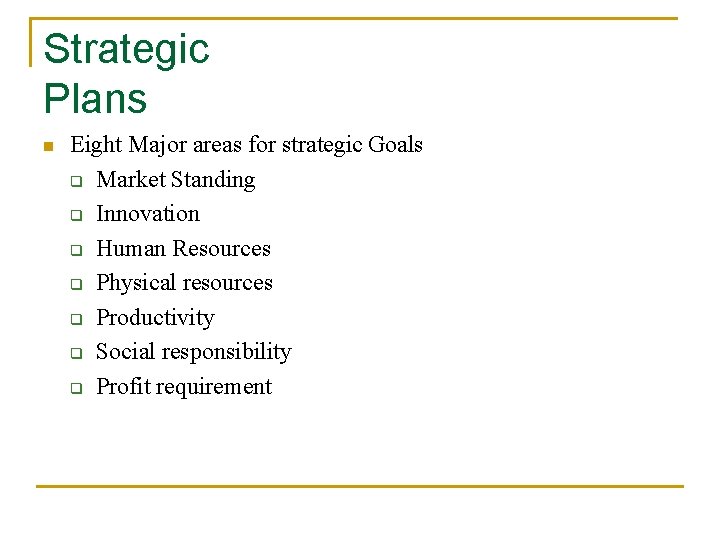
Strategic Plans Eight Major areas for strategic Goals Market Standing Innovation Human Resources Physical resources Productivity Social responsibility Profit requirement
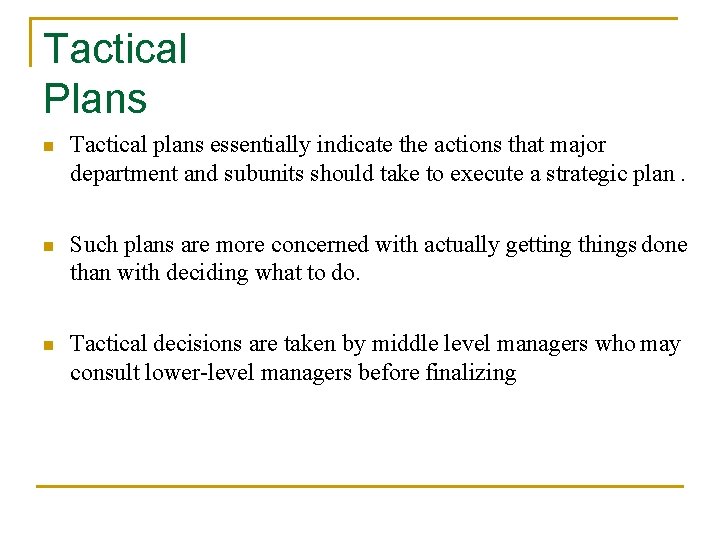
Tactical Plans Tactical plans essentially indicate the actions that major department and subunits should take to execute a strategic plan. Such plans are more concerned with actually getting things done than with deciding what to do. Tactical decisions are taken by middle level managers who may consult lower-level managers before finalizing
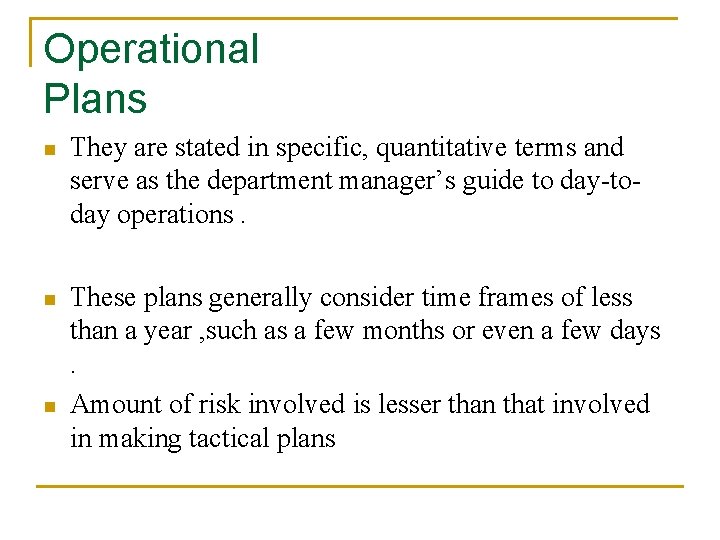
Operational Plans They are stated in specific, quantitative terms and serve as the department manager’s guide to day-today operations. These plans generally consider time frames of less than a year , such as a few months or even a few days. Amount of risk involved is lesser than that involved in making tactical plans
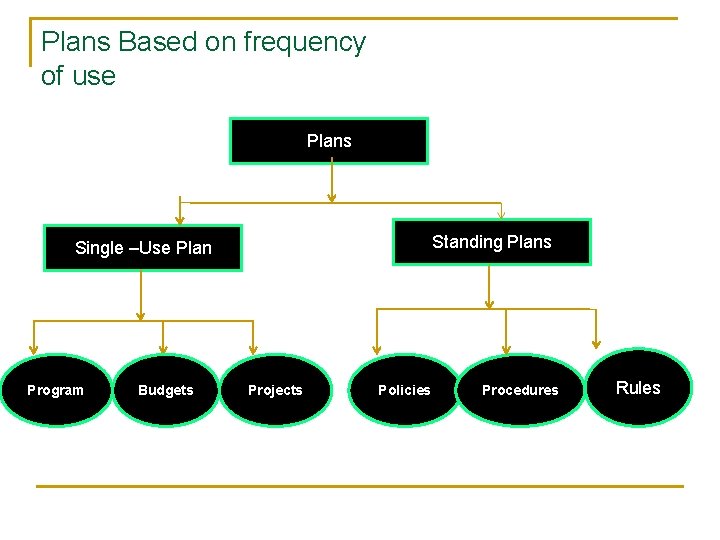
Plans Based on frequency of use Plans Standing Plans Single –Use Plan Program Budgets Projects Policies Procedures Rules
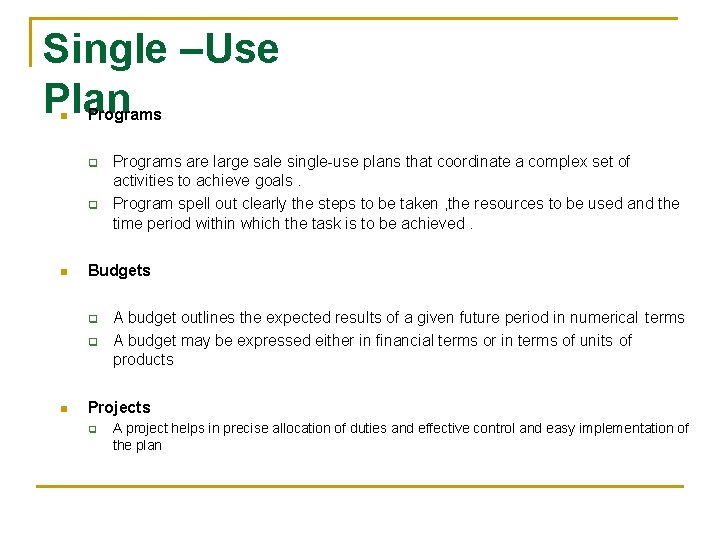
Single –Use Plan Programs Budgets Programs are large sale single-use plans that coordinate a complex set of activities to achieve goals. Program spell out clearly the steps to be taken , the resources to be used and the time period within which the task is to be achieved. A budget outlines the expected results of a given future period in numerical terms A budget may be expressed either in financial terms or in terms of units of products Projects A project helps in precise allocation of duties and effective control and easy implementation of the plan
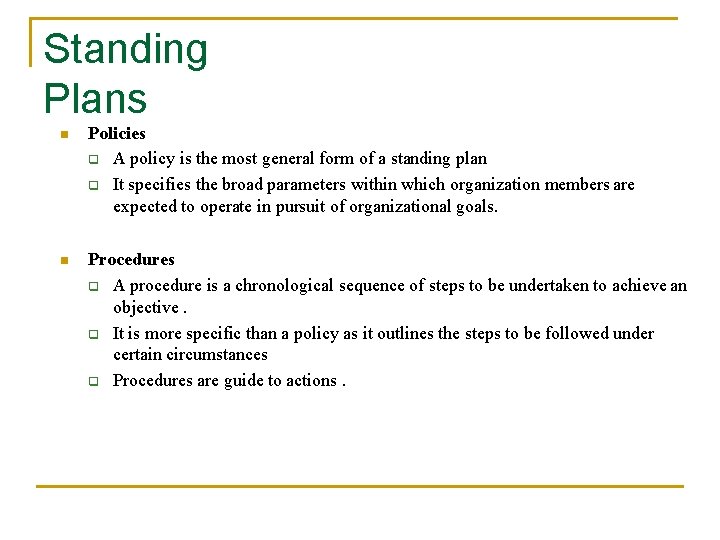
Standing Plans Policies A policy is the most general form of a standing plan It specifies the broad parameters within which organization members are expected to operate in pursuit of organizational goals. Procedures A procedure is a chronological sequence of steps to be undertaken to achieve an objective. It is more specific than a policy as it outlines the steps to be followed under certain circumstances Procedures are guide to actions.
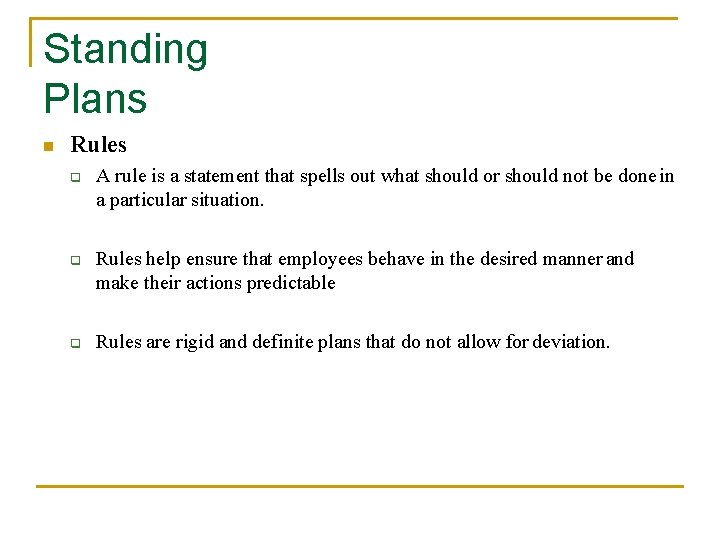
Standing Plans Rules A rule is a statement that spells out what should or should not be done in a particular situation. Rules help ensure that employees behave in the desired manner and make their actions predictable Rules are rigid and definite plans that do not allow for deviation.
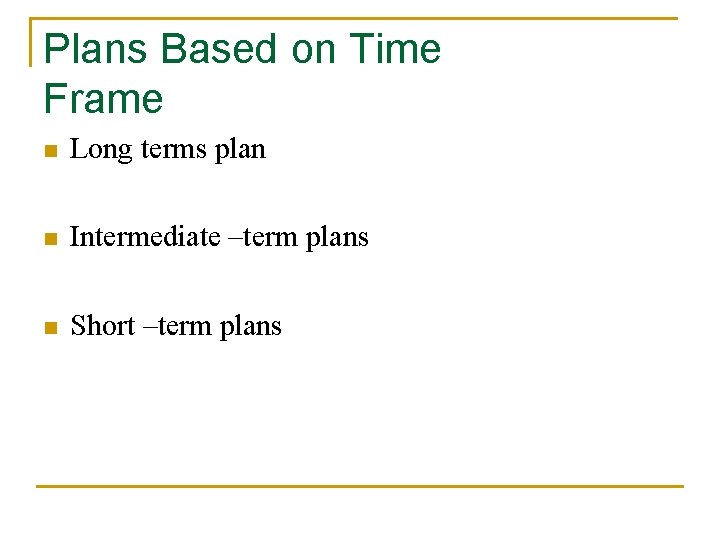
Plans Based on Time Frame Long terms plan Intermediate –term plans Short –term plans
The Planning Process
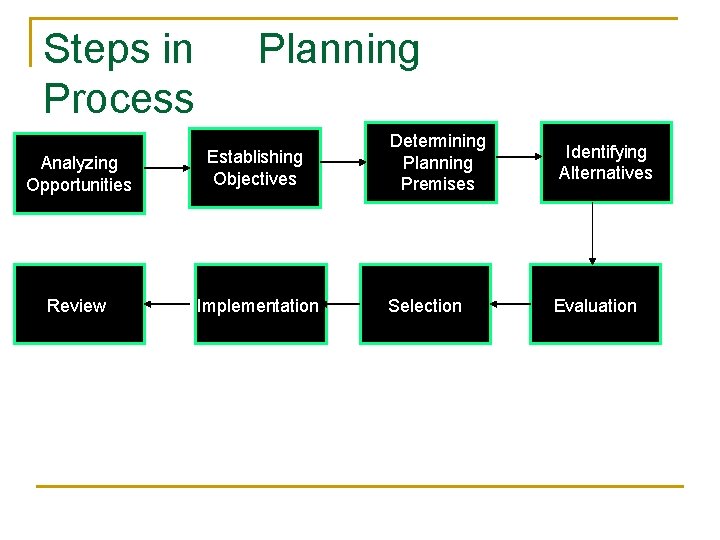
Steps in Process Planning Analyzing Opportunities Establishing Objectives Review Implementation Determining Planning Premises Selection Identifying Alternatives Evaluation
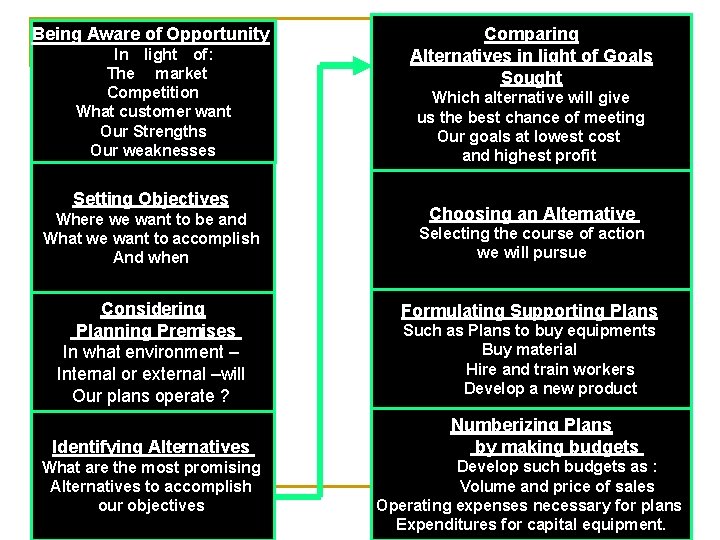
Extended Model of the Planning Process
Being Aware of Opportunity In light of: The market Competition What customer want Our Strengths Our weaknesses Setting Objectives Where we want to be and What we want to accomplish And when Considering Planning Premises In what environment – Internal or external –will Our plans operate ? Identifying Alternatives What are the most promising Alternatives to accomplish our objectives Comparing Alternatives in light of Goals Sought Which alternative will give us the best chance of meeting Our goals at lowest cost and highest profit Choosing an Alternative Selecting the course of action we will pursue Formulating Supporting Plans Such as Plans to buy equipments Buy material Hire and train workers Develop a new product Numberizing Plans by making budgets Develop such budgets as : Volume and price of sales Operating expenses necessary for plans Expenditures for capital equipment.
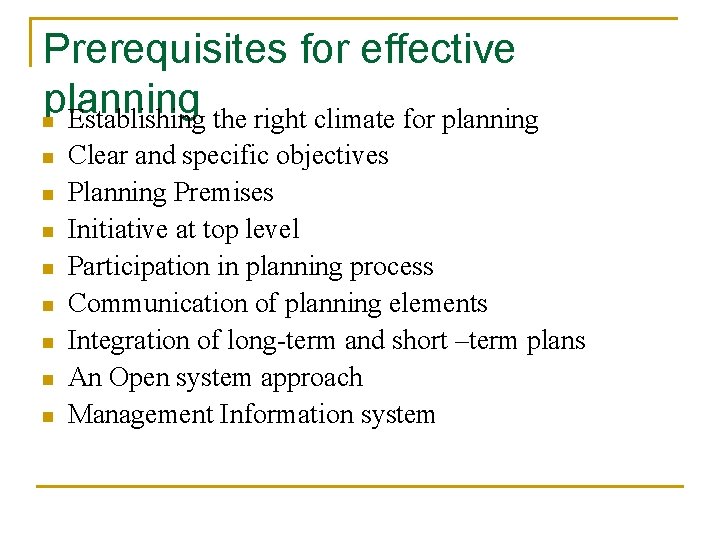
Prerequisites for effective planning Establishing the right climate for planning Clear and specific objectives Planning Premises Initiative at top level Participation in planning process Communication of planning elements Integration of long-term and short –term plans An Open system approach Management Information system
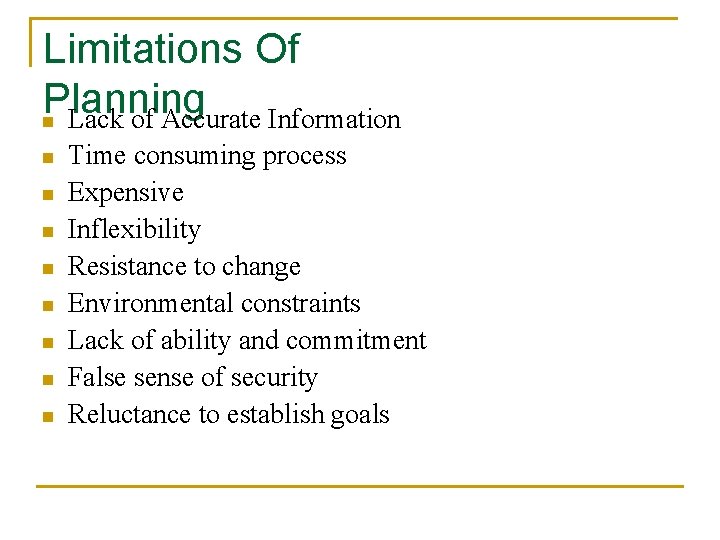
Limitations Of Planning Lack of Accurate Information Time consuming process Expensive Inflexibility Resistance to change Environmental constraints Lack of ability and commitment False sense of security Reluctance to establish goals