
Fundamentals of Planning and Developing Tourism Blent I
Fundamentals of Planning and Developing Tourism Bülent I. Kastarlak © 2012 by Pearson Education, Inc Upper Saddle River, New Jersey 07458 • All Rights Reserved
Part One: Basic Principles of Planning and Developing Tourism Fundamentals of Planning and Developing Tourism Bülent I. Kastarlak and Brian Barber © 2012 by Pearson Education, Inc Upper Saddle River, New Jersey 07458 • All Rights Reserved
Chapter One: Understanding Tourism Development Fundamentals of Planning and Developing Tourism Bülent I. Kastarlak and Brian Barber © 2012 by Pearson Education, Inc Upper Saddle River, New Jersey 07458 • All Rights Reserved
1. 1 World Development Trends § An estimated 2. 5 billion people are trying to survive on $2 or less a day § The poor typically lack access to education, adequate health services, clean water and sanitation § Rising inequality over the 1990 s severely reduced potential impact on poverty from the rapid growth experienced by many countries Fundamentals of Planning and Developing Tourism Bülent I. Kastarlak and Brian Barber © 2012 by Pearson Education, Inc Upper Saddle River, New Jersey 07458 • All Rights Reserved
1. 1 World Development Trends Projected GDP increase for developing countries will decline to 7. 1% in 2008 High-income countries are predicted to grow by a modest 2. 2% Source: International Bank for Reconstruction and Development/The World Bank: The World Bank Annual Report 2008, The Year in Review, pp. 13– 15 Fundamentals of Planning and Developing Tourism Bülent I. Kastarlak and Brian Barber © 2012 by Pearson Education, Inc Upper Saddle River, New Jersey 07458 • All Rights Reserved
1. 2 World Bank Strategy for Eliminating Poverty Common targets of the international development community Source: International Bank for Reconstruction and Development/The World Bank: The World Bank Annual Report 2008, The Year in Review, p. 17 Fundamentals of Planning and Developing Tourism Bülent I. Kastarlak and Brian Barber Goal 1 Eradicate extreme poverty and hunger Goal 2 Achieve universal primary education Goal 3 Promote gender equality and empower women Goal 4 Reduce child mortality © 2012 by Pearson Education, Inc Upper Saddle River, New Jersey 07458 • All Rights Reserved
1. 2 World Bank Strategy for Eliminating Poverty Common targets of the international development community Source: International Bank for Reconstruction and Development/The World Bank: The World Bank Annual Report 2008, The Year in Review, p. 17 Fundamentals of Planning and Developing Tourism Bülent I. Kastarlak and Brian Barber Goal 5 Improve maternal health Goal 6 Combat HIV/AIDS, malaria, and other diseases Goal 7 Ensure environmental sustainability Goal 8 Develop a global partnership for development © 2012 by Pearson Education, Inc Upper Saddle River, New Jersey 07458 • All Rights Reserved
1. 2 World Bank Strategy for Eliminating Poverty § The World Bank has established the following strategic priorities for its actions: ― Build the economic conditions for investment, jobs, and sustainable growth ― Invest in poor people and empower them to participate in development ― Reach across country boundaries and address issues regionally and globally ― Improve management and finance practices Fundamentals of Planning and Developing Tourism Bülent I. Kastarlak and Brian Barber © 2012 by Pearson Education, Inc Upper Saddle River, New Jersey 07458 • All Rights Reserved
1. 2 World Bank Strategy for Eliminating Poverty Pro-poor tourism: Paying greater attention to the role tourism development can play in reducing poverty Fundamentals of Planning and Developing Tourism Bülent I. Kastarlak and Brian Barber © 2012 by Pearson Education, Inc Upper Saddle River, New Jersey 07458 • All Rights Reserved
1. 7 Definitions of “Tourism” and “Tourist” § Travel refers to the activity of travelers § Travelers are those who undertake travel ― Domestic, inbound or outbound Fundamentals of Planning and Developing Tourism Bülent I. Kastarlak and Brian Barber © 2012 by Pearson Education, Inc Upper Saddle River, New Jersey 07458 • All Rights Reserved
1. 7 Definitions of “Tourism” and “Tourist” § Domestic travel is travel within a country by residents § Inbound travel is travel to a country by non-residents § Outbound travel is travel outside a country by residents Fundamentals of Planning and Developing Tourism Bülent I. Kastarlak and Brian Barber © 2012 by Pearson Education, Inc Upper Saddle River, New Jersey 07458 • All Rights Reserved
1. 7 Definitions of “Tourism” and “Tourist” § A trip refers to travel by a person from the time of departure from his/her usual residence until he/she returns—a round trip § An inbound trip is the travel between arriving in a country and leaving § A domestic trip or an outbound trip will correspond to the travel between leaving the place of residence and returning Fundamentals of Planning and Developing Tourism Bülent I. Kastarlak and Brian Barber © 2012 by Pearson Education, Inc Upper Saddle River, New Jersey 07458 • All Rights Reserved
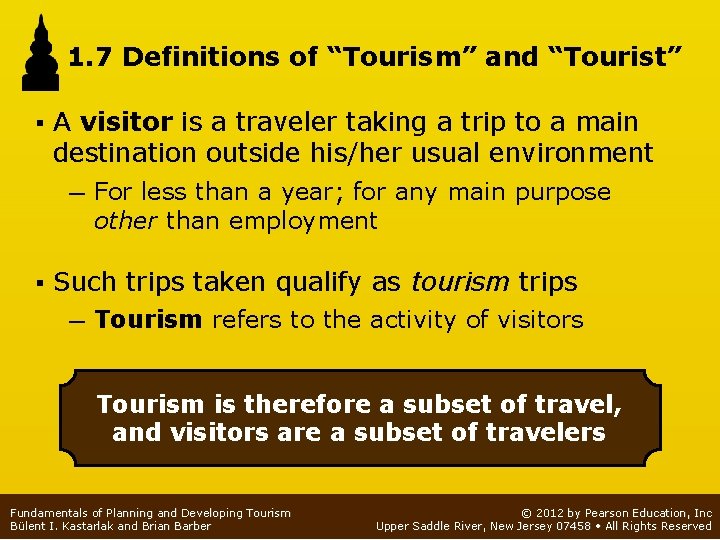
1. 7 Definitions of “Tourism” and “Tourist” § A visitor is a traveler taking a trip to a main destination outside his/her usual environment ― § For less than a year; for any main purpose other than employment Such trips taken qualify as tourism trips ― Tourism refers to the activity of visitors Tourism is therefore a subset of travel, and visitors are a subset of travelers Fundamentals of Planning and Developing Tourism Bülent I. Kastarlak and Brian Barber © 2012 by Pearson Education, Inc Upper Saddle River, New Jersey 07458 • All Rights Reserved
1. 7 Definitions of “Tourism” and “Tourist” § A visitor (domestic, inbound or outbound) is classified as: ― A tourist (or overnight visitor) if his/her trip includes an overnight stay ― A same-day visitor (or excursionist), otherwise Fundamentals of Planning and Developing Tourism Bülent I. Kastarlak and Brian Barber © 2012 by Pearson Education, Inc Upper Saddle River, New Jersey 07458 • All Rights Reserved
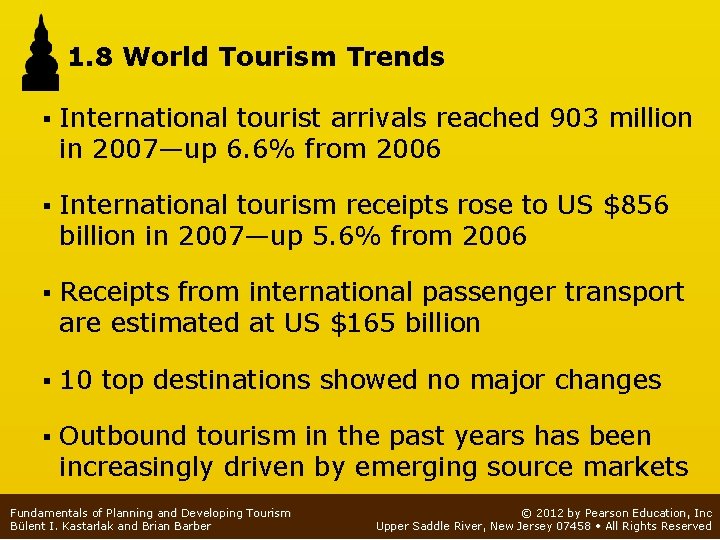
1. 8 World Tourism Trends § International tourist arrivals reached 903 million in 2007—up 6. 6% from 2006 § International tourism receipts rose to US $856 billion in 2007—up 5. 6% from 2006 § Receipts from international passenger transport are estimated at US $165 billion § 10 top destinations showed no major changes § Outbound tourism in the past years has been increasingly driven by emerging source markets Fundamentals of Planning and Developing Tourism Bülent I. Kastarlak and Brian Barber © 2012 by Pearson Education, Inc Upper Saddle River, New Jersey 07458 • All Rights Reserved
1. 8 World Tourism Trends § Conclusions drawn from these trends: ― Leisure travel is a function of disposable income • As is business travel, to an extent ― As disposable income grows in richer countries, international tourists increasingly demand more convenience and better service ― Standards of facilities & services for domestic tourism may vary widely from generally accepted international tourism standards ― Personal security plays a major role in selecting a tourism destination Fundamentals of Planning and Developing Tourism Bülent I. Kastarlak and Brian Barber © 2012 by Pearson Education, Inc Upper Saddle River, New Jersey 07458 • All Rights Reserved
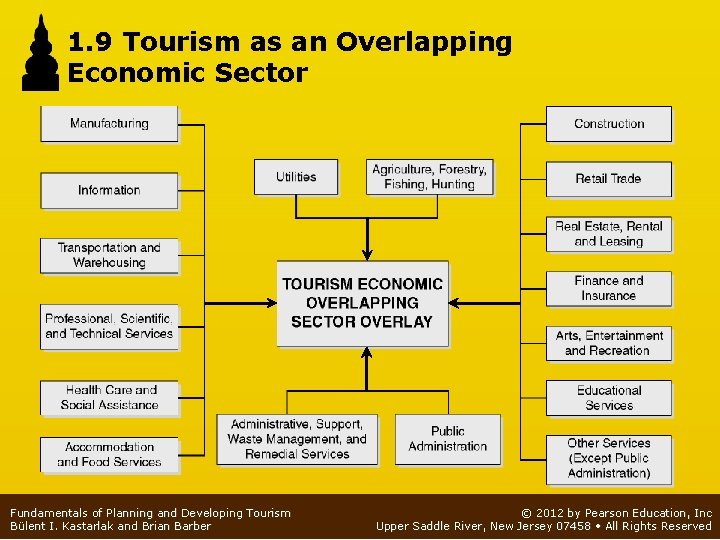
1. 9 Tourism as an Overlapping Economic Sector Fundamentals of Planning and Developing Tourism Bülent I. Kastarlak and Brian Barber © 2012 by Pearson Education, Inc Upper Saddle River, New Jersey 07458 • All Rights Reserved
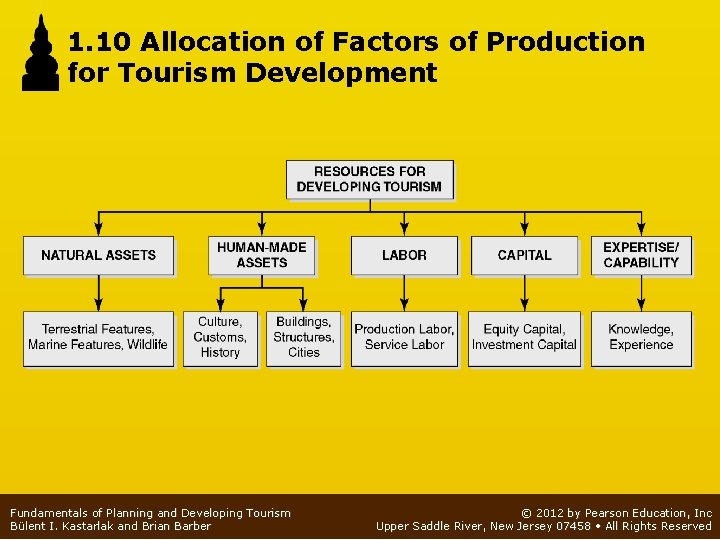
1. 10 Allocation of Factors of Production for Tourism Development Fundamentals of Planning and Developing Tourism Bülent I. Kastarlak and Brian Barber © 2012 by Pearson Education, Inc Upper Saddle River, New Jersey 07458 • All Rights Reserved
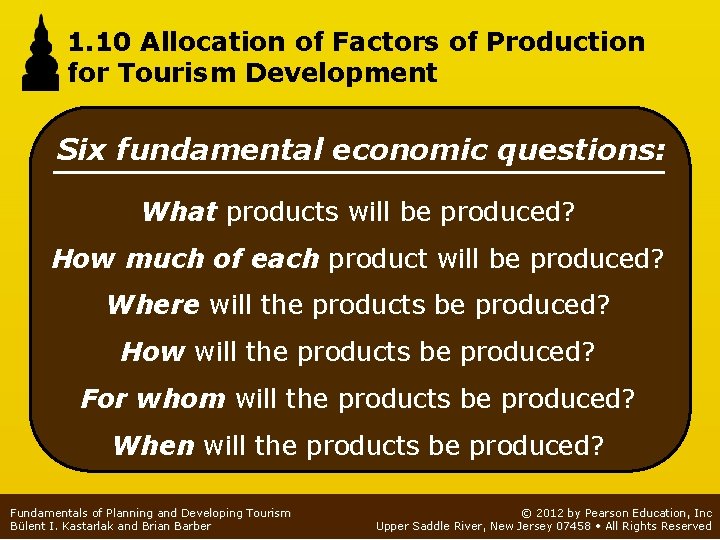
1. 10 Allocation of Factors of Production for Tourism Development Six fundamental economic questions: What products will be produced? How much of each product will be produced? Where will the products be produced? How will the products be produced? For whom will the products be produced? When will the products be produced? Fundamentals of Planning and Developing Tourism Bülent I. Kastarlak and Brian Barber © 2012 by Pearson Education, Inc Upper Saddle River, New Jersey 07458 • All Rights Reserved
1. 10 Allocation of Factors of Production for Tourism Development Increasing returns to scale: When labor, land, and all other inputs are prepared in the proper proportions and quantities, the result could be a higher multiplier Fundamentals of Planning and Developing Tourism Bülent I. Kastarlak and Brian Barber © 2012 by Pearson Education, Inc Upper Saddle River, New Jersey 07458 • All Rights Reserved
1. 11 Economic Geography of Tourism and the Theory of Central Places § The city–region service relationship is defined by central place theory ― A central place is an urban center where economic activities originate • ― and disperse to a service area, hinterland or region, around it The relationship between the central place and its region is symbiotic • Reciprocal and complementary activities flow in both directions Fundamentals of Planning and Developing Tourism Bülent I. Kastarlak and Brian Barber © 2012 by Pearson Education, Inc Upper Saddle River, New Jersey 07458 • All Rights Reserved
1. 11 Economic Geography of Tourism and the Theory of Central Places § The city–region service relationship is defined by central place theory ― Factors determining the perimeter of the service region may depend primarily on city–region relationships • ― But may also be independent of them Factors determining the perimeter of the tourism region are often independent of these relations Fundamentals of Planning and Developing Tourism Bülent I. Kastarlak and Brian Barber © 2012 by Pearson Education, Inc Upper Saddle River, New Jersey 07458 • All Rights Reserved
1. 11 Economic Geography of Tourism and the Theory of Central Places § Walter Christaller showed that: ― Urban centers have a rank order • ― Centers of various population sizes form a hierarchy over the geography of the land If one center of this hierarchy is removed, the system will readjust to compensate • For functions the center previously performed ― Larger cities will be spaced farther apart than smaller towns and villages ― The geographic pattern of urban centers is a product of particular social-economic-physical forces that create the ordered network Fundamentals of Planning and Developing Tourism Bülent I. Kastarlak and Brian Barber © 2012 by Pearson Education, Inc Upper Saddle River, New Jersey 07458 • All Rights Reserved
1. 11 Economic Geography of Tourism and the Theory of Central Places § Christaller’s two classes of goods and services produced by central places: ― Dispersed goods ― Central goods and services Fundamentals of Planning and Developing Tourism Bülent I. Kastarlak and Brian Barber © 2012 by Pearson Education, Inc Upper Saddle River, New Jersey 07458 • All Rights Reserved
1. 3 Sustainable Tourism as an Agent for Reducing Poverty Sustainable tourism development should: Make optimal use of environmental resources that constitute a key element in tourism development, maintaining essential ecological processes and helping conserve natural heritage and biodiversity Source: United Nations World Tourism Organization: http: //www. unep. fr/scp/tourism/sustain Fundamentals of Planning and Developing Tourism Bülent I. Kastarlak and Brian Barber © 2012 by Pearson Education, Inc Upper Saddle River, New Jersey 07458 • All Rights Reserved
1. 3 Sustainable Tourism as an Agent for Reducing Poverty Sustainable tourism development should: Respect the socio-cultural authenticity of host communities, conserve their built and living cultural heritage and traditional values, and contribute to inter-cultural understanding and tolerance Source: United Nations World Tourism Organization: http: //www. unep. fr/scp/tourism/sustain Fundamentals of Planning and Developing Tourism Bülent I. Kastarlak and Brian Barber © 2012 by Pearson Education, Inc Upper Saddle River, New Jersey 07458 • All Rights Reserved
1. 3 Sustainable Tourism as an Agent for Reducing Poverty Sustainable tourism development should: Ensure viable, long-term economic operations, providing fairly distributed socio-economic benefits to stakeholders—including stable employment and income-earning opportunities, social services to host communities, and contributing to poverty alleviation Source: United Nations World Tourism Organization: http: //www. unep. fr/scp/tourism/sustain Fundamentals of Planning and Developing Tourism Bülent I. Kastarlak and Brian Barber © 2012 by Pearson Education, Inc Upper Saddle River, New Jersey 07458 • All Rights Reserved
1. 3 Sustainable Tourism as an Agent for Reducing Poverty § Ground rules in planning sustainable tourism: ― Benefits from tourism are received immediately • ― Natural, historical, cultural, and other resources are protected for the long-term future Tourism development is planned/managed in a way that avoids social & environmental damage • In the near or long term Fundamentals of Planning and Developing Tourism Bülent I. Kastarlak and Brian Barber © 2012 by Pearson Education, Inc Upper Saddle River, New Jersey 07458 • All Rights Reserved
1. 3 Sustainable Tourism as an Agent for Reducing Poverty § Ground rules in planning sustainable tourism: ― Tourism development enhances environmental quality and social well-being wherever it occurs • ― So that tourism destinations retain their marketability and competitive advantage Tourism development and management is an integral part of national & regional development Fundamentals of Planning and Developing Tourism Bülent I. Kastarlak and Brian Barber © 2012 by Pearson Education, Inc Upper Saddle River, New Jersey 07458 • All Rights Reserved
1. 5 Tourism as a Production and Consumption Process Kastarlak identified two principal characteristics of tourism fundamental to understanding the dynamics of the tourism industry: It is not a traditional industrial sector… at least not presently Its product can be consumed only at its place of production Fundamentals of Planning and Developing Tourism Bülent I. Kastarlak and Brian Barber © 2012 by Pearson Education, Inc Upper Saddle River, New Jersey 07458 • All Rights Reserved
1. 6 The Demonstration Effect of Tourism and Social Change § The Demonstration Effect: ― Tourism has great potential for providing exposure to different cultures ― Applies both to traveling tourists and to receiving host populations at the destination ― Interaction between the two portrays norms, values, social structure, and social organization of both parties ― The demonstration effect can take place spontaneously or it can be planned Fundamentals of Planning and Developing Tourism Bülent I. Kastarlak and Brian Barber © 2012 by Pearson Education, Inc Upper Saddle River, New Jersey 07458 • All Rights Reserved
1. 6 The Demonstration Effect of Tourism and Social Change § A social structure consists of a set of consistently repeated social relationships among groups, individuals, or positions § Social stratification is a subclass of social structure, or a ranking system, among the participants in social relationships Fundamentals of Planning and Developing Tourism Bülent I. Kastarlak and Brian Barber © 2012 by Pearson Education, Inc Upper Saddle River, New Jersey 07458 • All Rights Reserved
Chapter End Fundamentals of Planning and Developing Tourism Bülent I. Kastarlak and Brian Barber © 2012 by Pearson Education, Inc Upper Saddle River, New Jersey 07458 • All Rights Reserved
- Slides: 33