
Fundamentals of Particle Detectors and Developments in Detector








- Slides: 58
Fundamentals of Particle Detectors and Developments in Detector Technologies for Future Experiments Werner Riegler, CERN Lecture 6/5 Abstract: This lecture series will first review the elementary processes and techniques on which particle detectors are based. These must always be kept in mind when discussing the limits of existing technologies and motivations for novel developments. Using the examples of LHC detectors, the limits of state of the art detectors will be outlined and the current detector R&D trends for the LHC upgrade and other future experiments will be discussed. This discussion will include micro-pattern gas detectors, novel solid state detector technologies and trends in microelectronics. 12/5/2020 W. Riegler, Particle Detectors 1
Outline 1) History of Instrumentation Cloud Chambers/Bubble Chambers/Geiger Counters/Scintillators/Electronics/Wire Chambers 2) Electro-Magnetic Interaction of Charged Particles with Matter Excitation/ Ionization/ Bethe Bloch Formula/ Range of Particles/ PAI model/ Ionization Fluctuation/ Bremsstrahlung/ Pair Production/ Showers/ Multiple Scattering 3) Signals/Gas Detector Signals/ Signal Theorems/ Gaseous Detectors/ Wire Chambers/ Drift Chamber/ TPCs/ RPCs/ Limits of Gaseous Detectors/ Current Trends in Gaseous Detector Development 4) Solid State Detectors Principles of Solid State Detectors/ Diamond Detectors/ Silicon Detectors/ Limits of Solid State Detectors/ Current Trends in Solid State Detectors 5) Calorimetry & Selected Topics EM showers/ Hadronic Showers/ Crystal Calorimeters/ Noble Liquid Calirimeters/ Current Trends in Calorimetry 12/5/2020 2
Calorimetry in Particle Physics This lecture draws heavily from the Review Article ‘Calorimetry for Particle Physics’, C. W. Fabjan and F. Gianotti, Rev. Mod. Phys. , Vol. 75, N 0. 4, October 2003 Much information was also taken from the massive Monograph ‘Calorimetry, Energy Measurement in Particle Physics’, R. Wigmans, Oxford University Press, 2000 W. Riegler/CERN 3
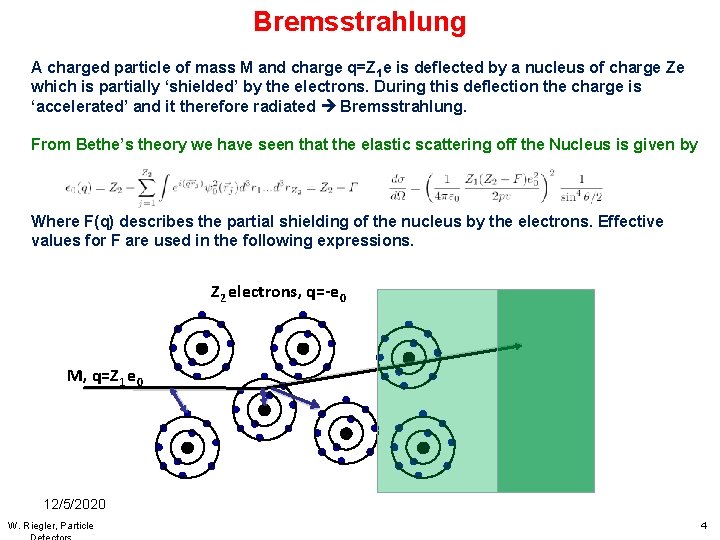
Bremsstrahlung A charged particle of mass M and charge q=Z 1 e is deflected by a nucleus of charge Ze which is partially ‘shielded’ by the electrons. During this deflection the charge is ‘accelerated’ and it therefore radiated Bremsstrahlung. From Bethe’s theory we have seen that the elastic scattering off the Nucleus is given by Where F(q) describes the partial shielding of the nucleus by the electrons. Effective values for F are used in the following expressions. Z 2 electrons, q=-e 0 M, q=Z 1 e 0 12/5/2020 W. Riegler, Particle 4
Bremsstrahlung, Classical A charged particle of mass M and charge q=Z 1 e is deflected by a nucleus of Charge Ze. Because of the acceleration the particle radiated EM waves energy loss. Coulomb-Scattering (Rutherford Scattering) describes the deflection of the particle. Maxwell’s Equations describe the radiated energy for a given momentum transfer. d. E/dx W. Riegler/CERN 5
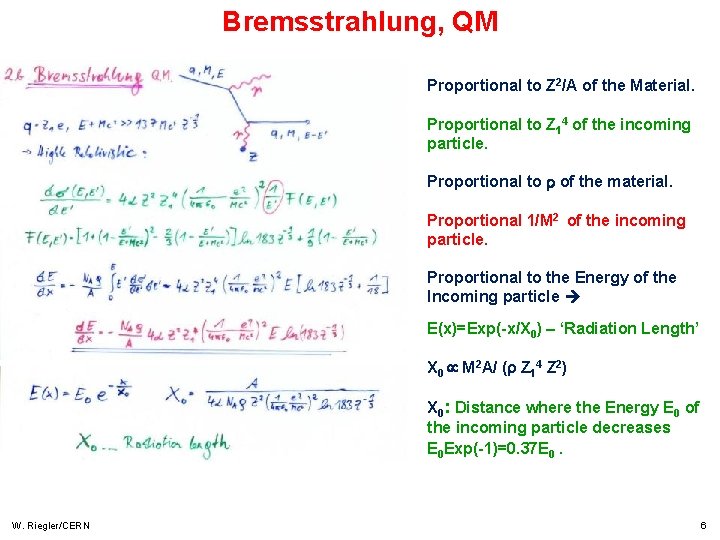
Bremsstrahlung, QM Proportional to Z 2/A of the Material. Proportional to Z 14 of the incoming particle. Proportional to of the material. Proportional 1/M 2 of the incoming particle. Proportional to the Energy of the Incoming particle E(x)=Exp(-x/X 0) – ‘Radiation Length’ X 0 M 2 A/ ( Z 14 Z 2) X 0: Distance where the Energy E 0 of the incoming particle decreases E 0 Exp(-1)=0. 37 E 0. W. Riegler/CERN 6
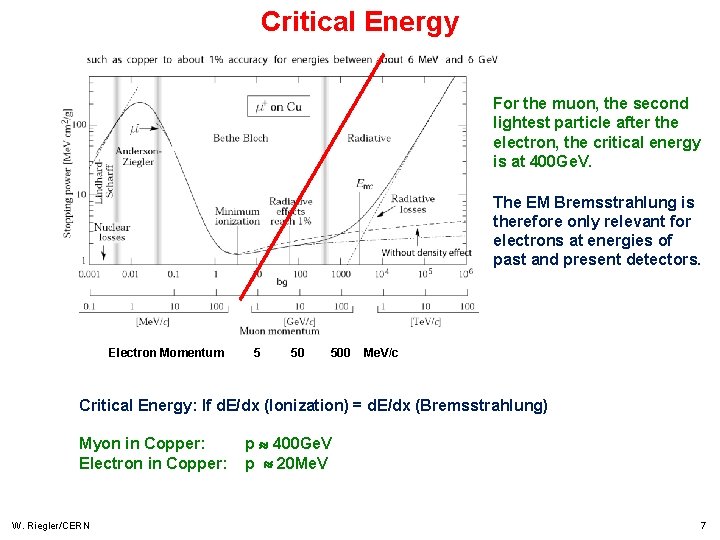
Critical Energy For the muon, the second lightest particle after the electron, the critical energy is at 400 Ge. V. The EM Bremsstrahlung is therefore only relevant for electrons at energies of past and present detectors. Electron Momentum 5 50 500 Me. V/c Critical Energy: If d. E/dx (Ionization) = d. E/dx (Bremsstrahlung) Myon in Copper: Electron in Copper: W. Riegler/CERN p 400 Ge. V p 20 Me. V 7
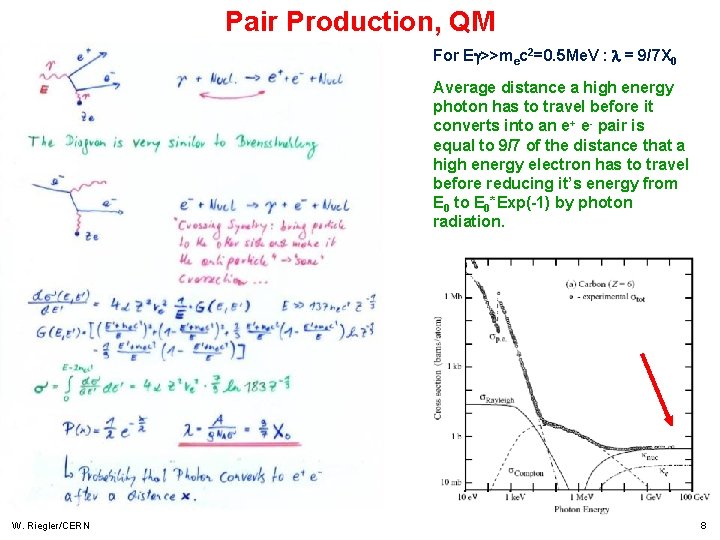
Pair Production, QM For E >>mec 2=0. 5 Me. V : = 9/7 X 0 Average distance a high energy photon has to travel before it converts into an e+ e- pair is equal to 9/7 of the distance that a high energy electron has to travel before reducing it’s energy from E 0 to E 0*Exp(-1) by photon radiation. W. Riegler/CERN 8
Bremsstrahlung + Pair Production EM Shower W. Riegler/CERN 9
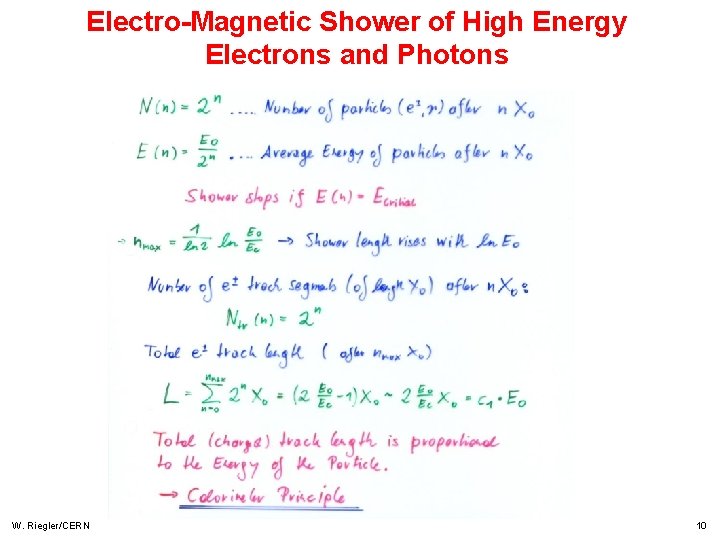
Electro-Magnetic Shower of High Energy Electrons and Photons W. Riegler/CERN 10
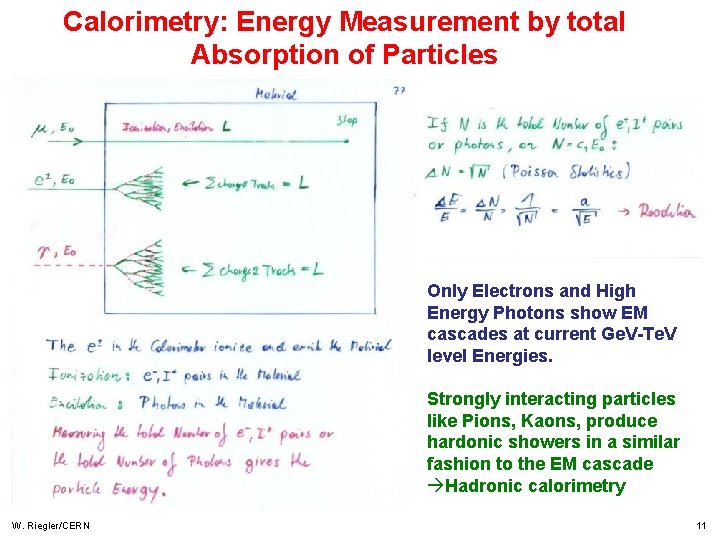
Calorimetry: Energy Measurement by total Absorption of Particles Only Electrons and High Energy Photons show EM cascades at current Ge. V-Te. V level Energies. Strongly interacting particles like Pions, Kaons, produce hardonic showers in a similar fashion to the EM cascade àHadronic calorimetry W. Riegler/CERN 11
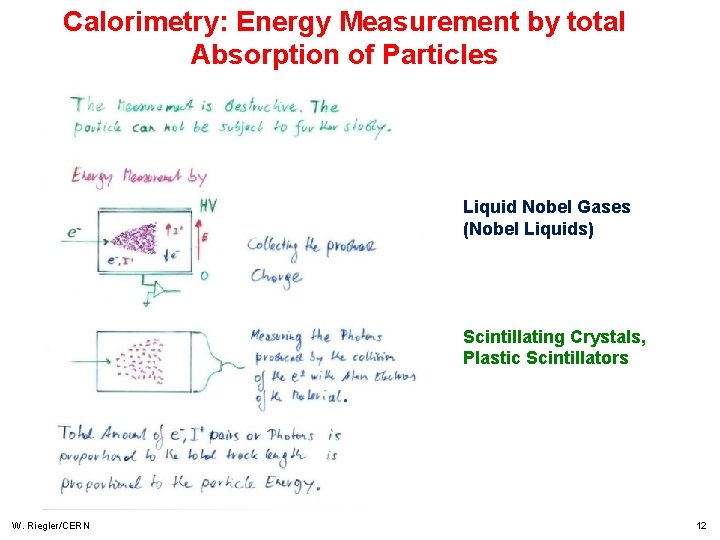
Calorimetry: Energy Measurement by total Absorption of Particles Liquid Nobel Gases (Nobel Liquids) Scintillating Crystals, Plastic Scintillators W. Riegler/CERN 12
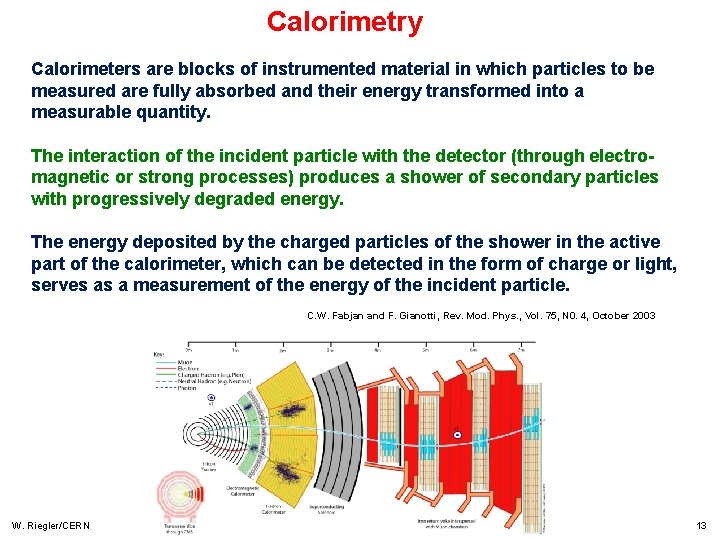
Calorimetry Calorimeters are blocks of instrumented material in which particles to be measured are fully absorbed and their energy transformed into a measurable quantity. The interaction of the incident particle with the detector (through electromagnetic or strong processes) produces a shower of secondary particles with progressively degraded energy. The energy deposited by the charged particles of the shower in the active part of the calorimeter, which can be detected in the form of charge or light, serves as a measurement of the energy of the incident particle. C. W. Fabjan and F. Gianotti, Rev. Mod. Phys. , Vol. 75, N 0. 4, October 2003 W. Riegler/CERN 13
Calorimetry Calorimeters can be classified into: Electromagnetic Calorimeters, to measure electrons and photons through their EM interactions. Hadron Calorimeters, Used to measure hadrons through their strong and EM interactions. The construction can be classified into: Homogeneous Calorimeters, that are built of only one type of material that performs both tasks, energy degradation and signal generation. Sampling Calorimeters, that consist of alternating layers of an absorber, a dense material used to degrade the energy of the incident particle, and an active medium that provides the detectable signal. C. W. Fabjan and F. Gianotti, Rev. Mod. Phys. , Vol. 75, N 0. 4, October 2003 W. Riegler/CERN 14
Calorimetry Calorimeters are attractive in our field for various reasons: In contrast with magnet spectrometers, in which the momentum resolution deteriorates linearly with the particle momentum, on most cases the calorimeter energy resolution improves as 1/Sqrt(E), where E is the energy of the incident particle. Therefore calorimeters are very well suited for high-energy physics experiments. In contrast to magnet spectrometers, calorimeters are sensitive to all types of particles, charged and neutral. They can even provide indirect detection of neutrinos and their energy through a measurement of the event missing energy. Calorimeters are commonly used for trigger purposes since they can provide fast signals that are easy to process and interpret. They are space and therefore cost effective. Because the shower length increases only logarithmically with energy, the detector thickness needs to increase only logarithmically with the energy of the particles. In contrast for a fixed momentum resolution, the bending power BL 2 of a magnetic spectrometer must increase linearly with the particle momentum. C. W. Fabjan and F. Gianotti, Rev. Mod. Phys. , Vol. 75, N 0. 4, October 2003 W. Riegler/CERN 15
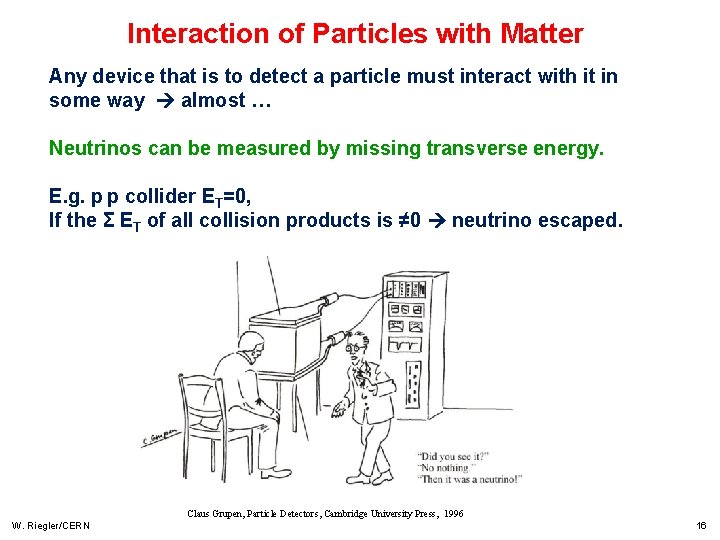
Interaction of Particles with Matter Any device that is to detect a particle must interact with it in some way almost … Neutrinos can be measured by missing transverse energy. E. g. p p collider ET=0, If the Σ ET of all collision products is ≠ 0 neutrino escaped. Claus Grupen, Particle Detectors, Cambridge University Press, 1996 W. Riegler/CERN 16
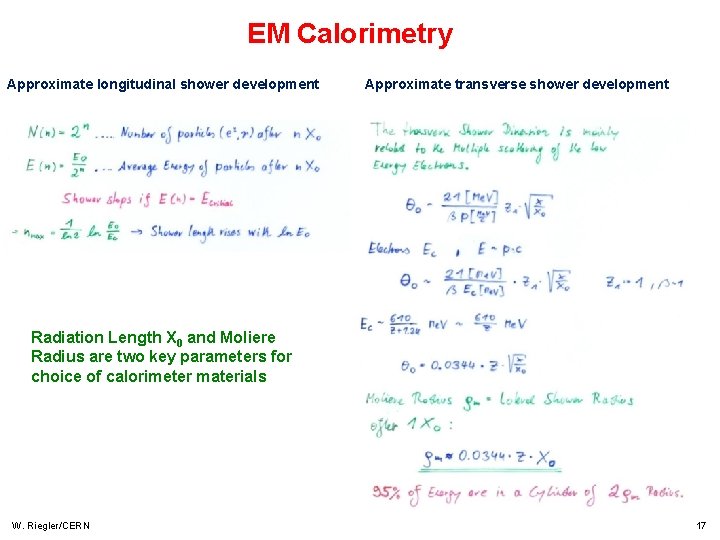
EM Calorimetry Approximate longitudinal shower development Approximate transverse shower development Radiation Length X 0 and Moliere Radius are two key parameters for choice of calorimeter materials W. Riegler/CERN 17
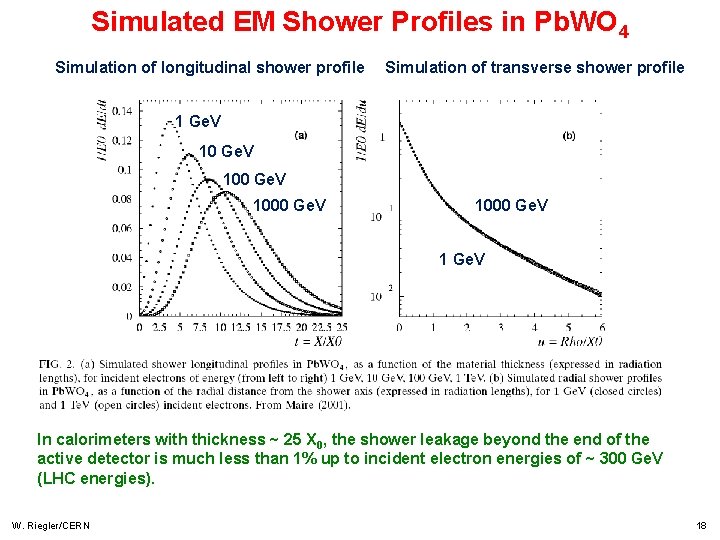
Simulated EM Shower Profiles in Pb. WO 4 Simulation of longitudinal shower profile Simulation of transverse shower profile 1 Ge. V 1000 Ge. V 1 Ge. V In calorimeters with thickness ~ 25 X 0, the shower leakage beyond the end of the active detector is much less than 1% up to incident electron energies of ~ 300 Ge. V (LHC energies). W. Riegler/CERN 18
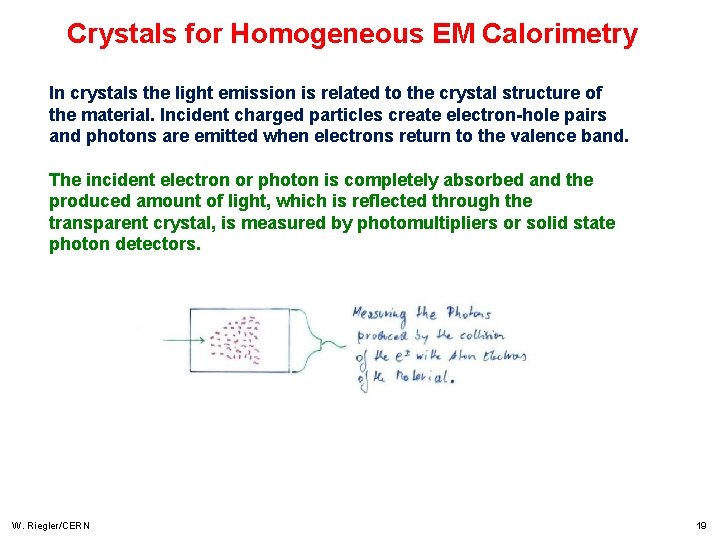
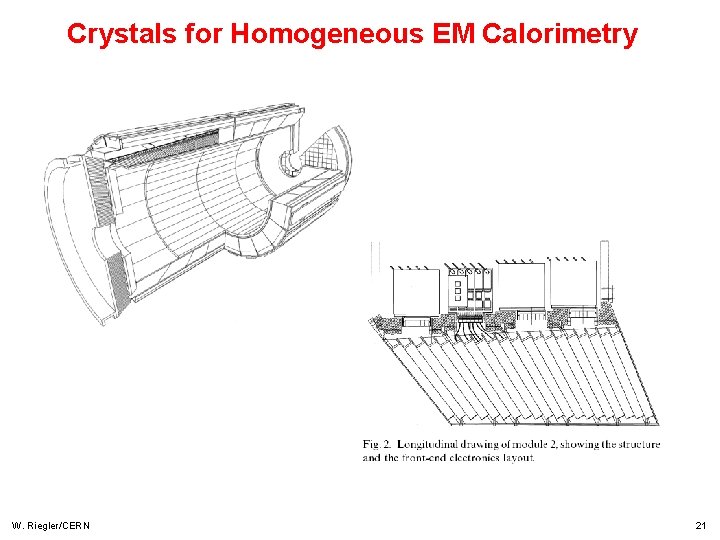
Crystals for Homogeneous EM Calorimetry In crystals the light emission is related to the crystal structure of the material. Incident charged particles create electron-hole pairs and photons are emitted when electrons return to the valence band. The incident electron or photon is completely absorbed and the produced amount of light, which is reflected through the transparent crystal, is measured by photomultipliers or solid state photon detectors. W. Riegler/CERN 19
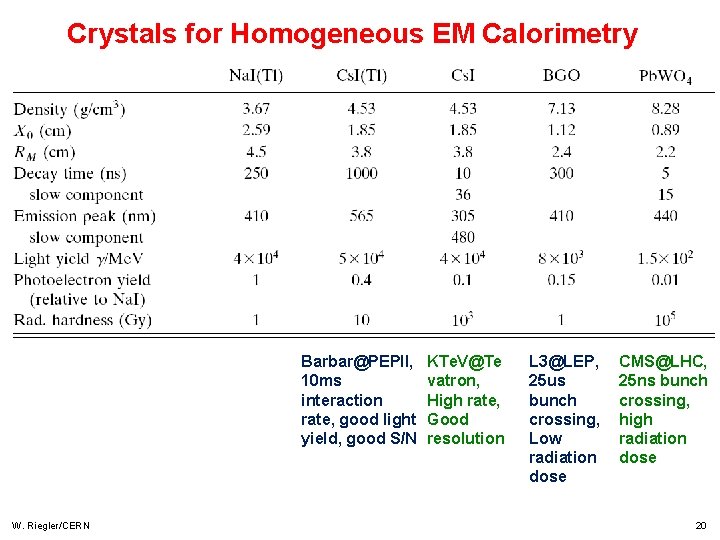
Crystals for Homogeneous EM Calorimetry Barbar@PEPII, 10 ms interaction rate, good light yield, good S/N W. Riegler/CERN KTe. V@Te vatron, High rate, Good resolution L 3@LEP, 25 us bunch crossing, Low radiation dose CMS@LHC, 25 ns bunch crossing, high radiation dose 20
Crystals for Homogeneous EM Calorimetry W. Riegler/CERN 21
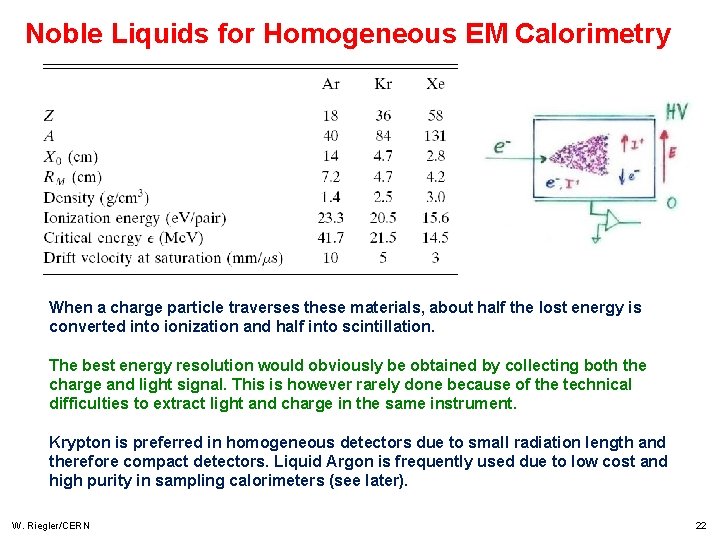
Noble Liquids for Homogeneous EM Calorimetry When a charge particle traverses these materials, about half the lost energy is converted into ionization and half into scintillation. The best energy resolution would obviously be obtained by collecting both the charge and light signal. This is however rarely done because of the technical difficulties to extract light and charge in the same instrument. Krypton is preferred in homogeneous detectors due to small radiation length and therefore compact detectors. Liquid Argon is frequently used due to low cost and high purity in sampling calorimeters (see later). W. Riegler/CERN 22
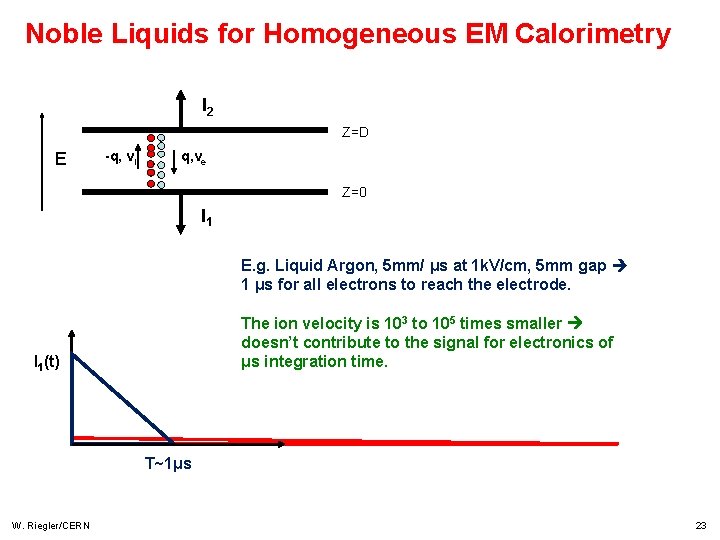
Noble Liquids for Homogeneous EM Calorimetry I 2 Z=D E -q, v. I q, ve Z=0 I 1 E. g. Liquid Argon, 5 mm/ μs at 1 k. V/cm, 5 mm gap 1 μs for all electrons to reach the electrode. The ion velocity is 103 to 105 times smaller doesn’t contribute to the signal for electronics of μs integration time. I 1(t) T~1μs W. Riegler/CERN 23
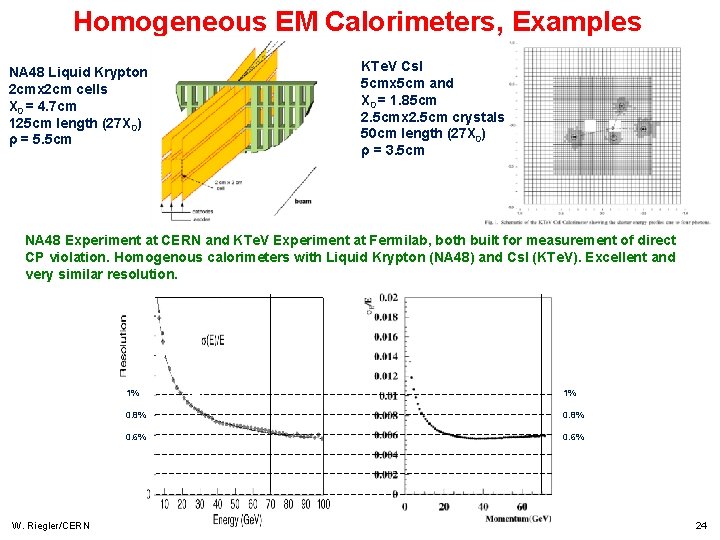
Homogeneous EM Calorimeters, Examples NA 48 Liquid Krypton 2 cmx 2 cm cells X 0 = 4. 7 cm 125 cm length (27 X 0) ρ = 5. 5 cm KTe. V Cs. I 5 cmx 5 cm and X 0 = 1. 85 cm 2. 5 cmx 2. 5 cm crystals 50 cm length (27 X 0) ρ = 3. 5 cm NA 48 Experiment at CERN and KTe. V Experiment at Fermilab, both built for measurement of direct CP violation. Homogenous calorimeters with Liquid Krypton (NA 48) and Cs. I (KTe. V). Excellent and very similar resolution. W. Riegler/CERN 1% 1% 0. 8% 0. 6% 24
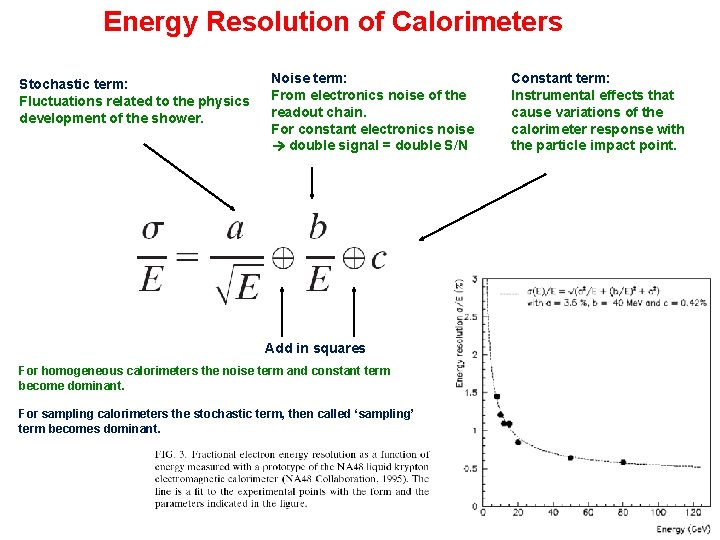
Energy Resolution of Calorimeters Stochastic term: Fluctuations related to the physics development of the shower. Noise term: From electronics noise of the readout chain. For constant electronics noise double signal = double S/N Constant term: Instrumental effects that cause variations of the calorimeter response with the particle impact point. Add in squares For homogeneous calorimeters the noise term and constant term become dominant. For sampling calorimeters the stochastic term, then called ‘sampling’ term becomes dominant. 25
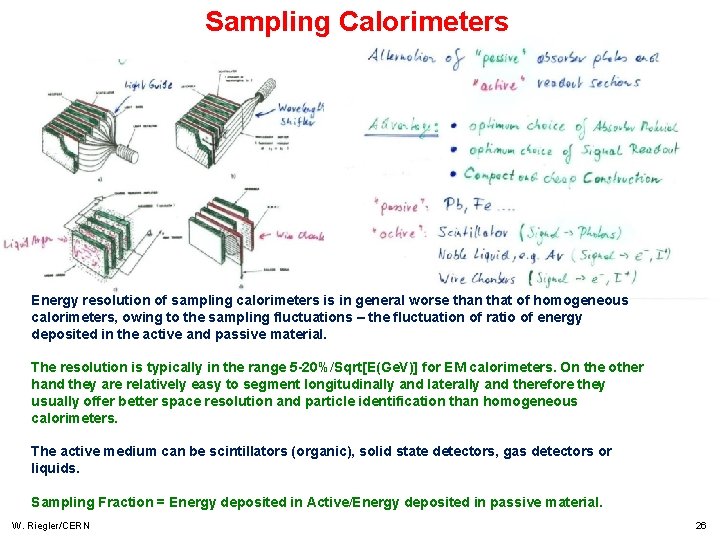
Sampling Calorimeters Energy resolution of sampling calorimeters is in general worse than that of homogeneous calorimeters, owing to the sampling fluctuations – the fluctuation of ratio of energy deposited in the active and passive material. The resolution is typically in the range 5 -20%/Sqrt[E(Ge. V)] for EM calorimeters. On the other hand they are relatively easy to segment longitudinally and laterally and therefore they usually offer better space resolution and particle identification than homogeneous calorimeters. The active medium can be scintillators (organic), solid state detectors, gas detectors or liquids. Sampling Fraction = Energy deposited in Active/Energy deposited in passive material. W. Riegler/CERN 26
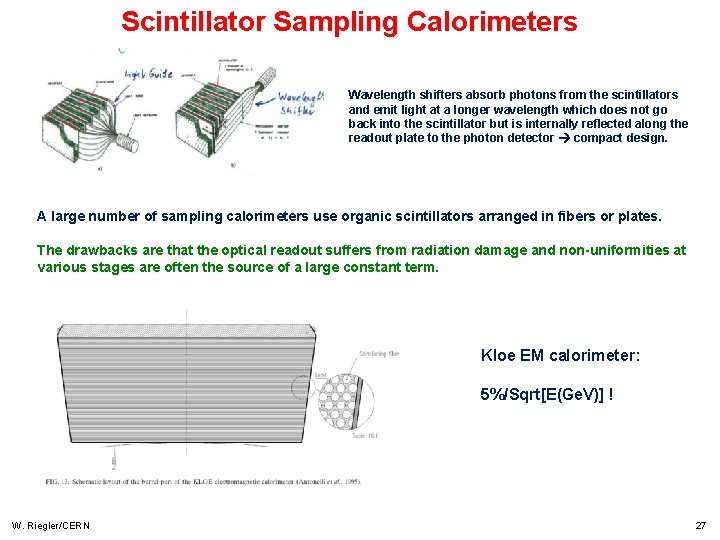
Scintillator Sampling Calorimeters Wavelength shifters absorb photons from the scintillators and emit light at a longer wavelength which does not go back into the scintillator but is internally reflected along the readout plate to the photon detector compact design. A large number of sampling calorimeters use organic scintillators arranged in fibers or plates. The drawbacks are that the optical readout suffers from radiation damage and non-uniformities at various stages are often the source of a large constant term. Kloe EM calorimeter: 5%/Sqrt[E(Ge. V)] ! W. Riegler/CERN 27
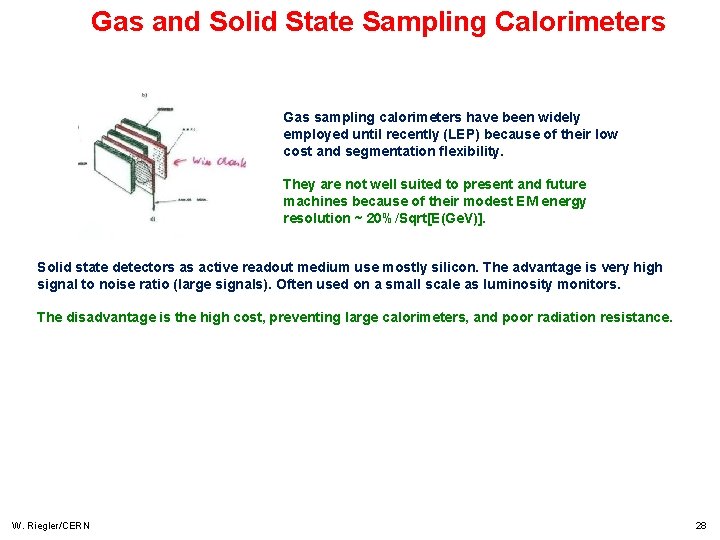
Gas and Solid State Sampling Calorimeters Gas sampling calorimeters have been widely employed until recently (LEP) because of their low cost and segmentation flexibility. They are not well suited to present and future machines because of their modest EM energy resolution ~ 20%/Sqrt[E(Ge. V)]. Solid state detectors as active readout medium use mostly silicon. The advantage is very high signal to noise ratio (large signals). Often used on a small scale as luminosity monitors. The disadvantage is the high cost, preventing large calorimeters, and poor radiation resistance. W. Riegler/CERN 28
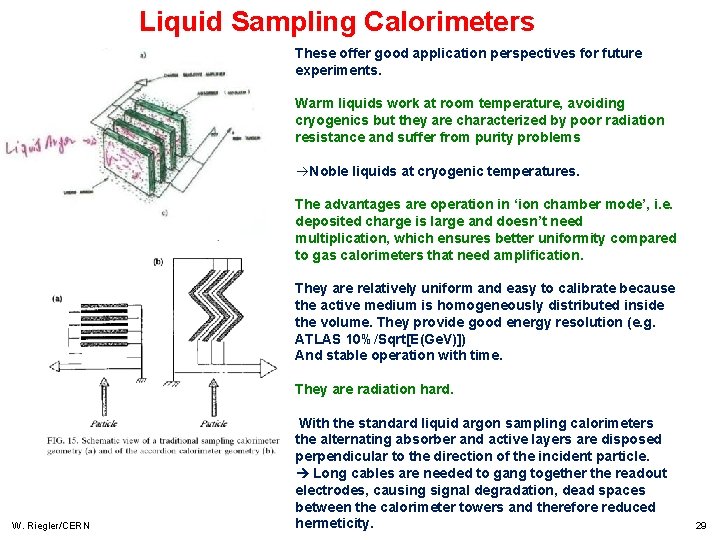
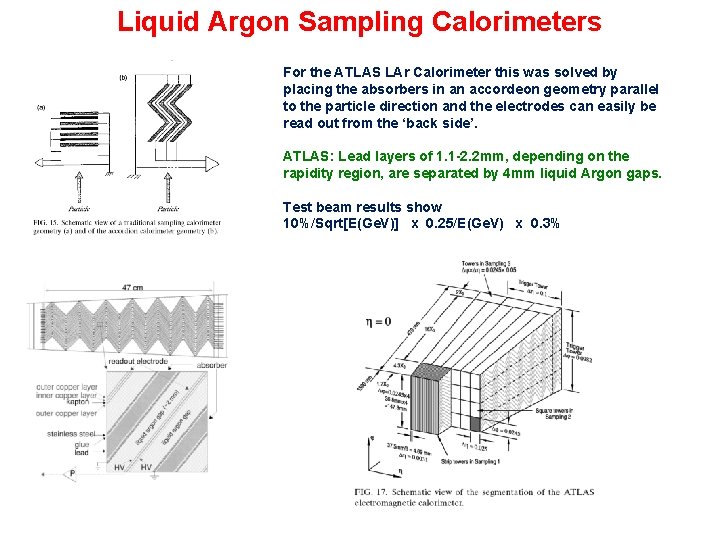
Liquid Sampling Calorimeters These offer good application perspectives for future experiments. Warm liquids work at room temperature, avoiding cryogenics but they are characterized by poor radiation resistance and suffer from purity problems àNoble liquids at cryogenic temperatures. The advantages are operation in ‘ion chamber mode’, i. e. deposited charge is large and doesn’t need multiplication, which ensures better uniformity compared to gas calorimeters that need amplification. They are relatively uniform and easy to calibrate because the active medium is homogeneously distributed inside the volume. They provide good energy resolution (e. g. ATLAS 10%/Sqrt[E(Ge. V)]) And stable operation with time. They are radiation hard. W. Riegler/CERN With the standard liquid argon sampling calorimeters the alternating absorber and active layers are disposed perpendicular to the direction of the incident particle. Long cables are needed to gang together the readout electrodes, causing signal degradation, dead spaces between the calorimeter towers and therefore reduced hermeticity. 29
Liquid Argon Sampling Calorimeters For the ATLAS LAr Calorimeter this was solved by placing the absorbers in an accordeon geometry parallel to the particle direction and the electrodes can easily be read out from the ‘back side’. ATLAS: Lead layers of 1. 1 -2. 2 mm, depending on the rapidity region, are separated by 4 mm liquid Argon gaps. Test beam results show 10%/Sqrt[E(Ge. V)] x 0. 25/E(Ge. V) x 0. 3%
Hadronic Calorimetry W. Riegler/CERN 31
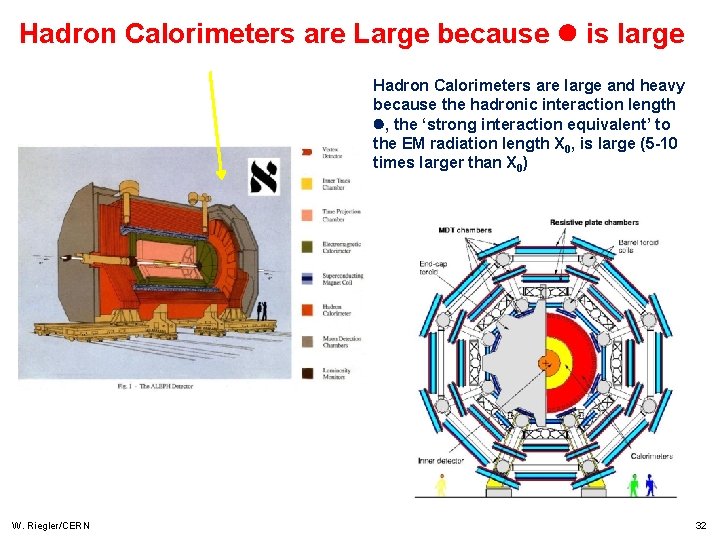
Hadron Calorimeters are Large because is large Hadron Calorimeters are large and heavy because the hadronic interaction length , the ‘strong interaction equivalent’ to the EM radiation length X 0, is large (5 -10 times larger than X 0) W. Riegler/CERN 32
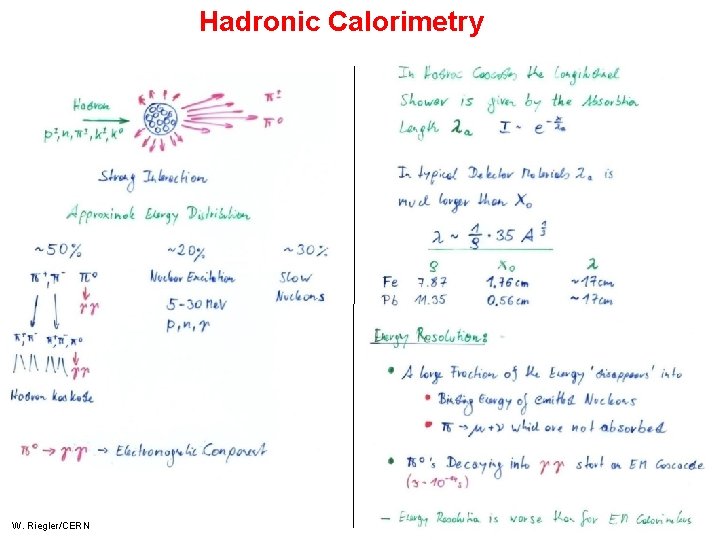
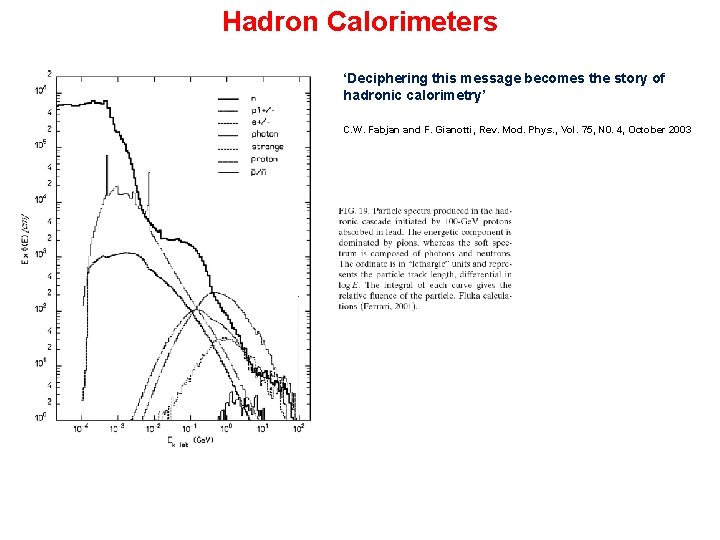
Hadron Calorimeters By analogy with EM showers, the energy degradation of hadrons proceeds through an increasing number of (mostly) strong interactions with the calorimeter material. However the complexity of the hadronic and nuclear processes produces a multitude of effects that determine the functioning and the performance of practical instruments, and make hadronic calorimeters more complicated instruments to optimize. By analogy with EM showers, the energy degradation of hadrons proceeds through an increasing number of (mostly) strong interactions with the calorimeter material. The hadronic interaction produces two classes of effects: First, energetic secondary hadrons are produced with a mean free path of between interactions. Their momenta are typically a fair fraction of the primary hadron momentum i. e. at the Ge. V scale. Second, in hadronic collisions with the material nuclei, a significant part of the primary energy is consumed in nuclear processes such as excitation, nucleon evaporation, spallation etc. , resulting in particles with characteristic nuclear energies on the Me. V scale. C. W. Fabjan and F. Gianotti, Rev. Mod. Phys. , Vol. 75, N 0. 4, October 2003 Because part of the energy is therefore ‘invisible’, the resolution of hadron calorimeters is typically worse than in EM calorimeters 20 -100%/Sqrt[E(Ge. V)].
Hadron Calorimeters ‘Deciphering this message becomes the story of hadronic calorimetry’ C. W. Fabjan and F. Gianotti, Rev. Mod. Phys. , Vol. 75, N 0. 4, October 2003
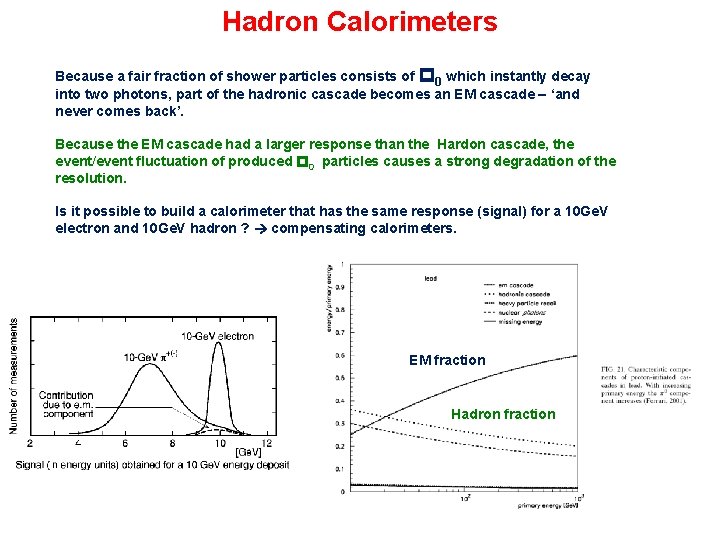
Hadron Calorimeters The signals from an electron or photon entering a hadronic calorimeter is typically larger than the signal from a hadron cascade because the hadroic interactions produce a fair fraction of invisible effects (excitations, neutrons …). Pion 10 Ge. V Electron 10 Ge. V
Hadron Calorimeters Because a fair fraction of shower particles consists of 0 which instantly decay into two photons, part of the hadronic cascade becomes an EM cascade – ‘and never comes back’. Because the EM cascade had a larger response than the Hardon cascade, the event/event fluctuation of produced 0 particles causes a strong degradation of the resolution. Is it possible to build a calorimeter that has the same response (signal) for a 10 Ge. V electron and 10 Ge. V hadron ? compensating calorimeters. EM fraction Hadron fraction
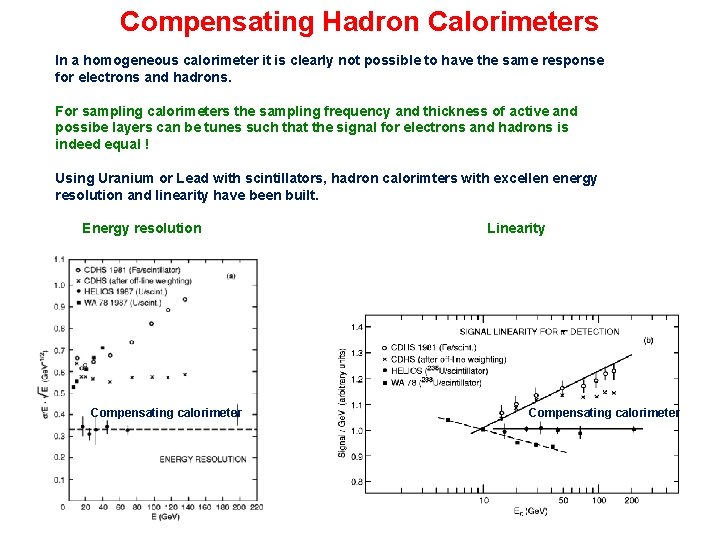
Compensating Hadron Calorimeters In a homogeneous calorimeter it is clearly not possible to have the same response for electrons and hadrons. For sampling calorimeters the sampling frequency and thickness of active and possibe layers can be tunes such that the signal for electrons and hadrons is indeed equal ! Using Uranium or Lead with scintillators, hadron calorimters with excellen energy resolution and linearity have been built. Energy resolution Compensating calorimeter Linearity Compensating calorimeter
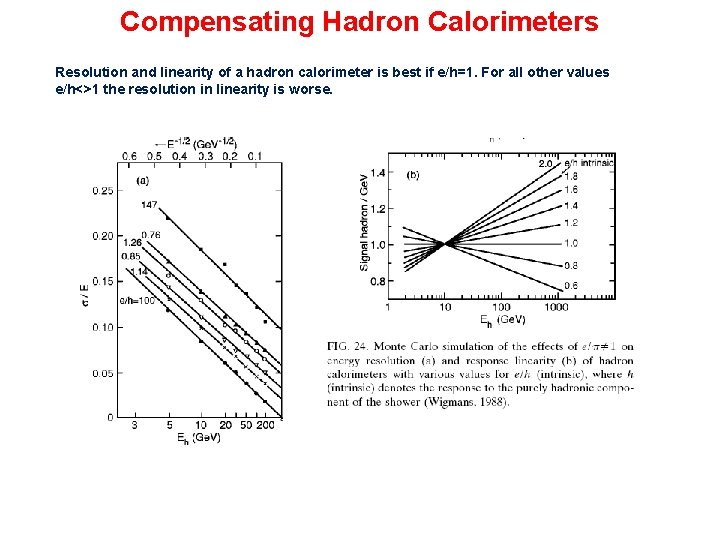
Compensating Hadron Calorimeters Resolution and linearity of a hadron calorimeter is best if e/h=1. For all other values e/h<>1 the resolution in linearity is worse.
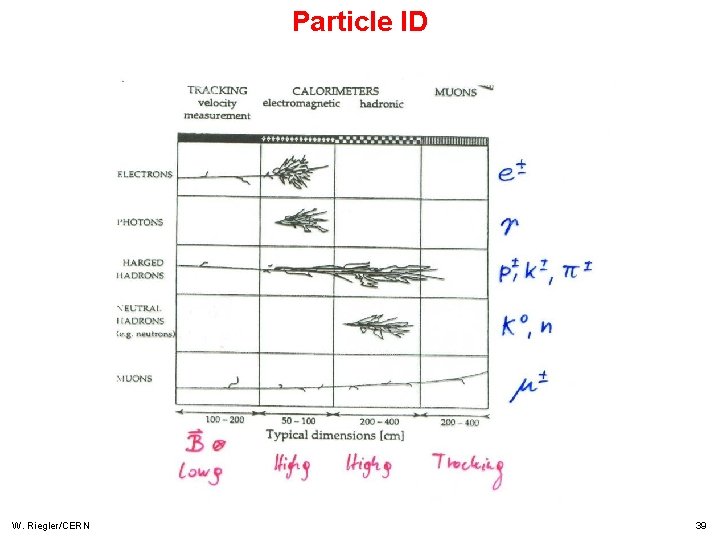
Particle ID W. Riegler/CERN 39
Particle Identification W. Riegler/CERN 40
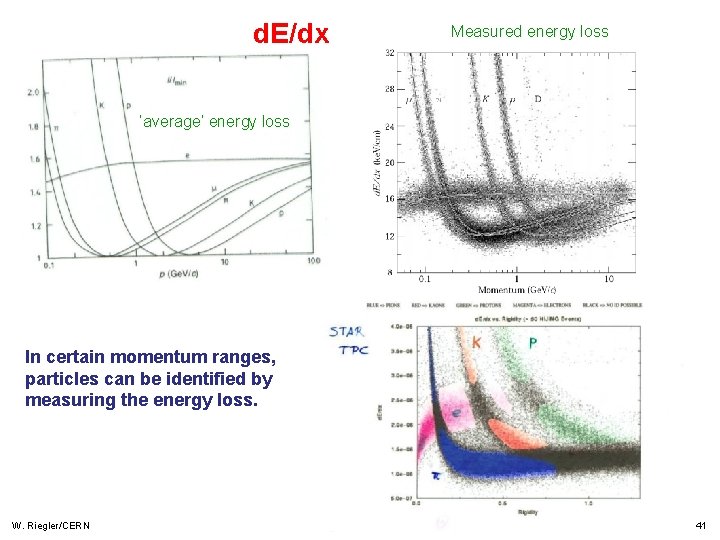
d. E/dx Measured energy loss ‘average’ energy loss In certain momentum ranges, particles can be identified by measuring the energy loss. W. Riegler/CERN 41
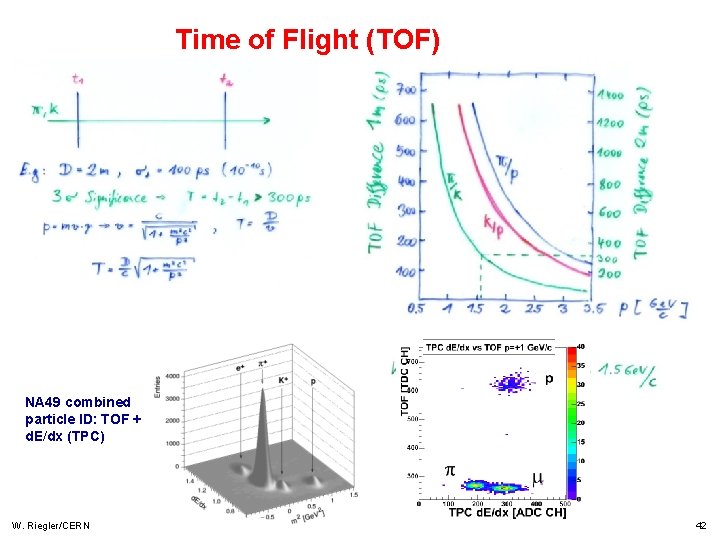
Time of Flight (TOF) NA 49 combined particle ID: TOF + d. E/dx (TPC) W. Riegler/CERN 42
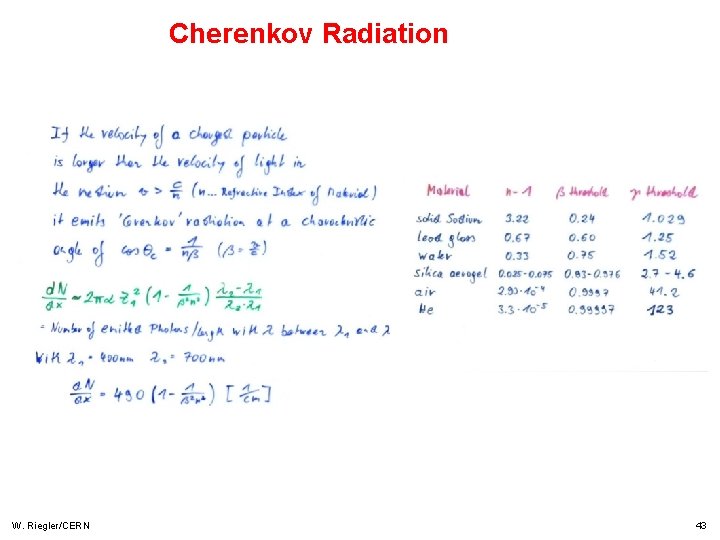
Cherenkov Radiation W. Riegler/CERN 43
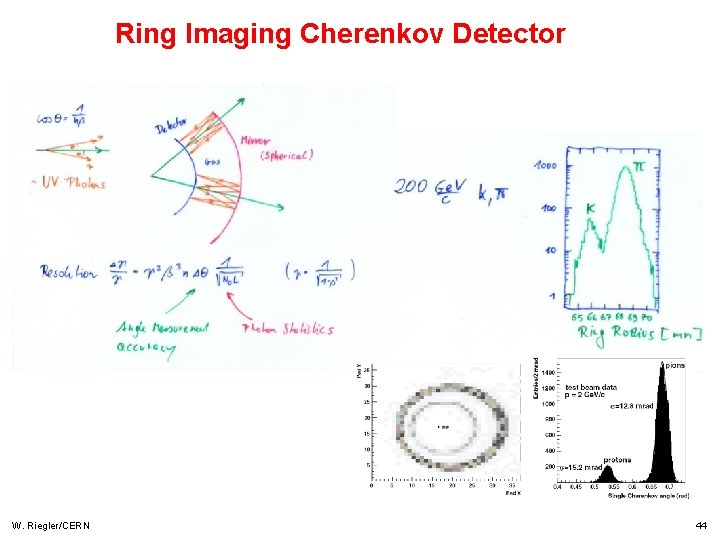
Ring Imaging Cherenkov Detector W. Riegler/CERN 44
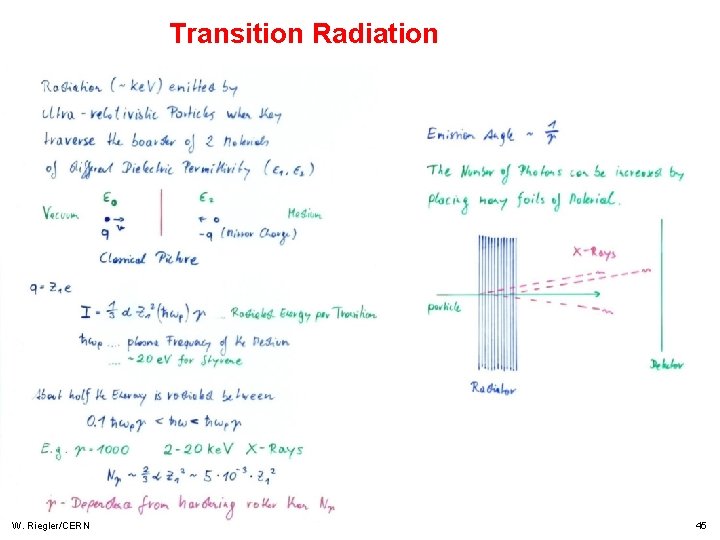
Transition Radiation W. Riegler/CERN 45
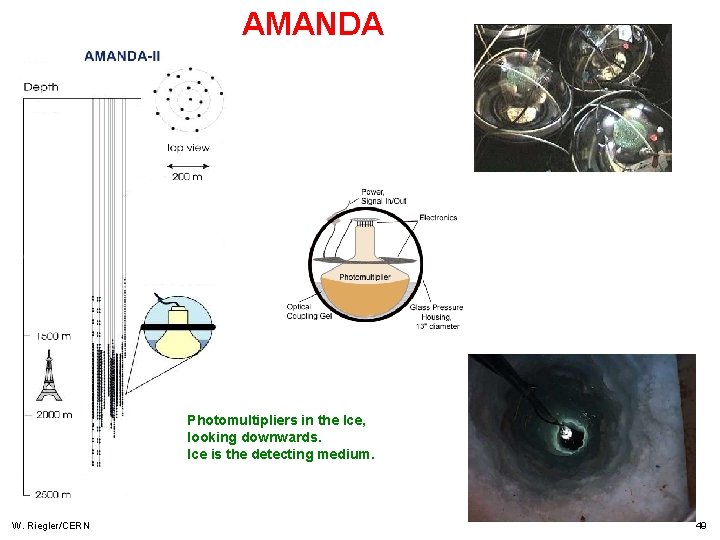
Instrumenting the Earth’s Atmosphere or the Polar Ice Cap we get huge Calorimeters for Astro Particle Physics ! Examples: AMANDA on the South Pole Pierre Auger Telescope in South America W. Riegler/CERN 46
AMANDA Antarctic Muon And Neutrino Detector Array W. Riegler/CERN 47
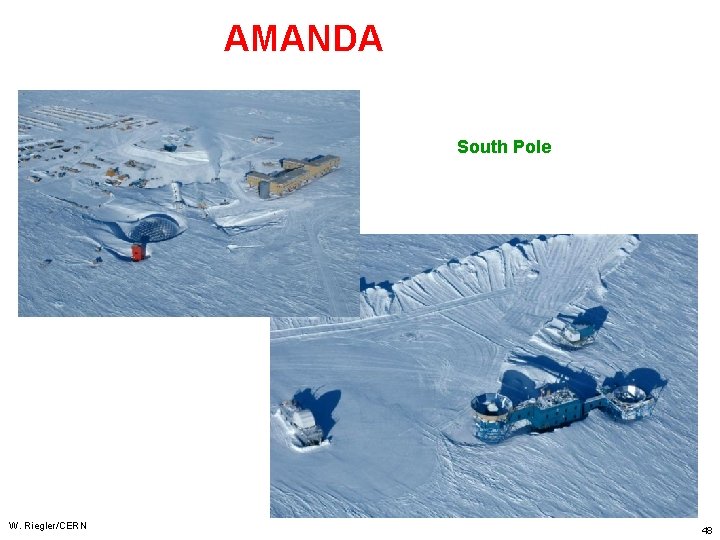
AMANDA South Pole W. Riegler/CERN 48
AMANDA Photomultipliers in the Ice, looking downwards. Ice is the detecting medium. W. Riegler/CERN 49
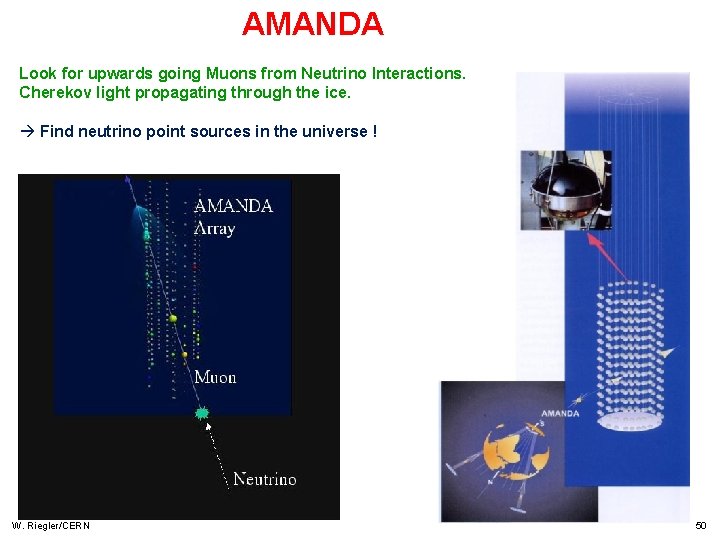
AMANDA Look for upwards going Muons from Neutrino Interactions. Cherekov light propagating through the ice. à Find neutrino point sources in the universe ! W. Riegler/CERN 50
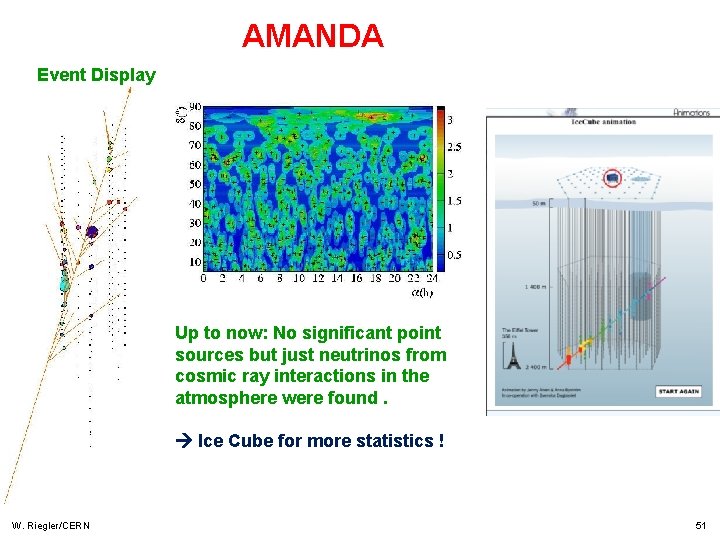
AMANDA Event Display Up to now: No significant point sources but just neutrinos from cosmic ray interactions in the atmosphere were found. Ice Cube for more statistics ! W. Riegler/CERN 51
Pierre Auger Cosmic Ray Observatory W. Riegler/CERN 52
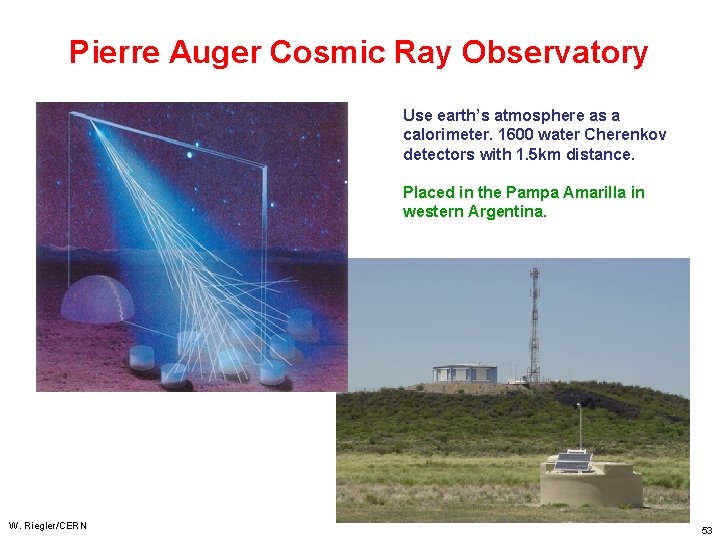
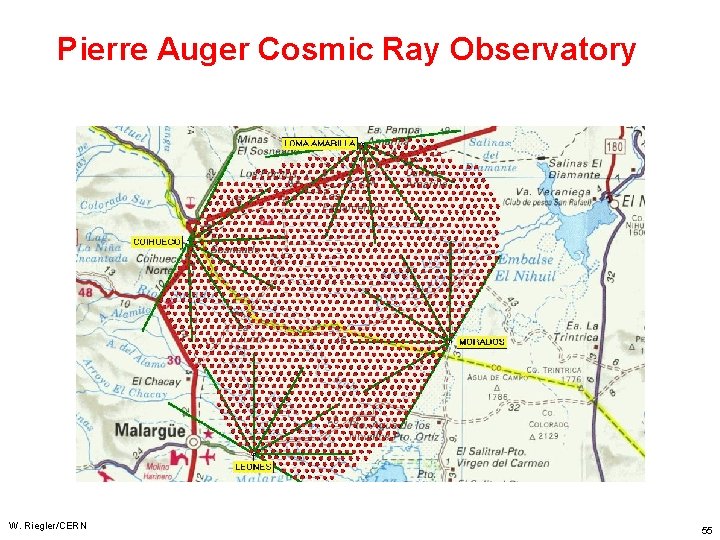
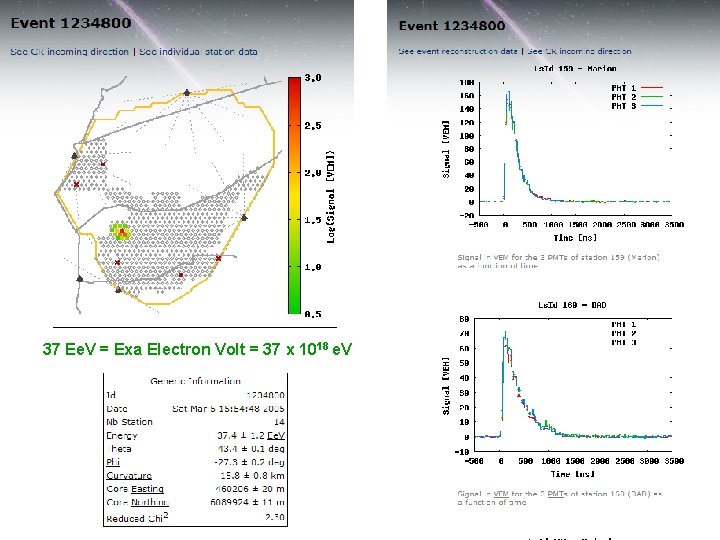
Pierre Auger Cosmic Ray Observatory Use earth’s atmosphere as a calorimeter. 1600 water Cherenkov detectors with 1. 5 km distance. Placed in the Pampa Amarilla in western Argentina. W. Riegler/CERN 53
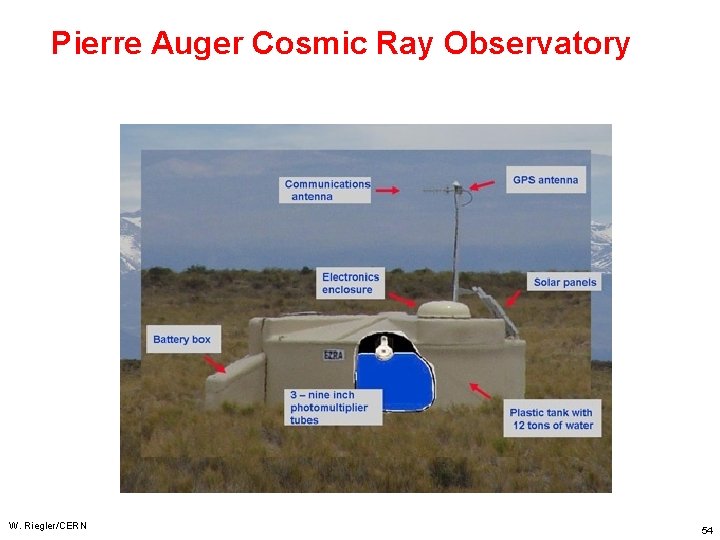
Pierre Auger Cosmic Ray Observatory W. Riegler/CERN 54
Pierre Auger Cosmic Ray Observatory W. Riegler/CERN 55
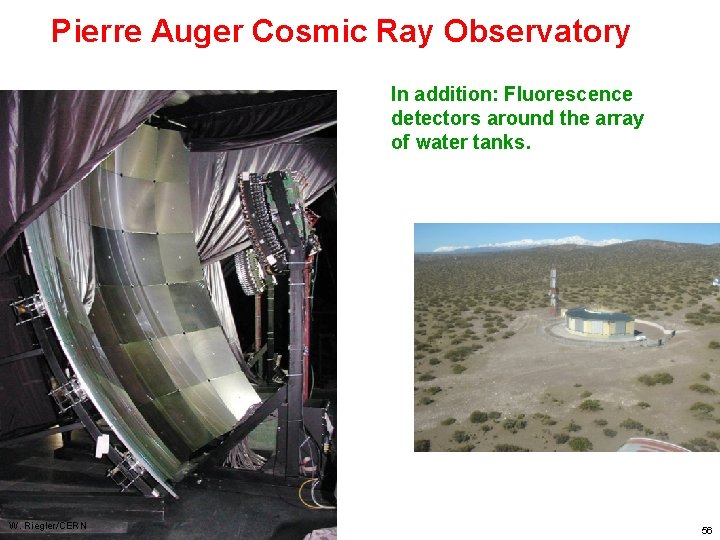
Pierre Auger Cosmic Ray Observatory In addition: Fluorescence detectors around the array of water tanks. W. Riegler/CERN 56
37 Ee. V = Exa Electron Volt = 37 x 1018 e. V W. Riegler/CERN 57
Conclusion The story of modern calorimetry is a textbook example of physics research driving the development of an experimental method. The long quest for precision electron and photon spectroscopy explains the remarkable progress in new instrumentation techniques, for both sampling and homogeneous calorimeters. The study of jets of particles as the macroscopic manifestation of quarks has driven the work on hadronic calorimeters. C. W. Fabjan and F. Gianotti, Rev. Mod. Phys. , Vol. 75, N 0. 4, October 2003 W. Riegler/CERN 58