
Fundamentals of Organic Chemistry CHEM 109 For Students
- Slides: 37
Fundamentals of Organic Chemistry CHEM 109 For Students of Health Colleges Credit hrs. : (2+1) King Saud University College of Science, Chemistry Department CHEM 109 CHAPTER 4. ALCOHOLS, PHENOLS AND ETHERS
Learning Objectives At the end of this chapter, students will able to: q know the difference in structure between alcohols, phenols and ethers. q Know the different classes of alcohols. q Know how to name alcohols, phenols and ethers using IUPAC method. q Recognize the basic properties (structure, physical and chemical properties) of alcohols, phenols and ethers. q Recognize the effect of hydrogen bonds on their physical properties. q Recognize the acidic properties of alcohols and phenols. q know the different methods for the preparation of alcohols, phenols and ethers. q Know the chemical reactions of these compounds.
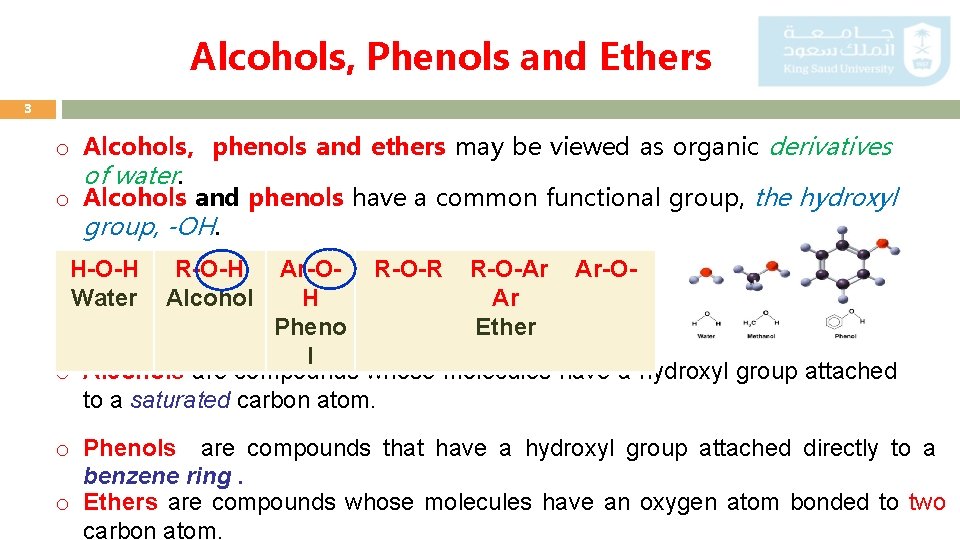
Alcohols, Phenols and Ethers 3 o Alcohols, phenols and ethers may be viewed as organic derivatives of water. o Alcohols and phenols have a common functional group, the hydroxyl group, -OH. H-O-H Water R-O-H Alcohol Ar-O- R-O-R R-O-Ar Ar-OH Ar Pheno Ether l o Alcohols are compounds whose molecules have a hydroxyl group attached to a saturated carbon atom. o Phenols are compounds that have a hydroxyl group attached directly to a benzene ring. o Ethers are compounds whose molecules have an oxygen atom bonded to two carbon atom.
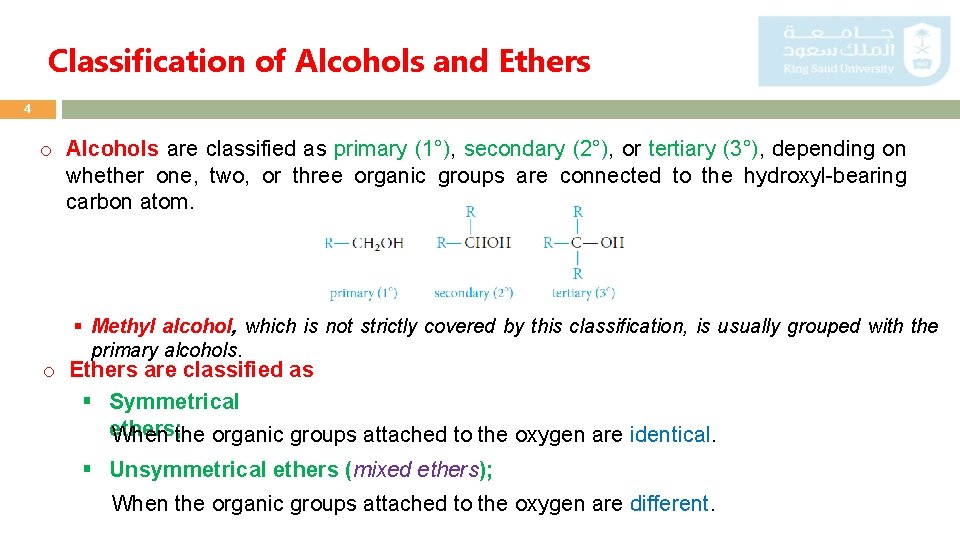
Classification of Alcohols and Ethers 4 o Alcohols are classified as primary (1°), secondary (2°), or tertiary (3°), depending on whether one, two, or three organic groups are connected to the hydroxyl-bearing carbon atom. § Methyl alcohol, which is not strictly covered by this classification, is usually grouped with the primary alcohols. o Ethers are classified as § Symmetrical ethers; When the organic groups attached to the oxygen are identical. § Unsymmetrical ethers (mixed ethers); When the organic groups attached to the oxygen are different.
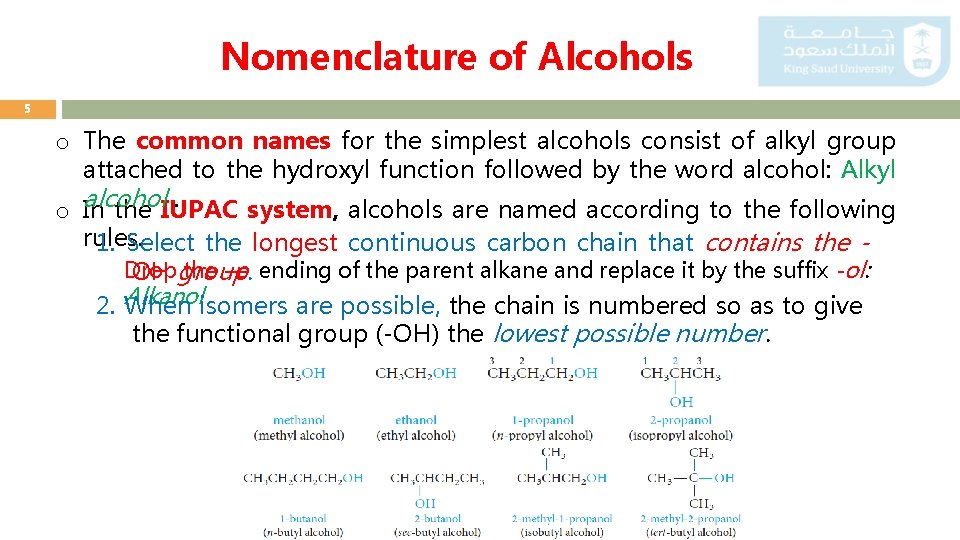
Nomenclature of Alcohols 5 o The common names for the simplest alcohols consist of alkyl group attached to the hydroxyl function followed by the word alcohol: Alkyl. o alcohol In the IUPAC system, alcohols are named according to the following rules. 1. Select the longest continuous carbon chain that contains the Drop the –e ending of the parent alkane and replace it by the suffix -ol: OH group. Alkanolisomers are possible, the chain is numbered so as to give 2. When the functional group (-OH) the lowest possible number.
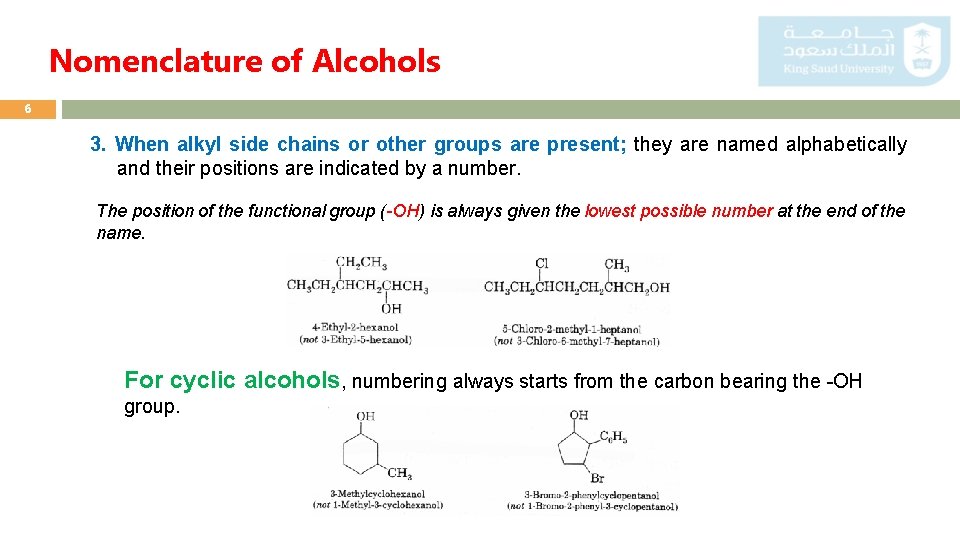
Nomenclature of Alcohols 6 3. When alkyl side chains or other groups are present; they are named alphabetically and their positions are indicated by a number. The position of the functional group (-OH) is always given the lowest possible number at the end of the name. For cyclic alcohols, numbering always starts from the carbon bearing the -OH group.
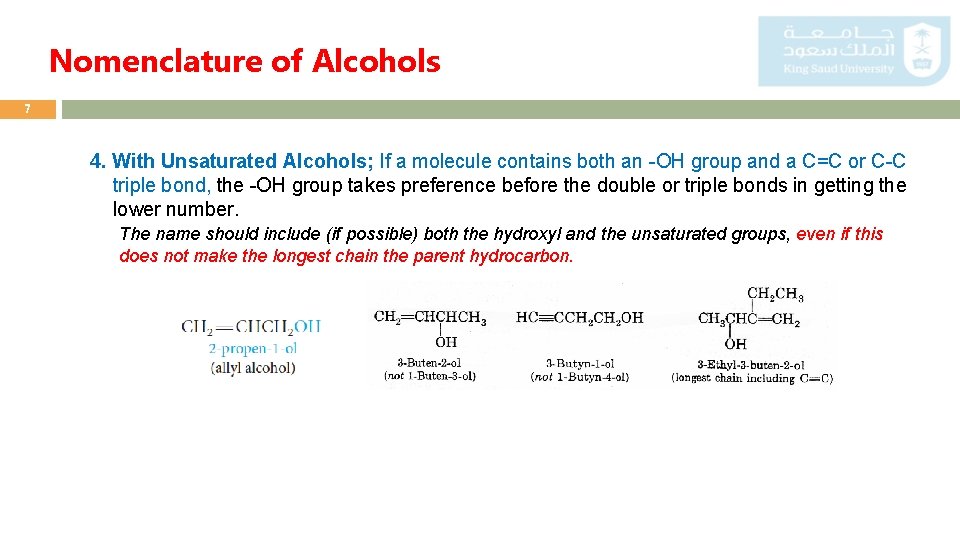
Nomenclature of Alcohols 7 4. With Unsaturated Alcohols; If a molecule contains both an -OH group and a C=C or C-C triple bond, the -OH group takes preference before the double or triple bonds in getting the lower number. The name should include (if possible) both the hydroxyl and the unsaturated groups, even if this does not make the longest chain the parent hydrocarbon.
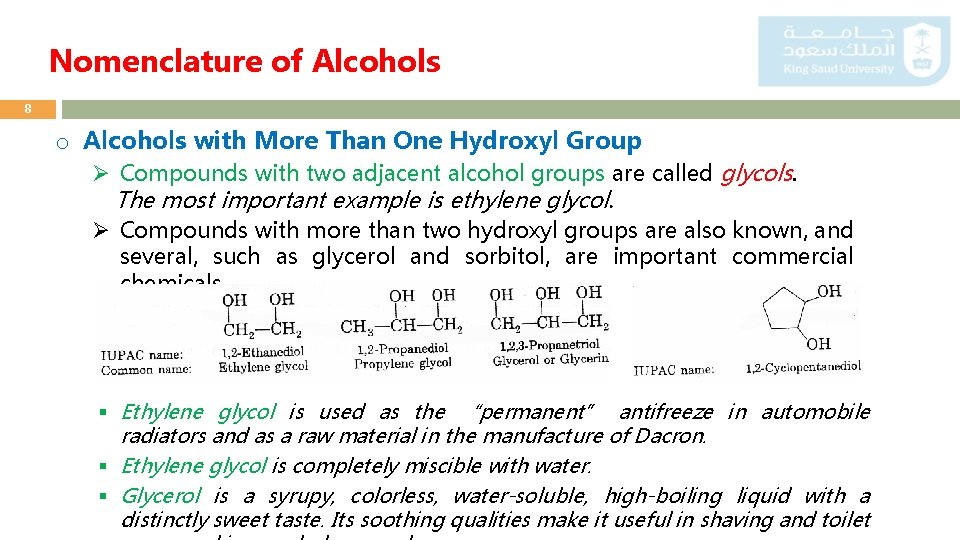
Nomenclature of Alcohols 8 o Alcohols with More Than One Hydroxyl Group Ø Compounds with two adjacent alcohol groups are called glycols. The most important example is ethylene glycol. Ø Compounds with more than two hydroxyl groups are also known, and several, such as glycerol and sorbitol, are important commercial chemicals. § Ethylene glycol is used as the “permanent” antifreeze in automobile radiators and as a raw material in the manufacture of Dacron. § Ethylene glycol is completely miscible with water. § Glycerol is a syrupy, colorless, water-soluble, high-boiling liquid with a distinctly sweet taste. Its soothing qualities make it useful in shaving and toilet
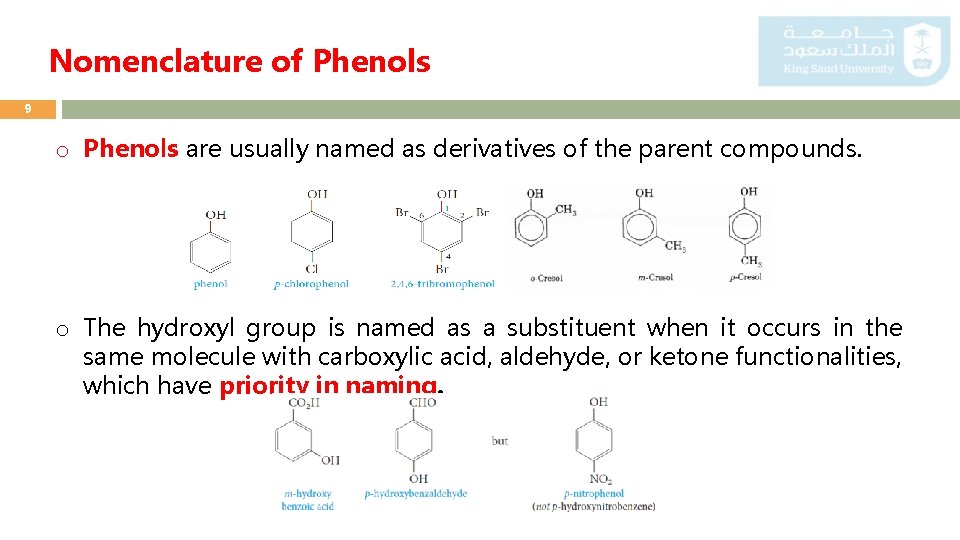
Nomenclature of Phenols 9 o Phenols are usually named as derivatives of the parent compounds. o The hydroxyl group is named as a substituent when it occurs in the same molecule with carboxylic acid, aldehyde, or ketone functionalities, which have priority in naming.
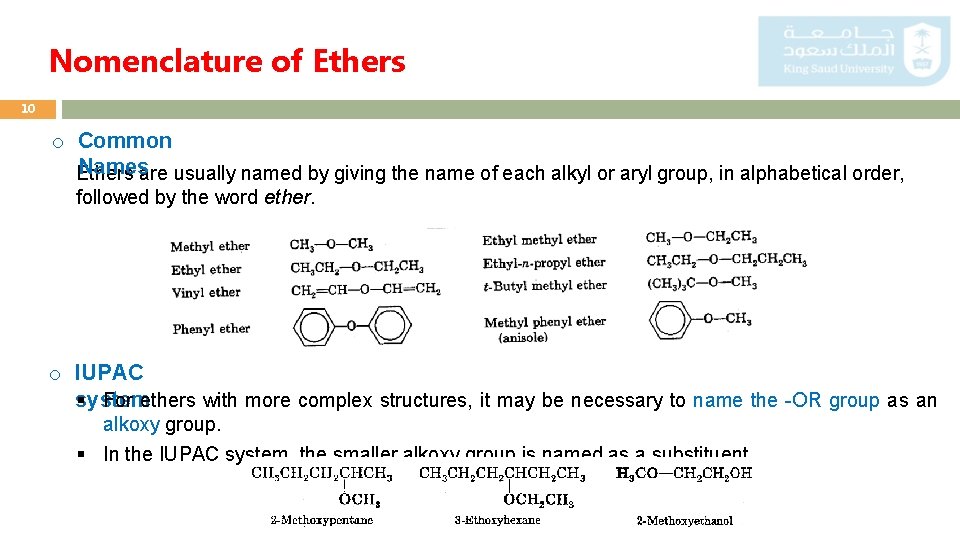
Nomenclature of Ethers 10 o Common Namesare usually named by giving the name of each alkyl or aryl group, in alphabetical order, Ethers followed by the word ether. o IUPAC system § For ethers with more complex structures, it may be necessary to name the -OR group as an alkoxy group. § In the IUPAC system, the smaller alkoxy group is named as a substituent.
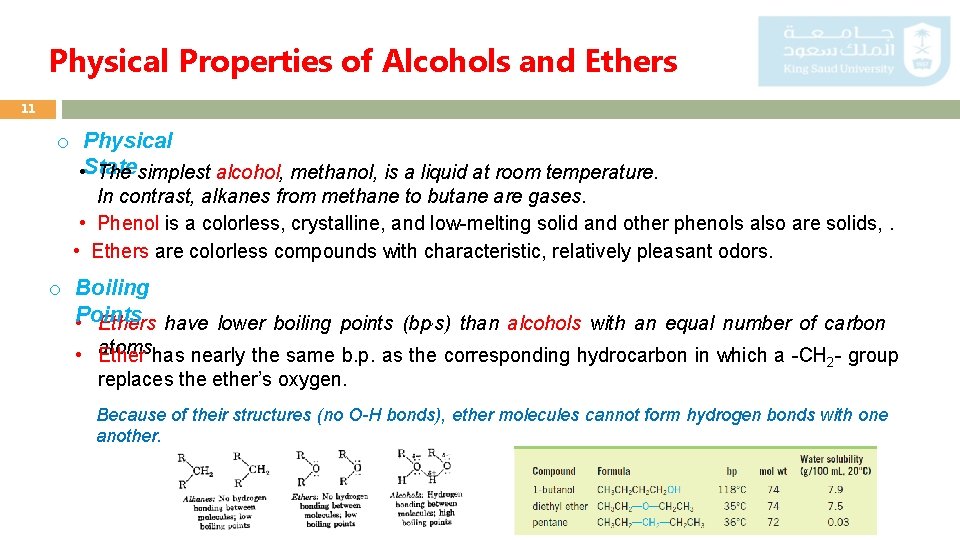
Physical Properties of Alcohols and Ethers 11 o Physical • State The simplest alcohol, methanol, is a liquid at room temperature. In contrast, alkanes from methane to butane are gases. • Phenol is a colorless, crystalline, and low-melting solid and other phenols also are solids, . • Ethers are colorless compounds with characteristic, relatively pleasant odors. o Boiling Points • Ethers have lower boiling points (bp, s) than alcohols with an equal number of carbon • atoms. Ether has nearly the same b. p. as the corresponding hydrocarbon in which a -CH 2 - group replaces the ether’s oxygen. Because of their structures (no O-H bonds), ether molecules cannot form hydrogen bonds with one another.
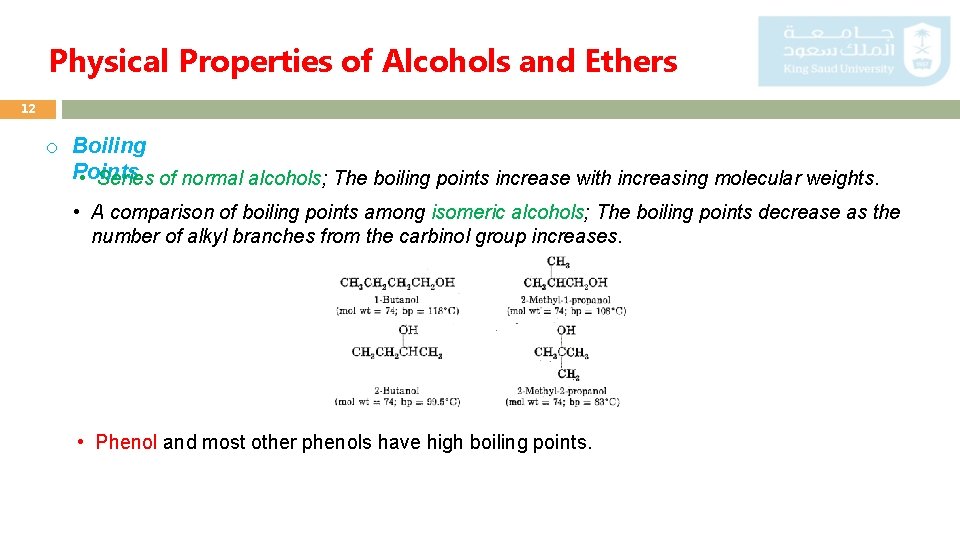
Physical Properties of Alcohols and Ethers 12 o Boiling Points • Series of normal alcohols; The boiling points increase with increasing molecular weights. • A comparison of boiling points among isomeric alcohols; The boiling points decrease as the number of alkyl branches from the carbinol group increases. • Phenol and most other phenols have high boiling points.
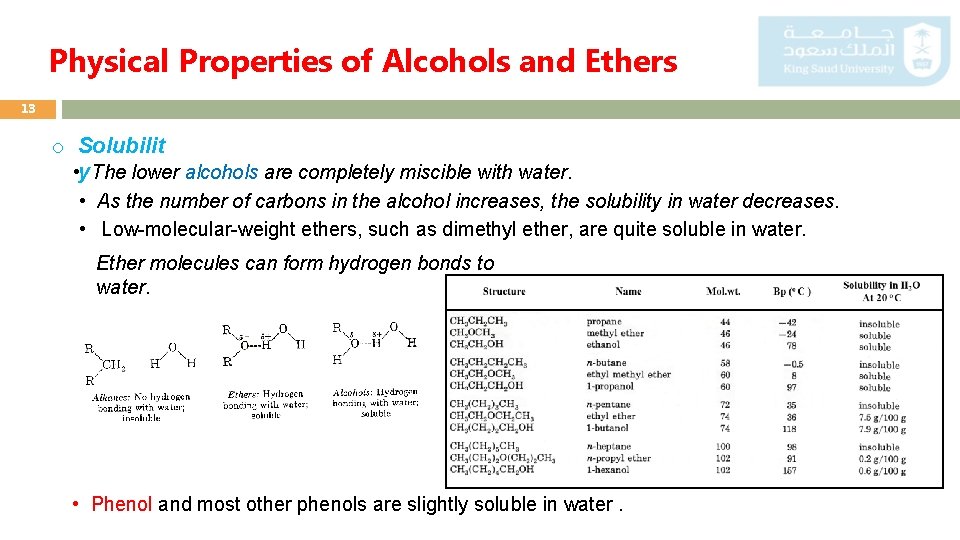
Physical Properties of Alcohols and Ethers 13 o Solubilit • y The lower alcohols are completely miscible with water. • As the number of carbons in the alcohol increases, the solubility in water decreases. • Low-molecular-weight ethers, such as dimethyl ether, are quite soluble in water. Ether molecules can form hydrogen bonds to water. • Phenol and most other phenols are slightly soluble in water.
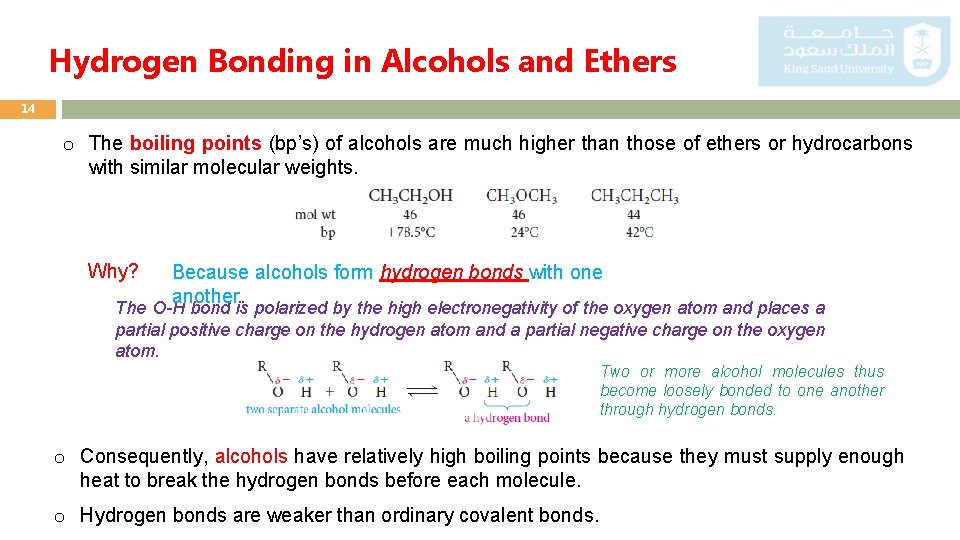
Hydrogen Bonding in Alcohols and Ethers 14 o The boiling points (bp’s) of alcohols are much higher than those of ethers or hydrocarbons with similar molecular weights. Why? Because alcohols form hydrogen bonds with one another. The O-H bond is polarized by the high electronegativity of the oxygen atom and places a partial positive charge on the hydrogen atom and a partial negative charge on the oxygen atom. Two or more alcohol molecules thus become loosely bonded to one another through hydrogen bonds. o Consequently, alcohols have relatively high boiling points because they must supply enough heat to break the hydrogen bonds before each molecule. o Hydrogen bonds are weaker than ordinary covalent bonds.
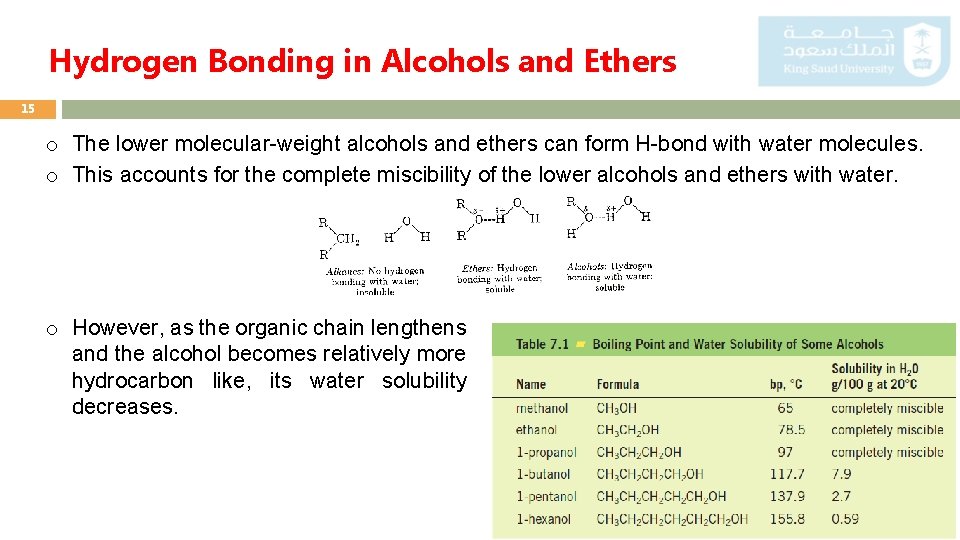
Hydrogen Bonding in Alcohols and Ethers 15 o The lower molecular-weight alcohols and ethers can form H-bond with water molecules. o This accounts for the complete miscibility of the lower alcohols and ethers with water. o However, as the organic chain lengthens and the alcohol becomes relatively more hydrocarbon like, its water solubility decreases.
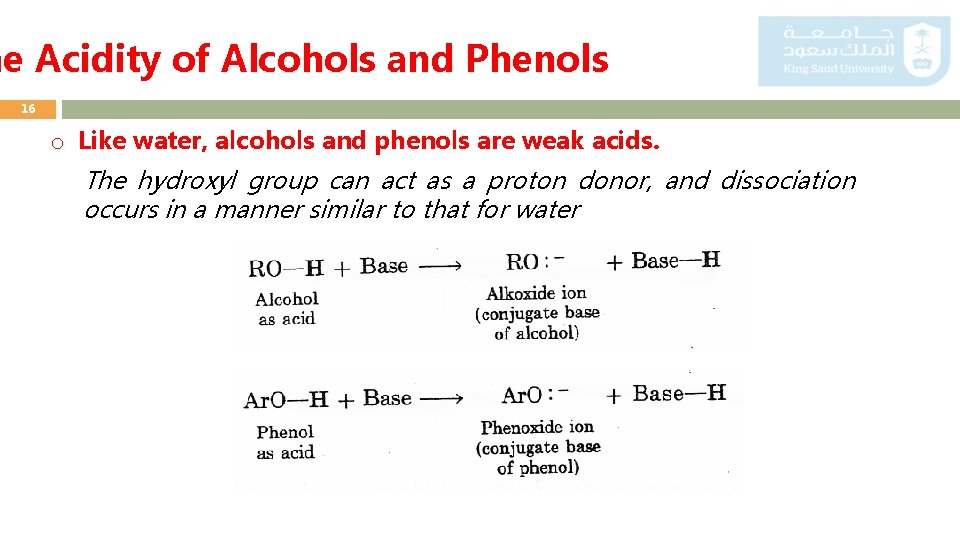
he Acidity of Alcohols and Phenols 16 o Like water, alcohols and phenols are weak acids. The hydroxyl group can act as a proton donor, and dissociation occurs in a manner similar to that for water
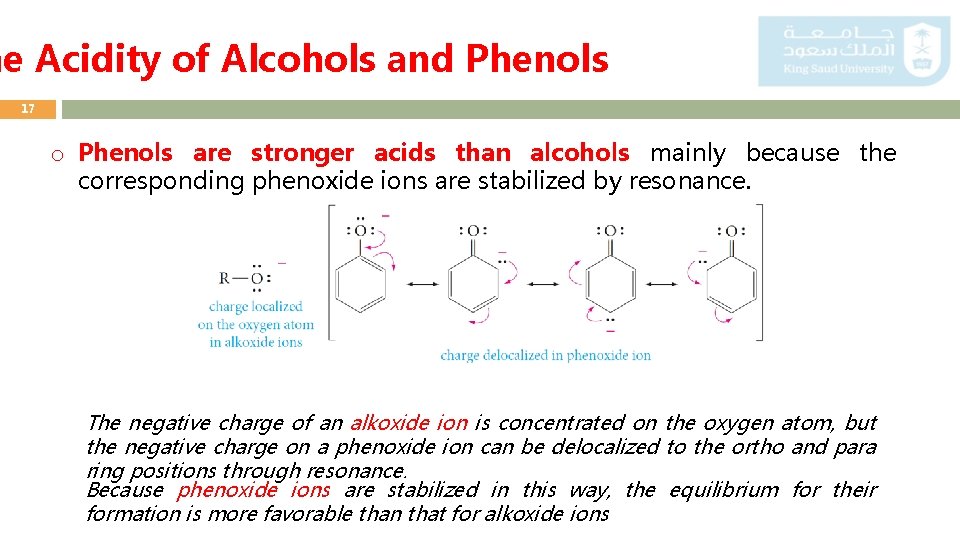
he Acidity of Alcohols and Phenols 17 o Phenols are stronger acids than alcohols mainly because the corresponding phenoxide ions are stabilized by resonance. The negative charge of an alkoxide ion is concentrated on the oxygen atom, but the negative charge on a phenoxide ion can be delocalized to the ortho and para ring positions through resonance. Because phenoxide ions are stabilized in this way, the equilibrium for their formation is more favorable than that for alkoxide ions
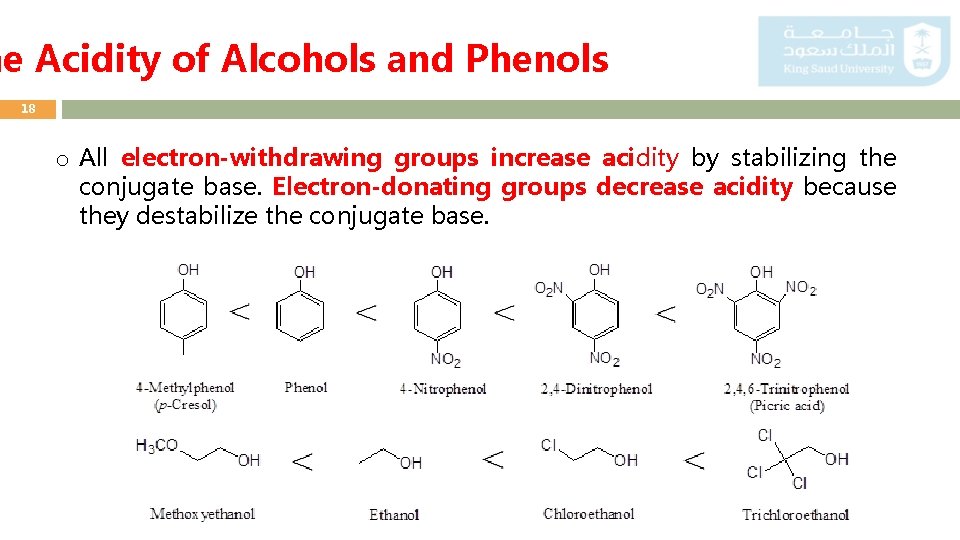
he Acidity of Alcohols and Phenols 18 o All electron-withdrawing groups increase acidity by stabilizing the conjugate base. Electron-donating groups decrease acidity because they destabilize the conjugate base.
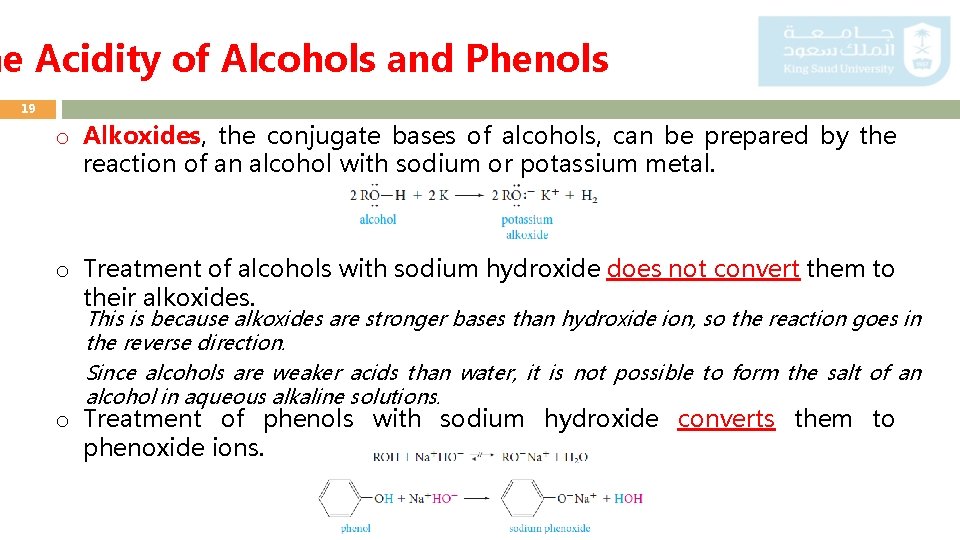
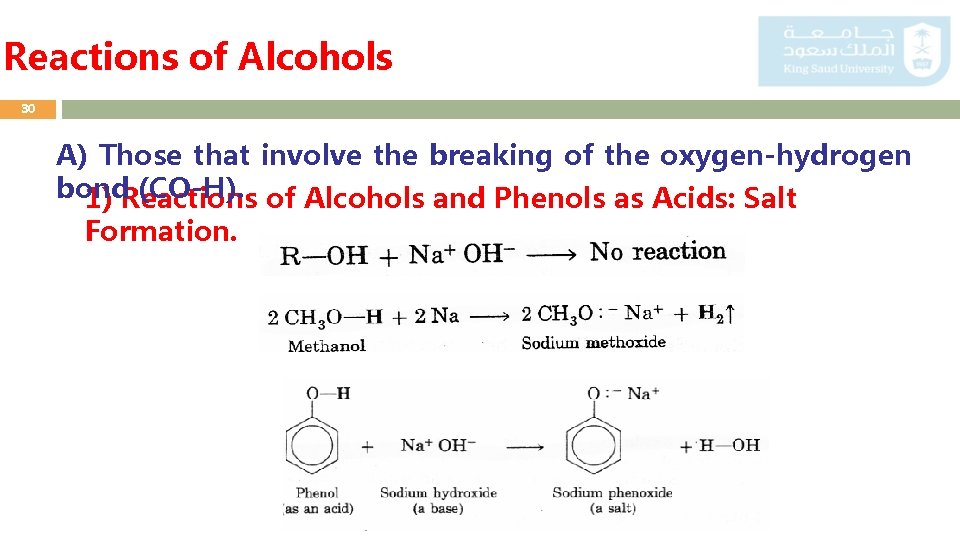
he Acidity of Alcohols and Phenols 19 o Alkoxides, the conjugate bases of alcohols, can be prepared by the reaction of an alcohol with sodium or potassium metal. o Treatment of alcohols with sodium hydroxide does not convert them to their alkoxides. This is because alkoxides are stronger bases than hydroxide ion, so the reaction goes in the reverse direction. Since alcohols are weaker acids than water, it is not possible to form the salt of an alcohol in aqueous alkaline solutions. o Treatment of phenols with sodium hydroxide converts them to phenoxide ions.
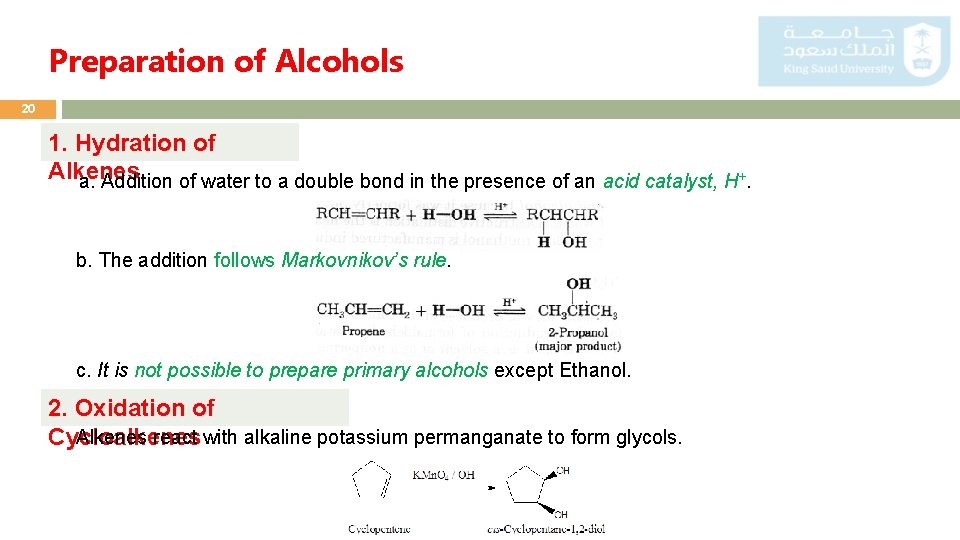
Preparation of Alcohols 20 1. Hydration of Alkenes a. Addition of water to a double bond in the presence of an acid catalyst, H+. b. The addition follows Markovnikov’s rule. c. It is not possible to prepare primary alcohols except Ethanol. 2. Oxidation of Alkenes react with alkaline potassium permanganate to form glycols. Cycloalkenes
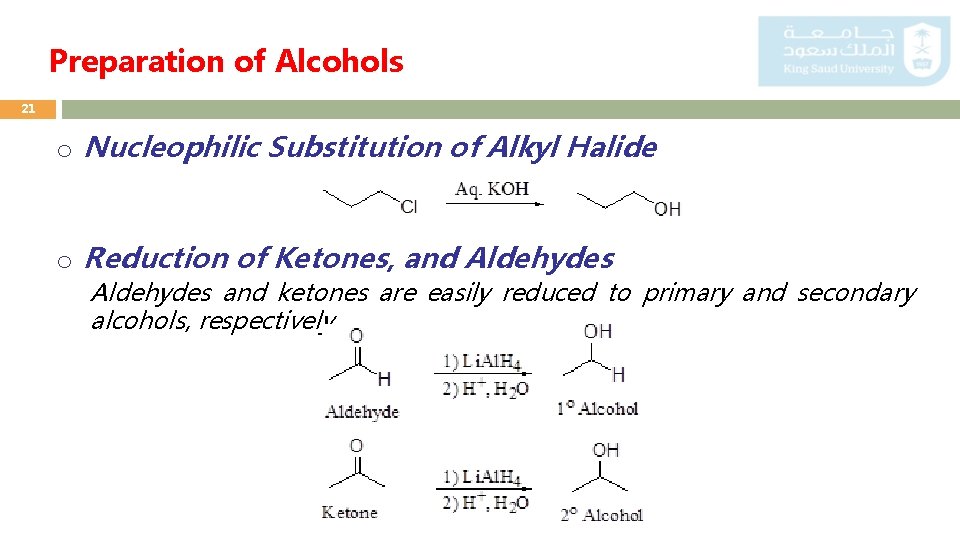
Preparation of Alcohols 21 o Nucleophilic Substitution of Alkyl Halide o Reduction of Ketones, and Aldehydes and ketones are easily reduced to primary and secondary alcohols, respectively.
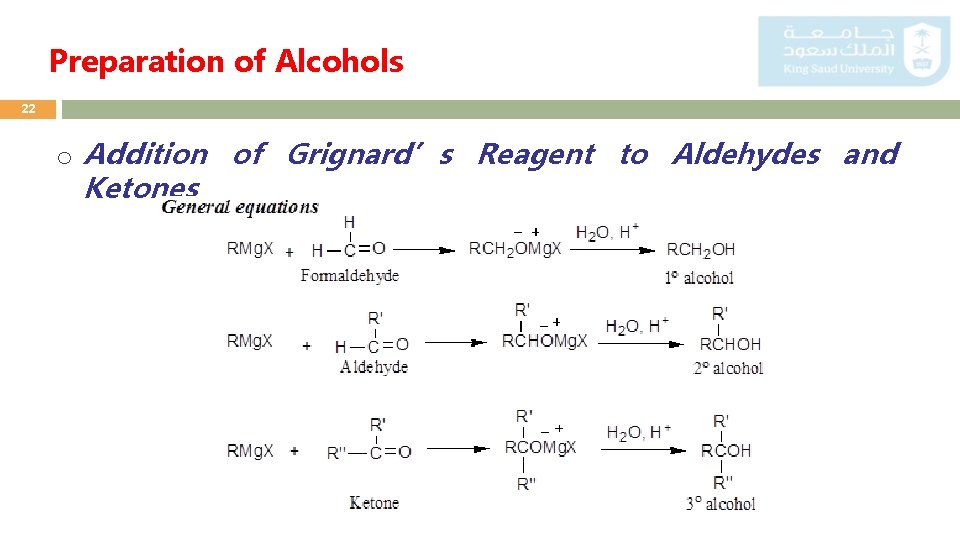
Preparation of Alcohols 22 o Addition of Grignard’s Reagent to Aldehydes and Ketones
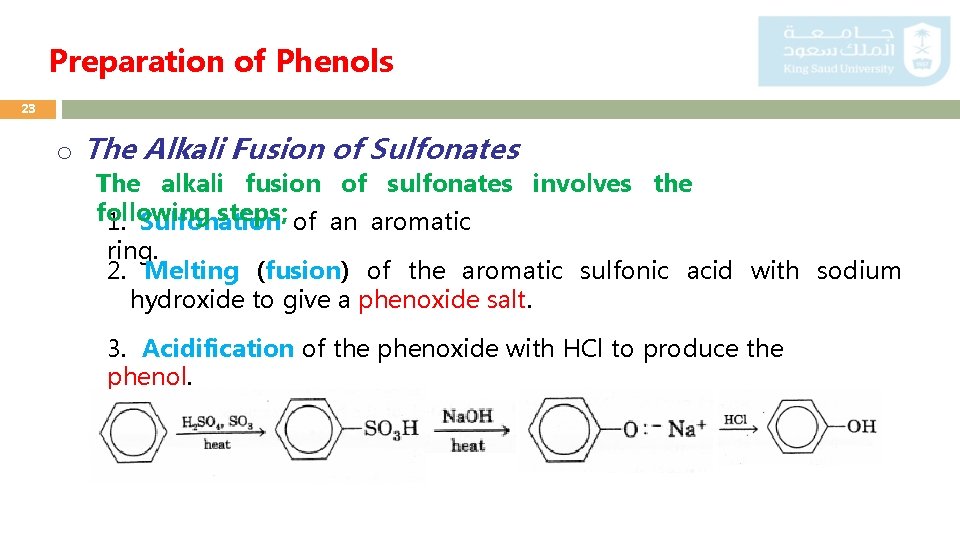
Preparation of Phenols 23 o The Alkali Fusion of Sulfonates The alkali fusion of sulfonates involves the following steps; of an aromatic 1. Sulfonation ring. 2. Melting (fusion) of the aromatic sulfonic acid with sodium hydroxide to give a phenoxide salt. 3. Acidification of the phenoxide with HCl to produce the phenol.
Uses of Alcohols and Phenols o Drinks – The “alcohol” in alcoholic drinks is simply ethanol. o As a fuel – Ethanol burns to give carbon dioxide and water and can be used as a fuel in its own right, or in mixtures with petrol (gasoline). o As a solvent – Ethanol is widely used as a solvent. It is relatively safe, and can be used to dissolve many organic compounds which are insoluble in water. It is used, for example, in many perfumes and cosmetics. o Isopropanol; rubbing alcohol, rapid evaporation, Antiseptic, more toxic than ethanol, but induces vomiting and used for manufacture of acetone. o Phenol is used for resins, and pharmacuticals.
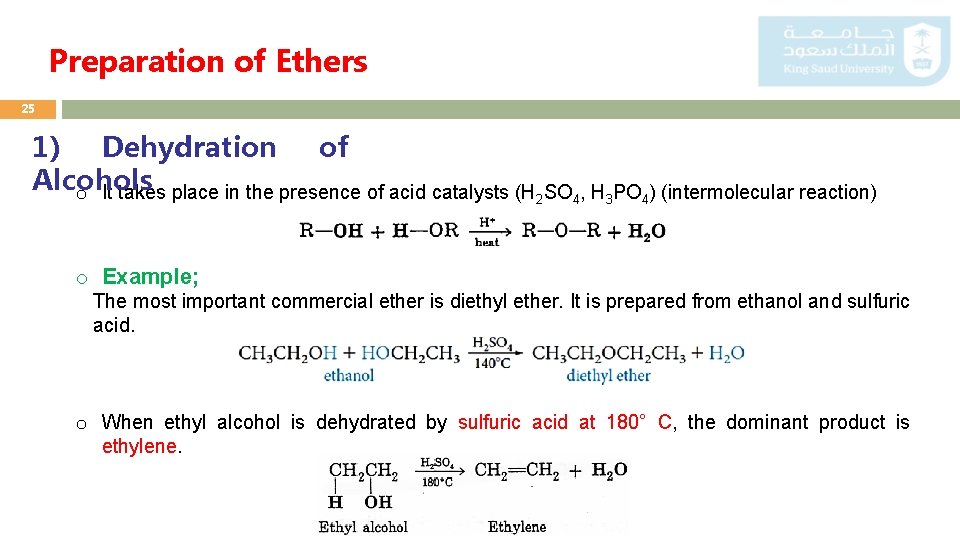
Preparation of Ethers 25 1) Dehydration of Alcohols o It takes place in the presence of acid catalysts (H 2 SO 4, H 3 PO 4) (intermolecular reaction) o Example; The most important commercial ether is diethyl ether. It is prepared from ethanol and sulfuric acid. o When ethyl alcohol is dehydrated by sulfuric acid at 180° C, the dominant product is ethylene.
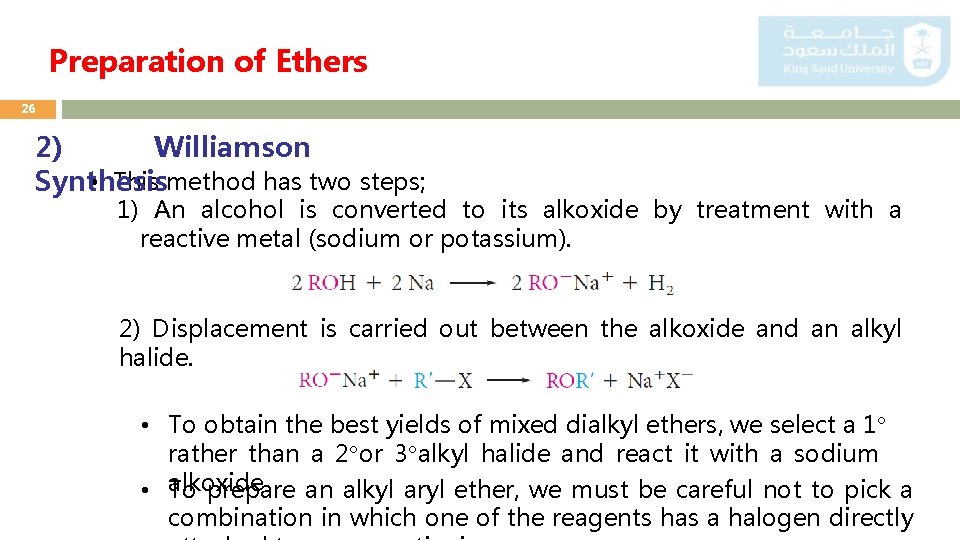
Preparation of Ethers 26 2) Williamson • This method has two steps; Synthesis 1) An alcohol is converted to its alkoxide by treatment with a reactive metal (sodium or potassium). 2) Displacement is carried out between the alkoxide and an alkyl halide. • To obtain the best yields of mixed dialkyl ethers, we select a 1 rather than a 2 or 3 alkyl halide and react it with a sodium • alkoxide To prepare an alkyl aryl ether, we must be careful not to pick a combination in which one of the reagents has a halogen directly
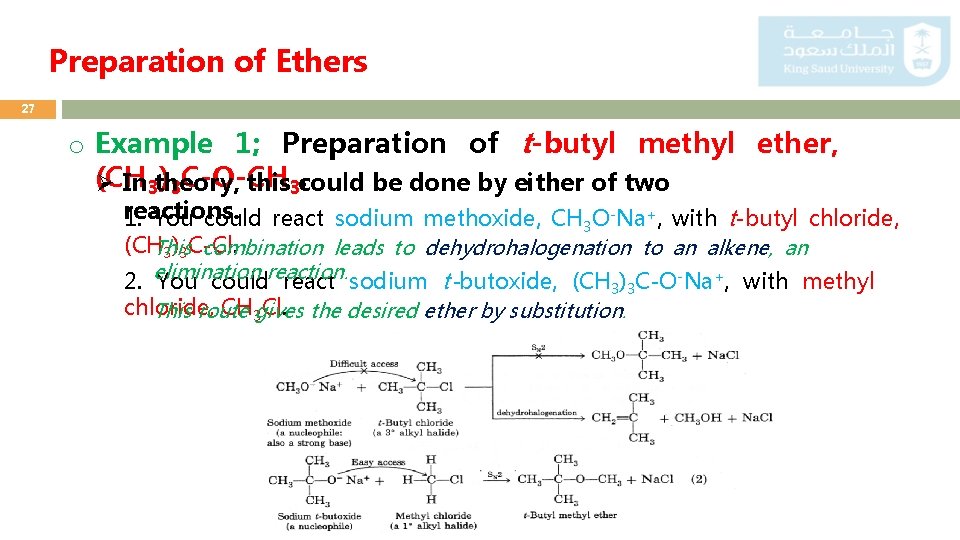
Preparation of Ethers 27 o Example 1; Preparation of t-butyl methyl ether, (CH )3 C-O-CH. Ø In 3 theory, this 3 could be done by either of two reactions. 1. You could react sodium methoxide, CH 3 O-Na+, with t-butyl chloride, (CHThis combination leads to dehydrohalogenation to an alkene, an 3)3 C-Cl. 2. elimination You couldreaction. react sodium t-butoxide, (CH ) C-O-Na+, with methyl 3 3 chloride, CH 3 gives Cl. the desired ether by substitution. This route
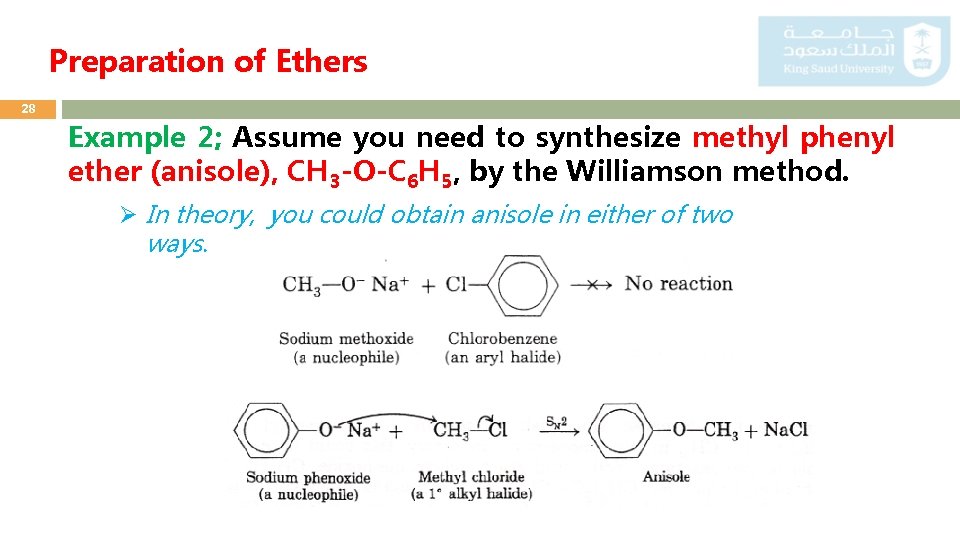
Preparation of Ethers 28 Example 2; Assume you need to synthesize methyl phenyl ether (anisole), CH 3 -O-C 6 H 5, by the Williamson method. Ø In theory, you could obtain anisole in either of two ways.
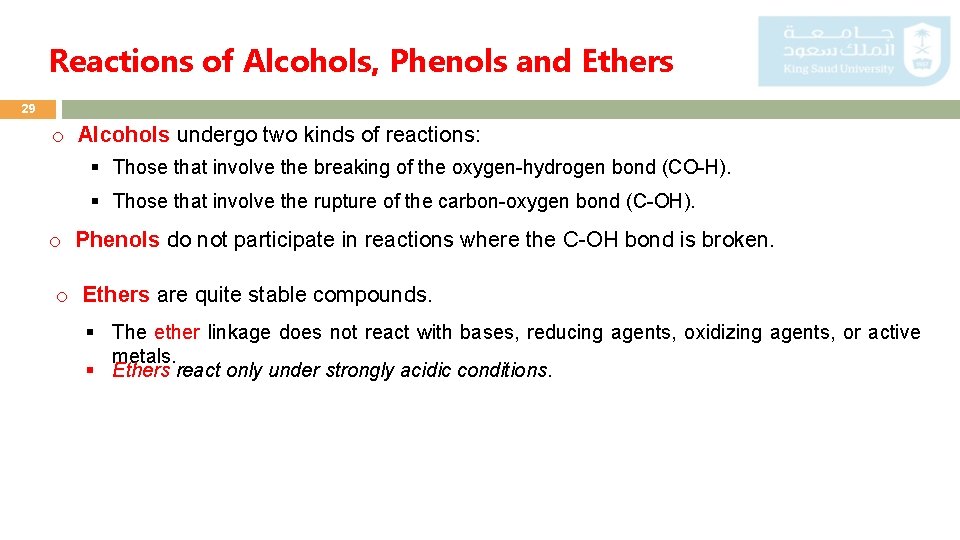
Reactions of Alcohols, Phenols and Ethers 29 o Alcohols undergo two kinds of reactions: § Those that involve the breaking of the oxygen-hydrogen bond (CO-H). § Those that involve the rupture of the carbon-oxygen bond (C-OH). o Phenols do not participate in reactions where the C-OH bond is broken. o Ethers are quite stable compounds. § The ether linkage does not react with bases, reducing agents, oxidizing agents, or active metals. § Ethers react only under strongly acidic conditions.
Reactions of Alcohols 30 A) Those that involve the breaking of the oxygen-hydrogen bond (CO-H). of Alcohols and Phenols as Acids: Salt 1) Reactions Formation.
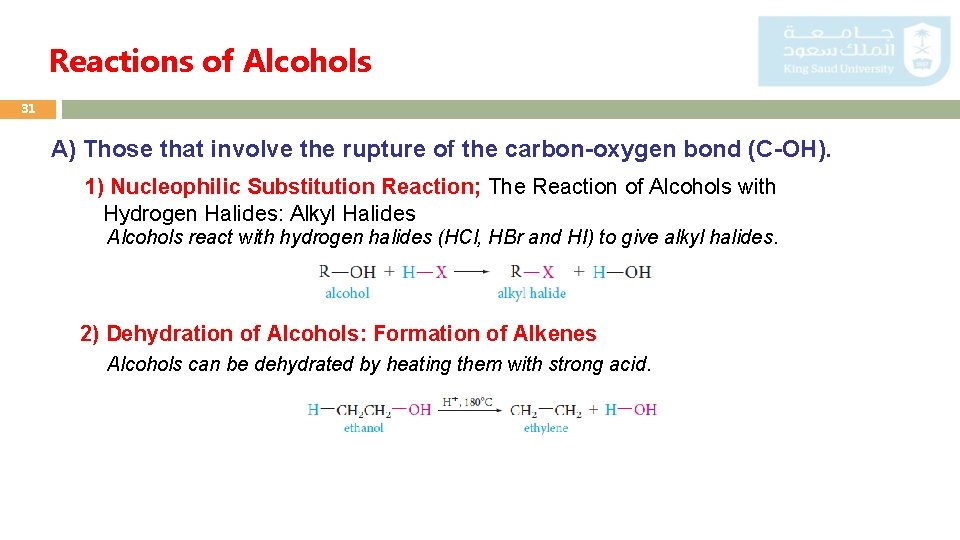
Reactions of Alcohols 31 A) Those that involve the rupture of the carbon-oxygen bond (C-OH). 1) Nucleophilic Substitution Reaction; The Reaction of Alcohols with Hydrogen Halides: Alkyl Halides Alcohols react with hydrogen halides (HCl, HBr and HI) to give alkyl halides. 2) Dehydration of Alcohols: Formation of Alkenes Alcohols can be dehydrated by heating them with strong acid.
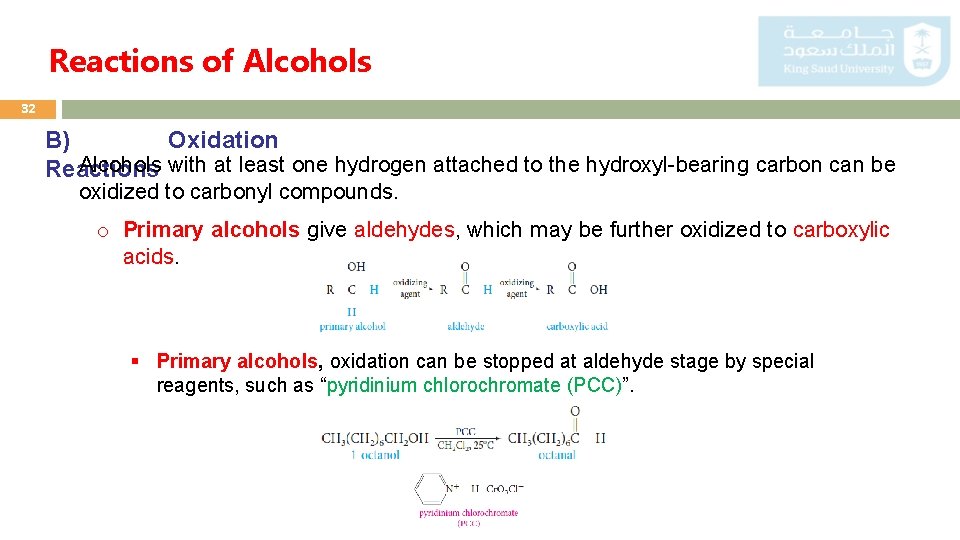
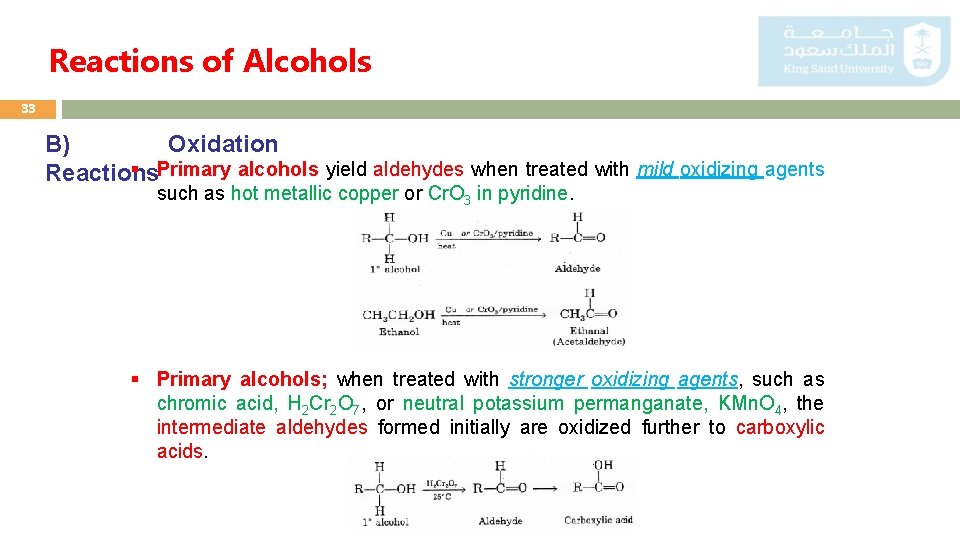
Reactions of Alcohols 32 B) Oxidation Alcohols with at least one hydrogen attached to the hydroxyl-bearing carbon can be Reactions oxidized to carbonyl compounds. o Primary alcohols give aldehydes, which may be further oxidized to carboxylic acids. § Primary alcohols, oxidation can be stopped at aldehyde stage by special reagents, such as “pyridinium chlorochromate (PCC)”.
Reactions of Alcohols 33 B) Oxidation § Primary alcohols yield aldehydes when treated with mild oxidizing agents Reactions such as hot metallic copper or Cr. O 3 in pyridine. § Primary alcohols; when treated with stronger oxidizing agents, such as chromic acid, H 2 Cr 2 O 7, or neutral potassium permanganate, KMn. O 4, the intermediate aldehydes formed initially are oxidized further to carboxylic acids.
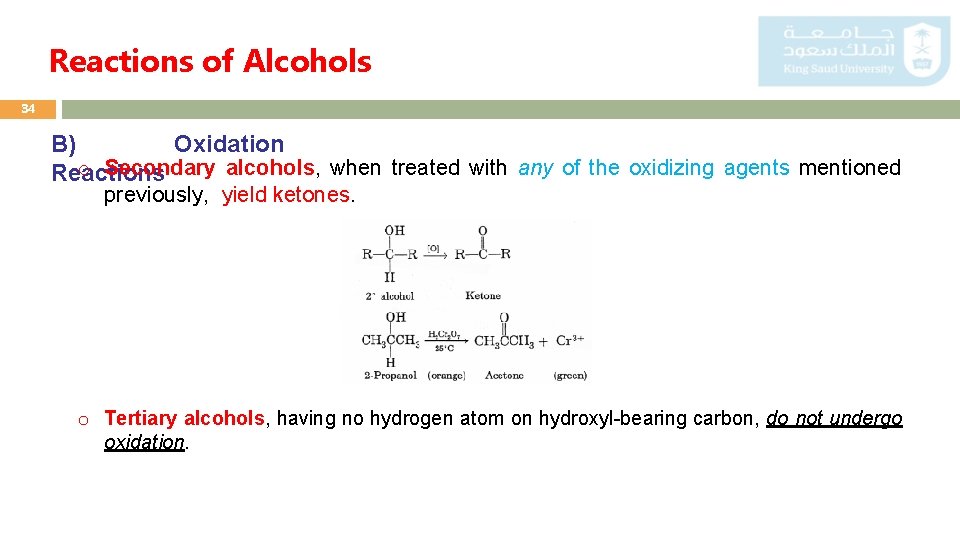
Reactions of Alcohols 34 B) Oxidation o Secondary alcohols, when treated with any of the oxidizing agents mentioned Reactions previously, yield ketones. o Tertiary alcohols, having no hydrogen atom on hydroxyl-bearing carbon, do not undergo oxidation.
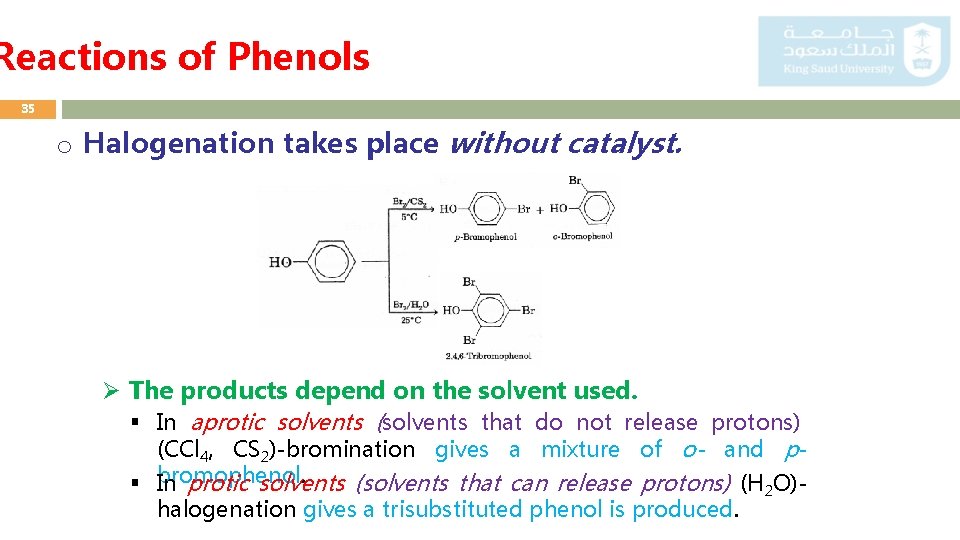
Reactions of Phenols 35 o Halogenation takes place without catalyst. Ø The products depend on the solvent used. § In aprotic solvents (solvents that do not release protons) (CCl 4, CS 2)-bromination gives a mixture of o- and p§ bromophenol. In protic solvents (solvents that can release protons) (H 2 O)halogenation gives a trisubstituted phenol is produced.
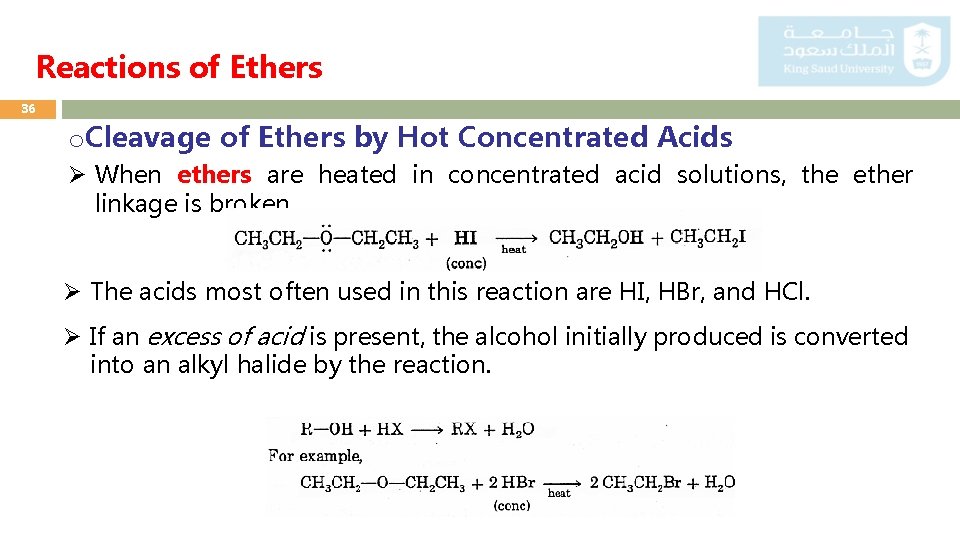
Reactions of Ethers 36 o. Cleavage of Ethers by Hot Concentrated Acids Ø When ethers are heated in concentrated acid solutions, the ether linkage is broken. Ø The acids most often used in this reaction are HI, HBr, and HCl. Ø If an excess of acid is present, the alcohol initially produced is converted into an alkyl halide by the reaction.
Uses of Ethers o Ether is used as a mild anesthetic and as a solvent in industries o It is used as an antiseptic to prevent infection when an injection is administered. o Dimethyl ether is used as refrigerant and as solvent at low temperature. o Diethyl ether is a common ingredient as an aesthesia in surgery. o Diethyl ether is common solvent for oils, gums, resins etc. o We use phenyl ether as a heat transfer medium because of its high boiling point.