
Fundamentals of Multiscale Fabrication Lecture 1 Introduction to
Fundamentals of Multiscale Fabrication Lecture 1 Introduction to multiscale fabrication: From historical background to current research Kahp-Yang Suh Associate Professor SNU MAE sky 4 u@snu. ac. kr Nano Fusion Technology Lab. Seoul National Univ. MAE
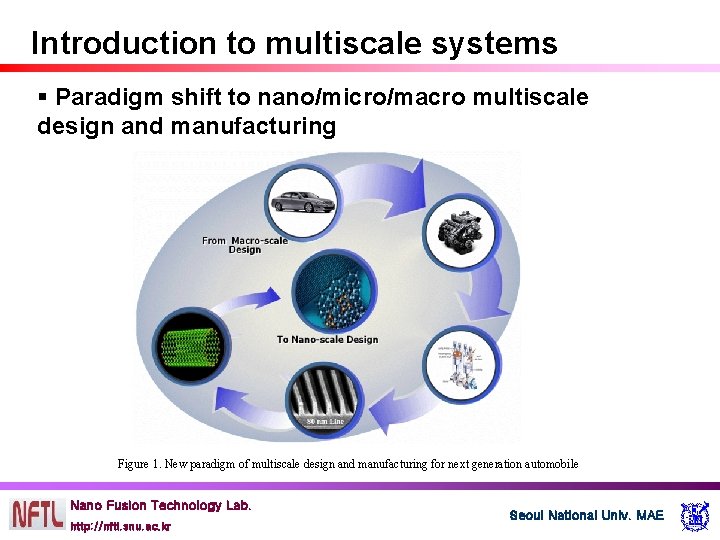
Introduction to multiscale systems § Paradigm shift to nano/micro/macro multiscale design and manufacturing Figure 1. New paradigm of multiscale design and manufacturing for next generation automobile Nano Fusion Technology Lab. http: //nftl. snu. ac. kr Seoul National Univ. MAE
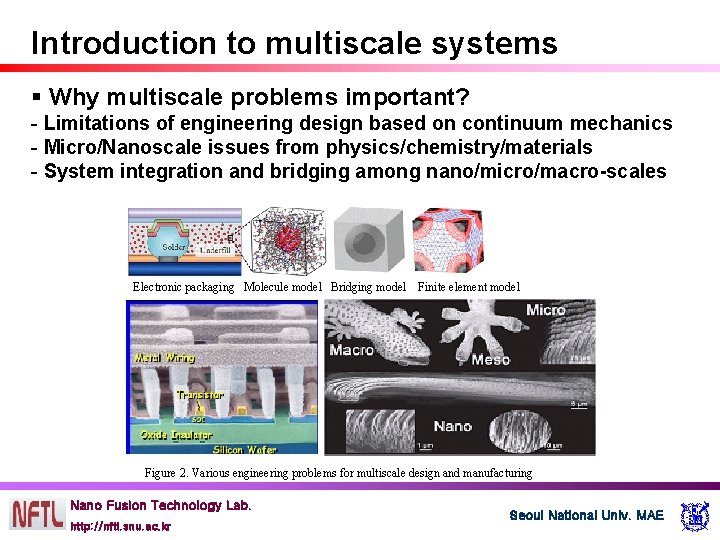
Introduction to multiscale systems § Why multiscale problems important? - Limitations of engineering design based on continuum mechanics - Micro/Nanoscale issues from physics/chemistry/materials - System integration and bridging among nano/micro/macro-scales Electronic packaging Molecule model Bridging model Finite element model Figure 2. Various engineering problems for multiscale design and manufacturing Nano Fusion Technology Lab. http: //nftl. snu. ac. kr Seoul National Univ. MAE
Introduction to multiscale systems § Recent trends - Academic interests explode: 44% of journal papers have been published for the last three years during 2000 - 2008. Among papers published during 2000 - 2008, mechanical engineering takes up more than 60%! - Many engineering research institutes: Center for integrative Multiscale Modeling and Simulation (Cal. Tech) Multiscale Science and Engineering Center (Rensselaer Polytechnic Institute) Center for Multiscale Modeling for Engineering Materials (Carnegie Mellon) Multiscale Engineering Classes at Stanford & MIT ex) MIT open course ware: http: //ocw. mit. edu/Ocw. Web/Mechanical-Engineering/2 -76 Fall- 2004/Course. Home/index. htm Center for Multiscale Mechanics and Mechanical Systems (Keio Univ) Department of Multiscale Physics (Delft Univ) Center for Multiscale Design, WCU program, MAE, Seoul National University Biomimetic Mechanical Systems, IAMD, Seoul National University Nano Fusion Technology Lab. http: //nftl. snu. ac. kr Seoul National Univ. MAE
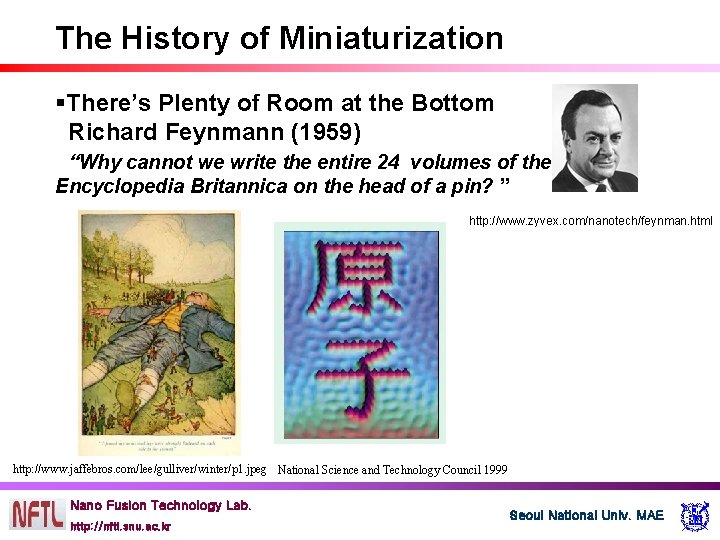
The History of Miniaturization §There’s Plenty of Room at the Bottom Richard Feynmann (1959) “Why cannot we write the entire 24 volumes of the Encyclopedia Britannica on the head of a pin? ” http: //www. zyvex. com/nanotech/feynman. html http: //www. jaffebros. com/lee/gulliver/winter/p 1. jpeg National Science and Technology Council 1999 Nano Fusion Technology Lab. http: //nftl. snu. ac. kr Seoul National Univ. MAE
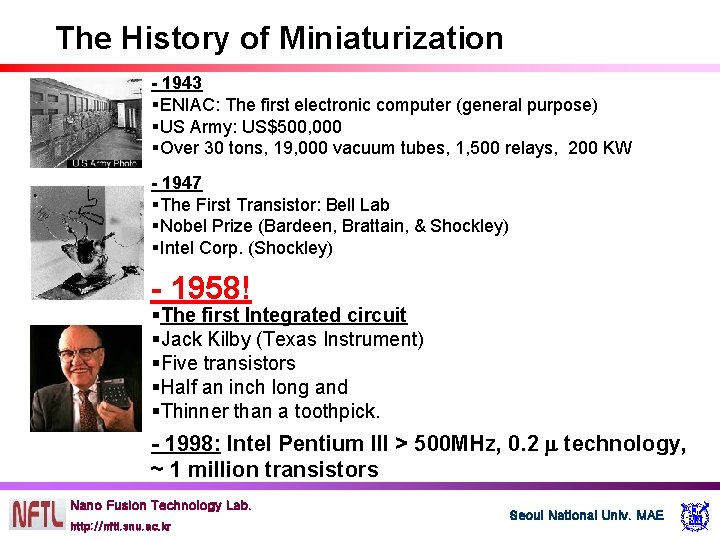
The History of Miniaturization - 1943 §ENIAC: The first electronic computer (general purpose) §US Army: US$500, 000 §Over 30 tons, 19, 000 vacuum tubes, 1, 500 relays, 200 KW - 1947 §The First Transistor: Bell Lab §Nobel Prize (Bardeen, Brattain, & Shockley) §Intel Corp. (Shockley) - 1958! §The first Integrated circuit §Jack Kilby (Texas Instrument) §Five transistors §Half an inch long and §Thinner than a toothpick. - 1998: Intel Pentium III > 500 MHz, 0. 2 technology, ~ 1 million transistors Nano Fusion Technology Lab. http: //nftl. snu. ac. kr Seoul National Univ. MAE
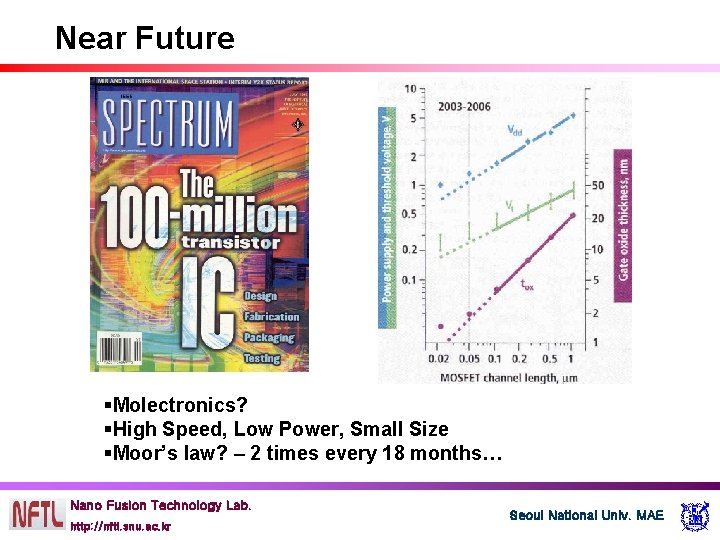
Near Future §Molectronics? §High Speed, Low Power, Small Size §Moor’s law? – 2 times every 18 months… Nano Fusion Technology Lab. http: //nftl. snu. ac. kr Seoul National Univ. MAE
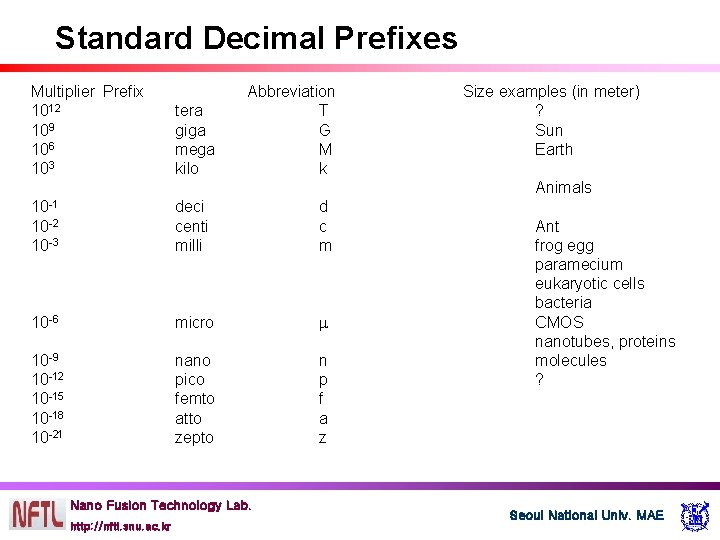
Standard Decimal Prefixes Multiplier Prefix 1012 109 106 103 tera giga mega kilo Abbreviation T G M k Size examples (in meter) ? Sun Earth Animals 10 -1 10 -3 deci centi milli d c m 10 -6 micro 10 -9 10 -12 10 -15 10 -18 10 -21 nano pico femto atto zepto n p f a z 10 -2 Nano Fusion Technology Lab. http: //nftl. snu. ac. kr Ant frog egg paramecium eukaryotic cells bacteria CMOS nanotubes, proteins molecules ? Seoul National Univ. MAE
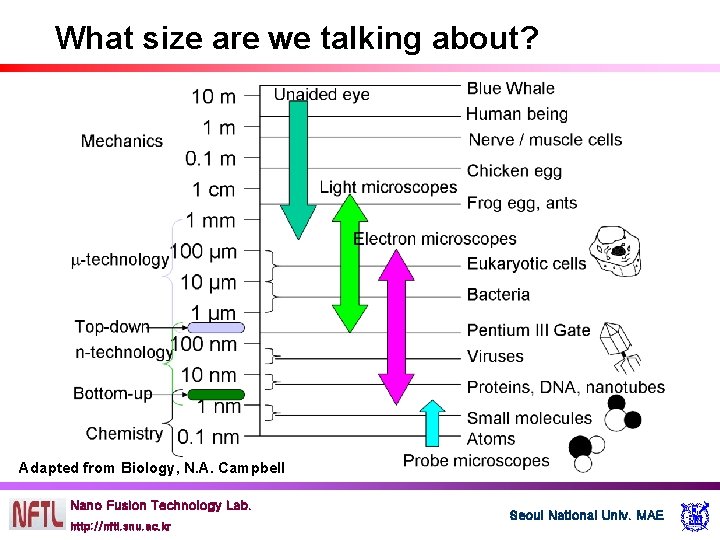
What size are we talking about? Adapted from Biology, N. A. Campbell Nano Fusion Technology Lab. http: //nftl. snu. ac. kr Seoul National Univ. MAE
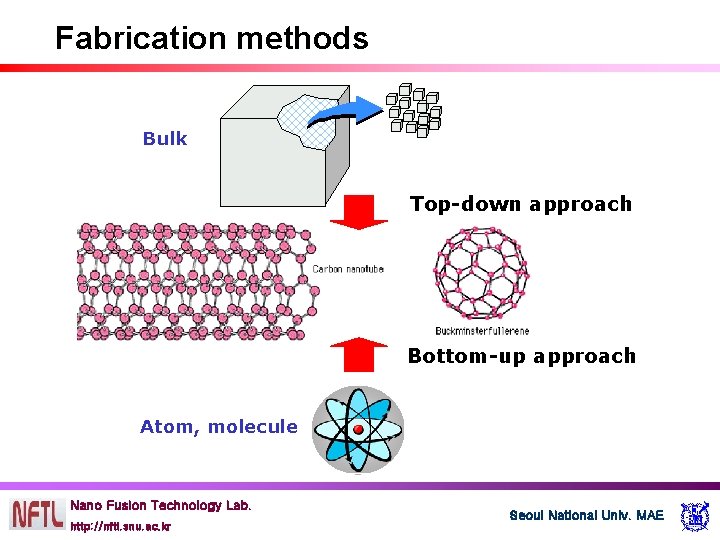
Fabrication methods Bulk Top-down approach Bottom-up approach Atom, molecule Nano Fusion Technology Lab. http: //nftl. snu. ac. kr Seoul National Univ. MAE
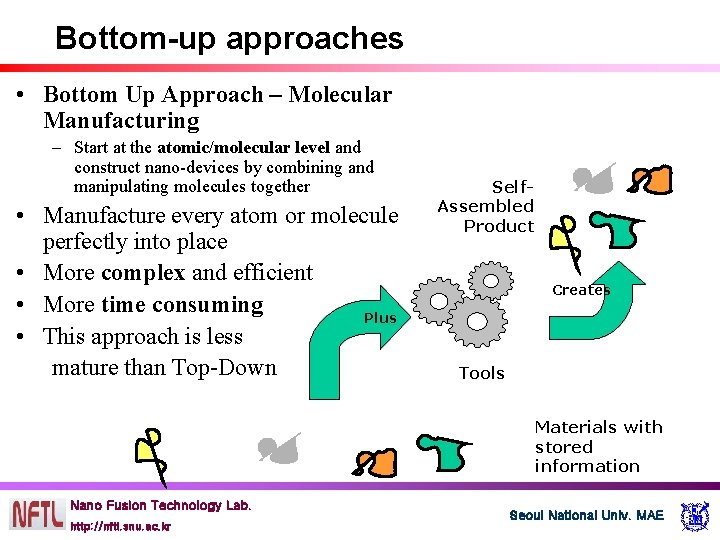
Bottom-up approaches • Bottom Up Approach – Molecular Manufacturing – Start at the atomic/molecular level and construct nano-devices by combining and manipulating molecules together • Manufacture every atom or molecule perfectly into place • More complex and efficient • More time consuming Plus • This approach is less mature than Top-Down Self. Assembled Product Creates Tools Materials with stored information Nano Fusion Technology Lab. http: //nftl. snu. ac. kr Seoul National Univ. MAE
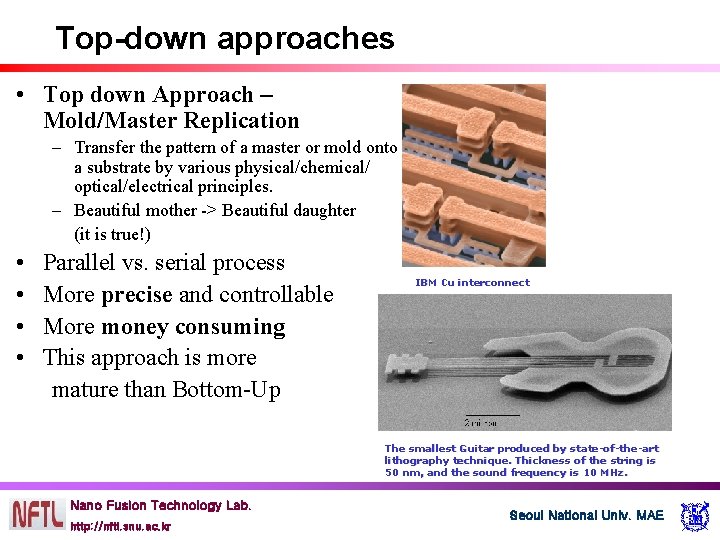
Top-down approaches • Top down Approach – Mold/Master Replication – Transfer the pattern of a master or mold onto a substrate by various physical/chemical/ optical/electrical principles. – Beautiful mother -> Beautiful daughter (it is true!) • • Parallel vs. serial process More precise and controllable More money consuming This approach is more mature than Bottom-Up IBM Cu interconnect The smallest Guitar produced by state-of-the-art lithography technique. Thickness of the string is 50 nm, and the sound frequency is 10 MHz. Nano Fusion Technology Lab. http: //nftl. snu. ac. kr Seoul National Univ. MAE
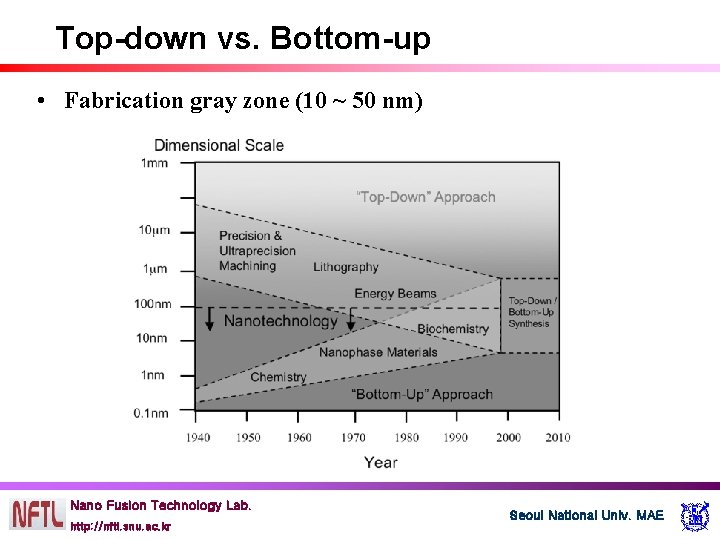
Top-down vs. Bottom-up • Fabrication gray zone (10 ~ 50 nm) Nano Fusion Technology Lab. http: //nftl. snu. ac. kr Seoul National Univ. MAE
- Slides: 13