
Fundamentals of Microelectronics CH 1 CH 2 CH



- Slides: 42
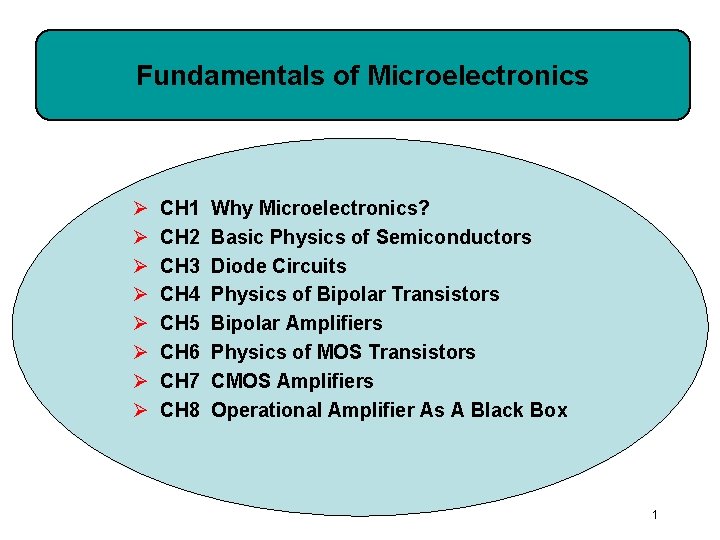
Fundamentals of Microelectronics Ø Ø Ø Ø CH 1 CH 2 CH 3 CH 4 CH 5 CH 6 CH 7 CH 8 Why Microelectronics? Basic Physics of Semiconductors Diode Circuits Physics of Bipolar Transistors Bipolar Amplifiers Physics of MOS Transistors CMOS Amplifiers Operational Amplifier As A Black Box 1
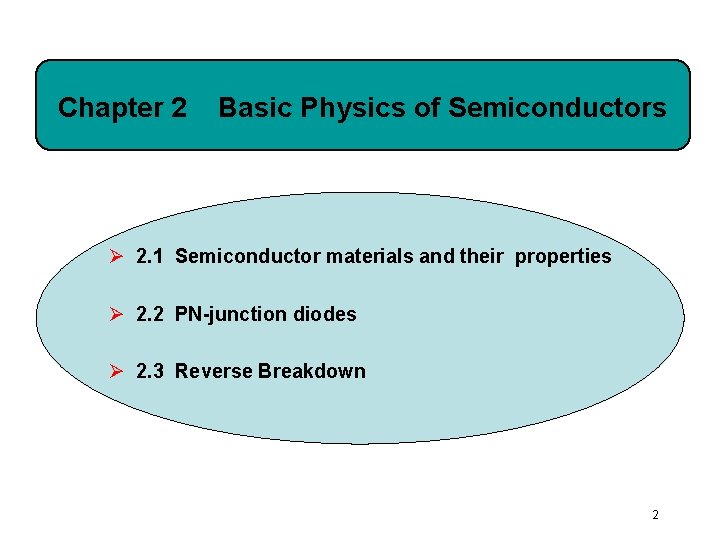
Chapter 2 Basic Physics of Semiconductors Ø 2. 1 Semiconductor materials and their properties Ø 2. 2 PN-junction diodes Ø 2. 3 Reverse Breakdown 2
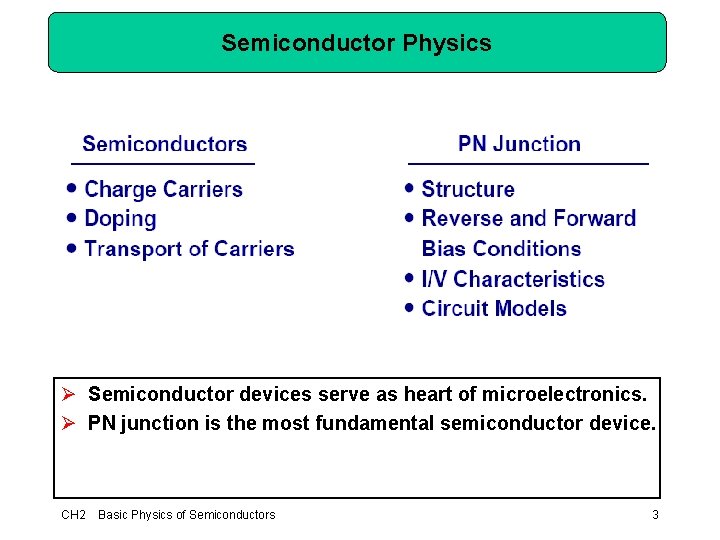
Semiconductor Physics Ø Semiconductor devices serve as heart of microelectronics. Ø PN junction is the most fundamental semiconductor device. CH 2 Basic Physics of Semiconductors 3
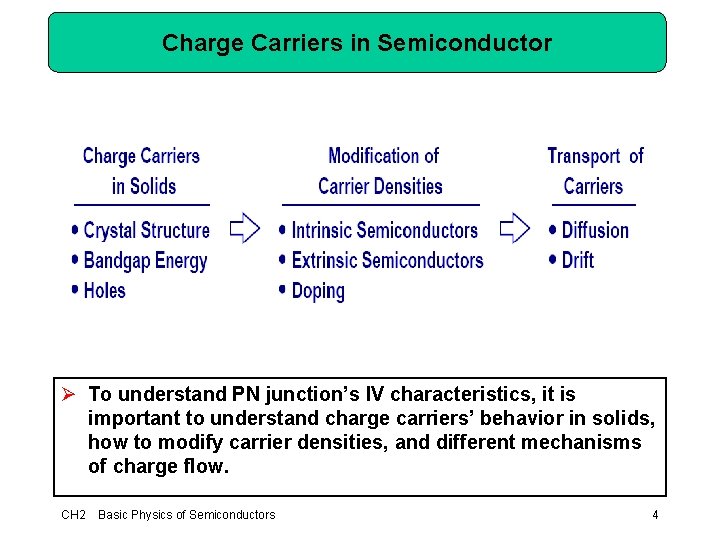
Charge Carriers in Semiconductor Ø To understand PN junction’s IV characteristics, it is important to understand charge carriers’ behavior in solids, how to modify carrier densities, and different mechanisms of charge flow. CH 2 Basic Physics of Semiconductors 4
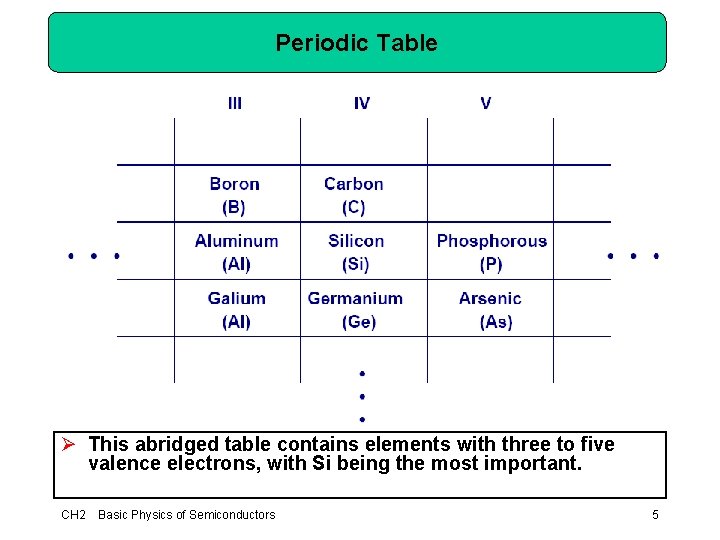
Periodic Table Ø This abridged table contains elements with three to five valence electrons, with Si being the most important. CH 2 Basic Physics of Semiconductors 5
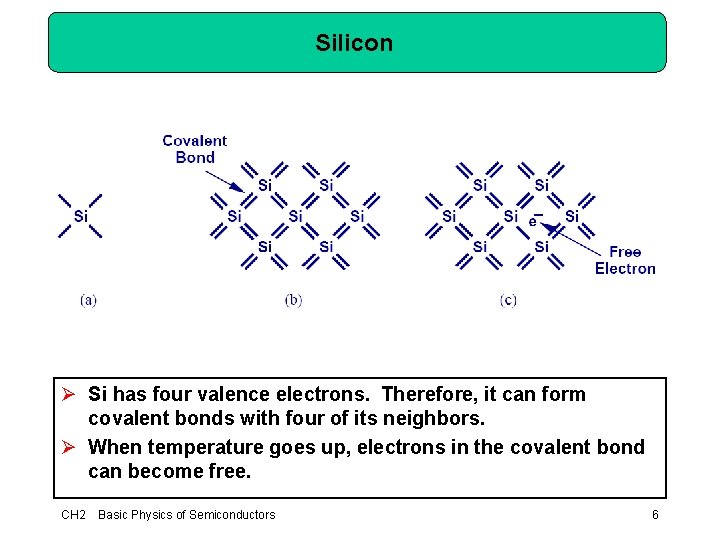
Silicon Ø Si has four valence electrons. Therefore, it can form covalent bonds with four of its neighbors. Ø When temperature goes up, electrons in the covalent bond can become free. CH 2 Basic Physics of Semiconductors 6
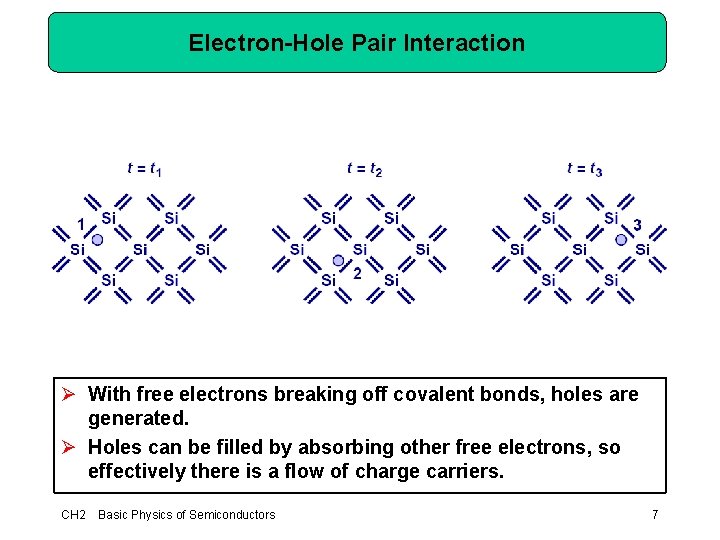
Electron-Hole Pair Interaction Ø With free electrons breaking off covalent bonds, holes are generated. Ø Holes can be filled by absorbing other free electrons, so effectively there is a flow of charge carriers. CH 2 Basic Physics of Semiconductors 7
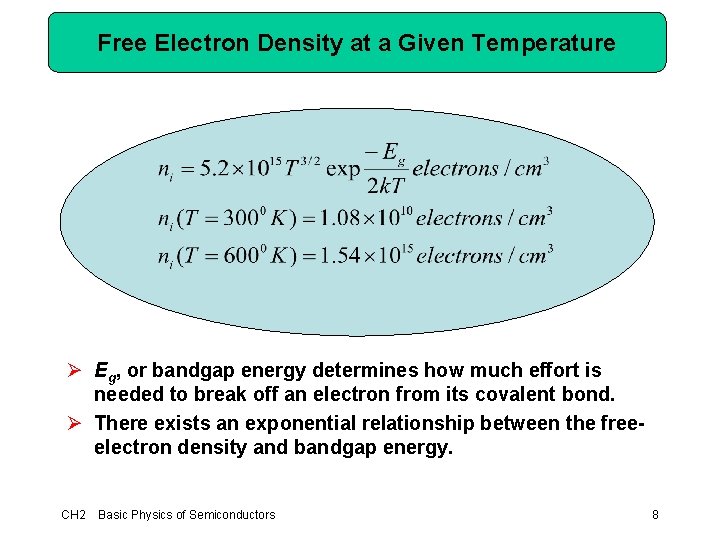
Free Electron Density at a Given Temperature Ø Eg, or bandgap energy determines how much effort is needed to break off an electron from its covalent bond. Ø There exists an exponential relationship between the freeelectron density and bandgap energy. CH 2 Basic Physics of Semiconductors 8
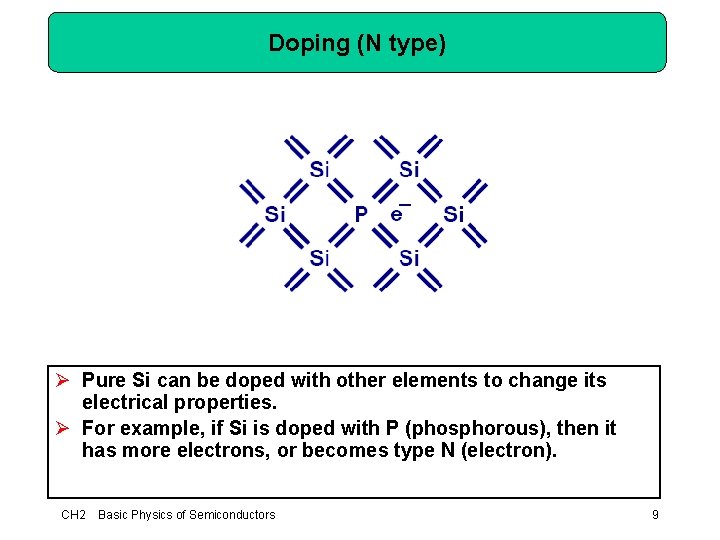
Doping (N type) Ø Pure Si can be doped with other elements to change its electrical properties. Ø For example, if Si is doped with P (phosphorous), then it has more electrons, or becomes type N (electron). CH 2 Basic Physics of Semiconductors 9
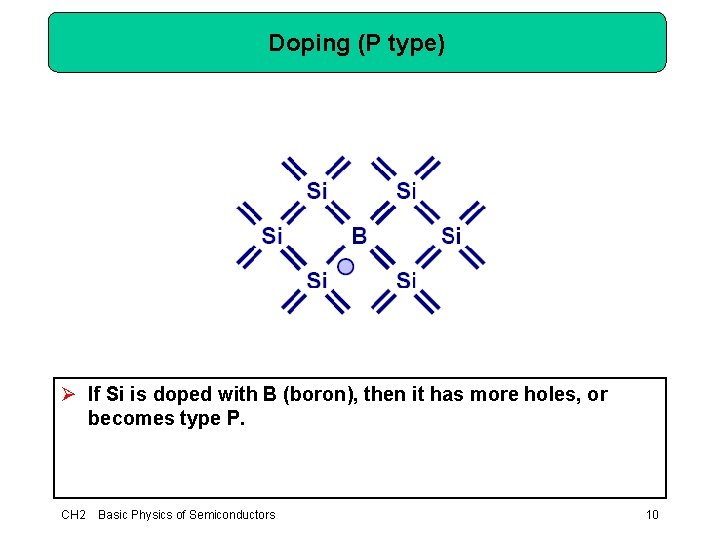
Doping (P type) Ø If Si is doped with B (boron), then it has more holes, or becomes type P. CH 2 Basic Physics of Semiconductors 10
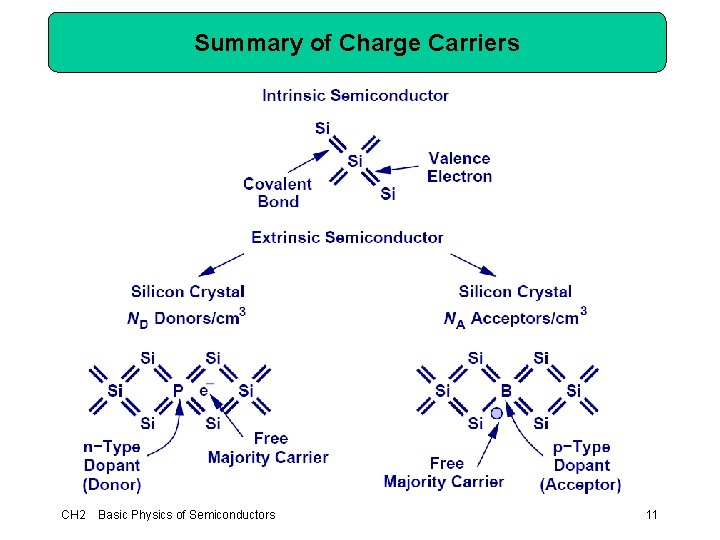
Summary of Charge Carriers CH 2 Basic Physics of Semiconductors 11
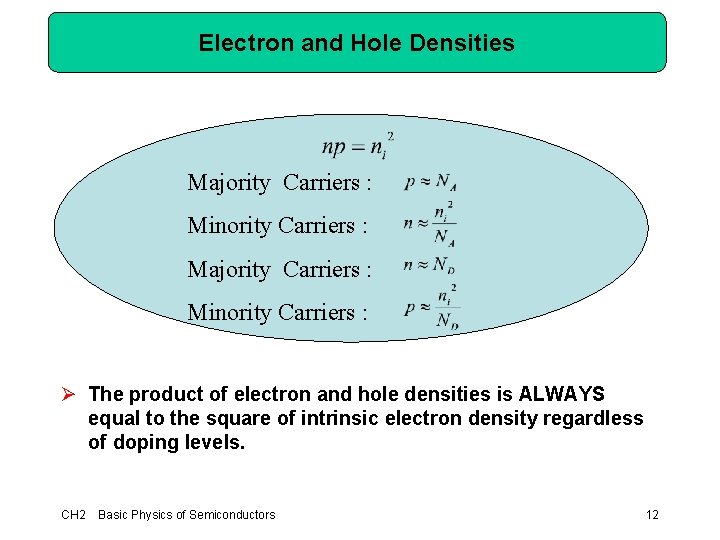
Electron and Hole Densities Majority Carriers : Minority Carriers : Ø The product of electron and hole densities is ALWAYS equal to the square of intrinsic electron density regardless of doping levels. CH 2 Basic Physics of Semiconductors 12
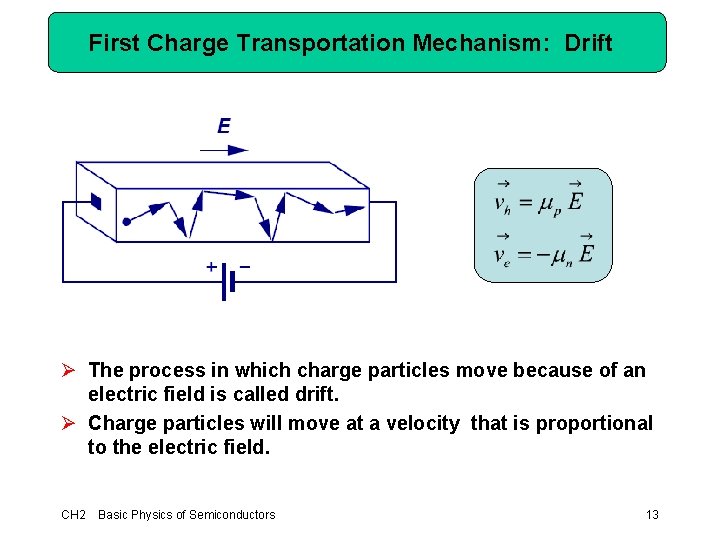
First Charge Transportation Mechanism: Drift Ø The process in which charge particles move because of an electric field is called drift. Ø Charge particles will move at a velocity that is proportional to the electric field. CH 2 Basic Physics of Semiconductors 13
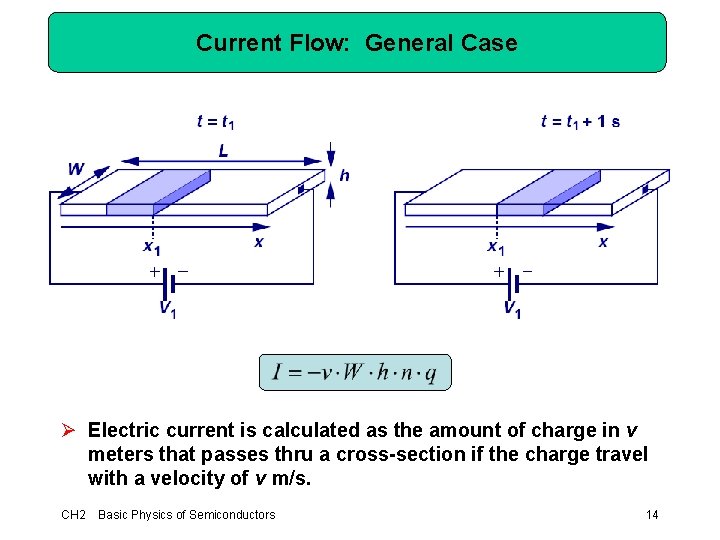
Current Flow: General Case Ø Electric current is calculated as the amount of charge in v meters that passes thru a cross-section if the charge travel with a velocity of v m/s. CH 2 Basic Physics of Semiconductors 14
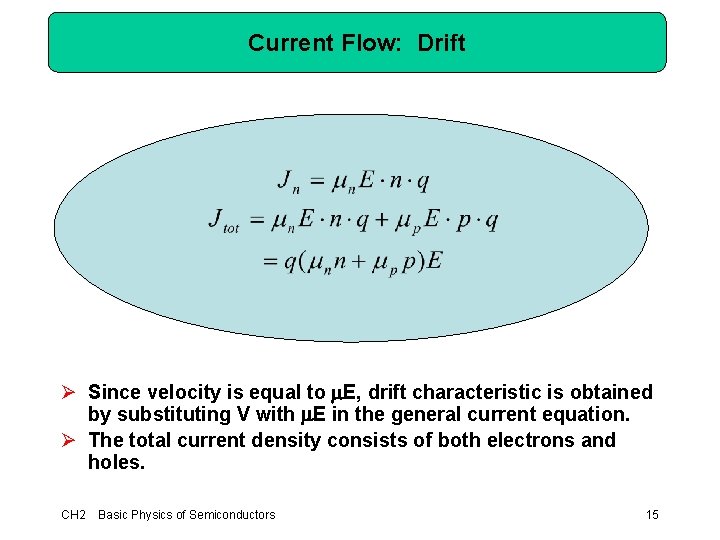
Current Flow: Drift Ø Since velocity is equal to E, drift characteristic is obtained by substituting V with E in the general current equation. Ø The total current density consists of both electrons and holes. CH 2 Basic Physics of Semiconductors 15
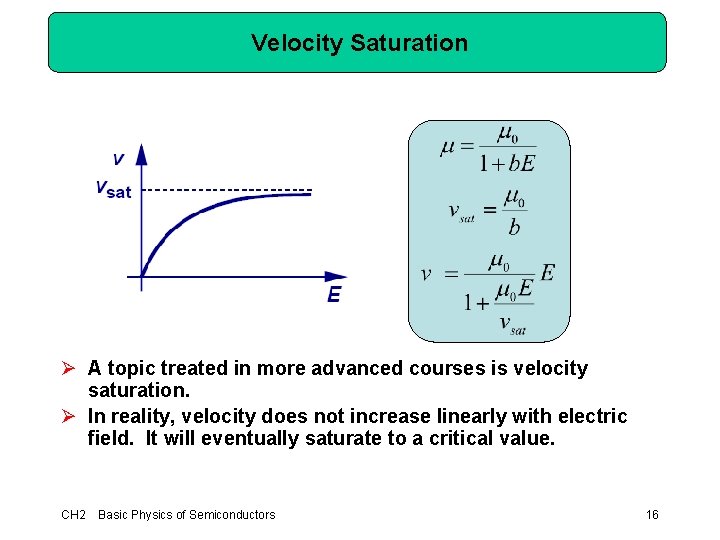
Velocity Saturation Ø A topic treated in more advanced courses is velocity saturation. Ø In reality, velocity does not increase linearly with electric field. It will eventually saturate to a critical value. CH 2 Basic Physics of Semiconductors 16
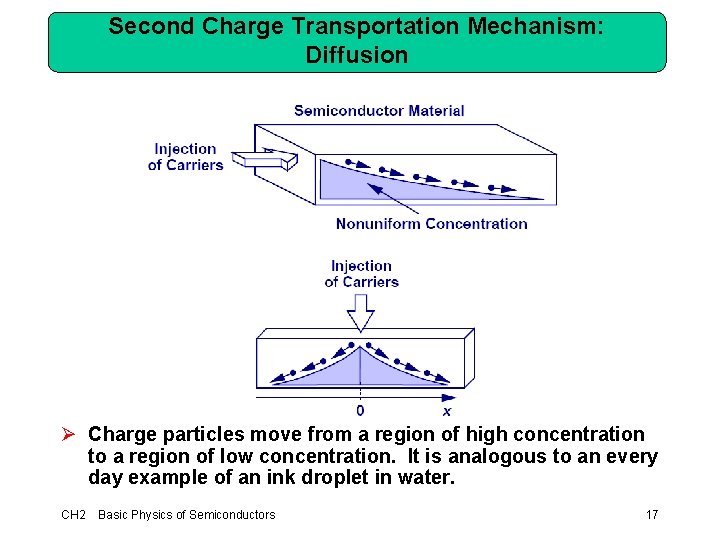
Second Charge Transportation Mechanism: Diffusion Ø Charge particles move from a region of high concentration to a region of low concentration. It is analogous to an every day example of an ink droplet in water. CH 2 Basic Physics of Semiconductors 17
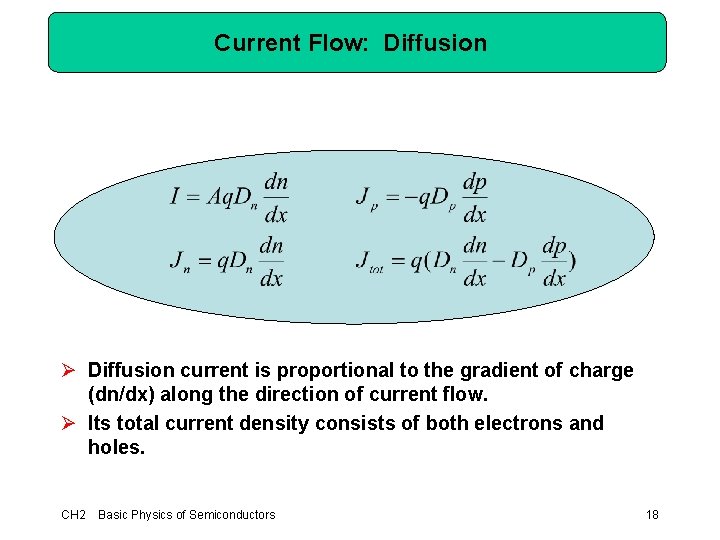
Current Flow: Diffusion Ø Diffusion current is proportional to the gradient of charge (dn/dx) along the direction of current flow. Ø Its total current density consists of both electrons and holes. CH 2 Basic Physics of Semiconductors 18
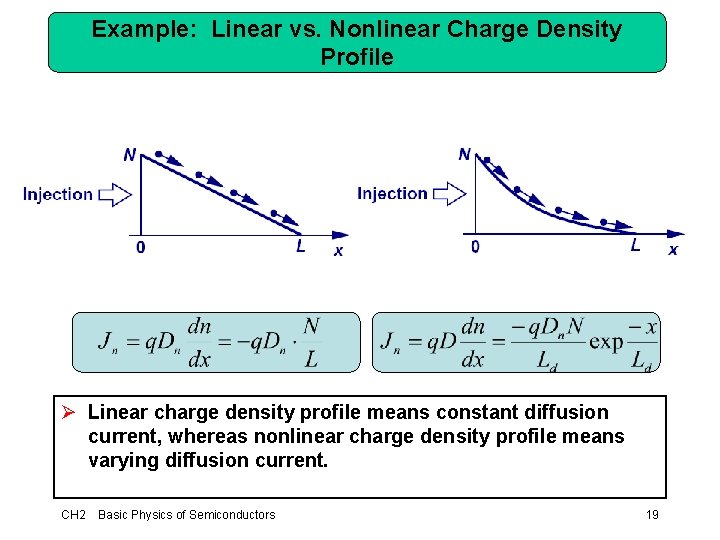
Example: Linear vs. Nonlinear Charge Density Profile Ø Linear charge density profile means constant diffusion current, whereas nonlinear charge density profile means varying diffusion current. CH 2 Basic Physics of Semiconductors 19
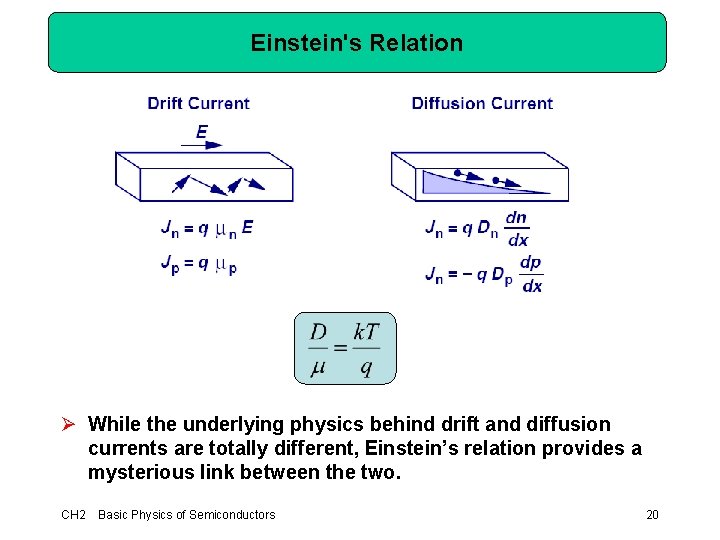
Einstein's Relation Ø While the underlying physics behind drift and diffusion currents are totally different, Einstein’s relation provides a mysterious link between the two. CH 2 Basic Physics of Semiconductors 20
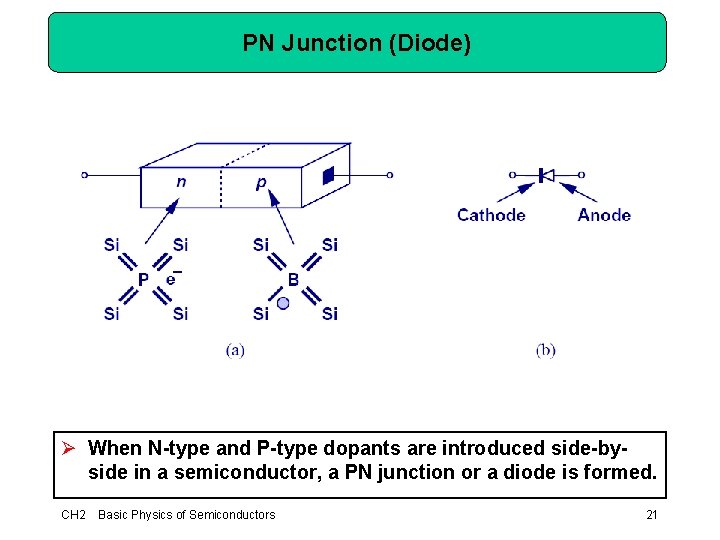
PN Junction (Diode) Ø When N-type and P-type dopants are introduced side-byside in a semiconductor, a PN junction or a diode is formed. CH 2 Basic Physics of Semiconductors 21
Diode’s Three Operation Regions Ø In order to understand the operation of a diode, it is necessary to study its three operation regions: equilibrium, reverse bias, and forward bias. CH 2 Basic Physics of Semiconductors 22
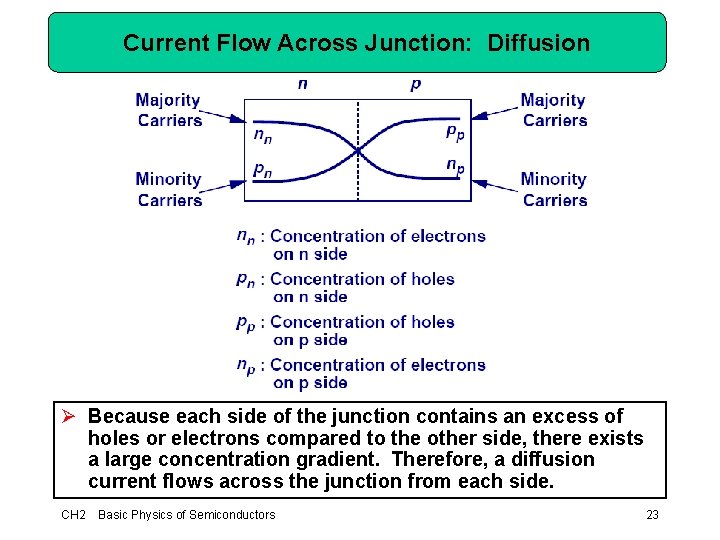
Current Flow Across Junction: Diffusion Ø Because each side of the junction contains an excess of holes or electrons compared to the other side, there exists a large concentration gradient. Therefore, a diffusion current flows across the junction from each side. CH 2 Basic Physics of Semiconductors 23
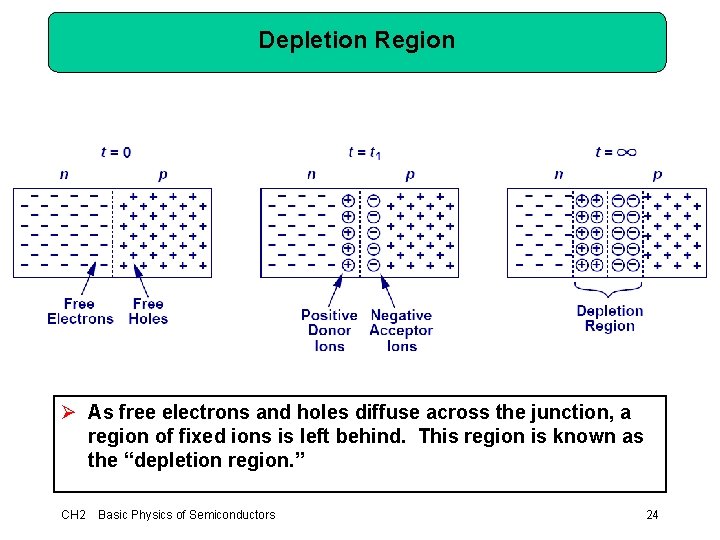
Depletion Region Ø As free electrons and holes diffuse across the junction, a region of fixed ions is left behind. This region is known as the “depletion region. ” CH 2 Basic Physics of Semiconductors 24
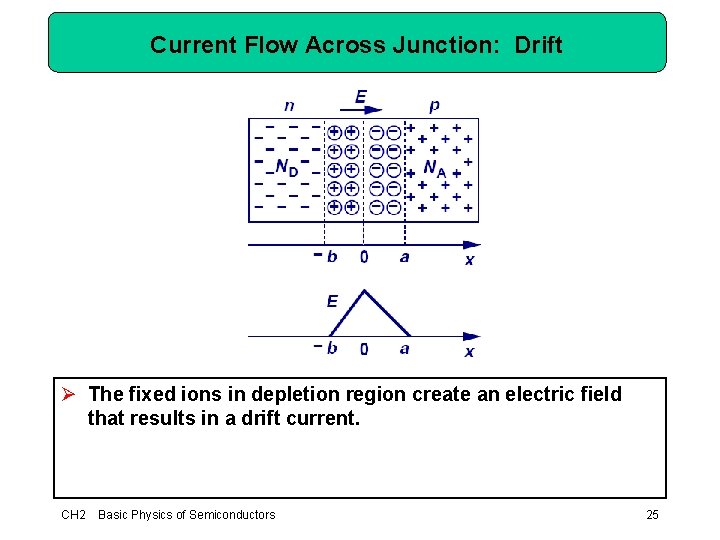
Current Flow Across Junction: Drift Ø The fixed ions in depletion region create an electric field that results in a drift current. CH 2 Basic Physics of Semiconductors 25
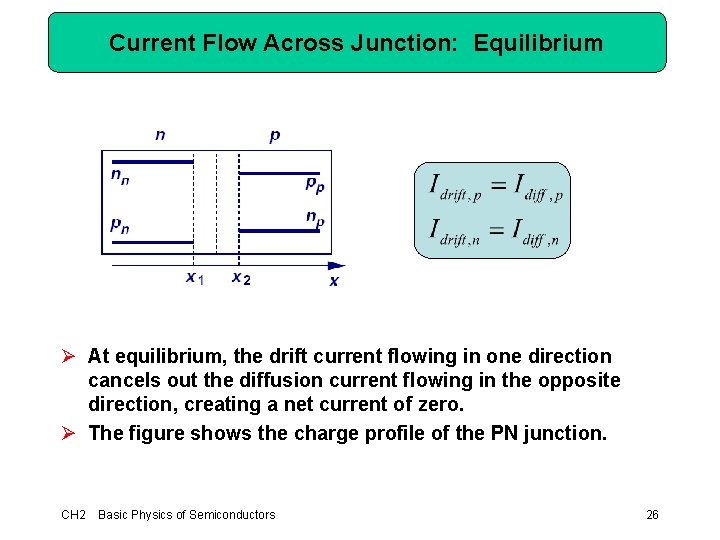
Current Flow Across Junction: Equilibrium Ø At equilibrium, the drift current flowing in one direction cancels out the diffusion current flowing in the opposite direction, creating a net current of zero. Ø The figure shows the charge profile of the PN junction. CH 2 Basic Physics of Semiconductors 26
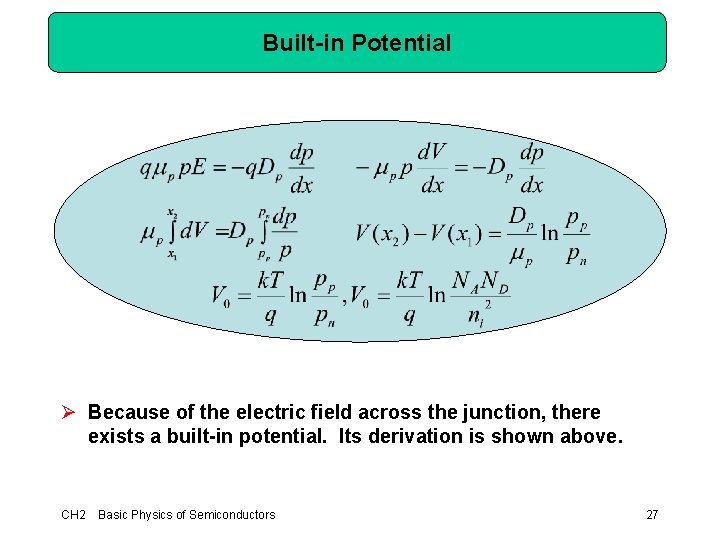
Built-in Potential Ø Because of the electric field across the junction, there exists a built-in potential. Its derivation is shown above. CH 2 Basic Physics of Semiconductors 27
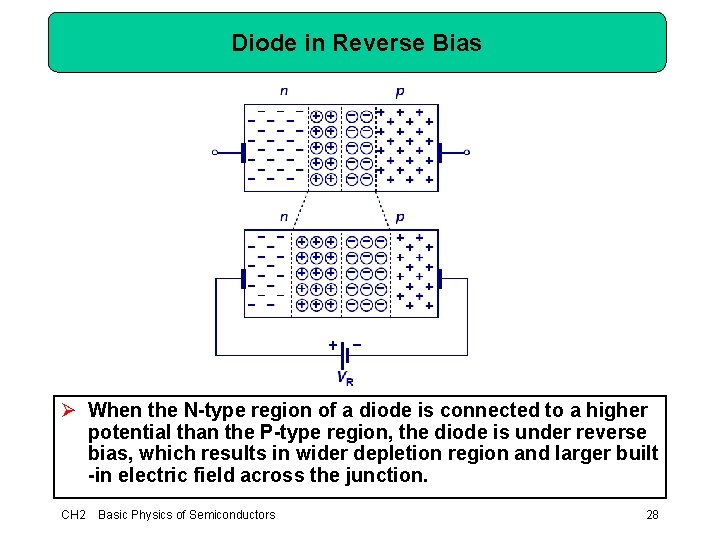
Diode in Reverse Bias Ø When the N-type region of a diode is connected to a higher potential than the P-type region, the diode is under reverse bias, which results in wider depletion region and larger built -in electric field across the junction. CH 2 Basic Physics of Semiconductors 28
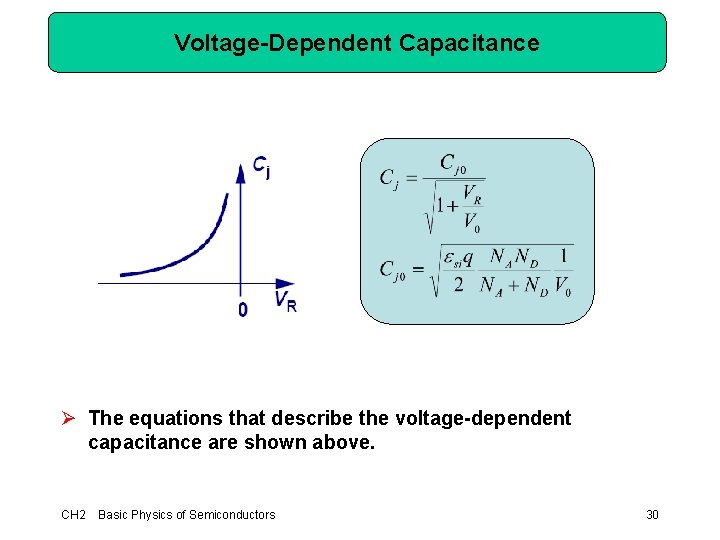
Reverse Biased Diode’s Application: Voltage. Dependent Capacitor Ø The PN junction can be viewed as a capacitor. By varying VR, the depletion width changes, changing its capacitance value; therefore, the PN junction is actually a voltagedependent capacitor. CH 2 Basic Physics of Semiconductors 29
Voltage-Dependent Capacitance Ø The equations that describe the voltage-dependent capacitance are shown above. CH 2 Basic Physics of Semiconductors 30
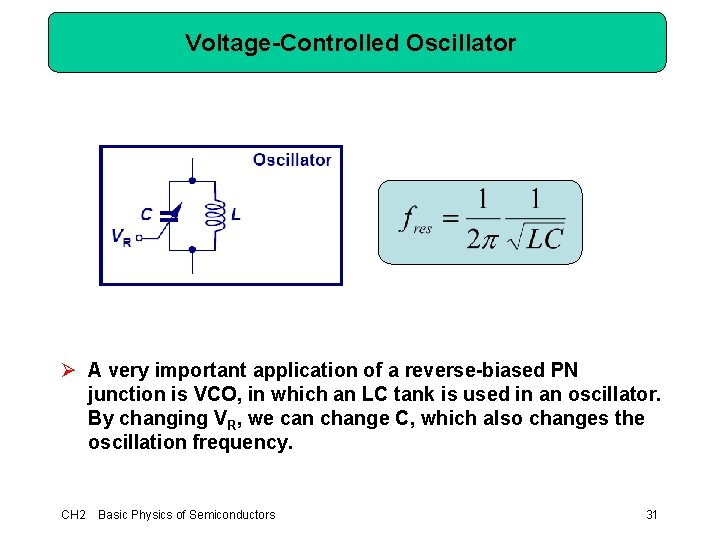
Voltage-Controlled Oscillator Ø A very important application of a reverse-biased PN junction is VCO, in which an LC tank is used in an oscillator. By changing VR, we can change C, which also changes the oscillation frequency. CH 2 Basic Physics of Semiconductors 31
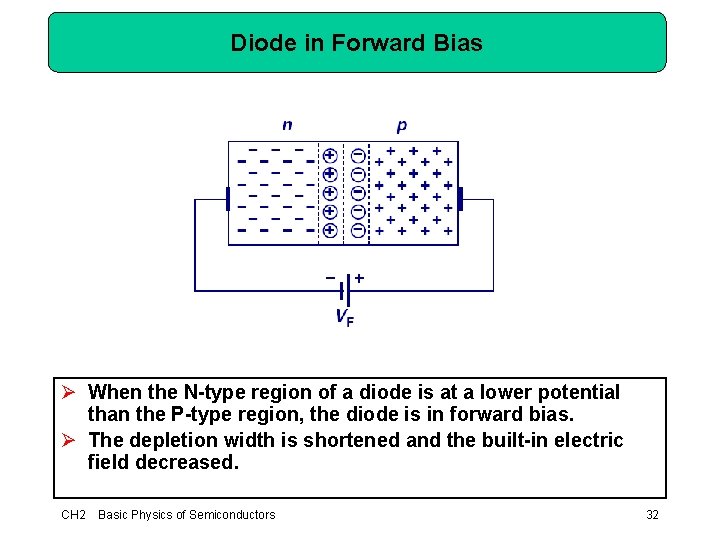
Diode in Forward Bias Ø When the N-type region of a diode is at a lower potential than the P-type region, the diode is in forward bias. Ø The depletion width is shortened and the built-in electric field decreased. CH 2 Basic Physics of Semiconductors 32
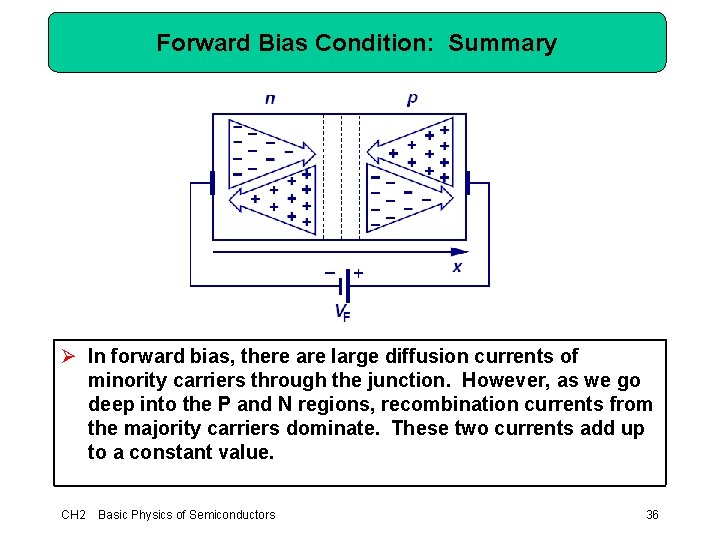
Minority Carrier Profile in Forward Bias Ø Under forward bias, minority carriers in each region increase due to the lowering of built-in field/potential. Therefore, diffusion currents increase to supply these minority carriers. CH 2 Basic Physics of Semiconductors 33
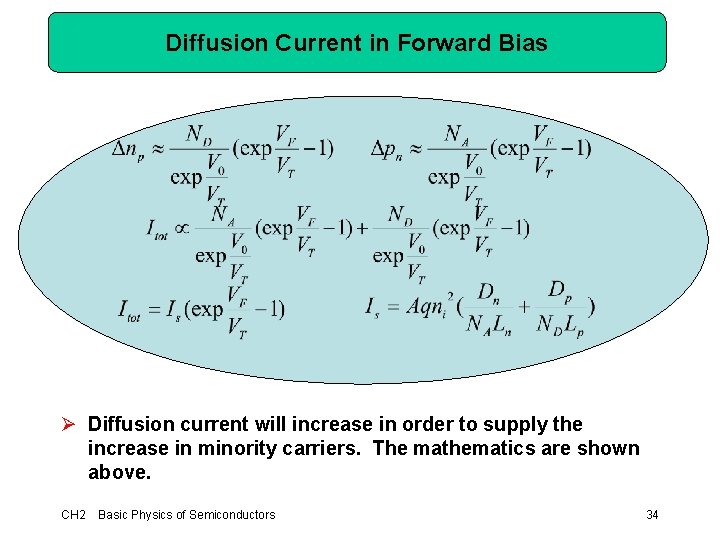
Diffusion Current in Forward Bias Ø Diffusion current will increase in order to supply the increase in minority carriers. The mathematics are shown above. CH 2 Basic Physics of Semiconductors 34
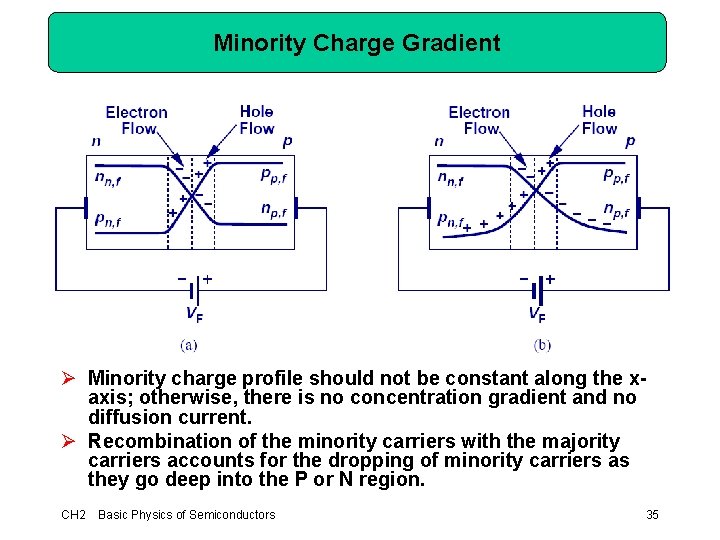
Minority Charge Gradient Ø Minority charge profile should not be constant along the xaxis; otherwise, there is no concentration gradient and no diffusion current. Ø Recombination of the minority carriers with the majority carriers accounts for the dropping of minority carriers as they go deep into the P or N region. CH 2 Basic Physics of Semiconductors 35
Forward Bias Condition: Summary Ø In forward bias, there are large diffusion currents of minority carriers through the junction. However, as we go deep into the P and N regions, recombination currents from the majority carriers dominate. These two currents add up to a constant value. CH 2 Basic Physics of Semiconductors 36
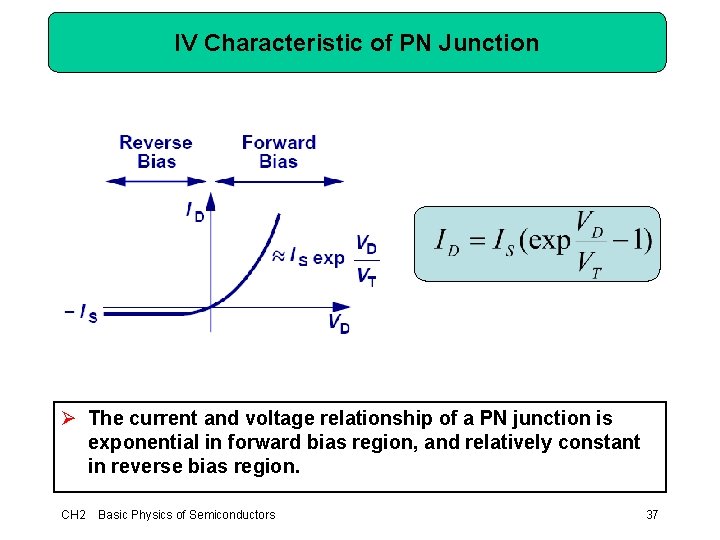
IV Characteristic of PN Junction Ø The current and voltage relationship of a PN junction is exponential in forward bias region, and relatively constant in reverse bias region. CH 2 Basic Physics of Semiconductors 37
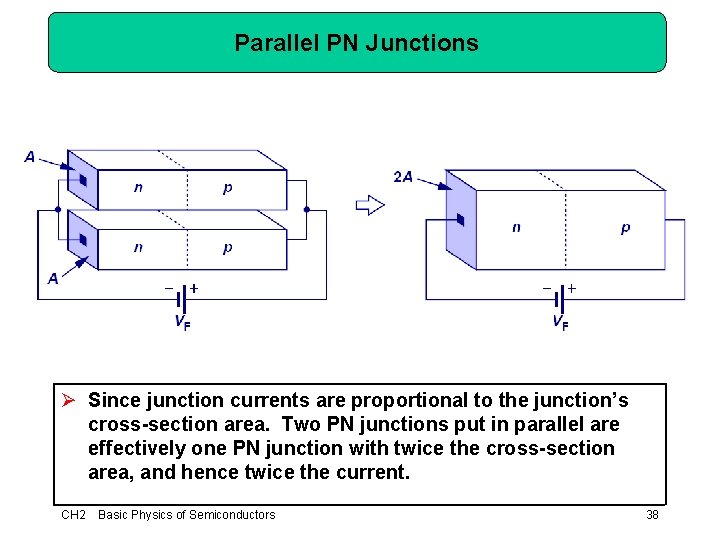
Parallel PN Junctions Ø Since junction currents are proportional to the junction’s cross-section area. Two PN junctions put in parallel are effectively one PN junction with twice the cross-section area, and hence twice the current. CH 2 Basic Physics of Semiconductors 38
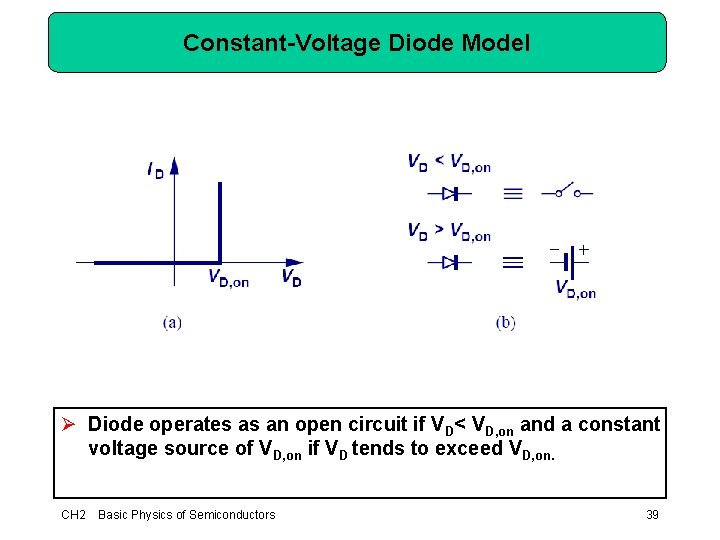
Constant-Voltage Diode Model Ø Diode operates as an open circuit if VD< VD, on and a constant voltage source of VD, on if VD tends to exceed VD, on. CH 2 Basic Physics of Semiconductors 39
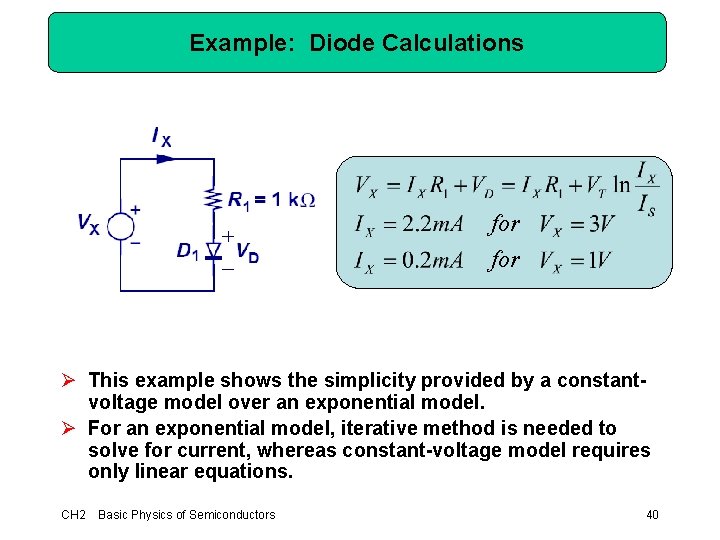
Example: Diode Calculations for Ø This example shows the simplicity provided by a constantvoltage model over an exponential model. Ø For an exponential model, iterative method is needed to solve for current, whereas constant-voltage model requires only linear equations. CH 2 Basic Physics of Semiconductors 40
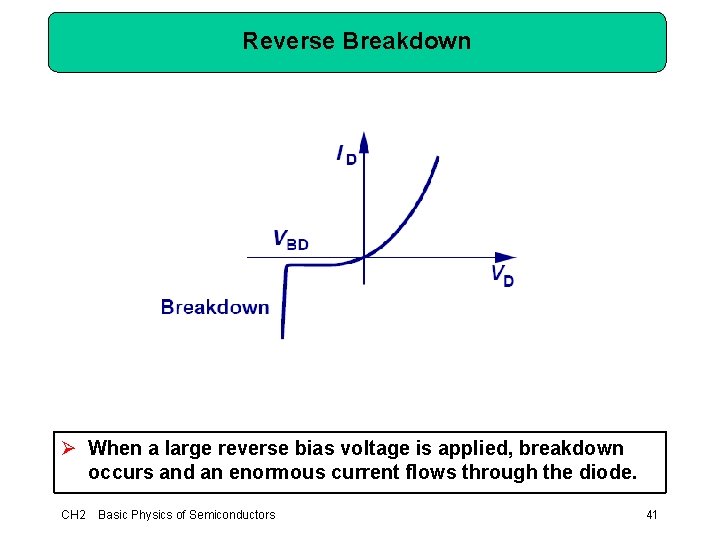
Reverse Breakdown Ø When a large reverse bias voltage is applied, breakdown occurs and an enormous current flows through the diode. CH 2 Basic Physics of Semiconductors 41
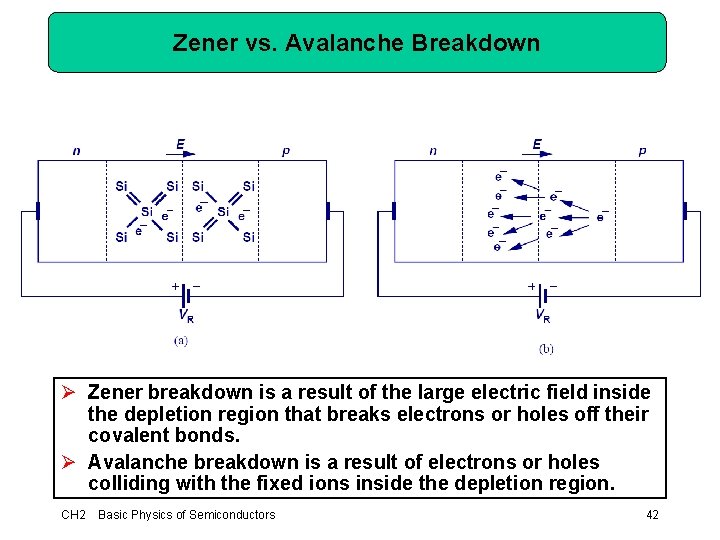
Zener vs. Avalanche Breakdown Ø Zener breakdown is a result of the large electric field inside the depletion region that breaks electrons or holes off their covalent bonds. Ø Avalanche breakdown is a result of electrons or holes colliding with the fixed ions inside the depletion region. CH 2 Basic Physics of Semiconductors 42