
Fundamentals of Management Prepared by Dr Mahmoud Kamal

Fundamentals of Management Prepared by Dr. Mahmoud Kamal EL Araby South Valley University Business Administration Department

Chapter Six Decision Making
Introduction �The world is becoming more and more complex, so do companies. As a consequence, the decisions that managers have to make are increasingly more difficult, since they have to contemplate every single element part of society, such as persons, resources, external environment, etc.
� An objective becomes a criterion by which decisions are made. A decision is a solution chosen from among alternatives. Decisions must be made when the supervisor is faced with a problem. Decision-making is the process of selecting an alternative course of action that will solve a problem. The first decision is whether or not to take corrective action. A simple solution might be to change the objective. Yet, the job of the supervisor is to achieve objectives. Thus, managers will attempt to solve most problems.
Key Points � The steps in the problem-solving process are (1) define the problem, (2) identify decision criteria, (3) develop alternatives, (4) decide, (5) implement the decision, and (6) evaluate the decision.
Making Decision Perspectives �Bounded Rationality � Intuition � Rationality
The Role of Intuition � Intuitive decision making: Making decision on the basis of experience, feelings and accumulated judgment. � Researchers reached five different aspects of intuitions (see Figure 3). � Making intuition decision doesn't necessarily happen independently from rational decision. � It plays an important role in managerial decision making. �.
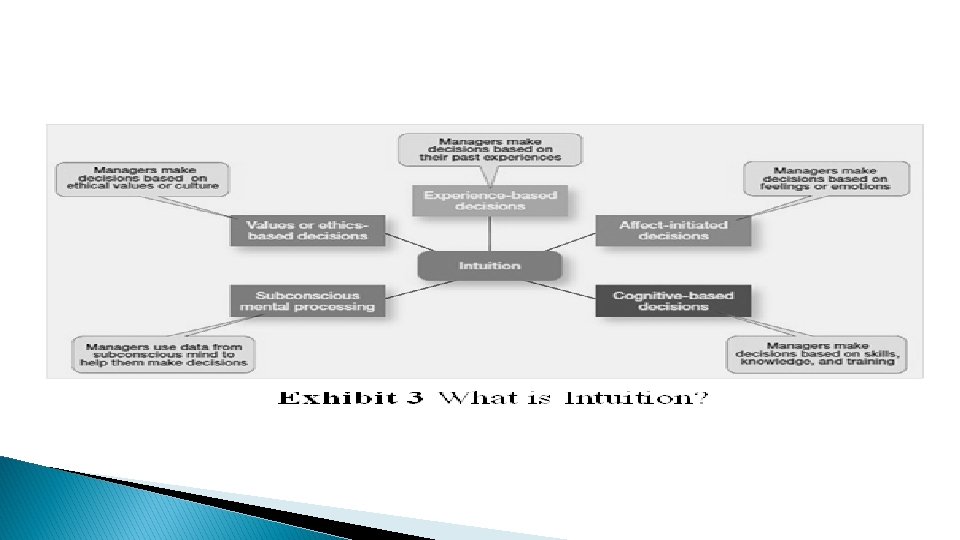
� Exhibit 3 What is Intuition?

Thank You Very Much”
- Slides: 9