
Fundamentals of Informatics Lecture 4 From Turing Machines
- Slides: 63
Fundamentals of Informatics Lecture 4 From Turing Machines to Algorithms Bas Luttik
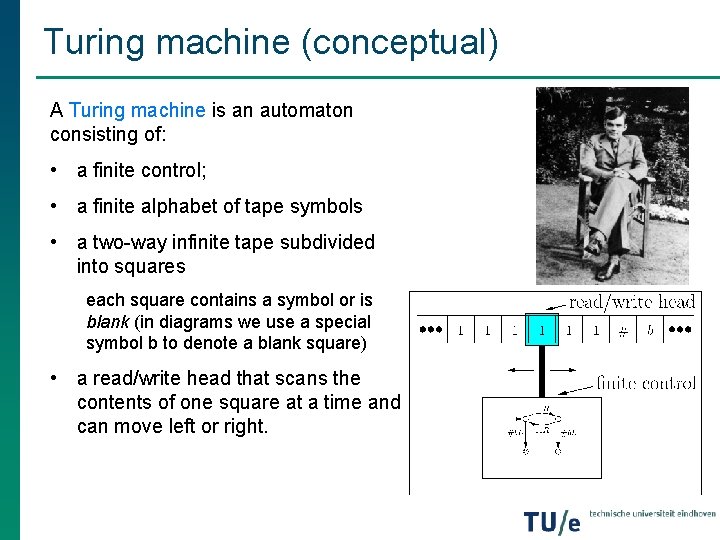
Turing machine (conceptual) A Turing machine is an automaton consisting of: • a finite control; • a finite alphabet of tape symbols • a two-way infinite tape subdivided into squares each square contains a symbol or is blank (in diagrams we use a special symbol b to denote a blank square) • a read/write head that scans the contents of one square at a time and can move left or right.
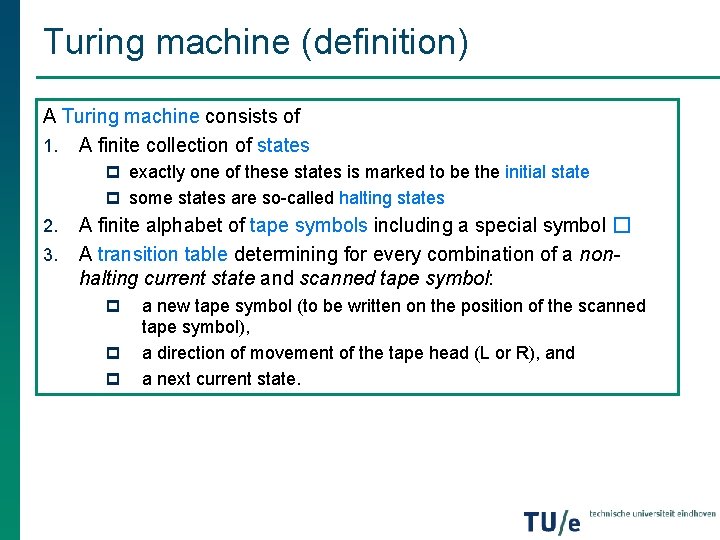
Turing machine (definition) A Turing machine consists of 1. A finite collection of states p exactly one of these states is marked to be the initial state p some states are so-called halting states 2. 3. A finite alphabet of tape symbols including a special symbol � A transition table determining for every combination of a nonhalting current state and scanned tape symbol: p p p a new tape symbol (to be written on the position of the scanned tape symbol), a direction of movement of the tape head (L or R), and a next current state.
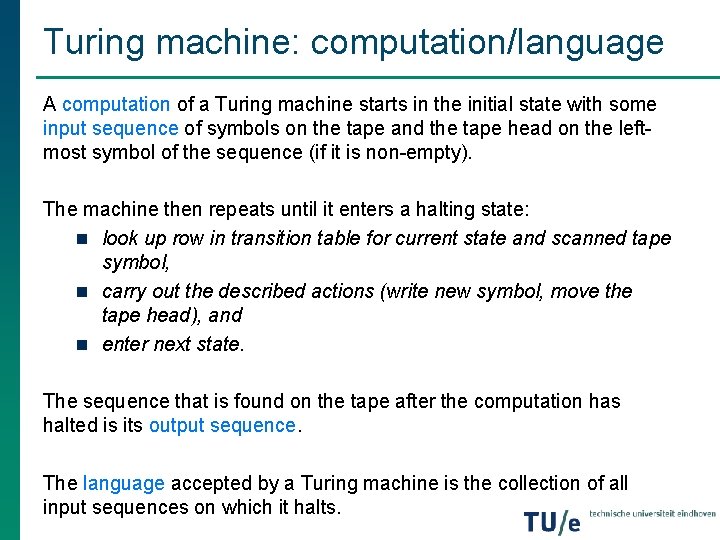
Turing machine: computation/language A computation of a Turing machine starts in the initial state with some input sequence of symbols on the tape and the tape head on the leftmost symbol of the sequence (if it is non-empty). The machine then repeats until it enters a halting state: n look up row in transition table for current state and scanned tape symbol, n carry out the described actions (write new symbol, move the tape head), and n enter next state. The sequence that is found on the tape after the computation has halted is its output sequence. The language accepted by a Turing machine is the collection of all input sequences on which it halts.
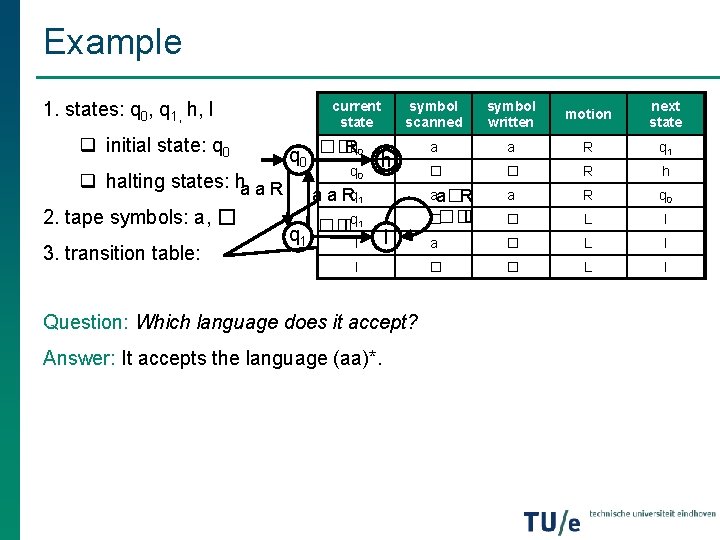
Example 1. states: q 0, q 1, h, l q initial state: q 0 q halting states: ha a R 2. tape symbols: a, � 3. transition table: current state symbol scanned symbol written motion next state a a R q 1 � � R h a a Rq 1 aa�R a R q 0 q 1 �� L q 1 l L ��� � L l a � L l � � L l q q 0 ��R 0 h q 0 l l Question: Which language does it accept? Answer: It accepts the language (aa)*.
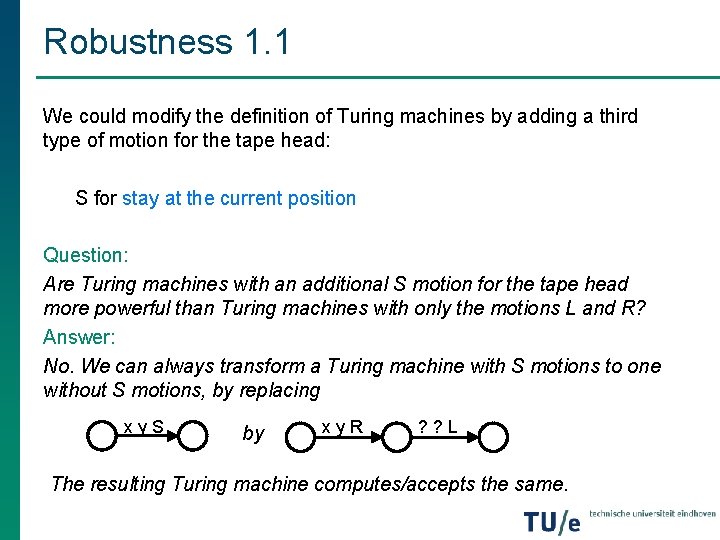
Robustness 1. 1 We could modify the definition of Turing machines by adding a third type of motion for the tape head: S for stay at the current position Question: Are Turing machines with an additional S motion for the tape head more powerful than Turing machines with only the motions L and R? Answer: No. We can always transform a Turing machine with S motions to one without S motions, by replacing xy. S by xy. R ? ? L The resulting Turing machine computes/accepts the same.
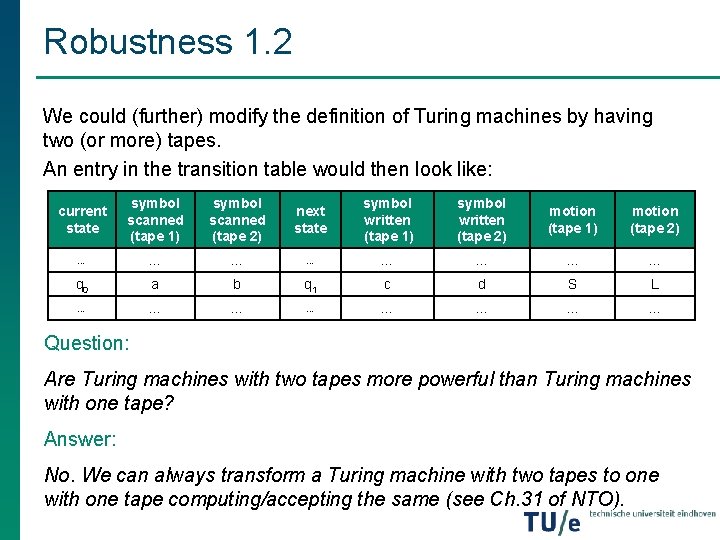
Robustness 1. 2 We could (further) modify the definition of Turing machines by having two (or more) tapes. An entry in the transition table would then look like: current state symbol scanned (tape 1) symbol scanned (tape 2) next state symbol written (tape 1) symbol written (tape 2) motion (tape 1) motion (tape 2) … … … … q 0 a b q 1 c d S L … … … … Question: Are Turing machines with two tapes more powerful than Turing machines with one tape? Answer: No. We can always transform a Turing machine with two tapes to one with one tape computing/accepting the same (see Ch. 31 of NTO).
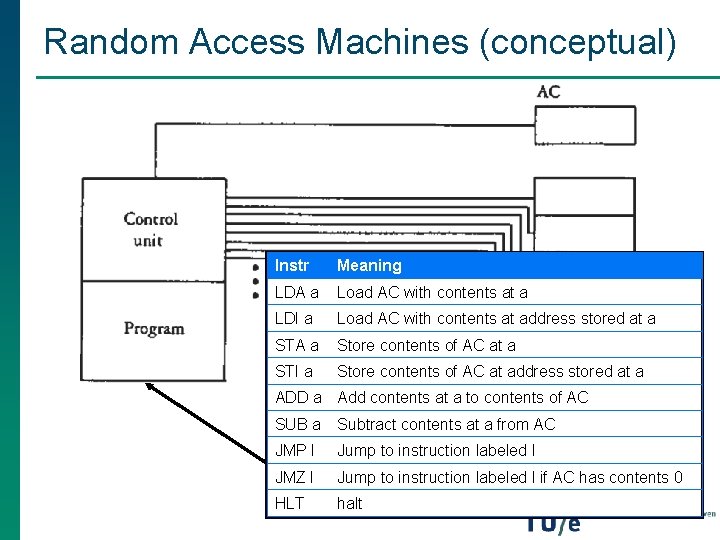
Random Access Machines (conceptual) Instr Meaning LDA a Load AC with contents at a LDI a Load AC with contents at address stored at a STA a Store contents of AC at a STI a Store contents of AC at address stored at a ADD a Add contents at a to contents of AC SUB a Subtract contents at a from AC JMP l Jump to instruction labeled l JMZ l Jump to instruction labeled l if AC has contents 0 HLT halt
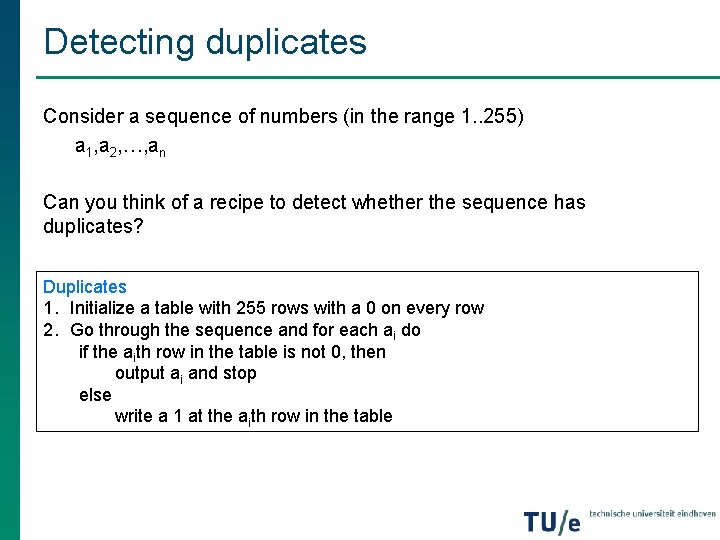
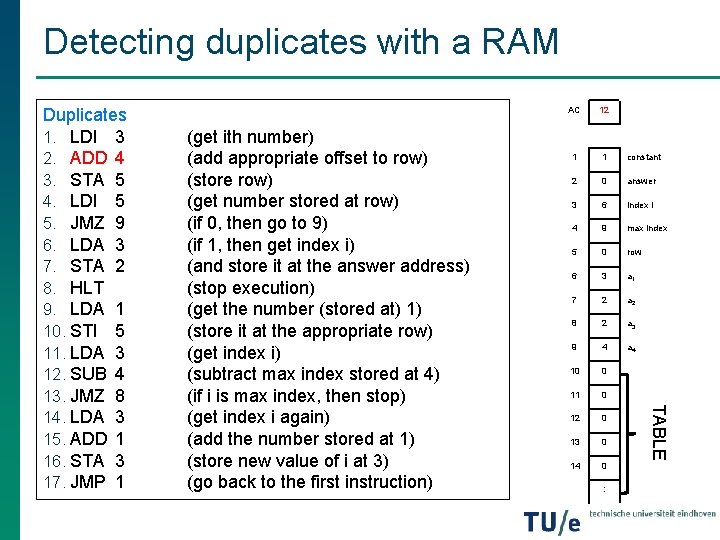
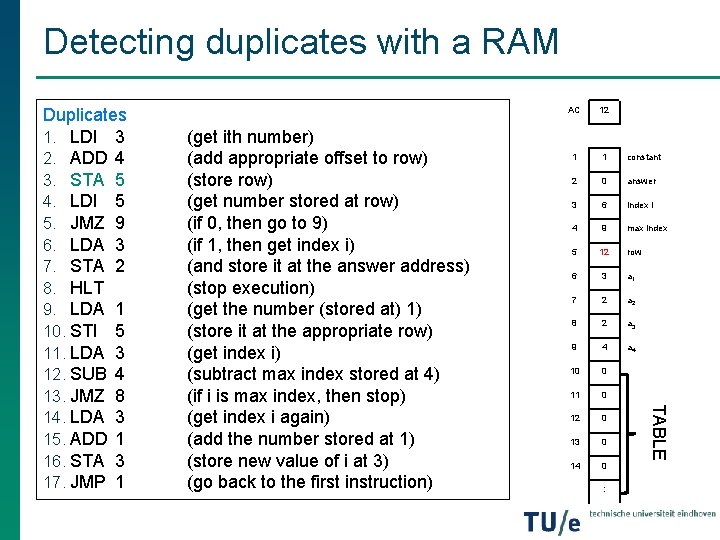
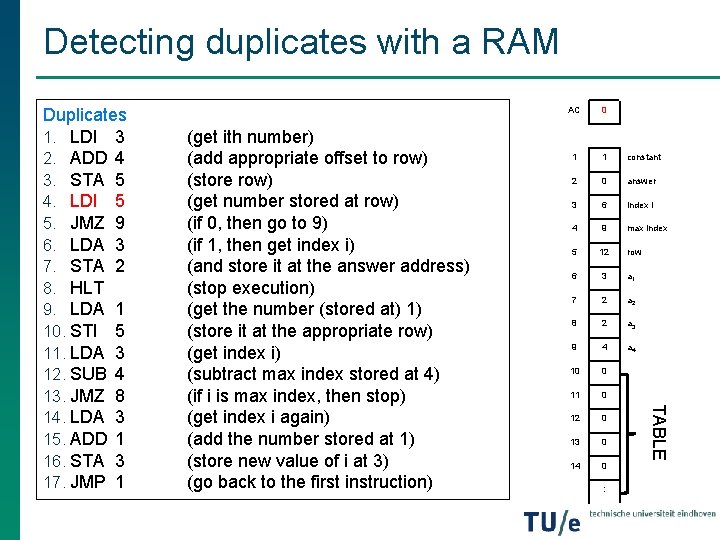
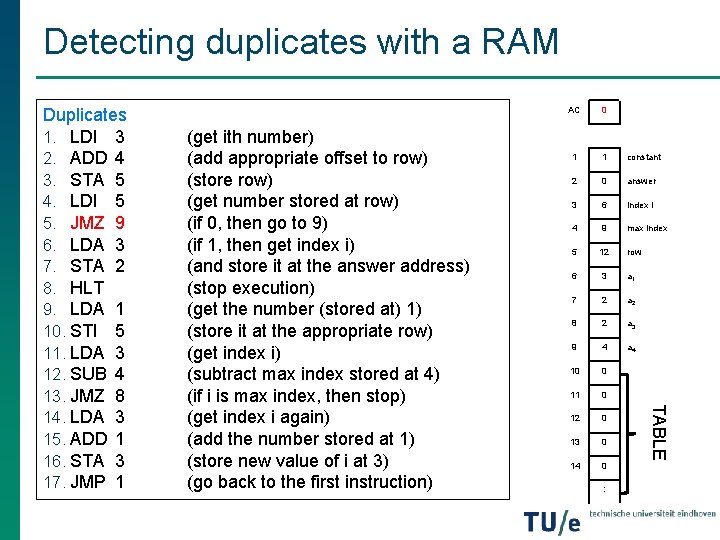
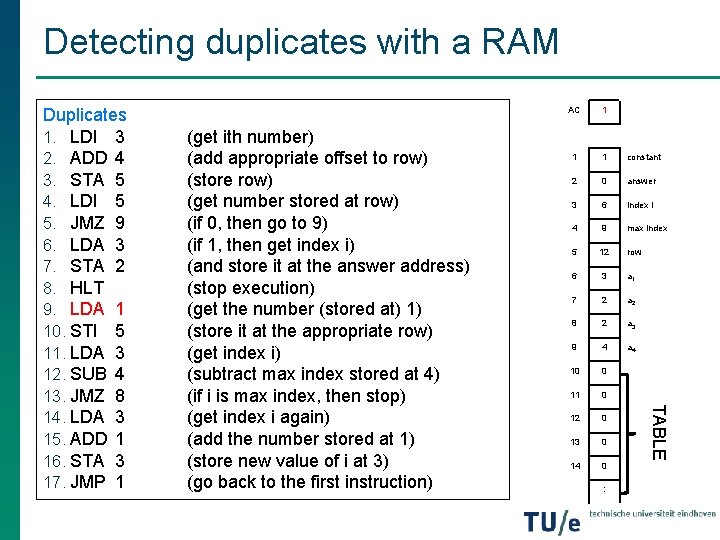
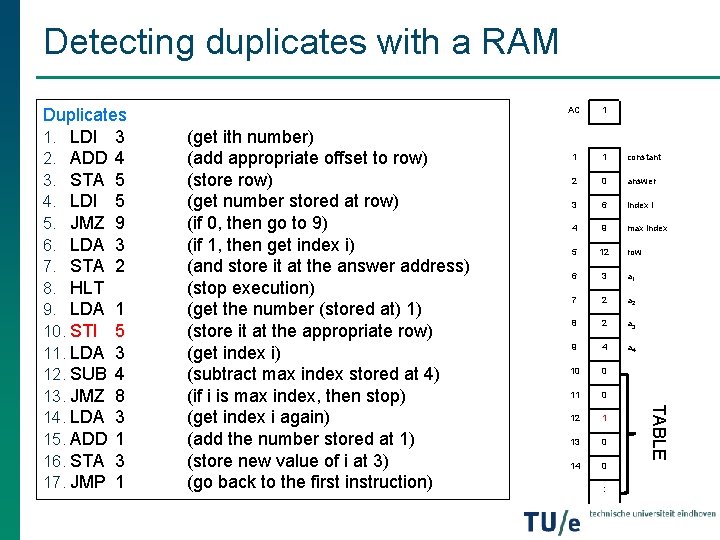
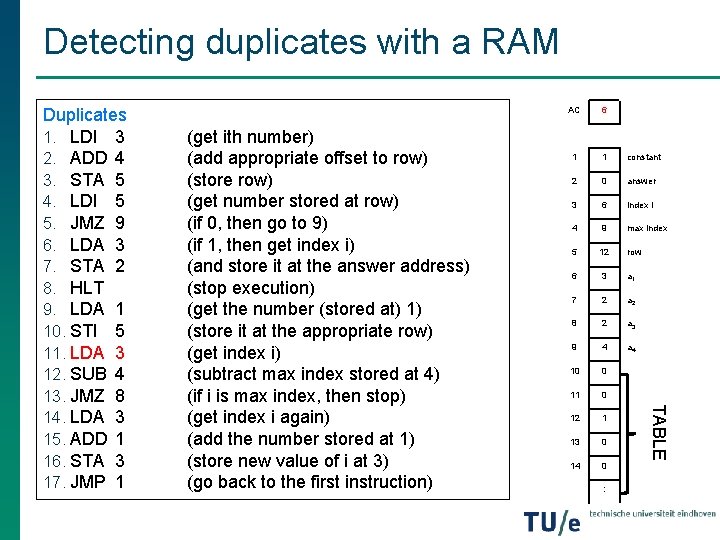
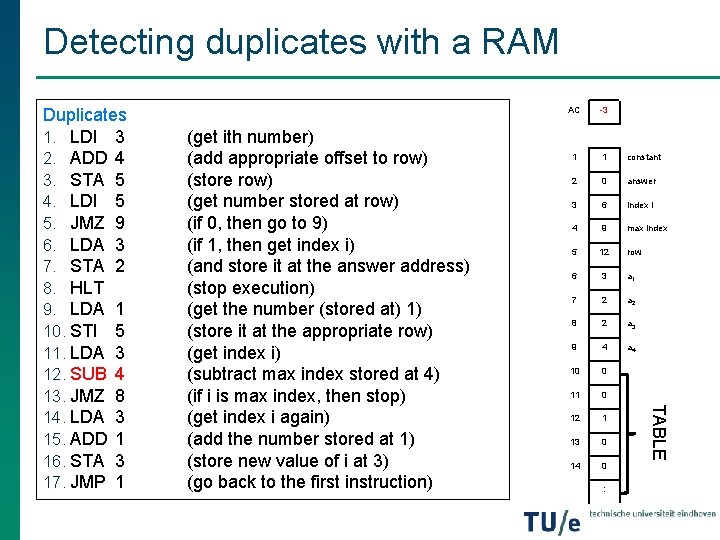
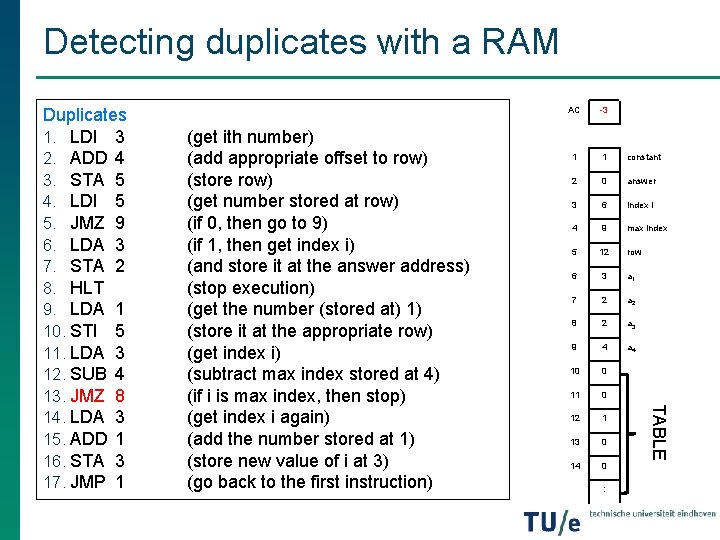
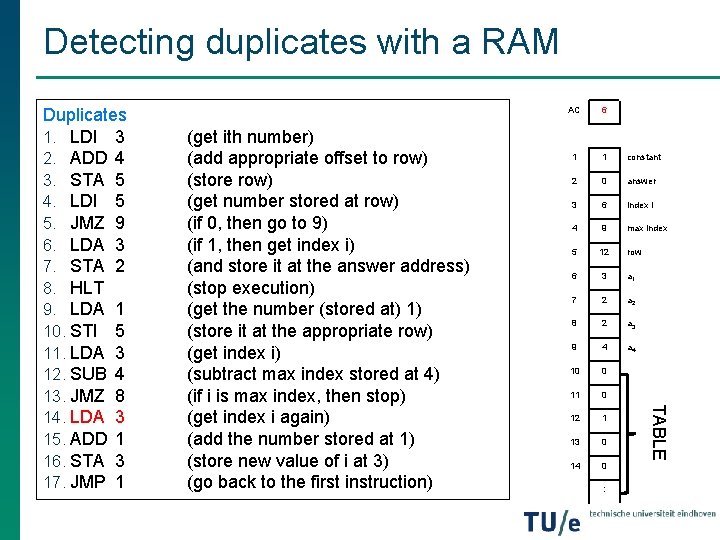
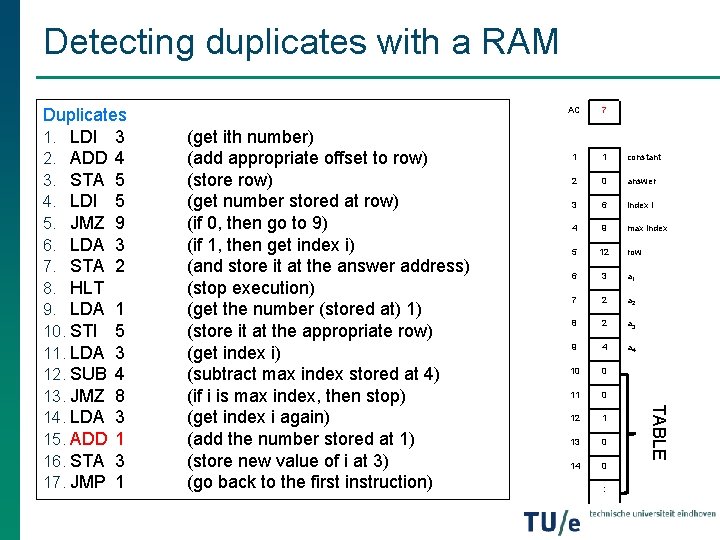
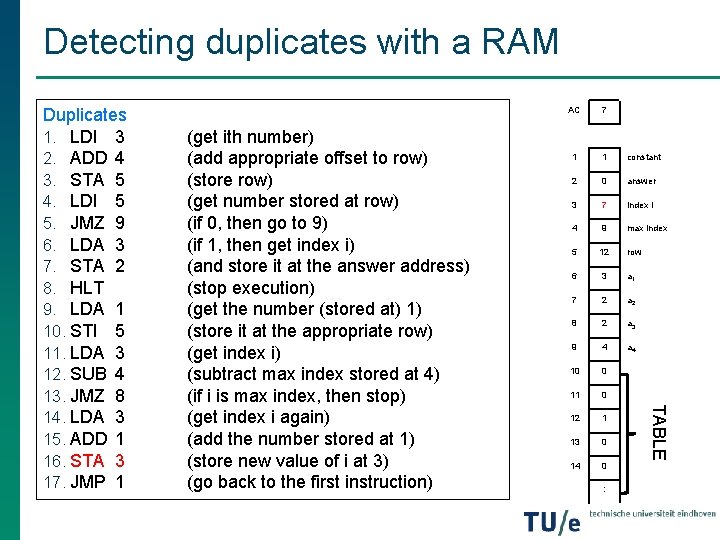
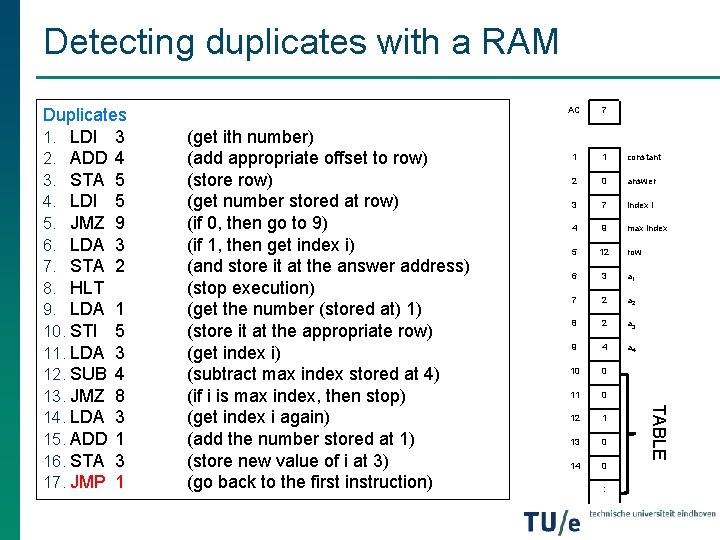
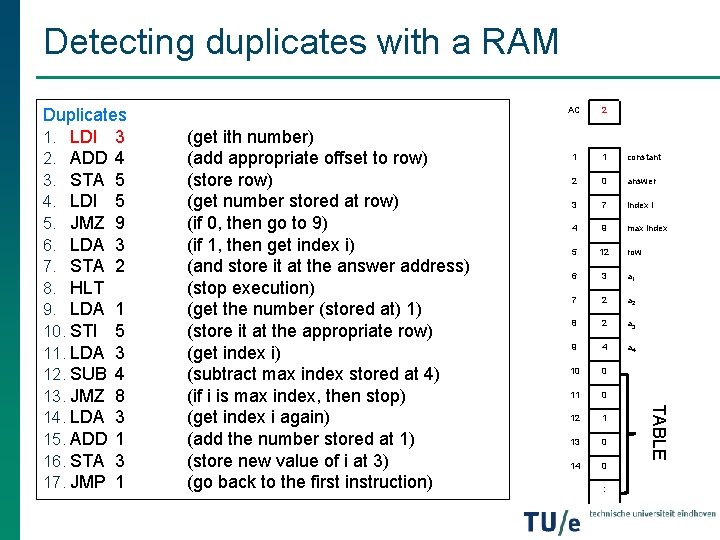
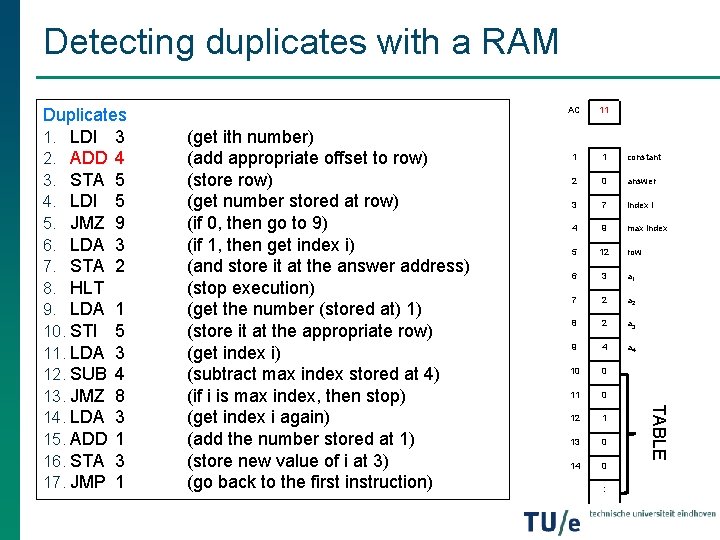
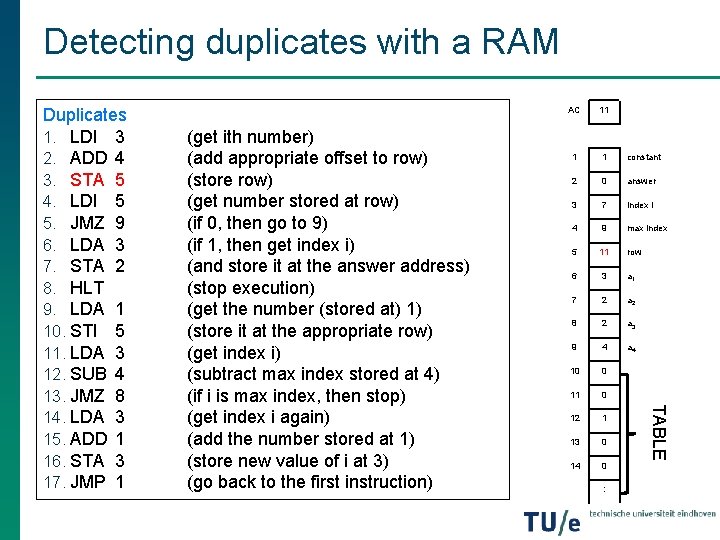
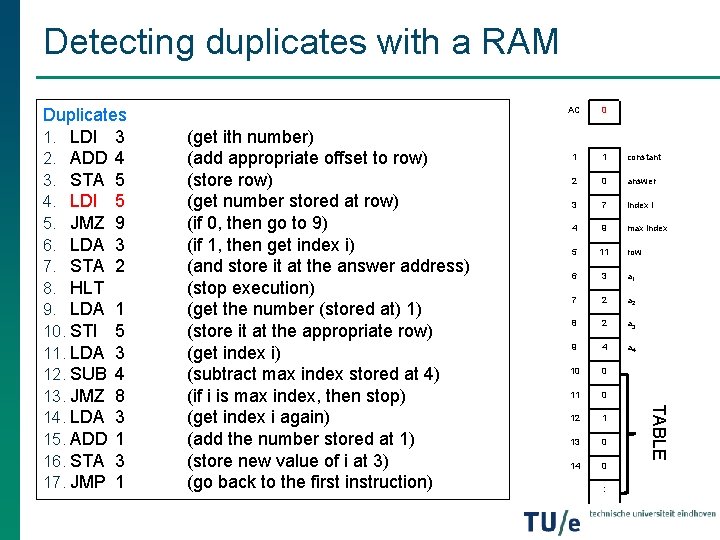
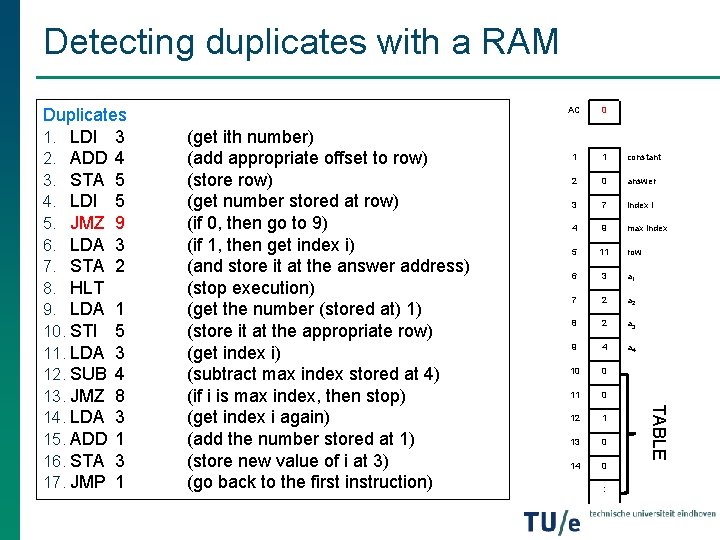
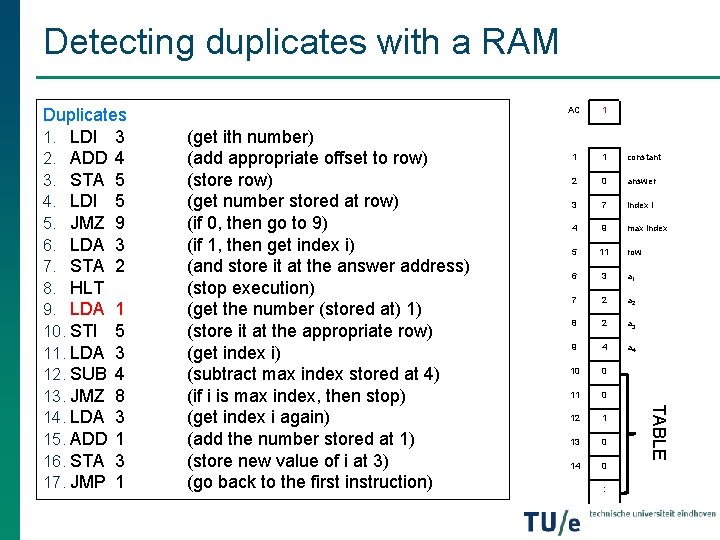
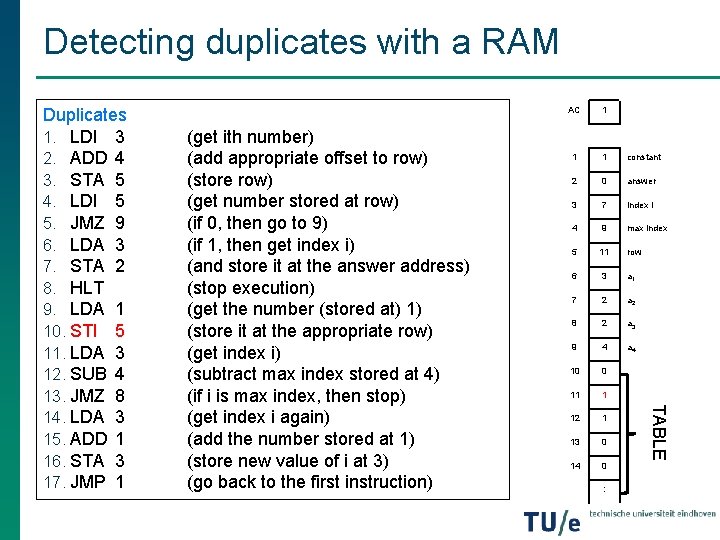
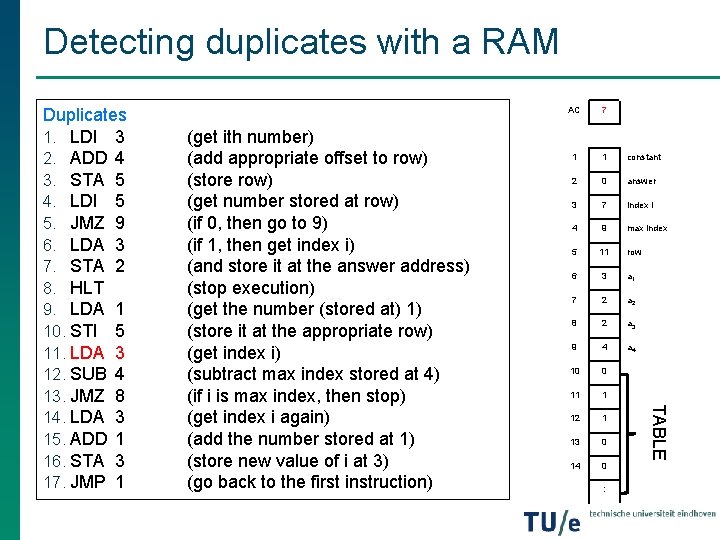
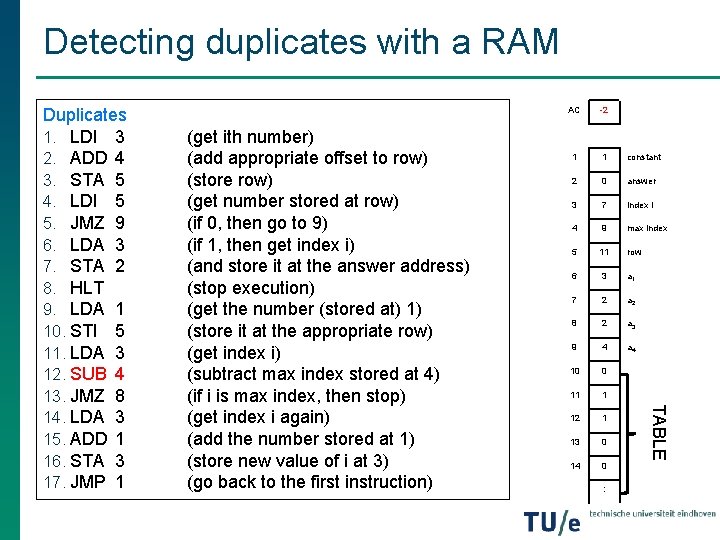
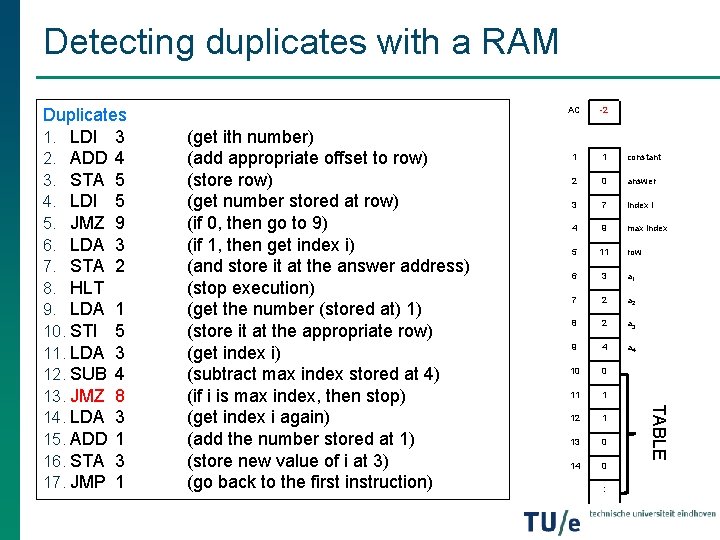
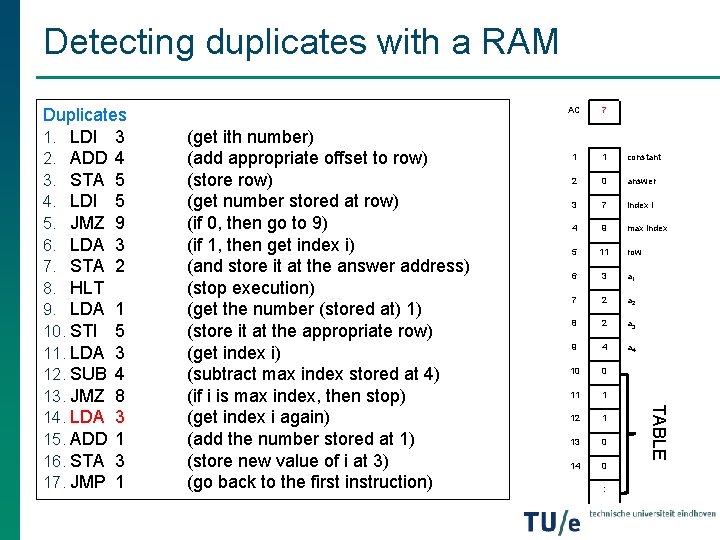
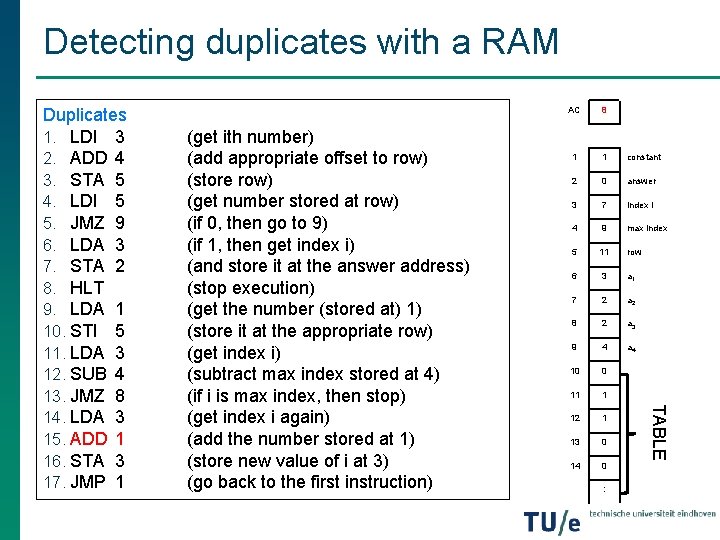
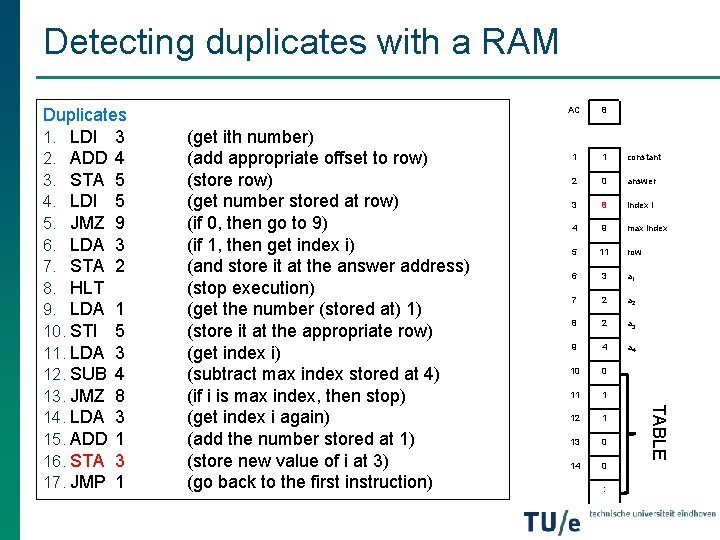
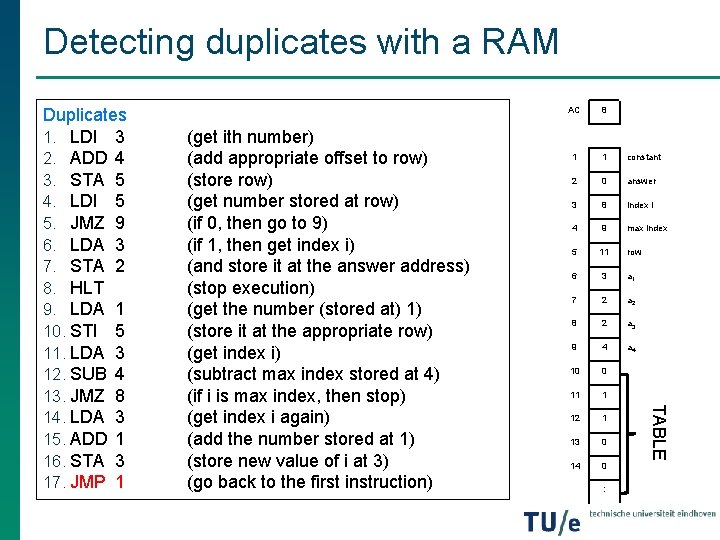
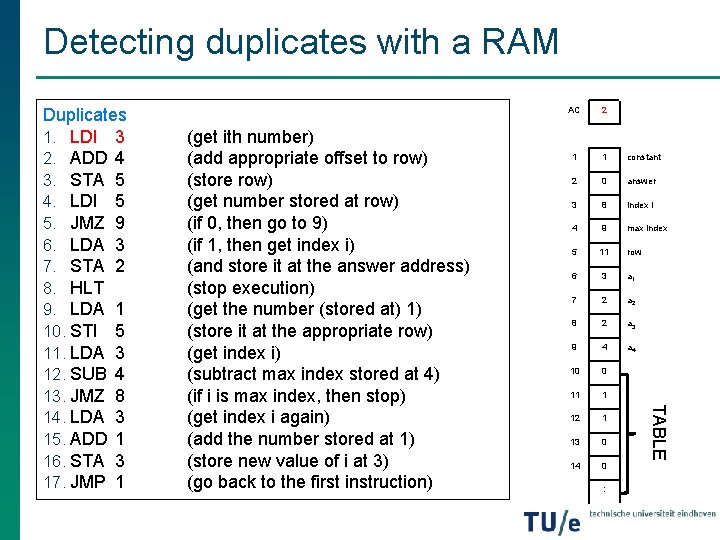
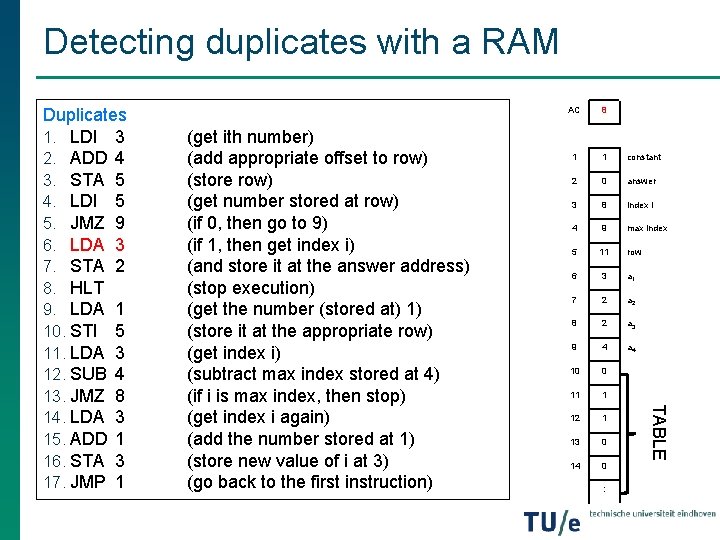
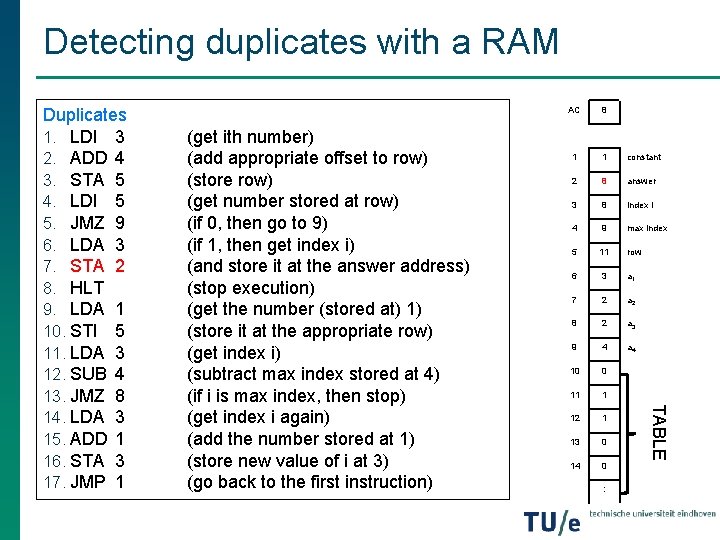
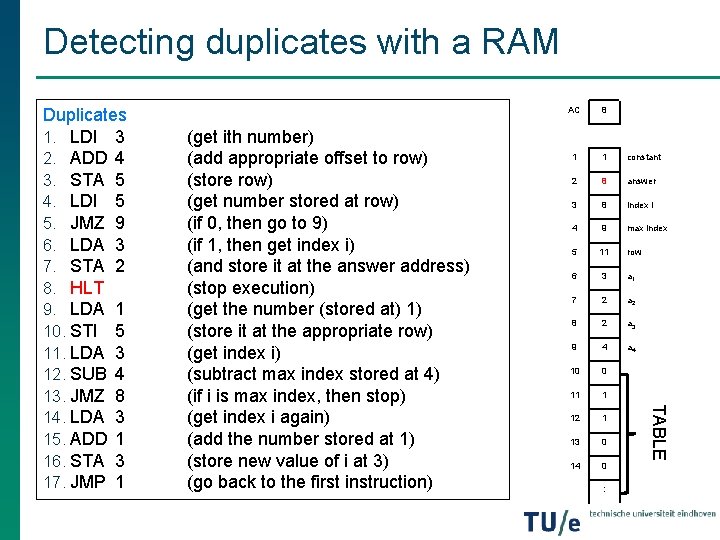
Detecting duplicates Consider a sequence of numbers (in the range 1. . 255) a 1, a 2, …, an Can you think of a recipe to detect whether the sequence has duplicates? Duplicates 1. Initialize a table with 255 rows with a 0 on every row 2. Go through the sequence and for each ai do if the aith row in the table is not 0, then output ai and stop else write a 1 at the aith row in the table
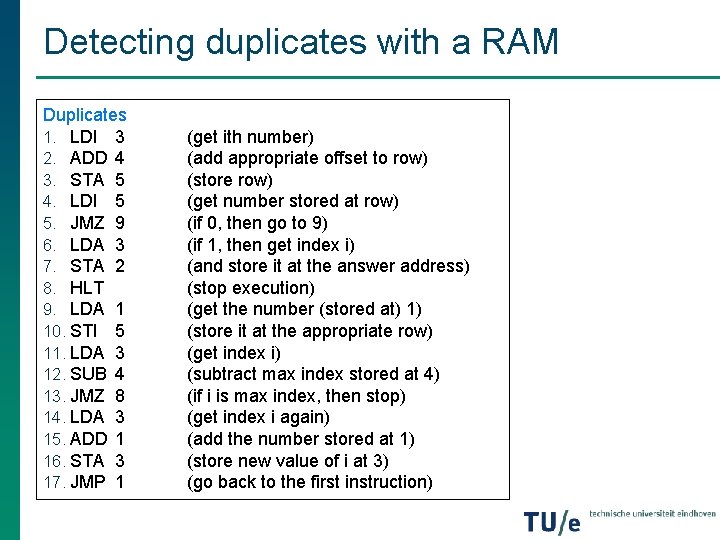
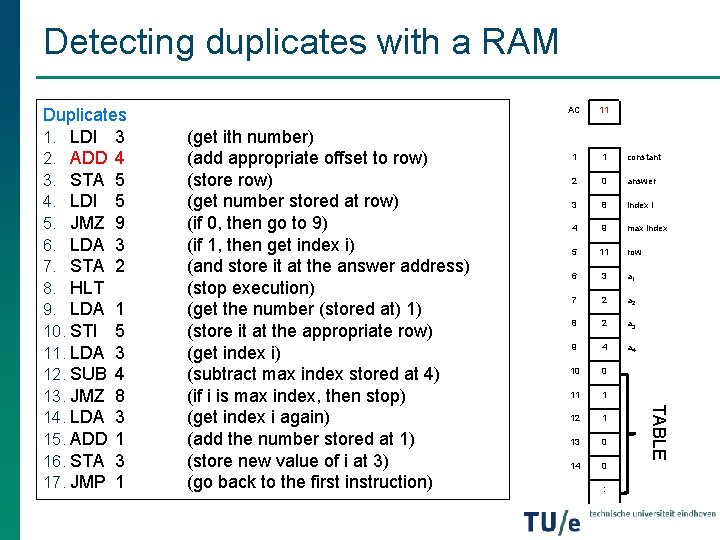
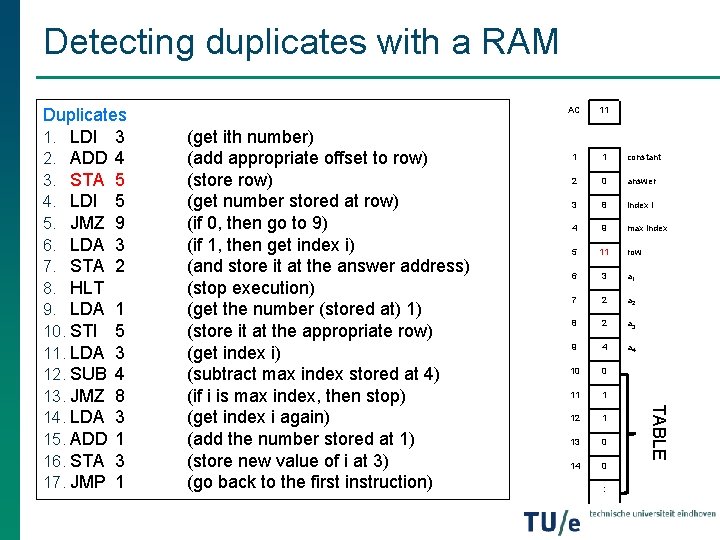
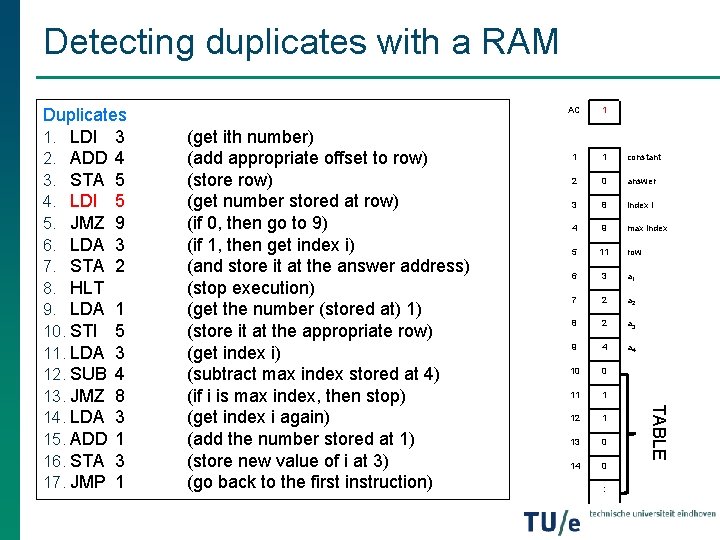
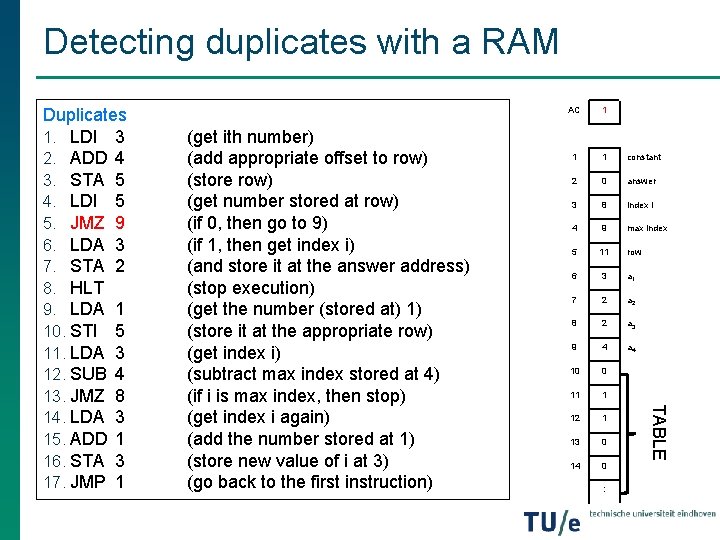
Detecting duplicates with a RAM Duplicates 1. LDI 3 2. ADD 4 3. STA 5 4. LDI 5 5. JMZ 9 6. LDA 3 7. STA 2 8. HLT 9. LDA 1 10. STI 5 11. LDA 3 12. SUB 4 13. JMZ 8 14. LDA 3 15. ADD 1 16. STA 3 17. JMP 1 (get ith number) (add appropriate offset to row) (store row) (get number stored at row) (if 0, then go to 9) (if 1, then get index i) (and store it at the answer address) (stop execution) (get the number (stored at) 1) (store it at the appropriate row) (get index i) (subtract max index stored at 4) (if i is max index, then stop) (get index i again) (add the number stored at 1) (store new value of i at 3) (go back to the first instruction)
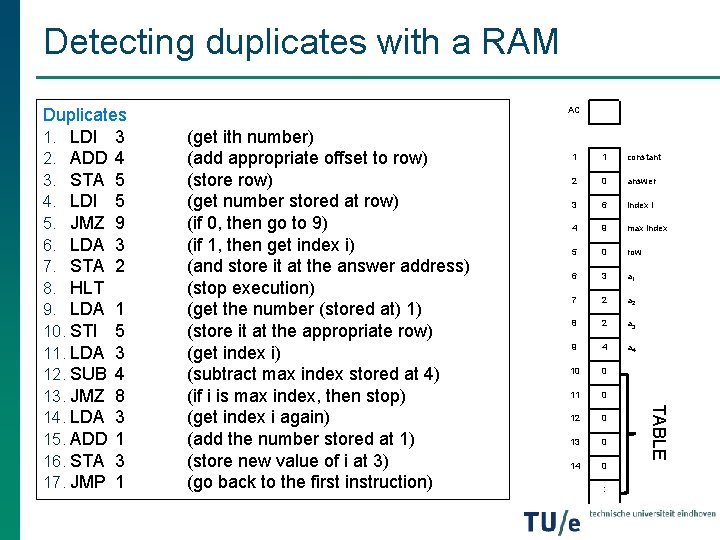
Detecting duplicates with a RAM AC (get ith number) (add appropriate offset to row) (store row) (get number stored at row) (if 0, then go to 9) (if 1, then get index i) (and store it at the answer address) (stop execution) (get the number (stored at) 1) (store it at the appropriate row) (get index i) (subtract max index stored at 4) (if i is max index, then stop) (get index i again) (add the number stored at 1) (store new value of i at 3) (go back to the first instruction) 1 1 constant 2 0 answer 3 6 index i 4 9 max index 5 0 row 6 3 a 1 7 2 a 2 8 2 a 3 9 4 a 4 10 0 11 0 12 0 13 0 14 0 : TABLE Duplicates 1. LDI 3 2. ADD 4 3. STA 5 4. LDI 5 5. JMZ 9 6. LDA 3 7. STA 2 8. HLT 9. LDA 1 10. STI 5 11. LDA 3 12. SUB 4 13. JMZ 8 14. LDA 3 15. ADD 1 16. STA 3 17. JMP 1
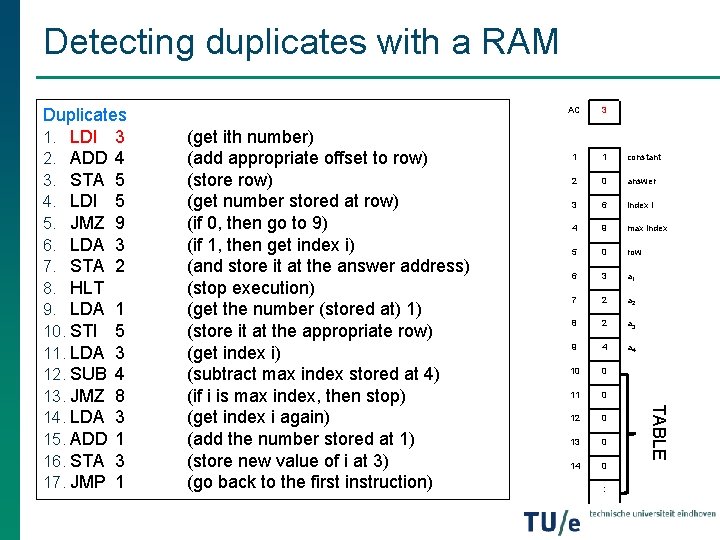
Detecting duplicates with a RAM (get ith number) (add appropriate offset to row) (store row) (get number stored at row) (if 0, then go to 9) (if 1, then get index i) (and store it at the answer address) (stop execution) (get the number (stored at) 1) (store it at the appropriate row) (get index i) (subtract max index stored at 4) (if i is max index, then stop) (get index i again) (add the number stored at 1) (store new value of i at 3) (go back to the first instruction) AC 3 1 1 constant 2 0 answer 3 6 index i 4 9 max index 5 0 row 6 3 a 1 7 2 a 2 8 2 a 3 9 4 a 4 10 0 11 0 12 0 13 0 14 0 : TABLE Duplicates 1. LDI 3 2. ADD 4 3. STA 5 4. LDI 5 5. JMZ 9 6. LDA 3 7. STA 2 8. HLT 9. LDA 1 10. STI 5 11. LDA 3 12. SUB 4 13. JMZ 8 14. LDA 3 15. ADD 1 16. STA 3 17. JMP 1
Detecting duplicates with a RAM (get ith number) (add appropriate offset to row) (store row) (get number stored at row) (if 0, then go to 9) (if 1, then get index i) (and store it at the answer address) (stop execution) (get the number (stored at) 1) (store it at the appropriate row) (get index i) (subtract max index stored at 4) (if i is max index, then stop) (get index i again) (add the number stored at 1) (store new value of i at 3) (go back to the first instruction) AC 12 1 1 constant 2 0 answer 3 6 index i 4 9 max index 5 0 row 6 3 a 1 7 2 a 2 8 2 a 3 9 4 a 4 10 0 11 0 12 0 13 0 14 0 : TABLE Duplicates 1. LDI 3 2. ADD 4 3. STA 5 4. LDI 5 5. JMZ 9 6. LDA 3 7. STA 2 8. HLT 9. LDA 1 10. STI 5 11. LDA 3 12. SUB 4 13. JMZ 8 14. LDA 3 15. ADD 1 16. STA 3 17. JMP 1
Detecting duplicates with a RAM (get ith number) (add appropriate offset to row) (store row) (get number stored at row) (if 0, then go to 9) (if 1, then get index i) (and store it at the answer address) (stop execution) (get the number (stored at) 1) (store it at the appropriate row) (get index i) (subtract max index stored at 4) (if i is max index, then stop) (get index i again) (add the number stored at 1) (store new value of i at 3) (go back to the first instruction) AC 12 1 1 constant 2 0 answer 3 6 index i 4 9 max index 5 12 row 6 3 a 1 7 2 a 2 8 2 a 3 9 4 a 4 10 0 11 0 12 0 13 0 14 0 : TABLE Duplicates 1. LDI 3 2. ADD 4 3. STA 5 4. LDI 5 5. JMZ 9 6. LDA 3 7. STA 2 8. HLT 9. LDA 1 10. STI 5 11. LDA 3 12. SUB 4 13. JMZ 8 14. LDA 3 15. ADD 1 16. STA 3 17. JMP 1
Detecting duplicates with a RAM (get ith number) (add appropriate offset to row) (store row) (get number stored at row) (if 0, then go to 9) (if 1, then get index i) (and store it at the answer address) (stop execution) (get the number (stored at) 1) (store it at the appropriate row) (get index i) (subtract max index stored at 4) (if i is max index, then stop) (get index i again) (add the number stored at 1) (store new value of i at 3) (go back to the first instruction) AC 0 1 1 constant 2 0 answer 3 6 index i 4 9 max index 5 12 row 6 3 a 1 7 2 a 2 8 2 a 3 9 4 a 4 10 0 11 0 12 0 13 0 14 0 : TABLE Duplicates 1. LDI 3 2. ADD 4 3. STA 5 4. LDI 5 5. JMZ 9 6. LDA 3 7. STA 2 8. HLT 9. LDA 1 10. STI 5 11. LDA 3 12. SUB 4 13. JMZ 8 14. LDA 3 15. ADD 1 16. STA 3 17. JMP 1
Detecting duplicates with a RAM (get ith number) (add appropriate offset to row) (store row) (get number stored at row) (if 0, then go to 9) (if 1, then get index i) (and store it at the answer address) (stop execution) (get the number (stored at) 1) (store it at the appropriate row) (get index i) (subtract max index stored at 4) (if i is max index, then stop) (get index i again) (add the number stored at 1) (store new value of i at 3) (go back to the first instruction) AC 0 1 1 constant 2 0 answer 3 6 index i 4 9 max index 5 12 row 6 3 a 1 7 2 a 2 8 2 a 3 9 4 a 4 10 0 11 0 12 0 13 0 14 0 : TABLE Duplicates 1. LDI 3 2. ADD 4 3. STA 5 4. LDI 5 5. JMZ 9 6. LDA 3 7. STA 2 8. HLT 9. LDA 1 10. STI 5 11. LDA 3 12. SUB 4 13. JMZ 8 14. LDA 3 15. ADD 1 16. STA 3 17. JMP 1
Detecting duplicates with a RAM (get ith number) (add appropriate offset to row) (store row) (get number stored at row) (if 0, then go to 9) (if 1, then get index i) (and store it at the answer address) (stop execution) (get the number (stored at) 1) (store it at the appropriate row) (get index i) (subtract max index stored at 4) (if i is max index, then stop) (get index i again) (add the number stored at 1) (store new value of i at 3) (go back to the first instruction) AC 1 1 1 constant 2 0 answer 3 6 index i 4 9 max index 5 12 row 6 3 a 1 7 2 a 2 8 2 a 3 9 4 a 4 10 0 11 0 12 0 13 0 14 0 : TABLE Duplicates 1. LDI 3 2. ADD 4 3. STA 5 4. LDI 5 5. JMZ 9 6. LDA 3 7. STA 2 8. HLT 9. LDA 1 10. STI 5 11. LDA 3 12. SUB 4 13. JMZ 8 14. LDA 3 15. ADD 1 16. STA 3 17. JMP 1
Detecting duplicates with a RAM (get ith number) (add appropriate offset to row) (store row) (get number stored at row) (if 0, then go to 9) (if 1, then get index i) (and store it at the answer address) (stop execution) (get the number (stored at) 1) (store it at the appropriate row) (get index i) (subtract max index stored at 4) (if i is max index, then stop) (get index i again) (add the number stored at 1) (store new value of i at 3) (go back to the first instruction) AC 1 1 1 constant 2 0 answer 3 6 index i 4 9 max index 5 12 row 6 3 a 1 7 2 a 2 8 2 a 3 9 4 a 4 10 0 11 0 12 1 13 0 14 0 : TABLE Duplicates 1. LDI 3 2. ADD 4 3. STA 5 4. LDI 5 5. JMZ 9 6. LDA 3 7. STA 2 8. HLT 9. LDA 1 10. STI 5 11. LDA 3 12. SUB 4 13. JMZ 8 14. LDA 3 15. ADD 1 16. STA 3 17. JMP 1
Detecting duplicates with a RAM (get ith number) (add appropriate offset to row) (store row) (get number stored at row) (if 0, then go to 9) (if 1, then get index i) (and store it at the answer address) (stop execution) (get the number (stored at) 1) (store it at the appropriate row) (get index i) (subtract max index stored at 4) (if i is max index, then stop) (get index i again) (add the number stored at 1) (store new value of i at 3) (go back to the first instruction) AC 6 1 1 constant 2 0 answer 3 6 index i 4 9 max index 5 12 row 6 3 a 1 7 2 a 2 8 2 a 3 9 4 a 4 10 0 11 0 12 1 13 0 14 0 : TABLE Duplicates 1. LDI 3 2. ADD 4 3. STA 5 4. LDI 5 5. JMZ 9 6. LDA 3 7. STA 2 8. HLT 9. LDA 1 10. STI 5 11. LDA 3 12. SUB 4 13. JMZ 8 14. LDA 3 15. ADD 1 16. STA 3 17. JMP 1
Detecting duplicates with a RAM (get ith number) (add appropriate offset to row) (store row) (get number stored at row) (if 0, then go to 9) (if 1, then get index i) (and store it at the answer address) (stop execution) (get the number (stored at) 1) (store it at the appropriate row) (get index i) (subtract max index stored at 4) (if i is max index, then stop) (get index i again) (add the number stored at 1) (store new value of i at 3) (go back to the first instruction) AC -3 1 1 constant 2 0 answer 3 6 index i 4 9 max index 5 12 row 6 3 a 1 7 2 a 2 8 2 a 3 9 4 a 4 10 0 11 0 12 1 13 0 14 0 : TABLE Duplicates 1. LDI 3 2. ADD 4 3. STA 5 4. LDI 5 5. JMZ 9 6. LDA 3 7. STA 2 8. HLT 9. LDA 1 10. STI 5 11. LDA 3 12. SUB 4 13. JMZ 8 14. LDA 3 15. ADD 1 16. STA 3 17. JMP 1
Detecting duplicates with a RAM (get ith number) (add appropriate offset to row) (store row) (get number stored at row) (if 0, then go to 9) (if 1, then get index i) (and store it at the answer address) (stop execution) (get the number (stored at) 1) (store it at the appropriate row) (get index i) (subtract max index stored at 4) (if i is max index, then stop) (get index i again) (add the number stored at 1) (store new value of i at 3) (go back to the first instruction) AC -3 1 1 constant 2 0 answer 3 6 index i 4 9 max index 5 12 row 6 3 a 1 7 2 a 2 8 2 a 3 9 4 a 4 10 0 11 0 12 1 13 0 14 0 : TABLE Duplicates 1. LDI 3 2. ADD 4 3. STA 5 4. LDI 5 5. JMZ 9 6. LDA 3 7. STA 2 8. HLT 9. LDA 1 10. STI 5 11. LDA 3 12. SUB 4 13. JMZ 8 14. LDA 3 15. ADD 1 16. STA 3 17. JMP 1
Detecting duplicates with a RAM (get ith number) (add appropriate offset to row) (store row) (get number stored at row) (if 0, then go to 9) (if 1, then get index i) (and store it at the answer address) (stop execution) (get the number (stored at) 1) (store it at the appropriate row) (get index i) (subtract max index stored at 4) (if i is max index, then stop) (get index i again) (add the number stored at 1) (store new value of i at 3) (go back to the first instruction) AC 6 1 1 constant 2 0 answer 3 6 index i 4 9 max index 5 12 row 6 3 a 1 7 2 a 2 8 2 a 3 9 4 a 4 10 0 11 0 12 1 13 0 14 0 : TABLE Duplicates 1. LDI 3 2. ADD 4 3. STA 5 4. LDI 5 5. JMZ 9 6. LDA 3 7. STA 2 8. HLT 9. LDA 1 10. STI 5 11. LDA 3 12. SUB 4 13. JMZ 8 14. LDA 3 15. ADD 1 16. STA 3 17. JMP 1
Detecting duplicates with a RAM (get ith number) (add appropriate offset to row) (store row) (get number stored at row) (if 0, then go to 9) (if 1, then get index i) (and store it at the answer address) (stop execution) (get the number (stored at) 1) (store it at the appropriate row) (get index i) (subtract max index stored at 4) (if i is max index, then stop) (get index i again) (add the number stored at 1) (store new value of i at 3) (go back to the first instruction) AC 7 1 1 constant 2 0 answer 3 6 index i 4 9 max index 5 12 row 6 3 a 1 7 2 a 2 8 2 a 3 9 4 a 4 10 0 11 0 12 1 13 0 14 0 : TABLE Duplicates 1. LDI 3 2. ADD 4 3. STA 5 4. LDI 5 5. JMZ 9 6. LDA 3 7. STA 2 8. HLT 9. LDA 1 10. STI 5 11. LDA 3 12. SUB 4 13. JMZ 8 14. LDA 3 15. ADD 1 16. STA 3 17. JMP 1
Detecting duplicates with a RAM (get ith number) (add appropriate offset to row) (store row) (get number stored at row) (if 0, then go to 9) (if 1, then get index i) (and store it at the answer address) (stop execution) (get the number (stored at) 1) (store it at the appropriate row) (get index i) (subtract max index stored at 4) (if i is max index, then stop) (get index i again) (add the number stored at 1) (store new value of i at 3) (go back to the first instruction) AC 7 1 1 constant 2 0 answer 3 7 index i 4 9 max index 5 12 row 6 3 a 1 7 2 a 2 8 2 a 3 9 4 a 4 10 0 11 0 12 1 13 0 14 0 : TABLE Duplicates 1. LDI 3 2. ADD 4 3. STA 5 4. LDI 5 5. JMZ 9 6. LDA 3 7. STA 2 8. HLT 9. LDA 1 10. STI 5 11. LDA 3 12. SUB 4 13. JMZ 8 14. LDA 3 15. ADD 1 16. STA 3 17. JMP 1
Detecting duplicates with a RAM (get ith number) (add appropriate offset to row) (store row) (get number stored at row) (if 0, then go to 9) (if 1, then get index i) (and store it at the answer address) (stop execution) (get the number (stored at) 1) (store it at the appropriate row) (get index i) (subtract max index stored at 4) (if i is max index, then stop) (get index i again) (add the number stored at 1) (store new value of i at 3) (go back to the first instruction) AC 7 1 1 constant 2 0 answer 3 7 index i 4 9 max index 5 12 row 6 3 a 1 7 2 a 2 8 2 a 3 9 4 a 4 10 0 11 0 12 1 13 0 14 0 : TABLE Duplicates 1. LDI 3 2. ADD 4 3. STA 5 4. LDI 5 5. JMZ 9 6. LDA 3 7. STA 2 8. HLT 9. LDA 1 10. STI 5 11. LDA 3 12. SUB 4 13. JMZ 8 14. LDA 3 15. ADD 1 16. STA 3 17. JMP 1
Detecting duplicates with a RAM (get ith number) (add appropriate offset to row) (store row) (get number stored at row) (if 0, then go to 9) (if 1, then get index i) (and store it at the answer address) (stop execution) (get the number (stored at) 1) (store it at the appropriate row) (get index i) (subtract max index stored at 4) (if i is max index, then stop) (get index i again) (add the number stored at 1) (store new value of i at 3) (go back to the first instruction) AC 2 1 1 constant 2 0 answer 3 7 index i 4 9 max index 5 12 row 6 3 a 1 7 2 a 2 8 2 a 3 9 4 a 4 10 0 11 0 12 1 13 0 14 0 : TABLE Duplicates 1. LDI 3 2. ADD 4 3. STA 5 4. LDI 5 5. JMZ 9 6. LDA 3 7. STA 2 8. HLT 9. LDA 1 10. STI 5 11. LDA 3 12. SUB 4 13. JMZ 8 14. LDA 3 15. ADD 1 16. STA 3 17. JMP 1
Detecting duplicates with a RAM (get ith number) (add appropriate offset to row) (store row) (get number stored at row) (if 0, then go to 9) (if 1, then get index i) (and store it at the answer address) (stop execution) (get the number (stored at) 1) (store it at the appropriate row) (get index i) (subtract max index stored at 4) (if i is max index, then stop) (get index i again) (add the number stored at 1) (store new value of i at 3) (go back to the first instruction) AC 11 1 1 constant 2 0 answer 3 7 index i 4 9 max index 5 12 row 6 3 a 1 7 2 a 2 8 2 a 3 9 4 a 4 10 0 11 0 12 1 13 0 14 0 : TABLE Duplicates 1. LDI 3 2. ADD 4 3. STA 5 4. LDI 5 5. JMZ 9 6. LDA 3 7. STA 2 8. HLT 9. LDA 1 10. STI 5 11. LDA 3 12. SUB 4 13. JMZ 8 14. LDA 3 15. ADD 1 16. STA 3 17. JMP 1
Detecting duplicates with a RAM (get ith number) (add appropriate offset to row) (store row) (get number stored at row) (if 0, then go to 9) (if 1, then get index i) (and store it at the answer address) (stop execution) (get the number (stored at) 1) (store it at the appropriate row) (get index i) (subtract max index stored at 4) (if i is max index, then stop) (get index i again) (add the number stored at 1) (store new value of i at 3) (go back to the first instruction) AC 11 1 1 constant 2 0 answer 3 7 index i 4 9 max index 5 11 row 6 3 a 1 7 2 a 2 8 2 a 3 9 4 a 4 10 0 11 0 12 1 13 0 14 0 : TABLE Duplicates 1. LDI 3 2. ADD 4 3. STA 5 4. LDI 5 5. JMZ 9 6. LDA 3 7. STA 2 8. HLT 9. LDA 1 10. STI 5 11. LDA 3 12. SUB 4 13. JMZ 8 14. LDA 3 15. ADD 1 16. STA 3 17. JMP 1
Detecting duplicates with a RAM (get ith number) (add appropriate offset to row) (store row) (get number stored at row) (if 0, then go to 9) (if 1, then get index i) (and store it at the answer address) (stop execution) (get the number (stored at) 1) (store it at the appropriate row) (get index i) (subtract max index stored at 4) (if i is max index, then stop) (get index i again) (add the number stored at 1) (store new value of i at 3) (go back to the first instruction) AC 0 1 1 constant 2 0 answer 3 7 index i 4 9 max index 5 11 row 6 3 a 1 7 2 a 2 8 2 a 3 9 4 a 4 10 0 11 0 12 1 13 0 14 0 : TABLE Duplicates 1. LDI 3 2. ADD 4 3. STA 5 4. LDI 5 5. JMZ 9 6. LDA 3 7. STA 2 8. HLT 9. LDA 1 10. STI 5 11. LDA 3 12. SUB 4 13. JMZ 8 14. LDA 3 15. ADD 1 16. STA 3 17. JMP 1
Detecting duplicates with a RAM (get ith number) (add appropriate offset to row) (store row) (get number stored at row) (if 0, then go to 9) (if 1, then get index i) (and store it at the answer address) (stop execution) (get the number (stored at) 1) (store it at the appropriate row) (get index i) (subtract max index stored at 4) (if i is max index, then stop) (get index i again) (add the number stored at 1) (store new value of i at 3) (go back to the first instruction) AC 0 1 1 constant 2 0 answer 3 7 index i 4 9 max index 5 11 row 6 3 a 1 7 2 a 2 8 2 a 3 9 4 a 4 10 0 11 0 12 1 13 0 14 0 : TABLE Duplicates 1. LDI 3 2. ADD 4 3. STA 5 4. LDI 5 5. JMZ 9 6. LDA 3 7. STA 2 8. HLT 9. LDA 1 10. STI 5 11. LDA 3 12. SUB 4 13. JMZ 8 14. LDA 3 15. ADD 1 16. STA 3 17. JMP 1
Detecting duplicates with a RAM (get ith number) (add appropriate offset to row) (store row) (get number stored at row) (if 0, then go to 9) (if 1, then get index i) (and store it at the answer address) (stop execution) (get the number (stored at) 1) (store it at the appropriate row) (get index i) (subtract max index stored at 4) (if i is max index, then stop) (get index i again) (add the number stored at 1) (store new value of i at 3) (go back to the first instruction) AC 1 1 1 constant 2 0 answer 3 7 index i 4 9 max index 5 11 row 6 3 a 1 7 2 a 2 8 2 a 3 9 4 a 4 10 0 11 0 12 1 13 0 14 0 : TABLE Duplicates 1. LDI 3 2. ADD 4 3. STA 5 4. LDI 5 5. JMZ 9 6. LDA 3 7. STA 2 8. HLT 9. LDA 1 10. STI 5 11. LDA 3 12. SUB 4 13. JMZ 8 14. LDA 3 15. ADD 1 16. STA 3 17. JMP 1
Detecting duplicates with a RAM (get ith number) (add appropriate offset to row) (store row) (get number stored at row) (if 0, then go to 9) (if 1, then get index i) (and store it at the answer address) (stop execution) (get the number (stored at) 1) (store it at the appropriate row) (get index i) (subtract max index stored at 4) (if i is max index, then stop) (get index i again) (add the number stored at 1) (store new value of i at 3) (go back to the first instruction) AC 1 1 1 constant 2 0 answer 3 7 index i 4 9 max index 5 11 row 6 3 a 1 7 2 a 2 8 2 a 3 9 4 a 4 10 0 11 1 12 1 13 0 14 0 : TABLE Duplicates 1. LDI 3 2. ADD 4 3. STA 5 4. LDI 5 5. JMZ 9 6. LDA 3 7. STA 2 8. HLT 9. LDA 1 10. STI 5 11. LDA 3 12. SUB 4 13. JMZ 8 14. LDA 3 15. ADD 1 16. STA 3 17. JMP 1
Detecting duplicates with a RAM (get ith number) (add appropriate offset to row) (store row) (get number stored at row) (if 0, then go to 9) (if 1, then get index i) (and store it at the answer address) (stop execution) (get the number (stored at) 1) (store it at the appropriate row) (get index i) (subtract max index stored at 4) (if i is max index, then stop) (get index i again) (add the number stored at 1) (store new value of i at 3) (go back to the first instruction) AC 7 1 1 constant 2 0 answer 3 7 index i 4 9 max index 5 11 row 6 3 a 1 7 2 a 2 8 2 a 3 9 4 a 4 10 0 11 1 12 1 13 0 14 0 : TABLE Duplicates 1. LDI 3 2. ADD 4 3. STA 5 4. LDI 5 5. JMZ 9 6. LDA 3 7. STA 2 8. HLT 9. LDA 1 10. STI 5 11. LDA 3 12. SUB 4 13. JMZ 8 14. LDA 3 15. ADD 1 16. STA 3 17. JMP 1
Detecting duplicates with a RAM (get ith number) (add appropriate offset to row) (store row) (get number stored at row) (if 0, then go to 9) (if 1, then get index i) (and store it at the answer address) (stop execution) (get the number (stored at) 1) (store it at the appropriate row) (get index i) (subtract max index stored at 4) (if i is max index, then stop) (get index i again) (add the number stored at 1) (store new value of i at 3) (go back to the first instruction) AC -2 1 1 constant 2 0 answer 3 7 index i 4 9 max index 5 11 row 6 3 a 1 7 2 a 2 8 2 a 3 9 4 a 4 10 0 11 1 12 1 13 0 14 0 : TABLE Duplicates 1. LDI 3 2. ADD 4 3. STA 5 4. LDI 5 5. JMZ 9 6. LDA 3 7. STA 2 8. HLT 9. LDA 1 10. STI 5 11. LDA 3 12. SUB 4 13. JMZ 8 14. LDA 3 15. ADD 1 16. STA 3 17. JMP 1
Detecting duplicates with a RAM (get ith number) (add appropriate offset to row) (store row) (get number stored at row) (if 0, then go to 9) (if 1, then get index i) (and store it at the answer address) (stop execution) (get the number (stored at) 1) (store it at the appropriate row) (get index i) (subtract max index stored at 4) (if i is max index, then stop) (get index i again) (add the number stored at 1) (store new value of i at 3) (go back to the first instruction) AC -2 1 1 constant 2 0 answer 3 7 index i 4 9 max index 5 11 row 6 3 a 1 7 2 a 2 8 2 a 3 9 4 a 4 10 0 11 1 12 1 13 0 14 0 : TABLE Duplicates 1. LDI 3 2. ADD 4 3. STA 5 4. LDI 5 5. JMZ 9 6. LDA 3 7. STA 2 8. HLT 9. LDA 1 10. STI 5 11. LDA 3 12. SUB 4 13. JMZ 8 14. LDA 3 15. ADD 1 16. STA 3 17. JMP 1
Detecting duplicates with a RAM (get ith number) (add appropriate offset to row) (store row) (get number stored at row) (if 0, then go to 9) (if 1, then get index i) (and store it at the answer address) (stop execution) (get the number (stored at) 1) (store it at the appropriate row) (get index i) (subtract max index stored at 4) (if i is max index, then stop) (get index i again) (add the number stored at 1) (store new value of i at 3) (go back to the first instruction) AC 7 1 1 constant 2 0 answer 3 7 index i 4 9 max index 5 11 row 6 3 a 1 7 2 a 2 8 2 a 3 9 4 a 4 10 0 11 1 12 1 13 0 14 0 : TABLE Duplicates 1. LDI 3 2. ADD 4 3. STA 5 4. LDI 5 5. JMZ 9 6. LDA 3 7. STA 2 8. HLT 9. LDA 1 10. STI 5 11. LDA 3 12. SUB 4 13. JMZ 8 14. LDA 3 15. ADD 1 16. STA 3 17. JMP 1
Detecting duplicates with a RAM (get ith number) (add appropriate offset to row) (store row) (get number stored at row) (if 0, then go to 9) (if 1, then get index i) (and store it at the answer address) (stop execution) (get the number (stored at) 1) (store it at the appropriate row) (get index i) (subtract max index stored at 4) (if i is max index, then stop) (get index i again) (add the number stored at 1) (store new value of i at 3) (go back to the first instruction) AC 8 1 1 constant 2 0 answer 3 7 index i 4 9 max index 5 11 row 6 3 a 1 7 2 a 2 8 2 a 3 9 4 a 4 10 0 11 1 12 1 13 0 14 0 : TABLE Duplicates 1. LDI 3 2. ADD 4 3. STA 5 4. LDI 5 5. JMZ 9 6. LDA 3 7. STA 2 8. HLT 9. LDA 1 10. STI 5 11. LDA 3 12. SUB 4 13. JMZ 8 14. LDA 3 15. ADD 1 16. STA 3 17. JMP 1
Detecting duplicates with a RAM (get ith number) (add appropriate offset to row) (store row) (get number stored at row) (if 0, then go to 9) (if 1, then get index i) (and store it at the answer address) (stop execution) (get the number (stored at) 1) (store it at the appropriate row) (get index i) (subtract max index stored at 4) (if i is max index, then stop) (get index i again) (add the number stored at 1) (store new value of i at 3) (go back to the first instruction) AC 8 1 1 constant 2 0 answer 3 8 index i 4 9 max index 5 11 row 6 3 a 1 7 2 a 2 8 2 a 3 9 4 a 4 10 0 11 1 12 1 13 0 14 0 : TABLE Duplicates 1. LDI 3 2. ADD 4 3. STA 5 4. LDI 5 5. JMZ 9 6. LDA 3 7. STA 2 8. HLT 9. LDA 1 10. STI 5 11. LDA 3 12. SUB 4 13. JMZ 8 14. LDA 3 15. ADD 1 16. STA 3 17. JMP 1
Detecting duplicates with a RAM (get ith number) (add appropriate offset to row) (store row) (get number stored at row) (if 0, then go to 9) (if 1, then get index i) (and store it at the answer address) (stop execution) (get the number (stored at) 1) (store it at the appropriate row) (get index i) (subtract max index stored at 4) (if i is max index, then stop) (get index i again) (add the number stored at 1) (store new value of i at 3) (go back to the first instruction) AC 8 1 1 constant 2 0 answer 3 8 index i 4 9 max index 5 11 row 6 3 a 1 7 2 a 2 8 2 a 3 9 4 a 4 10 0 11 1 12 1 13 0 14 0 : TABLE Duplicates 1. LDI 3 2. ADD 4 3. STA 5 4. LDI 5 5. JMZ 9 6. LDA 3 7. STA 2 8. HLT 9. LDA 1 10. STI 5 11. LDA 3 12. SUB 4 13. JMZ 8 14. LDA 3 15. ADD 1 16. STA 3 17. JMP 1
Detecting duplicates with a RAM (get ith number) (add appropriate offset to row) (store row) (get number stored at row) (if 0, then go to 9) (if 1, then get index i) (and store it at the answer address) (stop execution) (get the number (stored at) 1) (store it at the appropriate row) (get index i) (subtract max index stored at 4) (if i is max index, then stop) (get index i again) (add the number stored at 1) (store new value of i at 3) (go back to the first instruction) AC 2 1 1 constant 2 0 answer 3 8 index i 4 9 max index 5 11 row 6 3 a 1 7 2 a 2 8 2 a 3 9 4 a 4 10 0 11 1 12 1 13 0 14 0 : TABLE Duplicates 1. LDI 3 2. ADD 4 3. STA 5 4. LDI 5 5. JMZ 9 6. LDA 3 7. STA 2 8. HLT 9. LDA 1 10. STI 5 11. LDA 3 12. SUB 4 13. JMZ 8 14. LDA 3 15. ADD 1 16. STA 3 17. JMP 1
Detecting duplicates with a RAM (get ith number) (add appropriate offset to row) (store row) (get number stored at row) (if 0, then go to 9) (if 1, then get index i) (and store it at the answer address) (stop execution) (get the number (stored at) 1) (store it at the appropriate row) (get index i) (subtract max index stored at 4) (if i is max index, then stop) (get index i again) (add the number stored at 1) (store new value of i at 3) (go back to the first instruction) AC 11 1 1 constant 2 0 answer 3 8 index i 4 9 max index 5 11 row 6 3 a 1 7 2 a 2 8 2 a 3 9 4 a 4 10 0 11 1 12 1 13 0 14 0 : TABLE Duplicates 1. LDI 3 2. ADD 4 3. STA 5 4. LDI 5 5. JMZ 9 6. LDA 3 7. STA 2 8. HLT 9. LDA 1 10. STI 5 11. LDA 3 12. SUB 4 13. JMZ 8 14. LDA 3 15. ADD 1 16. STA 3 17. JMP 1
Detecting duplicates with a RAM (get ith number) (add appropriate offset to row) (store row) (get number stored at row) (if 0, then go to 9) (if 1, then get index i) (and store it at the answer address) (stop execution) (get the number (stored at) 1) (store it at the appropriate row) (get index i) (subtract max index stored at 4) (if i is max index, then stop) (get index i again) (add the number stored at 1) (store new value of i at 3) (go back to the first instruction) AC 11 1 1 constant 2 0 answer 3 8 index i 4 9 max index 5 11 row 6 3 a 1 7 2 a 2 8 2 a 3 9 4 a 4 10 0 11 1 12 1 13 0 14 0 : TABLE Duplicates 1. LDI 3 2. ADD 4 3. STA 5 4. LDI 5 5. JMZ 9 6. LDA 3 7. STA 2 8. HLT 9. LDA 1 10. STI 5 11. LDA 3 12. SUB 4 13. JMZ 8 14. LDA 3 15. ADD 1 16. STA 3 17. JMP 1
Detecting duplicates with a RAM (get ith number) (add appropriate offset to row) (store row) (get number stored at row) (if 0, then go to 9) (if 1, then get index i) (and store it at the answer address) (stop execution) (get the number (stored at) 1) (store it at the appropriate row) (get index i) (subtract max index stored at 4) (if i is max index, then stop) (get index i again) (add the number stored at 1) (store new value of i at 3) (go back to the first instruction) AC 1 1 1 constant 2 0 answer 3 8 index i 4 9 max index 5 11 row 6 3 a 1 7 2 a 2 8 2 a 3 9 4 a 4 10 0 11 1 12 1 13 0 14 0 : TABLE Duplicates 1. LDI 3 2. ADD 4 3. STA 5 4. LDI 5 5. JMZ 9 6. LDA 3 7. STA 2 8. HLT 9. LDA 1 10. STI 5 11. LDA 3 12. SUB 4 13. JMZ 8 14. LDA 3 15. ADD 1 16. STA 3 17. JMP 1
Detecting duplicates with a RAM (get ith number) (add appropriate offset to row) (store row) (get number stored at row) (if 0, then go to 9) (if 1, then get index i) (and store it at the answer address) (stop execution) (get the number (stored at) 1) (store it at the appropriate row) (get index i) (subtract max index stored at 4) (if i is max index, then stop) (get index i again) (add the number stored at 1) (store new value of i at 3) (go back to the first instruction) AC 1 1 1 constant 2 0 answer 3 8 index i 4 9 max index 5 11 row 6 3 a 1 7 2 a 2 8 2 a 3 9 4 a 4 10 0 11 1 12 1 13 0 14 0 : TABLE Duplicates 1. LDI 3 2. ADD 4 3. STA 5 4. LDI 5 5. JMZ 9 6. LDA 3 7. STA 2 8. HLT 9. LDA 1 10. STI 5 11. LDA 3 12. SUB 4 13. JMZ 8 14. LDA 3 15. ADD 1 16. STA 3 17. JMP 1
Detecting duplicates with a RAM (get ith number) (add appropriate offset to row) (store row) (get number stored at row) (if 0, then go to 9) (if 1, then get index i) (and store it at the answer address) (stop execution) (get the number (stored at) 1) (store it at the appropriate row) (get index i) (subtract max index stored at 4) (if i is max index, then stop) (get index i again) (add the number stored at 1) (store new value of i at 3) (go back to the first instruction) AC 8 1 1 constant 2 0 answer 3 8 index i 4 9 max index 5 11 row 6 3 a 1 7 2 a 2 8 2 a 3 9 4 a 4 10 0 11 1 12 1 13 0 14 0 : TABLE Duplicates 1. LDI 3 2. ADD 4 3. STA 5 4. LDI 5 5. JMZ 9 6. LDA 3 7. STA 2 8. HLT 9. LDA 1 10. STI 5 11. LDA 3 12. SUB 4 13. JMZ 8 14. LDA 3 15. ADD 1 16. STA 3 17. JMP 1
Detecting duplicates with a RAM (get ith number) (add appropriate offset to row) (store row) (get number stored at row) (if 0, then go to 9) (if 1, then get index i) (and store it at the answer address) (stop execution) (get the number (stored at) 1) (store it at the appropriate row) (get index i) (subtract max index stored at 4) (if i is max index, then stop) (get index i again) (add the number stored at 1) (store new value of i at 3) (go back to the first instruction) AC 8 1 1 constant 2 8 answer 3 8 index i 4 9 max index 5 11 row 6 3 a 1 7 2 a 2 8 2 a 3 9 4 a 4 10 0 11 1 12 1 13 0 14 0 : TABLE Duplicates 1. LDI 3 2. ADD 4 3. STA 5 4. LDI 5 5. JMZ 9 6. LDA 3 7. STA 2 8. HLT 9. LDA 1 10. STI 5 11. LDA 3 12. SUB 4 13. JMZ 8 14. LDA 3 15. ADD 1 16. STA 3 17. JMP 1
Detecting duplicates with a RAM (get ith number) (add appropriate offset to row) (store row) (get number stored at row) (if 0, then go to 9) (if 1, then get index i) (and store it at the answer address) (stop execution) (get the number (stored at) 1) (store it at the appropriate row) (get index i) (subtract max index stored at 4) (if i is max index, then stop) (get index i again) (add the number stored at 1) (store new value of i at 3) (go back to the first instruction) AC 8 1 1 constant 2 8 answer 3 8 index i 4 9 max index 5 11 row 6 3 a 1 7 2 a 2 8 2 a 3 9 4 a 4 10 0 11 1 12 1 13 0 14 0 : TABLE Duplicates 1. LDI 3 2. ADD 4 3. STA 5 4. LDI 5 5. JMZ 9 6. LDA 3 7. STA 2 8. HLT 9. LDA 1 10. STI 5 11. LDA 3 12. SUB 4 13. JMZ 8 14. LDA 3 15. ADD 1 16. STA 3 17. JMP 1
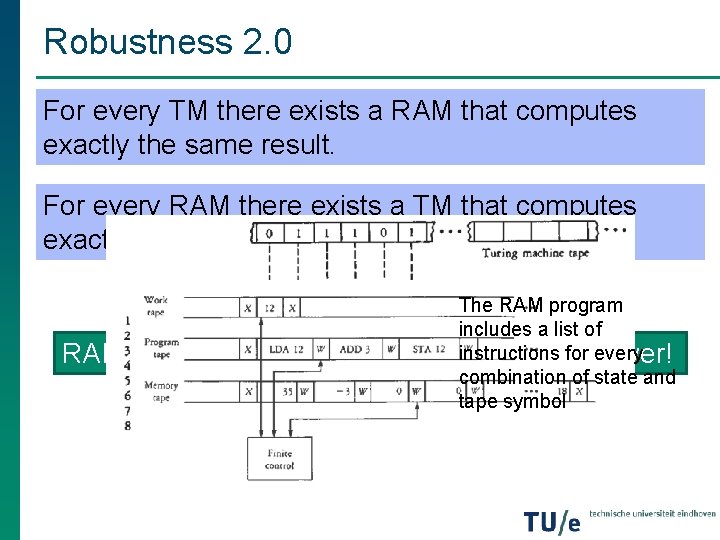
Robustness 2. 0 For every TM there exists a RAM that computes exactly the same result. For every RAM there exists a TM that computes exactly the same result. RAMs and TMs have equal The RAM program includes a list of instructions forpower! every computational combination of state and tape symbol
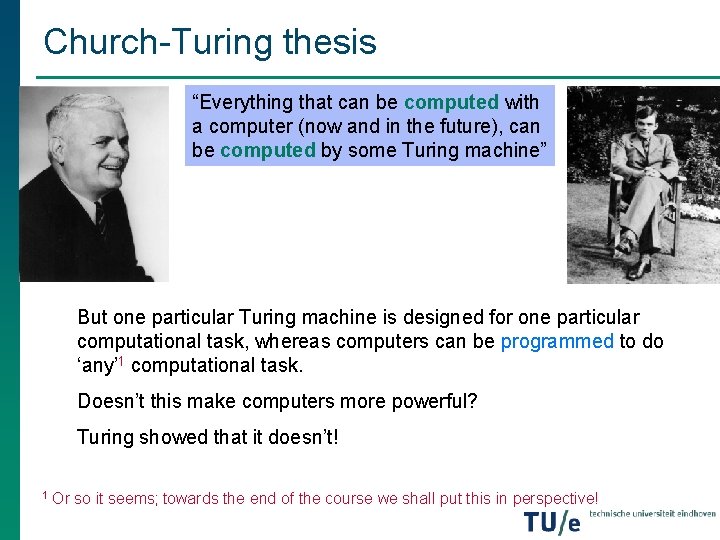
Church-Turing thesis “Everything that can be computed with a computer (now and in the future), can be computed by some Turing machine” But one particular Turing machine is designed for one particular computational task, whereas computers can be programmed to do ‘any’ 1 computational task. Doesn’t this make computers more powerful? Turing showed that it doesn’t! 1 Or so it seems; towards the end of the course we shall put this in perspective!
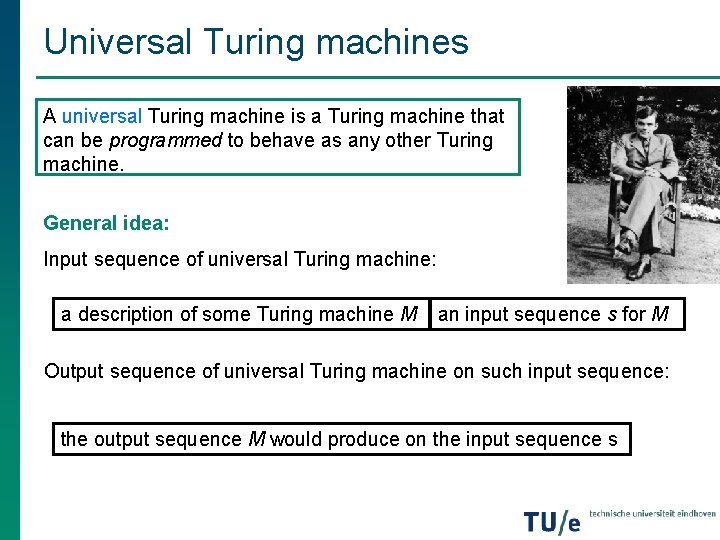
Universal Turing machines A universal Turing machine is a Turing machine that can be programmed to behave as any other Turing machine. General idea: Input sequence of universal Turing machine: a description of some Turing machine M an input sequence s for M Output sequence of universal Turing machine on such input sequence: the output sequence M would produce on the input sequence s
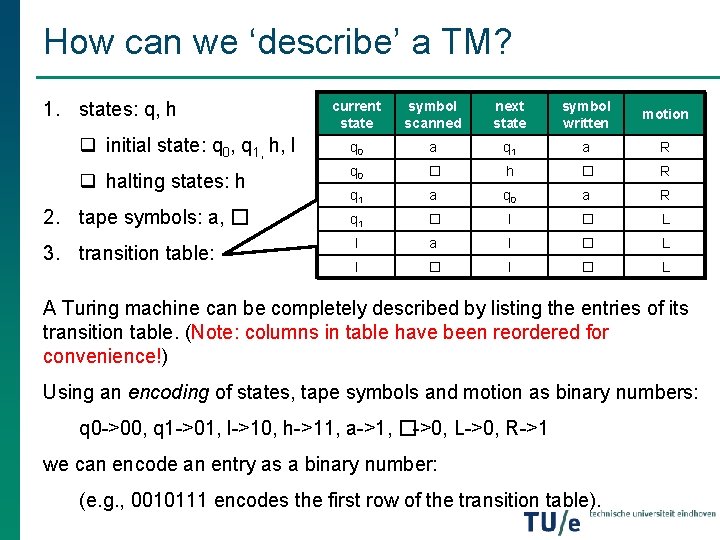
How can we ‘describe’ a TM? 1. states: q, h current state symbol scanned next state symbol written motion q initial state: q 0, q 1, h, l q 0 a q 1 a R q halting states: h q 0 � h � R q 1 a q 0 a R 2. tape symbols: a, � q 1 � l � L l a l � L 3. transition table: A Turing machine can be completely described by listing the entries of its transition table. (Note: columns in table have been reordered for convenience!) Using an encoding of states, tape symbols and motion as binary numbers: q 0 ->00, q 1 ->01, l->10, h->11, a->1, �->0, L->0, R->1 we can encode an entry as a binary number: (e. g. , 0010111 encodes the first row of the transition table).
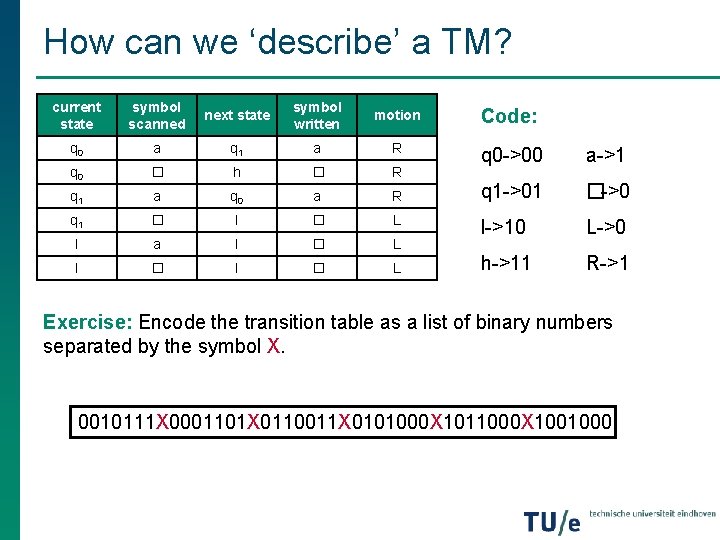
How can we ‘describe’ a TM? current state symbol scanned next state symbol written motion Code: q 0 a q 1 a R q 0 � h � R q 0 ->00 a->1 q 1 a q 0 a R q 1 ->01 �->0 q 1 � l � L l a l � L l->10 L->0 l � L h->11 R->1 Exercise: Encode the transition table as a list of binary numbers separated by the symbol X. 0010111 X 0001101 X 0110011 X 0101000 X 1011000 X 1001000
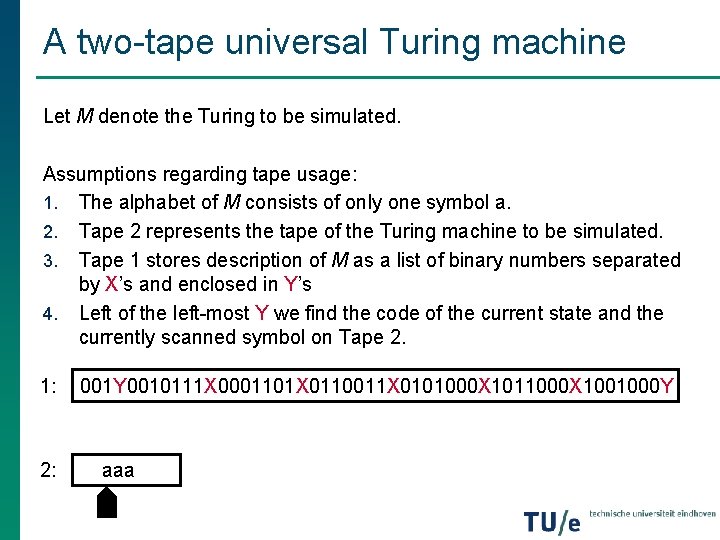
A two-tape universal Turing machine Let M denote the Turing to be simulated. Assumptions regarding tape usage: 1. The alphabet of M consists of only one symbol a. 2. Tape 2 represents the tape of the Turing machine to be simulated. 3. Tape 1 stores description of M as a list of binary numbers separated by X’s and enclosed in Y’s 4. Left of the left-most Y we find the code of the current state and the currently scanned symbol on Tape 2. 1: 2: 001 Y 0010111 X 0001101 X 0110011 X 0101000 X 1011000 X 1001000 Y aaa
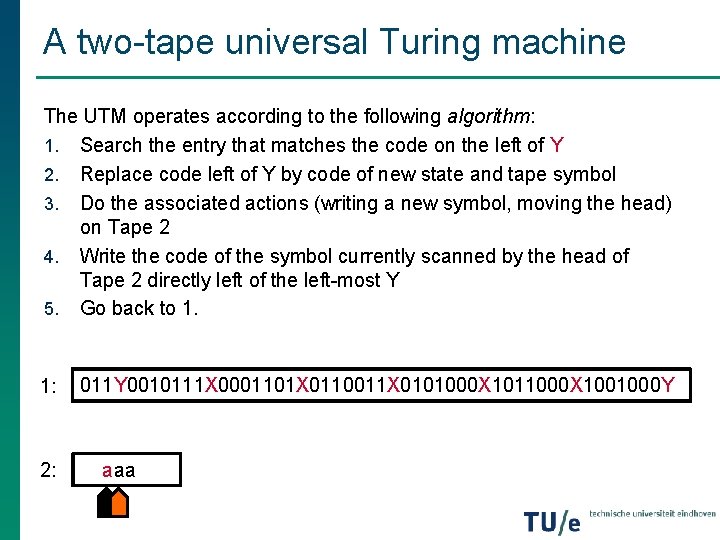
A two-tape universal Turing machine The UTM operates according to the following algorithm: 1. Search the entry that matches the code on the left of Y 2. Replace code left of Y by code of new state and tape symbol 3. Do the associated actions (writing a new symbol, moving the head) on Tape 2 4. Write the code of the symbol currently scanned by the head of Tape 2 directly left of the left-most Y 5. Go back to 1. 1: 2: 001 Y 0010111 X 0001101 X 0110011 X 0101000 X 1011000 X 1001000 Y 011 Y 0010111 X 0001101 X 0110011 X 0101000 X 1011000 X 1001000 Y aaa
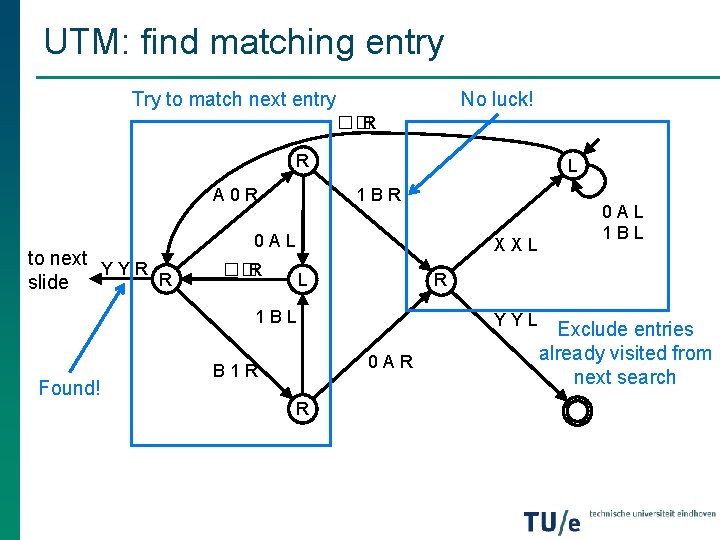
UTM: find matching entry Try to match next entry No luck! �� R R A 0 R to next YYR R slide L 1 BR 0 AL XXL �� R R L 1 BL Found! YYL 0 AR B 1 R R 0 AL 1 BL Exclude entries already visited from next search
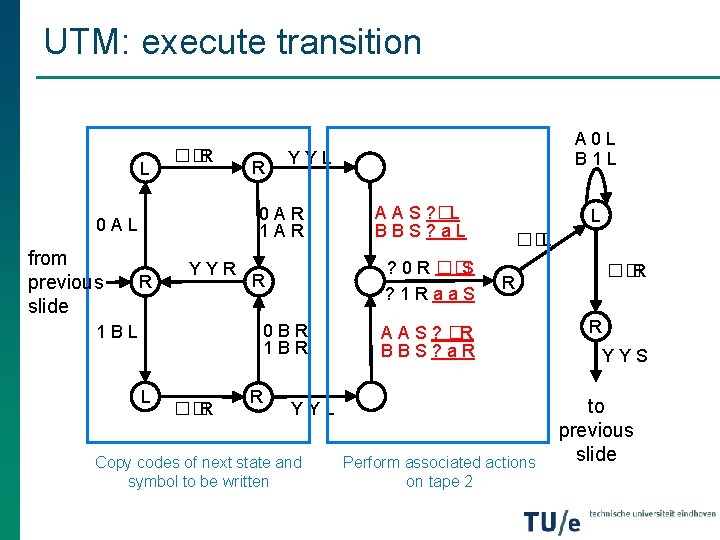
UTM: execute transition L �� R YYL 0 AR 1 AR 0 AL from previous slide R R YYR L �� R R A A S ? �L BBS? a. L ? 0 R ��S ? 1 Raa. S R 0 BR 1 BL A 0 L B 1 L L �� L A A S ? �R BBS? a. R YYL Copy codes of next state and symbol to be written �� R R Perform associated actions on tape 2 R YYS to previous slide
Universal Turing machine The preceding slides define a universal Turing machine. p We used two tapes and S motion to simulate a Turing machine with only one tape and no S motion. Did we cheat? No, we didn’t: there is a robustness result saying that a two-tape Turing machine with S motion can be transformed into a one-tape Turing machine without S motion that computes the same thing! p We used extra symbols. Did we cheat? No, we didn’t: there is a robustness result saying that any Turing machine can be simulated with having only one symbol.
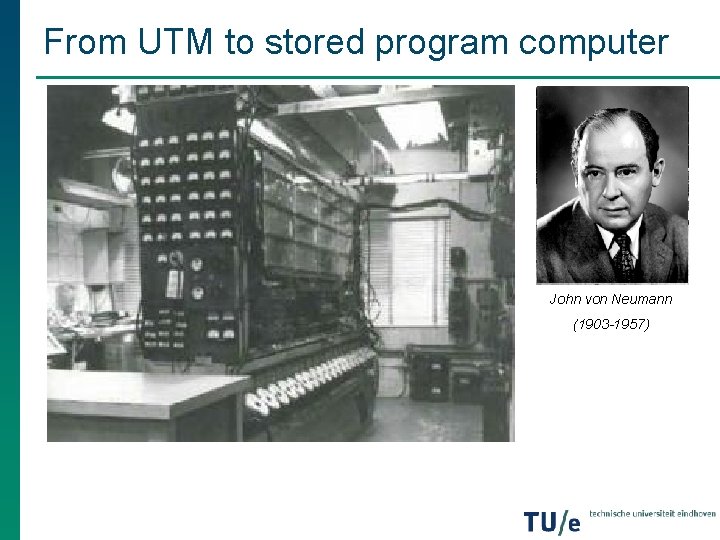
From UTM to stored program computer John von Neumann (1903 -1957)
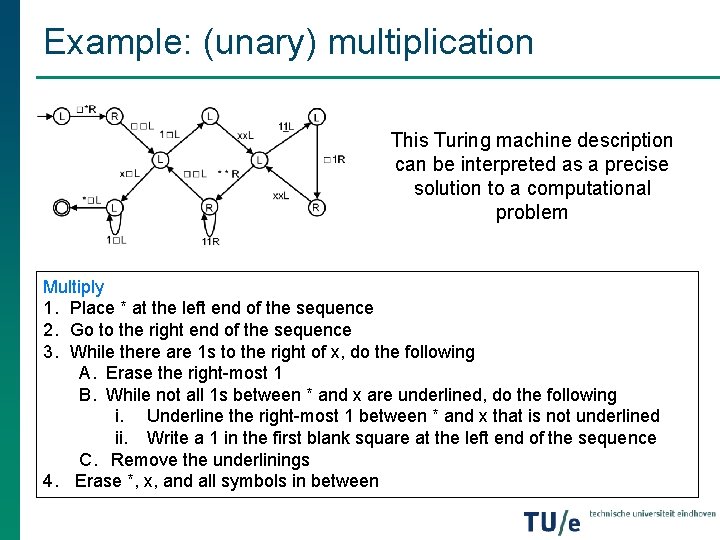
Example: (unary) multiplication This Turing machine description can be interpreted as a precise solution to a computational problem Multiply 1. Place * at the left end of the sequence 2. Go to the right end of the sequence 3. While there are 1 s to the right of x, do the following A. Erase the right-most 1 B. While not all 1 s between * and x are underlined, do the following i. Underline the right-most 1 between * and x that is not underlined ii. Write a 1 in the first blank square at the left end of the sequence C. Remove the underlinings 4. Erase *, x, and all symbols in between
From Automata to Algorithms “An algorithm is a set of steps to accomplish a task that is described precisely enough that a computer can run it. ”
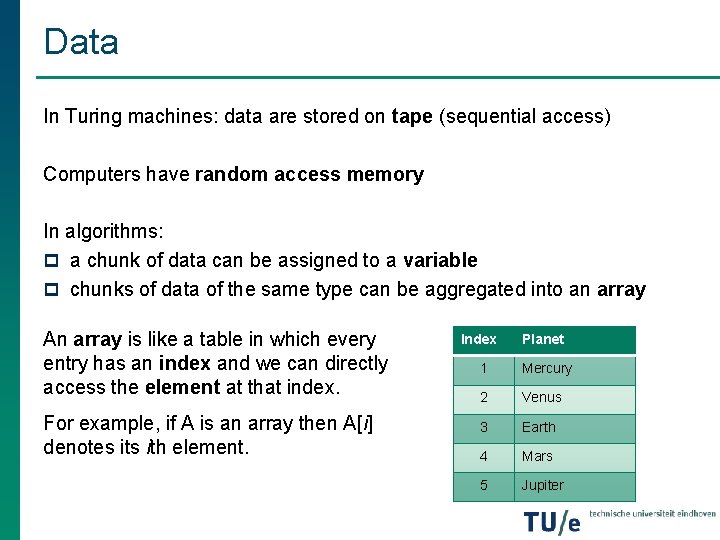
Data In Turing machines: data are stored on tape (sequential access) Computers have random access memory In algorithms: p a chunk of data can be assigned to a variable p chunks of data of the same type can be aggregated into an array An array is like a table in which every entry has an index and we can directly access the element at that index. For example, if A is an array then A[i] denotes ith element. Index Planet 1 Mercury 2 Venus 3 Earth 4 Mars 5 Jupiter
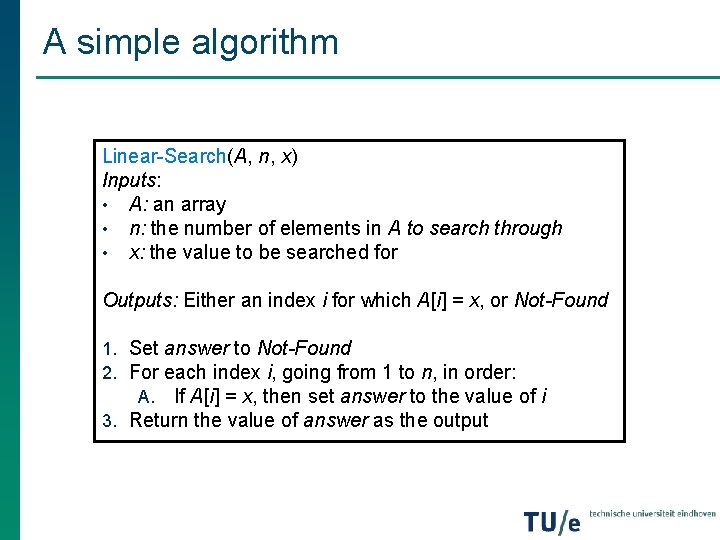
A simple algorithm Linear-Search(A, n, x) Inputs: • A: an array • n: the number of elements in A to search through • x: the value to be searched for Outputs: Either an index i for which A[i] = x, or Not-Found 1. Set answer to Not-Found 2. For each index i, going from 1 to n, in order: A. If A[i] = x, then set answer to the value of i 3. Return the value of answer as the output
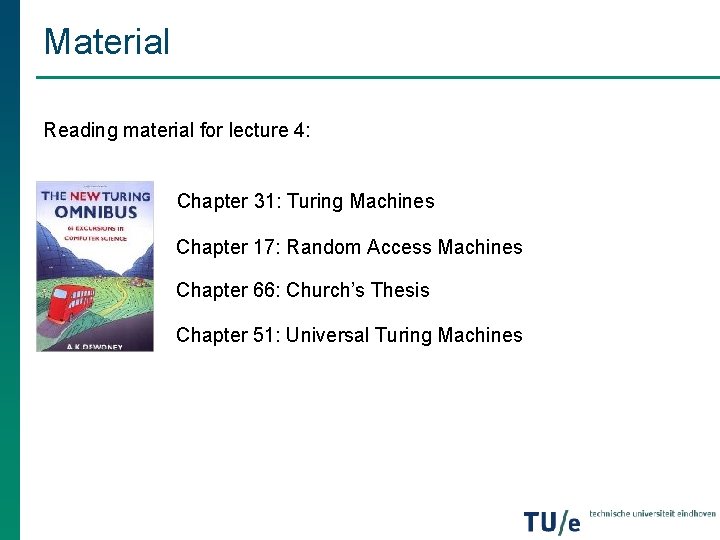
Material Reading material for lecture 4: Chapter 31: Turing Machines Chapter 17: Random Access Machines Chapter 66: Church’s Thesis Chapter 51: Universal Turing Machines