
Fundamentals of Industrial Hygiene 6 th Edition Part




- Slides: 23
Fundamentals of Industrial Hygiene 6 th Edition Part VI: Evaluation of Hazards Chapter 15: Evaluation Compiled by Allen Sullivan, Assistant Professor, Safety and Health Management Central Washington University
General Principles • In 2009, 3. 3 million occupational work-related injuries and illnesses occurred in private industry. • actual number is much larger: • many occupational illnesses are unrecognized • many injuries and illnesses are not reported • public sector not included in the count • Given the weaknesses of the data systems, a focus on evaluation of hazards is even more important.
General Principles (cont. ) • The evaluation of the nature and severity of hazards relies on many factors: • toxicity; • exposure levels or dose; • duration of exposure • process or operation analysis; • maintenance activities, spills, and accidents; • epidemiology and risk assessment; • interview; • unequal distribution of risks; and • variability of response
Basic Approach to Hazard Recognition • Three-step, systematic procedure: 1. consider the raw materials being used 2. consider how raw materials are modified during use 3. evaluate the finished products and by-products (wastes) Note: Should be evaluated under normal conditions and under anticipated emergency conditions.
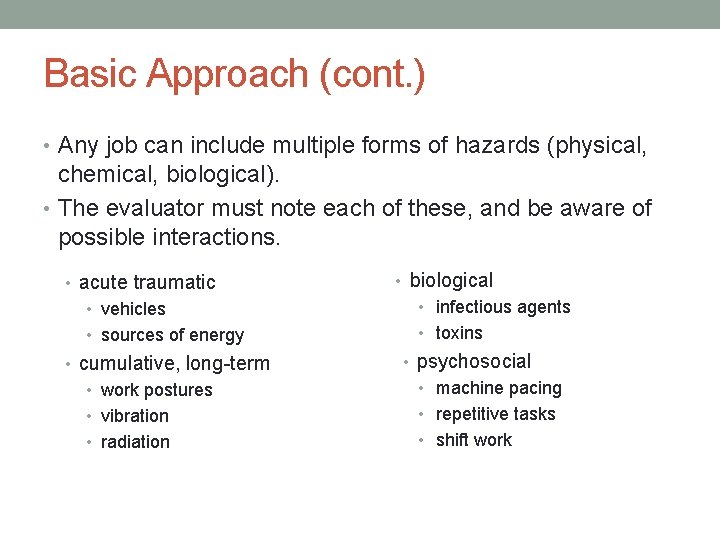
Basic Approach (cont. ) • Any job can include multiple forms of hazards (physical, chemical, biological). • The evaluator must note each of these, and be aware of possible interactions. • acute traumatic • biological • vehicles • infectious agents • sources of energy • toxins • cumulative, long-term • work postures • vibration • radiation • psychosocial • machine pacing • repetitive tasks • shift work
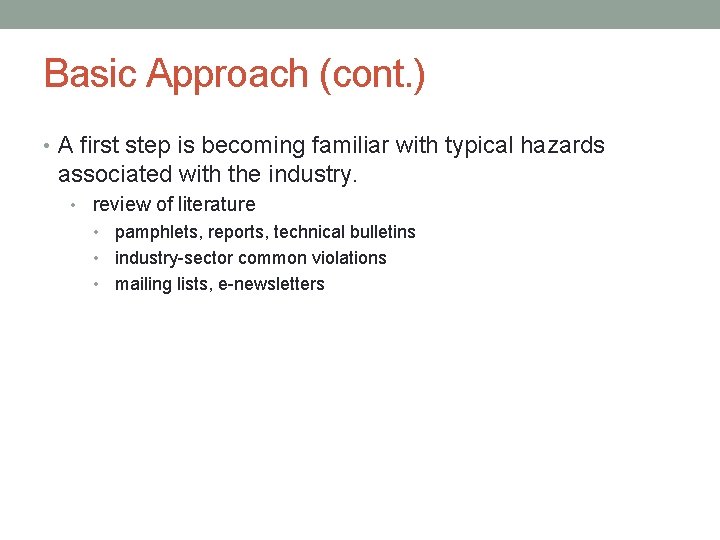
Basic Approach (cont. ) • A first step is becoming familiar with typical hazards associated with the industry. • review of literature pamphlets, reports, technical bulletins • industry-sector common violations • mailing lists, e-newsletters •
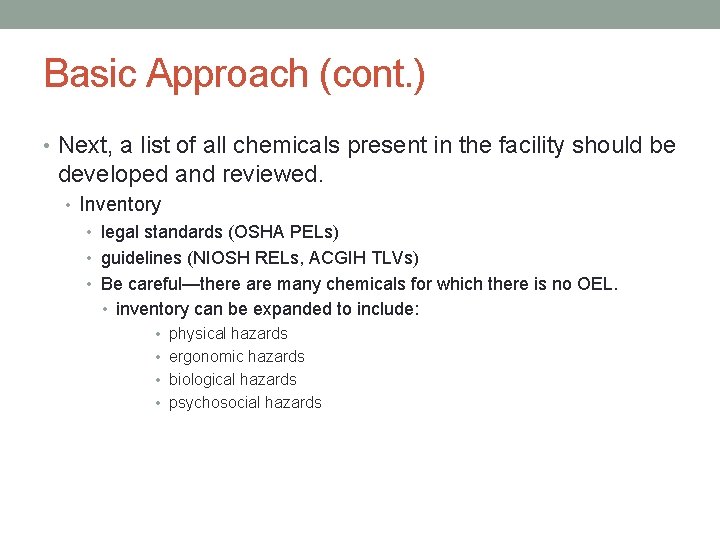
Basic Approach (cont. ) • Next, a list of all chemicals present in the facility should be developed and reviewed. • Inventory • legal standards (OSHA PELs) • guidelines (NIOSH RELs, ACGIH TLVs) • Be careful—there are many chemicals for which there is no OEL. • inventory can be expanded to include: • physical hazards • ergonomic hazards • biological hazards • psychosocial hazards
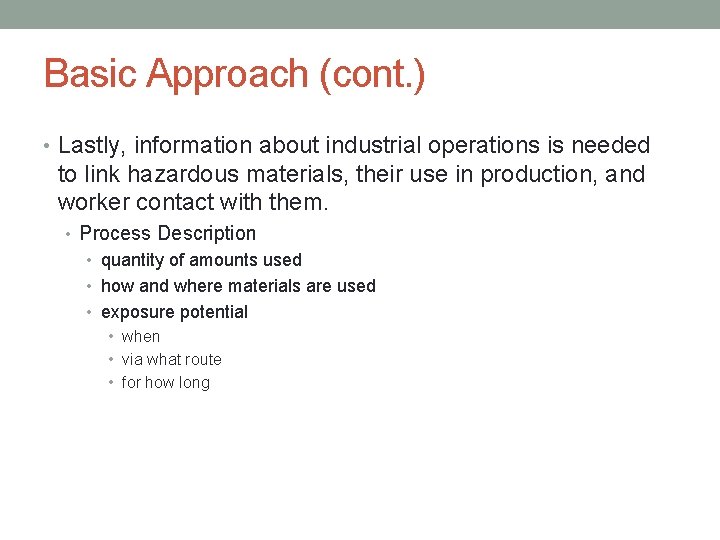
Basic Approach (cont. ) • Lastly, information about industrial operations is needed to link hazardous materials, their use in production, and worker contact with them. • Process Description • quantity of amounts used • how and where materials are used • exposure potential • when • via what route • for how long
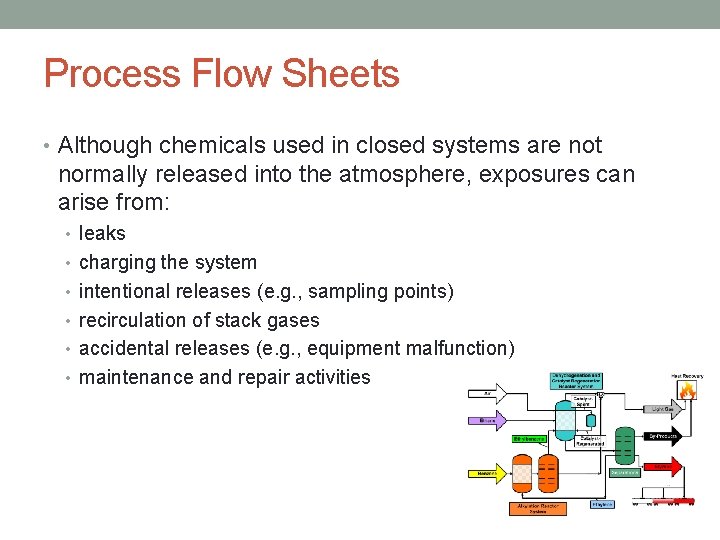
Process Flow Sheets • Although chemicals used in closed systems are not normally released into the atmosphere, exposures can arise from: • leaks • charging the system • intentional releases (e. g. , sampling points) • recirculation of stack gases • accidental releases (e. g. , equipment malfunction) • maintenance and repair activities
Checklists • A checklist for evaluating environmental hazards arising from industrial operations can be created. • Should be modified to fit each organization’s particular situation. • overall process or operation • list all hazardous agents used during the process • equipment • list all equipment that contain hazardous materials or energy that could be suddenly released • cleaning methods • list all hazardous materials used • list all contaminants that could be displaced
Process Safety Management • 29 CFR 1910. 119 recognizes that catastrophic releases could occur wherever large quantities of highly hazardous chemicals are used or stored. • evaluation of potential causes and consequences of: • fires • explosions • releases • spills • includes requirements for: • written operating procedures • training • inspection and testing • safety reviews
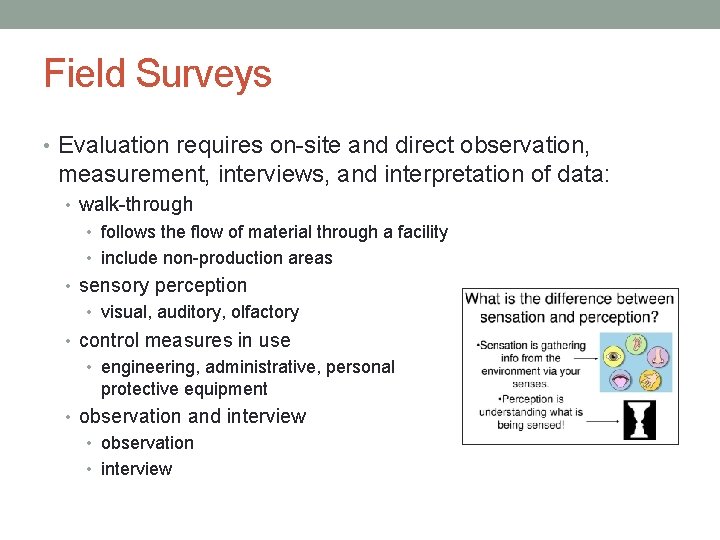
Field Surveys • Evaluation requires on-site and direct observation, measurement, interviews, and interpretation of data: • walk-through • follows the flow of material through a facility • include non-production areas • sensory perception • visual, auditory, olfactory • control measures in use • engineering, administrative, personal protective equipment • observation and interview • observation • interview
Monitoring and Sampling • There a number of reasons why environmental measurements should be taken in the workplace: • evaluating degree of worker exposure • identification of sources for peak exposures • evaluation of control-measure effectiveness • compliance with occupational and environmental regulations • deciding if an area is clear for re-occupancy • establishing background concentrations • warning of peak releases
Monitoring • Monitoring is a continuous program of observation, measurement, and judgment—it is more than just sampling. • personal monitoring • active sampling • passive sampling • environmental (area) monitoring • ambient air sampling • biological monitoring • measurement of the contaminant • measurement of metabolites • measurement of enzymes or functions that reflect harm • medical monitoring • screening, early detection, preventative
Sampling • Preliminary research and initial field surveys help identify potential hazards to which workers may be exposed. • strategy • worst-case approach • typical-condition approach • how it will be used • what to sample • should represent workers’ exposures • how to sample • time-weighted averages • grab sampling • direct-read instruments
Sampling (cont. ) • where to sample • personal monitoring • area monitoring • whom to sample • proximity • work habit • when to sample • season-to-season variations • air-conditioning • work-shift
Sampling (cont. ) • how long to sample • sensitivity of instrument • estimated air concentration • OSHA PEL or ACGIH TLV • what to note while sampling • fundamental records • supplemental records • how many samples to take • purpose of sampling • number of tasks performed • contaminant generation variability
Sampling (cont. ) • when to stop sampling • regulated contaminants (ongoing, routine) • results from most recent sampling (compared to baseline) • who should conduct sampling • adequately trained workers • supervised by professional industrial hygienist • needs knowledge of: • • • potential errors proper calibration and maintenance of equipment potential problems sampling limitations how to integrate observations and interviews when it is not necessary to sample
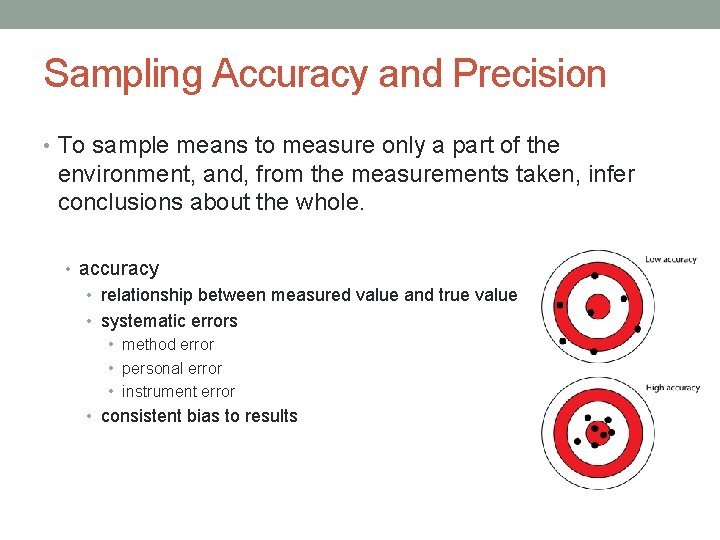
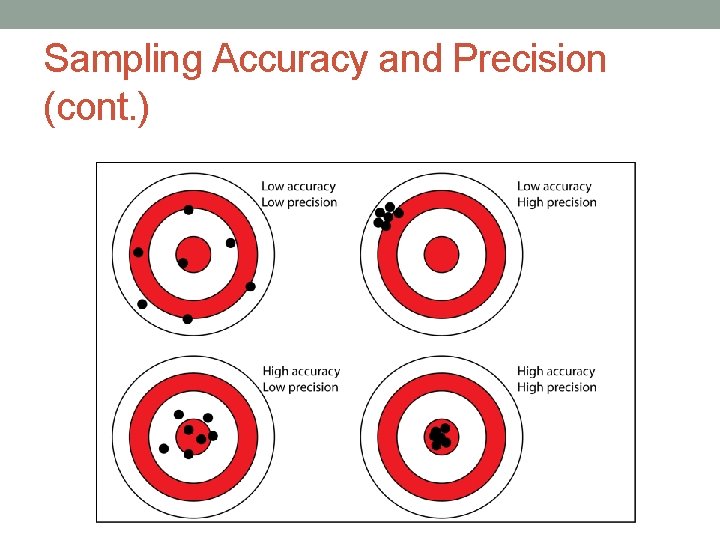
Sampling Accuracy and Precision • To sample means to measure only a part of the environment, and, from the measurements taken, infer conclusions about the whole. • accuracy • relationship between measured value and true value • systematic errors • method error • personal error • instrument error • consistent bias to results
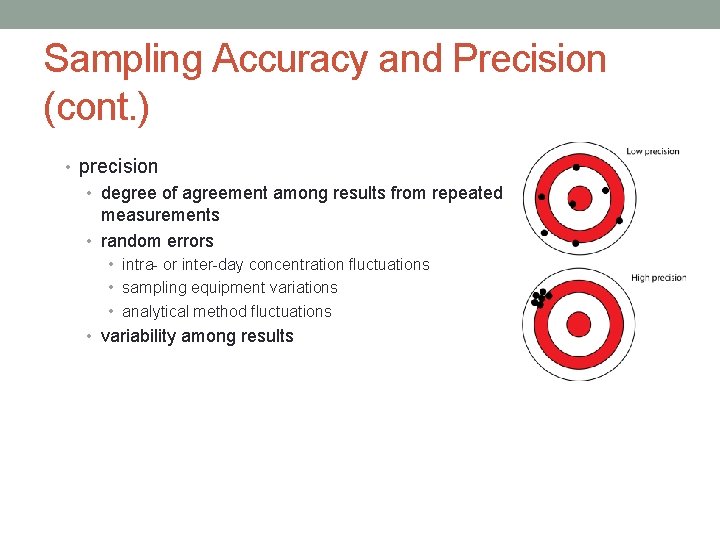
Sampling Accuracy and Precision (cont. ) • precision • degree of agreement among results from repeated measurements • random errors • intra- or inter-day concentration fluctuations • sampling equipment variations • analytical method fluctuations • variability among results
Sampling Accuracy and Precision (cont. )
Interpretation of Results • There are times when the interpretation of results is not a completely straightforward process. • It is always important to keep in mind why the sampling was done: • compliance • OSHA PELs • good practices and worker protection • ACGIH TLVs and NIOSH RELs
Limitations of Standards • While any sampling result that is less than the PEL is considered to be in compliance with the law, this shouldn’t be interpreted as a “clean bill of health. ” • only evaluate inhalation exposures (not dermal or ingestion) • out of date (most based on 1968 TLVs) • based on inadequate research (do not address chronic toxicity) • based on white, male workers • allow a level of risk not tolerated for general environmental exposure • fail to account for multiple exposures (ignore additive or synergistic) • fail to offer comprehensive protections (only 10% of chemicals have PELs) • represent a political compromise (regarding economic feasibility)