
FUNDAMENTALS OF INCLUSIVE GOVERNANCE Fundamentals of Inclusive Governance
- Slides: 23
FUNDAMENTALS OF INCLUSIVE GOVERNANCE
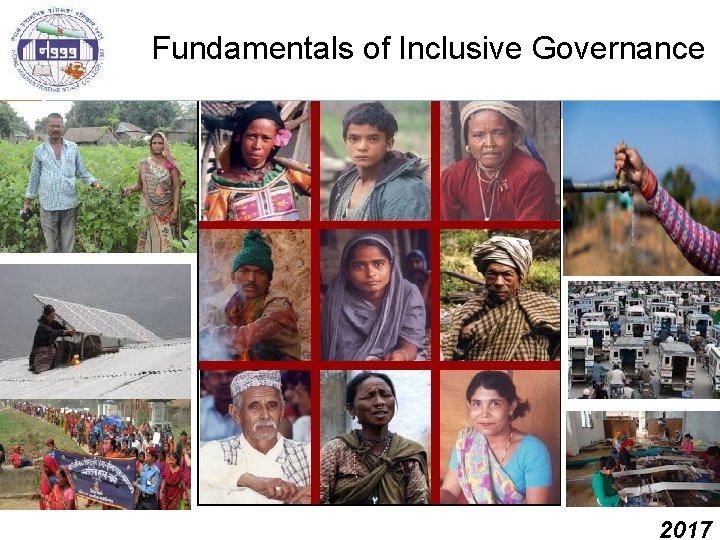
Fundamentals of Inclusive Governance 2017
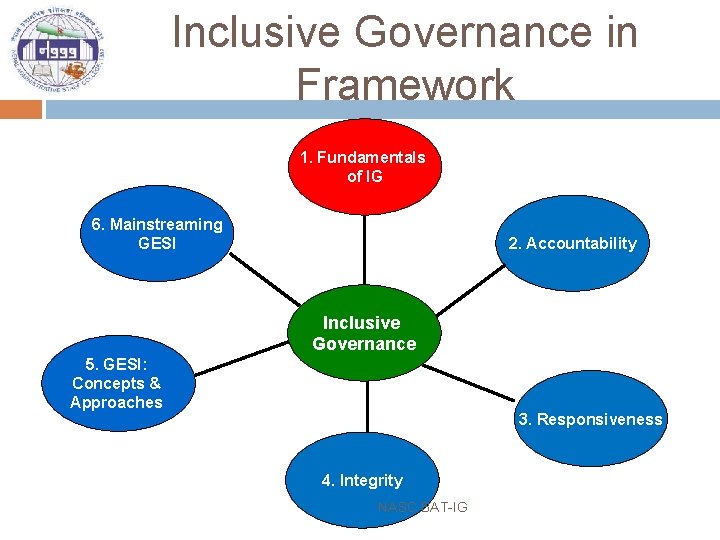
Inclusive Governance in Framework 1. Fundamentals of IG 6. Mainstreaming GESI 2. Accountability Inclusive Governance 5. GESI: Concepts & Approaches 3. Responsiveness 4. Integrity NASC BAT-IG
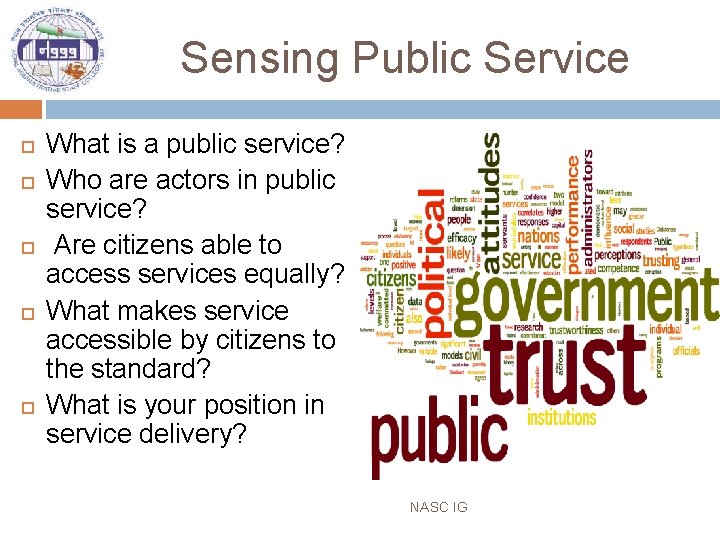
Sensing Public Service What is a public service? Who are actors in public service? Are citizens able to access services equally? What makes service accessible by citizens to the standard? What is your position in service delivery? NASC IG
Group Activity What is “good” service delivery? 1. 3. Groups 1 -2 work on Task A: Draw a picture/diagram on flip illustrating the characteristics of a “Good Rural Municipality services” from the perspective of citizens. - use pictures and words Groups 3 -4 work on Task B: Draw a picture/diagram on flip chart illustrating the characteristics of a “Good Rural Municipality services” from the perspective of the Rural Municipality. - use pictures and words Be prepared to discuss your findings verbally in plenary. You have 15 minutes NASC - IG
Key Learning Points Participation of local people in planning and implementation Recognition of needs of people in exclusion Adequate and timely information about the functions and services Supportive local leadership People friendly attitude and behaviour of service providers and environment Promptness of service delivery The characteristics and vision of good service delivery may often be similar for users and providers NASC IG
Key Learning Points (1) Supporting factors National commitment through constitution, policy and legal frameworks People’s awareness and support Improved institutional arrangement Capacity of service providers International support NASC IG
Key Learning Points (2) Challenges Weak legal enforcement and compliance Attitude and behaviour of service provider Lengthy process and formalities Inadequate institutional facilities Reducing state-people gap NASC IG
National Commitments National commitment reflected in Constitution, General Code of Nepal (Muluki Ain) (Recent amendments), National plan documents, Election Act and Regulations, LSGA 1999/LSGR 2000, Civil Service Act, Good Governance Policy 2008, Right to Information Act 2008 and ratification of international commitments Provisions for ensuring representation, participation, empowerment Capacity building of civil servants Civic education and capacity building of people NASC IG
Group Activity Defining IG terms Work in your groups Use a set of cards Match up each IG term with the correct definition You have 20 minutes NASC IG
Key learning points (1) �Accountability- being answerable for decisions, actions and behaviours towards people �Integrity-being honest and fair. �Responsiveness: responding with empathy, courtesy and pro-activeness to people and their needs. �Gender-a social construct that differentiates roles, responsibilities and needs of man and woman. NASC IG
Key learning points (2) Social exclusion-systemic denial of rights, privileges and social systems Social inclusion-removal of institutional barriers to overcome exclusions Equity-fairness Equality-equal of opportunity Empowerment-developing capacity (livelihood and voice) GESI- approach to mainstream WPEs/ marginalized NASC IG
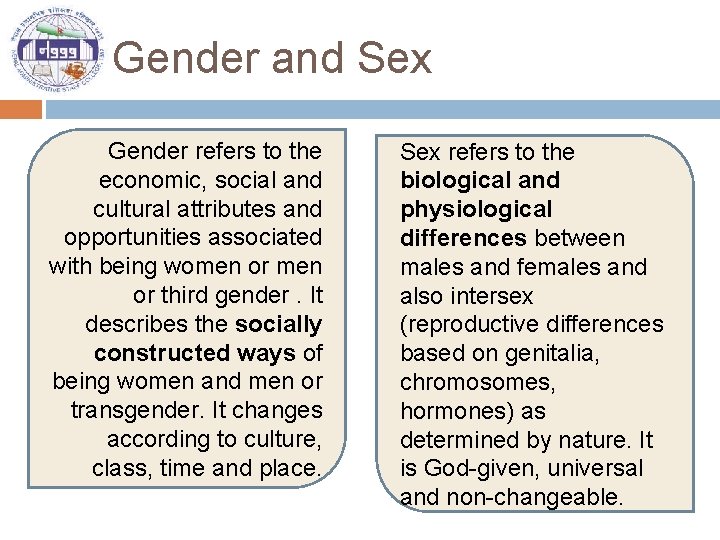
Gender and Sex Gender refers to the economic, social and cultural attributes and opportunities associated with being women or third gender. It describes the socially constructed ways of being women and men or transgender. It changes according to culture, class, time and place. Sex refers to the biological and physiological differences between males and females and also intersex (reproductive differences based on genitalia, chromosomes, hormones) as determined by nature. It is God-given, universal and non-changeable.
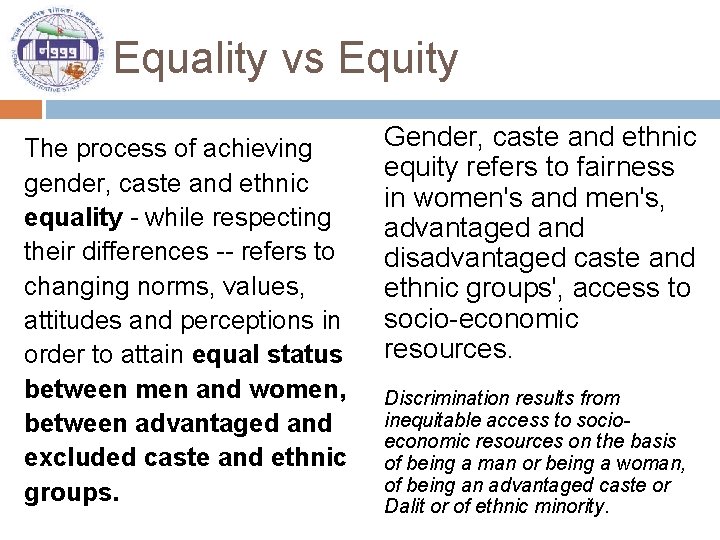
Equality vs Equity The process of achieving gender, caste and ethnic equality - while respecting their differences -- refers to changing norms, values, attitudes and perceptions in order to attain equal status between men and women, between advantaged and excluded caste and ethnic groups. Gender, caste and ethnic equity refers to fairness in women's and men's, advantaged and disadvantaged caste and ethnic groups', access to socio-economic resources. Discrimination results from inequitable access to socioeconomic resources on the basis of being a man or being a woman, of being an advantaged caste or Dalit or of ethnic minority.
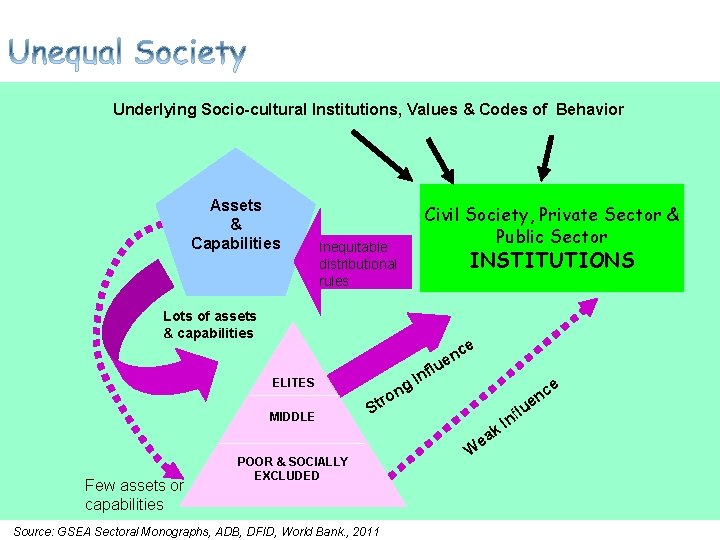
Underlying Socio-cultural Institutions, Values & Codes of Behavior Assets & Capabilities Inequitable distributional rules Civil Society, Private Sector & Public Sector INSTITUTIONS Lots of assets & capabilities e ELITES MIDDLE ng o r t Inf c en lu e S ea Few assets or capabilities POOR & SOCIALLY EXCLUDED Source: GSEA Sectoral Monographs, ADB, DFID, World Bank. , 2011 W k In fl nc e u
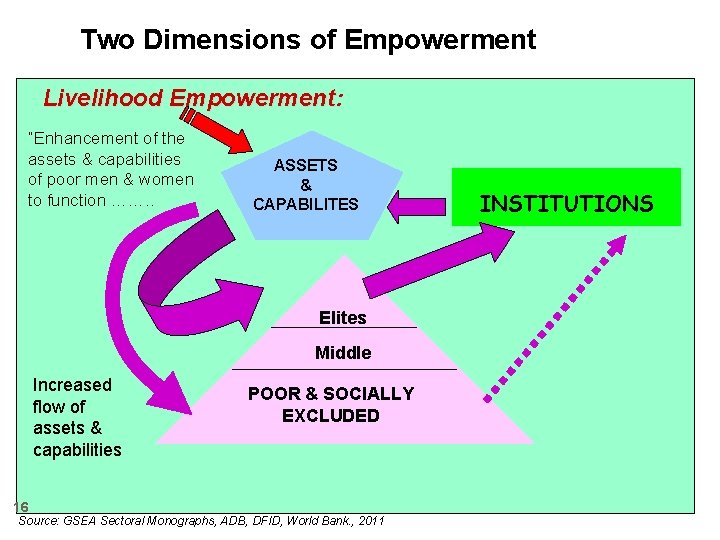
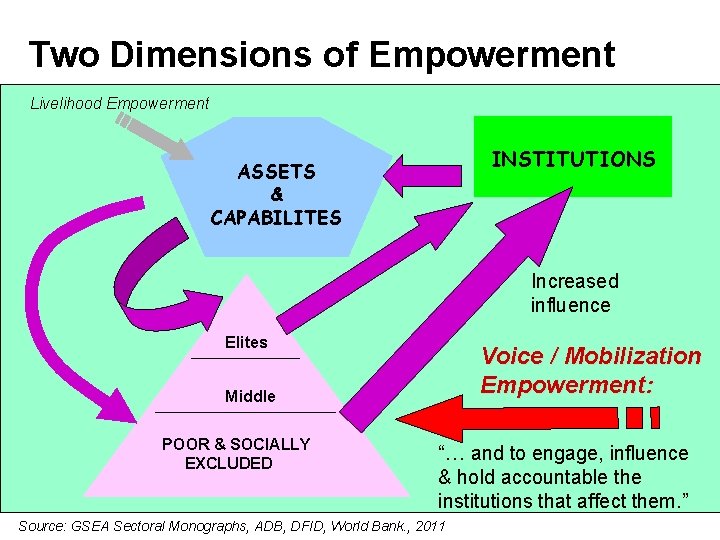
Two Dimensions of Empowerment Livelihood Empowerment: “Enhancement of the assets & capabilities of poor men & women to function ……. . ASSETS & CAPABILITES Elites Middle Increased flow of assets & capabilities 16 POOR & SOCIALLY EXCLUDED Source: GSEA Sectoral Monographs, ADB, DFID, World Bank. , 2011 INSTITUTIONS
Two Dimensions of Empowerment Livelihood Empowerment INSTITUTIONS ASSETS & CAPABILITES Increased influence Elites Voice / Mobilization Empowerment: Middle POOR & SOCIALLY EXCLUDED “… and to engage, influence & hold accountable the institutions that affect them. ” Source: GSEA Sectoral Monographs, ADB, DFID, World Bank. , 2011
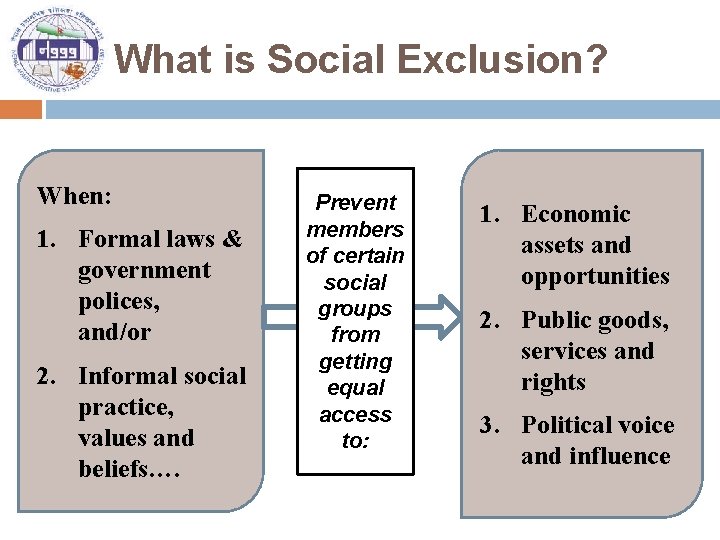
What is Social Exclusion? When: 1. Formal laws & government polices, and/or 2. Informal social practice, values and beliefs…. Prevent members of certain social groups from getting equal access to: 1. Economic assets and opportunities 2. Public goods, services and rights 3. Political voice and influence
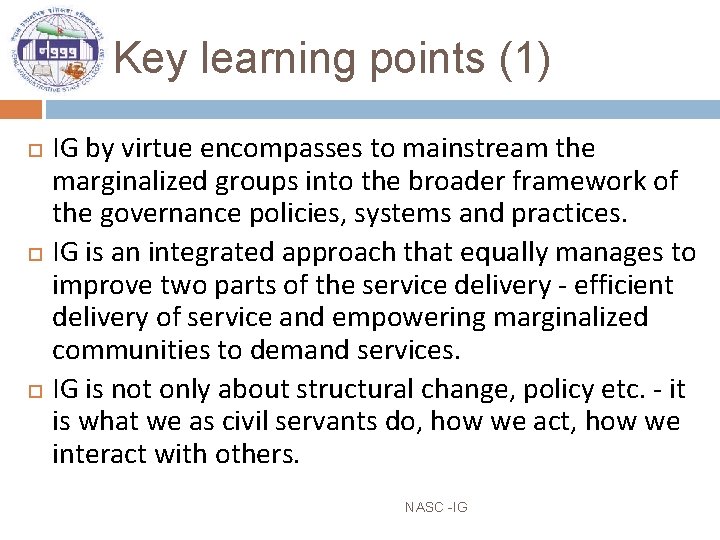
Key learning points (1) IG by virtue encompasses to mainstream the marginalized groups into the broader framework of the governance policies, systems and practices. IG is an integrated approach that equally manages to improve two parts of the service delivery - efficient delivery of service and empowering marginalized communities to demand services. IG is not only about structural change, policy etc. - it is what we as civil servants do, how we act, how we interact with others. NASC -IG
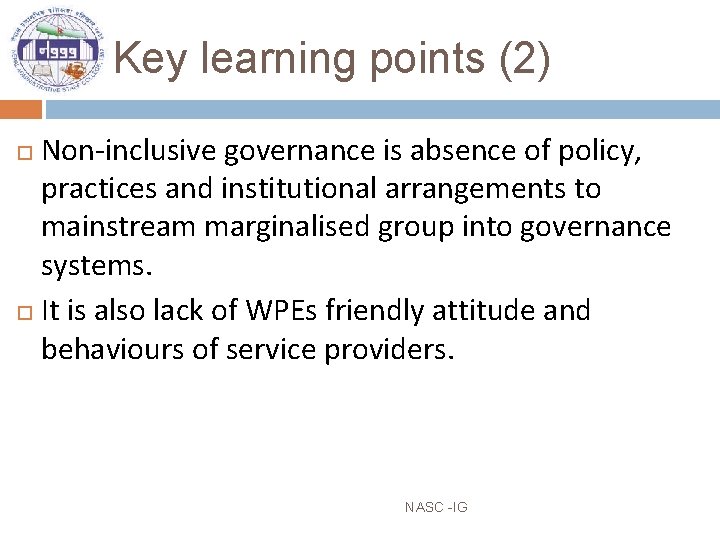
Key learning points (2) Non-inclusive governance is absence of policy, practices and institutional arrangements to mainstream marginalised group into governance systems. It is also lack of WPEs friendly attitude and behaviours of service providers. NASC -IG
Key learning points Why inclusive governance? Rights: equal participation, equal treatment, equal rights before the law, rights to access to services Redistribution: equitable access to resources and opportunities Recognition: representation and meaningful participation in state institutions and decision making process, identity, voices NASC BAT-IG
Conclusion Inclusive Governance is for: Better governance Efficient public service delivery Engaging citizens Ensuring rights of citizens Empowering citizens NASC BAT-IG
Thank You! NASC -IG