
Fundamentals of Human Resource Management 11 e Chapter
- Slides: 27
Fundamentals of Human Resource Management 11 e Chapter 8 Socializing, Orienting, and Developing Employees
Introduction § Ideally, employees who understand what working is about in the organization will become fully productive. § HR helps employees become well-adjusted and productive through socialization, training, and development programs. In other words, they’re hired – now what? Fundamentals of Human Resource Management 11 e
The Insider-Outsider Passage § Socialization, or “onboarding” is a process of adaptation to a new work role § Adjustments must be made whenever individuals change jobs § The most profound adjustment occurs when an individual first enters an organization Fundamentals of Human Resource Management 11 e
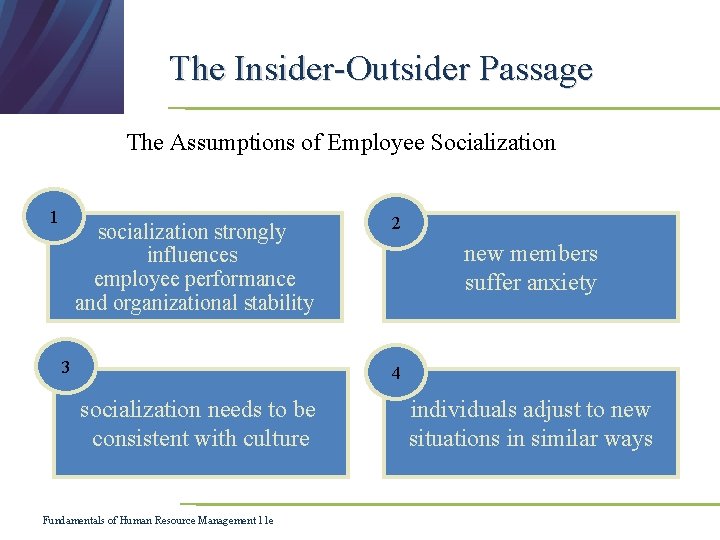
The Insider-Outsider Passage The Assumptions of Employee Socialization 1 socialization strongly influences employee performance and organizational stability 3 2 new members suffer anxiety 4 socialization needs to be consistent with culture Fundamentals of Human Resource Management 11 e individuals adjust to new situations in similar ways
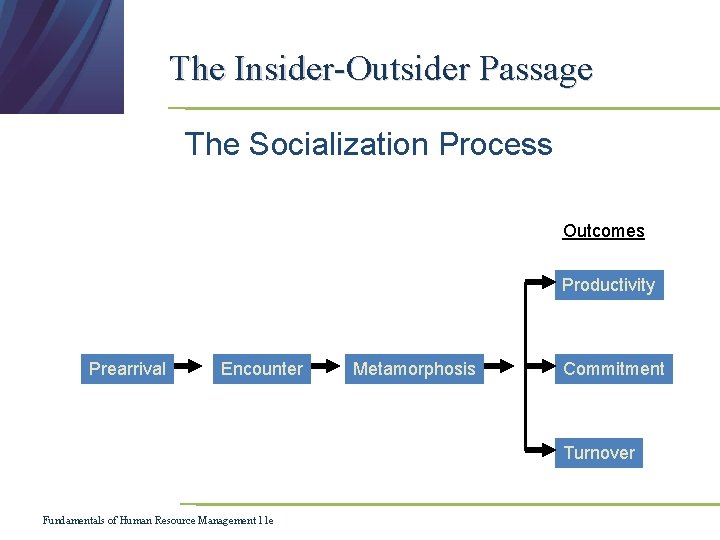
The Insider-Outsider Passage The Socialization Process § Prearrival • Individuals arrive with a set of values, attitudes, and expectations developed from previous experience and the selection process. § Encounter • Individuals discover how well their expectations match realities within the organization. Where differences exist, socialization occurs to imbue the employee with the organization’s standards. § Metamorphosis • Individuals have adapted to the organization, feel accepted, and know what is expected of them. Fundamentals of Human Resource Management 11 e
The Insider-Outsider Passage The Socialization Process Outcomes Productivity Prearrival Encounter Metamorphosis Commitment Turnover Fundamentals of Human Resource Management 11 e
The Purpose of New-Employee Orientation § May be done by supervisor, HR staff, computerbased programs, or some combination § Can be formal or informal, depending on the organization’s size § Teaches the organization’s culture, or system of shared meaning Socialized employees know how things are done, what matters, and which behaviors and perspectives are acceptable Fundamentals of Human Resource Management 11 e
The Purpose of New-Employee Orientation http: //www. southwest. com/careers/culture. html http: //www. hp. com/hpinfo/abouthp/diversity/sharedvalues. html http: //www. google. com/corporate/culture. html http: //walmartstores. com/About. Us/321. aspx Fundamentals of Human Resource Management 11 e
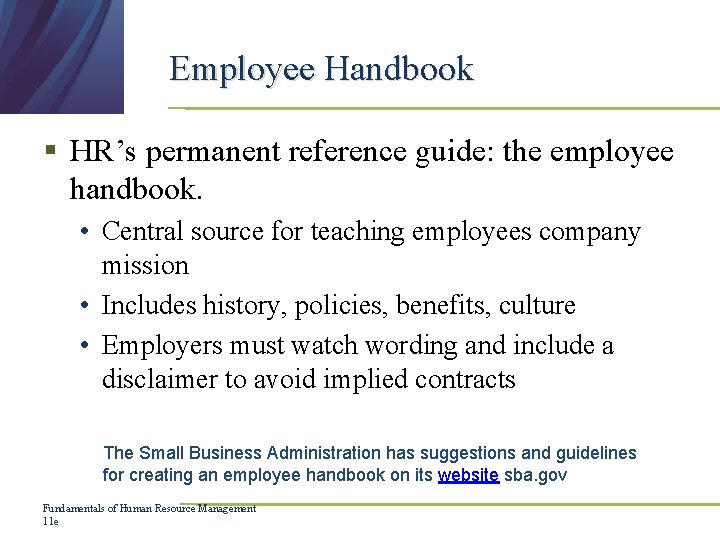
Employee Handbook § HR’s permanent reference guide: the employee handbook. • Central source for teaching employees company mission • Includes history, policies, benefits, culture • Employers must watch wording and include a disclaimer to avoid implied contracts The Small Business Administration has suggestions and guidelines for creating an employee handbook on its website sba. gov Fundamentals of Human Resource Management 11 e
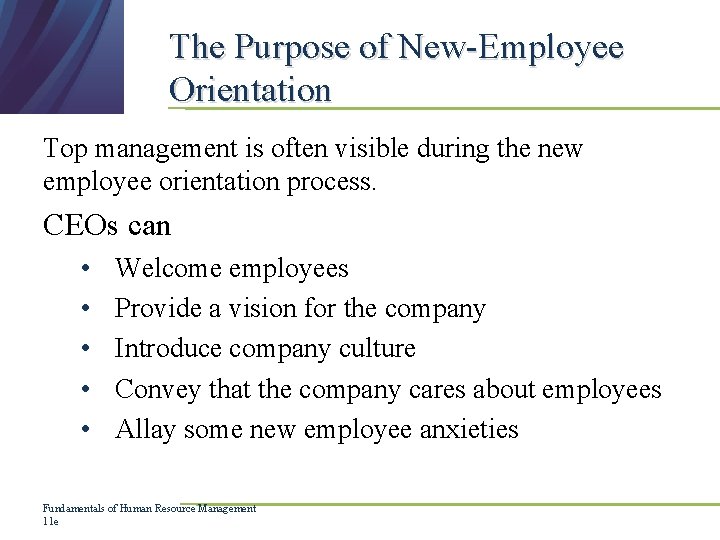
The Purpose of New-Employee Orientation Top management is often visible during the new employee orientation process. CEOs can • • • Welcome employees Provide a vision for the company Introduce company culture Convey that the company cares about employees Allay some new employee anxieties Fundamentals of Human Resource Management 11 e
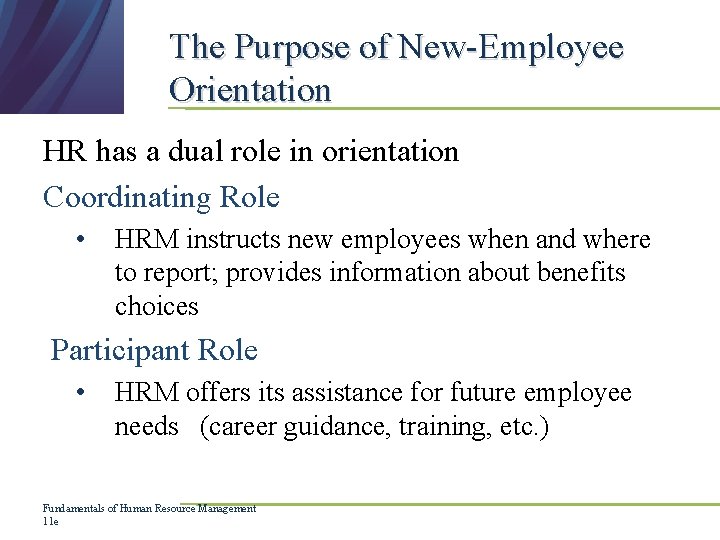
The Purpose of New-Employee Orientation HR has a dual role in orientation Coordinating Role • HRM instructs new employees when and where to report; provides information about benefits choices Participant Role • HRM offers its assistance for future employee needs (career guidance, training, etc. ) Fundamentals of Human Resource Management 11 e
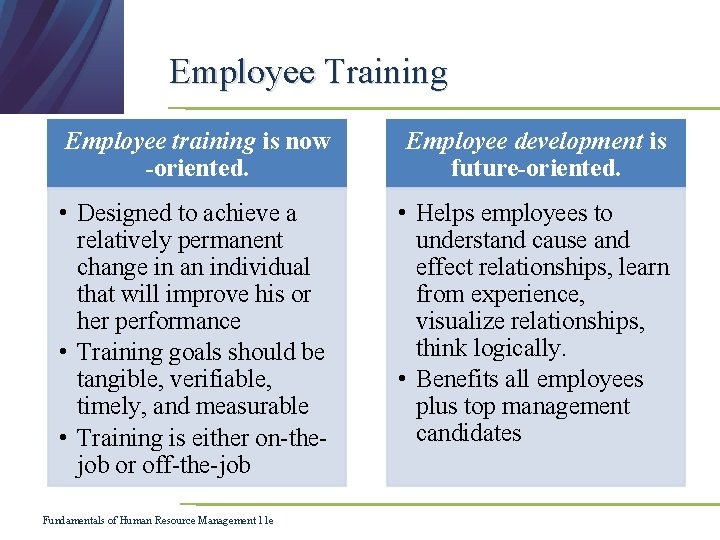
Employee Training Employee training is now -oriented. Employee development is future-oriented. • Designed to achieve a relatively permanent change in an individual that will improve his or her performance • Training goals should be tangible, verifiable, timely, and measurable • Training is either on-thejob or off-the-job • Helps employees to understand cause and effect relationships, learn from experience, visualize relationships, think logically. • Benefits all employees plus top management candidates Fundamentals of Human Resource Management 11 e
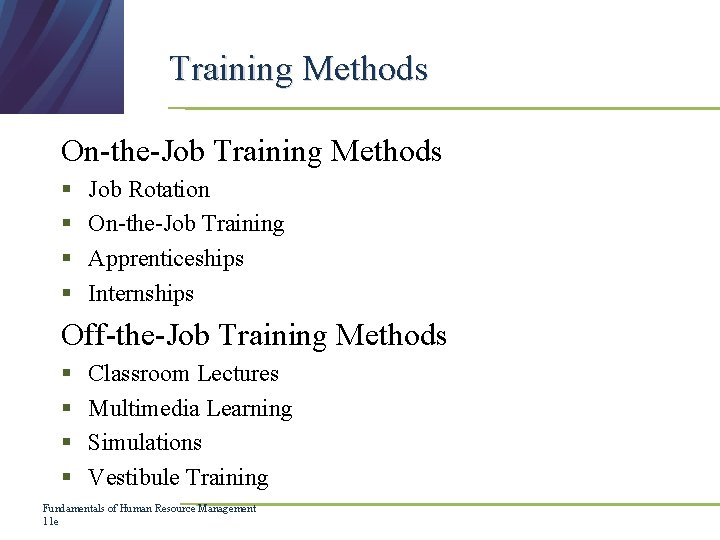
Training Methods On-the-Job Training Methods § § Job Rotation On-the-Job Training Apprenticeships Internships Off-the-Job Training Methods § § Classroom Lectures Multimedia Learning Simulations Vestibule Training Fundamentals of Human Resource Management 11 e
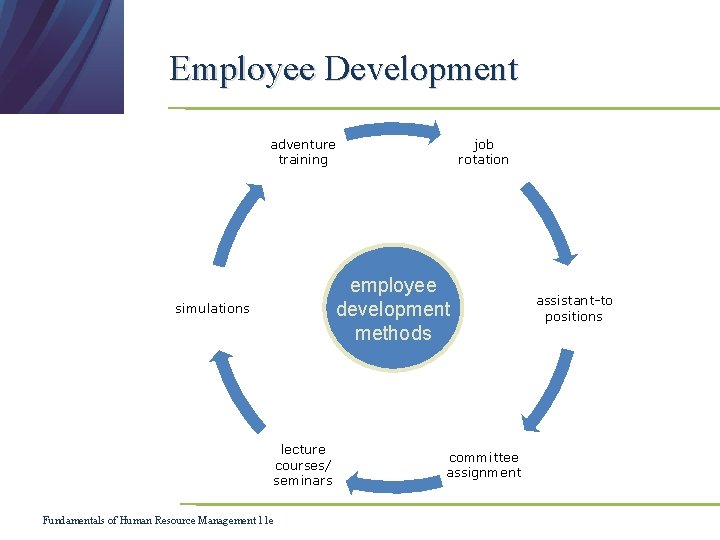
Employee Development adventure training job rotation employee development methods simulations lecture courses/ seminars Fundamentals of Human Resource Management 11 e committee assignment assistant-to positions
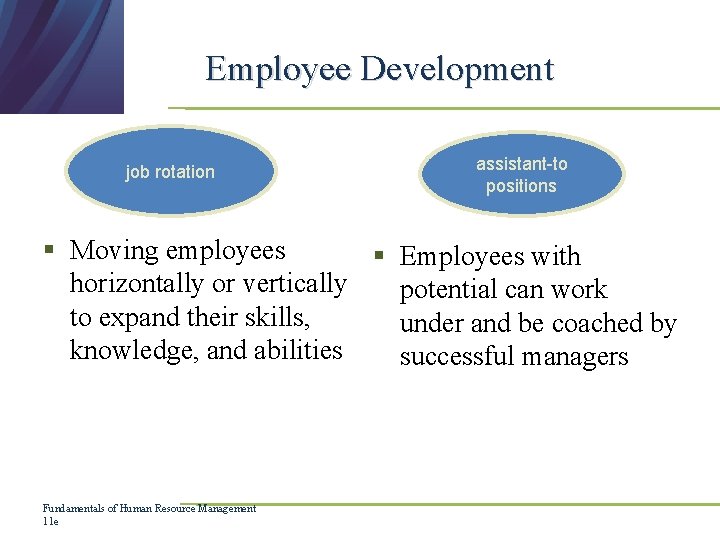
Employee Development job rotation assistant-to positions § Moving employees § Employees with horizontally or vertically potential can work to expand their skills, under and be coached by knowledge, and abilities successful managers Fundamentals of Human Resource Management 11 e
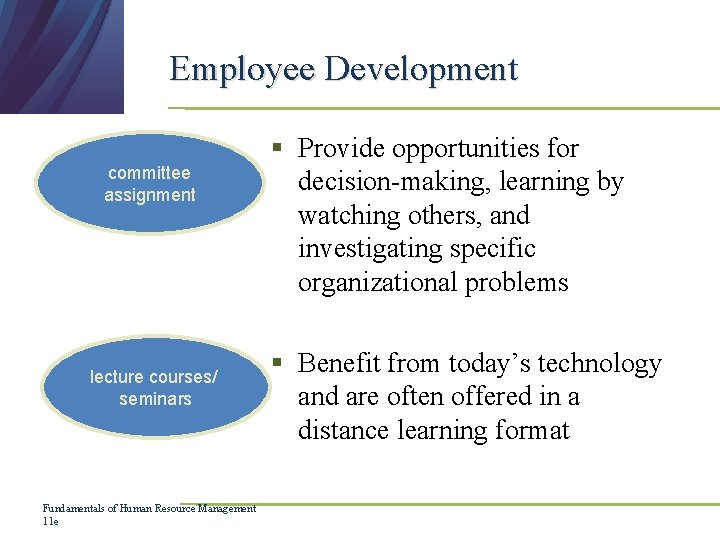
Employee Development committee assignment lecture courses/ seminars Fundamentals of Human Resource Management 11 e § Provide opportunities for decision-making, learning by watching others, and investigating specific organizational problems § Benefit from today’s technology and are often offered in a distance learning format
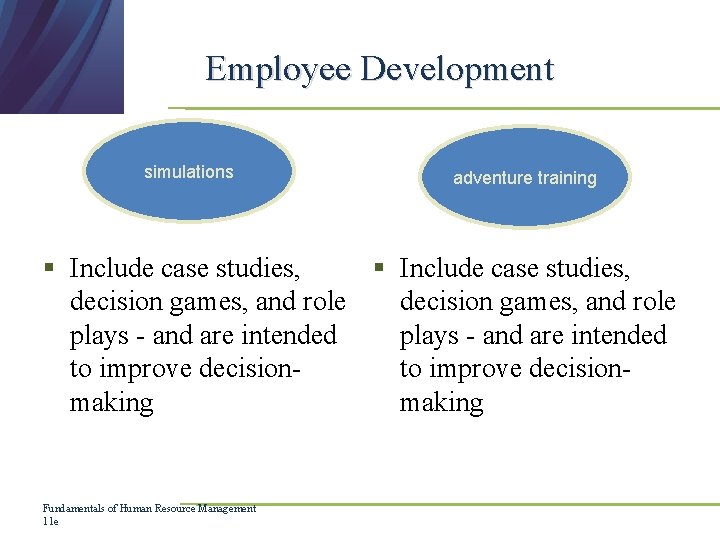
Employee Development simulations adventure training § Include case studies, decision games, and role plays - and are intended to improve decisionmaking Fundamentals of Human Resource Management 11 e
Training Costs § $171. 5 billion is spent annually on employee training. Nearly two-thirds of that was spent internally. The balance was spent on training by external organizations. § $1, 228 was the average spent per employee in the United States. § Employees spend an average of nearly 32 a year in training , with 22 of those spent in a classroom, and nearly 9 of those hours spent online using a self-paced or instructor-led online learning. Fundamentals of Human Resource Management 11 e
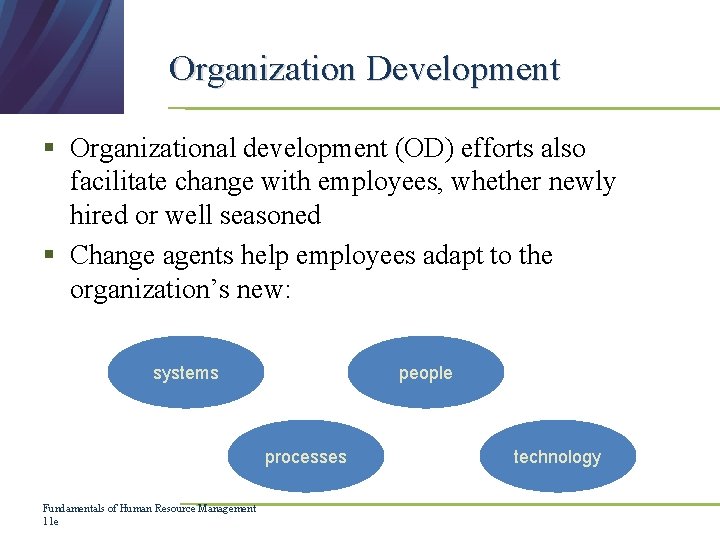
Organization Development § Organizational development (OD) efforts also facilitate change with employees, whether newly hired or well seasoned § Change agents help employees adapt to the organization’s new: systems people processes Fundamentals of Human Resource Management 11 e technology
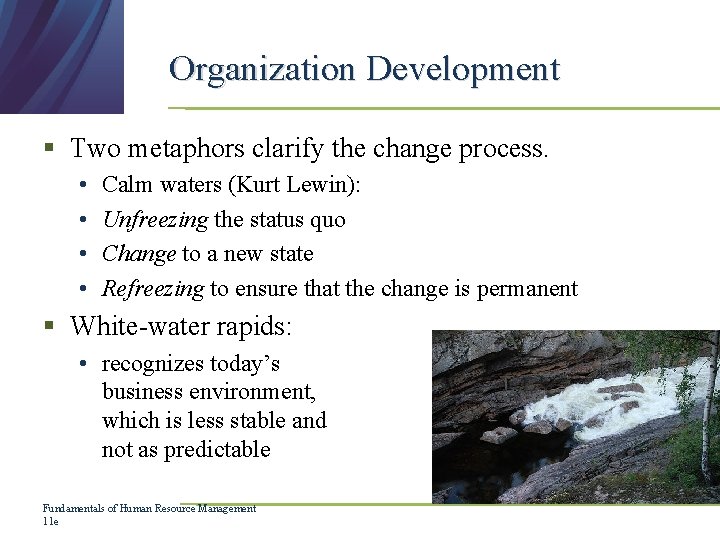
Organization Development § Two metaphors clarify the change process. • • Calm waters (Kurt Lewin): Unfreezing the status quo Change to a new state Refreezing to ensure that the change is permanent § White-water rapids: • recognizes today’s business environment, which is less stable and not as predictable Fundamentals of Human Resource Management 11 e
Organization Development Organizational development facilitates long-term organization-wide changes. § OD techniques include: • Survey feedback gets workers’ attitudes/perceptions on the change • Process consultation gets outside experts to help ease OD efforts • Team building strives for cohesion in a work group • Intergroup development achieves cohesion among different work groups change can be stressful for employees Fundamentals of Human Resource Management 11 e
Organization Development A learning organization values continued learning and believes a competitive advantage can be gained from it. § Characterized by • A capacity to continuously adapt • Employees continually acquiring and sharing new knowledge • Collaboration across functional specialties • Supporting teams, leadership, and culture Fundamentals of Human Resource Management 11 e
Evaluating Training and Development Effectiveness § Employee and management opinions aren’t necessarily valid measures of evaluating effective training. They may be influenced by: • Difficulty • Entertainment value • Personality of the instructor § Performance-based measures (benefits gained) are better indicators of training’s cost-effectiveness § Divide the benefit of the training by the cost of the training to determine ROI (return on investment) Fundamentals of Human Resource Management 11 e
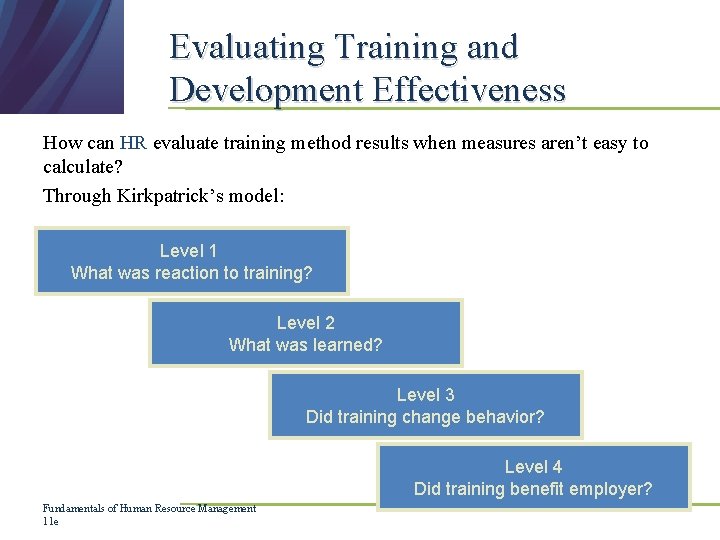
Evaluating Training and Development Effectiveness How can HR evaluate training method results when measures aren’t easy to calculate? Through Kirkpatrick’s model: Level 1 What was reaction to training? Level 2 What was learned? Level 3 Did training change behavior? Level 4 Did training benefit employer? Fundamentals of Human Resource Management 11 e
Evaluating Training and Development Effectiveness HR can also use performance-based evaluation measures. § Post-training method: • Employees’ on-the-job performance is assessed after training § Pre-post-training method: • Employee’s job performance is assessed both before and after training, to determine whether a change has taken place § Pre-post-training w/control group: • Compares results of instructed group to non-instructed group Fundamentals of Human Resource Management 11 e
International Training and Development Issues Training and development is critical to overseas employees. It must teach the culture’s: § § § § Politics Language Religion Economy History Social climate Business practice may involve role playing, simulations, and immersion in the culture Fundamentals of Human Resource Management 11 e
Let’s Play Jeopardy-style! 1. A process of adaptation to a new work role. What is socialization/onboarding? 2. Individuals adjust to new situations in similar ways. What is an assumption of employee socialization? 3. Prearrival, encounter, metamorphosis What are the steps in the socialization process? 4. A central source on company mission, history, policies, benefits, and culture. What is an employee handbook? 5. Job rotation, assistant-to positions, committee assignments, lectures/seminars, simulations. What are the employee development methods? 6. They help employees adapt to OD efforts. What are change agents? 7. Post-training method, pre-post-training w/control group. What are performance-based evaluation methods? Fundamentals of Human Resource Management 11 e