
Fundamentals of Health Workflow Process Analysis and Redesign
- Slides: 34
Fundamentals of Health Workflow Process Analysis and Redesign Unit 10. 7 Facilitating Implementation Decisions Meeting
Unit Objectives Upon successful completion of this unit the student is able to: • Plan and conduct a decision making meeting • Present a walk through of a decision making meeting • Prepare a presentation to communicate findings of a workflow process analysis to healthcare facility decision makers • Document decisions made and actions identified in a decision making meeting. Component 10/Unit 7 Health IT Workforce Curriculum Version 1. 0/Fall 2010 Slide 2
Topics – Unit 10. 7 • Coordinating a decision making meeting • Appropriate group methods to discuss and make decisions on inefficiencies • Opportunities for streamlining • Transition from analysis and redesign to implementation planning • Examples of plan content Component 10/Unit 7 Health IT Workforce Curriculum Version 1. 0/Fall 2010 Slide 3
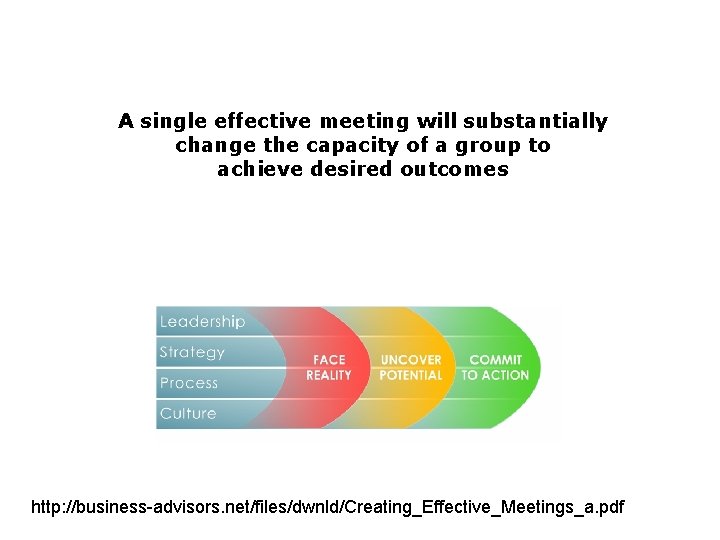
A single effective meeting will substantially change the capacity of a group to achieve desired outcomes http: //business-advisors. net/files/dwnld/Creating_Effective_Meetings_a. pdf
Meeting Goals • “ to make as good or as effective as possible”: – Using the experience and skills of Healthcare personnel – Expanding the range of solutions – Achieve overall optimum efficiency • All within the contextual framework of “Meaningful Use of IT” Component 10/Unit 7 Health IT Workforce Curriculum Version 1. 0/Fall 2010 Slide 5
Focus • Analyzed the “As is” Process • Redesigned the “As is” Process to create a Plan • Have the “To be” Process • Now – Streamline the process – Chart the course for moving into implementation Component 10/Unit 7 Health IT Workforce Curriculum Version 1. 0/Fall 2010 Slide 6
Meeting Purpose • • Streamline the Redesigned Workflow Diagrams Establish rapid, efficient information sharing Preserve established workflow when appropriate Build Consensus as necessary on the final redesign plans • Build “Buy In” of the participants to the changes proposed • Provide the decisions for the “Implementation” report Component 10/Unit 7 Health IT Workforce Curriculum Version 1. 0/Fall 2010 Slide 7
Meeting Facilitator Role • Facilitation - process of designing/running a successful meeting • HC Workflow Analysis and Redesign Specialist Role – – – – Establish Group Norms Manage Time Describe your role in the meeting Describe participants role in the meeting Walk through the redesigned Process Workflow Diagrams Establish ground rules for the meeting Listen to and document Feedback Incorporate changes in the Process Diagrams Component 10/Unit 7 Health IT Workforce Curriculum Version 1. 0/Fall 2010 Slide 8
Meeting Participants Role • Work within the established ground rules • Suggest changes to the redesigned Process Workflow Diagrams • Provide “reality checks” • Identify: – Correction of any errors identified in the “To Be” process design – Reformatting (revision) needs of Workflow Diagrams – Training needs of new processes • Participate actively in the meeting Component 10/Unit 7 Health IT Workforce Curriculum Version 1. 0/Fall 2010 Slide 9
Key elements of success • Involvement of key personnel who have thought through potential solutions • Involvement of key personnel results in ownership of ideas (solutions) and develops commitment for implementation • Immediate focus on changes which will make the greatest possible contribution to “Meaningful Use” • Initial implementation planning is begun in a debriefing wrap-up session at the conclusion of the decision-making meeting Component 10/Unit 7 Health IT Workforce Curriculum Version 1. 0/Fall 2010 Slide 10
Facilitation methods • Focused Conversation Method – Surface new ideas and solutions – Stimulate candid feedback • Consensus Workshop Method – – Tap rational and intuitive thought processes Integrate diverse ideas Generate practical and creative solutions Develop group consensus • Action Planning Method – – Visualize a successful result Analyze the current reality Create a practical plan Maximize group involvement Component 10/Unit 7 Health IT Workforce Curriculum Version 1. 0/Fall 2010 Slide 11
Aspects of Facilitation • Making arrangements for the meeting • Setting the agenda • Understanding group norms • Understanding group dynamics Component 10/Unit 7 Health IT Workforce Curriculum Version 1. 0/Fall 2010 Slide 12
Suggested Approaches • Discuss reformatting (revision) of Workflow Diagrams • Walk through the redesigned Process Workflow Diagrams • Incorporate changes in the Process Diagrams • Provide Feedback on the Workflow Process Redesign • Discuss training needs of new processes Component 10/Unit 7 Health IT Workforce Curriculum Version 1. 0/Fall 2010 Slide 13
Meeting Preparation Step 1: Select participants for the Meeting Step 2: Prepare detailed Agenda Step 3: Prepare Review of the redesign reports Step 4: Design group processes to attain final streamlined implementation plan where each member’s input is documented Step 5: Appropriate Setting and Materials: – Flipcharts, Post It Notes, Markers, Wall Space Component 10/Unit 7 Health IT Workforce Curriculum Version 1. 0/Fall 2010 Slide 14
Identify processes Ripe for Improvement • Those that can increase satisfaction, compliance, and meaningful use if health IT • Appeal to patients, clinicians and administrators • Some health care providers can show much a change can improve services in specific areas • Review “Best Practices” in other Health care facilities for items to discuss. Best practice far exceeds health care service. Component 10/Unit 7 Health IT Workforce Curriculum Version 1. 0/Fall 2010 Slide 15
Select topic exercise • • Identify topics ripe for Improvement in your organization (or use your current topic) Once you have selected a topic, list specific ways in which each topic meets the selection criteria Define the gap (include outcome measure) Identify the good examples Identify business implications Component 10/Unit 7 Health IT Workforce Curriculum Version 1. 0/Fall 2010 Slide 16
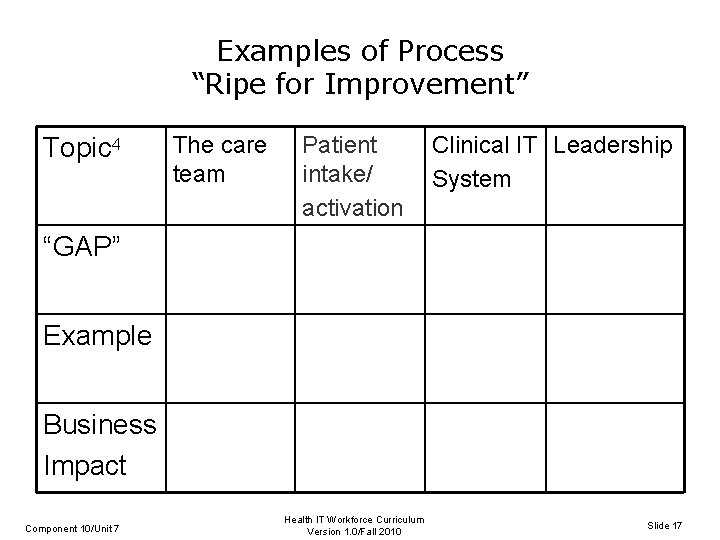
Examples of Process “Ripe for Improvement” Topic 4 The care team Patient intake/ activation Clinical IT Leadership System “GAP” Example Business Impact Component 10/Unit 7 Health IT Workforce Curriculum Version 1. 0/Fall 2010 Slide 17
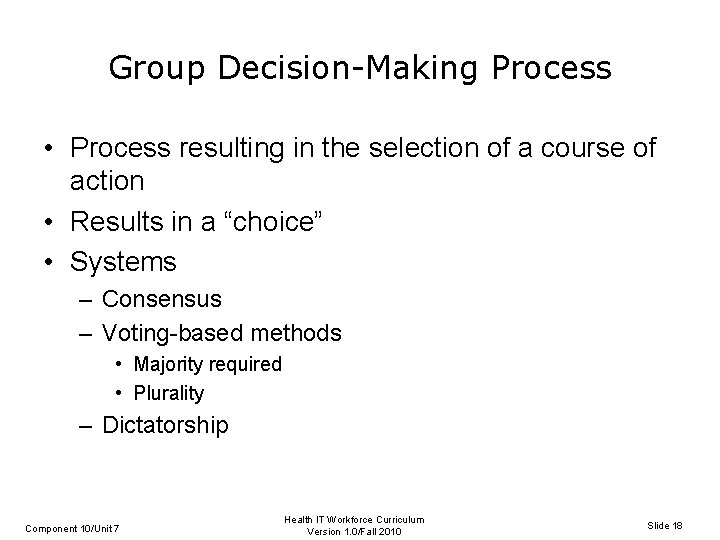
Group Decision-Making Process • Process resulting in the selection of a course of action • Results in a “choice” • Systems – Consensus – Voting-based methods • Majority required • Plurality – Dictatorship Component 10/Unit 7 Health IT Workforce Curriculum Version 1. 0/Fall 2010 Slide 18
Decision-making in the health care setting • Analyze • Discuss with clinic to determine this • Incorporate when planning the meeting Component 10/Unit 7 Health IT Workforce Curriculum Version 1. 0/Fall 2010 Slide 19
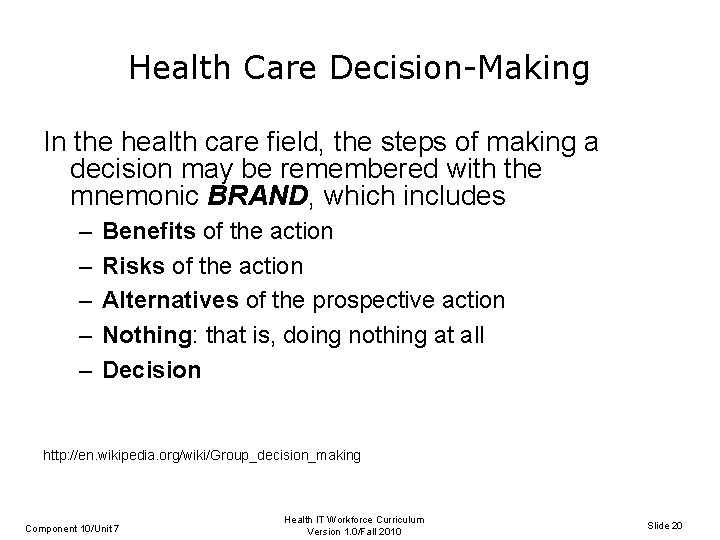
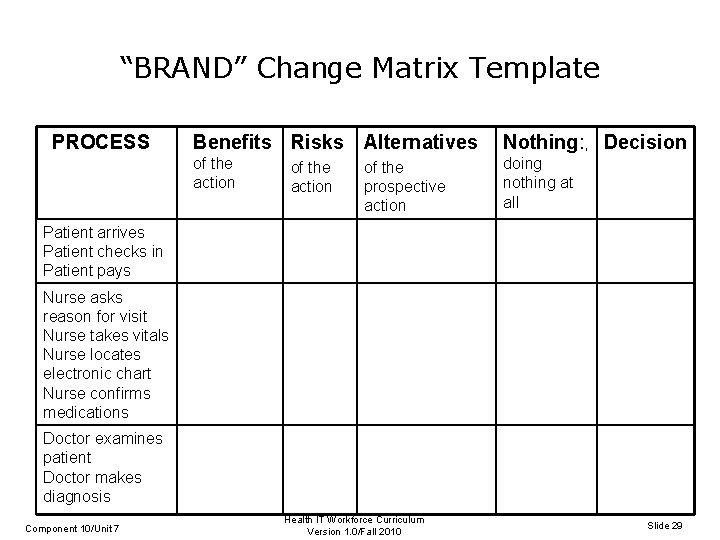
Health Care Decision-Making In the health care field, the steps of making a decision may be remembered with the mnemonic BRAND, which includes – – – Benefits of the action Risks of the action Alternatives of the prospective action Nothing: that is, doing nothing at all Decision http: //en. wikipedia. org/wiki/Group_decision_making Component 10/Unit 7 Health IT Workforce Curriculum Version 1. 0/Fall 2010 Slide 20
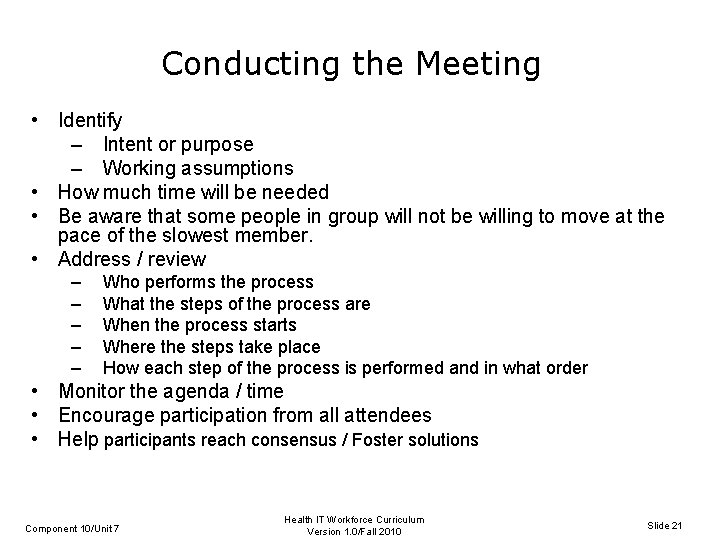
Conducting the Meeting • Identify – Intent or purpose – Working assumptions • How much time will be needed • Be aware that some people in group will not be willing to move at the pace of the slowest member. • Address / review – – – Who performs the process What the steps of the process are When the process starts Where the steps take place How each step of the process is performed and in what order • Monitor the agenda / time • Encourage participation from all attendees • Help participants reach consensus / Foster solutions Component 10/Unit 7 Health IT Workforce Curriculum Version 1. 0/Fall 2010 Slide 21
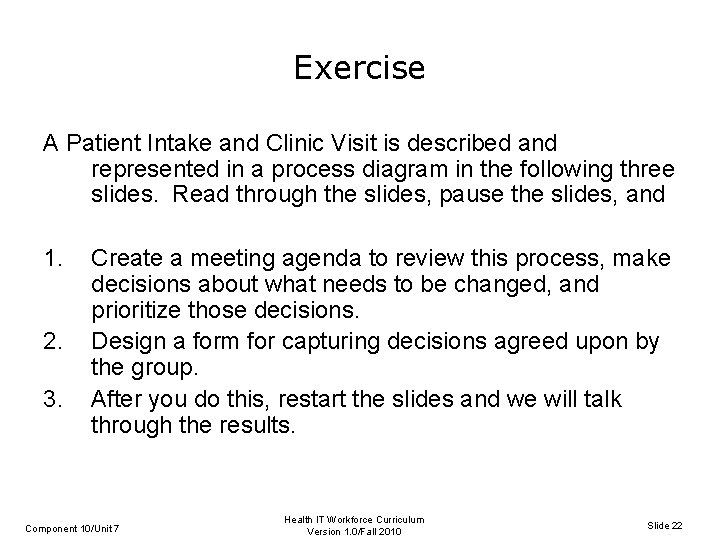
Exercise A Patient Intake and Clinic Visit is described and represented in a process diagram in the following three slides. Read through the slides, pause the slides, and 1. 2. 3. Create a meeting agenda to review this process, make decisions about what needs to be changed, and prioritize those decisions. Design a form for capturing decisions agreed upon by the group. After you do this, restart the slides and we will talk through the results. Component 10/Unit 7 Health IT Workforce Curriculum Version 1. 0/Fall 2010 Slide 22
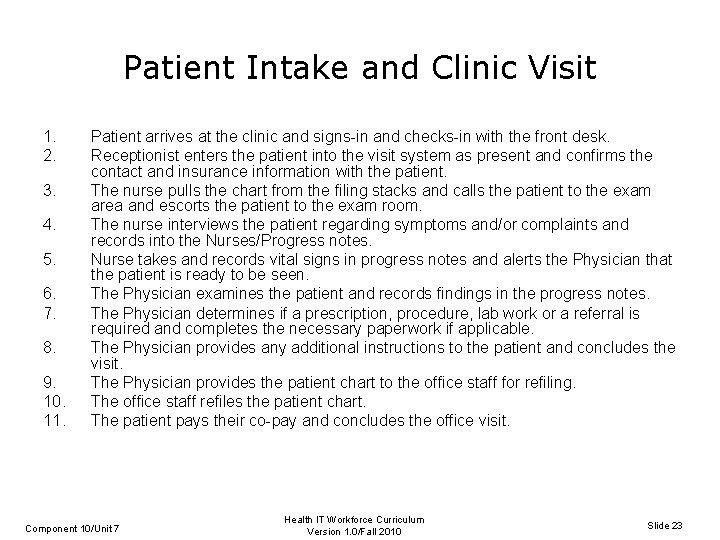
Patient Intake and Clinic Visit 1. 2. 3. 4. 5. 6. 7. 8. 9. 10. 11. Patient arrives at the clinic and signs-in and checks-in with the front desk. Receptionist enters the patient into the visit system as present and confirms the contact and insurance information with the patient. The nurse pulls the chart from the filing stacks and calls the patient to the exam area and escorts the patient to the exam room. The nurse interviews the patient regarding symptoms and/or complaints and records into the Nurses/Progress notes. Nurse takes and records vital signs in progress notes and alerts the Physician that the patient is ready to be seen. The Physician examines the patient and records findings in the progress notes. The Physician determines if a prescription, procedure, lab work or a referral is required and completes the necessary paperwork if applicable. The Physician provides any additional instructions to the patient and concludes the visit. The Physician provides the patient chart to the office staff for refiling. The office staff refiles the patient chart. The patient pays their co-pay and concludes the office visit. Component 10/Unit 7 Health IT Workforce Curriculum Version 1. 0/Fall 2010 Slide 23
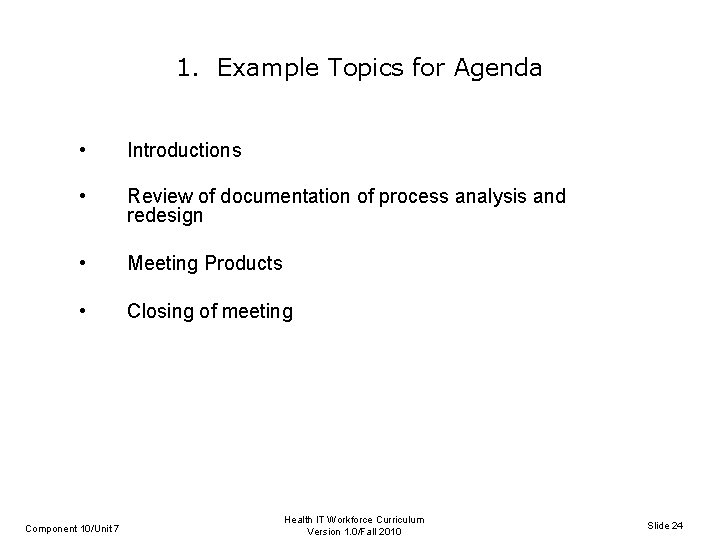
1. Example Topics for Agenda • Introductions • Review of documentation of process analysis and redesign • Meeting Products • Closing of meeting Component 10/Unit 7 Health IT Workforce Curriculum Version 1. 0/Fall 2010 Slide 24
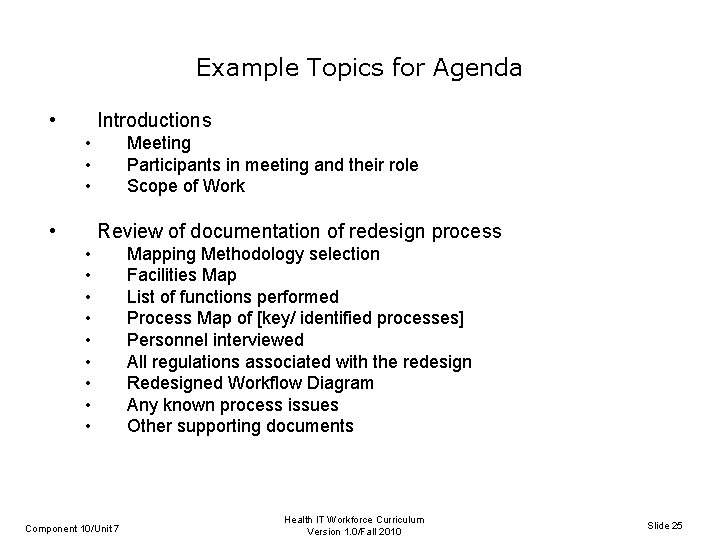
Example Topics for Agenda • Introductions • • Meeting Participants in meeting and their role Scope of Work Review of documentation of redesign process • • • Component 10/Unit 7 Mapping Methodology selection Facilities Map List of functions performed Process Map of [key/ identified processes] Personnel interviewed All regulations associated with the redesign Redesigned Workflow Diagram Any known process issues Other supporting documents Health IT Workforce Curriculum Version 1. 0/Fall 2010 Slide 25
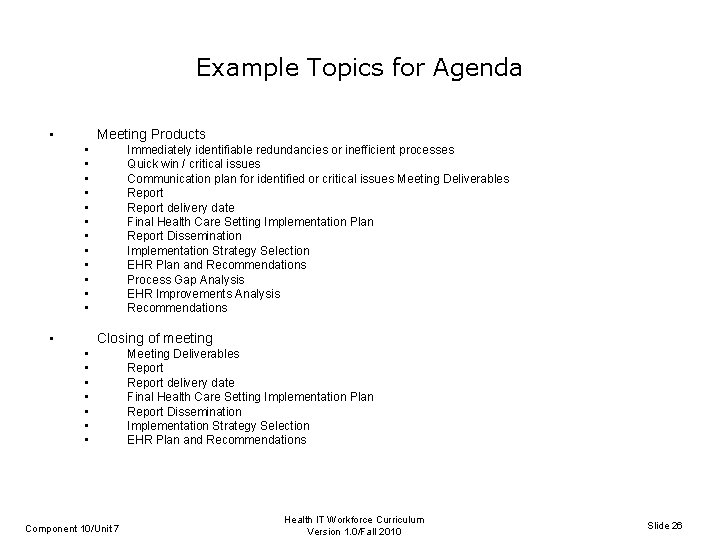
Example Topics for Agenda • Meeting Products • • • • Immediately identifiable redundancies or inefficient processes Quick win / critical issues Communication plan for identified or critical issues Meeting Deliverables Report delivery date Final Health Care Setting Implementation Plan Report Dissemination Implementation Strategy Selection EHR Plan and Recommendations Process Gap Analysis EHR Improvements Analysis Recommendations Closing of meeting • • Component 10/Unit 7 Meeting Deliverables Report delivery date Final Health Care Setting Implementation Plan Report Dissemination Implementation Strategy Selection EHR Plan and Recommendations Health IT Workforce Curriculum Version 1. 0/Fall 2010 Slide 26
2. Example forms for capturing decisions agreed upon by the group. Component 10/Unit 7 Health IT Workforce Curriculum Version 1. 0/Fall 2010 Slide 27
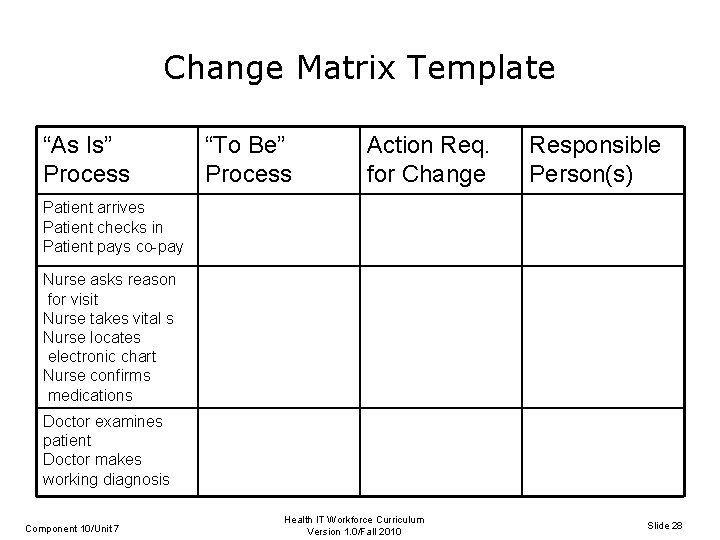
Change Matrix Template “As Is” Process “To Be” Process Action Req. for Change Responsible Person(s) Patient arrives Patient checks in Patient pays co-pay Nurse asks reason for visit Nurse takes vital s Nurse locates electronic chart Nurse confirms medications Doctor examines patient Doctor makes working diagnosis Component 10/Unit 7 Health IT Workforce Curriculum Version 1. 0/Fall 2010 Slide 28
“BRAND” Change Matrix Template PROCESS Benefits Risks Alternatives Nothing: , Decision of the action doing nothing at all of the action of the prospective action Patient arrives Patient checks in Patient pays Nurse asks reason for visit Nurse takes vitals Nurse locates electronic chart Nurse confirms medications Doctor examines patient Doctor makes diagnosis Component 10/Unit 7 Health IT Workforce Curriculum Version 1. 0/Fall 2010 Slide 29
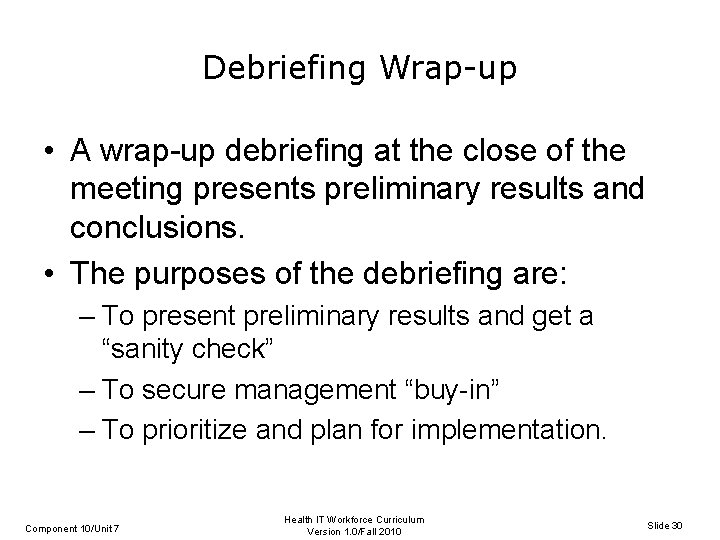
Debriefing Wrap-up • A wrap-up debriefing at the close of the meeting presents preliminary results and conclusions. • The purposes of the debriefing are: – To present preliminary results and get a “sanity check” – To secure management “buy-in” – To prioritize and plan for implementation. Component 10/Unit 7 Health IT Workforce Curriculum Version 1. 0/Fall 2010 Slide 30
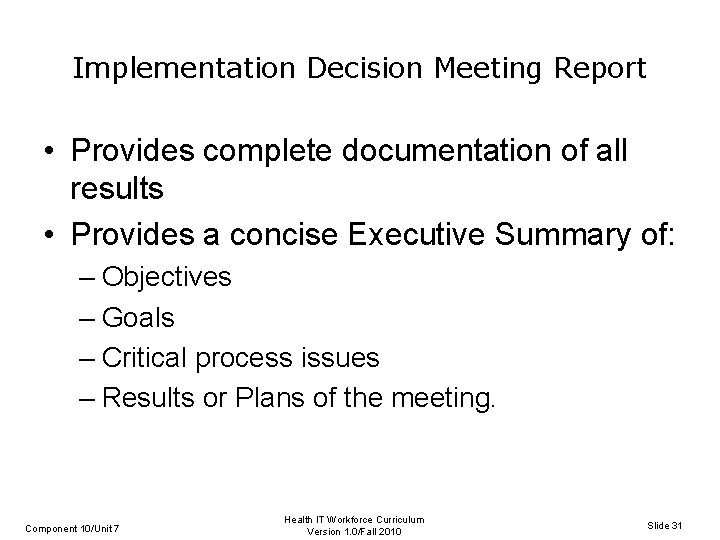
Implementation Decision Meeting Report • Provides complete documentation of all results • Provides a concise Executive Summary of: – Objectives – Goals – Critical process issues – Results or Plans of the meeting. Component 10/Unit 7 Health IT Workforce Curriculum Version 1. 0/Fall 2010 Slide 31
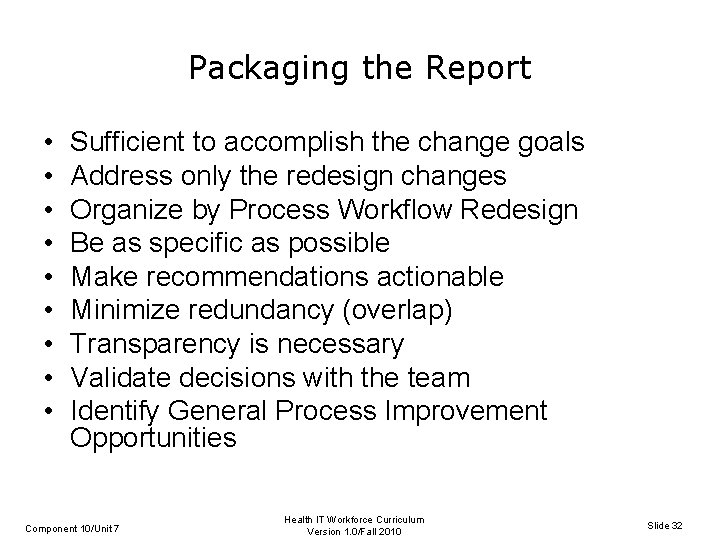
Packaging the Report • • • Sufficient to accomplish the change goals Address only the redesign changes Organize by Process Workflow Redesign Be as specific as possible Make recommendations actionable Minimize redundancy (overlap) Transparency is necessary Validate decisions with the team Identify General Process Improvement Opportunities Component 10/Unit 7 Health IT Workforce Curriculum Version 1. 0/Fall 2010 Slide 32
Summary In summary, this unit has • Provided strategies, tools, and aids for planning and conducting a decision making meeting • Presented examples of agenda and tables for conducting a walk through of a process • Provided tools for documenting decisions made and actions identified in a decision making meeting. Component 10/Unit 7 Health IT Workforce Curriculum Version 1. 0/Fall 2010 Slide 33
References 1. 2. 3. 4. Delbecq, Andre L. and Van de Ven, Andrew H. , A Group Process Model for Problem Identification and Program Planning in The Journal of Applied Behavioral Sciences, Vol. 7, No 4, 1971 pp 467 -492. Haynes, Stephen C. , The Facilitators Perspective on Meetings and Implications for Group Support Systems Design in The DATA BASE for Advances in Information Systems, Summer-Fall 1999, Vol. 30, No. 3, 4, pp 72 -90. Available free from http: //en. wikipedia. org/wiki/Facilitation_(business) Kabcenell AI, Langley J, Hupke C. Innovations in Planned Care. IHI Innovation Series white paper. Cambridge, MA: Institute for Healthcare Improvement; 2006. (Available on www. IHI. org) Component 10/Unit 7 Health IT Workforce Curriculum Version 1. 0/Fall 2010 Slide 34