
Fundamentals of General Organic and Biological Chemistry 6
Fundamentals of General, Organic and Biological Chemistry 6 th Edition Chapter Ten Acids and Bases James E. Mayhugh Copyright © 2010 Pearson Education, Inc.
10. 1 Acids and Bases in Aqueous Solution ► An acid is a covalent compound that produces hydrogen ions, H+, and an anion when dissolved in water. HCl (+water) → H+(aq) + Cl-(aq) ► The H+ ion is always “picked up” by something else… often water unless there is a base around to “snag” it.
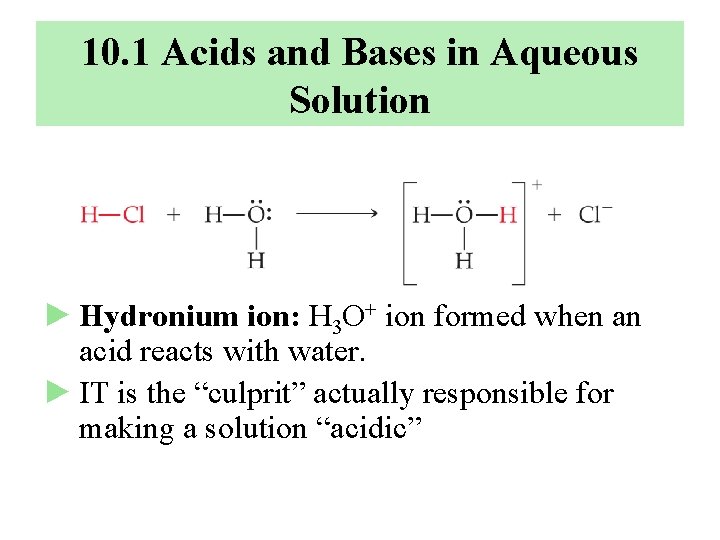
10. 1 Acids and Bases in Aqueous Solution ► Hydronium ion: H 3 O+ ion formed when an acid reacts with water. ► IT is the “culprit” actually responsible for making a solution “acidic”
10. 1 Acids and Bases in Aqueous Solution ► Hydroxide ions, OH-, are the “culprits” responsible for making solutions basic (or “alkaline”). ► A base is a substance that, one way or another, increases the concentration of hydroxide ions, OH-, in solution.
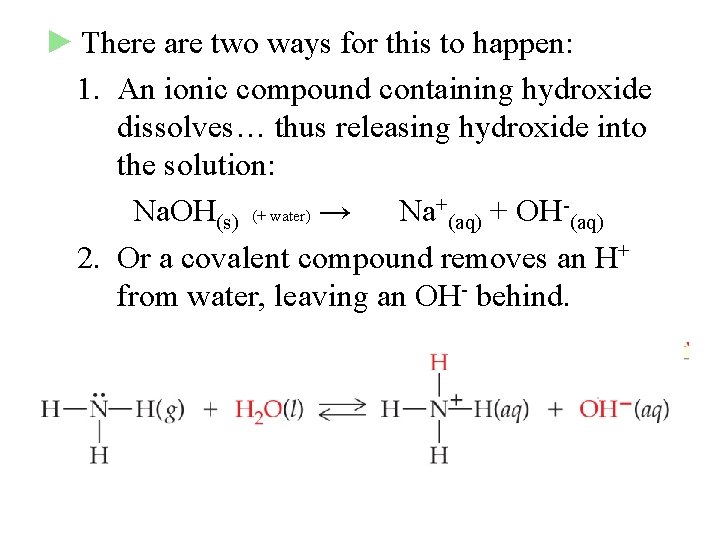
► There are two ways for this to happen: 1. An ionic compound containing hydroxide dissolves… thus releasing hydroxide into the solution: Na. OH(s) (+ water) → Na+(aq) + OH-(aq) 2. Or a covalent compound removes an H+ from water, leaving an OH- behind.

10. 2 Some Common Acids – Formulas and Names Must be MEMORIZED ► Sulfuric acid, H 2 SO 4 ► Hydrochloric acid, HCl ► Phosphoric acid, H 3 PO 4 ► Carbonic acid, H 2 CO 3 ► Nitric acid, HNO 3 ► Acetic acid, HCH 3 CO 2
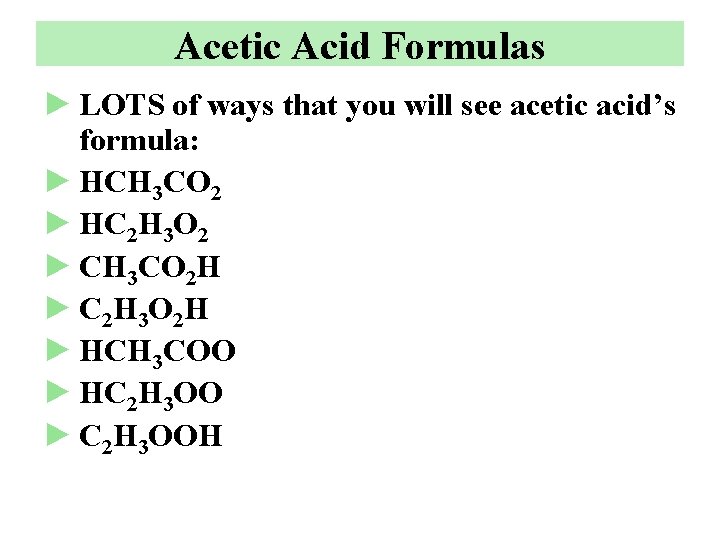
Acetic Acid Formulas ► LOTS of ways that you will see acetic acid’s formula: ► HCH 3 CO 2 ► HC 2 H 3 O 2 ► CH 3 CO 2 H ► C 2 H 3 O 2 H ► HCH 3 COO ► HC 2 H 3 OO ► C 2 H 3 OOH
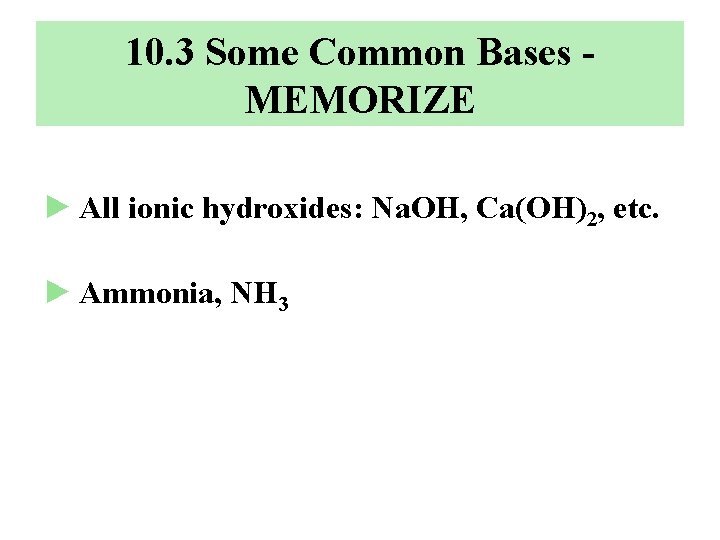
10. 3 Some Common Bases MEMORIZE ► All ionic hydroxides: Na. OH, Ca(OH)2, etc. ► Ammonia, NH 3
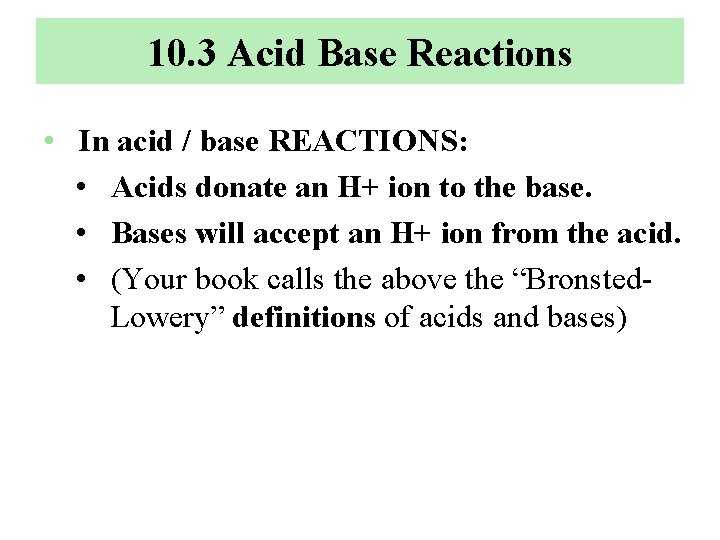
10. 3 Acid Base Reactions • In acid / base REACTIONS: • Acids donate an H+ ion to the base. • Bases will accept an H+ ion from the acid. • (Your book calls the above the “Bronsted. Lowery” definitions of acids and bases)
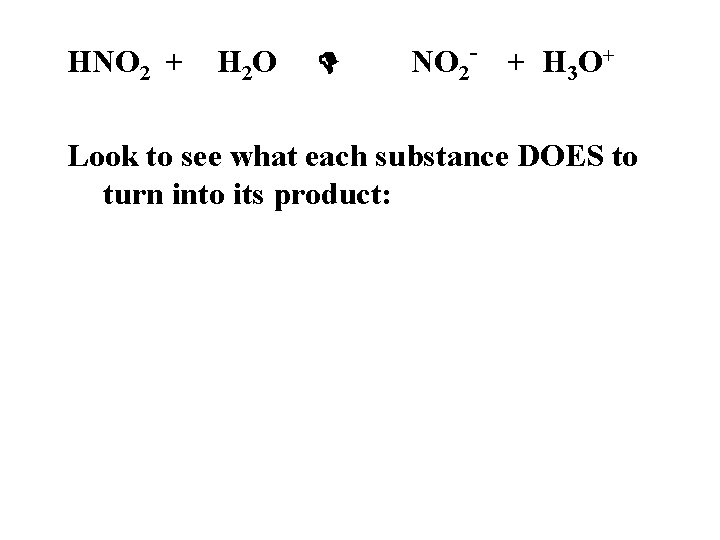
HNO 2 + H 2 O NO 2 - + H 3 O+ Look to see what each substance DOES to turn into its product:
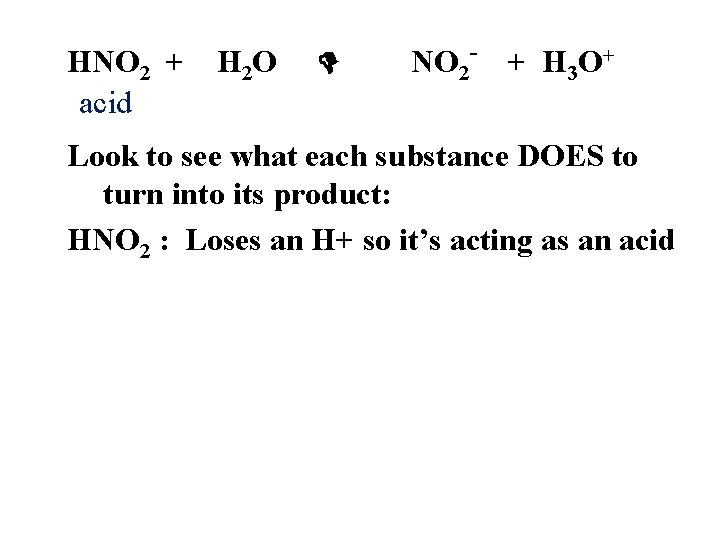
HNO 2 + acid H 2 O NO 2 - + H 3 O+ Look to see what each substance DOES to turn into its product: HNO 2 : Loses an H+ so it’s acting as an acid

HNO 2 + acid H 2 O base NO 2 - + H 3 O+ Look to see what each substance DOES to turn into its product: HNO 2 : Loses an H+ so it’s acting as an acid H 2 O: Takes and H+ so it’s acting as a base
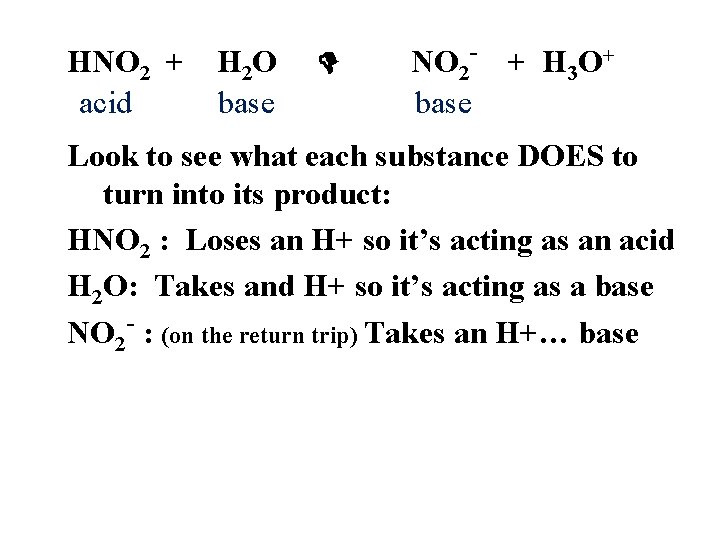
HNO 2 + acid H 2 O base NO 2 - + H 3 O+ base Look to see what each substance DOES to turn into its product: HNO 2 : Loses an H+ so it’s acting as an acid H 2 O: Takes and H+ so it’s acting as a base NO 2 - : (on the return trip) Takes an H+… base
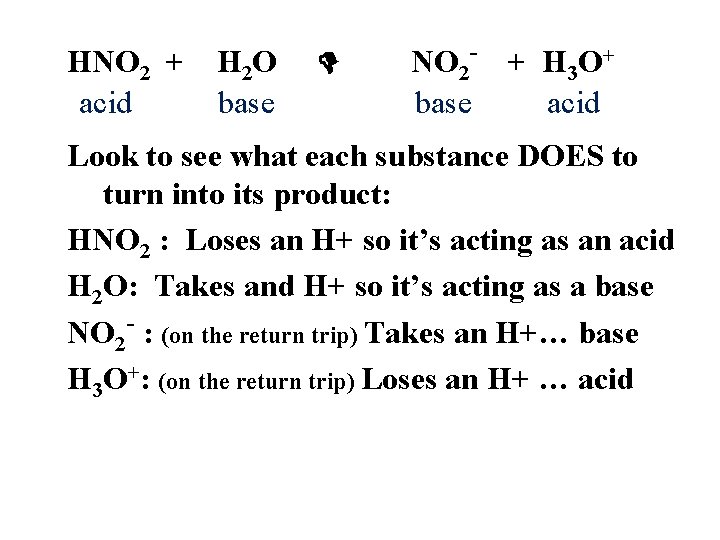
HNO 2 + acid H 2 O base NO 2 - + H 3 O+ base acid Look to see what each substance DOES to turn into its product: HNO 2 : Loses an H+ so it’s acting as an acid H 2 O: Takes and H+ so it’s acting as a base NO 2 - : (on the return trip) Takes an H+… base H 3 O+: (on the return trip) Loses an H+ … acid
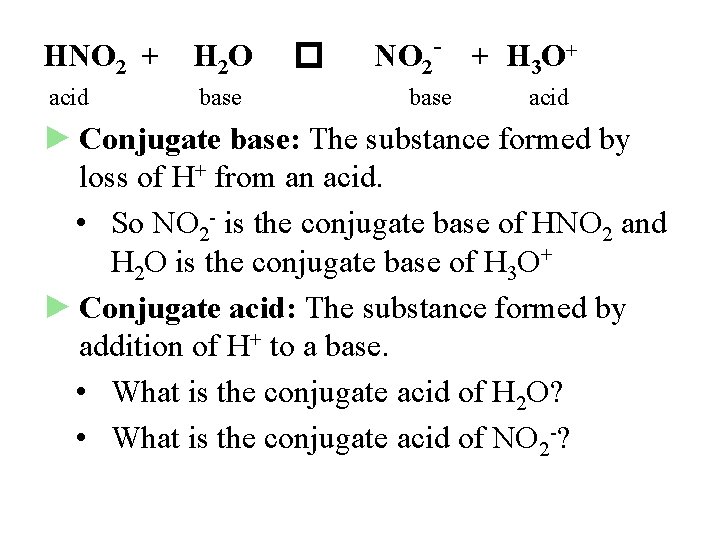
HNO 2 + H 2 O acid base � NO 2 - + H 3 O+ base acid ► Conjugate base: The substance formed by loss of H+ from an acid. • So NO 2 - is the conjugate base of HNO 2 and H 2 O is the conjugate base of H 3 O+ ► Conjugate acid: The substance formed by addition of H+ to a base. • What is the conjugate acid of H 2 O? • What is the conjugate acid of NO 2 -?
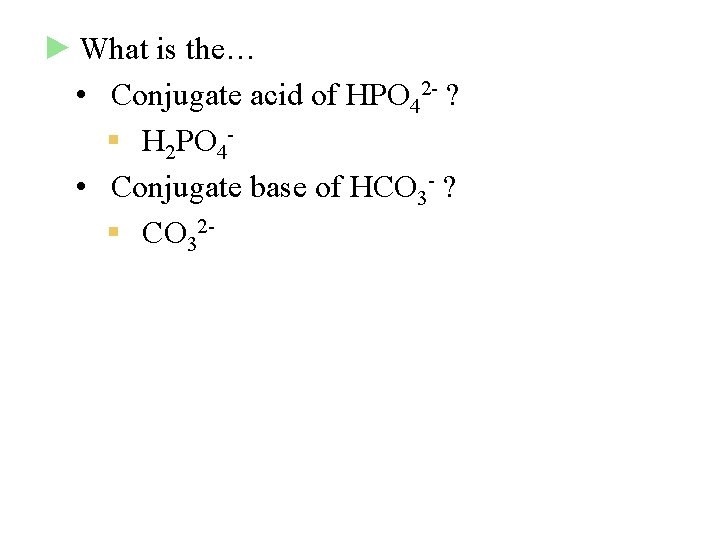
► What is the… • Conjugate acid of HPO 42 - ? § H 2 PO 4 • Conjugate base of HCO 3 - ? § CO 32 -
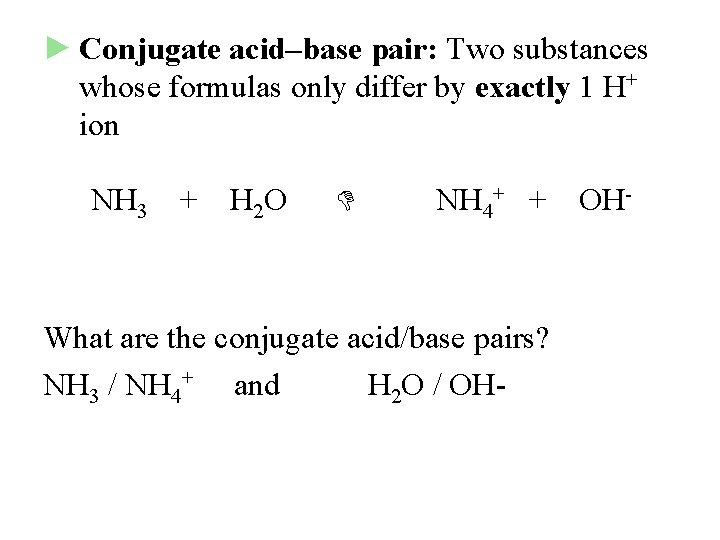
► Conjugate acid–base pair: Two substances whose formulas only differ by exactly 1 H+ ion NH 3 + H 2 O NH 4+ + What are the conjugate acid/base pairs? NH 3 / NH 4+ and H 2 O / OH-
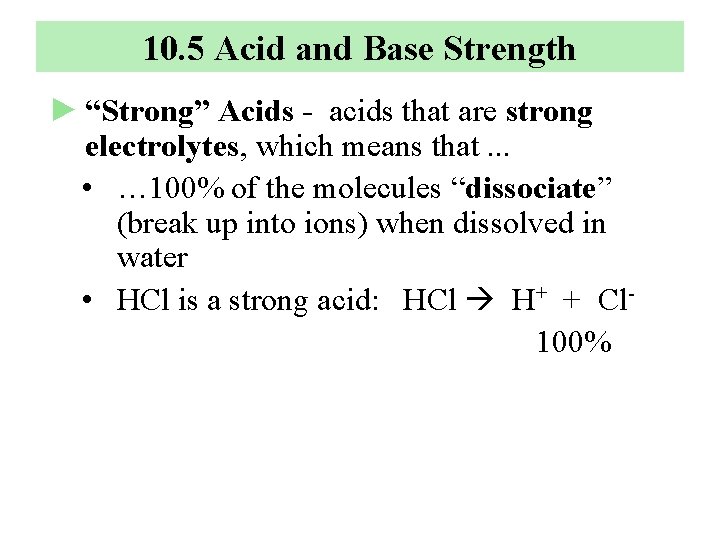
10. 5 Acid and Base Strength ► “Strong” Acids - acids that are strong electrolytes, which means that. . . • … 100% of the molecules “dissociate” (break up into ions) when dissolved in water • HCl is a strong acid: HCl H+ + Cl 100%
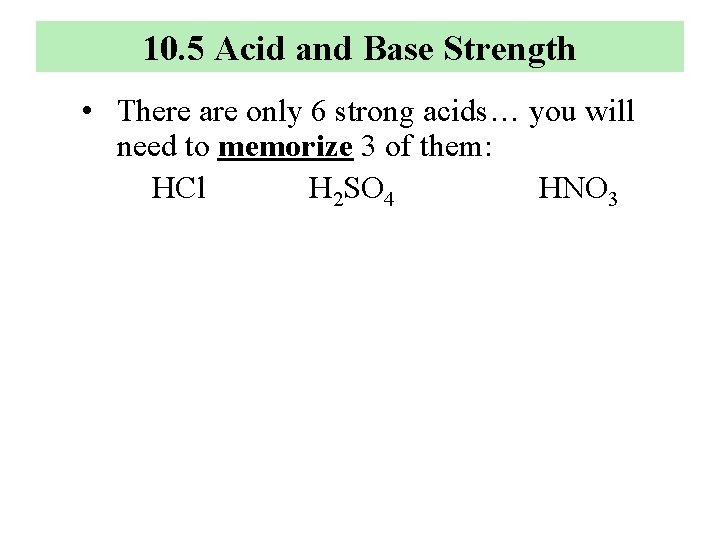
10. 5 Acid and Base Strength • There are only 6 strong acids… you will need to memorize 3 of them: HCl H 2 SO 4 HNO 3
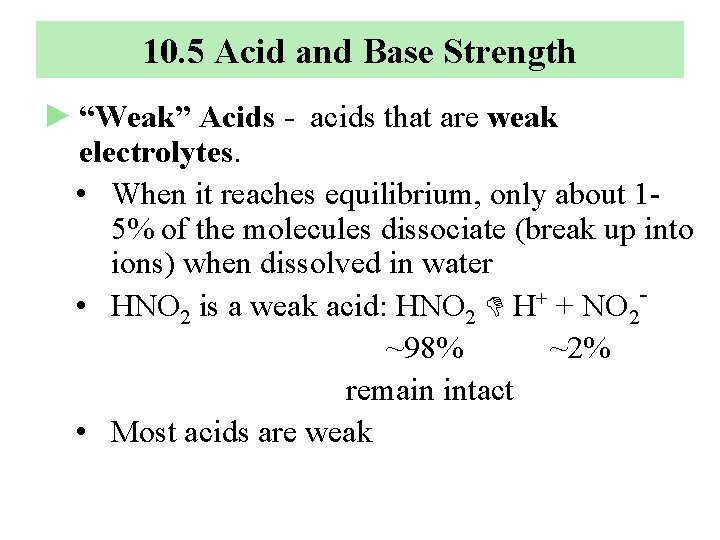
10. 5 Acid and Base Strength ► “Weak” Acids - acids that are weak electrolytes. • When it reaches equilibrium, only about 15% of the molecules dissociate (break up into ions) when dissolved in water • HNO 2 is a weak acid: HNO 2 H+ + NO 2~98% ~2% remain intact • Most acids are weak
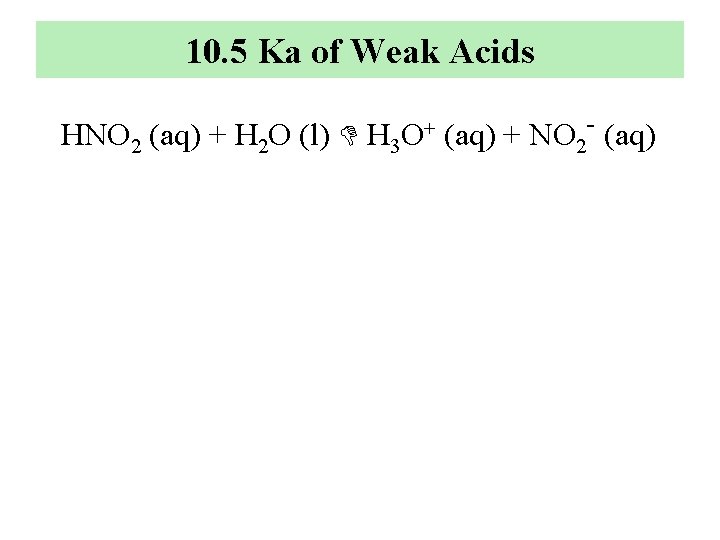
10. 5 Ka of Weak Acids HNO 2 (aq) + H 2 O (l) H 3 O+ (aq) + NO 2 - (aq)
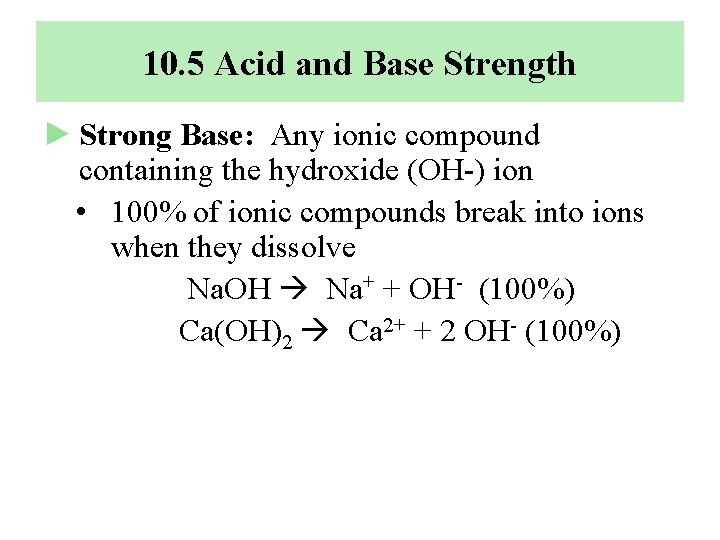
10. 5 Acid and Base Strength ► Strong Base: Any ionic compound containing the hydroxide (OH-) ion • 100% of ionic compounds break into ions when they dissolve Na. OH Na+ + OH- (100%) Ca(OH)2 Ca 2+ + 2 OH- (100%)
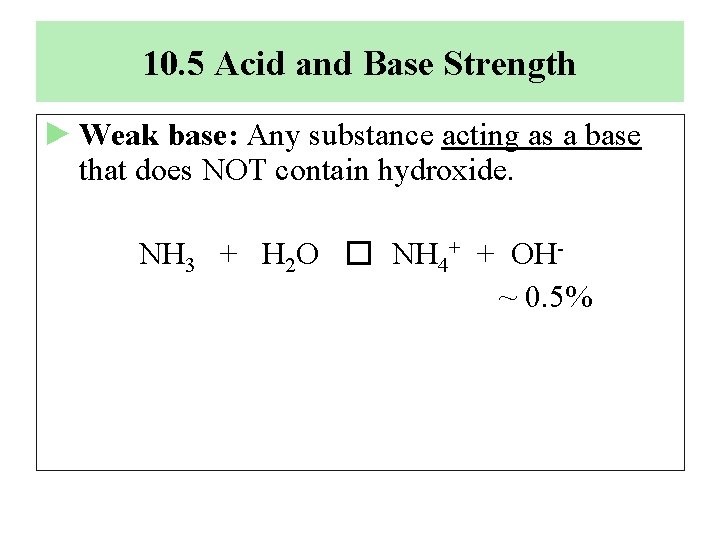
10. 5 Acid and Base Strength ► Weak base: Any substance acting as a base that does NOT contain hydroxide. NH 3 + H 2 O � NH 4+ + OH~ 0. 5%
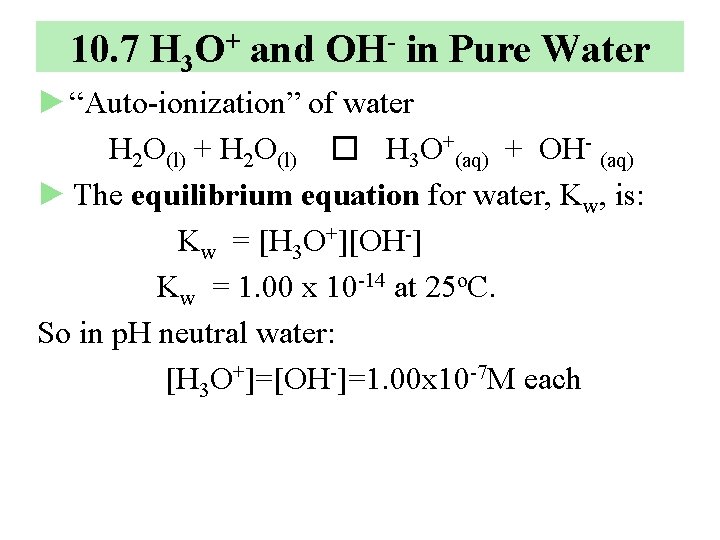
10. 7 H 3 O+ and OH- in Pure Water ►“Auto-ionization” of water H 2 O(l) + H 2 O(l) � H 3 O+(aq) + OH- (aq) ► The equilibrium equation for water, Kw, is: Kw = [H 3 O+][OH-] Kw = 1. 00 x 10 -14 at 25 o. C. So in p. H neutral water: [H 3 O+]=[OH-]=1. 00 x 10 -7 M each
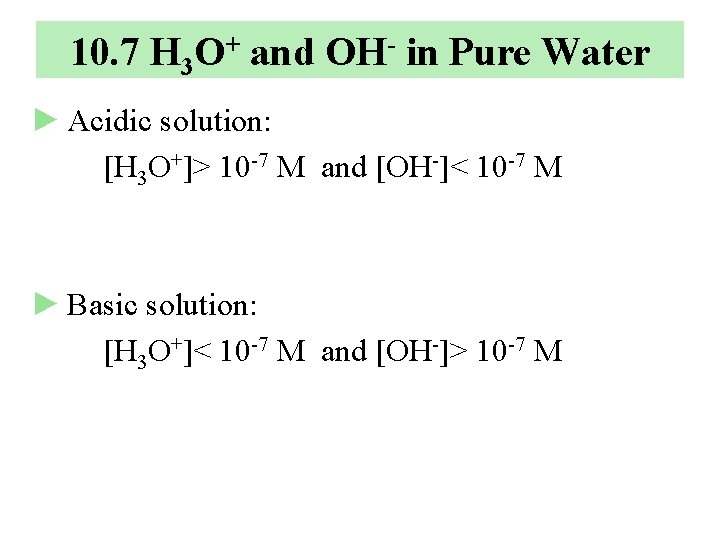
10. 7 H 3 O+ and OH- in Pure Water ► Acidic solution: [H 3 O+]> 10 -7 M and [OH-]< 10 -7 M ► Basic solution: [H 3 O+]< 10 -7 M and [OH-]> 10 -7 M
![10. 7 Using Kw If a solution’s [OH-] = 1. 5 x 10 -9](http://slidetodoc.com/presentation_image_h2/e76f5a46552899fdee091686cce212ec/image-26.jpg "10. 7 Using Kw If a solution’s [OH-] = 1. 5 x 10 -9")
10. 7 Using Kw If a solution’s [OH-] = 1. 5 x 10 -9 M (a) Is the solution acidic or basic? (b) What is the [H 3 O+] ? Kw = [H 3 O+][OH-] = 1. 00 x 10 -14 In neutral solutions: [H 3 O+]=[OH-]=1. 00 x 10 -7 M
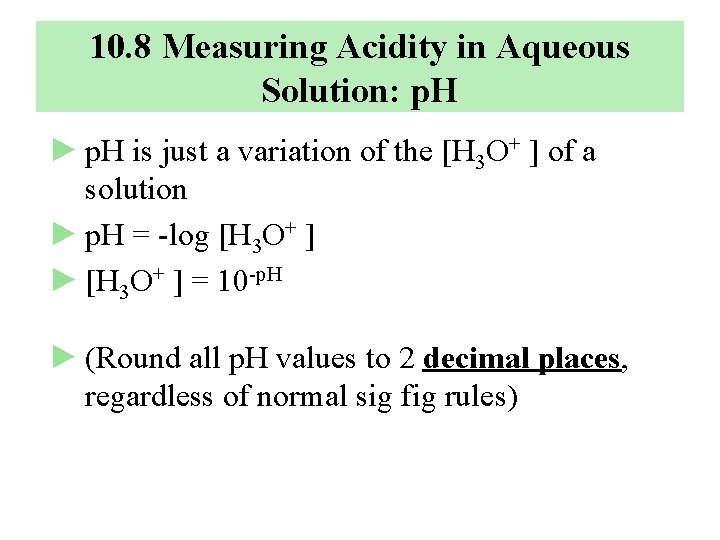
10. 8 Measuring Acidity in Aqueous Solution: p. H ► p. H is just a variation of the [H 3 O+ ] of a solution ► p. H = -log [H 3 O+ ] ► [H 3 O+ ] = 10 -p. H ► (Round all p. H values to 2 decimal places, regardless of normal sig fig rules)
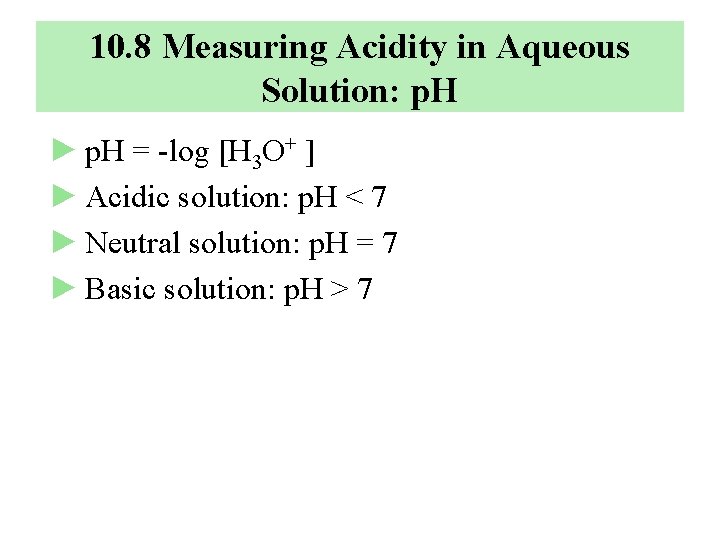
10. 8 Measuring Acidity in Aqueous Solution: p. H ► p. H = -log [H 3 O+ ] ► Acidic solution: p. H < 7 ► Neutral solution: p. H = 7 ► Basic solution: p. H > 7
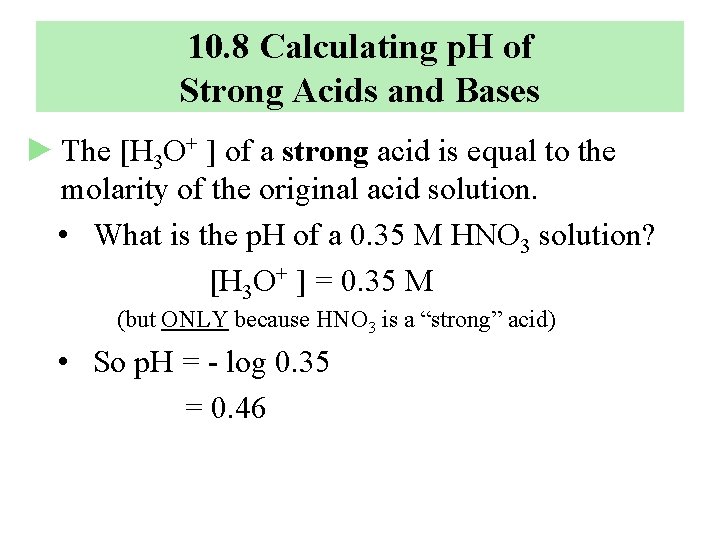
10. 8 Calculating p. H of Strong Acids and Bases ► The [H 3 O+ ] of a strong acid is equal to the molarity of the original acid solution. • What is the p. H of a 0. 35 M HNO 3 solution? [H 3 O+ ] = 0. 35 M (but ONLY because HNO 3 is a “strong” acid) • So p. H = - log 0. 35 = 0. 46
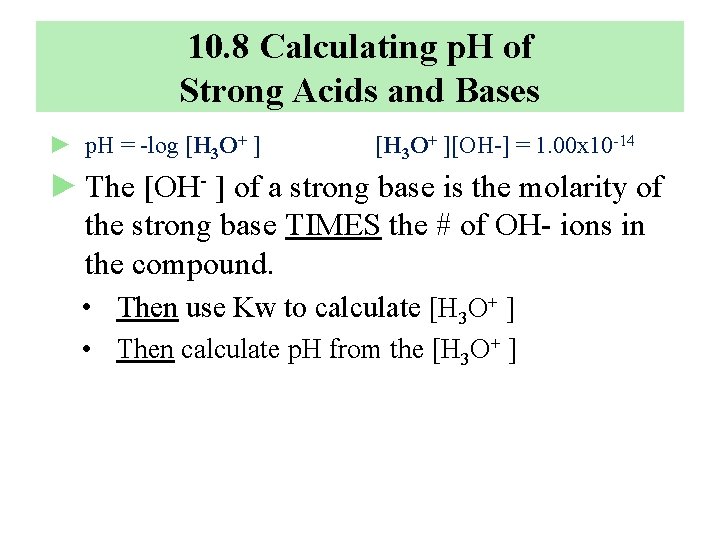
10. 8 Calculating p. H of Strong Acids and Bases ► p. H = -log [H 3 O+ ][OH-] = 1. 00 x 10 -14 ► The [OH- ] of a strong base is the molarity of the strong base TIMES the # of OH- ions in the compound. • Then use Kw to calculate [H 3 O+ ] • Then calculate p. H from the [H 3 O+ ]
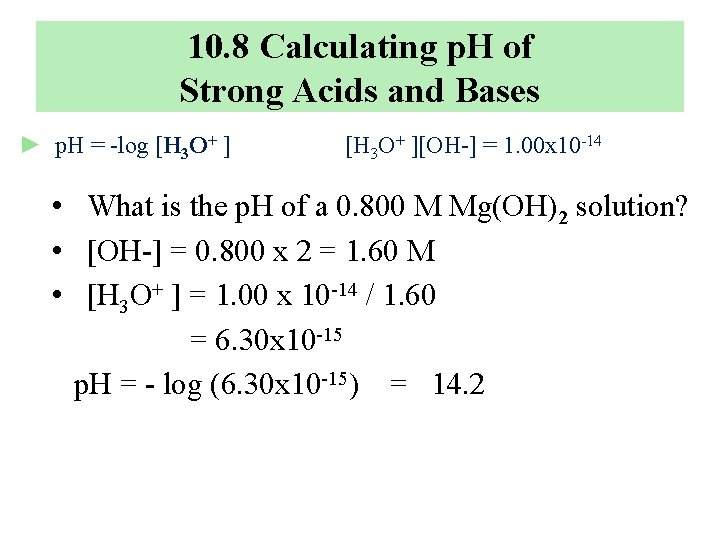
10. 8 Calculating p. H of Strong Acids and Bases ► p. H = -log [H 3 O+ ][OH-] = 1. 00 x 10 -14 • What is the p. H of a 0. 800 M Mg(OH)2 solution? • [OH-] = 0. 800 x 2 = 1. 60 M • [H 3 O+ ] = 1. 00 x 10 -14 / 1. 60 = 6. 30 x 10 -15 p. H = - log (6. 30 x 10 -15) = 14. 2
10. 8 Calculating p. H of WEAK Acids and Bases ► You will be given the molarity of acid or base … ► AND the percent of it that turns into H 3 O+ or OH-
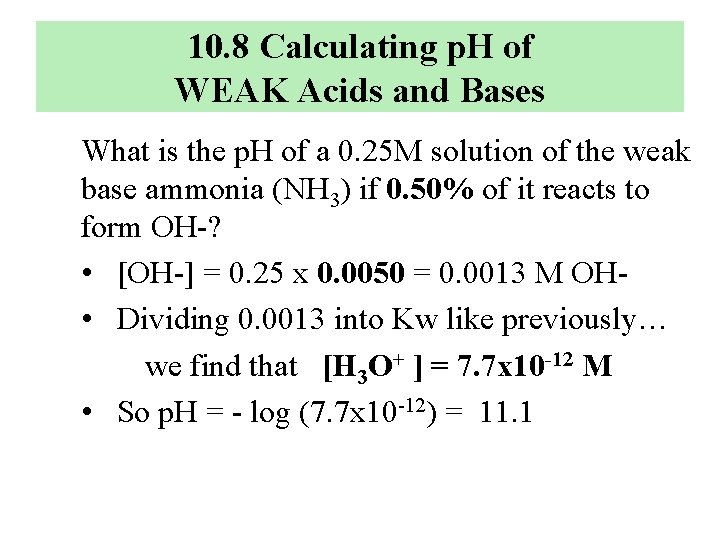
10. 8 Calculating p. H of WEAK Acids and Bases What is the p. H of a 0. 25 M solution of the weak base ammonia (NH 3) if 0. 50% of it reacts to form OH-? • [OH-] = 0. 25 x 0. 0050 = 0. 0013 M OH • Dividing 0. 0013 into Kw like previously… we find that [H 3 O+ ] = 7. 7 x 10 -12 M • So p. H = - log (7. 7 x 10 -12) = 11. 1
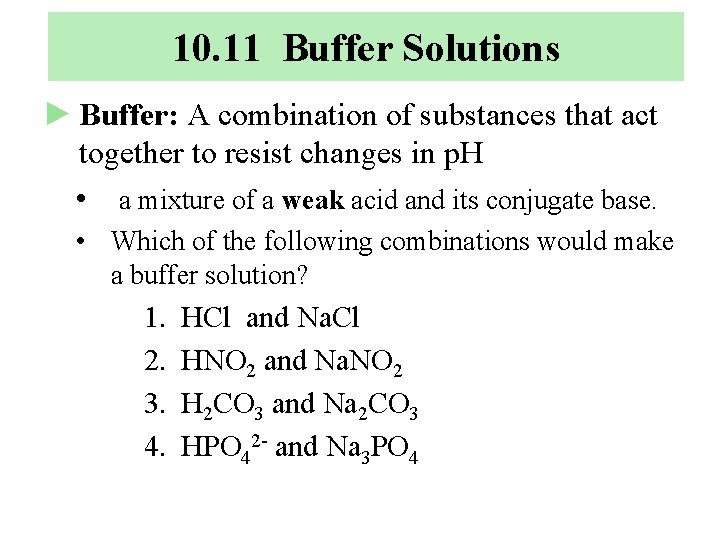
10. 11 Buffer Solutions ► Buffer: A combination of substances that act together to resist changes in p. H • a mixture of a weak acid and its conjugate base. • Which of the following combinations would make a buffer solution? 1. 2. 3. 4. HCl and Na. Cl HNO 2 and Na. NO 2 H 2 CO 3 and Na 2 CO 3 HPO 42 - and Na 3 PO 4
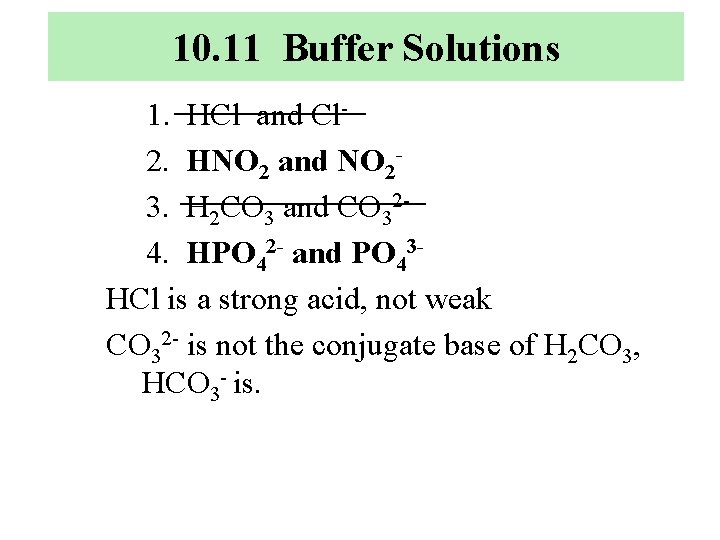
10. 11 Buffer Solutions 1. HCl and Cl 2. HNO 2 and NO 23. H 2 CO 3 and CO 324. HPO 42 - and PO 43 HCl is a strong acid, not weak CO 32 - is not the conjugate base of H 2 CO 3, HCO 3 - is.
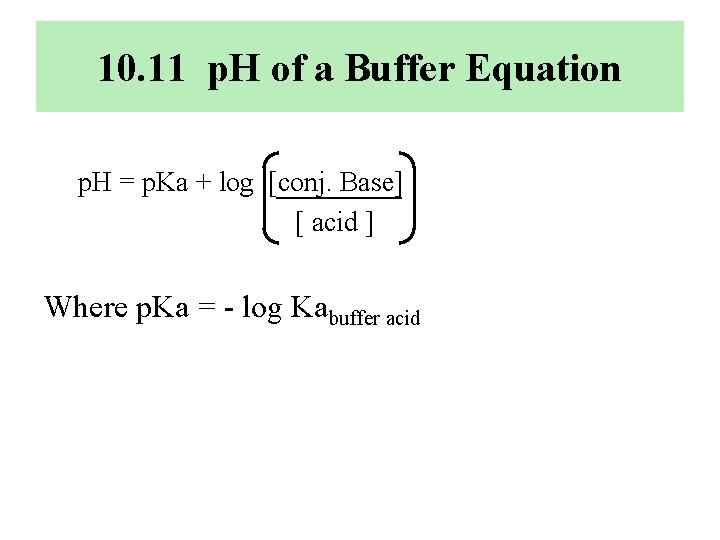
10. 11 p. H of a Buffer Equation p. H = p. Ka + log [conj. Base] [ acid ] Where p. Ka = - log Kabuffer acid
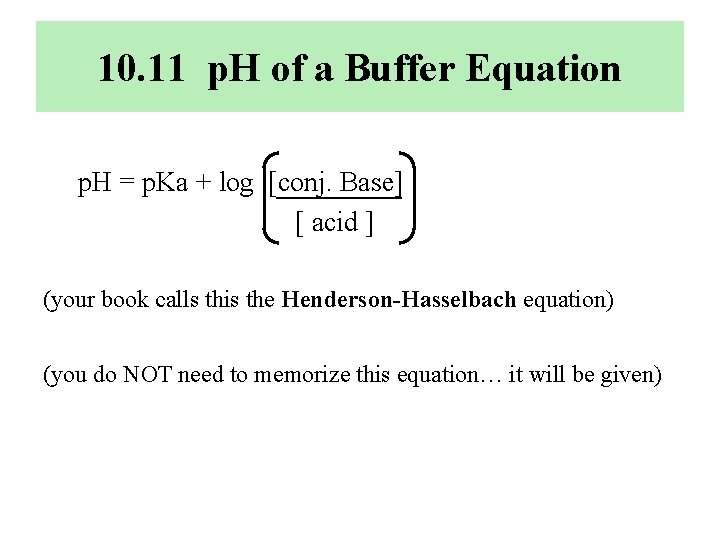
10. 11 p. H of a Buffer Equation p. H = p. Ka + log [conj. Base] [ acid ] (your book calls this the Henderson-Hasselbach equation) (you do NOT need to memorize this equation… it will be given)
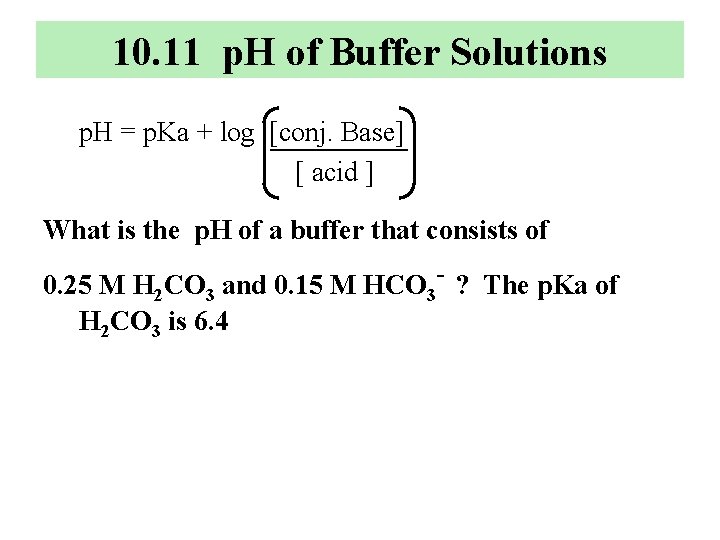
10. 11 p. H of Buffer Solutions p. H = p. Ka + log [conj. Base] [ acid ] What is the p. H of a buffer that consists of 0. 25 M H 2 CO 3 and 0. 15 M HCO 3 - ? The p. Ka of H 2 CO 3 is 6. 4
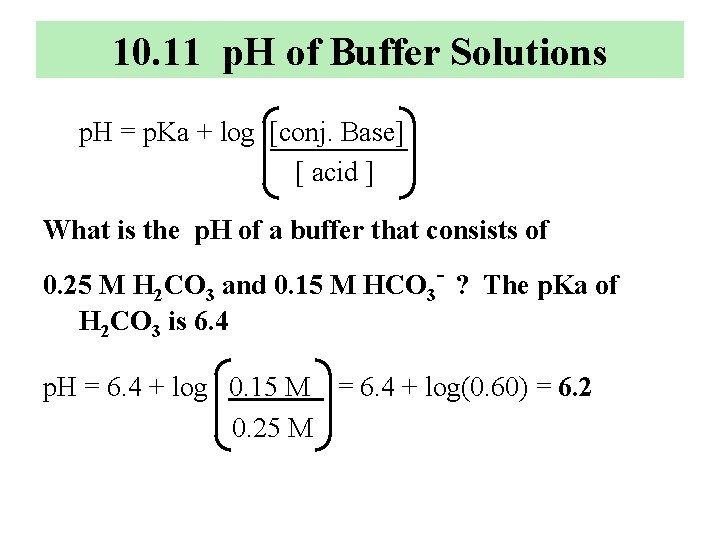
10. 11 p. H of Buffer Solutions p. H = p. Ka + log [conj. Base] [ acid ] What is the p. H of a buffer that consists of 0. 25 M H 2 CO 3 and 0. 15 M HCO 3 - ? The p. Ka of H 2 CO 3 is 6. 4 p. H = 6. 4 + log 0. 15 M = 6. 4 + log(0. 60) = 6. 2 0. 25 M
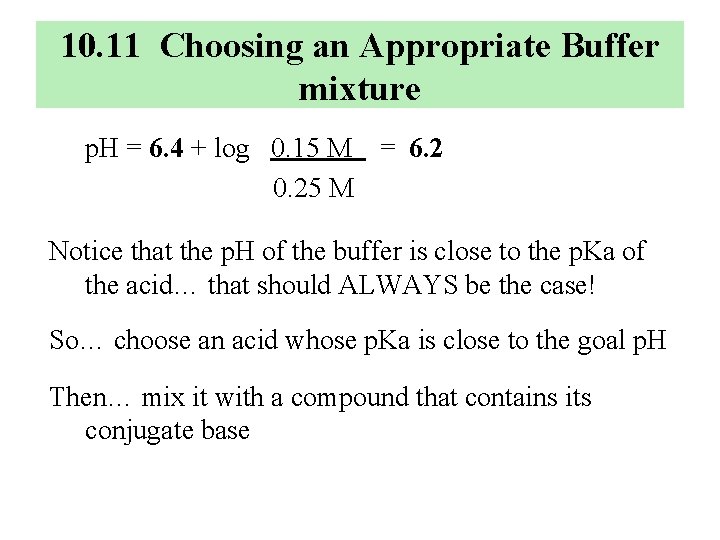
10. 11 Choosing an Appropriate Buffer mixture p. H = 6. 4 + log 0. 15 M = 6. 2 0. 25 M Notice that the p. H of the buffer is close to the p. Ka of the acid… that should ALWAYS be the case! So… choose an acid whose p. Ka is close to the goal p. H Then… mix it with a compound that contains its conjugate base
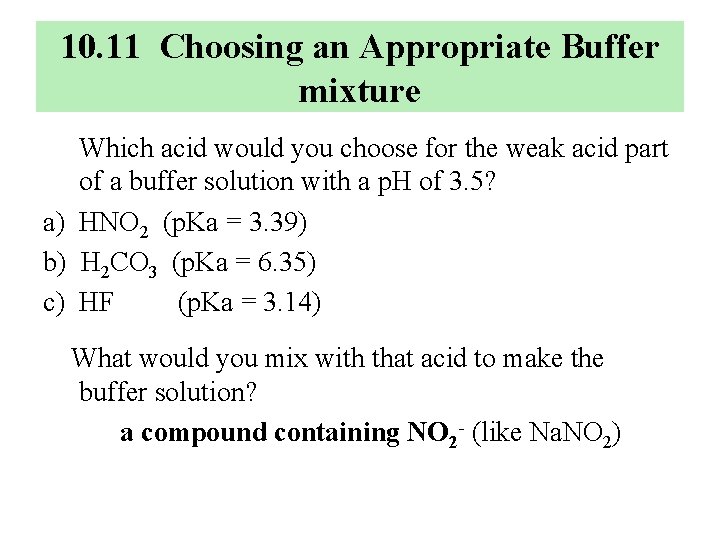
10. 11 Choosing an Appropriate Buffer mixture Which acid would you choose for the weak acid part of a buffer solution with a p. H of 3. 5? a) HNO 2 (p. Ka = 3. 39) b) H 2 CO 3 (p. Ka = 6. 35) c) HF (p. Ka = 3. 14) What would you mix with that acid to make the buffer solution? a compound containing NO 2 - (like Na. NO 2)
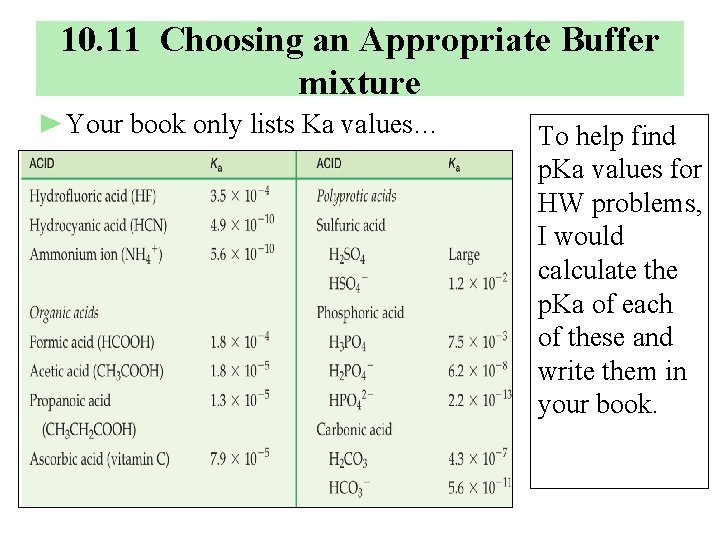
10. 11 Choosing an Appropriate Buffer mixture ►Your book only lists Ka values… To help find p. Ka values for HW problems, I would calculate the p. Ka of each of these and write them in your book.
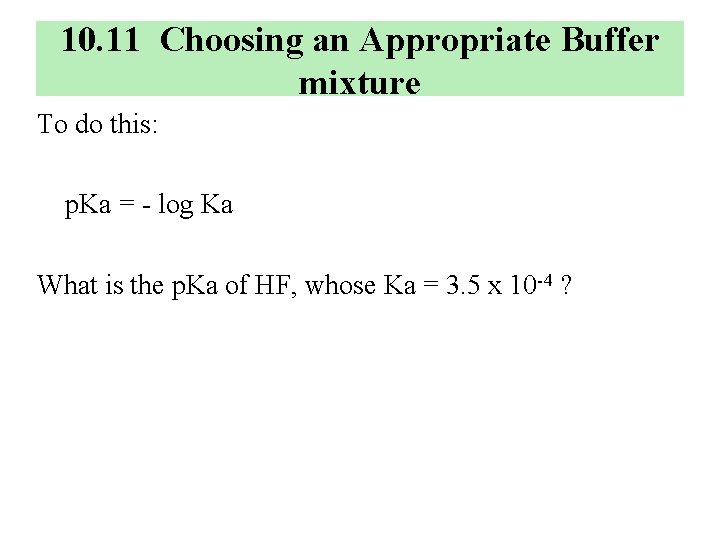
10. 11 Choosing an Appropriate Buffer mixture To do this: p. Ka = - log Ka What is the p. Ka of HF, whose Ka = 3. 5 x 10 -4 ?
10. 11 How Buffers Work How does the HF / F- buffer solution keep the p. H around 3. 2? If a base is added to the buffer solution: OH- + HF H 2 O + Fthe base has been neutralized so p. H resists change!
10. 11 How Buffers Work How does the HF / F- buffer solution keep the p. H around 3. 2? If an acid is added to the buffer solution: H 3 O+ + F- H 2 O + HF the acid has been neutralized so p. H resists change!
10. 11 How Buffers Work HF / FAnd each reaction generates more of the other buffer component! H 3 O+ + F- H 2 O + HF OH- + HF H 2 O + F-
10. 12 Buffers in the Body ► The p. H of body fluids is maintained by three major buffer systems. ► The H 2 CO 3 / HCO 3 - system is the principal buffer in blood • It keeps the p. H of blood at ~ 7. 4 • (H 2 CO 3 is made by CO 2 mixing with H 2 O)
Conjugate ratios in a buffer • If the p. Ka of H 2 CO 3 = 6. 37, what is the ratio of HCO 3 - to H 2 CO 3 in blood if the p. H of blood is 7. 40?
10. 14 Acid / Strong Base Neutralization Reactions ► All acid/base reaction examples thus far this chapter have been net ionic equations. ► But sometimes full molecular chemical equations are more useful ► So a review is in order…
10. 14 Acid / Strong Base Neutralization Reactions ► Acid + Strong Base water + aqueous salt HA(aq) + MOH(aq) H 2 O(l) +MA(aq) • “salt” is another term for an ionic compound • If the water is evaporated away, you could recover the ionic compound that was produced
10. 14 Acid / Strong Base Neutralization Reactions ► Predicting products of neutralization rxns: • They are double replacement reactions… studied in chapter 6… • “Swap partners”, re-check charges, balance
10. 14 Acid / Strong Base Neutralization Reactions • Write the balanced equation for the reaction between: 1. Nitric acid and calcium hydroxide 2. Acetic acid and sodium hydroxide
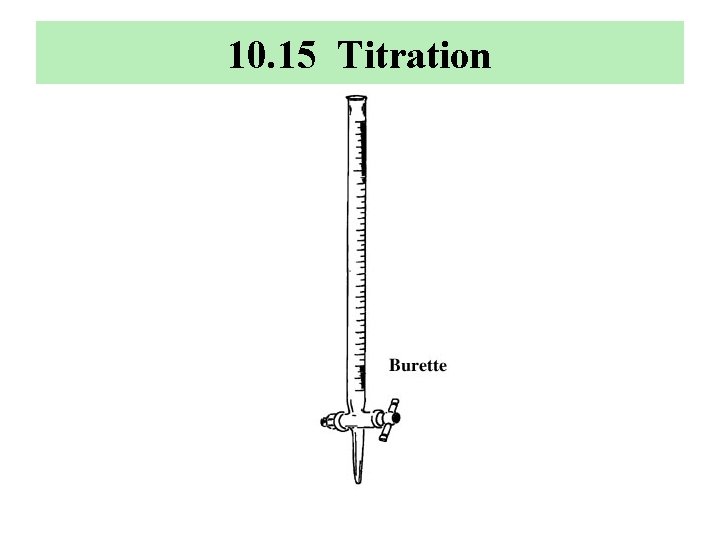
10. 15 Titration ►An experimental technique used to determine the molarity of an acid or base solution. ►“Titrating” is the process of carefully adding a base to an acid until the acid is neutralized (or vice versa). • The base is dispensed from a special device called a buret
10. 15 Titration
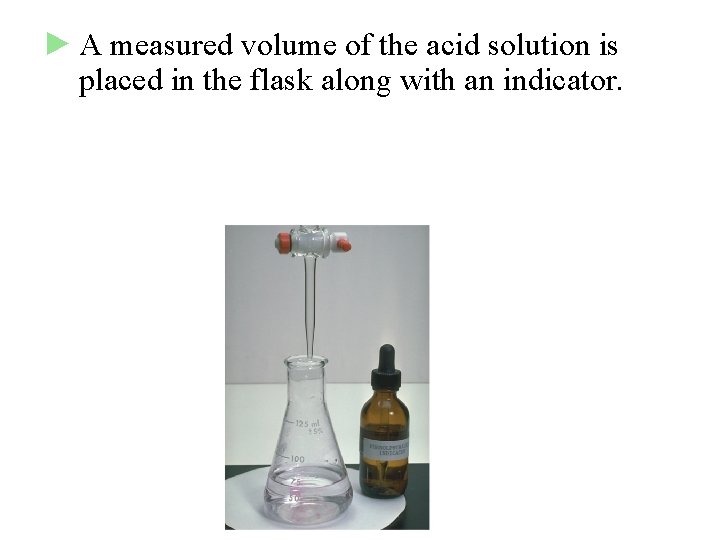
► A measured volume of the acid solution is placed in the flask along with an indicator.
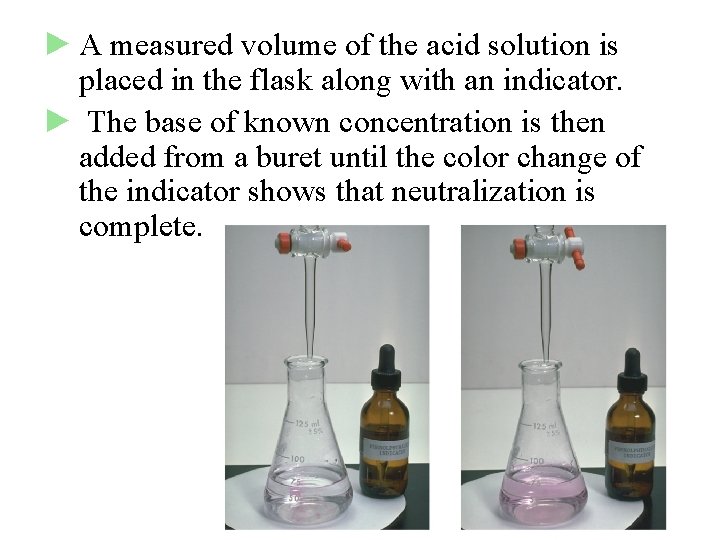
► A measured volume of the acid solution is placed in the flask along with an indicator. ► The base of known concentration is then added from a buret until the color change of the indicator shows that neutralization is complete.
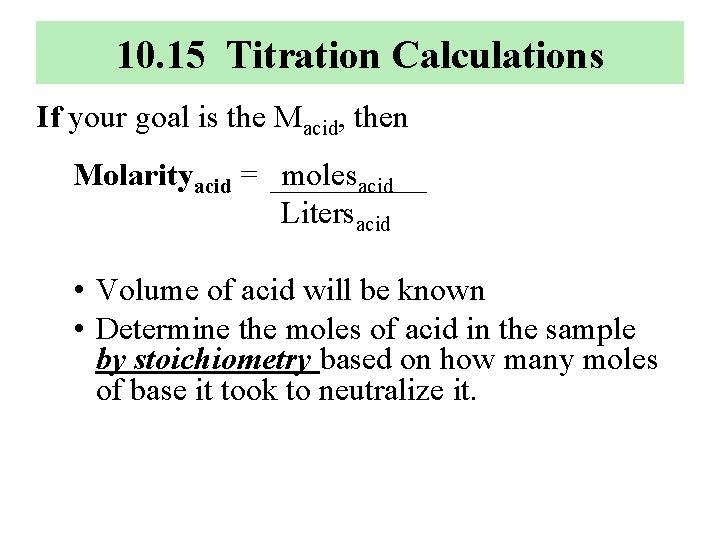
10. 15 Titration Calculations If your goal is the Macid, then Molarityacid = molesacid Litersacid • Volume of acid will be known • Determine the moles of acid in the sample by stoichiometry based on how many moles of base it took to neutralize it.
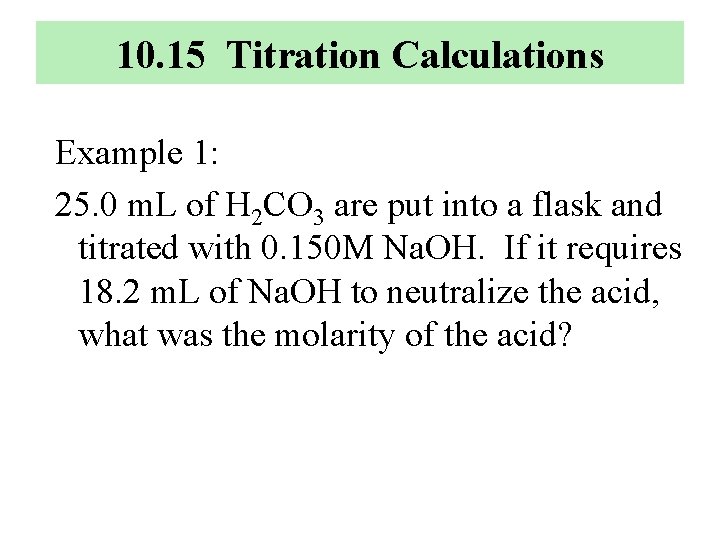
10. 15 Titration Calculations Example 1: 25. 0 m. L of H 2 CO 3 are put into a flask and titrated with 0. 150 M Na. OH. If it requires 18. 2 m. L of Na. OH to neutralize the acid, what was the molarity of the acid?
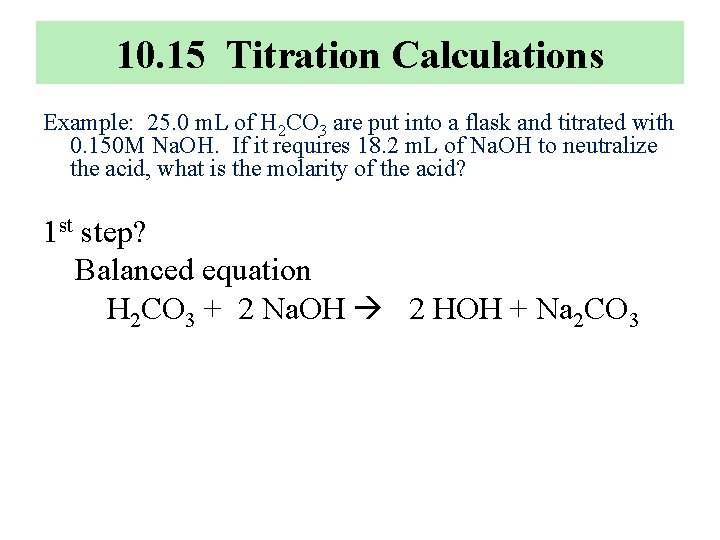
10. 15 Titration Calculations Example: 25. 0 m. L of H 2 CO 3 are put into a flask and titrated with 0. 150 M Na. OH. If it requires 18. 2 m. L of Na. OH to neutralize the acid, what is the molarity of the acid? 1 st step? Balanced equation H 2 CO 3 + 2 Na. OH 2 HOH + Na 2 CO 3
2. Since molarity of H 2 CO 3 is the unknown, use stoichiometry to find moles of this acid needed for the neutralization. (Which will then be divided by the liters of H 2 CO 3 solution to find molarity)
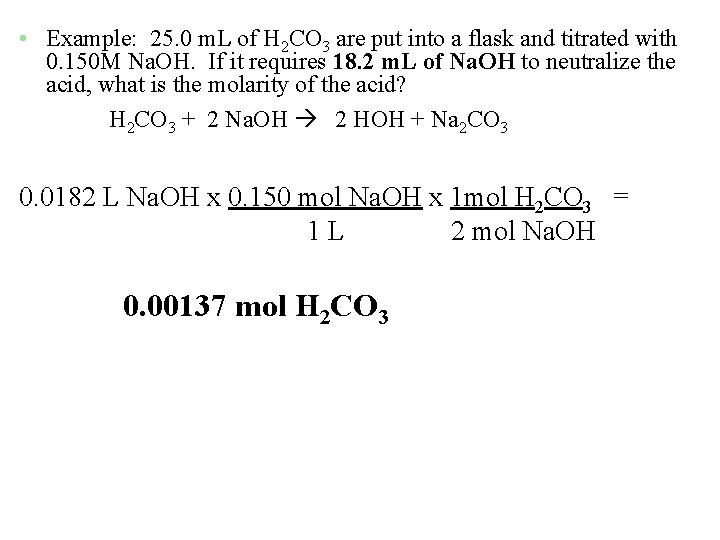
• Example: 25. 0 m. L of H 2 CO 3 are put into a flask and titrated with 0. 150 M Na. OH. If it requires 18. 2 m. L of Na. OH to neutralize the acid, what is the molarity of the acid? H 2 CO 3 + 2 Na. OH 2 HOH + Na 2 CO 3 0. 0182 L Na. OH x 0. 150 mol Na. OH x 1 mol H 2 CO 3 = 1 L 2 mol Na. OH 0. 00137 mol H 2 CO 3
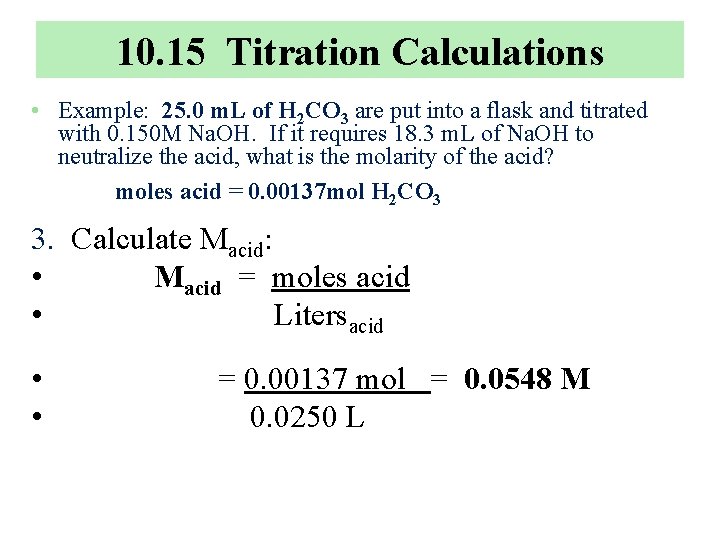
10. 15 Titration Calculations • Example: 25. 0 m. L of H 2 CO 3 are put into a flask and titrated with 0. 150 M Na. OH. If it requires 18. 3 m. L of Na. OH to neutralize the acid, what is the molarity of the acid? moles acid = 0. 00137 mol H 2 CO 3 3. Calculate Macid: • Macid = moles acid • Litersacid • • = 0. 00137 mol = 0. 0548 M 0. 0250 L
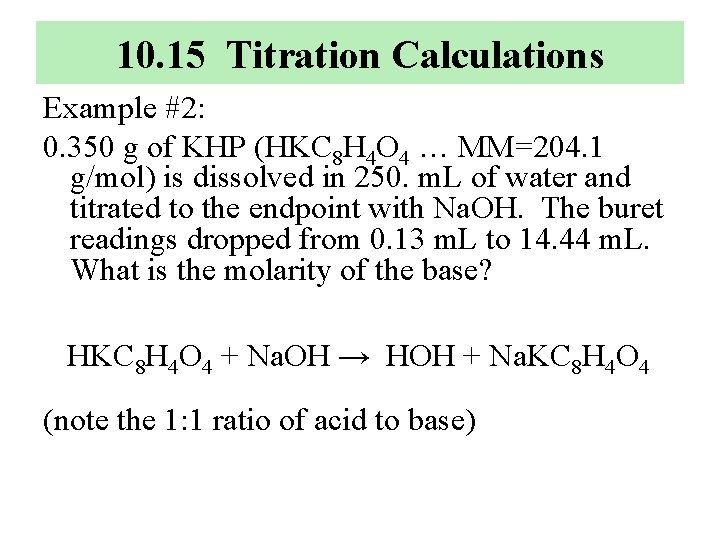
10. 15 Titration Calculations Example #2: 0. 350 g of KHP (HKC 8 H 4 O 4 … MM=204. 1 g/mol) is dissolved in 250. m. L of water and titrated to the endpoint with Na. OH. The buret readings dropped from 0. 13 m. L to 14. 44 m. L. What is the molarity of the base? HKC 8 H 4 O 4 + Na. OH → HOH + Na. KC 8 H 4 O 4 (note the 1: 1 ratio of acid to base)
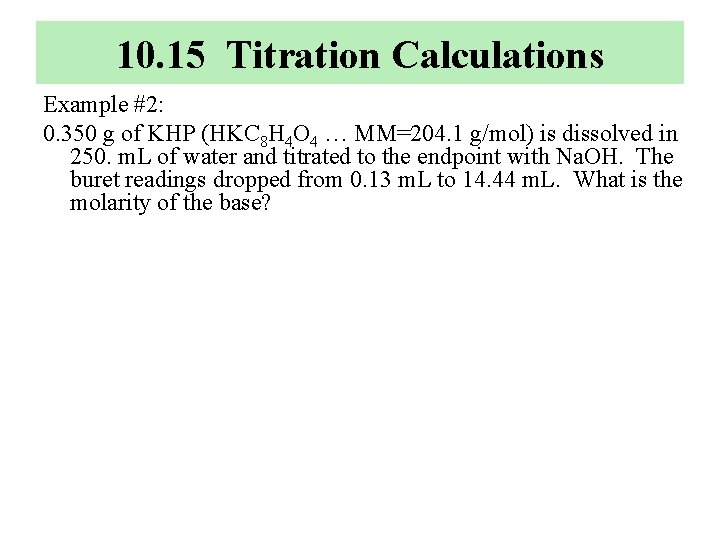
10. 15 Titration Calculations Example #2: 0. 350 g of KHP (HKC 8 H 4 O 4 … MM=204. 1 g/mol) is dissolved in 250. m. L of water and titrated to the endpoint with Na. OH. The buret readings dropped from 0. 13 m. L to 14. 44 m. L. What is the molarity of the base?

10. 15 Titration Calculations Example #3: How many m. L of 0. 520 M Na. OH would be required to neutralize 100. m. L of a 0. 150 M sulfuric acid solution?
End of Chapter 10
- Slides: 66