
Fundamentals of General Organic and Biological Chemistry 5
Fundamentals of General, Organic, and Biological Chemistry 5 th Edition Chapter Six Chemical Reactions: Classification and Mass Relationships James E. Mayhugh Oklahoma City University 2007 Prentice Hall, Inc.
Outline ► 6. 1 Chemical Equations ► 6. 2 Balancing Chemical Equations ► 6. 3 Avogadro’s Number and the Mole ► 6. 4 Gram–Mole Conversions ► 6. 5 Mole Relationships and Chemical Equations ► 6. 6 Mass Relationships and Chemical Equations ► 6. 7 Percent Yield ► 6. 8 Classes of Chemical Reactions ► 6. 9 Precipitation Reactions and Solubility Guidelines ► 6. 10 Acids, Bases, and Neutralization Reactions ► 6. 11 Redox Reactions ► 6. 12 Recognizing Redox Reactions ► 6. 13 Net Ionic Equations Prentice Hall © 2007 Chapter Six 2

6. 1 Chemical Equations ► Chemical equation: An expression in which symbols are used to represent a chemical reaction. ► Reactant: A substance that undergoes change in a chemical reaction and is written on the left side of the reaction arrow in a chemical equation. ► Product: A substance that is formed in a chemical reaction and is written on the right side of the reaction arrow in a chemical equation. Prentice Hall © 2007 Chapter Six 3
► The numbers and kinds of atoms must be the same on both sides of the reaction arrow. ► Numbers in front of formulas are called coefficients; they multiply all the atoms in a formula. ► The symbol 2 Na. HCO 3 indicates two units of sodium bicarbonate, which contains 2 Na, 2 H, 2 C, and 6 O. ► Substances involved in chemical reactions may be solids, liquids, gases, or they may be in solution. ► This information is added to an equation by placing the appropriate symbols after the formulas: ► Solid=(s) Liquid=(l) Gas=(g) Aqueous solution=(aq) Prentice Hall © 2007 Chapter Six 4
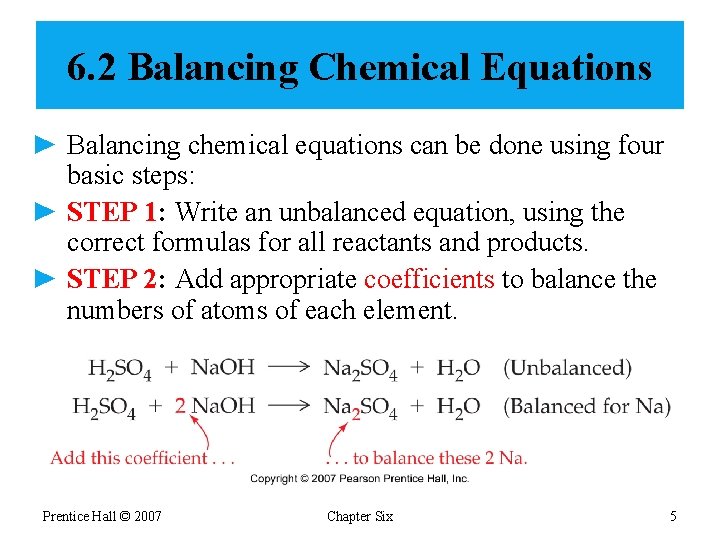
6. 2 Balancing Chemical Equations ► Balancing chemical equations can be done using four basic steps: ► STEP 1: Write an unbalanced equation, using the correct formulas for all reactants and products. ► STEP 2: Add appropriate coefficients to balance the numbers of atoms of each element. Prentice Hall © 2007 Chapter Six 5
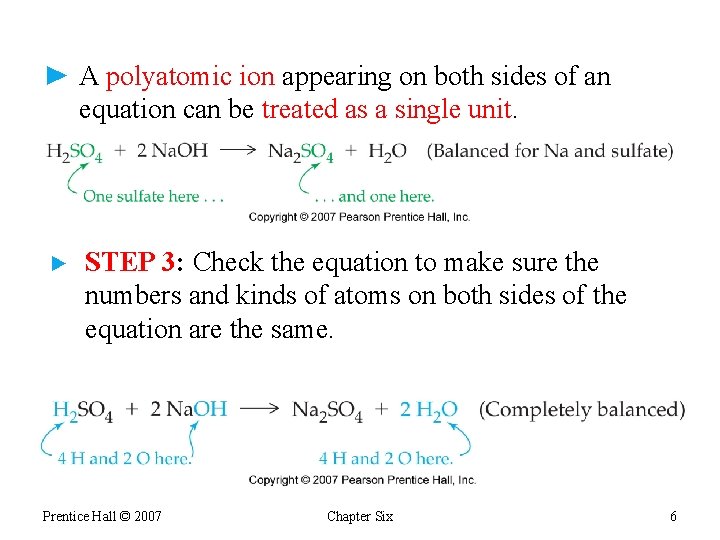
► A polyatomic ion appearing on both sides of an equation can be treated as a single unit. ► STEP 3: Check the equation to make sure the numbers and kinds of atoms on both sides of the equation are the same. Prentice Hall © 2007 Chapter Six 6
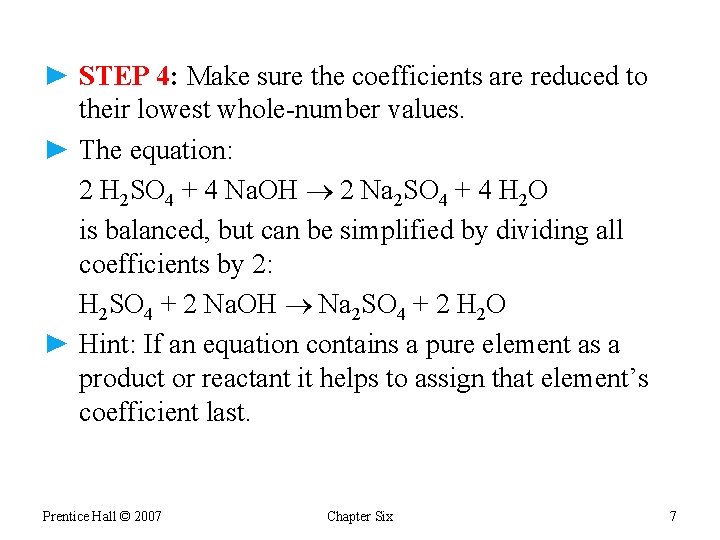
► STEP 4: Make sure the coefficients are reduced to their lowest whole-number values. ► The equation: 2 H 2 SO 4 + 4 Na. OH 2 Na 2 SO 4 + 4 H 2 O is balanced, but can be simplified by dividing all coefficients by 2: H 2 SO 4 + 2 Na. OH Na 2 SO 4 + 2 H 2 O ► Hint: If an equation contains a pure element as a product or reactant it helps to assign that element’s coefficient last. Prentice Hall © 2007 Chapter Six 7
Law of Conservation of Matter ►In a chemical reaction, matter can neither be created nor destroyed. ►In other words… The mass of the reactants must equal the mass of the products. ►See questions 6. 28 -30 Prentice Hall © 2007 Chapter Six 8
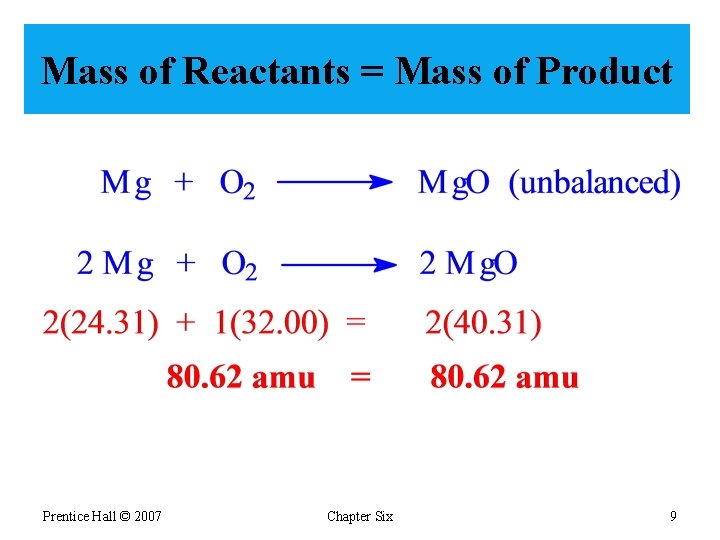
Mass of Reactants = Mass of Product Prentice Hall © 2007 Chapter Six 9
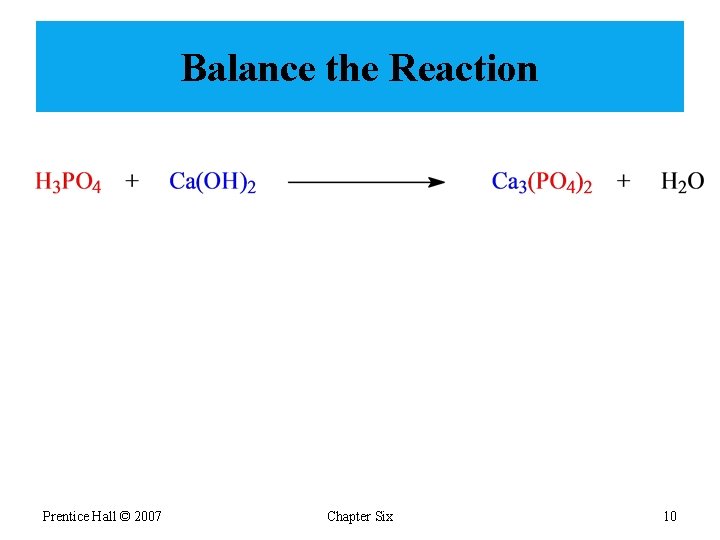
Balance the Reaction Prentice Hall © 2007 Chapter Six 10
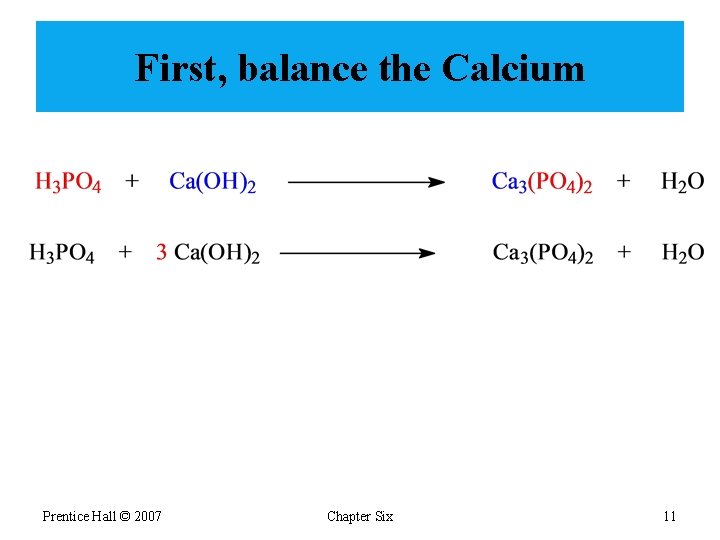
First, balance the Calcium Prentice Hall © 2007 Chapter Six 11
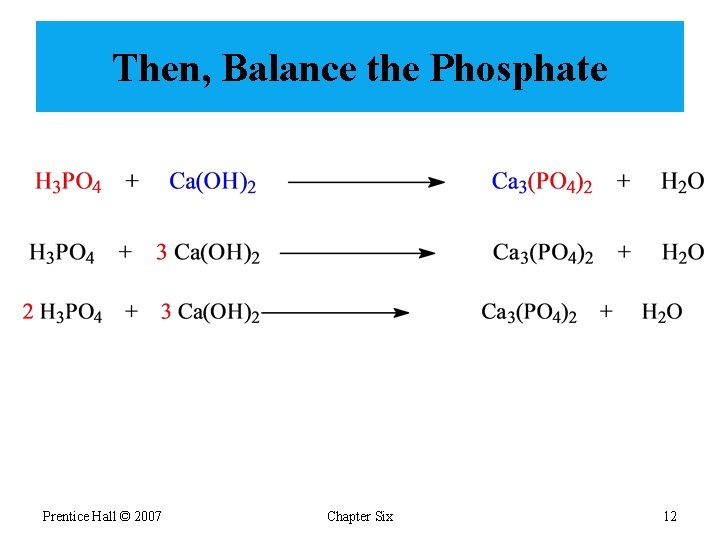
Then, Balance the Phosphate Prentice Hall © 2007 Chapter Six 12
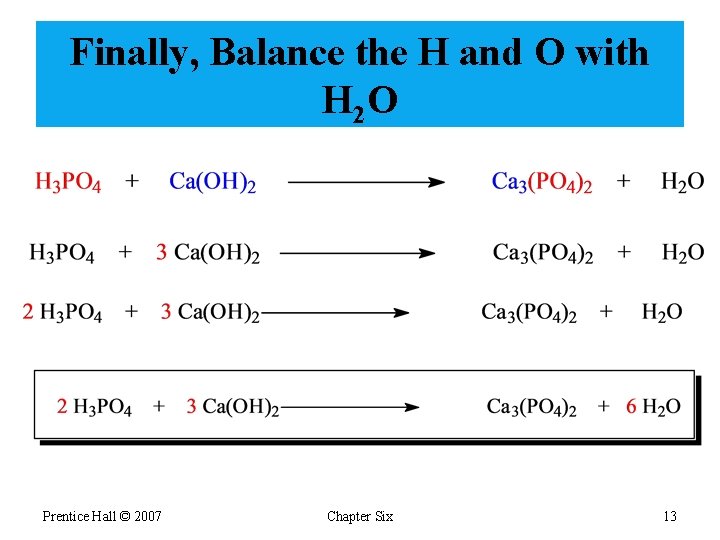
Finally, Balance the H and O with H 2 O Prentice Hall © 2007 Chapter Six 13
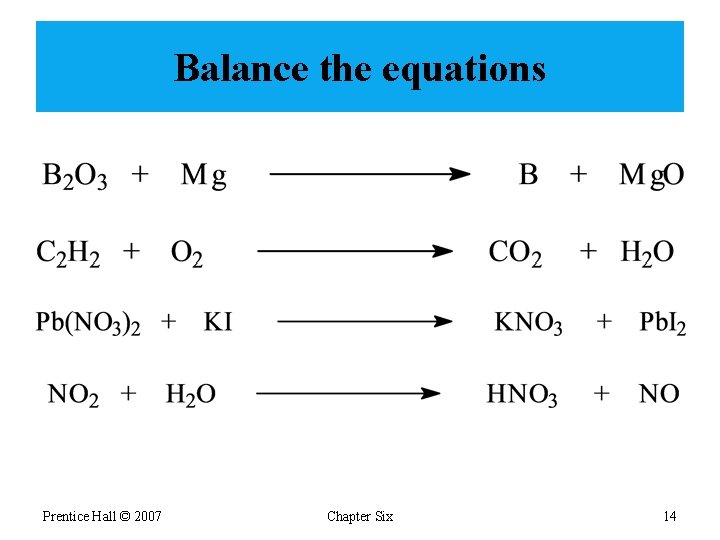
Balance the equations Prentice Hall © 2007 Chapter Six 14
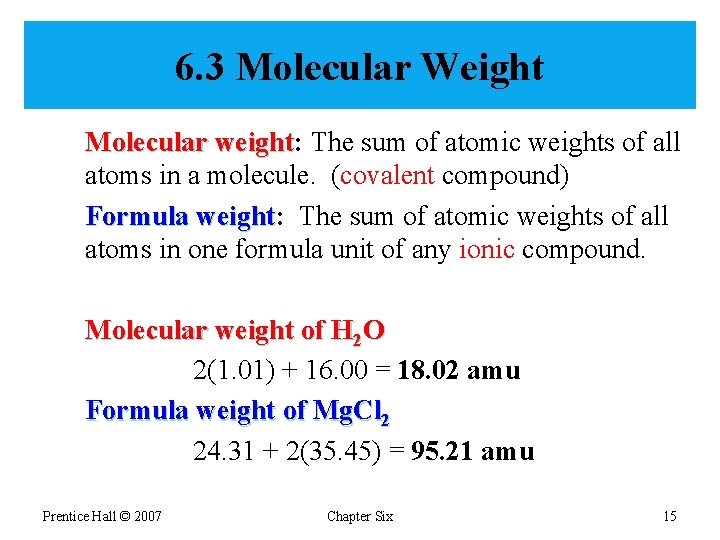
6. 3 Molecular Weight Molecular weight: weight The sum of atomic weights of all atoms in a molecule. (covalent compound) Formula weight: weight The sum of atomic weights of all atoms in one formula unit of any ionic compound. Molecular weight of H 2 O 2(1. 01) + 16. 00 = 18. 02 amu Formula weight of Mg. Cl 2 24. 31 + 2(35. 45) = 95. 21 amu Prentice Hall © 2007 Chapter Six 15
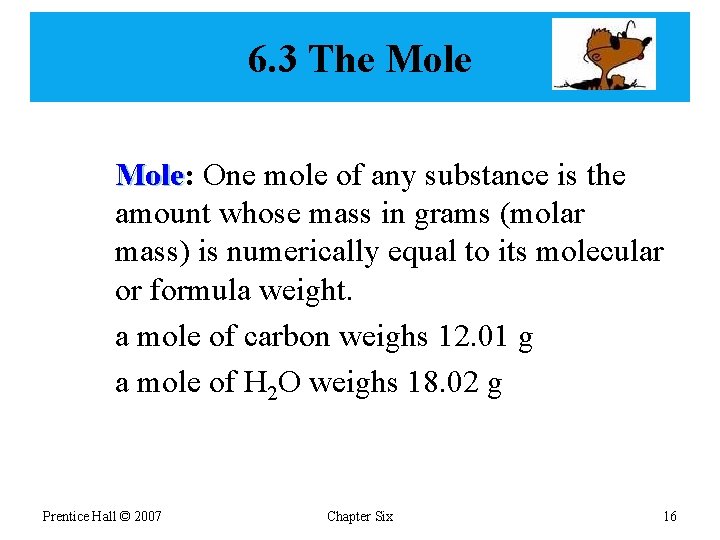
6. 3 The Mole: Mole One mole of any substance is the amount whose mass in grams (molar mass) is numerically equal to its molecular or formula weight. a mole of carbon weighs 12. 01 g a mole of H 2 O weighs 18. 02 g Prentice Hall © 2007 Chapter Six 16
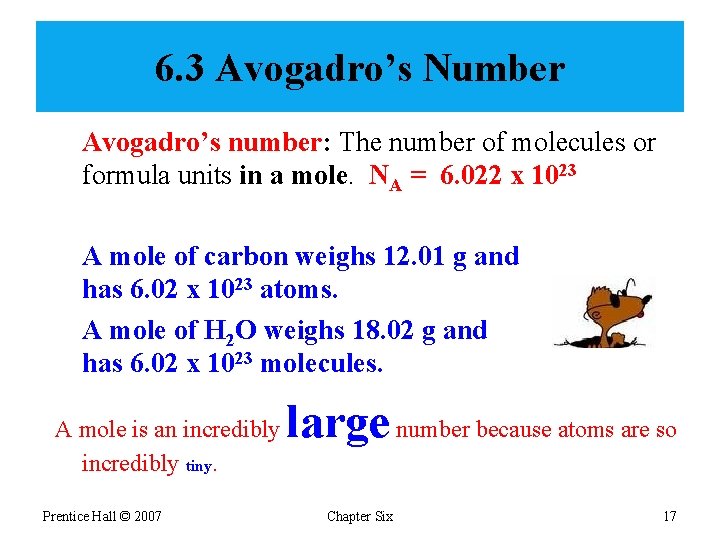
6. 3 Avogadro’s Number Avogadro’s number: The number of molecules or formula units in a mole. NA = 6. 022 x 1023 A mole of carbon weighs 12. 01 g and has 6. 02 x 1023 atoms. A mole of H 2 O weighs 18. 02 g and has 6. 02 x 1023 molecules. A mole is an incredibly tiny. Prentice Hall © 2007 large number because atoms are so Chapter Six 17
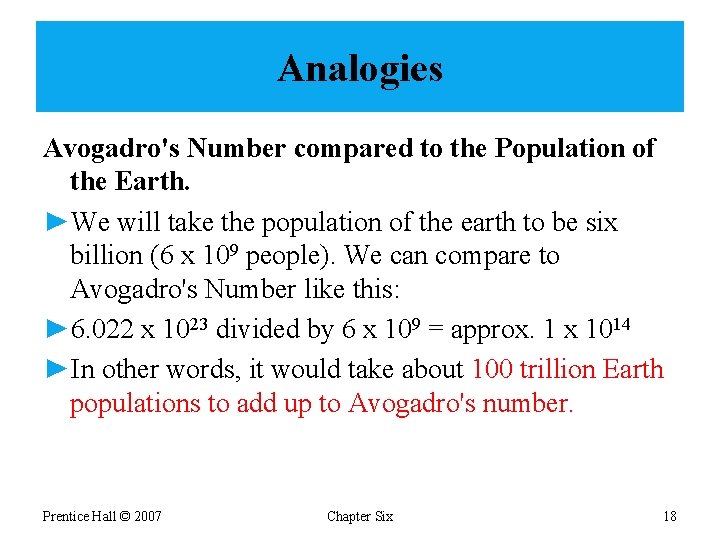
Analogies Avogadro's Number compared to the Population of the Earth. ►We will take the population of the earth to be six billion (6 x 10⁹ people). We can compare to Avogadro's Number like this: ► 6. 022 x 1023 divided by 6 x 109 = approx. 1 x 10¹⁴ ►In other words, it would take about 100 trillion Earth populations to add up to Avogadro's number. Prentice Hall © 2007 Chapter Six 18
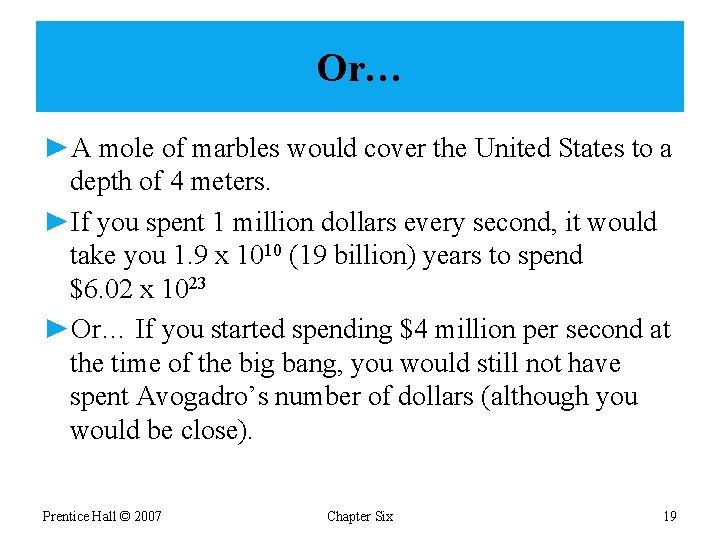
Or… ►A mole of marbles would cover the United States to a depth of 4 meters. ►If you spent 1 million dollars every second, it would take you 1. 9 x 10¹⁰ (19 billion) years to spend $6. 02 x 1023 ►Or… If you started spending $4 million per second at the time of the big bang, you would still not have spent Avogadro’s number of dollars (although you would be close). Prentice Hall © 2007 Chapter Six 19
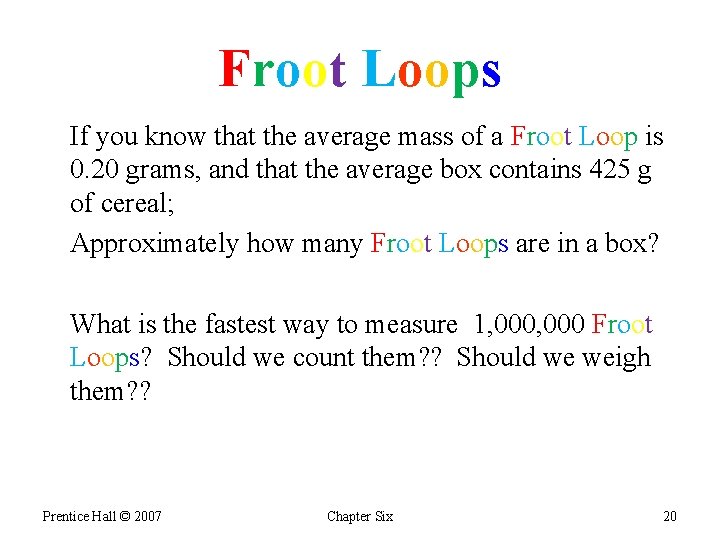
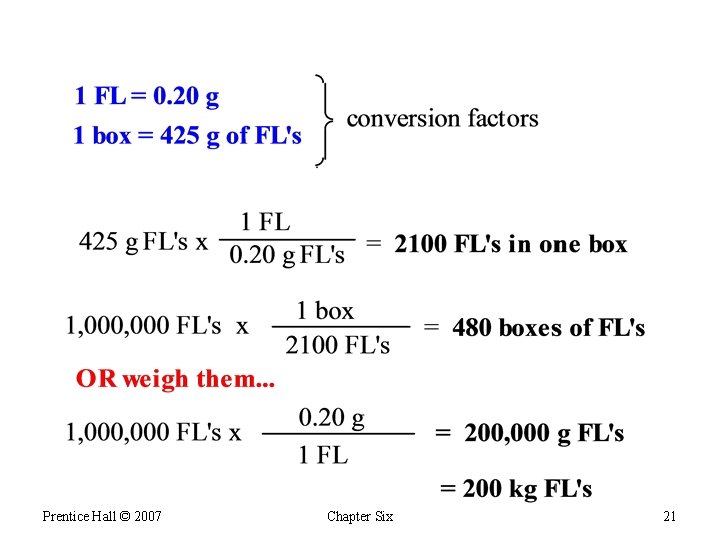
Froot Loops If you know that the average mass of a Froot Loop is 0. 20 grams, and that the average box contains 425 g of cereal; Approximately how many Froot Loops are in a box? What is the fastest way to measure 1, 000 Froot Loops? Should we count them? ? Should we weigh them? ? Prentice Hall © 2007 Chapter Six 20
Prentice Hall © 2007 Chapter Six 21
6. 4 Gram – Mole Conversions ► Molar mass = Mass of 1 mole of a substance. = Mass of 6. 022 x 1023 molecules of a substance. = Molecular (formula) weight of substance in grams. ► Molar mass serves as a conversion factor between numbers of moles and mass. If you know how many moles you have, you can calculate their mass; if you know the mass of a sample, you can calculate the number of moles. Prentice Hall © 2007 Chapter Six 22
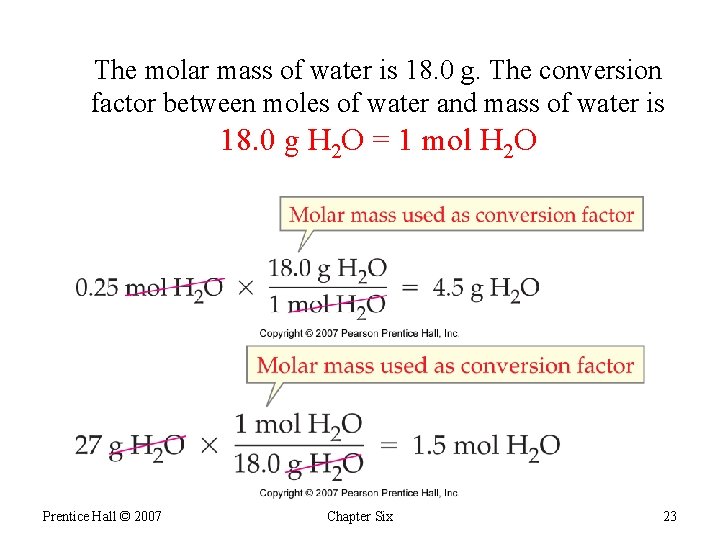
The molar mass of water is 18. 0 g. The conversion factor between moles of water and mass of water is 18. 0 g H 2 O = 1 mol H 2 O Prentice Hall © 2007 Chapter Six 23
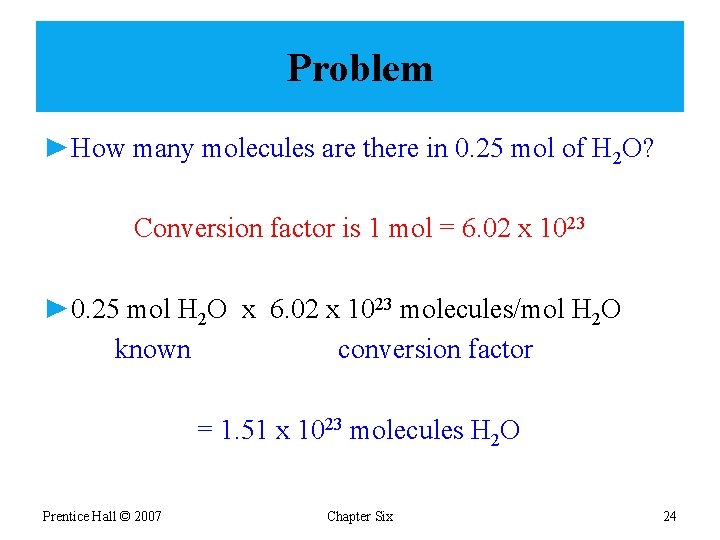
Problem ►How many molecules are there in 0. 25 mol of H 2 O? Conversion factor is 1 mol = 6. 02 x 1023 ► 0. 25 mol H 2 O x 6. 02 x 1023 molecules/mol H 2 O known conversion factor = 1. 51 x 1023 molecules H 2 O Prentice Hall © 2007 Chapter Six 24
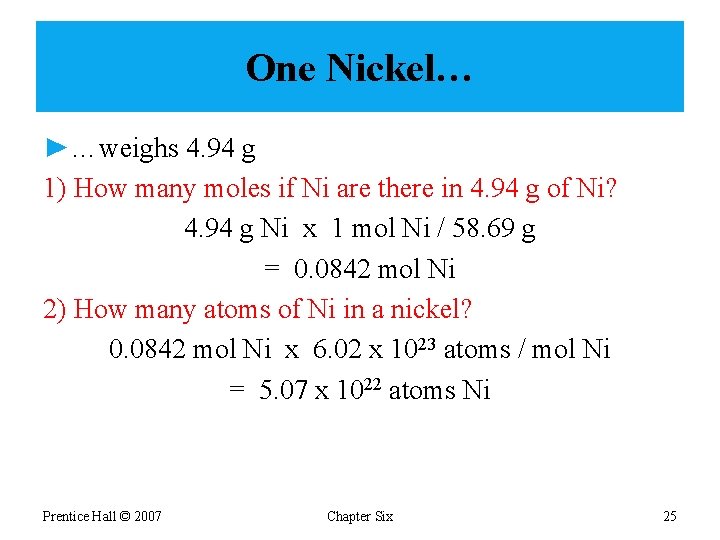
One Nickel… ►…weighs 4. 94 g 1) How many moles if Ni are there in 4. 94 g of Ni? 4. 94 g Ni x 1 mol Ni / 58. 69 g = 0. 0842 mol Ni 2) How many atoms of Ni in a nickel? 0. 0842 mol Ni x 6. 02 x 1023 atoms / mol Ni = 5. 07 x 1022 atoms Ni Prentice Hall © 2007 Chapter Six 25
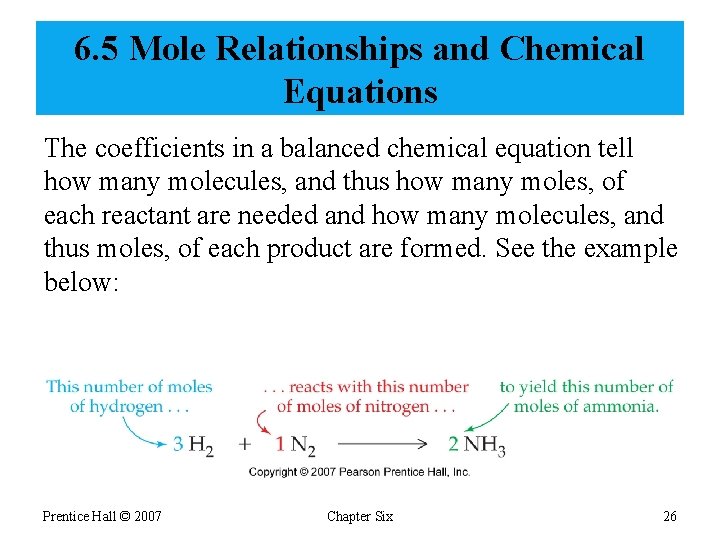
6. 5 Mole Relationships and Chemical Equations The coefficients in a balanced chemical equation tell how many molecules, and thus how many moles, of each reactant are needed and how many molecules, and thus moles, of each product are formed. See the example below: Prentice Hall © 2007 Chapter Six 26
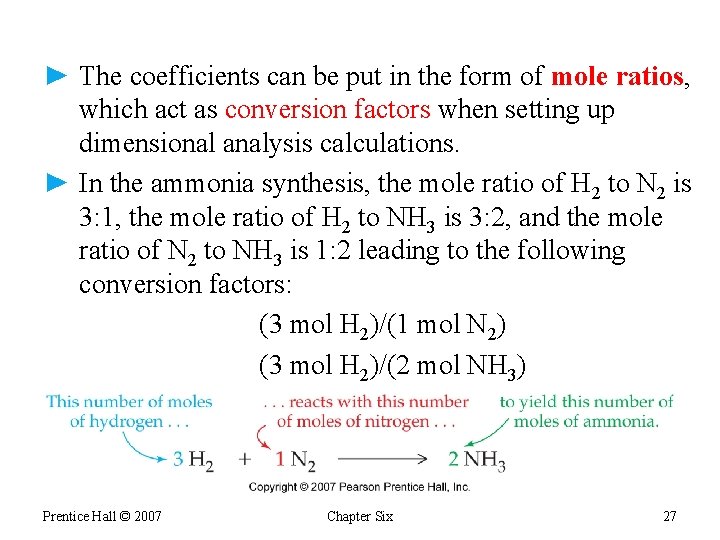
► The coefficients can be put in the form of mole ratios, which act as conversion factors when setting up dimensional analysis calculations. ► In the ammonia synthesis, the mole ratio of H 2 to N 2 is 3: 1, the mole ratio of H 2 to NH 3 is 3: 2, and the mole ratio of N 2 to NH 3 is 1: 2 leading to the following conversion factors: (3 mol H 2)/(1 mol N 2) (3 mol H 2)/(2 mol NH 3) (1 mol N 2)/(2 mol NH 3) Prentice Hall © 2007 Chapter Six 27
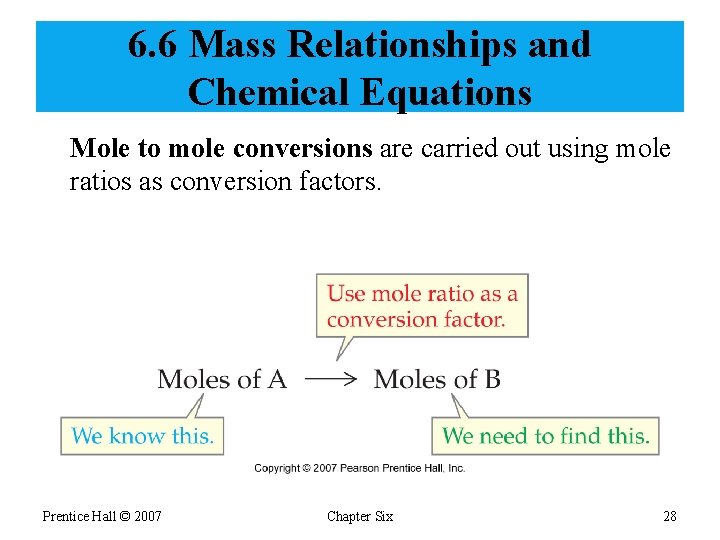
6. 6 Mass Relationships and Chemical Equations Mole to mole conversions are carried out using mole ratios as conversion factors. Prentice Hall © 2007 Chapter Six 28
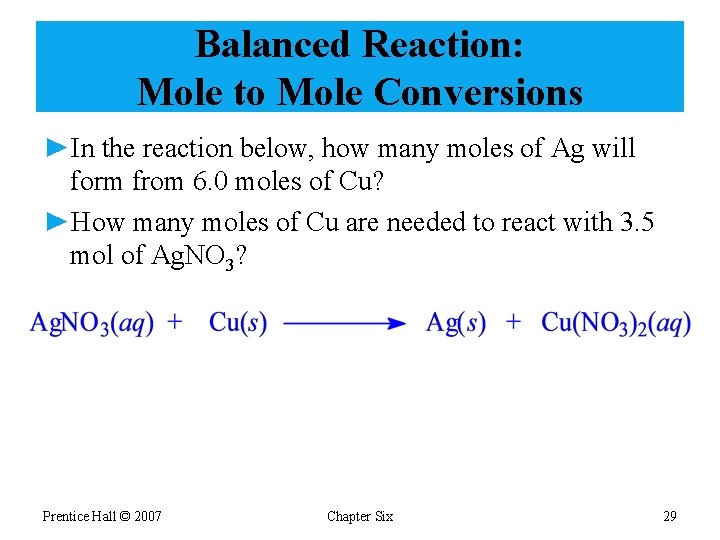
Balanced Reaction: Mole to Mole Conversions ►In the reaction below, how many moles of Ag will form from 6. 0 moles of Cu? ►How many moles of Cu are needed to react with 3. 5 mol of Ag. NO 3? Prentice Hall © 2007 Chapter Six 29
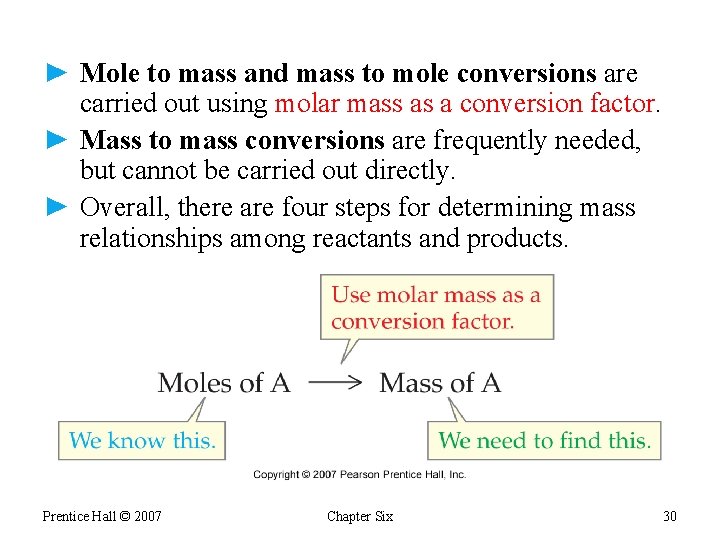
► Mole to mass and mass to mole conversions are carried out using molar mass as a conversion factor. ► Mass to mass conversions are frequently needed, but cannot be carried out directly. ► Overall, there are four steps for determining mass relationships among reactants and products. Prentice Hall © 2007 Chapter Six 30
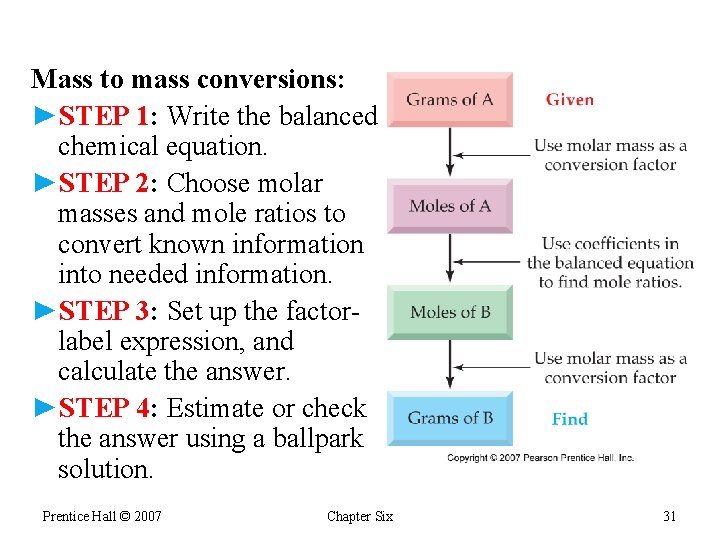
Mass to mass conversions: ►STEP 1: Write the balanced chemical equation. ►STEP 2: Choose molar masses and mole ratios to convert known information into needed information. ►STEP 3: Set up the factorlabel expression, and calculate the answer. ►STEP 4: Estimate or check the answer using a ballpark solution. Prentice Hall © 2007 Chapter Six 31
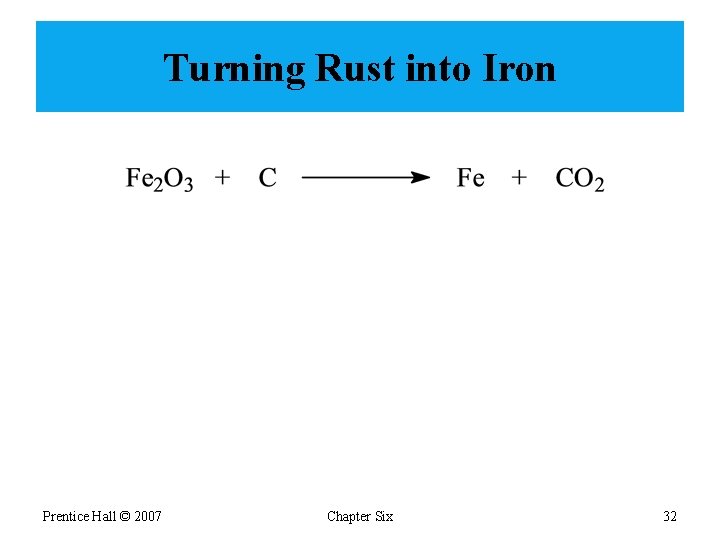
Turning Rust into Iron Prentice Hall © 2007 Chapter Six 32
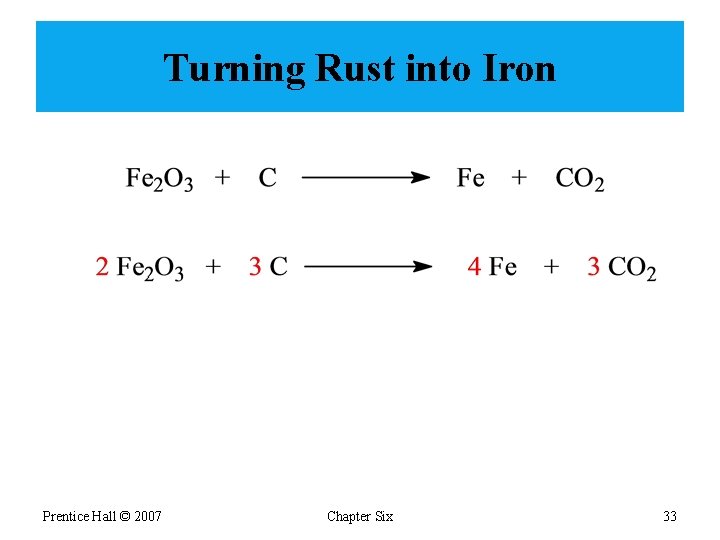
Turning Rust into Iron Prentice Hall © 2007 Chapter Six 33
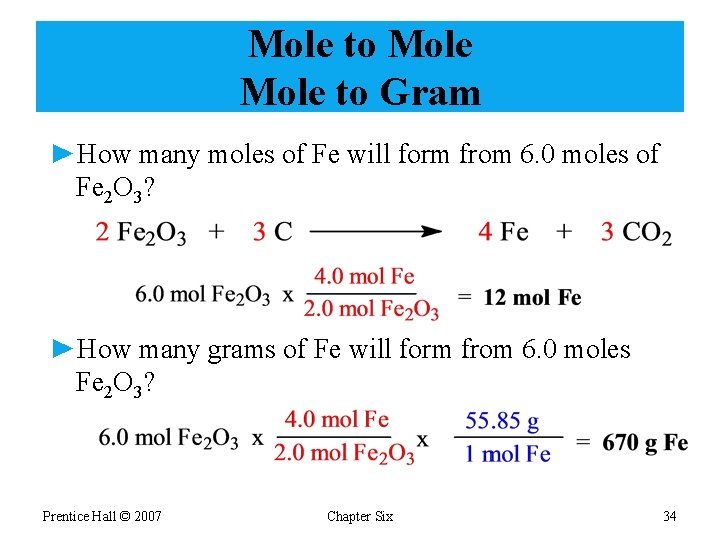
Mole to Gram ►How many moles of Fe will form from 6. 0 moles of Fe 2 O 3? ►How many grams of Fe will form from 6. 0 moles Fe 2 O 3? Prentice Hall © 2007 Chapter Six 34
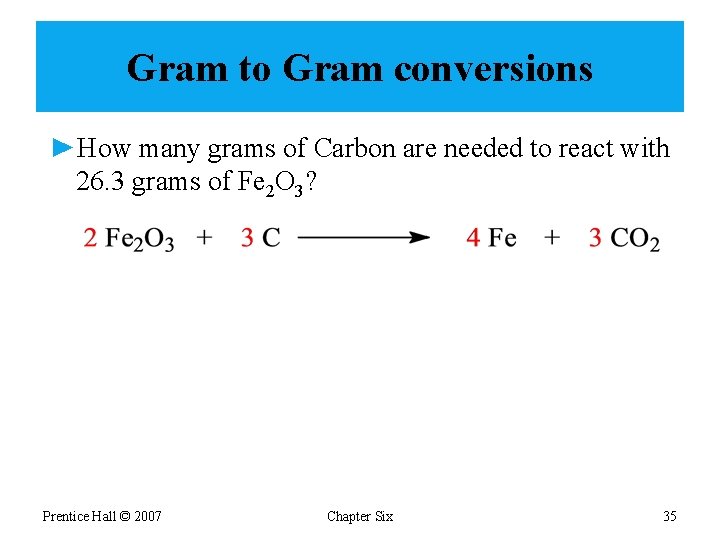
Gram to Gram conversions ►How many grams of Carbon are needed to react with 26. 3 grams of Fe 2 O 3? Prentice Hall © 2007 Chapter Six 35
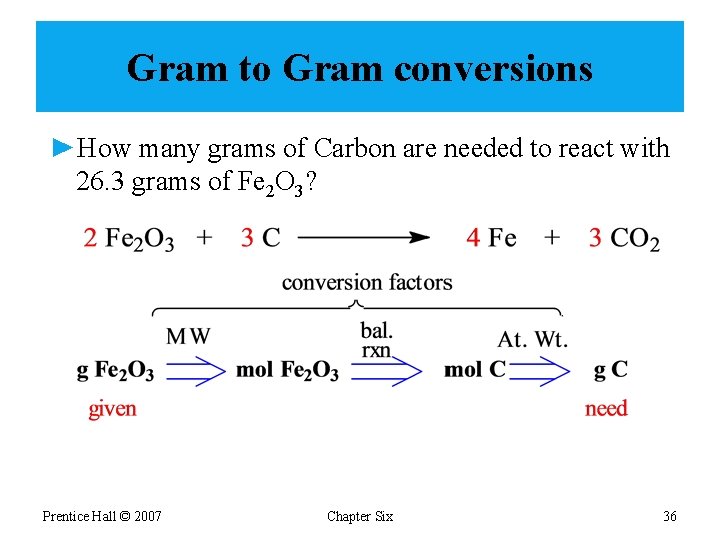
Gram to Gram conversions ►How many grams of Carbon are needed to react with 26. 3 grams of Fe 2 O 3? Prentice Hall © 2007 Chapter Six 36
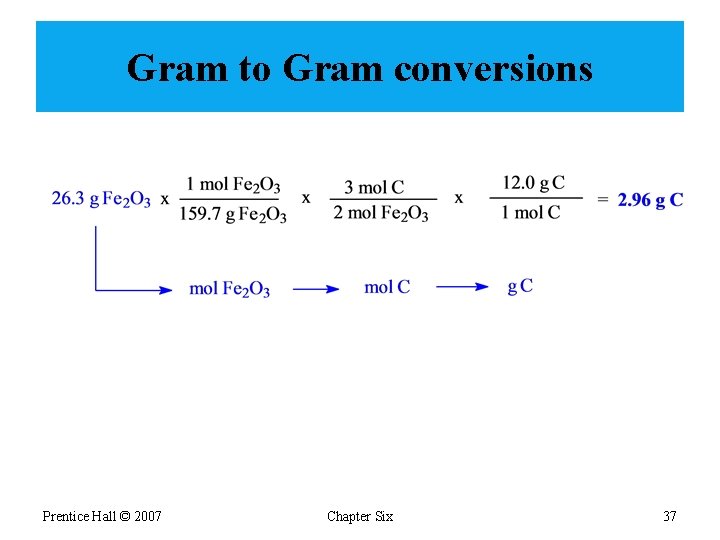
Gram to Gram conversions Prentice Hall © 2007 Chapter Six 37
6. 7 Percent Yield ► The amount of product actually formed in a chemical reaction is often somewhat less than the amount predicted by theory. ► Unwanted side reactions and loss of product during handling prevent one from obtaining a perfect conversion of all the reactants to desired products. ► The amount of product actually obtained in a chemical reaction is usually expressed as a percent yield. Prentice Hall © 2007 Chapter Six 38
► Percent yield is defined as: (Actual yield ÷ Theoretical yield) x 100% ► The actual yield is found by weighing the product obtained. ► The theoretical yield is found by a mass-to-mass calculation. Prentice Hall © 2007 Chapter Six 39
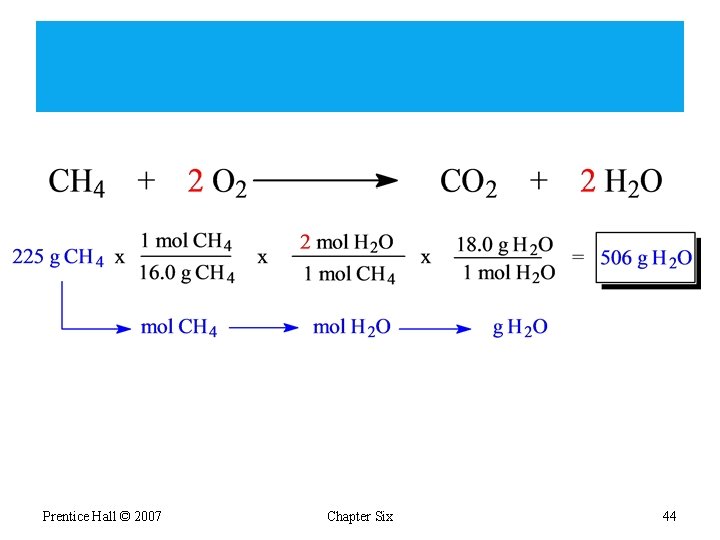
►How many grams of H 2 O will be produced in the combustion of 225 g of methane (CH 4)? Prentice Hall © 2007 Chapter Six 40
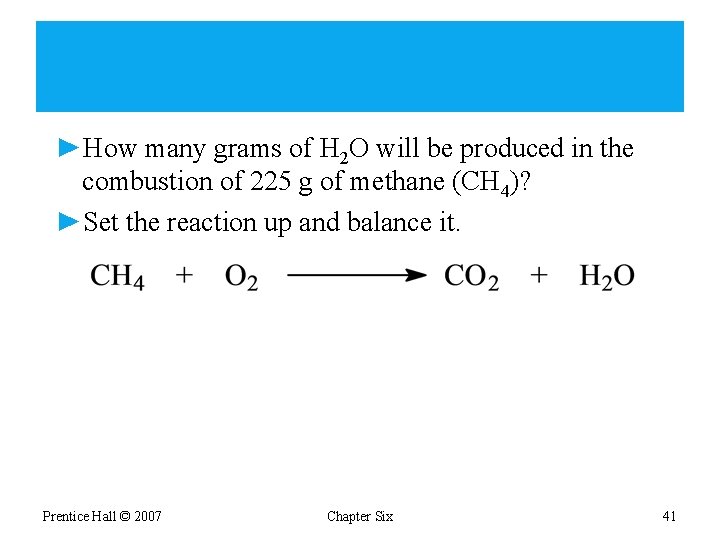
►How many grams of H 2 O will be produced in the combustion of 225 g of methane (CH 4)? ►Set the reaction up and balance it. Prentice Hall © 2007 Chapter Six 41
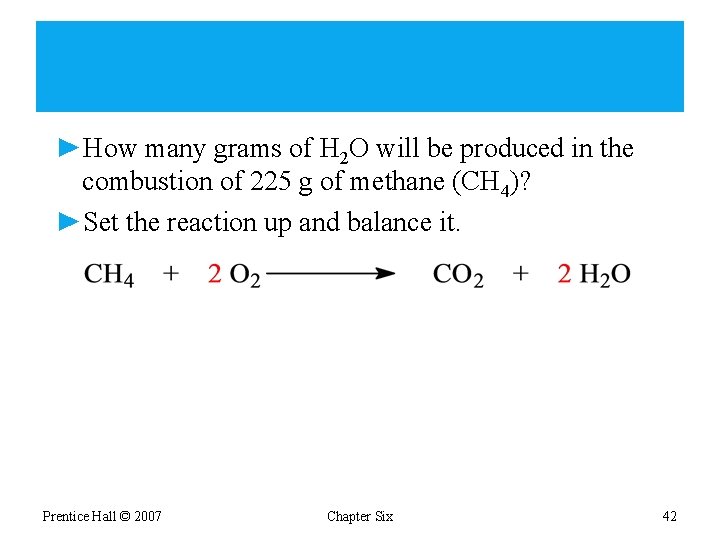
►How many grams of H 2 O will be produced in the combustion of 225 g of methane (CH 4)? ►Set the reaction up and balance it. Prentice Hall © 2007 Chapter Six 42
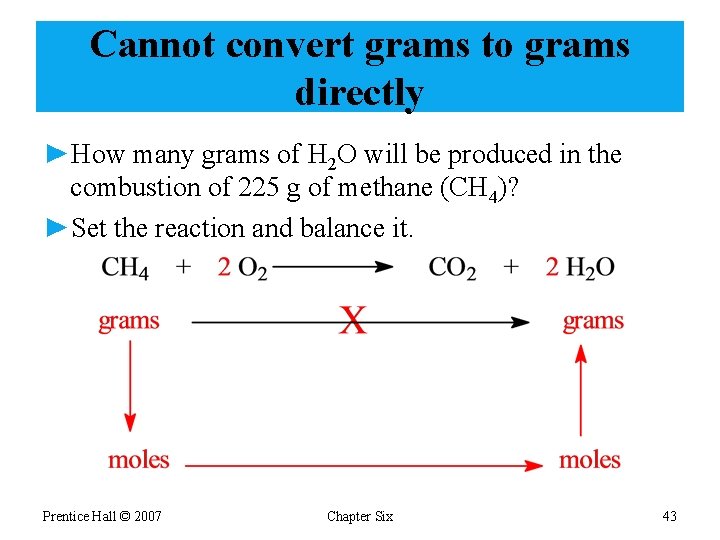
Cannot convert grams to grams directly ►How many grams of H 2 O will be produced in the combustion of 225 g of methane (CH 4)? ►Set the reaction and balance it. Prentice Hall © 2007 Chapter Six 43
Prentice Hall © 2007 Chapter Six 44
6. 8 Classes of Chemical Reactions ► When learning about chemical reactions it is helpful to group the reactions of ionic compounds into three general classes: precipitation reactions, acid–base neutralization reactions, and oxidation–reduction reactions. ► Precipitation reactions are processes in which an insoluble solid (s) called a precipitate forms when reactants are combined in aqueous solution. Prentice Hall © 2007 Chapter Six 45
► Acid–base neutralization reactions are processes in which H+ ions from an acid react with OH- ions from a base to yield water. An ionic compound called a salt is also produced. The “salt” produced need not be common table salt. Any ionic compound produced in an acid–base reaction is called a salt. ► Oxidation–reduction reactions, or redox reactions, are processes in which one or more electrons are transferred between reaction partners (atoms, molecules, or ions). As a result of this transfer, the charges on atoms in the various reactants change. Prentice Hall © 2007 Chapter Six 46
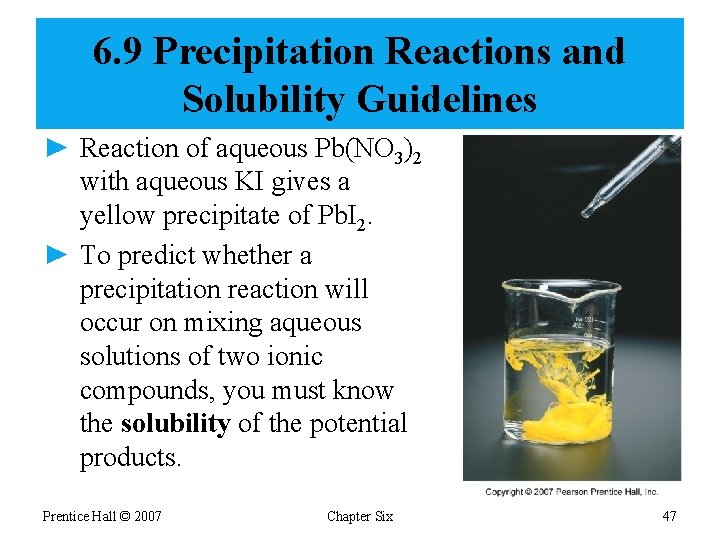
6. 9 Precipitation Reactions and Solubility Guidelines ► Reaction of aqueous Pb(NO 3)2 with aqueous KI gives a yellow precipitate of Pb. I 2. ► To predict whether a precipitation reaction will occur on mixing aqueous solutions of two ionic compounds, you must know the solubility of the potential products. Prentice Hall © 2007 Chapter Six 47
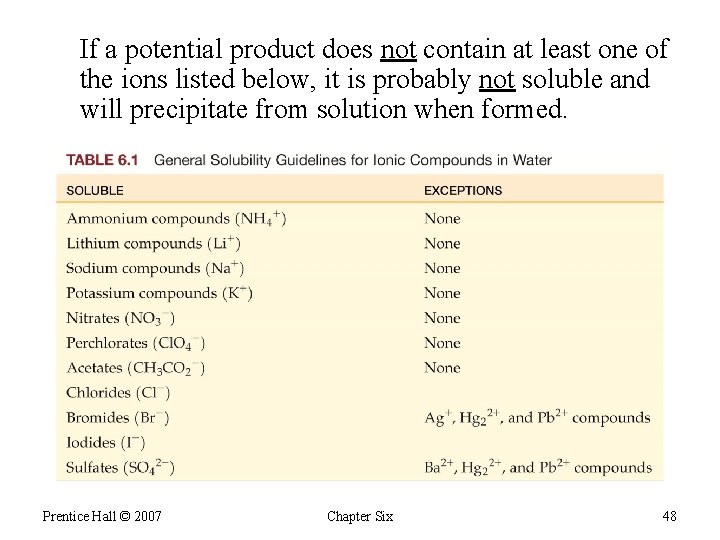
If a potential product does not contain at least one of the ions listed below, it is probably not soluble and will precipitate from solution when formed. Prentice Hall © 2007 Chapter Six 48
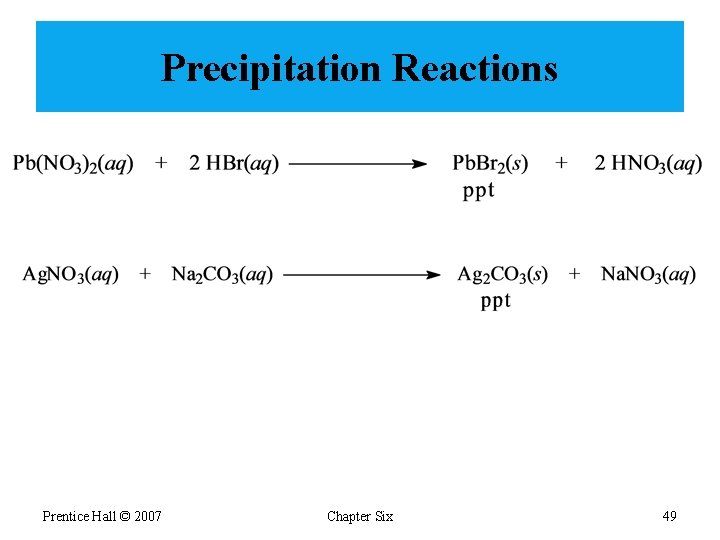
Precipitation Reactions Prentice Hall © 2007 Chapter Six 49
6. 10 Acids, Bases, and Neutralization Reactions ► When acids and bases are mixed together in correct proportion, acidic and basic properties disappear. ► A neutralization reaction produces water and a salt. HA(aq) + MOH(aq) H 2 O(l) + MA(aq) acid + base water + salt ► The reaction of hydrochloric acid with potassium hydroxide to produce potassium chloride is an example: ► HCl(aq) + KOH(aq) H 2 O(l) + KCl(aq) Prentice Hall © 2007 Chapter Six 50
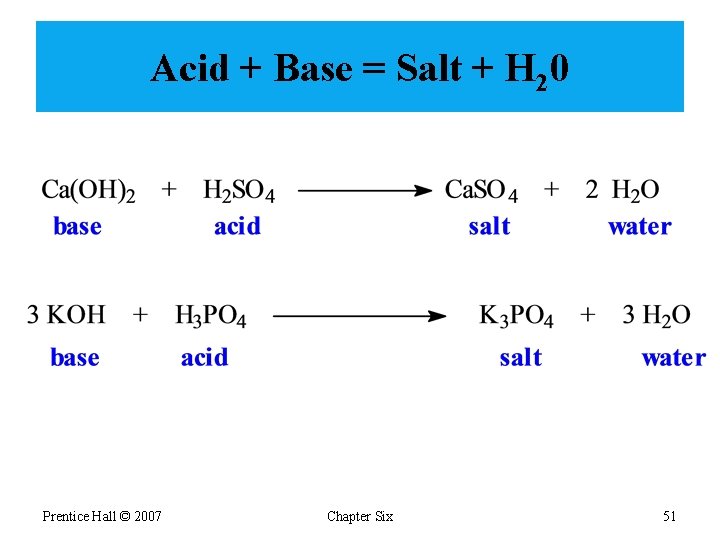
Acid + Base = Salt + H 20 Prentice Hall © 2007 Chapter Six 51
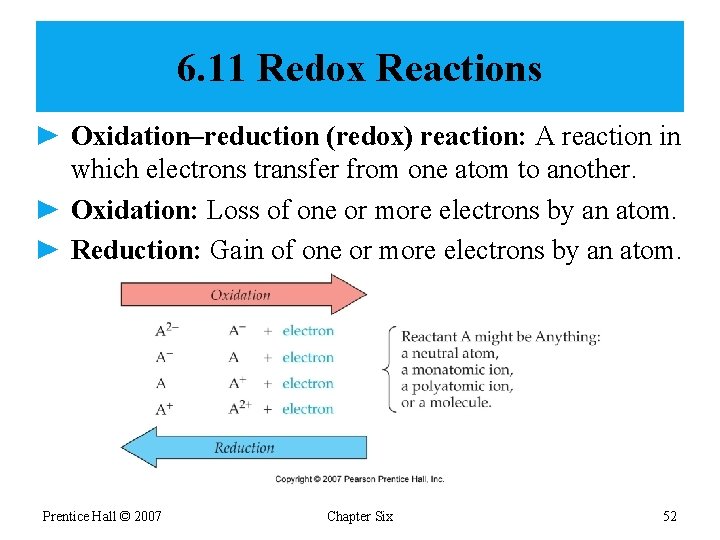
6. 11 Redox Reactions ► Oxidation–reduction (redox) reaction: A reaction in which electrons transfer from one atom to another. ► Oxidation: Loss of one or more electrons by an atom. ► Reduction: Gain of one or more electrons by an atom. Prentice Hall © 2007 Chapter Six 52
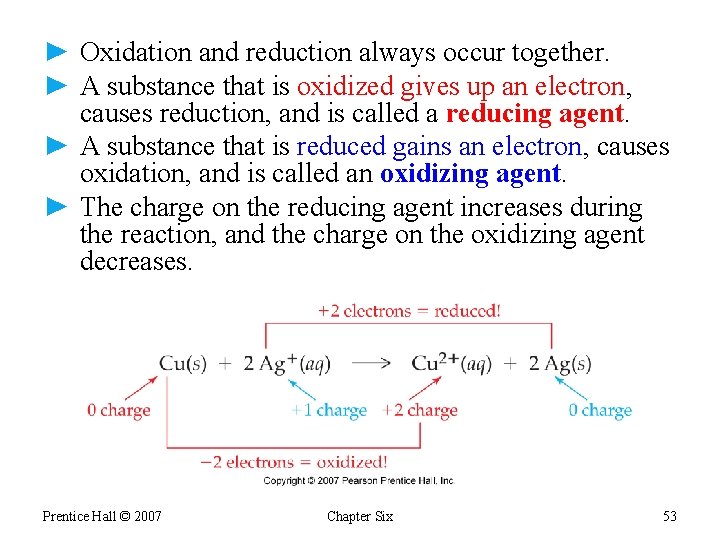
► Oxidation and reduction always occur together. ► A substance that is oxidized gives up an electron, causes reduction, and is called a reducing agent. ► A substance that is reduced gains an electron, causes oxidation, and is called an oxidizing agent. ► The charge on the reducing agent increases during the reaction, and the charge on the oxidizing agent decreases. Prentice Hall © 2007 Chapter Six 53
Reducing agent: ► Loses one or more electrons ► Causes reduction ► Undergoes oxidation ► Becomes more positive (or less negative) Oxidizing agent: ► Gains one or more electrons ► Causes oxidation ► Undergoes reduction ► Becomes more negative (or less positive) Prentice Hall © 2007 Chapter Six 54
6. 12 Recognizing Redox Reactions ► One can determine whether atoms are oxidized or reduced in a reaction by keeping track of changes in electron sharing by the atoms. Each atom in a substance is assigned a value called an oxidation number or oxidation state. ► The oxidation number indicates whether the atom is neutral, electron-rich, or electron-poor. ► By comparing the oxidation state of an atom before and after reaction, we can tell whether the atom has gained or lost electrons. Prentice Hall © 2007 Chapter Six 55
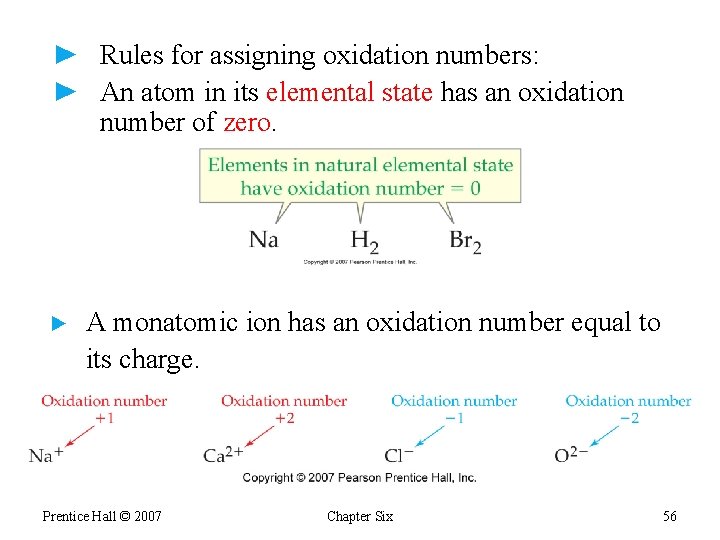
► Rules for assigning oxidation numbers: ► An atom in its elemental state has an oxidation number of zero. ► A monatomic ion has an oxidation number equal to its charge. Prentice Hall © 2007 Chapter Six 56
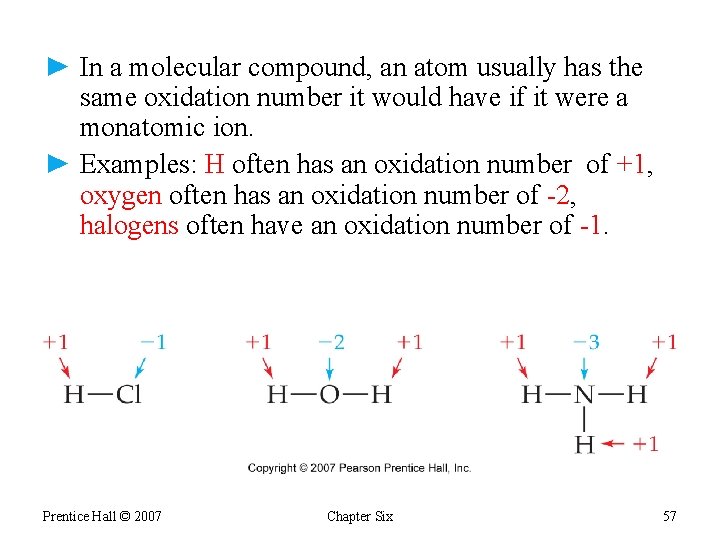
► In a molecular compound, an atom usually has the same oxidation number it would have if it were a monatomic ion. ► Examples: H often has an oxidation number of +1, oxygen often has an oxidation number of -2, halogens often have an oxidation number of -1. Prentice Hall © 2007 Chapter Six 57
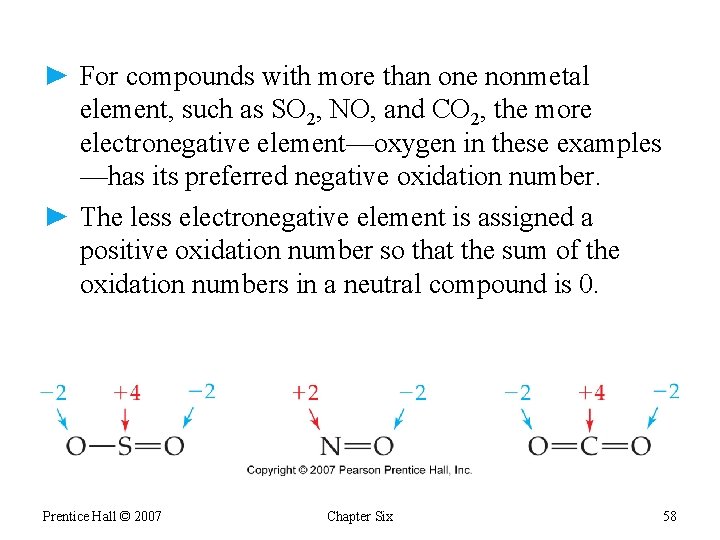
► For compounds with more than one nonmetal element, such as SO 2, NO, and CO 2, the more electronegative element—oxygen in these examples —has its preferred negative oxidation number. ► The less electronegative element is assigned a positive oxidation number so that the sum of the oxidation numbers in a neutral compound is 0. Prentice Hall © 2007 Chapter Six 58
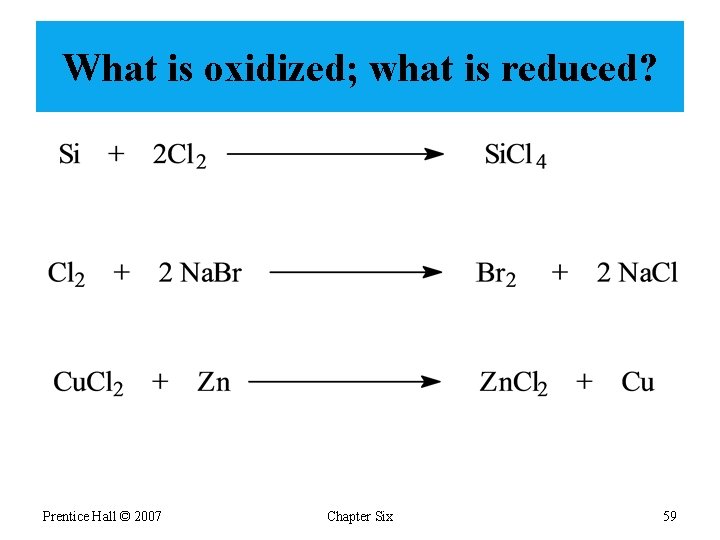
What is oxidized; what is reduced? Prentice Hall © 2007 Chapter Six 59
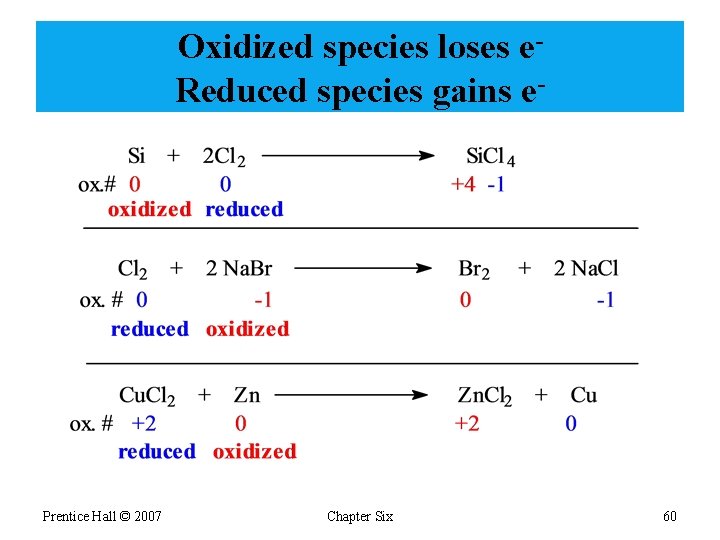
Oxidized species loses e. Reduced species gains e- Prentice Hall © 2007 Chapter Six 60
6. 13 Net Ionic Equations ► Ionic equation: An equation in which ions are explicitly shown. ► Spectator ion: An ion that appears unchanged on both sides of a reaction arrow. ► Net ionic equation: An equation that does not include spectator ions. Prentice Hall © 2007 Chapter Six 61
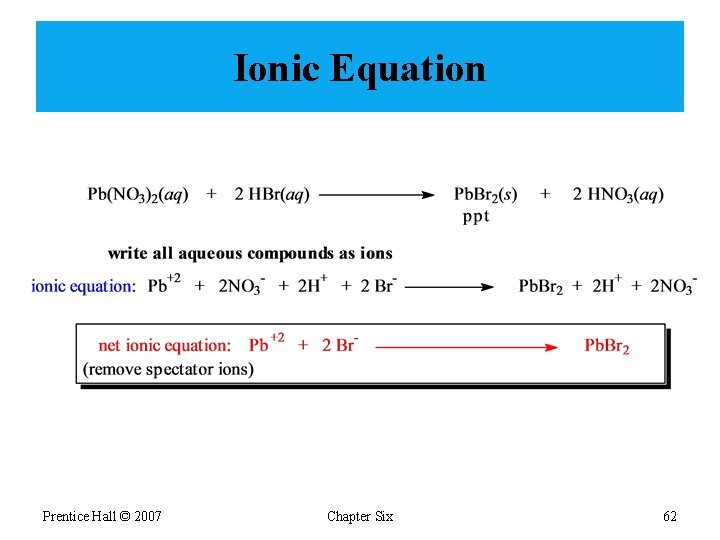
Ionic Equation Prentice Hall © 2007 Chapter Six 62
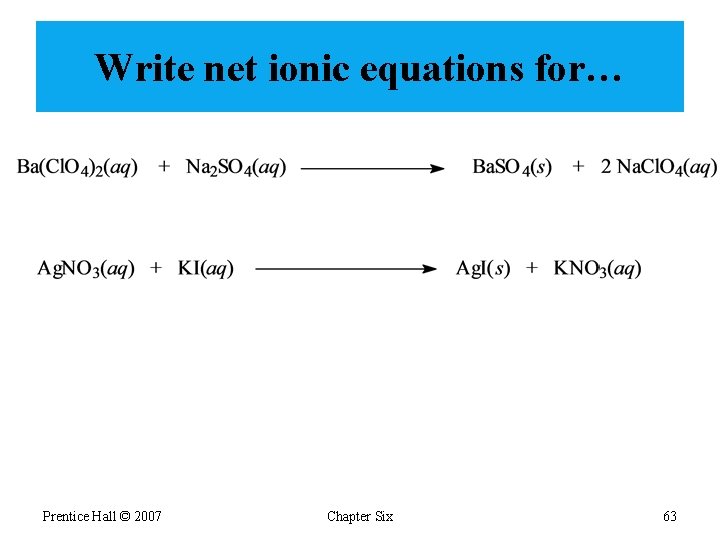
Write net ionic equations for… Prentice Hall © 2007 Chapter Six 63
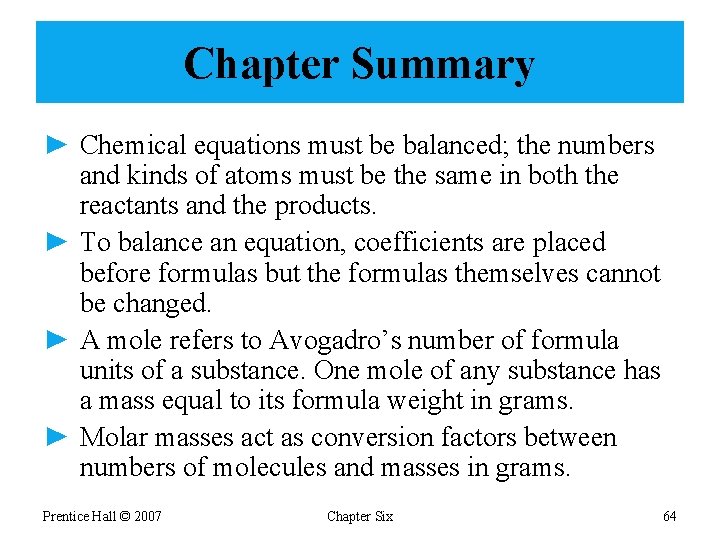
Chapter Summary ► Chemical equations must be balanced; the numbers and kinds of atoms must be the same in both the reactants and the products. ► To balance an equation, coefficients are placed before formulas but the formulas themselves cannot be changed. ► A mole refers to Avogadro’s number of formula units of a substance. One mole of any substance has a mass equal to its formula weight in grams. ► Molar masses act as conversion factors between numbers of molecules and masses in grams. Prentice Hall © 2007 Chapter Six 64
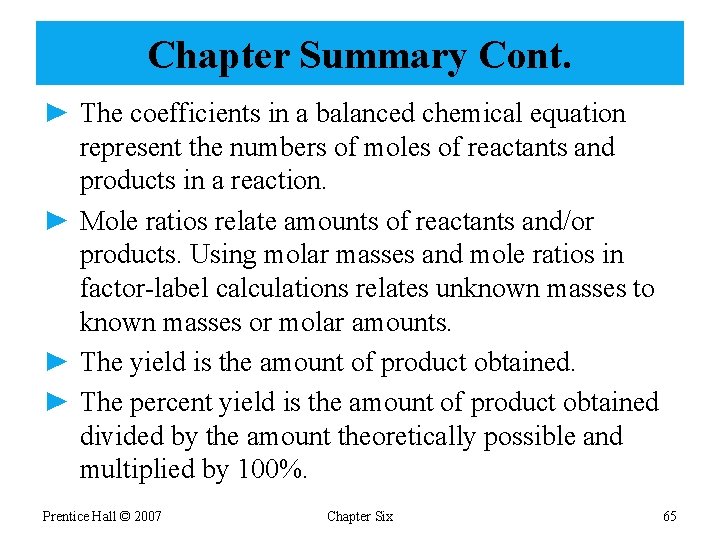
Chapter Summary Cont. ► The coefficients in a balanced chemical equation represent the numbers of moles of reactants and products in a reaction. ► Mole ratios relate amounts of reactants and/or products. Using molar masses and mole ratios in factor-label calculations relates unknown masses to known masses or molar amounts. ► The yield is the amount of product obtained. ► The percent yield is the amount of product obtained divided by the amount theoretically possible and multiplied by 100%. Prentice Hall © 2007 Chapter Six 65
Chapter Summary Cont. ► Precipitation reactions are processes in which an insoluble solid called a precipitate is formed. ► In acid–base neutralization reactions an acid reacts with a base to yield water plus a salt. ► Oxidation–reduction (redox) reactions are processes in which one or more electrons are transferred between reaction partners. ► Oxidation is the loss of electrons by an atom, and reduction is the gain of electrons by an atom. ► Oxidation numbers are assigned to provide a measure of whether an atom is neutral, electron-rich, or electron-poor. Prentice Hall © 2007 Chapter Six 66
- Slides: 66