
Fundamentals of Gas Chromatography Theory BUILDING BETTER SCIENCE
Fundamentals of Gas Chromatography: Theory BUILDING BETTER SCIENCE AGILENT AND YOU For teaching purpose only June 22, 2016 © Agilent Technologies, Inc. 2016 1

Agilent is committed to the educational community and is willing to provide access to company-owned material contained herein. This slide set is created by Agilent Technologies. The usage of the slides is limited to teaching purpose only. These materials and the information contained herein are accepted “as is” and Agilent makes no representations or warranties of any kind with respect to the materials and disclaims any responsibility for them as may be used or reproduced by you. Agilent will not be liable for any damages resulting from or in connection with your use, copying or disclosure of the materials contained herein. You agree to indemnify and hold Agilent harmless for any claims incurred by Agilent as a result of your use or reproduction of these materials. In case pictures, sketches or drawings should be used for any other purpose please contact Agilent Technologies a priori. For teaching purpose only November 3, 2020 © Agilent Technologies, Inc. 2016 2
Table of Contents Introduction How to Influence Selectivity • Compound Separation • Plate Number • What Happens Inside the Column? • Bring It Together Key Parameters Van Deemter Equation • Eddy Diffusion • Axial Diffusion • Resistance to Mass Transfer • More on Van Deemter • Retention Time and Peak Width • Retention Factor • Selectivity or Separation Factor • Efficiency • Resolution For teaching purpose only November 3, 2020 © Agilent Technologies, Inc. 2016 3 Learn More • Agilent Academia Webpage • Publications
Introduction In analytical chemistry, scientists use gas chromatography (GC) to separate and analyze compounds that can be vaporized without decomposition. They often use GC to test the purity of a particular substance, or to separate the components of a mixture to determine the relative amounts of each. Scientists use GC for both qualitative and quantitative analysis of volatile analytes. The instrument, called a gas chromatograph, employs a mobile phase and a stationary phase. That is, a moving gas carries the sample across a stationary support (a piece of glass or metal tubing called a column) inside the instrument. For teaching purpose only November 3, 2020 © Agilent Technologies, Inc. 2016 4
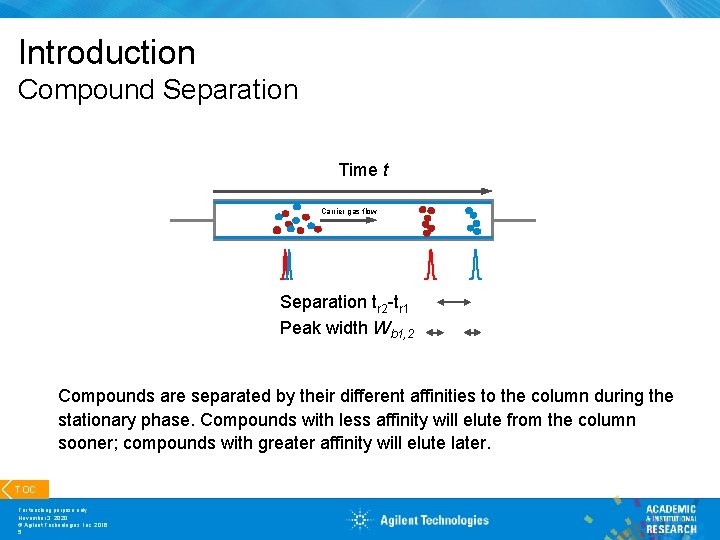
Introduction Compound Separation Time t Carrier gas flow Separation tr 2 -tr 1 Peak width Wb 1, 2 Compounds are separated by their different affinities to the column during the stationary phase. Compounds with less affinity will elute from the column sooner; compounds with greater affinity will elute later. TOC For teaching purpose only November 3, 2020 © Agilent Technologies, Inc. 2016 5

Introduction What Happens Inside the Column? Gas chromatography uses a gaseous mobile phase to transport the sample through the column, which can be packed or coated on its inside surface. In most cases, GC columns have smaller internal diameters and are longer than HPLC columns. As the GC column is heated, the compounds begin to separate based on boiling point. Changing the column to polar stationary phase will change the separation capabilities. Compounds will separate by both boiling point and polarity characteristics. TOC For teaching purpose only November 3, 2020 © Agilent Technologies, Inc. 2016 6 GC columns HPLC columns
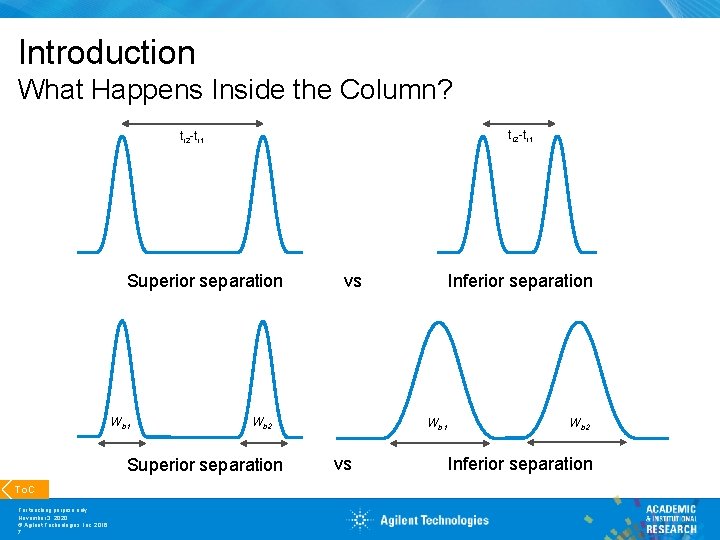
Introduction What Happens Inside the Column? tr 2 -tr 1 Superior separation Wb 1 Wb 2 Superior separation To. C For teaching purpose only November 3, 2020 © Agilent Technologies, Inc. 2016 7 Inferior separation vs Wb 1 vs Wb 2 Inferior separation
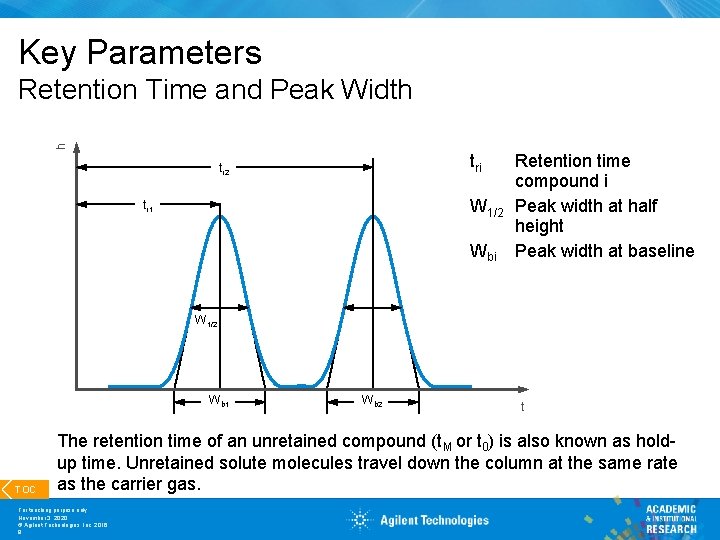
Key Parameters h Retention Time and Peak Width tri tr 2 W 1/2 tr 1 Wbi Retention time compound i Peak width at half height Peak width at baseline W 1/2 Wb 1 TOC Wb 2 t The retention time of an unretained compound (t. M or t 0) is also known as holdup time. Unretained solute molecules travel down the column at the same rate as the carrier gas. For teaching purpose only November 3, 2020 © Agilent Technologies, Inc. 2016 8
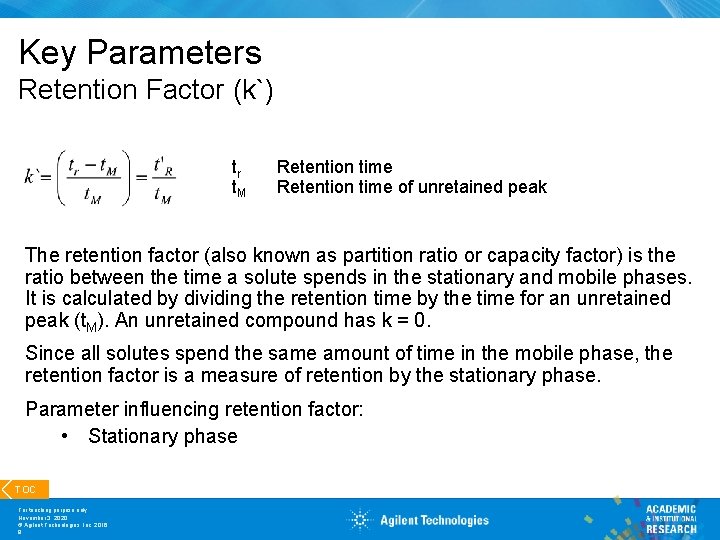
Key Parameters Retention Factor (k`) tr t. M Retention time of unretained peak The retention factor (also known as partition ratio or capacity factor) is the ratio between the time a solute spends in the stationary and mobile phases. It is calculated by dividing the retention time by the time for an unretained peak (t. M). An unretained compound has k = 0. Since all solutes spend the same amount of time in the mobile phase, the retention factor is a measure of retention by the stationary phase. Parameter influencing retention factor: • Stationary phase TOC For teaching purpose only November 3, 2020 © Agilent Technologies, Inc. 2016 9
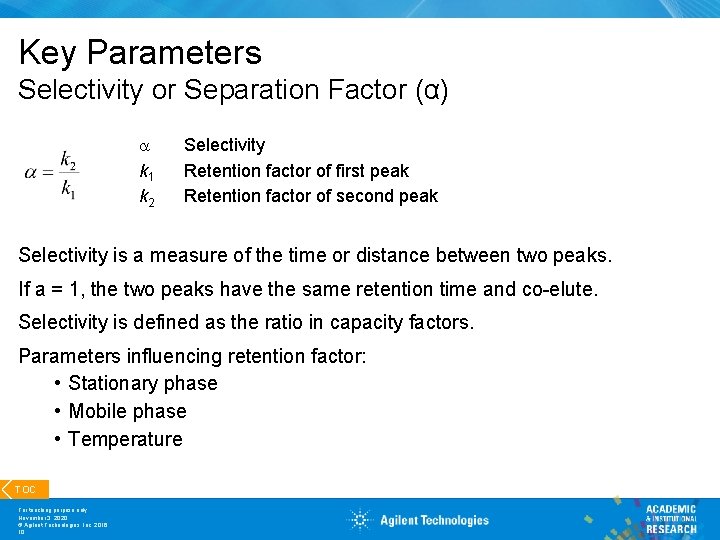
Key Parameters Selectivity or Separation Factor (α) a k 1 k 2 Selectivity Retention factor of first peak Retention factor of second peak Selectivity is a measure of the time or distance between two peaks. If a = 1, the two peaks have the same retention time and co-elute. Selectivity is defined as the ratio in capacity factors. Parameters influencing retention factor: • Stationary phase • Mobile phase • Temperature TOC For teaching purpose only November 3, 2020 © Agilent Technologies, Inc. 2016 10
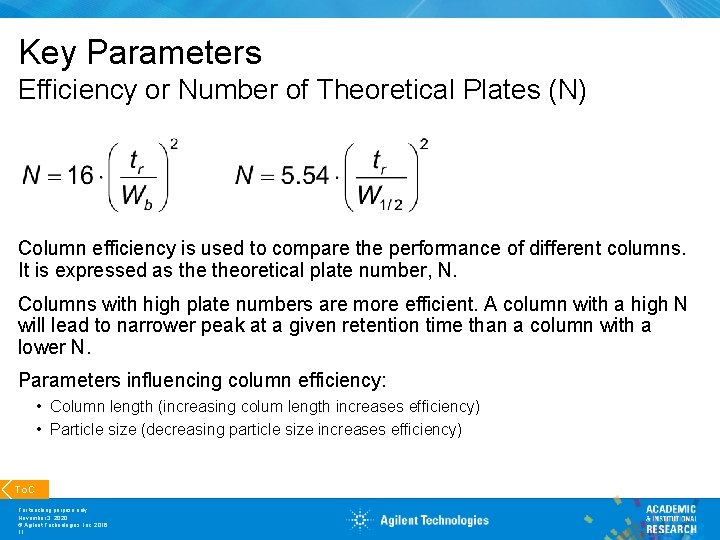
Key Parameters Efficiency or Number of Theoretical Plates (N) Column efficiency is used to compare the performance of different columns. It is expressed as theoretical plate number, N. Columns with high plate numbers are more efficient. A column with a high N will lead to narrower peak at a given retention time than a column with a lower N. Parameters influencing column efficiency: • Column length (increasing colum length increases efficiency) • Particle size (decreasing particle size increases efficiency) To. C For teaching purpose only November 3, 2020 © Agilent Technologies, Inc. 2016 11
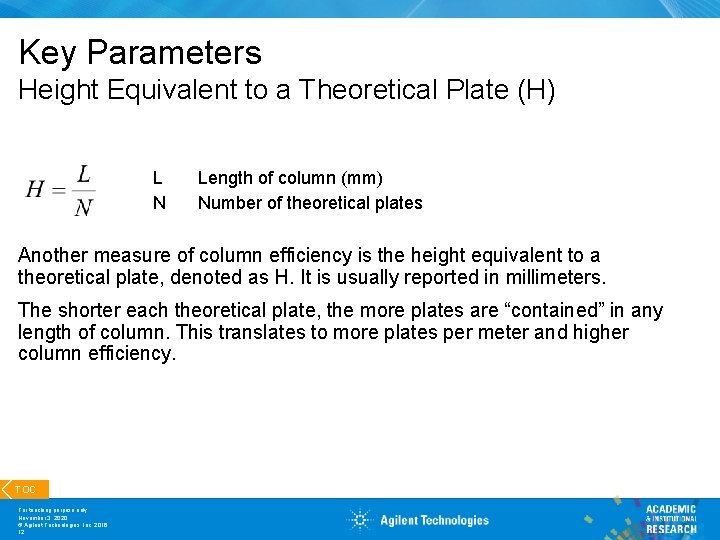
Key Parameters Height Equivalent to a Theoretical Plate (H) L N Length of column (mm) Number of theoretical plates Another measure of column efficiency is the height equivalent to a theoretical plate, denoted as H. It is usually reported in millimeters. The shorter each theoretical plate, the more plates are “contained” in any length of column. This translates to more plates per meter and higher column efficiency. TOC For teaching purpose only November 3, 2020 © Agilent Technologies, Inc. 2016 12
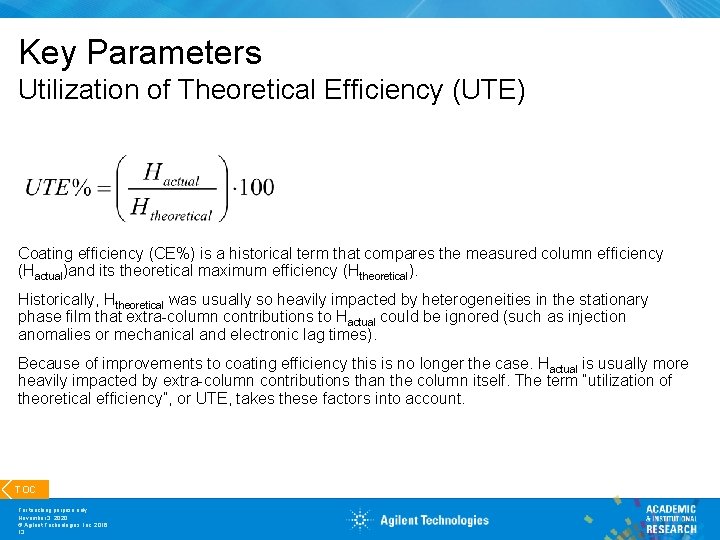
Key Parameters Utilization of Theoretical Efficiency (UTE) Coating efficiency (CE%) is a historical term that compares the measured column efficiency (Hactual)and its theoretical maximum efficiency (Htheoretical). Historically, Htheoretical was usually so heavily impacted by heterogeneities in the stationary phase film that extra-column contributions to Hactual could be ignored (such as injection anomalies or mechanical and electronic lag times). Because of improvements to coating efficiency this is no longer the case. Hactual is usually more heavily impacted by extra-column contributions than the column itself. The term “utilization of theoretical efficiency”, or UTE, takes these factors into account. TOC For teaching purpose only November 3, 2020 © Agilent Technologies, Inc. 2016 13
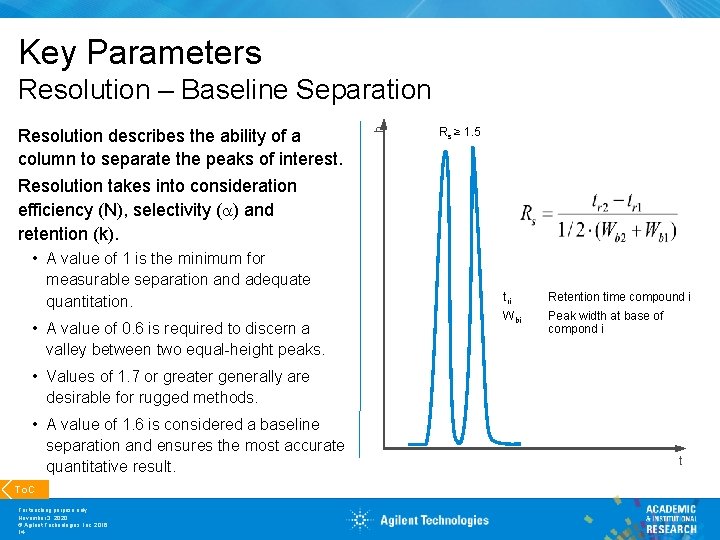
Key Parameters Resolution describes the ability of a column to separate the peaks of interest. Resolution takes into consideration efficiency (N), selectivity (a) and retention (k). • A value of 1 is the minimum for measurable separation and adequate quantitation. • A value of 0. 6 is required to discern a valley between two equal-height peaks. h Resolution – Baseline Separation Rs ≥ 1. 5 tri Retention time compound i Wbi Peak width at base of compond i • Values of 1. 7 or greater generally are desirable for rugged methods. • A value of 1. 6 is considered a baseline separation and ensures the most accurate quantitative result. To. C For teaching purpose only November 3, 2020 © Agilent Technologies, Inc. 2016 14 t
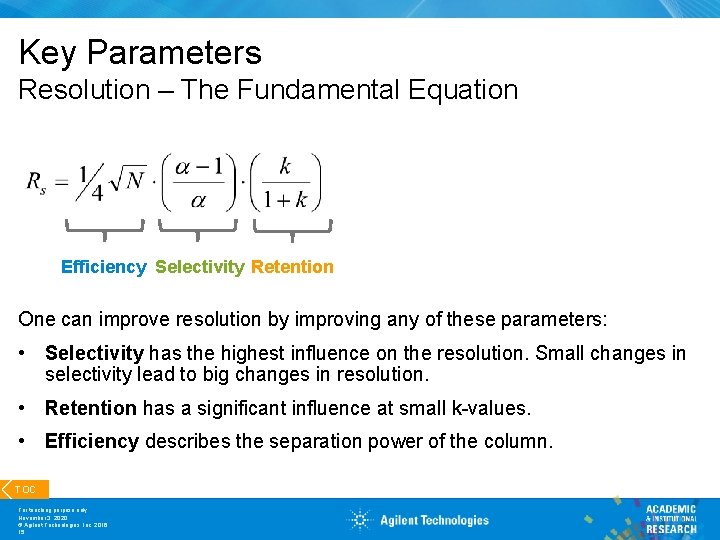
Key Parameters Resolution – The Fundamental Equation Efficiency Selectivity Retention One can improve resolution by improving any of these parameters: • Selectivity has the highest influence on the resolution. Small changes in selectivity lead to big changes in resolution. • Retention has a significant influence at small k-values. • Efficiency describes the separation power of the column. TOC For teaching purpose only November 3, 2020 © Agilent Technologies, Inc. 2016 15
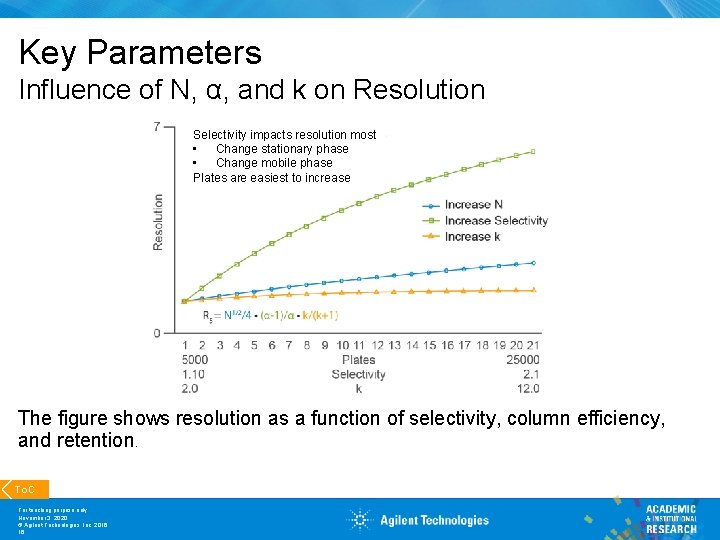
Key Parameters Influence of N, α, and k on Resolution Selectivity impacts resolution most • Change stationary phase • Change mobile phase Plates are easiest to increase The figure shows resolution as a function of selectivity, column efficiency, and retention. To. C For teaching purpose only November 3, 2020 © Agilent Technologies, Inc. 2016 16
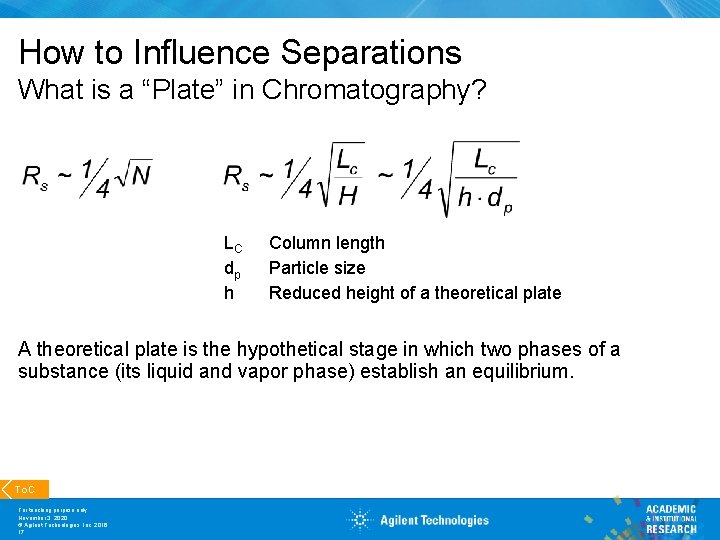
How to Influence Separations What is a “Plate” in Chromatography? LC dp h Column length Particle size Reduced height of a theoretical plate A theoretical plate is the hypothetical stage in which two phases of a substance (its liquid and vapor phase) establish an equilibrium. To. C For teaching purpose only November 3, 2020 © Agilent Technologies, Inc. 2016 17
How to Influence Separations High plate number (N) provides: • Sharp and narrow peaks • Better detection • Peak capacity to resolve complex samples But resolution increases only with the square root of the plate number. • RS ~ N Plate number increase is limited by experimental conditions • Analysis time, pressure TOC For teaching purpose only November 3, 2020 © Agilent Technologies, Inc. 2016 18
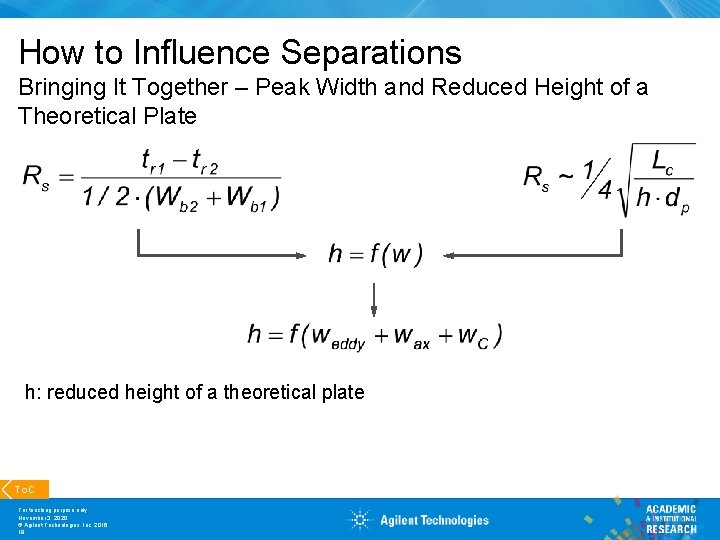
How to Influence Separations Bringing It Together – Peak Width and Reduced Height of a Theoretical Plate h: reduced height of a theoretical plate To. C For teaching purpose only November 3, 2020 © Agilent Technologies, Inc. 2016 19
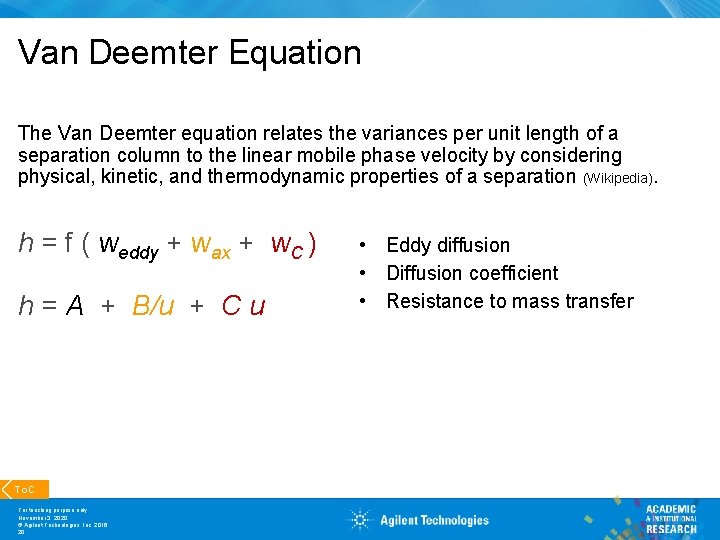
Van Deemter Equation The Van Deemter equation relates the variances per unit length of a separation column to the linear mobile phase velocity by considering physical, kinetic, and thermodynamic properties of a separation (Wikipedia). h = f ( weddy + wax + w. C ) h = A + B/u + C u To. C For teaching purpose only November 3, 2020 © Agilent Technologies, Inc. 2016 20 • Eddy diffusion • Diffusion coefficient • Resistance to mass transfer
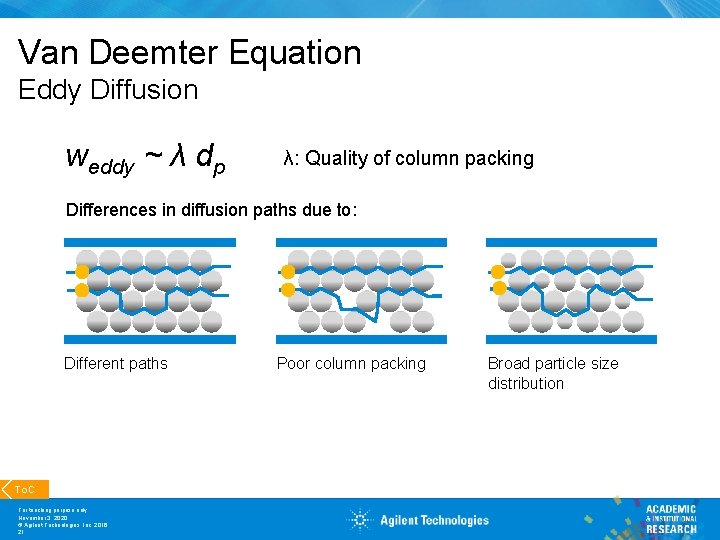
Van Deemter Equation Eddy Diffusion weddy ~ λ dp λ: Quality of column packing Differences in diffusion paths due to: Different paths To. C For teaching purpose only November 3, 2020 © Agilent Technologies, Inc. 2016 21 Poor column packing Broad particle size distribution
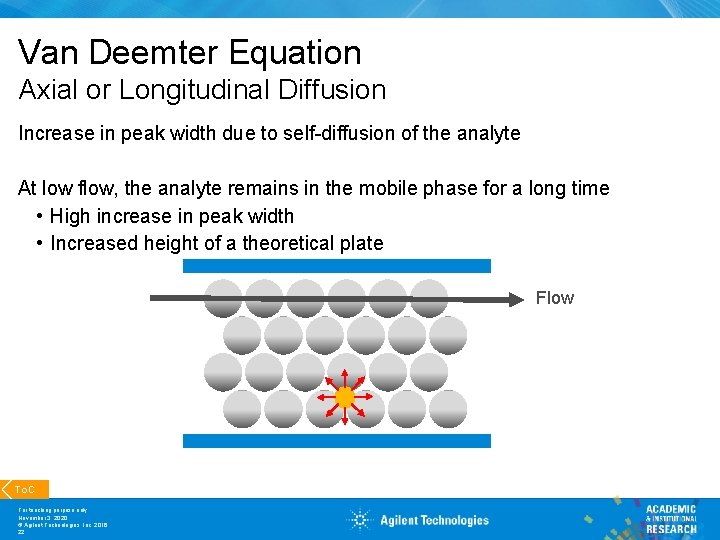
Van Deemter Equation Axial or Longitudinal Diffusion Increase in peak width due to self-diffusion of the analyte At low flow, the analyte remains in the mobile phase for a long time • High increase in peak width • Increased height of a theoretical plate Flow To. C For teaching purpose only November 3, 2020 © Agilent Technologies, Inc. 2016 22
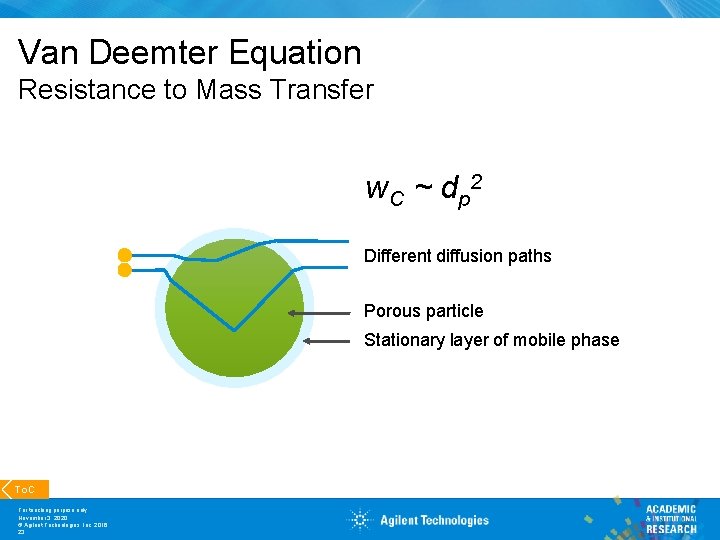
Van Deemter Equation Resistance to Mass Transfer w C ~ d p 2 Different diffusion paths Porous particle Stationary layer of mobile phase To. C For teaching purpose only November 3, 2020 © Agilent Technologies, Inc. 2016 23
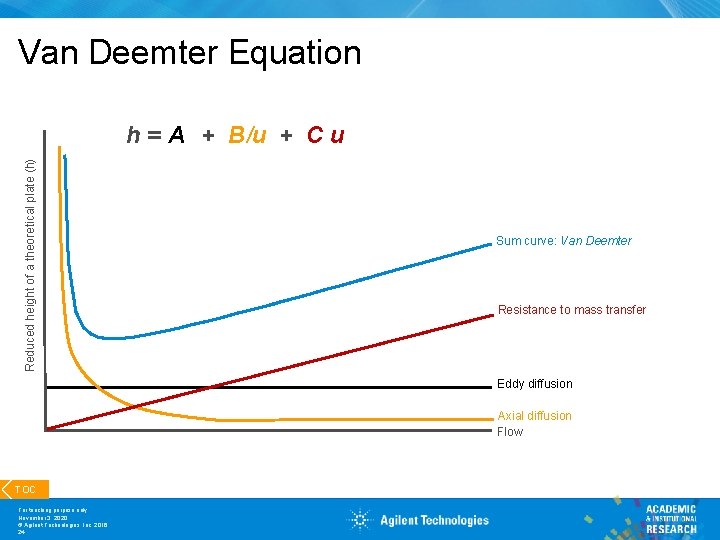
Van Deemter Equation Reduced height of a theoretical plate (h) h = A + B/u + C u Sum curve: Van Deemter Resistance to mass transfer Eddy diffusion Axial diffusion Flow TOC For teaching purpose only November 3, 2020 © Agilent Technologies, Inc. 2016 24
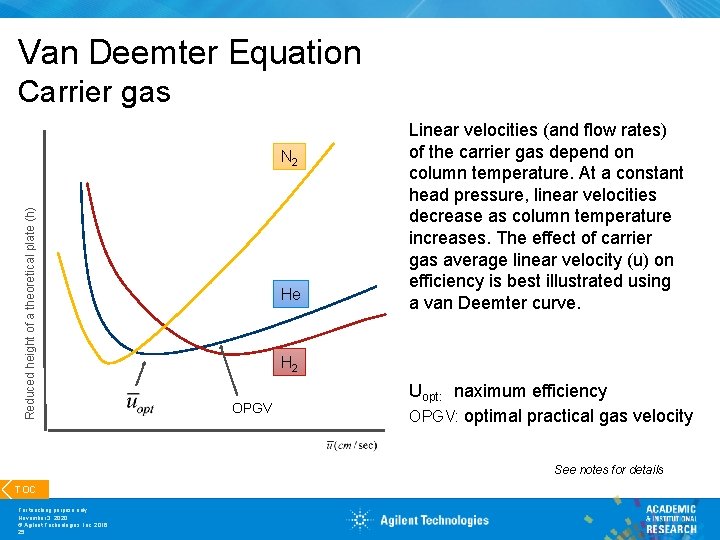
Van Deemter Equation Carrier gas Reduced height of a theoretical plate (h) N 2 He Linear velocities (and flow rates) of the carrier gas depend on column temperature. At a constant head pressure, linear velocities decrease as column temperature increases. The effect of carrier gas average linear velocity (u) on efficiency is best illustrated using a van Deemter curve. H 2 OPGV Uopt: naximum efficiency OPGV: optimal practical gas velocity See notes for details TOC For teaching purpose only November 3, 2020 © Agilent Technologies, Inc. 2016 25
Learn More For more information on products from Agilent, visit www. agilent. com or www. agilent. com/chem/academia Have questions or suggestions to this presentation? Contact academia. team@agilent. com Publication Title Pub. No. Primer Fundamentals of Gas Chromatography G 1176 -90000 Video Fundamentals of Gas Chromatography (14 min) Guide Agilent J&W GC Column Selection Guide Web CHROMacademy – free access for students and university staff to online courses Application compendium A compilation of Application Notes (22 MB) TOC For teaching purpose only November 3, 2020 © Agilent Technologies, Inc. 2016 26 5990 -9867 EN 5991 -3592 EN

Publication number 5991 -5422 EN For teaching purpose only November 3, 2020 © Agilent Technologies, Inc. 2016 27
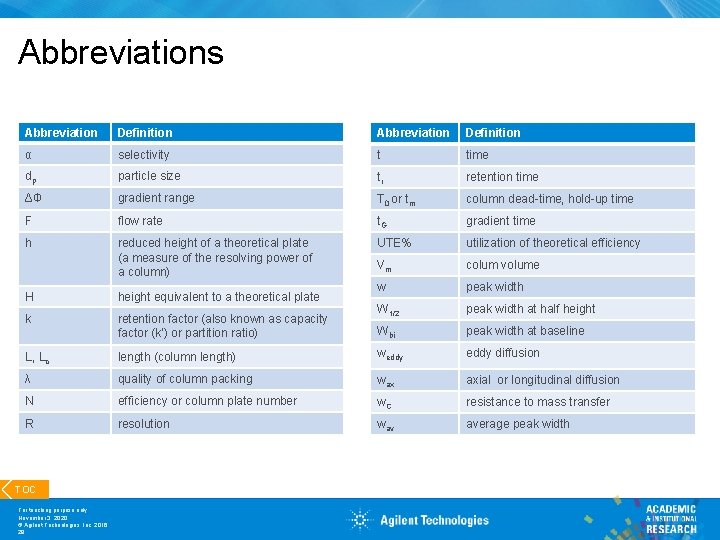
Abbreviations Abbreviation Definition α selectivity t time dp particle size tr retention time ΔΦ gradient range T 0 or tm column dead-time, hold-up time F flow rate t. G gradient time h reduced height of a theoretical plate (a measure of the resolving power of a column) UTE% utilization of theoretical efficiency Vm colum volume w peak width W 1/2 peak width at half height Wbi peak width at baseline H height equivalent to a theoretical plate k retention factor (also known as capacity factor (k’) or partition ratio) L, Lc length (column length) weddy diffusion λ quality of column packing wax axial or longitudinal diffusion N efficiency or column plate number w. C resistance to mass transfer R resolution wav average peak width TOC For teaching purpose only November 3, 2020 © Agilent Technologies, Inc. 2016 28
- Slides: 28