
Fundamentals of Flexible Bronchoscopy Conventional Transbronchial Needle Aspiration
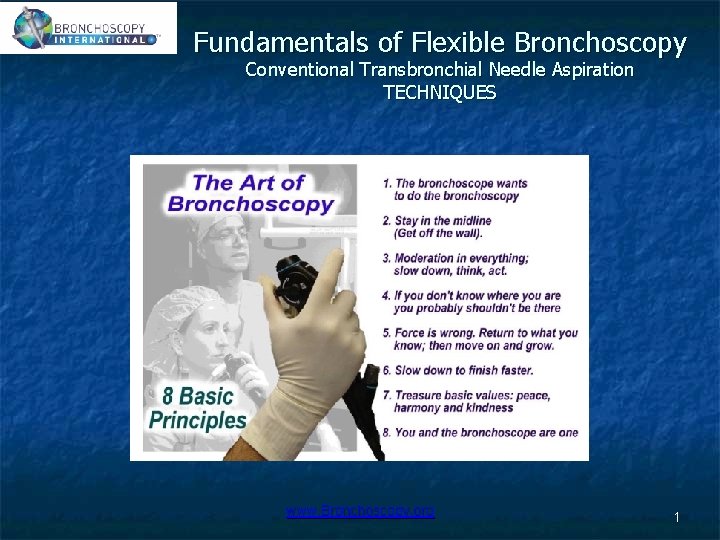
Fundamentals of Flexible Bronchoscopy Conventional Transbronchial Needle Aspiration TECHNIQUES www. Bronchoscopy. org 1
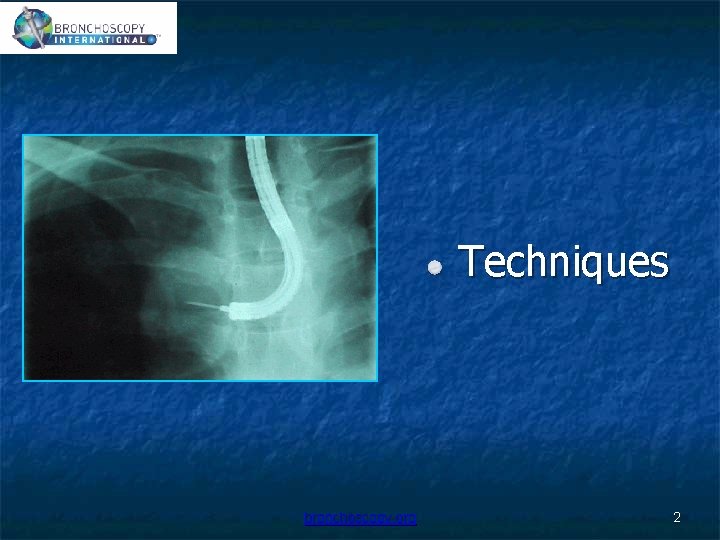
Techniques bronchoscopy. org 2

c. TBNA Jab Technique (Image from Uptodate) ■ Jabbing ■ ■ Courtesy H. Colt Needle out. Hold scope firmly at the mouth or nostril and push the needle through the tissues. www. bronchoscopy. org 3
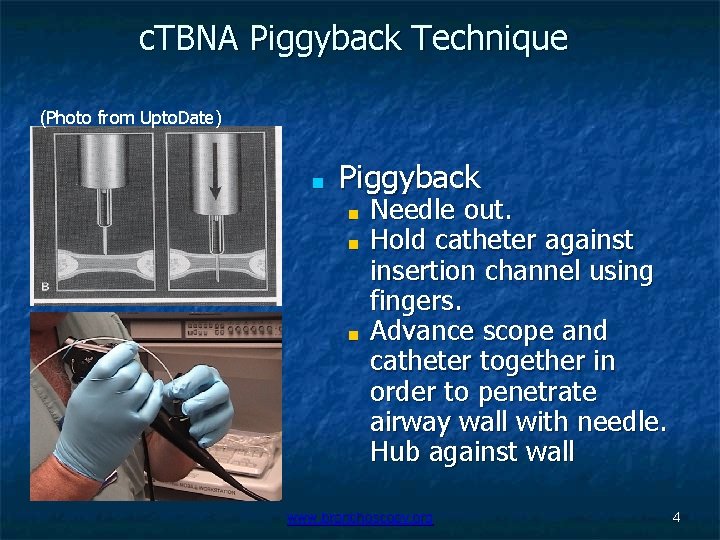
c. TBNA Piggyback Technique (Photo from Upto. Date) ■ Piggyback ■ ■ ■ Needle out. Hold catheter against insertion channel using fingers. Advance scope and catheter together in order to penetrate airway wall with needle. Hub against wall www. bronchoscopy. org 4
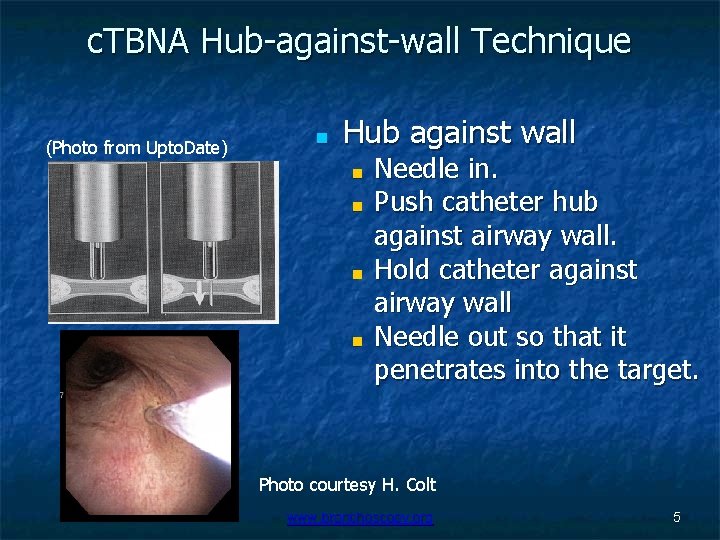
c. TBNA Hub-against-wall Technique (Photo from Upto. Date) ■ Hub against wall ■ ■ Needle in. Push catheter hub against airway wall. Hold catheter against airway wall Needle out so that it penetrates into the target. Photo courtesy H. Colt www. bronchoscopy. org 5
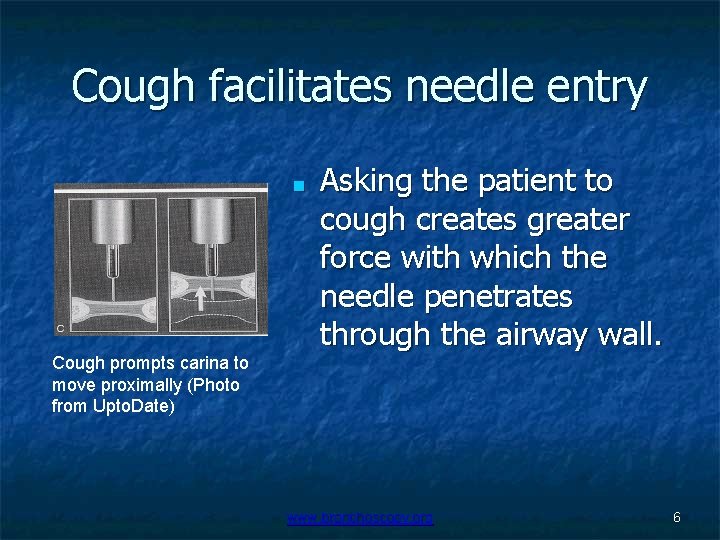
Cough facilitates needle entry ■ Cough prompts carina to move proximally (Photo from Upto. Date) Asking the patient to cough creates greater force with which the needle penetrates through the airway wall. www. bronchoscopy. org 6
Improving diagnostic yield ■ ■ ■ c. TBNA is performed after complete airway examination, but before other diagnostic bronchoscopic procedures to avoid contaminating specimens. ■ Suction is minimized during scope insertion to avoid contaminating specimens. ■ The target area can be rinsed with saline prior to needle insertion. If suction is used to pull material into the needle, release suction before withdrawing the needle from the airway wall. On-site cytology is ideally available. www. bronchoscopy. org 7
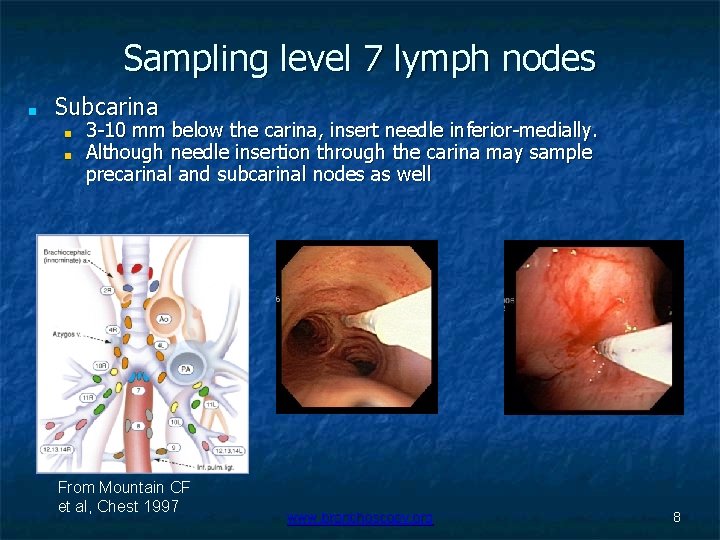
Sampling level 7 lymph nodes ■ Subcarina ■ ■ 3 -10 mm below the carina, insert needle inferior-medially. Although needle insertion through the carina may sample precarinal and subcarinal nodes as well From Mountain CF et al, Chest 1997 www. bronchoscopy. org 8
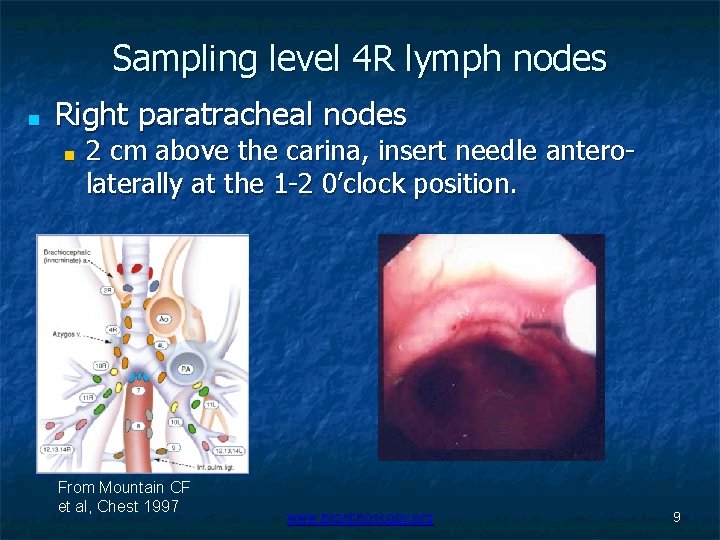
Sampling level 4 R lymph nodes ■ Right paratracheal nodes ■ 2 cm above the carina, insert needle anterolaterally at the 1 -2 0’clock position. From Mountain CF et al, Chest 1997 www. bronchoscopy. org 9
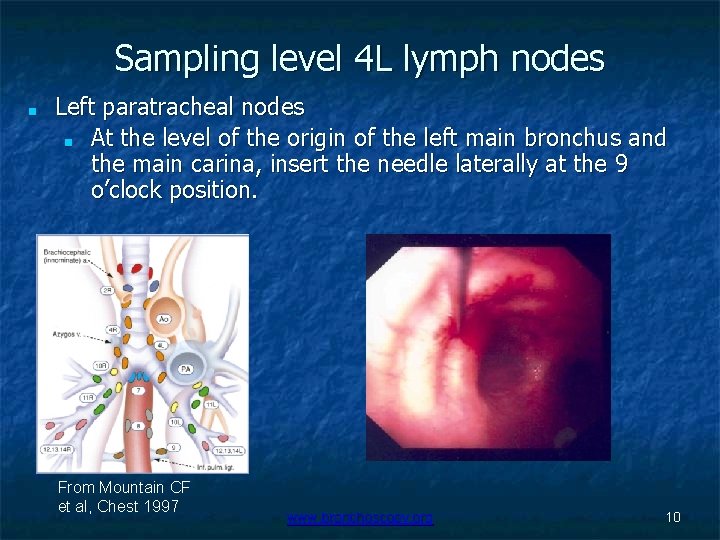
Sampling level 4 L lymph nodes ■ Left paratracheal nodes ■ At the level of the origin of the left main bronchus and the main carina, insert the needle laterally at the 9 o’clock position. From Mountain CF et al, Chest 1997 www. bronchoscopy. org 10
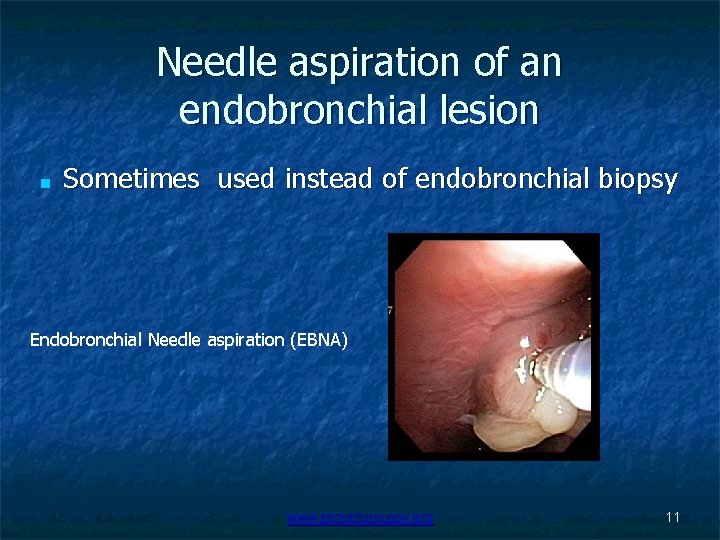
Needle aspiration of an endobronchial lesion ■ Sometimes used instead of endobronchial biopsy Endobronchial Needle aspiration (EBNA) www. bronchoscopy. org 11
Helpful hints for performing c. TBNA ■ ■ ■ Tell patients “there are no nerve endings in the airway, so the needle insertion itself will not hurt”. Use moderate sedation to improve patient comfort. Carefully examine airway-computed tomography correlations to plan the procedure. Inform bronchoscopy assistants of procedure plan. Use instructions such as “needle out”, “needle in” , “remove catheter”, “hold scope at nose” to communicate with assistants. Send copies of bronchoscopy report to assisting cytopathologists. www. bronchoscopy. org 12
More helpful hints for c. TBNA ■ ■ ■ Begin by sampling the nodal station with the worst prognosis (n 3 followed by n 2 followed by n 1). Cytology samples should be processed in the bronchoscopy suite using smear techniques. Core tissues should be submitted in 10% formaldehyde. Histology needles (19 gauge) can also be flushed with normal saline to obtain a cytology sample. Samples are acceptable when there is a predominance of lymphocytes and few or no respiratory epithelial cells. www. bronchoscopy. org 13
Prepared with help from Udaya Prakash M. D. (USA), Atul Mehta M. D. (USA), Stefano Gasparini, and Wes Shepherd M. D. (USA) www. Bronchoscopy. org 14
- Slides: 14