
Fundamentals of Cost Analysis for Decision Making Chapter
- Slides: 58
Fundamentals of Cost Analysis for Decision Making Chapter 3
2 Learning Objectives 1. Use cost-volume-profit (CVP) analysis to analyze decisions. 2. Understand the effect of cost structure on decisions. 3. Use differential analysis to analyze decisions. 4. Understand how to apply differential analysis to pricing decisions. 5. Understand several approaches for establishing prices based on costs for long-run pricing decisions. 6. Understand how to apply differential analysis to production decisions. 7. Understand theory of constraints (Appendix).
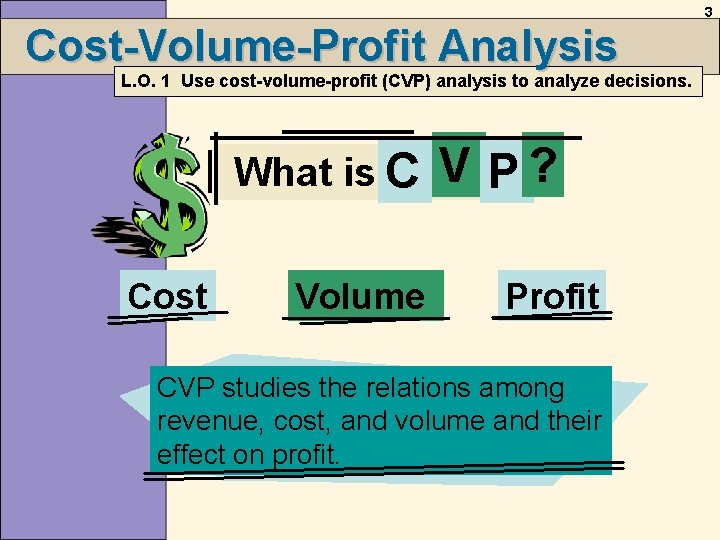
3 Cost-Volume-Profit Analysis L. O. 1 Use cost-volume-profit (CVP) analysis to analyze decisions. What is C Cost Volume V P? Profit CVP studies the relations among revenue, cost, and volume and their effect on profit.
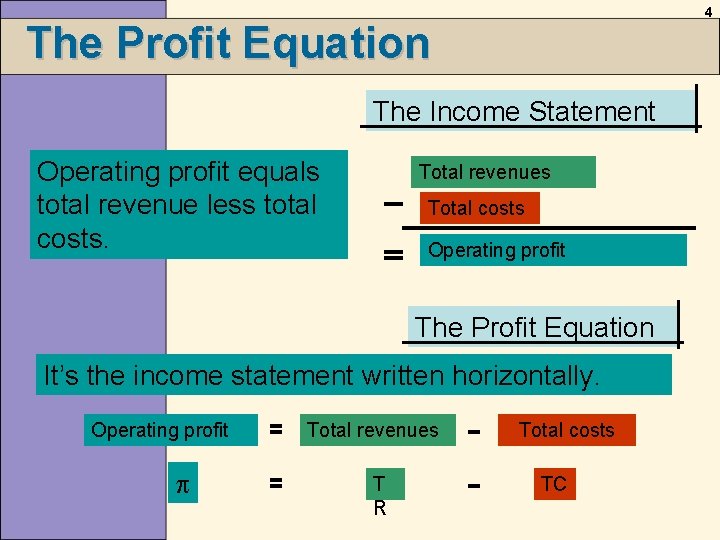
4 The Profit Equation The Income Statement Operating profit equals total revenue less total costs. Total revenues Total costs Operating profit The Profit Equation It’s the income statement written horizontally. Operating profit p Total revenues T R Total costs TC
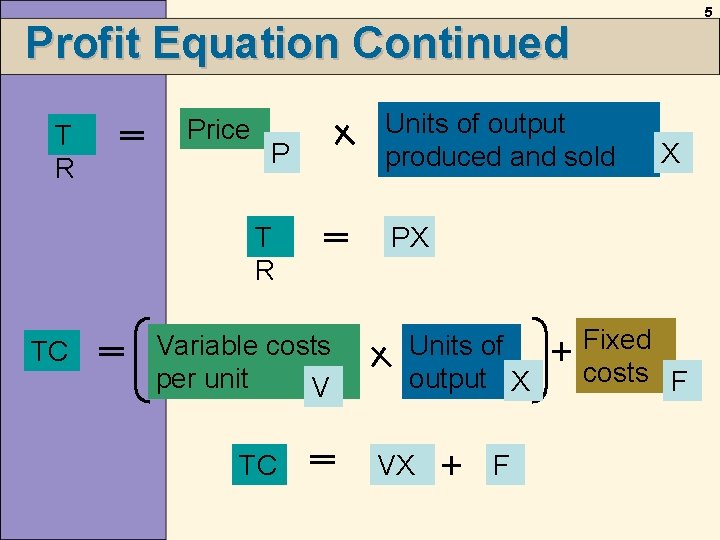
5 Profit Equation Continued T R Price P T R TC Variable costs per unit V TC Units of output produced and sold X PX Units of output X VX F Fixed costs F
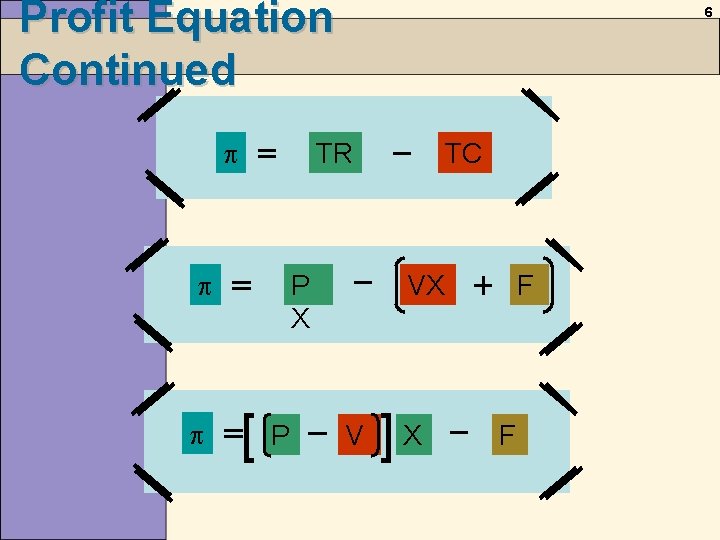
Profit Equation Continued p TR p p 6 P X [P TC VX V ]X F F
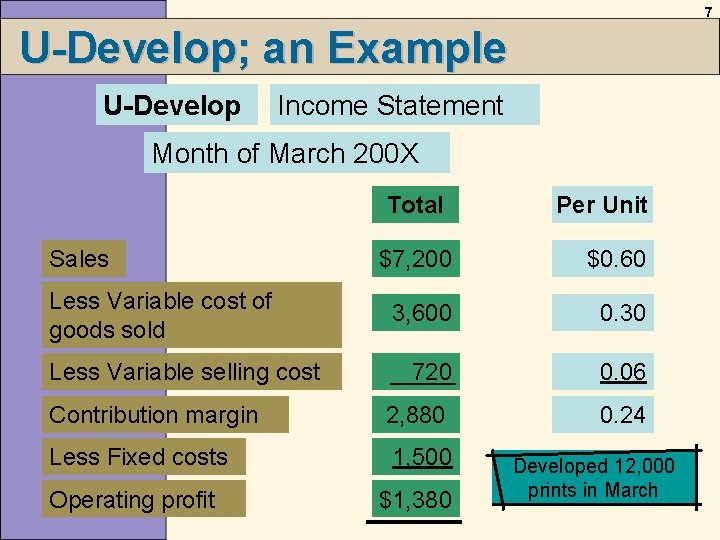
7 U-Develop; an Example U-Develop Income Statement Month of March 200 X Total Sales Per Unit $7, 200 $0. 60 3, 600 0. 30 720 0. 06 Contribution margin 2, 880 0. 24 Less Fixed costs 1, 500 Operating profit $1, 380 Less Variable cost of goods sold Less Variable selling cost Developed 12, 000 prints in March
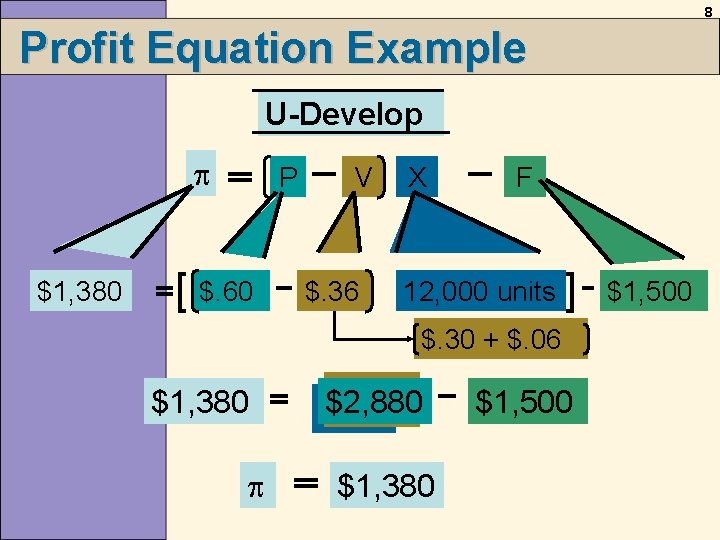
8 Profit Equation Example U-Develop p $1, 380 P [ $. 60 V $. 36 X F 12, 000 units ] $. 30 + $. 06 $1, 380 p $2, 880 $1, 380 $1, 500
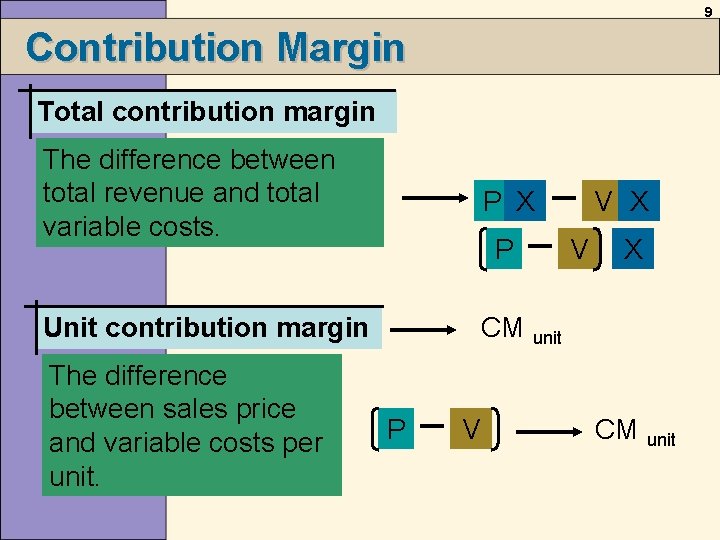
9 Contribution Margin Total contribution margin The difference between total revenue and total variable costs. P X Unit contribution margin CM unit The difference between sales price and variable costs per unit. P P V V X CM unit
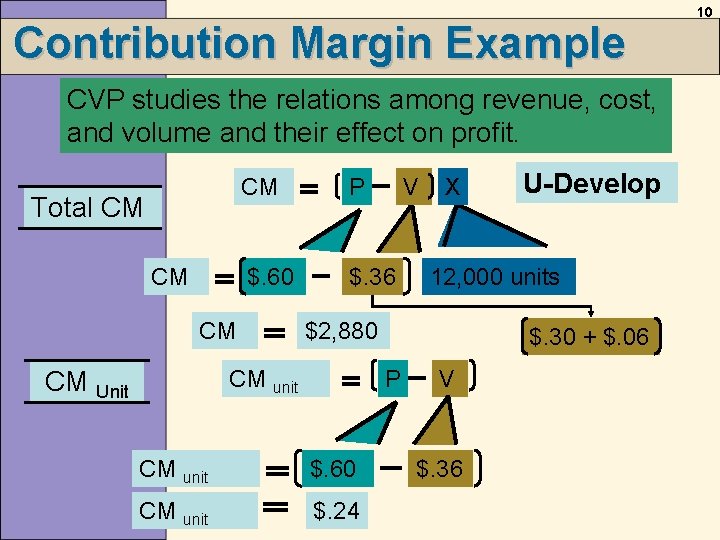
Contribution Margin Example CVP studies the relations among revenue, cost, and volume and their effect on profit. Total CM CM CM P $. 60 $. 36 CM X $. 30 + $. 06 P CM unit $. 60 CM unit $. 24 U-Develop 12, 000 units $2, 880 CM unit CM Unit V V $. 36 10
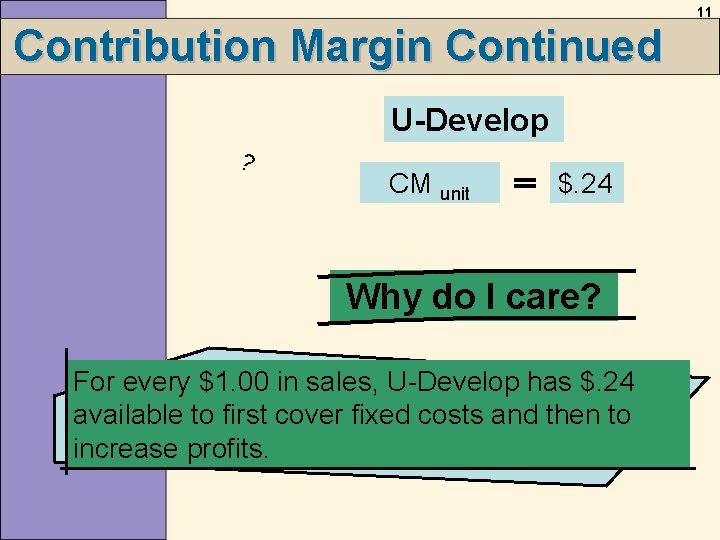
11 Contribution Margin Continued U-Develop ? CM unit $. 24 Why do I care? For every $1. 00 in sales, U-Develop has $. 24 available to first cover fixed costs and then to increase profits.
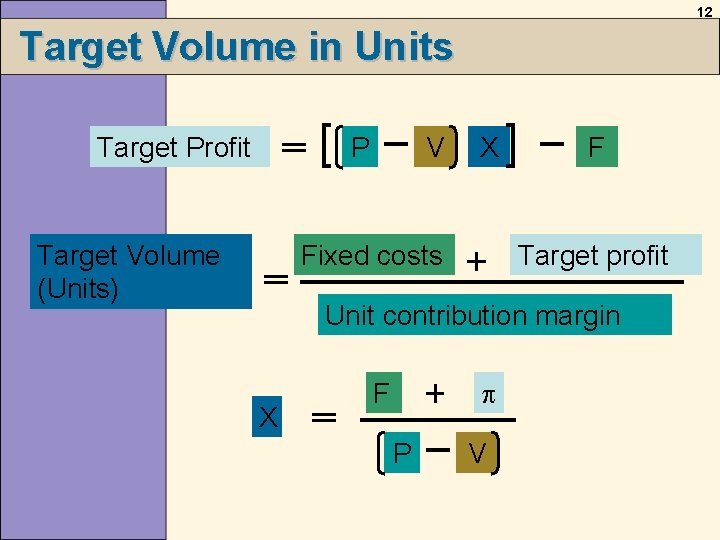
12 Target Volume in Units [ Target Profit Target Volume (Units) P V X Fixed costs ] F Target profit Unit contribution margin X p F P V
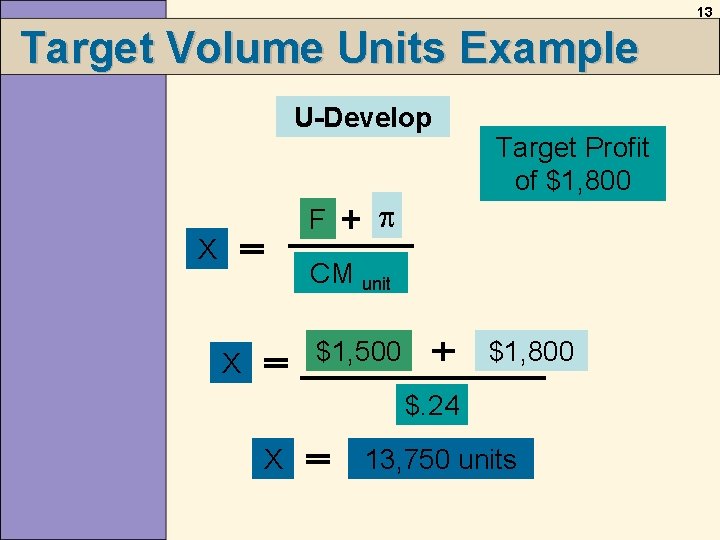
13 Target Volume Units Example U-Develop F X p Target Profit of $1, 800 CM unit $1, 500 X $1, 800 $. 24 X 13, 750 units
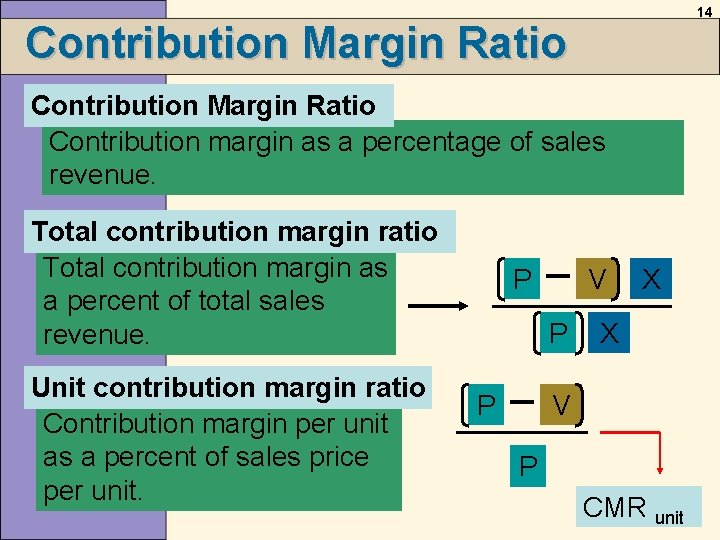
14 Contribution Margin Ratio Contribution margin as a percentage of sales revenue. Total contribution margin ratio Total contribution margin as a percent of total sales revenue. Unit contribution margin ratio Contribution margin per unit as a percent of sales price per unit. P V P P X X V P CMR unit
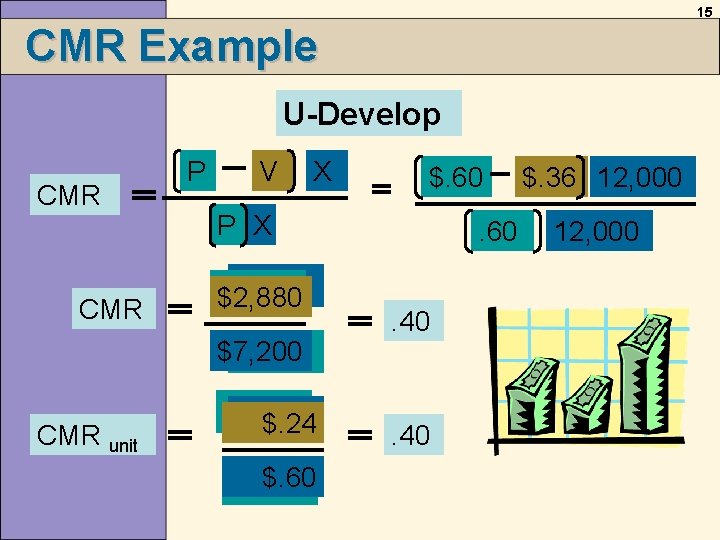
15 CMR Example U-Develop CMR P V X P X $2, 880 $7, 200 CMR unit $. 60 $. 24 $. 60. 40 $. 36 12, 000
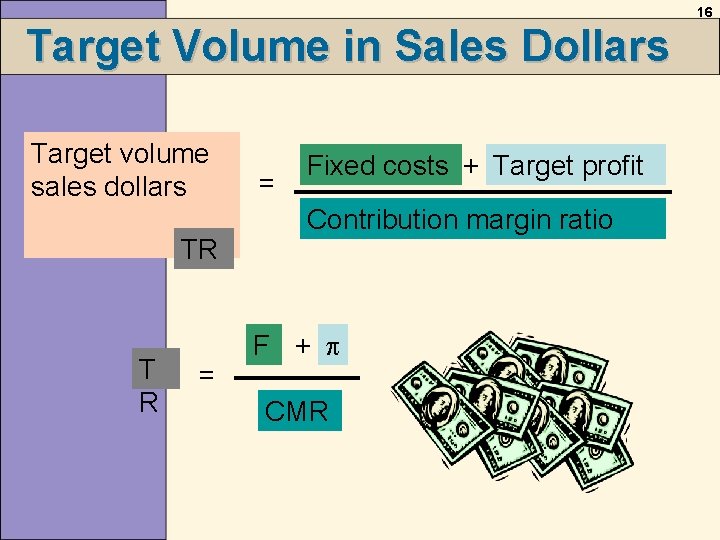
16 Target Volume in Sales Dollars Target volume sales dollars TR T R = = Fixed costs + Target profit Contribution margin ratio F + p CMR
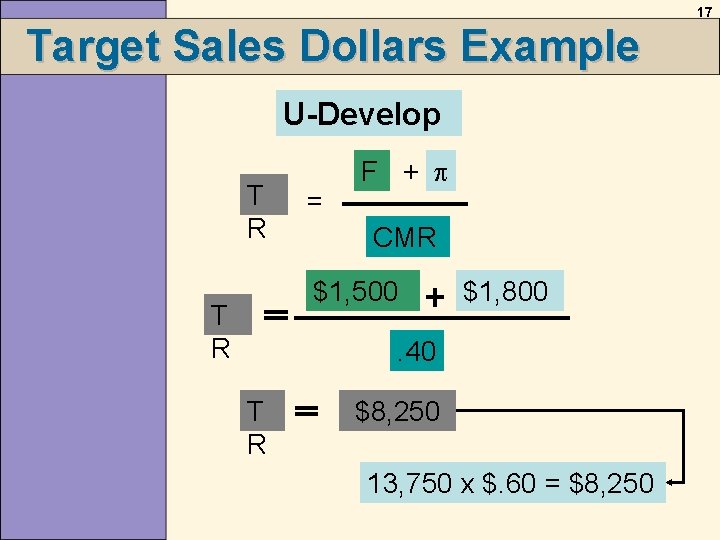
17 Target Sales Dollars Example U-Develop T R = F + p CMR $1, 500 T R $1, 800 . 40 T R $8, 250 13, 750 x $. 60 = $8, 250
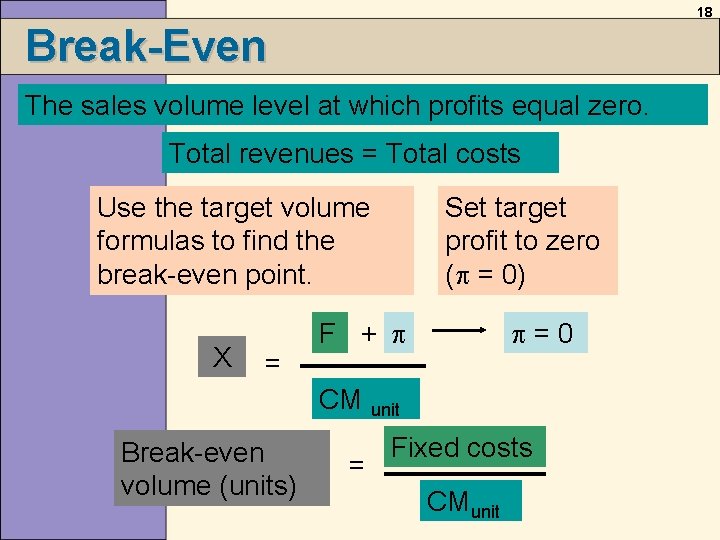
18 Break-Even The sales volume level at which profits equal zero. Total revenues = Total costs Use the target volume formulas to find the break-even point. X = Set target profit to zero (p = 0) p=0 F + p CM unit Break-even volume (units) = Fixed costs CMunit
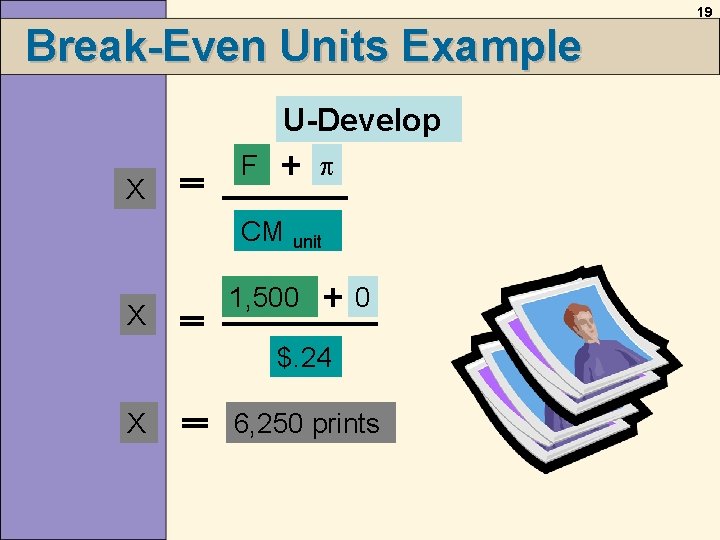
19 Break-Even Units Example U-Develop X p F CM unit X 1, 500 0 $. 24 X 6, 250 prints
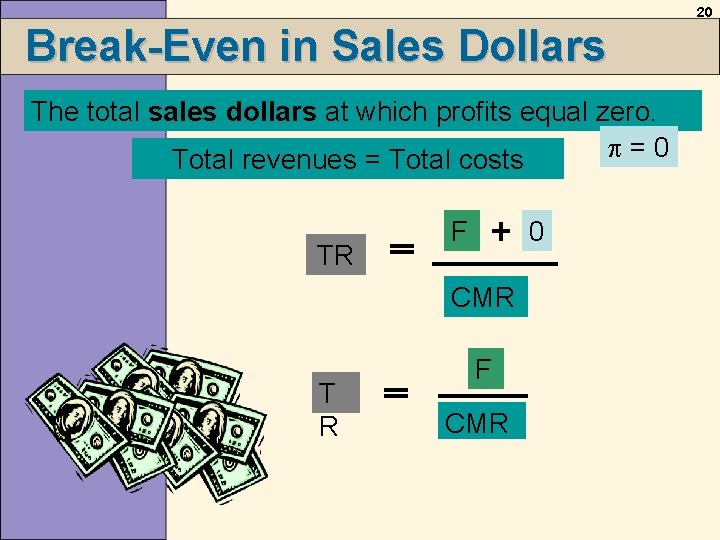
20 Break-Even in Sales Dollars The total sales dollars at which profits equal zero. p=0 Total revenues = Total costs TR F 0 CMR T R F CMR
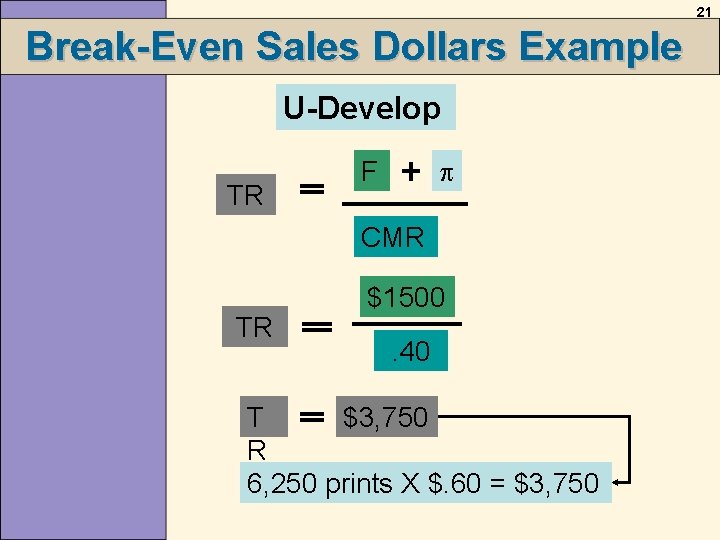
21 Break-Even Sales Dollars Example U-Develop TR p F CMR TR $1500. 40 T $3, 750 R 6, 250 prints X $. 60 = $3, 750
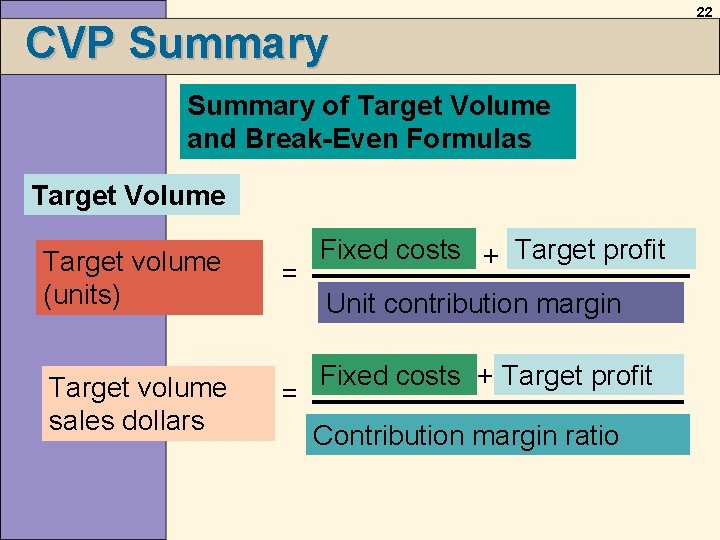
CVP Summary of Target Volume and Break-Even Formulas Target Volume Target volume (units) Target volume sales dollars = = Fixed costs + Target profit Unit contribution margin Fixed costs + Target profit Contribution margin ratio 22
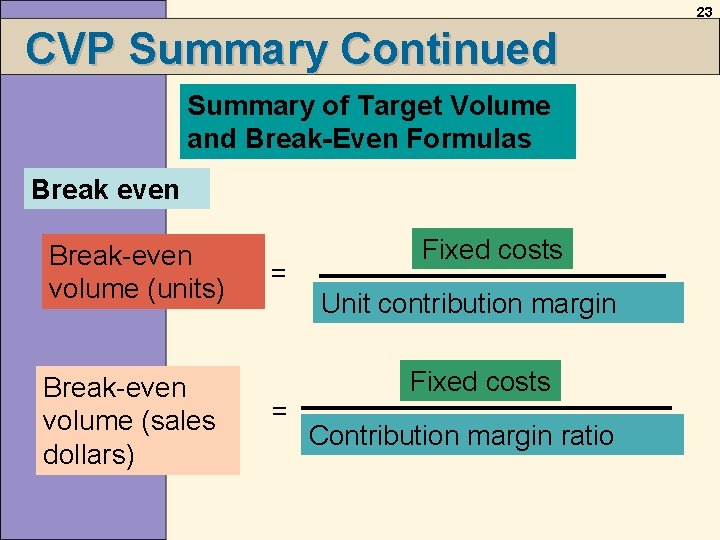
23 CVP Summary Continued Summary of Target Volume and Break-Even Formulas Break even Break-even volume (units) Break-even volume (sales dollars) = = Fixed costs Unit contribution margin Fixed costs Contribution margin ratio
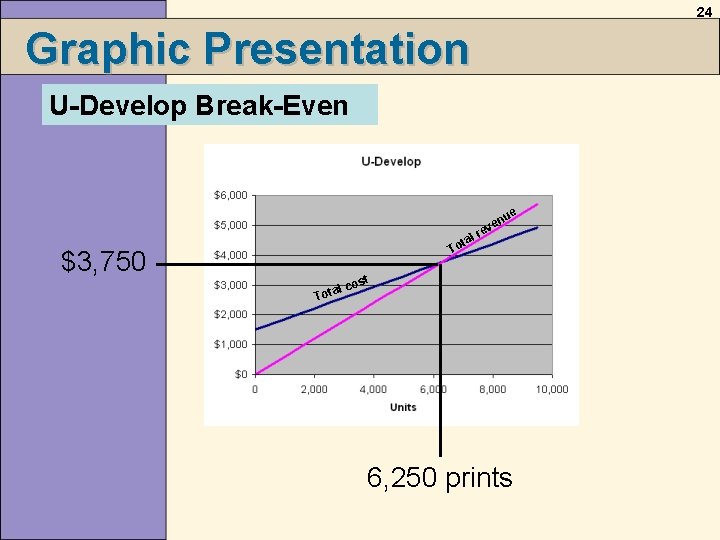
24 Graphic Presentation U-Develop Break-Even nu tal To $3, 750 al Tot e rev e t cos 6, 250 prints
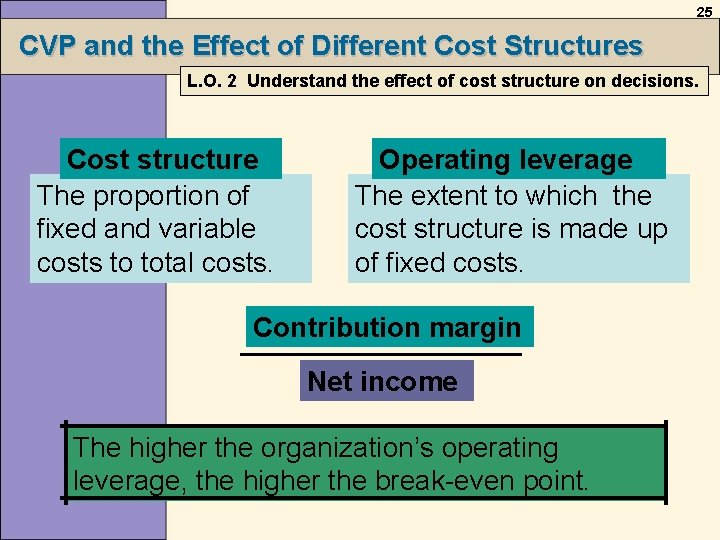
25 CVP and the Effect of Different Cost Structures L. O. 2 Understand the effect of cost structure on decisions. Cost structure The proportion of fixed and variable costs to total costs. Operating leverage The extent to which the cost structure is made up of fixed costs. Contribution margin Net income The higher the organization’s operating leverage, the higher the break-even point.
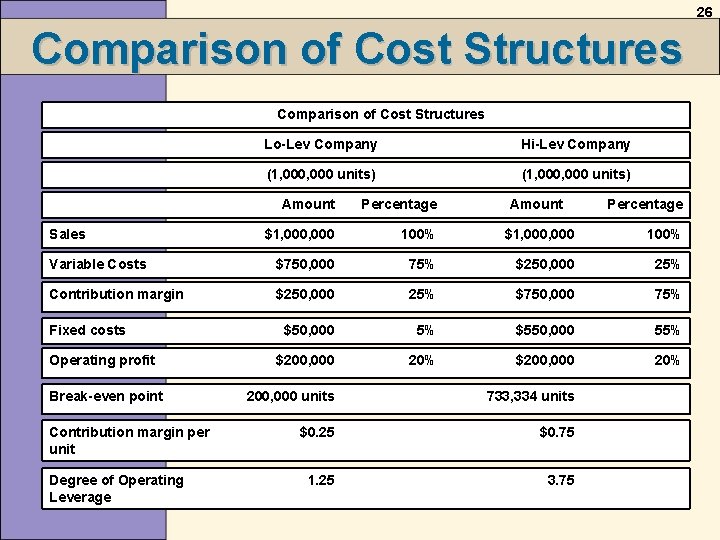
26 Comparison of Cost Structures Lo-Lev Company Hi-Lev Company (1, 000, 000 units) Amount Percentage $1, 000, 000 100% Variable Costs $750, 000 75% $250, 000 25% Contribution margin $250, 000 25% $750, 000 75% $50, 000 5% $550, 000 55% $200, 000 20% Sales Fixed costs Operating profit Break-even point Contribution margin per unit Degree of Operating Leverage Amount 200, 000 units 733, 334 units $0. 25 $0. 75 1. 25 3. 75 Percentage
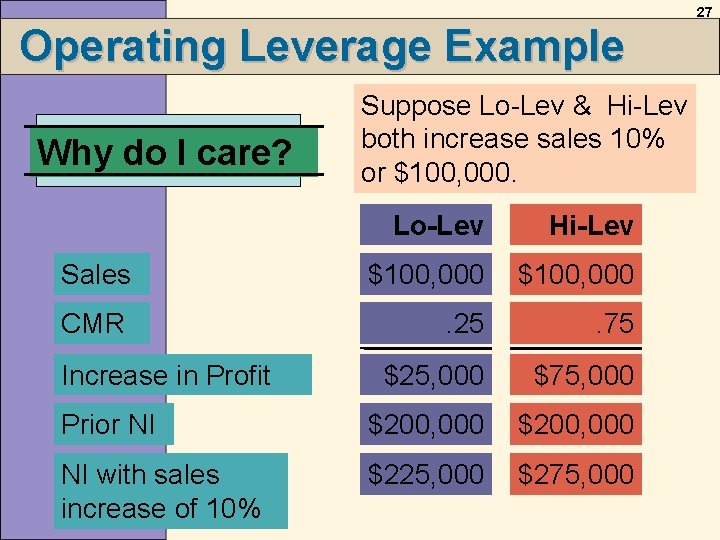
27 Operating Leverage Example Why do I care? Suppose Lo-Lev & Hi-Lev both increase sales 10% or $100, 000. Lo-Lev Hi-Lev Sales $100, 000 CMR . 25 . 75 $25, 000 $75, 000 Prior NI $200, 000 NI with sales increase of 10% $225, 000 $275, 000 Increase in Profit
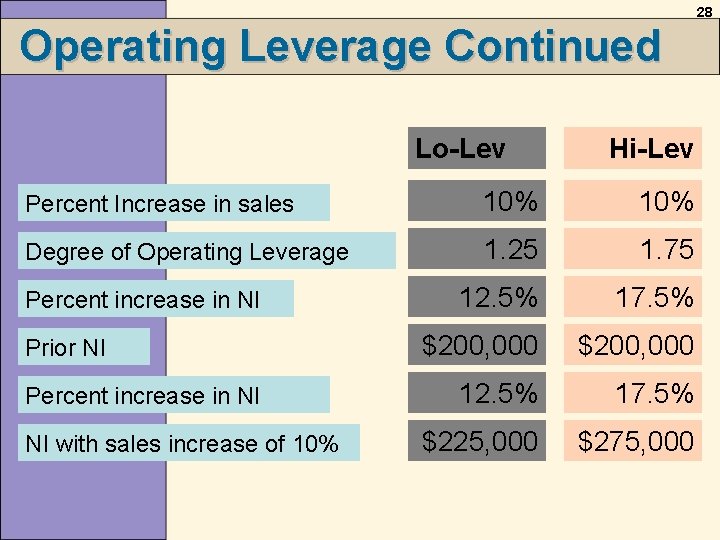
28 Operating Leverage Continued Lo-Lev Hi-Lev Percent Increase in sales 10% Degree of Operating Leverage 1. 25 1. 75 12. 5% 17. 5% $200, 000 12. 5% 17. 5% $225, 000 $275, 000 Percent increase in NI Prior NI Percent increase in NI NI with sales increase of 10%
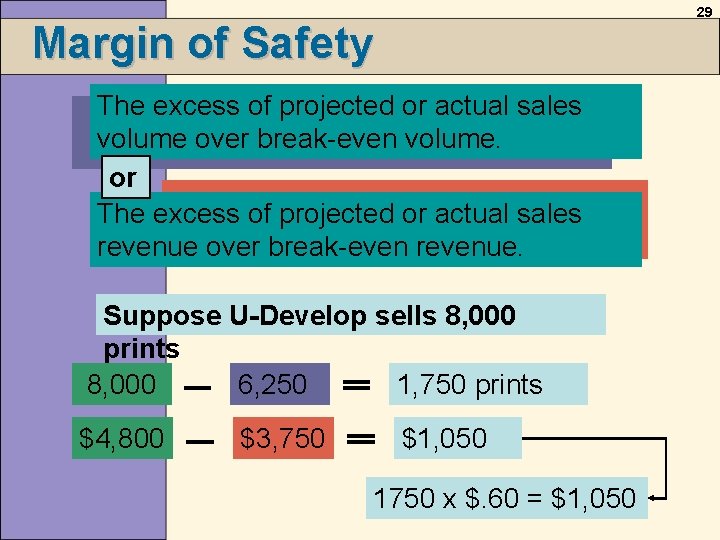
29 Margin of Safety The excess of projected or actual sales volume over break-even volume. or The excess of projected or actual sales revenue over break-even revenue. Suppose U-Develop sells 8, 000 prints 8, 000 6, 250 1, 750 prints $4, 800 $3, 750 $1, 050 1750 x $. 60 = $1, 050
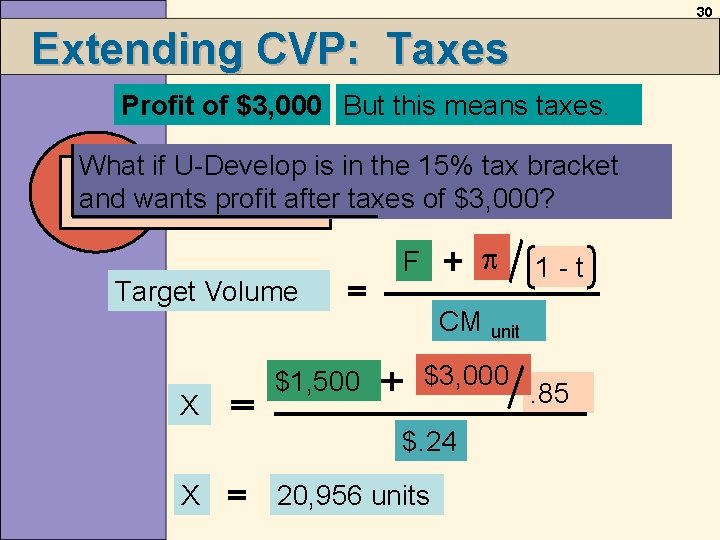
30 Extending CVP: Taxes Profit of $3, 000 But this means taxes. What if U-Develop is in the 15% tax bracket and wants profit after taxes of $3, 000? Target Volume X $1, 500 p F CM unit $3, 000 $. 24 X 1 -t 20, 956 units . 85
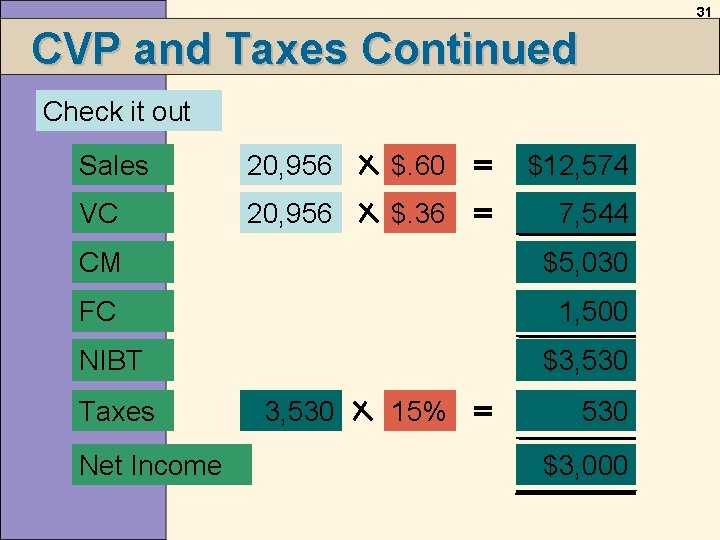
31 CVP and Taxes Continued Check it out Sales 20, 956 $. 60 $12, 574 VC 20, 956 $. 36 7, 544 CM $5, 030 FC 1, 500 NIBT Taxes Net Income $3, 530 15% 530 $3, 000
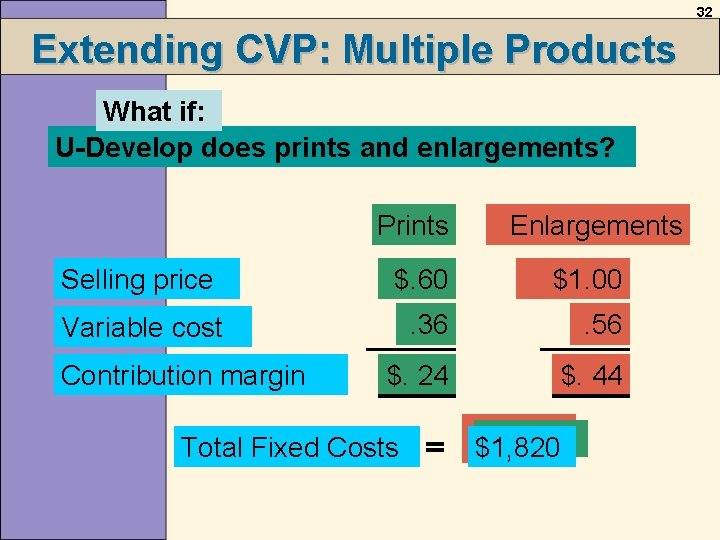
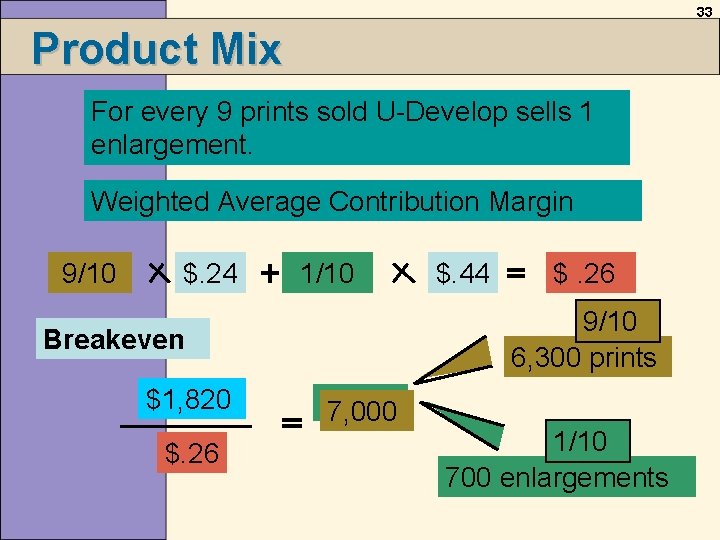
32 Extending CVP: Multiple Products What if: U-Develop does prints and enlargements? Prints Enlargements Selling price $. 60 $1. 00 Variable cost . 36 . 56 $. 24 $. 44 Contribution margin Total Fixed Costs $1, 820
33 Product Mix For every 9 prints sold U-Develop sells 1 enlargement. Weighted Average Contribution Margin 9/10 $. 24 1/10 $. 26 9/10 6, 300 prints Breakeven $1, 820 $. 44 7, 000 1/10 700 enlargements
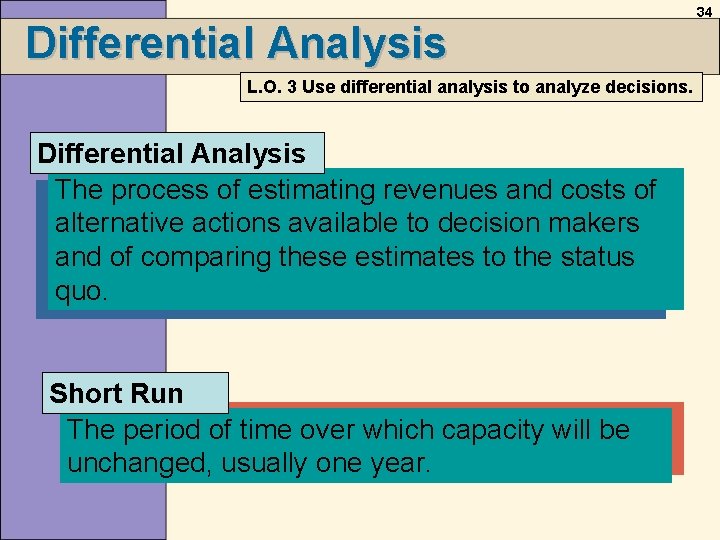
Differential Analysis L. O. 3 Use differential analysis to analyze decisions. Differential Analysis The process of estimating revenues and costs of alternative actions available to decision makers and of comparing these estimates to the status quo. Short Run The period of time over which capacity will be unchanged, usually one year. 34
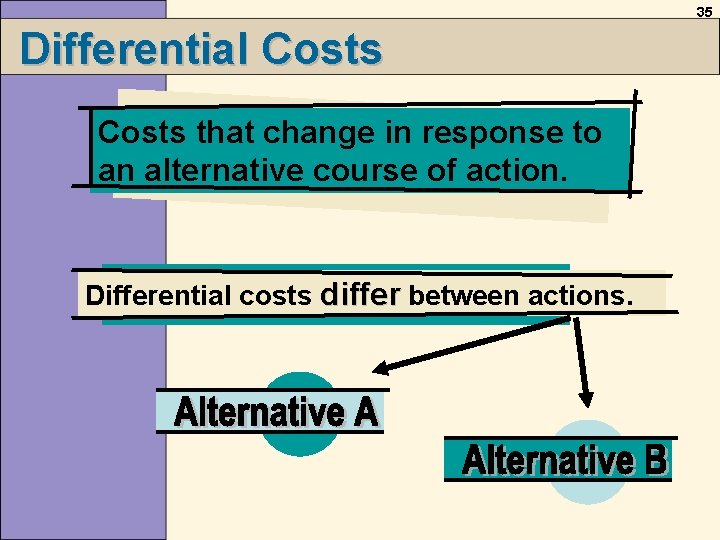
35 Differential Costs that change in response to an alternative course of action. Differential costs differ between actions.
36 Sunk Costs incurred in the past that cannot be changed by present or future decisions. A sunk cost is NOT relevant.
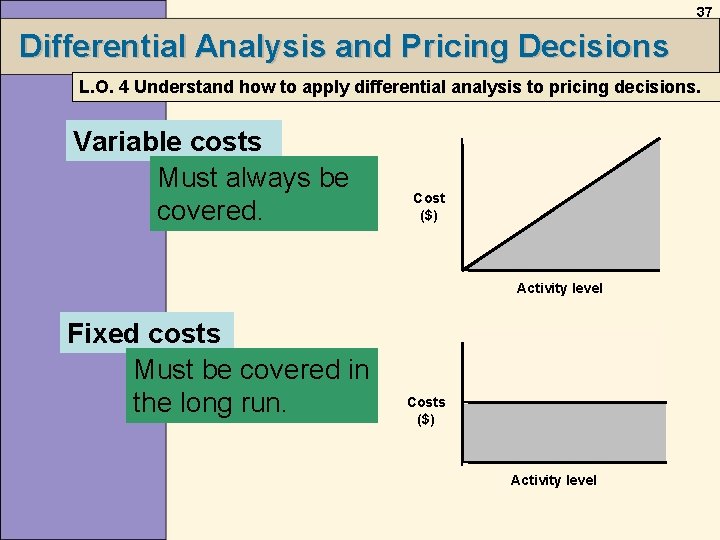
37 Differential Analysis and Pricing Decisions L. O. 4 Understand how to apply differential analysis to pricing decisions. Variable costs Must always be covered. Cost ($) Activity level Fixed costs Must be covered in the long run. Costs ($) Activity level
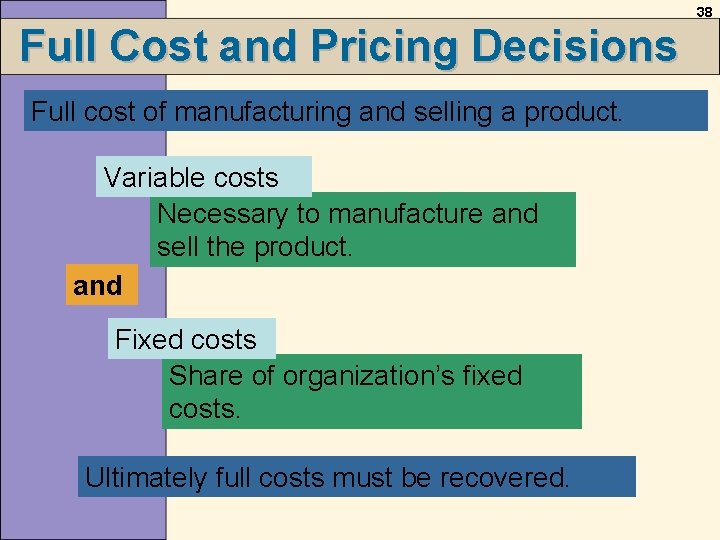
38 Full Cost and Pricing Decisions Full cost of manufacturing and selling a product. Variable costs Necessary to manufacture and sell the product. and Fixed costs Share of organization’s fixed costs. Ultimately full costs must be recovered.
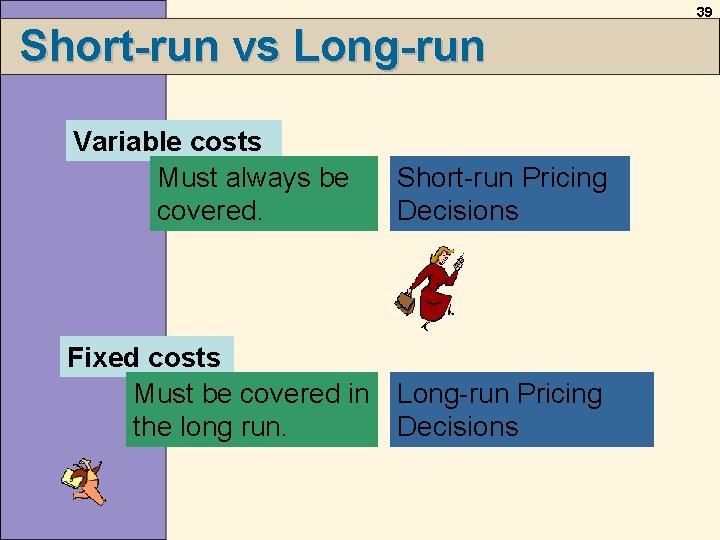
39 Short-run vs Long-run Variable costs Must always be covered. Short-run Pricing Decisions Fixed costs Must be covered in Long-run Pricing the long run. Decisions
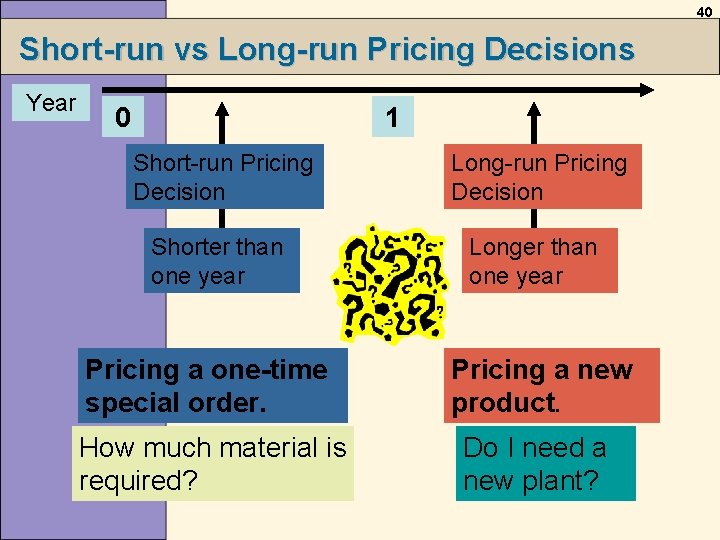
40 Short-run vs Long-run Pricing Decisions Year 0 1 Short-run Pricing Decision Long-run Pricing Decision Shorter than one year Longer than one year Pricing a one-time special order. Pricing a new product. How much material is required? Do I need a new plant?
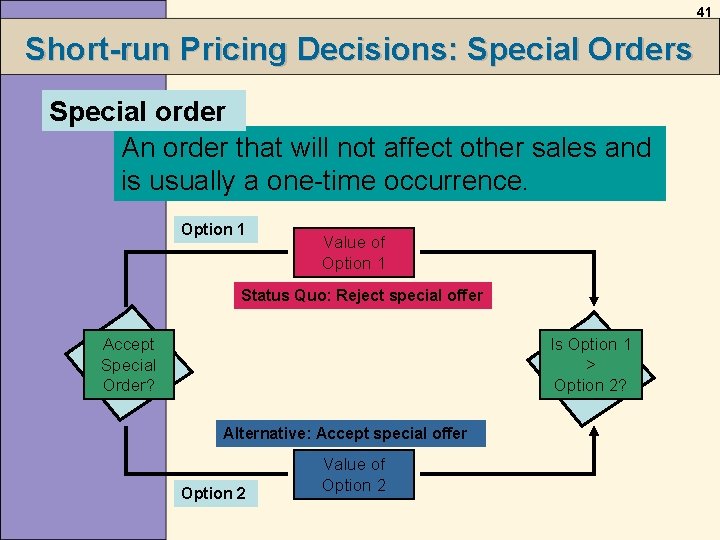
41 Short-run Pricing Decisions: Special Orders Special order An order that will not affect other sales and is usually a one-time occurrence. Option 1 Value of Option 1 Status Quo: Reject special offer Accept Special Order? Is Option 1 > Option 2? Alternative: Accept special offer Option 2 Value of Option 2
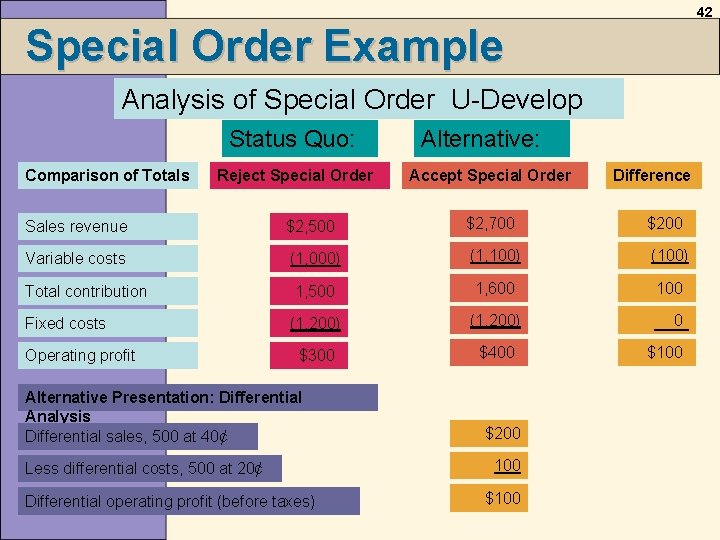
42 Special Order Example Analysis of Special Order U-Develop Status Quo: Comparison of Totals Reject Special Order Alternative: Accept Special Order Difference Sales revenue $2, 500 $2, 700 $200 Variable costs (1, 000) (1, 100) (100) 1, 500 1, 600 100 (1, 200) $300 $400 Total contribution Fixed costs Operating profit Alternative Presentation: Differential Analysis Differential sales, 500 at 40¢ Less differential costs, 500 at 20¢ Differential operating profit (before taxes) $200 100 $100
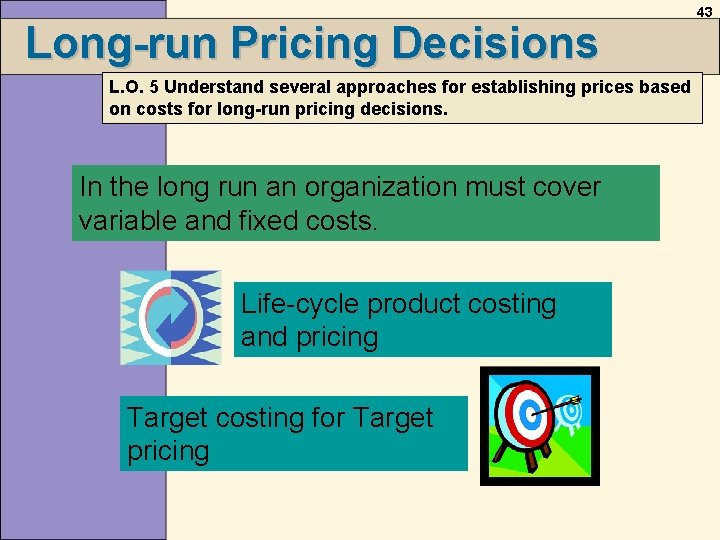
Long-run Pricing Decisions L. O. 5 Understand several approaches for establishing prices based on costs for long-run pricing decisions. In the long run an organization must cover variable and fixed costs. Life-cycle product costing and pricing Target costing for Target pricing 43
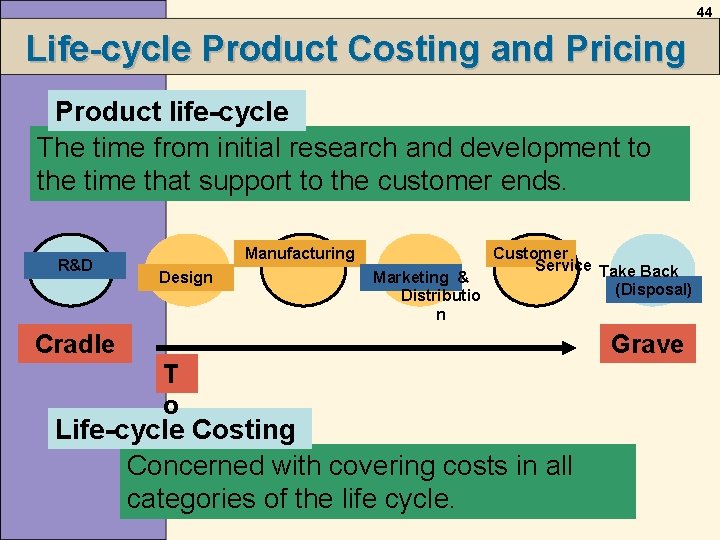
44 Life-cycle Product Costing and Pricing Product life-cycle The time from initial research and development to the time that support to the customer ends. R&D Manufacturing Design Customer Service Take Back Marketing & (Disposal) Distributio n Cradle Grave T o Life-cycle Costing Concerned with covering costs in all categories of the life cycle.
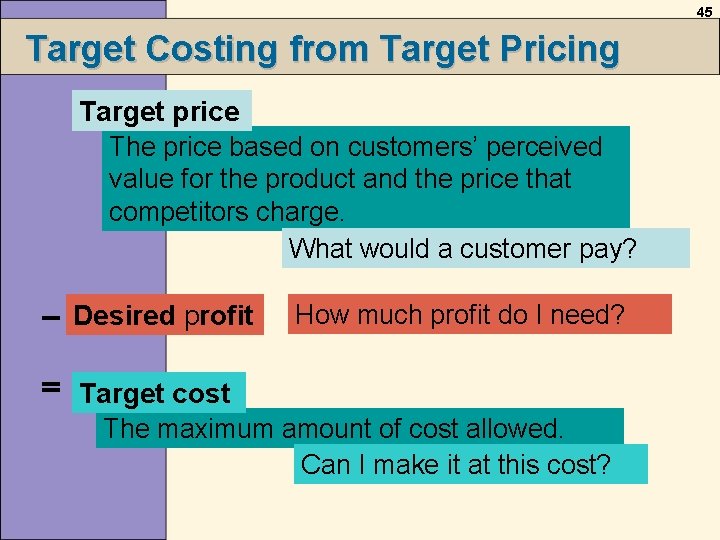
45 Target Costing from Target Pricing Target price The price based on customers’ perceived value for the product and the price that competitors charge. What would a customer pay? Desired profit How much profit do I need? Target cost The maximum amount of cost allowed. Can I make it at this cost?
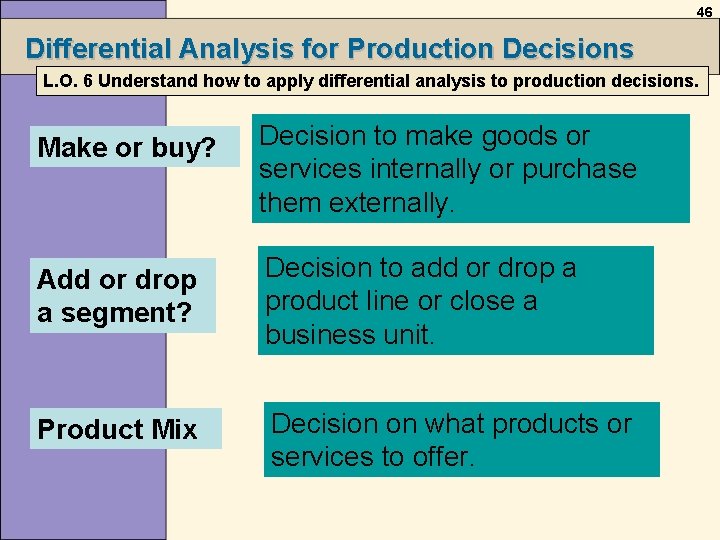
46 Differential Analysis for Production Decisions L. O. 6 Understand how to apply differential analysis to production decisions. Make or buy? Decision to make goods or services internally or purchase them externally. Add or drop a segment? Decision to add or drop a product line or close a business unit. Product Mix Decision on what products or services to offer.
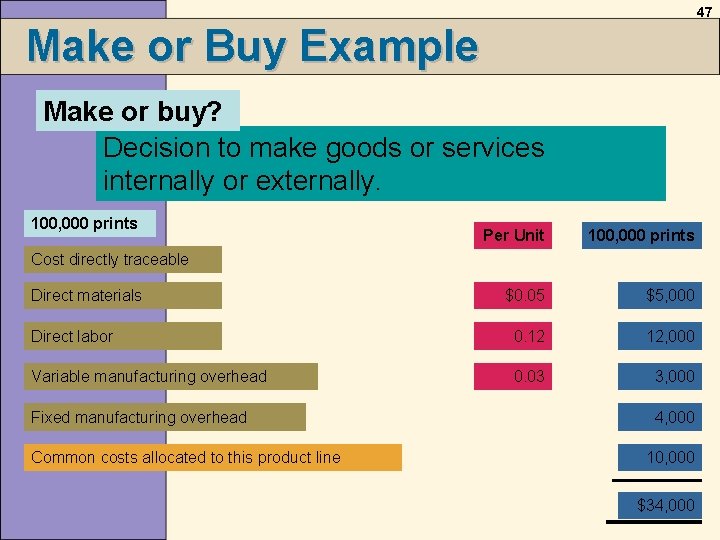
47 Make or Buy Example Make or buy? Decision to make goods or services internally or externally. 100, 000 prints Per Unit 100, 000 prints $0. 05 $5, 000 Direct labor 0. 12 12, 000 Variable manufacturing overhead 0. 03 3, 000 Cost directly traceable Direct materials Fixed manufacturing overhead Common costs allocated to this product line 4, 000 10, 000 $34, 000
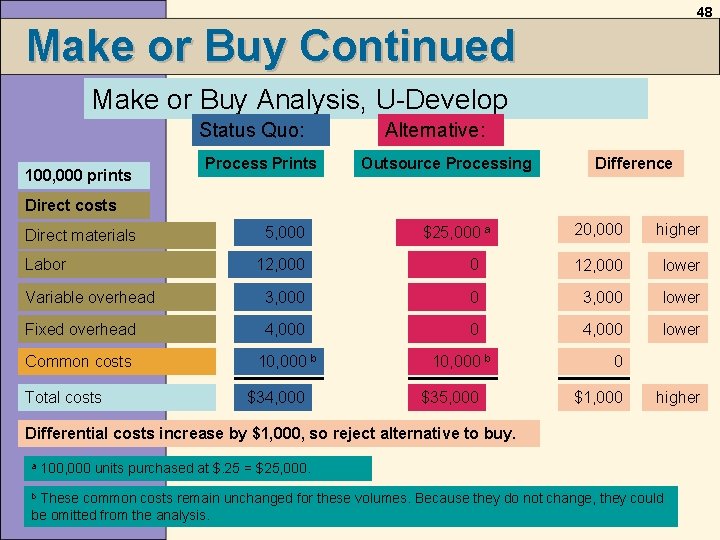
48 Make or Buy Continued Make or Buy Analysis, U-Develop Status Quo: 100, 000 prints Process Prints Alternative: Outsource Processing Difference Direct costs Direct materials Labor 5, 000 $25, 000 a 20, 000 higher 12, 000 0 12, 000 lower Variable overhead 3, 000 0 3, 000 lower Fixed overhead 4, 000 0 4, 000 lower Common costs 10, 000 b Total costs $34, 000 10, 000 b $35, 000 0 $1, 000 higher Differential costs increase by $1, 000, so reject alternative to buy. a 100, 000 units purchased at $. 25 = $25, 000. These common costs remain unchanged for these volumes. Because they do not change, they could be omitted from the analysis. b
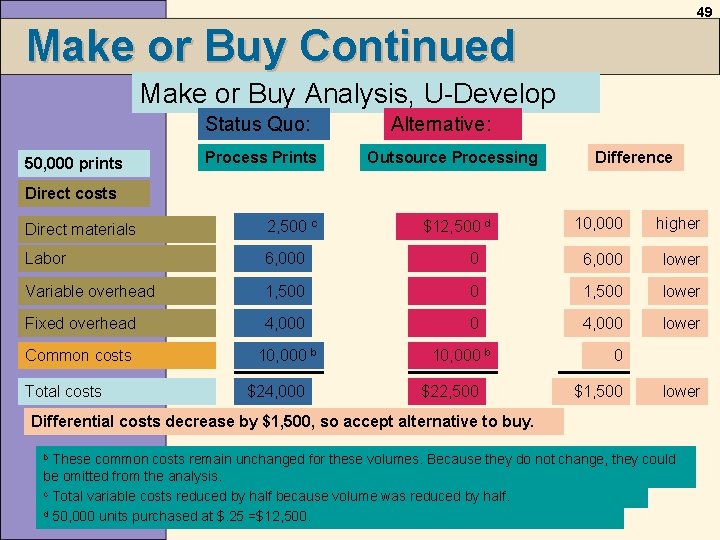
49 Make or Buy Continued Make or Buy Analysis, U-Develop Status Quo: 50, 000 prints Process Prints Alternative: Outsource Processing Difference Direct costs 10, 000 higher 0 6, 000 lower 1, 500 0 1, 500 lower Fixed overhead 4, 000 0 4, 000 lower Common costs 10, 000 b Direct materials 2, 500 c Labor 6, 000 Variable overhead Total costs $24, 000 $12, 500 d 10, 000 b $22, 500 0 $1, 500 lower Differential costs decrease by $1, 500, so accept alternative to buy. These common costs remain unchanged for these volumes. Because they do not change, they could be omitted from the analysis. c Total variable costs reduced by half because volume was reduced by half. d 50, 000 units purchased at $. 25 =$12, 500. b
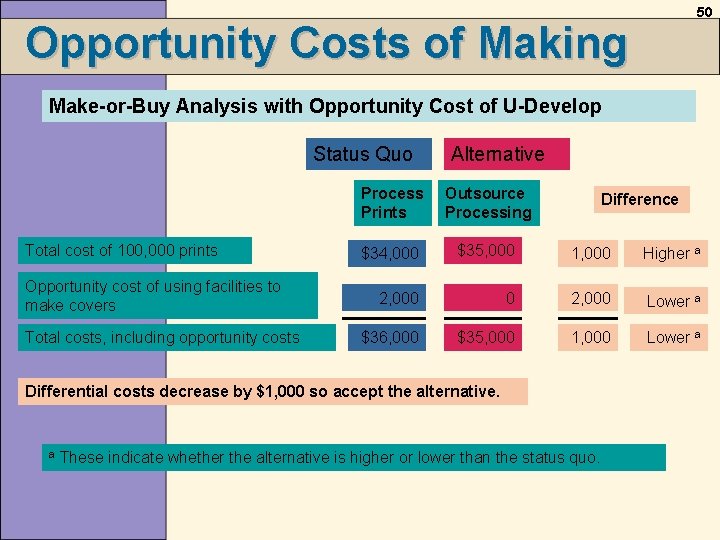
50 Opportunity Costs of Making Make-or-Buy Analysis with Opportunity Cost of U-Develop Status Quo Total cost of 100, 000 prints Opportunity cost of using facilities to make covers Total costs, including opportunity costs Alternative Process Prints Outsource Processing $34, 000 $35, 000 1, 000 Higher a 2, 000 0 2, 000 Lower a $36, 000 $35, 000 1, 000 Lower a Difference Differential costs decrease by $1, 000 so accept the alternative. a These indicate whether the alternative is higher or lower than the status quo.
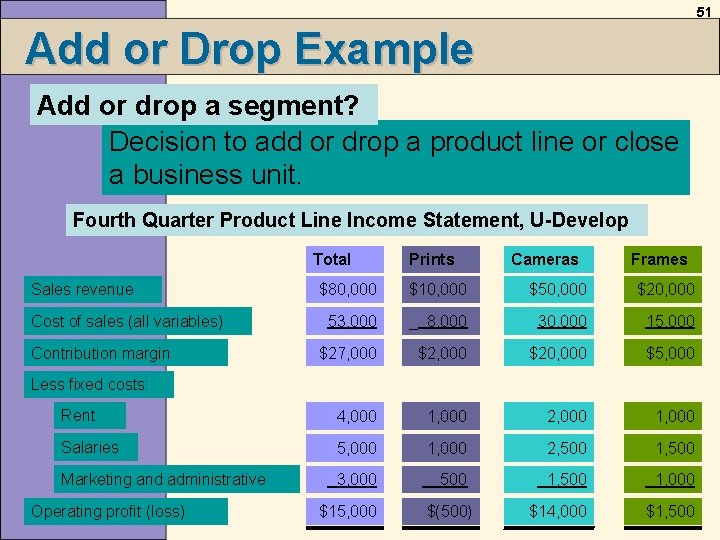
51 Add or Drop Example Add or drop a segment? Decision to add or drop a product line or close a business unit. Fourth Quarter Product Line Income Statement, U-Develop Total Sales revenue Prints Cameras Frames $80, 000 $10, 000 $50, 000 $20, 000 53, 000 _ 8, 000 30, 000 15, 000 $27, 000 $20, 000 $5, 000 Rent 4, 000 1, 000 2, 000 1, 000 Salaries 5, 000 1, 000 2, 500 1, 500 _3, 000 __500 _1, 000 $14, 000 $1, 500 Cost of sales (all variables) Contribution margin Less fixed costs: Marketing and administrative Operating profit (loss) $15, 000 $(500)
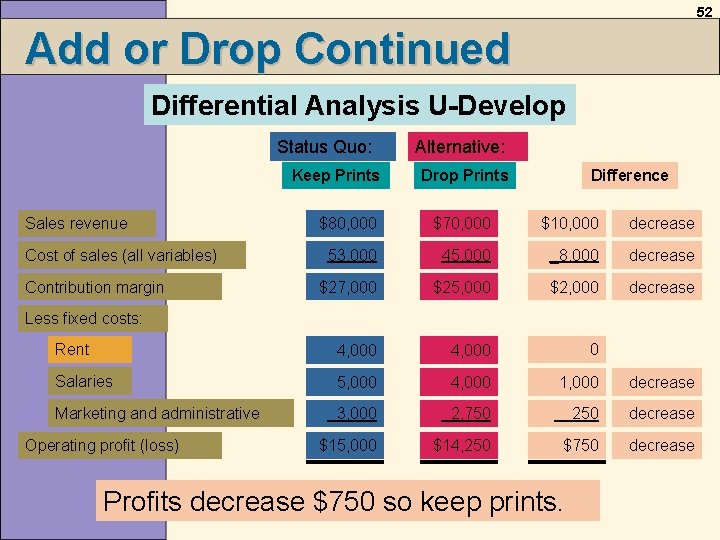
52 Add or Drop Continued Differential Analysis U-Develop Status Quo: Keep Prints Sales revenue Alternative: Drop Prints Difference $80, 000 $70, 000 $10, 000 decrease 53, 000 45, 000 _8, 000 decrease $27, 000 $25, 000 $2, 000 decrease Rent 4, 000 0 Salaries 5, 000 4, 000 1, 000 decrease _3, 000 _2, 750 __250 decrease $15, 000 $14, 250 $750 decrease Cost of sales (all variables) Contribution margin Less fixed costs: Marketing and administrative Operating profit (loss) Profits decrease $750 so keep prints.
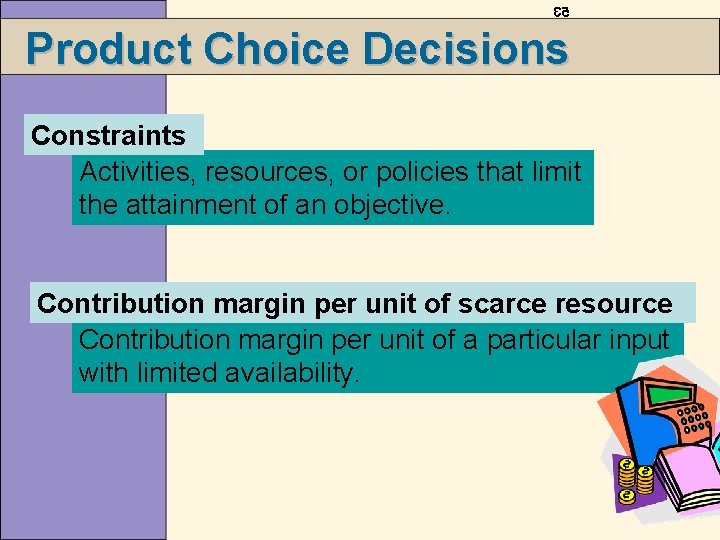
35 Product Choice Decisions Constraints Activities, resources, or policies that limit the attainment of an objective. Contribution margin per unit of scarce resource Contribution margin per unit of a particular input with limited availability.
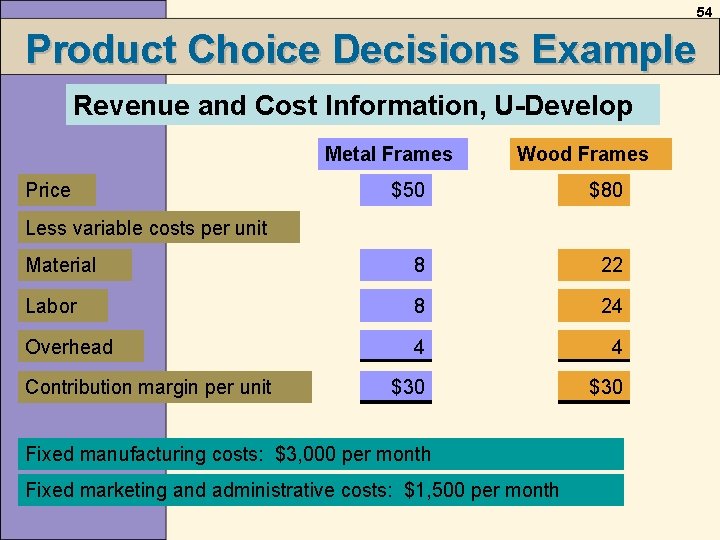
54 Product Choice Decisions Example Revenue and Cost Information, U-Develop Metal Frames Price Wood Frames $50 $80 Material 8 22 Labor 8 24 Overhead 4 4 $30 Less variable costs per unit Contribution margin per unit Fixed manufacturing costs: $3, 000 per month Fixed marketing and administrative costs: $1, 500 per month
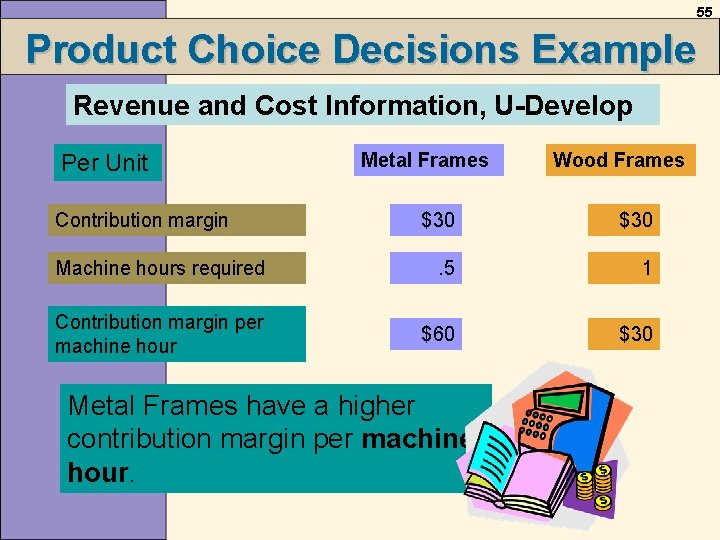
55 Product Choice Decisions Example Revenue and Cost Information, U-Develop Per Unit Contribution margin Metal Frames Wood Frames $30 Machine hours required . 5 1 Contribution margin per machine hour $60 $30 Metal Frames have a higher contribution margin per machine hour.
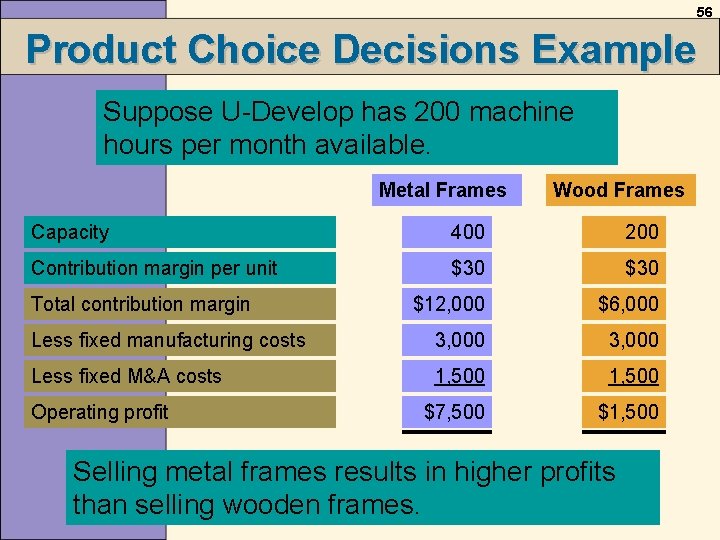
56 Product Choice Decisions Example Suppose U-Develop has 200 machine hours per month available. Metal Frames Wood Frames Capacity 400 200 Contribution margin per unit $30 $12, 000 $6, 000 Less fixed manufacturing costs 3, 000 Less fixed M&A costs 1, 500 $7, 500 $1, 500 Total contribution margin Operating profit Selling metal frames results in higher profits than selling wooden frames.
57 Theory of Constraints L. O. 7 Understand theory of constraints (Appendix). Theory of Constraints Focuses on revenue and cost management when faced with bottlenecks. Bottleneck Operation where the work required limits production. The bottleneck is a constraining resource.
58 Chapter 3